
Central Pamir
PIK ROSSII
6878 m
ASCENT REPORT
of the ascent by the team of Sverdlovsk Regional Sports Committee along the center of the Western wall
Team leader, coach Efimov S.B. MS "Burevestnik". Team members:
- Samoylin M.A. MS "Burevestnik"
- Lebedikhin A.V. MS "Burevestnik"
- Vinogradsky E.M. MS "Burevestnik"
- Bryksin V.M. CMS "Burevestnik"
- Samoylin V.A. CMS "Voen. Sily"
WESTERN WALL
- WALL
p. Rossii
(semi-profile)
GROUP MOVEMENT PATH
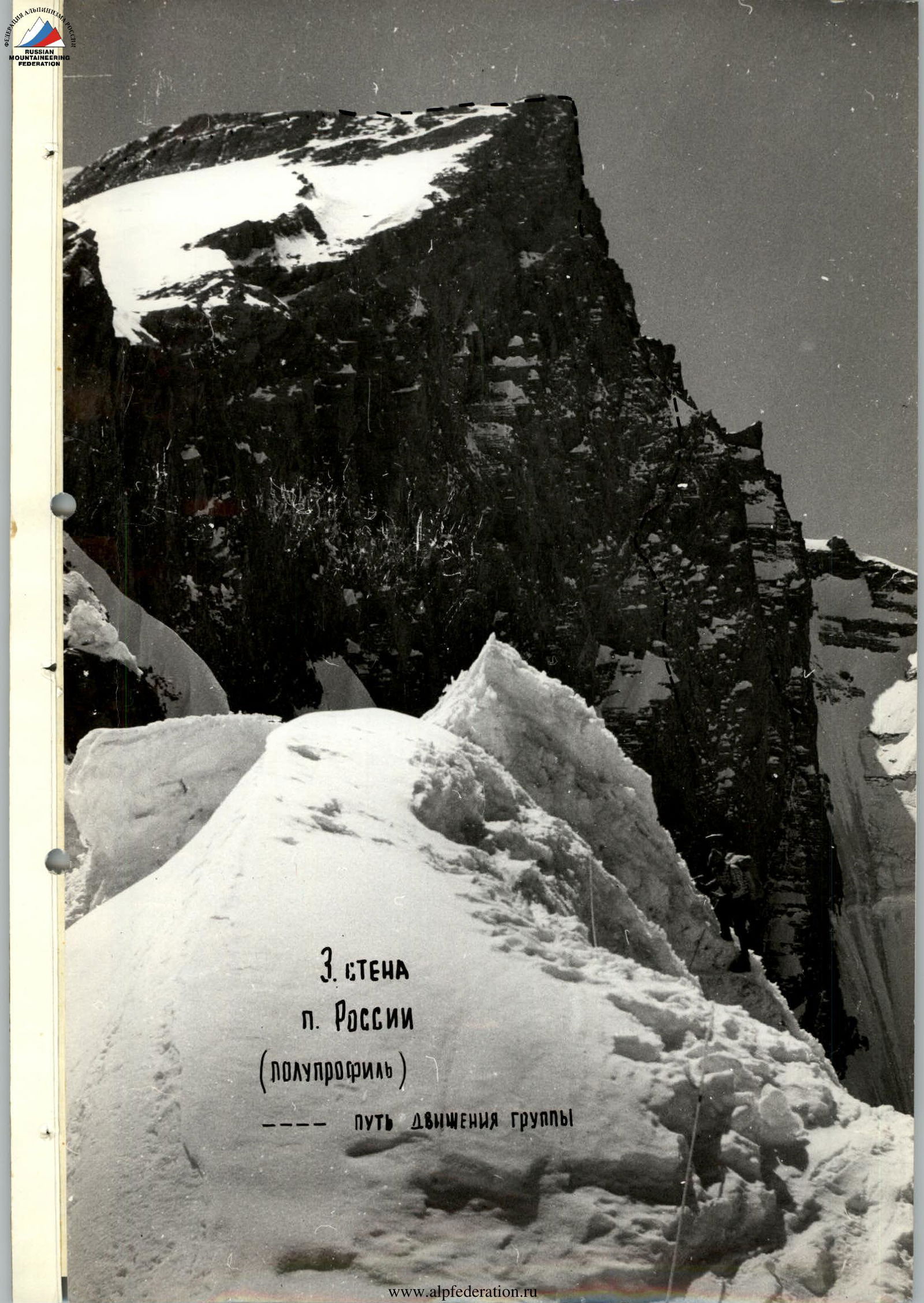
Starting from 1970, this route appears in applications for the USSR Alpine Climbing Championship, sometimes as the main option, sometimes as a reserve, but so far it has remained unattempted. "Exotic route," "route of extra class" — that's what we heard about it. We saw it in photos, but we didn't expect that this wall could be so impressive in real life.
And when we saw this route, we realized that we simply had to climb it. However, this decision didn't come immediately. Initially, we were amazed by the uniqueness of the ice wall. It's hard to find another ice mirror without any relief, over 1 km long and with a slope of 60° or more. It seemed crazy to find ourselves on it, exposed to all the rocks falling from almost a 1 km vertical cliff, and that it was a cliff was clearly visible from the slopes of Pik Kommunizma.
We know what an ice wall is. Or rather, we thought we knew, having gained good ice experience back in 1967 when we, still young third-category climbers, traversed three steps of the Sandal Glacier with loads, and in subsequent years were enthusiastic about ice technique. We thought we knew, but not entirely. It's one thing to climb ice walls 10–30 m long on an icefall, even of greater length and complexity, or during ice training when you feel that ice brings joy, and quite another to crawl under a heavy backpack on front points:
- one,
- second,
- third… rope,
continuously feeling a dull pain in your ankles, which sharply intensifies in a static position when you start to hammer in a hook.
But we understood this difference later. For now, we were admiring the beauty and scale of this exotic route. And with each passing day, along with discussions about the route, observations of its character, and getting accustomed to its grandeur, our desire to test our strength on it grew.
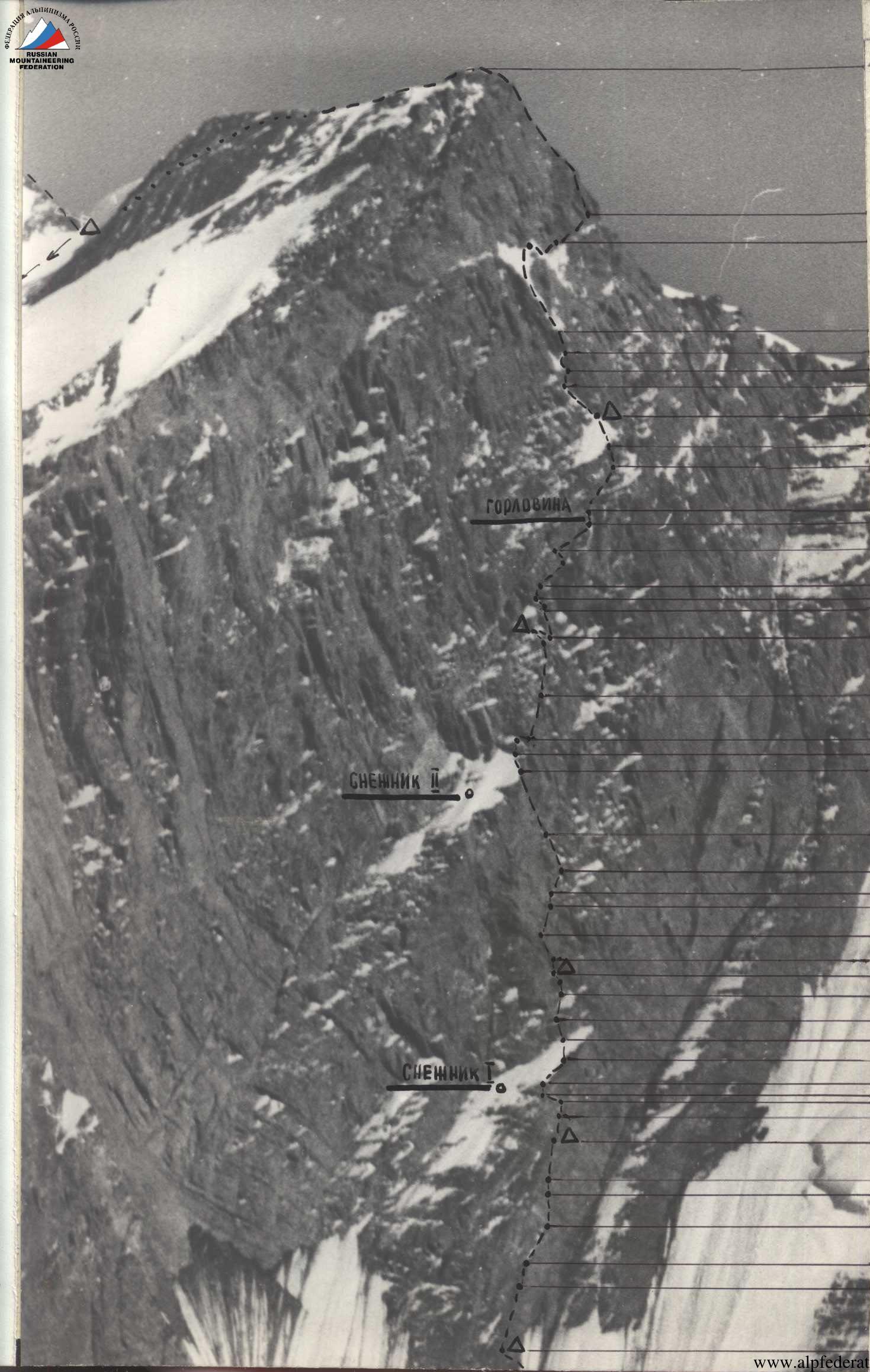
A unique combination — 1 km of almost vertical ice slope, shining in the rays of the evening sun, and 1 km of rock cliff. The second part worried us less. We knew we would make it. We had experience, although the steepness also commanded respect. "Guys, it's really steep there," said E. Ilyinsky later. Yes, it was indeed very steep. Back home, looking through slides and photos, we made a final conclusion — the route is feasible in principle, but it requires thorough preparation. We needed to:
- test ourselves on ice again;
- check our equipment;
- develop tactics for passing ice walls.
- We chose the a/l Ala-Archa region. Pik Svobodnaya Koreya. This was exactly what we needed: 300 m of ice, 300 m of cliff, местами нависания and 300 m of rocks covered in ice.
The ice of Svobodnaya Koreya solved some questions and raised others. The speed of the group of 5–6 people was approximately 80–100 m per hour, meaning we could pass the Rossii wall in 15–16 hours. But it's one thing to climb 300 m, and another to climb 1000–1300 m. 16 hours on front points is a problem. Standard VCSSPovskie crampons wouldn't solve it; new crampons were necessary.
Necessary equipment and tools:
- Special assault ice axes (justified themselves)
- Ice hammers (necessity was clarified)
So, after the 1976 season, the plan to climb the Rossii ice gained a real foundation.
By the spring of 1977, we had developed crampons of a new original design (500 g — a pair). Subsequently, they fully justified themselves (the leg is loaded less than in crampons like "Saleva"). Ice axes were improved, ice screws and piton hooks were prepared. All equipment was tested on winter ice in Alaska.
And here we are again under the wall of Pik Rossii. A snowless winter and sunny July weather did their job. The entire ice wall is menacingly exposed. Well, the more interesting it will be to climb it. Now it's crucial to understand the rockfall pattern. In 1975, there was more snow. We determine the critical time. It's 2 pm and 05:00–06:00 am. It seems we'll have to violate the canons regarding the time of starting ice routes. An early start is dangerous. The area comes to life at 05:00–06:00 am:
- The rumble of avalanches and rockfalls is heard.
At 02:00 am, the wall is illuminated, and stones start falling again, but after 1–1.5 hours, everything stabilizes.
We test our equipment again on a training ascent to Pik Pravdy via the central counterfort. This ascent was planned by us back in 1975. The wall has almost the same orientation, the ice is of the same structure, just three times shorter and less steep. Just right for training.
Pik Pravdy wall is illuminated at 10:30 am. Immediately, single stones start falling, and an hour later, their fall stops. This is an encouraging pattern. It means that on the Rossii cliff, we need to cross the main rockfall path by 02:00 pm, and it's clearly marked by a deep groove running from top to bottom.
When we descended from the Pravdy plateau and observed our rockfall, we noticed a kind of "grotto" on the ice about 200 m above the bergschrund. If we can shelter there for the night, it will greatly ease our task since we have very little daylight.
So, the final tactical plan for the ascent took shape:
- Climb the ice wall in one day.
- Start the route no earlier than 07:00 am; cross the large groove by 02:00 pm.
- If possible, spend the night in the "grotto" and reach it by 15:00 on the first day.
- On the rocks, process sections above the bivouac on warm rocks every day so that in the morning, in the cool, we can move along the fixed ropes (the wall is very cold, and the sun illuminates it very late).
- Processing the beginning of the ice wall and reconnaissance regarding the bivouac was scheduled for August 10.
We pack food for 8 days, calculating 500 g per person per day. We decide to eat as we always have:
- In the morning — milk porridge;
- During the day — a snack that each person has in a bag;
- In the evening — soup.
We prepare equipment based on the experience of ascending Pik Pravdy via the wall. The rocks of Rossii should be of the same structure. Subsequently, this turned out not to be entirely true.
ASCENT DESCRIPTION
August 10. In the morning, the duo Lebedikhin – Samoylin M., taking all the ropes, heads out for reconnaissance and processing the beginning of the route. When the duo approached the bergschrund, the grandeur of the route became evident. Above two tiny humans, like ants, stretched the ice wall, and above it rose a kilometer-high mass of rock wall.
We thought the bergschrund was smaller and would be passed without significant problems. But here… The guys pull out ladders and start working with them from the first meters.
By 12:00, all five ropes were fixed, and a joyful message was sent via radio: "There's a good platform for the night in the grotto."
An hour later, the guys had already descended to the glacier. We review and cut down the food supplies again and have lunch. At 16:00, we head out to the route. Our task for today is to:
- reach the grotto;
- process 3–4 ropes.
The 5-meter vertical wall of the bergschrund (R1) is climbed using ladders. 100 m higher, a rock wall is visible, like an island protruding from the ice. The ice board leading to this large rock island becomes steeper and steeper — from 50° to 60° (R2). Monolithic rocks in the lower part are covered with fairly destroyed stones. Climbing is difficult, 40 m (R3), and then there's a sheer, partially overhanging section of large-block rocks, 20 m of which are climbed with extreme difficulty. At one point, the leading duo fixed a ladder. We move along the fixed ropes on ladders with "jumar" (R4). To the right is the mouth of an ice chute. It's dangerous to go there.
After the wall, there are slabs covered in ice — 30 m. Steepness 60° (R5). The rock island ends; further, it's pure ice until the wall, which seems so close because the uniformity of the ice wall hides the distance. We traverse 40 m to the grotto along very steep ice, practically a sheer face (R6). The overhang of the upper part of the ice chute reaches 70°. Here, 5 ice hooks are used.
The ice grotto is a magnificent sight. It's a huge ice chamber with stalactites, where there's a convenient platform among chaos of huge blocks. Even, soft light.
While the tent is being set up, the duo Efimov S. – Samoylin V. heads out to process the ice.
To avoid crossing the ice chute twice, we exit the ice wall from the grotto upwards (5 m, 75°, R7). The ice is soft under the sun. The teeth of crampons, assault ice axes, and ice hammers reliably bite into the ice.
The absence of a backpack is a joy. Ankles hold well on front points; fatigue hasn't accumulated in the muscles yet, and the altitude hasn't taken its toll.
By 20:00, processing is complete. 60 m of fixed ropes are in place. Steepness 60°. 40 m remain to the second rock island (R8–R9).
August 11. Early in the morning, we wake up to the buzzing of falling stones. Yes, that's right, 05:00. In an hour, it should stop, but a doubt creeps in — what if it doesn't? But everything works like clockwork.
We leave the bivouac at 07:15 am. The ice is unrecognizably hard; in the grooves, there's ice formed from yesterday's trickles. Depressions for hooks are filled with ice. Vinogradsky, who is last, has to work hard to clear them. From the second rock island to the third — 4 ropes of 40 m each. Further, the steepness of the ice increases to 65°. Fatigue accumulates. Ankles ache continuously. Big toes are numb (this is numbness, a slight loss of sensitivity, which remained for a whole month after the ascent for all participants). We approach the rocks at 22:00. The steepness decreases somewhat, to about 60°. We move 30 m along destroyed rocks with a slope of 65° to a ledge (R11), where we planned to bivouac. But no, it's not a ledge. It starts to get dark quickly. It's snowing. It's cold. There's only enough space for 4 people to sit. We secure the backpacks, and on them, 2 more people are accommodated. Already in the dark, by the light of lanterns, the tent is fixed. Almost a hanging bivouac.
August 12. We leave at 11:00. Rocks are covered with freshly fallen snow. Ahead is a couloir. The slabs of the couloir (R12), which at first glance seem несложными, present a significant difficulty. Besides being partially covered in ice and lacking sufficient cracks for organizing belays, everything is exacerbated by fresh snow. Climbing is complex. The couloir leads under a wall 25 m high with a steepness of 70° (R13). Extremely complex climbing. Further, we traverse along debris-covered slabs (40 m, 45°, R14) under a large wall ending in a steep inclined shelf, on which lies a snowpatch. Rocks are strong but very steep. The first 20 m, 85° (R15), lead under an overhanging part. The overhang (10 m, 95%) is passed using ladders (R16), and then another 50 m of extremely complex climbing (85°–90°) lead to a narrow ledge. Here, we start building a platform for the tent. 2 hours later, when Lebedikhin – Efimov returned from processing (50 m of the wall were passed), the platform for a sitting bivouac was ready. This night, everyone sat comfortably.
August 13. From the bivouac, straight up the wall, towards a large protruding block, which seems to hang over our heads, climbing is extremely complex, 80°. Cracks are mostly wide. Segments and eccentrics work well. The overhanging block is passed on the left, between it and the wall, along an internal corner — 7 m, 95%. The overhanging section, although extremely complex, is climbed using free climbing with body tension (R18). We emerge onto a rock block. We can stand without holding onto the rock. This is one of the few places on the wall where the belayer can stand rather than sit in a harness. But further, the wall overhangs again. To the left, a traverse is visible — 10 m, extremely complex (R19), but further, there's an upward exit onto a snowpatch along a sheer face — 10 m, 90°; extremely complex, artificial holds (R20). The snowpatch is very steep. We move along the edge of the wall and snow: 60 m, 45°–50° (R21). Climbing is quite dangerous. There are no belay points. The snow cover is thin, and the rocks are composed of monolithic slabs covered in ice and lacking cracks. This turned out to be characteristic of the entire wall. Sections that had some inclination turned out to be very complex to pass because they were smooth, icy, and lacked relief and cracks, and often it was easier to climb vertical, even overhanging sections, but clean of ice and with cracks for hammering in hooks.
(R22) — traverse along snow to the wall, 20 m, 45° (careful! Thin snow cover!), where a chimney is visible. Along the chimney (R23), which is overhanging in the upper part, we exit onto a small ledge. Rocks are heavily destroyed. Extremely complex climbing (one ladder is fixed). Destroyed but very steep rocks continue further (85°, 10 m, R24). Further, the wall starts to overhang. A detour is planned to the left along an internal corner, first slightly descending (15 m, 80°, R25) towards another overhanging wall, under which there's an inclined shelf. The exit onto the shelf is very complex (5 m, 90°, R26, artificial holds). Rather, it's not a shelf but an inclined slab, 45°, covered in snow (R27). Here, we decide to build a platform from snow and stone.
The shelf, where we decide to spend the night, is bounded on one side by a 30-meter monolithic, with tiny footholds, sheer wall — 85°–90°, lacking cracks, and on the other side — by a monolithic, completely smooth, overhanging — 110°–120° — rock.
The wall is climbed using free climbing in galoshes, maximally lightened. A small eccentric entered the only crack at a height of 5 m (R28, 7 m, 85°–90°).
Extremely complex climbing.
After the wall, something like a ledge goes left upwards, and straight ahead, rocks start to overhang again "in feathers." We make a detour along the ledge, 15 m — very cautiously, the rock is heavily destroyed (R29). The overhanging section is bypassed; we can move up the wall. Rocks consist of large monolithic blocks. The relief is smoothed out; the steepness is very high — up to 80°–85°. Extremely complex climbing, 25 m, and then again along an internal corner formed by the wall and an overhanging block, 5 m, 90° (R30). There's not a single place to relax. Processing is complete. The working day is 8.5 hours. We contact Ilyinsky in the evening. The radio isn't working well; we can't hear the "base." This radio works better for transmission. We give information.
August 14. We leave at 10:00 as always. The sky is clear. Very cold. We move from the processed fixed ropes upwards to the left, 10 m, then to the right, bypassing an overhanging rock. Very characteristic relief — overhanging "irons" that are bypassed on the left and right with very difficult climbing along sheer and slightly inclined walls, 80° (R31). Further, a path to an unclearly expressed corner is visible, which should lead to the next upper snowpatch. 30 m of complex climbing remain (R32, 70%).
(R33) — internal corner. Very steep destroyed rocks — 40 m, 85°–90°, inconvenient to pass with backpacks. We pull them up. We emerged into the upper part of the second snowpatch. Above us rises the next part of the route — a huge wall, 300–350 m, with an overall steepness of 85°–87°. The structure is typical — huge "irons" 40–50 m, overhanging at an angle of 95°–100°. Our task is to find the most convenient path among them.
(R34) — 10 m of steep snow. The beginning of the wall — a sheer face, 5 m, 90°. We have to use ladders (R35). Then a traverse to the right, 10 m (R36), then upwards along a series of sheer walls (40 m, 80°, R37). The general direction of movement is towards an unclearly expressed couloir going left upwards (R38). Rocks are steep, heavily destroyed, sometimes covered with ice. 10 m are pulled up for the first backpack, and after 50 m of extremely complex climbing, we exit under a smooth overhang. The place is very similar to the previous bivouac. The same slab, just with less snow. The same smooth overhang, and on the other side — a wall, 90°, forming a corner, but without any выступs or cracks — a completely smooth monolith. It can't be passed without pitons, and we don't have them. We'll have to move around, descending slightly from the bivouac.
And again, there's no good lying-down bivouac. We dream of when we'll finally be able to lie down in a tent, stretched out. While the guys clear snow and ice, trying to level the platform as much as possible, Efimov – Vinogradsky head out for processing.
It's necessary to pass this problematic section, 50 m long, on warm rocks in galoshes; otherwise, tomorrow, in the cold, it will take much longer.
- The first 25 m are sheer rocks. Steepness 80°–85°; footholds are unreliable. There are no cracks for hooks. Only large "eccentrics" and "segments" work well.
- Further, a traverse to the left along slabs covered in ice, 3 m.
- Again upwards along crevices — 5 m, 90° (R39), using a ladder and climbing in supports and body tension.
At the top of the crevice begins the main key section of this area. (R40) is a 10-meter overhanging wall, for which 12 hooks were hammered.
Processing took 1.5 hours. The working day is 9.5 hours. 6 ropes were passed.
August 15. The morning greets us with wind and gathering clouds. We leave at 10:30. While we were passing the fixed ropes, the weather worsened. It started snowing. It's blowing. Ahead is a couloir, 60°, narrowing in the middle into a gorge. The beginning of the couloir is not encouraging. A smooth monolith without even slight relief or cracks, bounded on the left by destroyed rocks, 85°–90°. Unusual structure. 30 m are passed in an hour (R41). Further movement is impossible — a smooth monolith. We exit by the steep wall (4 m, 90°) onto a more upper shelf running along the couloir (R42). Along the shelf, although complex, movement and belay are possible (50 m, 60°).
(R43) — we hit an overhanging wall and again make a traverse into the couloir under the gorge. Very unpleasant traverse; all footholds break under load. The first today is Samoylin M. Snow intensifies; it's very cold. The gorge (R44) is entirely icy. There are no points for hammering in hooks. The passage is made in body tension along destroyed and icy rocks (9 m, 80%). Very, very complex. Another 40 m of tense climbing follows, taking 2 hours 30 minutes. Reliable cracks are very few. Ladder steps were used 3 times (R45). The couloir leads to a wall, 20 m long, with a steepness of 85°, which leads onto a snowpatch (R46). Here, there's already quite a solid relief (extremely complex climbing). 30 m of steep snowpatch (R47) lead onto a snow ridge. Here, we bivouac on a narrow ridge; it's hard to clear a platform. A semi-reclining bivouac. The working day is from 10:30 to 19:30; 5 ropes were passed.
August 16. A very cold, clear morning. We put on all our warm clothes. We leave at 10:30. The ridge hits a sheer, smooth wall. To the left, a chimney is visible, covered in ice, ending in a gorge like "ram's foreheads." Chimney 60°, 10 m. Gorge — 3 m, 80°. Extremely complex climbing (R48). We pass the gorge using ladders. Behind it is an ice groove that widens and approaches under the wall. The steepness of the rocks reaches 65°. Climbing on front points of crampons (20 m). Ice is fragile, of variable structure. The special ice axe and ice hammer come to the rescue several times. Under the wall, ice is covered in snow. Front points start to slip (R49).
In the right part of the wall, a rock chimney is visible, through which it's possible to climb using free climbing, 10 m, 75°–80%. Extremely complex climbing (R50). This chimney leads to the next ice field (R51), which stretches to the summit overhanging tower.
- The first 40 m are passed along destroyed rocks; in the middle part, the steepness is 65°.
- Cracks for hooks have to be searched for by clearing snow and chiseling ice.
- Progress is very slow.
- Further, rocks are covered with an ice crust 2–3 cm thick; this ice gradually increases the steepness, which upon exiting onto the ice ridge reaches 70°.
A very complex and unpleasant section (R52).
The summit part of the wall is climbed in a spiral, left upwards to the right, but first, we have to descend to the other side of the ridge, 3–4 m, and then climb up to the blocks along steep, partially sheer rocks. Protrusions are very unreliable, break under load (the section is climbed in crampons). 10 m of very unpleasant, tense climbing (steepness 80°). Further, rocks become monolithic. There are large crevices for eccentrics.
We move towards the ridge:
- 40 m, 75°;
- the remaining 50 m to the top of the wall are climbed with несложным climbing (65°, R53).
The path to the summit tower lies along a snow ridge. The weather worsens. We stop for the night. Finally, we make a normal platform under the tent.
On the morning of August 17, we head out to the summit, then descend to the Pik Pravdy plateau.
TABLE
of sections of the passed route
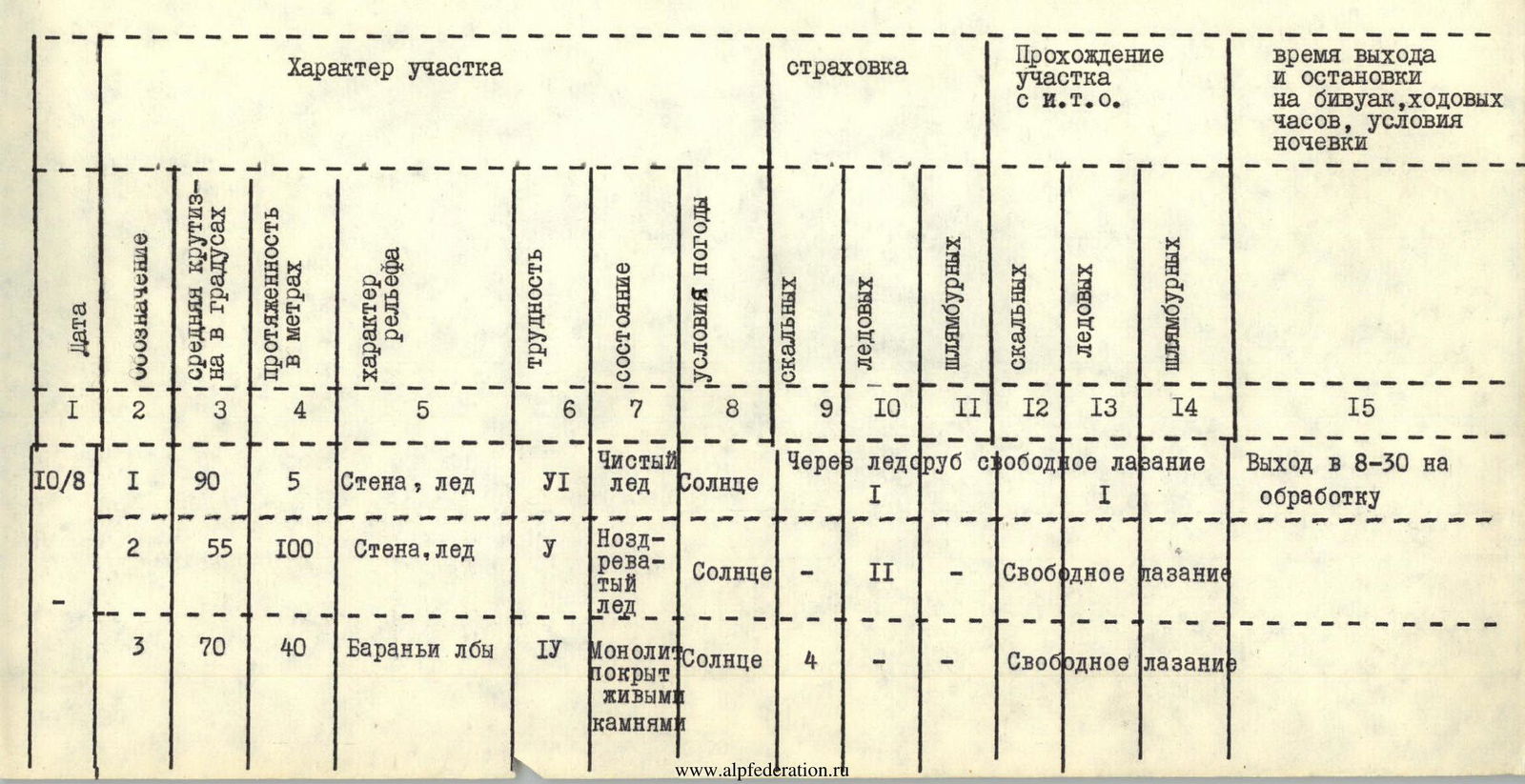
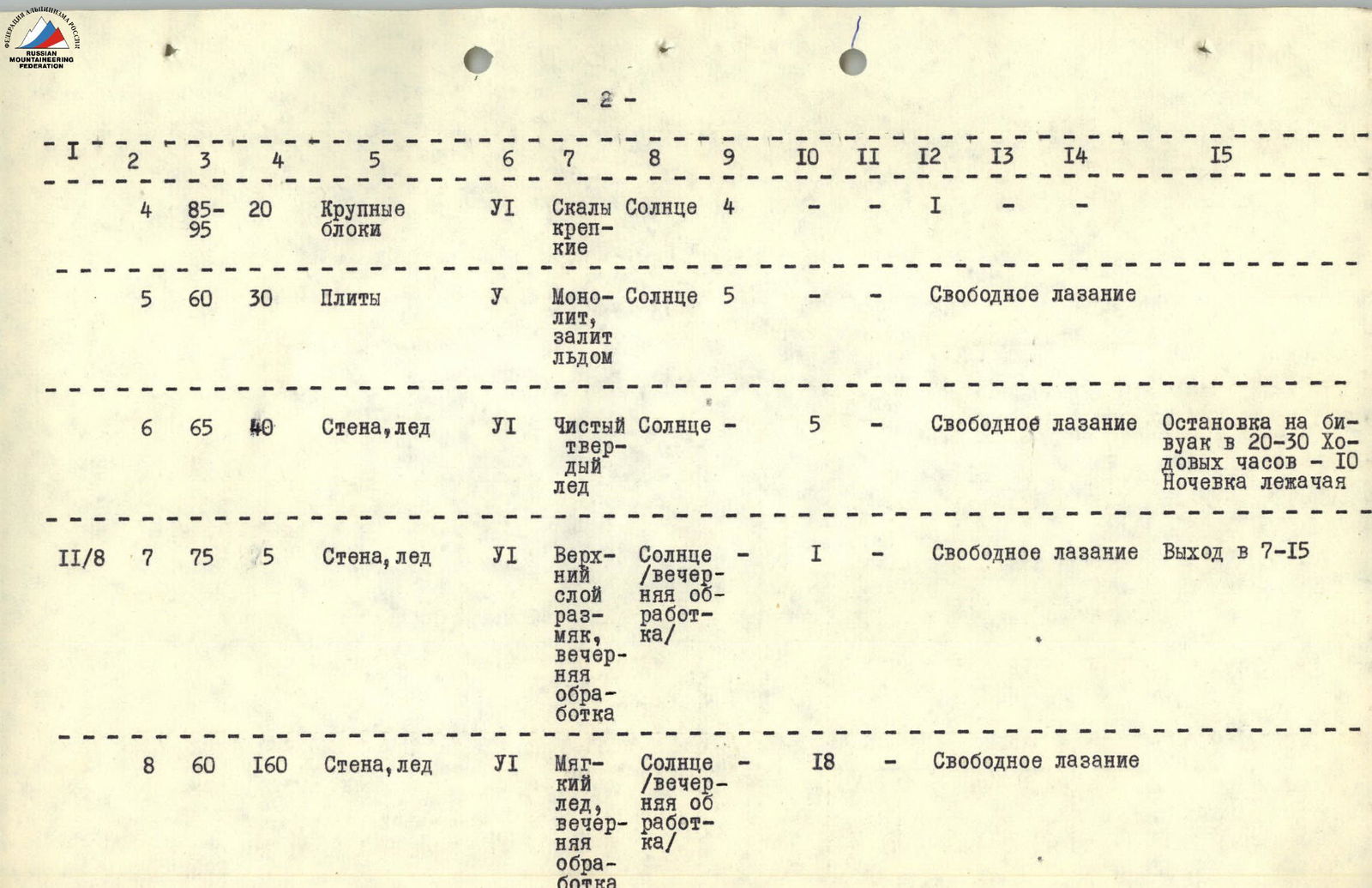
| Date | Designation | Average steepness in degrees | Length in meters | Character of relief | Difficulty | State | Weather conditions | Rock belays | Ice belays | Piton belays | Passage with artificial holds (rock) | Passage with artificial holds (ice) | Passage with artificial holds (piton) | Time of exit and stop for bivouac, working hours, bivouac conditions |
|---|---|---|---|---|---|---|---|---|---|---|---|---|---|---|
| 10/8 | R1 | 90 | 5 | Wall, ice | 6 | Pure ice | Sun | 1 | — | — | Free climbing | — | — | Exit at 08:30 for processing |
| — | R2 | 55 | 100 | Wall, ice | 3 | Porous ice | Sun | — | 2 | — | Free climbing | — | — | — |
| — | R3 | 70 | 40 | Ram's foreheads | 4 | Monolith covered with loose stones | Sun | 4 | — | — | Free climbing | — | — | — |
| — | R4 | 85–95 | 20 | Large blocks | 6 | Strong rocks | Sun | 4 | — | — | 1 | — | — | — |
| — | R5 | 60 | 30 | Slabs | 3 | Monolith, iced | Sun | 5 | — | — | Free climbing | — | — | — |
| — | R6 | 65 | 40 | Wall, ice | 6 | Hard ice | Sun | — | 5 | — | Free climbing | — | — | Stop for bivouac at 20:30, 10 working hours, lying bivouac |
| 11/8 | R7 | 75 | 5 | Wall, ice | 6 | Upper layer soft, evening processing | Sun, /evening processing/ | — | 1 | — | Free climbing | — | — | Exit at 07:15 |
| — | R8 | 60 | 160 | Wall, ice | 6 | Soft ice, evening processing | Sun, /evening processing/ | — | 18 | — | Free climbing | — | — | — |
| — | R9 | 60 | 40 | Wall, ice | 6 | Hard ice | Cold, cloudy | 4 | — | — | Free climbing | — | — | — |
| — | R10 | 60–65 | 880 | Wall, ice | 6 | Hard ice | Cool, cloudy | — | 99 | — | Free climbing | — | — | — |
| — | R11 | 65 | 30 | Wall, ice | 4 | Destroyed rocks | Cold, snow | 3 | — | — | Free climbing | — | — | Stop for bivouac at 22:15, 15 working hours, sitting bivouac |
| 12/8 | R12 | 60 | 30 | Couloir | 3 | Slabs iced, snow-covered | Cold, clear sky | — | — | — | Free climbing | — | — | Exit at 11:00 |
| — | R13 | 70 | 25 | Wall | 6 | Rocks not strong, snow-covered | — | — | 4 | — | Free climbing | — | — | — |
| — | R14 | 45 | 40 | Slabs | 4 | Slabs, scree, snow-covered | Cold, clear sky | 3 | — | — | Free climbing | — | — | — |
| — | R15 | 85 | 20 | Wall | 3 | Strong rocks | Sun appeared | 4 | — | — | Free climbing | — | — | — |
| — | R16 | 95 | 10 | Overhanging wall | 6 | — | Sun warm | 2 | — | — | 3 | — | — | — |
| — | R17 | 85–90 | 50 | Wall | 6 | — | — | 9 | — | — | Free climbing | — | — | Stop for bivouac at 20:30, 9:30 working hours, sitting bivouac |
| 13/8 | R18 | 85–90 | 45 | Wall, internal corner | 6 | Monolith | Cold, no sun, clear sky | 6 | — | — | Free climbing | — | — | Exit at 10:00 |
| — | R19 | 95 | 10 | Wall | 6 | Monolith | Cold | 1 | — | — | Free climbing | — | — | — |
| — | R20 | 90 | 10 | Wall | 6 | Strong rocks | — | 2 | — | — | 2 | — | — | — |
| — | R21 | 45–50 | 60 | Inclined shelf | 6 | Slabs iced, snow-covered | — | 9 | — | — | Free climbing | — | — | — |
| — | R22 | 45 | 20 | Inclined shelf | 4 | — | Clear sky, cold, no sun | 2 | — | — | Free climbing | — | — | — |
| — | R23 | 90 | 15 | Chimney | 6 | Rocks heavily destroyed | Sun appeared | 4 | — | — | 1 | — | — | — |
| — | R24 | 85 | 10 | Wall | 6 | Rocks destroyed | Good weather | 3 | — | — | Free climbing | — | — | — |
| — | R25 | 80 | 15 | Internal corner | 3 | Rocks destroyed | Good weather | 5 | — | — | Free climbing | — | — | — |
| — | R26 | 90 | 5 | Internal corner | 6 | — | Wind starts | 1 | — | — | 2 | — | — | — |
| — | R27 | 45 | 4 | Inclined slab | 4 | Slab snow-covered | Wind, cold | — | — | — | Free climbing | — | — | Stop for bivouac at 18:30, 8:30 working hours, sitting bivouac |
| 14/8 | R28 | 85–90 | 7 | Wall | 6 | Monolith | Very cold, clear | 1 | — | — | Free climbing | — | — | Exit at 10:00 |
| — | R29 | 80–85 | 40 | Unclear shelf turning into a wall composed of blocks | 6 | Rocks destroyed but turning into monolith | Clear, cold | 6 | — | — | Free climbing | — | — | — |
| — | R30 | 90 | 5 | Internal corner | 6 | Monolith | Clear, cold | 2 | — | — | Free climbing | — | — | — |
| — | R31 | 80 | 25 | Wall | 3 | — | — | 4 | — | — | Free climbing | — | — | — |
| — | R32 | 70 | 30 | Wall | 3 | Rocks partially destroyed | — | 4 | — | — | Free climbing | — | — | — |
| — | R33 | 85–90 | 20 | Internal corner | 6 | — | — | 3 | — | — | Free climbing | — | — | — |
| — | R34 | 55 | 10 | Inclined slabs | 3 | Slabs iced | — | — | — | — | Free climbing | — | — | — |
| — | R35 | 90 | 5 | Wall | 6 | Rocks destroyed | Sun appeared | 2 | — | — | Free climbing | — | — | — |
| — | R36 | 85 | 10 | Wall | 6 | — | Sun, wind starts | 2 | — | — | Free climbing | — | — | — |
| — | R37 | 80 | 40 | Series of short walls | 6 | Rocks destroyed | Clear, cold, windy | 6 | — | — | Free climbing | — | — | — |
| — | R38 | 80 | 60 | Couloir | 6 | Rocks heavily destroyed, iced | — | 9 | — | — | Free climbing | — | — | Stop for bivouac at 19:30, 9:30 working hours, sitting bivouac |
| 15/8 | R39 | 85–90 | 35 | Wall | 6 | Rocks destroyed, iced | Very cold, windy | 5 | — | — | Free climbing | — | — | Exit at 10:30 |
| — | R40 | 95 | 10 | Overhanging wall | 6 | Rocks partially destroyed | Snow, very cold | 3 | — | — | 9 |