
Central Council of the Spartak Sports Society
Report
on the ascent of Peak OGPU via the right central wall (first ascent). Nalchik, 1968
Brief information about the object and the ascent area
Peak OGPU is located in the Central Pamir in the upper reaches of the Bivachny Glacier (see diagram). The area is frequently visited by mountaineering expeditions and is fairly well-studied both geographically and in terms of mountaineering. However, the only ascent to Peak OGPU was made in 1966 by a team from the Central Council of Spartak led by A. Kustovsky via the North wall with an exit to the northeast counterfort (see photo No. 1). Peak OGPU, despite its relatively low height (6055 m), impresses everyone with its:
- beauty;
- grandeur;
- steep walls that rise to the summit from almost all sides.
The easiest route to the summit is the descent route taken by Kustovsky's group (4B–5B category of difficulty):
- The route follows the descent line.
- It has a category of difficulty of 4B–5B.
- It is considered the least challenging compared to other options.
All other paths are very challenging. Senior team coach V. M. Abalakov gathered and provided all necessary information, photographs, descriptions from Kustovsky's group, data on rock types, weather conditions, etc.
The entire OGPU massif consists of very soft rocks, which, combined with the great steepness and extent of the walls, as well as unstable weather in the OGPU "microdistrict", significantly complicates the ascent. To the right of Kustovsky's group route, there were several options for ascending to the summit. Preliminary information indicated that all these paths were more challenging than the route taken by the Kiev group.
The final variant was chosen after prolonged observations of the wall.
| No. | Surname, first name, and patronymic | Sports rank | Year of birth | Place of work and position | Place of residence | Ascents in 1967 | Ascents in 1968 |
|---|---|---|---|---|---|---|---|
| 1. | Stepanov Gely Vladimirovich | Master of Sports | 1934 | VGI — junior researcher | KBAASSR, Terskol settlement | 4A in winter, 4B, 5A | 2A in winter, 2B in winter |
| 2. | Naugolny Viktor Kuzmich | Master of Sports | 1937 | Kabardino-Balkarian Spartak Sports Society — coach | Nalchik, Lenin St., 73, apt. 7 | 5B+, 4A in winter, 2A in winter | 2A in winter, 5A, 4B, 5A |
| 3. | Zalikhanov Mikhail Chokkaevich | Master of Sports | 1939 | VGI — senior researcher | Nalchik, Lenin St. | 4A in winter, 2A in winter | 5A |
| 4. | Lezhenin Anatoly Ivanovich | Master of Sports | 1940 | KBGU — student, sports faculty | Nalchik, Gagarin St., 1 | 5B+, 4A in winter, 5A, 5A, 4A in winter | 2A in winter, 5A, 5A, 4A in winter |
| 5. | Lezhenin Alexei Ivanovich | Master of Sports | 1937 | Shkhelda alpine camp — instructor | Nalchik, Gagarin St., 1 | 4A in winter | 4B, 5A |
| 6. | Shvedov Stanislav Vladimirovich | Master of Sports | 1931 | ZPP — senior engineer | Nalchik, Gornaya St. | 2B in winter, 4A in winter | 2B in winter, 5A, 5A |
| 7. | Terletsky Viktor Aristakhovich | 1st sports category | 1939 | ZPP — senior engineer | Nalchik, Gagarin St. | 5B, 2B in winter, 5A, 4B in winter | 2B in winter, 5A, 4B |
| 8. | Babayev Shakman Magomedovich | 1st sports category | 1942 | KBGU — student, sports faculty | Nalchik, Chernyshevsky St., 1 | 4A in winter | 5A, 3B, 4B |
Note: Instead of the originally listed Amshokov A. K. and Shatsky, who were unable to travel to the Pamir, Babayev and Shvedov were included in the team and approved as part of the expedition. Kakhiani was unable to participate in the ascent due to health reasons and was replaced by Lezhenin Anat.
Description of the ascent
August 6, 1968. Early in the morning, the entire group set out to the central wall of Peak OGPU to "process" the route and cache equipment.
The group in the composition of V. Naugolny, G. Stepanov, An. Lezhenin, and M. Zalikhanov moved forward lightly, taking only the necessary equipment for "processing". The remaining four people: Al. Lezhenin, V. Terletsky, S. Shvedov, and Sh. Babayev, leaving their loads under the wall, were to descend.
The glacier was crossed quickly, and the ascent began up the highly fragmented rocks, abundant with "live" stones. Fortunately, they moved along a counterfort safe from rockfall.
The formidable yellow wall up close proved to be even more challenging than expected, very smooth, with a small number of cracks. They chose the only possible ascent variant, representing a rock internal angle with a narrow slit (see photo and diagram). However, to enter the internal angle, it was necessary to overcome a rock cornice, which was approached via a 3.5-meter sheer drop. The Naugolny—Stepanov team moved forward.
Here, it became clear that the wall consisted of extremely soft rock:
-
handholds crumble;
-
hammer blows sound dull.
-
V. Naugolny began to ascend slowly, with great caution, feeling out each protrusion.
The cornice blocking the path to the internal angle was overcome using a ladder. Further progress along the internal angle was not easier, but here it was possible to drive in hooks for belaying, although only ice and large rock hooks. V. Naugolny was the first to climb vertically up two ropes, then G. Stepanov took the lead.
The team reached the overhanging rocks, where ladders were used again.
On this day, the plan was to reach a ledge visible from the storm camp, but due to the late hour, they decided not to push on and began descending.
Everyone was satisfied with the "processing" results — 4 rope lengths of sheer drop — but were slightly concerned about the unusually soft rock.
August 8, 1968
7:00 — The group set out on the assault. The weather is excellent, and the participants' mood is too. They reached the yellow wall in 3.5 hours. Here, they loaded up with food and equipment cached earlier. The backpacks became significantly heavier, and it became clear that advancing up the wall with such a load was questionable.
They had to:
- climb up using jumar and étriers;
- then pull up the backpacks on a rope, which proved not to be difficult since the wall was sheer and smooth.
Naugolny led again. The internal angle was partially clogged with stone "plugs", and the challenging climbing proceeded slowly. Ladders were used again when passing the "plugs".
After 7 hours of tiring advancement up the yellow wall, its steepness began to decrease gradually, and ledges appeared where they could rest and gather in groups of 2–3 people.
Finally:
- the first team;
- and the rest of the group members reached a ledge suitable for an overnight stay.
At 17:30, they began preparing for the night, chiseling out places in the soft rock for two tents and settling in for the night.
August 9, 1968. The weather remains good. They set out on the route at 8:00. The further path follows the wall counterfort, composed of destroyed soft rocks. Many "live" stones are present, and they had to proceed with great caution; the climbing is very challenging. Numerous cracks are suitable for driving in large hooks, but progress is complicated by the heavy backpacks. After 150 m of challenging climbing, they approached a couloir separating two counterforts. Above the couloir, the counterforts merge and turn into a wall.
Preliminary observations suggested that the ascent options along the counterforts were equally challenging, and the group chose the path to the right because it:
- seemed more monolithic;
- was safer from rockfall;
- although it was steeper than the left one.
With careful belaying, they crossed the couloir and reached the counterfort. Here, they encountered fragile light-colored rocks with a steepness of about 65°. Climbing them was very challenging, requiring careful belaying, caution, and attention. Belaying was mainly done using regular rock and ice hooks. The group spent 7 hours on this section. At 20:00, they stopped for the night, having previously equipped platforms for tents.
August 10, 1968. The first team began advancing upward at 7:00. The further path is visible for about 100 m. The counterfort gradually becomes steeper — from 65° to 75° — and at the top, it turns into a sheer wall with overhanging rock cornices.
Immediately, difficult climbing began, and V. Naugolny, leading, advanced with great caution, sometimes moving right or left along barely noticeable ledges, choosing the path forward. Progress became increasingly complicated. The counterfort turned into a smooth slab-like wall with a small number of cracks and handholds. This section of the route faces west, and the sun begins to illuminate it only in the second half of the day. Cold and tension caused numbness in fingers and toes. The slab-like wall approached another wall with an overhanging section. The only option for exiting the wall was to the right via a vertical chimney. However, approaching the chimney was extremely challenging: it required traversing to the right along a smooth wall and then ascending, where the cornice was significantly smaller.
V. Naugolny first climbed under the cornice, drove in an ice hook there, and then descended 6–7 m, from where he moved right via a pendulum into an internal rock angle.
Further, beyond the internal angle, the overhanging 1 m cornice was overcome using a ladder.
After 3–5 m of climbing overhanging rocks (see photo):
- a traverse to the right along a ledge — to the chimney.
On the ledge, there is space for 2–3 people, where they could rest under the protection of large rock cornices, shielding the platform from falling stones.
After a short rest, the first team began ascending the chimney (5–6). Naugolny led again. As on the previous section, he climbed in rock shoes and without a backpack.
The chimney is sheer, 1.5–2 m wide, with smooth walls. After 10 m of challenging advancement, a stone overhanging "plug" was overcome. Here, they drove in two piton hooks and hung a ladder.
- Another "plug" was encountered higher up.
- Throughout this section, maximum effort and attention were required.
There were only two places to rest, standing wedged in a crack under overhanging rocks. In the upper part of the chimney, progress was complicated by the rocks becoming wet and slippery from rime ice.
The first team required about 5 hours to pass this section. Despite the ropes being already in place, the rest of the group climbed very slowly because they had to ascend with backpacks using jumar and étriers. The backpacks could not be pulled up due to the large rock cornices overhanging the ledge. Additionally, the successful advancement was hindered by the danger of rockfall and the backpacks getting stuck in the chimney.
Above the chimney lies a beautiful ledge under overhanging monolithic walls, where a night's stay was planned from the storm camp.
This is the last place where tents could be set up. The leading teams had already begun setting up tents, and the last ones arrived at the bivouac site only at 20:00. The chimney was one of the most challenging sections the team had ever encountered.
On the ledge, they managed to set up one tent and prepare two small platforms for overnight stays in "zhdarkas". That evening, the weather began to deteriorate. It snowed during the night.
August 11, 1968. It snowed all night. In the morning, there were occasional breaks in the cloud cover, through which the surrounding snow-covered peaks were visible.
Again, the team faced two options for further advancement: the first, most challenging but less dangerous, went straight up from the overnight stay; the second — to the right along the ledge to an internal angle, exiting upward onto an inclined oblique ledge leading to the ridge.
At 8:00, the S. Shvedov — An. Lezhenin team went to scout the second option. After 1 hour, they returned and reported that the right option was not suitable for movement because it:
- was dangerous;
- was constantly exposed to rockfall;
- the transition to the upper ledge was very challenging.
They decided to move straight up the gray monolithic wall. According to the tactical plan for the ascent, two overnight stays were planned on the ledge due to the need to scout the further path and the lack of suitable bivouac sites along the route. There was no point in changing the planned schedule, especially since the weather had significantly worsened. That day, they decided to "process" the most challenging sections of the route.
Two teams: V. Naugolny — G. Stepanov and M. Zalikhanov — An. Lezhenin, set out to "process" the further path. They began moving straight up the gray overhanging rocks dusted with snow. The challenging climbing was further complicated by the cold and snow, but the rock was strong, there were no "live" stones, handholds were reliable, and for the first time on the wall, the driven-in hooks "rang", providing "iron" belaying. Finally, they passed the 40-meter sheer wall, and to their disappointment, softer rock appeared again higher up. The wall's steepness decreased to 65°, but the slab-like rocks were heavily destroyed, with blocks flaking off, surrounded by snow and rime ice in many places.
Naugolny led. It was visible how he:
- cleaned snow and ice from each handhold;
- warmed his hands;
- persisted, with great caution, crawled upward.
Belaying on this section was mainly done using ice hooks driven into rock cracks. They passed another 40 m. The route was "processed" for 7 hours. The weather worsened further, and a blizzard began. They decided to descend for the night.
August 12, 1968. The weather is abysmal: continuous cloud cover with rare "windows", visibility is almost zero, snow is falling. They set out at 9:00 on the section "processed" the day before. On the 7–8 rope length, the rope was icy from the night before, and advancing upward with backpacks was, of course, challenging.
Further on, the path became even more complicated:
- a chimney with walls covered in rime ice;
- avalanches of snow "groats" swept through the chimney;
- wind with snow was so strong that it knocked people off their feet;
- snow "groats" stung faces like needles;
- it was impossible to see a teammate just a couple of steps away.
It was especially challenging to pass the icy cornice in the chimney with half-meter icicles hanging from it. To pass this spot, they had to use pitons to exit to the outer part of the chimney and then, after hanging a ladder, climb to the top of the cornice. With great difficulty, the chimney was finally passed.
Beyond the chimney lay a smooth sheer wall. However, it was already late — 18:00 — time to stop for the night. After an hour and a half of work, they managed to adapt a small platform for setting up one tent. Four team members spent the night sitting on small ledges in "zhdarkas".
During the night, the snowfall ceased, but it became significantly colder, the wind strengthened, and stars appeared in the gaps between the clouds.
From the overnight stay, a smooth rock wall led upward, and everyone understood that this was the key section of the route and that the next day would decide the fate of the ascent (section 8–9).
August 13, 1968. Friday the 13th and the key section of the route! (Thank God they were not superstitious). The weather improved, the sun was shining, but it was still very cold — the altitude was taking its toll. The surrounding peaks were covered in soft clouds, and a strong cold wind was blowing.
The entire group watched the formidable wall ahead with particular attention. Its steepness was up to 85°, it was smooth, with virtually no cracks, and snow did not stick to it due to the steepness. The rock was still soft, and it was clear that piton hooks would be unreliable.
The group prepared for the ascent. The necessary hooks were selected, ropes and loops were prepared, and as always on challenging sections, Viktor Naugolny led.
The only possible ascent variant was via an internal angle leading left under a rock cornice and then a traverse to the right around the cornice.
At 9:00, the group began the assault on the key wall. From the very first meters, the climbing was extremely challenging. Overcoming sections proceeded as follows:
- 20 m along a rock angle — over an hour and a half, with two ladders hung;
- traversing the cornice along a barely noticeable, sometimes interrupted ledge — using a pendulum;
- overcoming 6 m of overhanging rocks — using piton hooks;
- further movement — along an internal angle under the cornice, then along rocks with a steepness of 85–90°.
The rope thrown from above did not touch the wall, hanging freely. The wall's steepness became about 80°, but the climbing remained extremely challenging. The weather began to deteriorate again: the wind strengthened, snow began to fall, and it was very cold.
The first team required 5 hours to overcome 100 m of this section. After incredibly challenging advancement along the sheer drop, a slight easing of the rock followed, above which a smooth wall hung like a slab. They decided to stop for the night before the wall.
While the subsequent teams caught up to the overnight stay site, the front team, having rested, set out again to "process" the further path. The weather deteriorated completely, with the wind strengthening to the point that a person on a rope was swaying like a toy.
Having "processed" about 40 m of the further route with great difficulty, the leading Naugolny — Stepanov team descended to their comrades. It was not possible to set up tents due to the lack of space; they spent the night sitting on barely noticeable ledges, one or two at a time, wrapped in "zhdarkas" and cloaks.
It snowed throughout the night. The night was not entirely calm.
August 14, 1968
The weather remains abysmal.
- Strong wind.
- Snow.
- Small avalanches blown from above.
The ropes hung the day before were icy. The group began ascending the slab-like snow-covered walls.
The ascent up the 70-degree rocks in the conditions of strong wind threatening to throw them off the cliff, snow-covered rocks, and continuous snowfall required enormous effort, skill, and expertise.
Only occasionally, in "windows" of clouds, the Bivachny Glacier and lateral moraines, completely covered in snow, were visible for a moment. Visibility was absent higher up the slope.
Observers from the group reported by radio that 10–15 cm of snow had fallen below.
Finally, by 18:00, the first pair reached the ridge. There was a good platform here, but a hurricane-force wind with snow made setting up tents impossible. The entire group divided into two parts:
- one descended down the rope to a spot where a tent could be set up;
- the other remained on the ridge.
Almost the entire night, there was a very strong wind with snow, which began to subside only in the morning.
August 15, 1968
Not a cloud in the sky. Everything around was white. The moraines on the glacier were covered in a layer of snow.
The further path to the summit represented a destroyed ridge with many "gendarmeries" that could be bypassed to the right along destroyed rocks, heavily snowed. The rocks were partly tile-like, covered in a layer of rime ice.
In 3–4 places, they crossed firn and ice slopes. Belaying was done through outcrops and, as before, through ice and rock hooks.
The group left the bivouac at 8:30 and stood on the summit at 16:00. Here, they found a note from Kustovsky's group and left their own.
They began descending from the summit along the southeast ridge to the saddle between Peaks OGPU and Borющийся Vyetnam.
At 19:00, they stopped for a bivouac. The site was excellent, and they set up 2 tents.
August 16, 1968. They descended down snow-ice slopes to the storm camp at 16:00. The descent was uneventful.
General conclusions
The route along the Central wall to Peak OGPU is logical and safe from rockfall and avalanches throughout.
The overall steepness of the route is 55–60° (see diagram), including an average steepness of steeper sections of 75°. The height difference (from the base to the summit) is 1900 m. The mountain relief along the route is diverse: chimneys, smooth walls, slabs, destroyed rocks, rock cornices, and icy sections are encountered.
Overcoming the route requires the application of various mountaineering technical techniques. Mainly, the route is climbed using free climbing, with extremely challenging climbing requiring excellent rock and physical preparation. In many places, the use of advanced mountaineering techniques is necessary:
- ladders;
- jumar and étriers;
- piton hooks.
The leading climber must pass the route without a backpack.
The complexity of the ascent is increased by the unusually soft rocks and poor weather. The combination of the great steepness and extent of the walls with the softness of the rocks and adverse weather conditions made this ascent exceptionally challenging. It required the mobilization of all the team's moral and physical strength. The ascent to Peak OGPU is undoubtedly more complex than all the ascents made by the Kabardino-Balkaria team.
Comparing it with previous first ascents made by team participants, such as the Northwest wall of Talgar (Snesarev's group), the East wall of Ushba (Snesarev's group), Peak Shchurovsky via the bastion (KBAASSR group), the East wall of Chatyn-Tau, the North wall of Dalar, and the Northeast wall of Peak Tadzhikistan, it can be said that the ascent to Peak OGPU is more challenging and difficult both technically and in terms of physical load.
The ascent is undoubtedly categorized as 6B complexity.
During the ascent, 286 hooks were driven in, including:
- 205 rock hooks;
- 75 ice hooks;
- 6 piton hooks.
Characterization of the participants' actions
The team successfully accomplished the set task. On the route, everyone worked coherently, in a coordinated manner, helping each other. Everyone was well-prepared physically and technically.
Particularly noteworthy is the team's best rock climber, V. Naugolny, who excelled on the most challenging rock sections of the route.
Team leader, Master of Sports USSR G. Stepanov
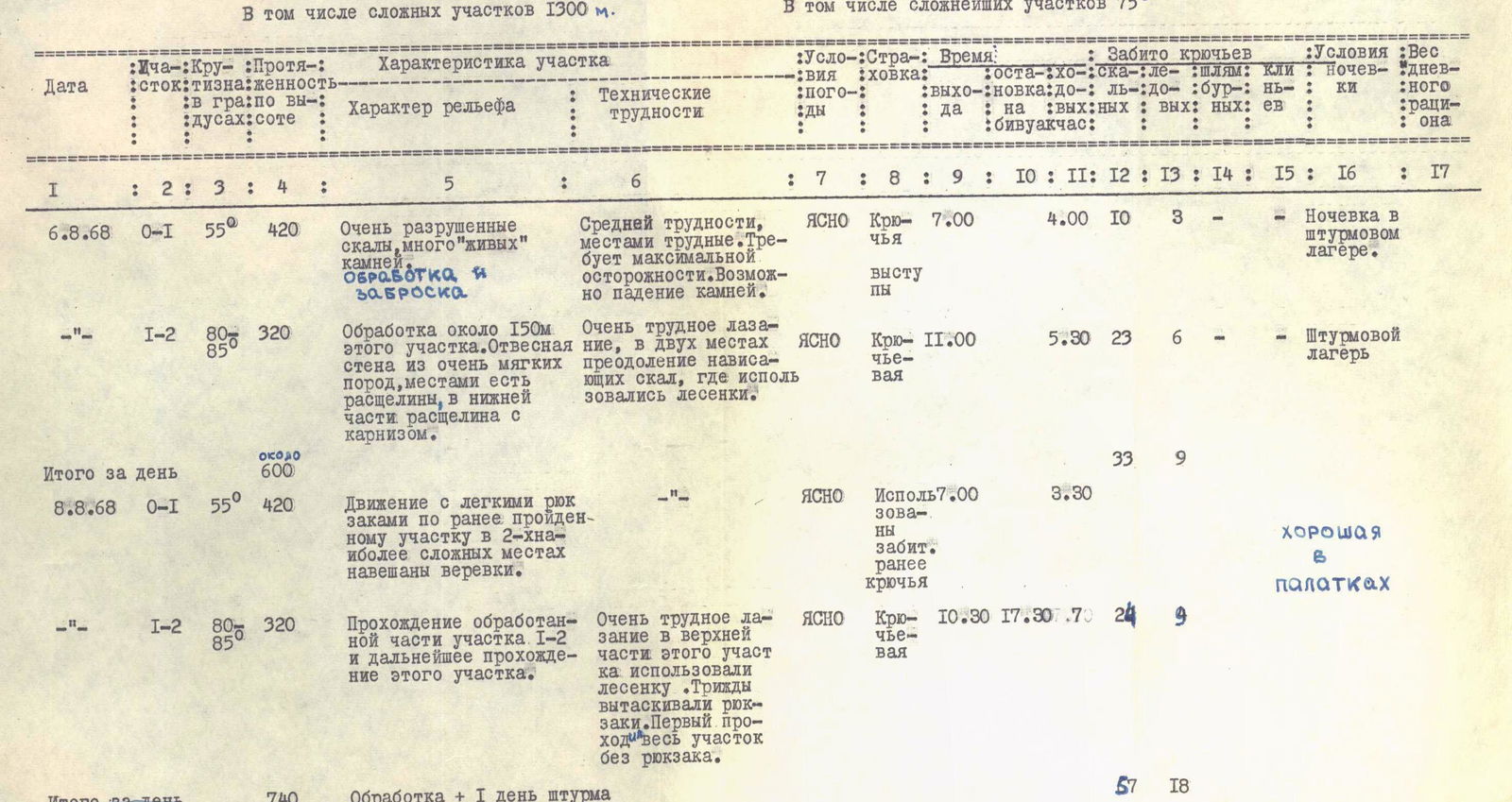
Table
of the main characteristics of the ascent route along the central wall of OGPU. Height difference 1950 m. Including complex sections 1300 m.
Steepness of the route 55–60°. Including the most complex sections 75°.
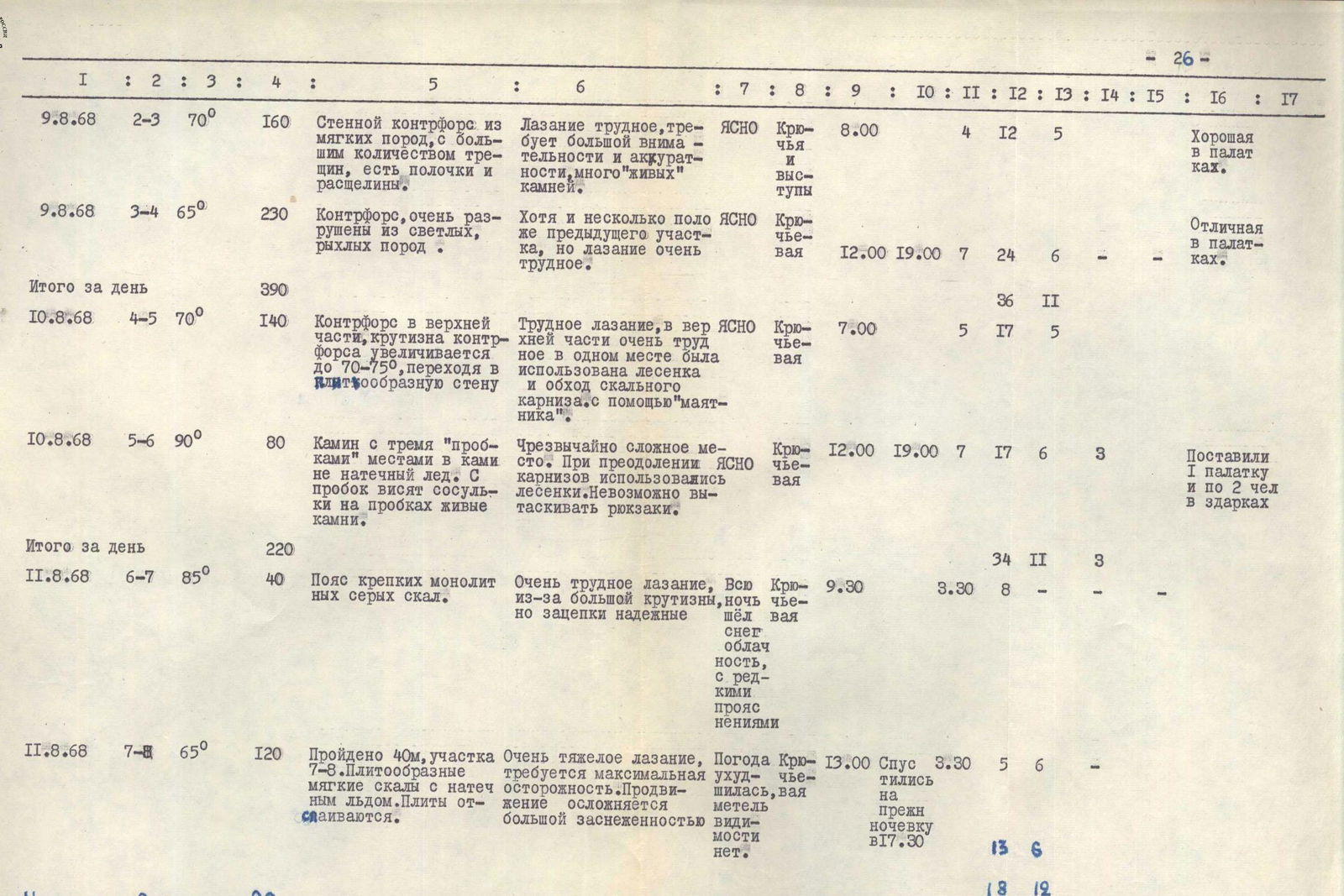
August 10, 1968 4–5 70° 5 80. Chimney with three "plugs", partly with rime ice in the chimney. Icicles hang from the plugs, and live stones are on the plugs.
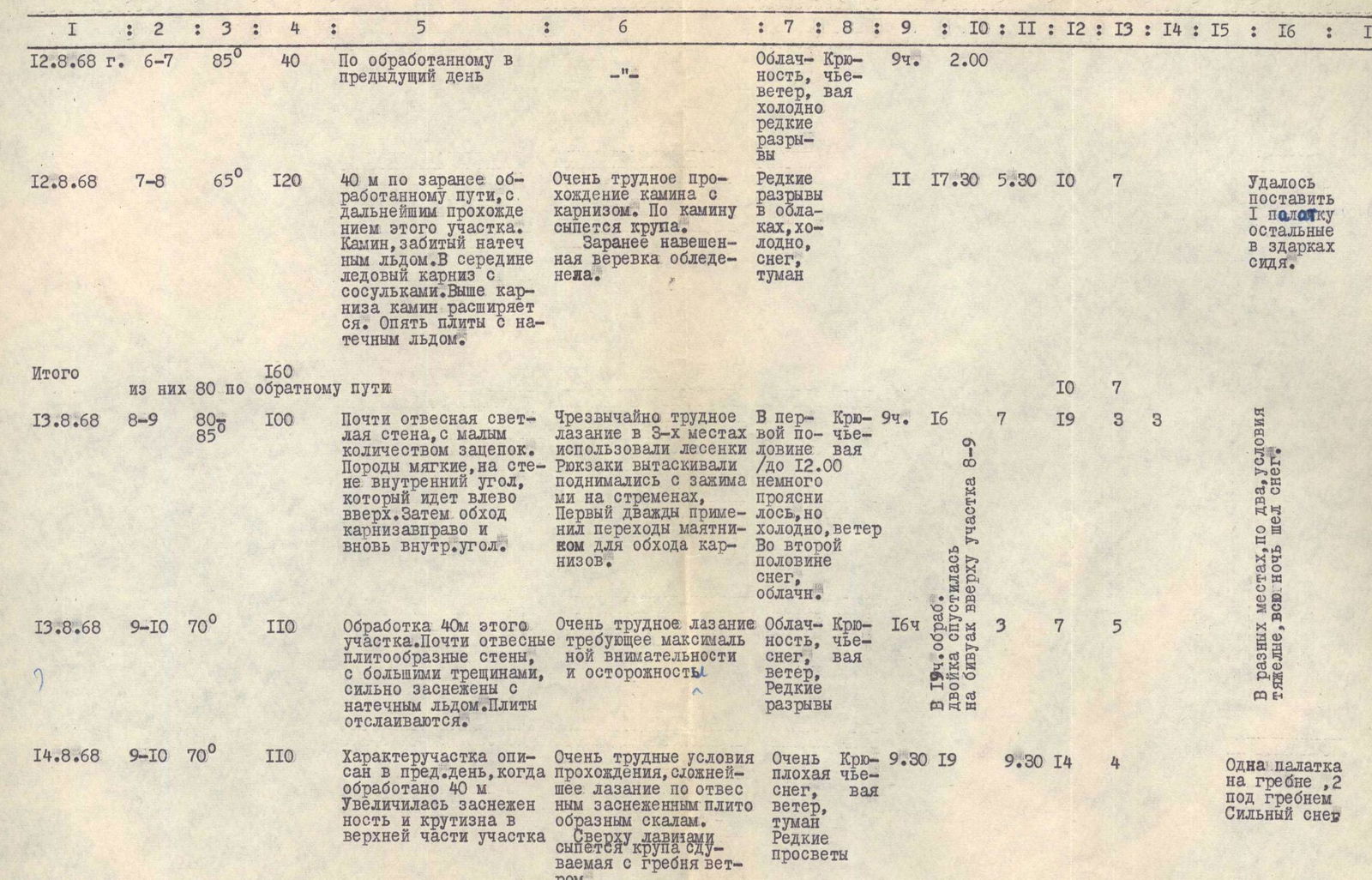
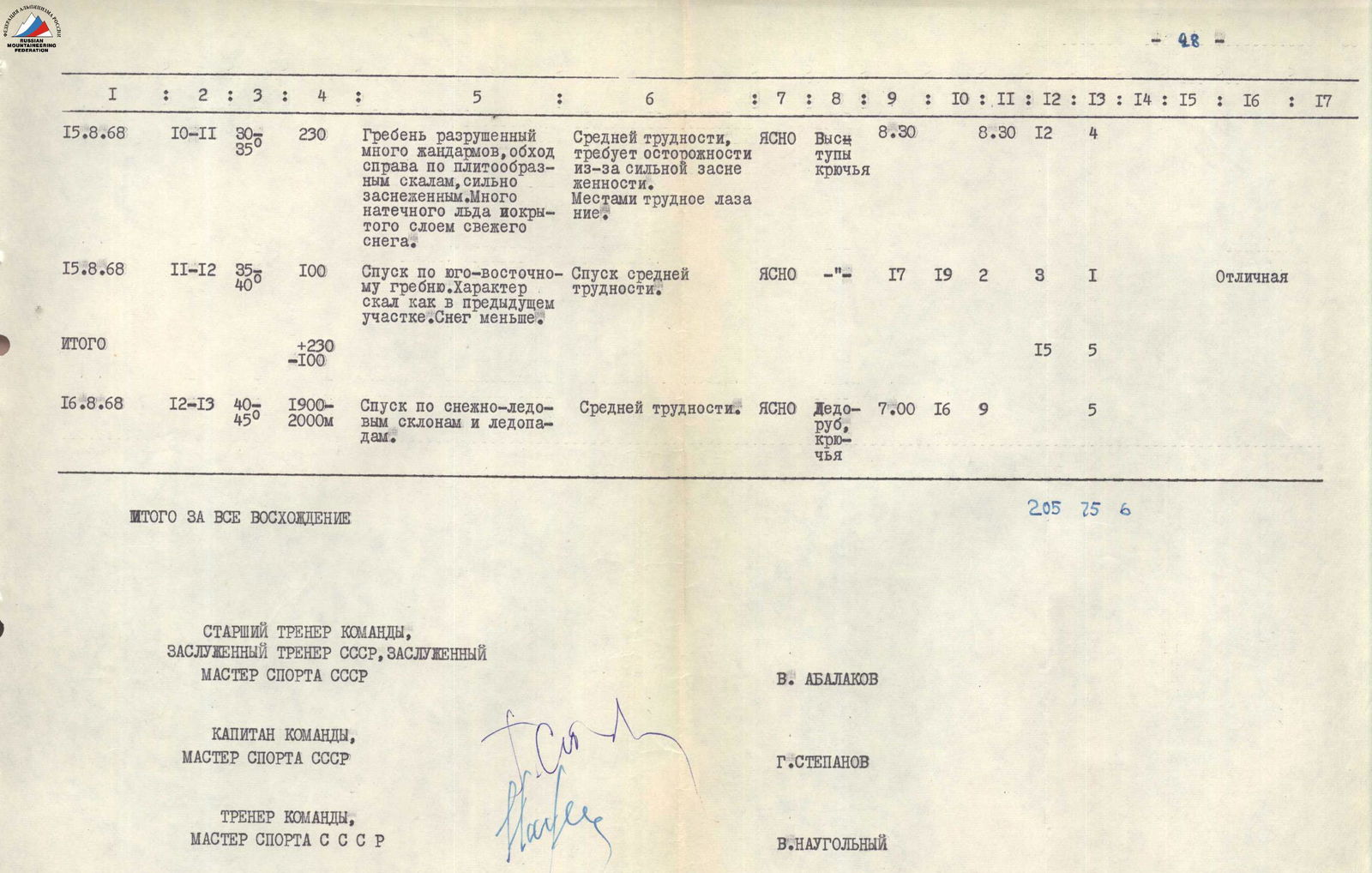
August 15, 1968 11–12 355 100. Descent along the southeast ridge. Character of the rocks — as in the previous section. Less snow.
Total — 230 — 100
August 16, 1968 12–13 405 1900–1900–2000 Descent along snow-ice slopes and icefalls. Moderately difficult. CLEAR ALL DAY 8:30 8:30
12
- 4 blunt hooks
- 17
- 19
- 2
- 3
- 1
Excellent 15 5 7:00
16 9 5 2000 m. Descent along snow-ice slopes and icefalls. 7:00
16 9 5 205 25 6 Moderately difficult. CLEAR
Ice axe, hooks
Total for the entire ascent
Senior team coach, Honored Coach of the USSR, Honored Master of Sports USSR V. Abalakov
Team captain, Master of Sports USSR G. Stepanov
Team coach, Master of Sports USSR V. Naugolny
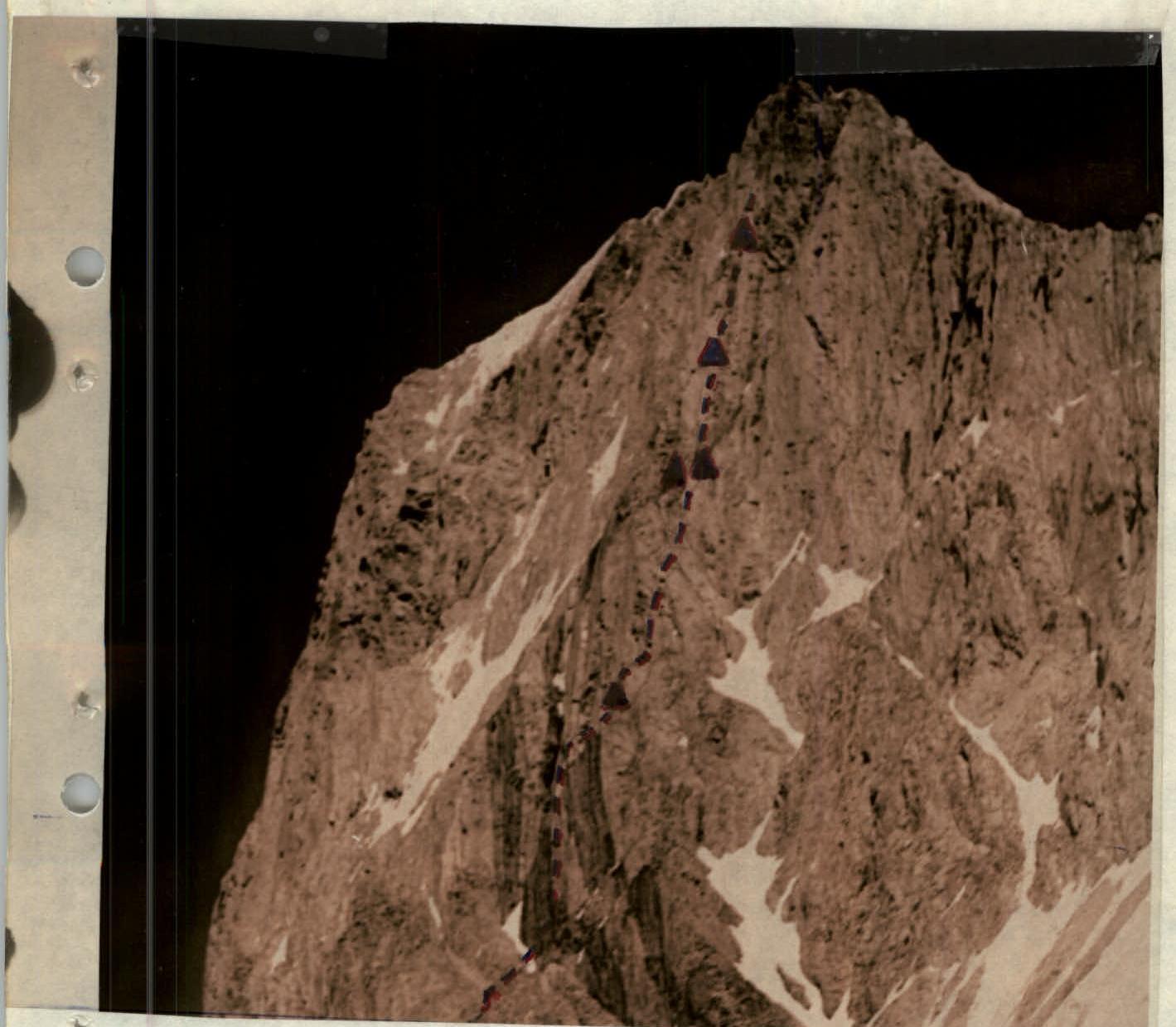
The wall of Peak OGPU, view from the West. The lower part of the wall is obscured by the Western ridge.
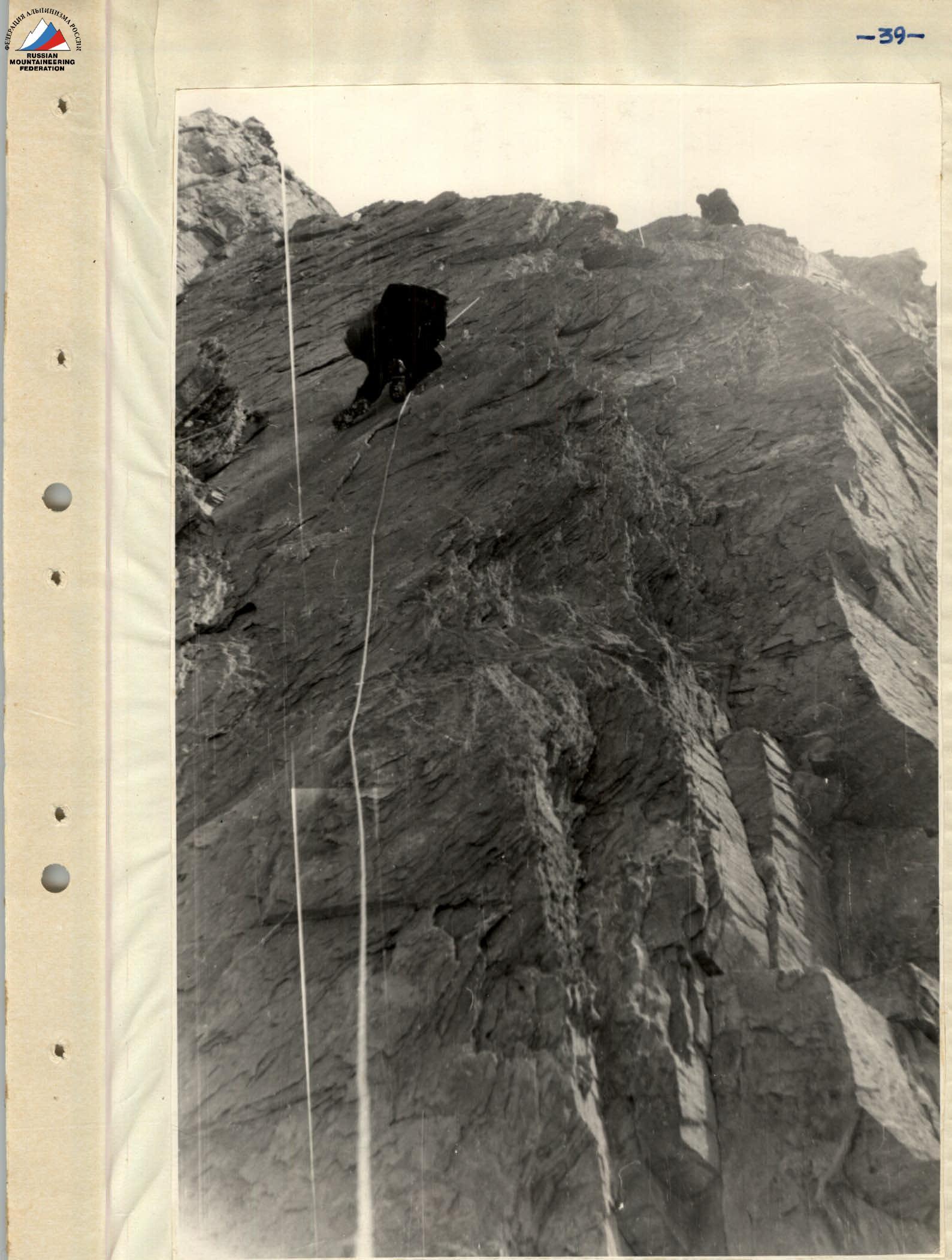
The middle part of section R4–R5