
Class of High-Altitude Technical Ascents.
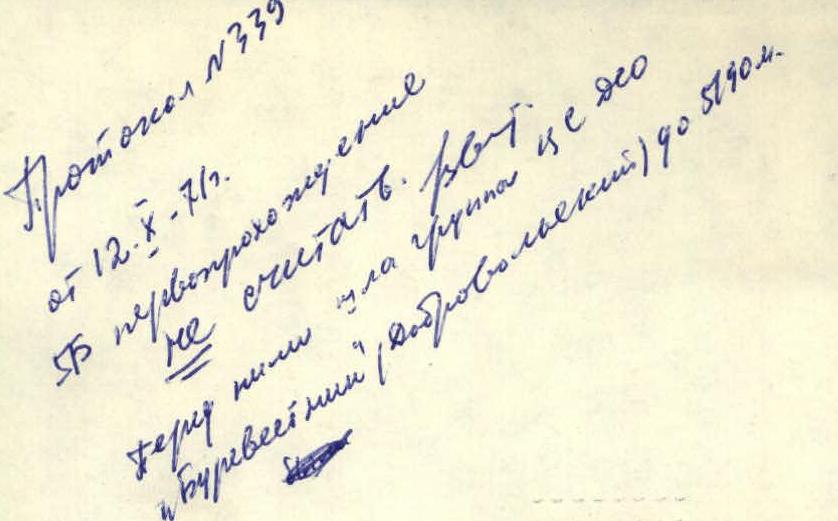
Protocol No. 339 dated 12.8.71 5B first ascent - not considered (revised) 90 5190 m Before him - the path of the group (tse) - and "Burevestnik" (Dobrovolsky's)
REPORT
ON THE ASCENT TO PEAK KOMMUNIZMA FROM VALTER GLACIER VIA PEAK "6701" WITH A CLIMB ALONG THE COUNTERFORT, DECLARED FOR THE USSR CHAMPIONSHIP IN ALPINISM IN THE 1971 SEASON.
Team of the Krasnoyarsk Regional Committee for Physical Culture and Sports under the Regional Executive Committee. July-August 1971.
Team captain
V. Bezzubkin
Krasnoyarsk, 1971
Photo 1. General view of Peak Kommunizma from Valter Glacier and the ascent route Peak
6701°
P
Peak
6701°
P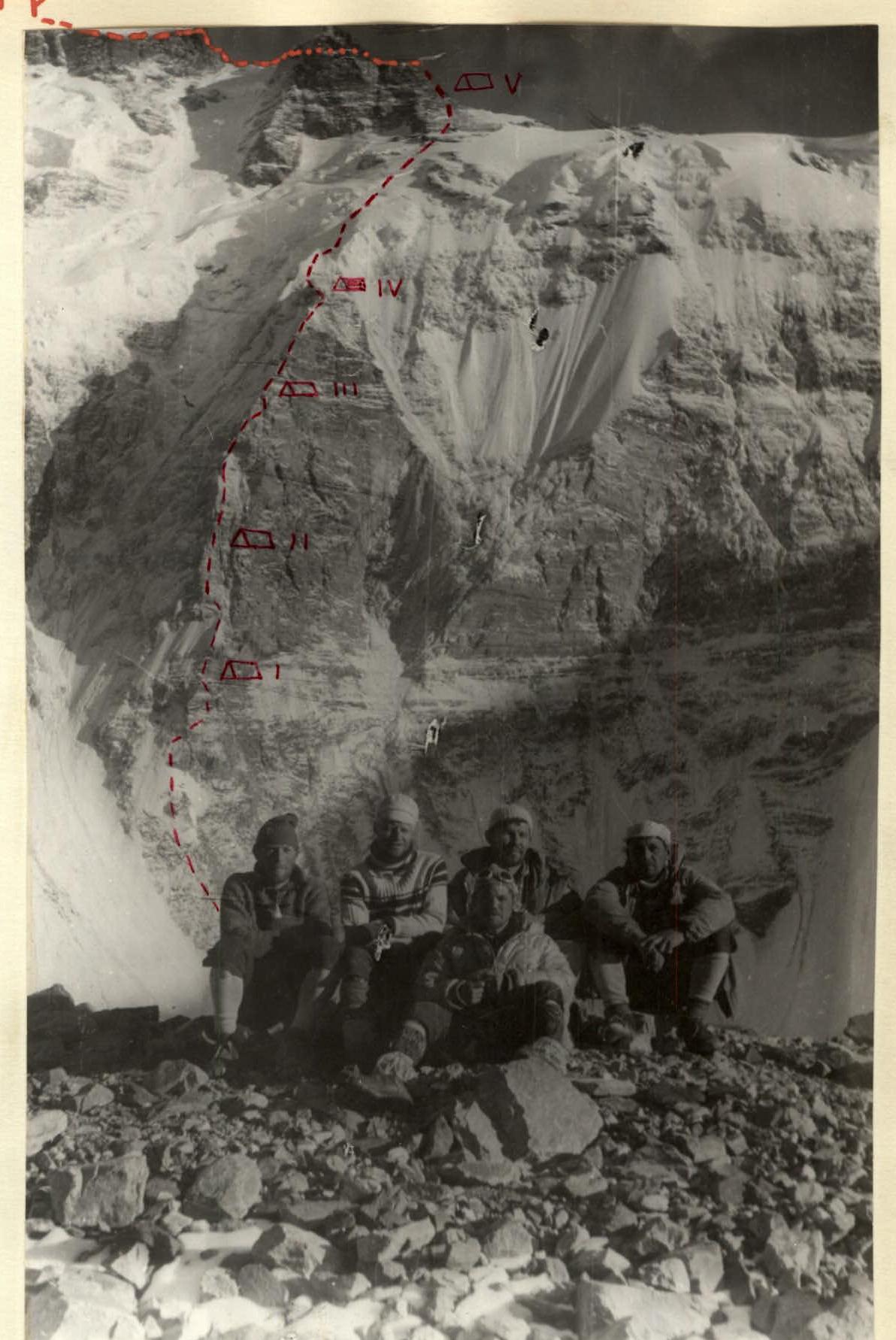
Photo 4. Composition of the assault group (from left to right):
- Yu. Andreev
- V. Bezzubkin
- V. Lyakh
- A. Vstavsky
in the center V. Ushakov and the ascent path along the counterfort.
Description of the Route Passage.
According to the tactical plan, the exit to the route is scheduled for tomorrow, August 12, at 3:00. Today, August 11, is the last day, we are with the hospitable observers, who are taking such care of each of us that it makes us feel uncomfortable about our "lordly" position.
For the last time, we look at the route through binoculars and a spyglass. We double-check our previous observations:
- possible paths for rockfall,
- details of overcoming individual sections of the wall.
Yes! Even from a close distance and with high magnification, the counterfort inspires sad thoughts.
The wall is as clear as day, and there is no need for a special exit. The difficult part may be the crossing over the bergschrund, but the snow-ice bridge should hold up in the conditions of an early exit, followed by an ascent along the ice slope, etc.
In the afternoon, we sort through the products, equipment, and personal belongings again. A list of each backpack is made, which will be kept on the valve: when changing in teams and pulling up backpacks, they will also have to swap backpacks. We double-check the route photographs with the observers, divided by horizontal lines (we will adjust our location according to these horizontal lines).
At 19:00, everything is quiet in our camp.
NOTE:
-
A profile of the route (Fig. 1) is attached to the description of the route passage.
-
Figures 2-6 are attached to the description of each day, showing the sections of the route passed during the day and a cross-section along the path of the assault group (profile of this section of the day).
-
During the ascent, a diary was kept, where the results of the day were recorded: sketches of the path traveled, the nature of the route, the number of meters traveled, the number of hooks driven, weather conditions, exit and stop times for bivouac, and other data.
August 12. 1st day. We rise at 2:30, the observers are already awake, making noise with their stoves, and breakfast is ready. Gathering and breakfast do not take much time. At 3:00, we leave the cozy overnight stay of our base camp at 4100. The night is light and moonlit. We cross the glacier, moving simultaneously along a snowy slope with a steepness of 25-30° (R1) and a length of 320 m, which leads to the bergschrund, clearly outlining the lower part of the ice slope of the counterfort. The snow is dense, and digging steps in it takes a lot of effort, and the first person changes frequently.
On the far left side, along the couloir, ice avalanches and rocks will fall all day, and rocks will fall from above to the right. The route line is safe, but we are in a hurry.
The bergschrund (R2) gapes with a deep crack, partially filled with ice and snow, with a width of 2-2.5 m, but the bridge is reliable. The opposite side of the bergschrund is a vertical 9-10-meter ice wall, turning into an ice slope. To facilitate and make the passage of the bergschrund safer, the first person removes their special backpack. Everyone puts on crampons. We carefully cross the bergschrund.
After 30-40 minutes, the first team, V. Bezzubkin - Yu. Andreev, reaches the ice slope, 120 m long (R3), moving alternately, organizing insurance through ice screws. The slope is steep, sometimes exceeding 60°, but crampons hold well, and moving straight up, we reach the rocks (R4). The rocks are moderately difficult, heavily snowed, and when moving, we have to carefully clear the holds and ledges. The movement is alternate, with hook insurance and through ledges. Further, after 40 m, the complexity and steepness of the rocks increase, and after 15-20 meters, the rocks abut into a twenty-meter chimney (R5). Climbing is complicated by the fact that the rocks in the chimney are covered with rim ice, and the sun is unlikely to be a frequent guest here. Using chimney technique, Valery Bezzubkin, without a backpack, climbs the chimney with difficulty and reaches an excellent ledge, where two or three people can gather. Insurance is hook-based. Yuri Andreev climbs up to him via the organized ropes.
At 8:00, we found the control tur of the group led by L. Dobrovolsky (a note from Yu. Borodkin is given in the appendix). We leave our note and continue moving along the rock wall of moderate difficulty (R6) straight up in the direction of the rock ridge, 20 m long, with a steepness of up to 75°. Hook insurance (photo 6). The ridge is rocks of moderate difficulty, with a steepness of 45-50°, sometimes the ridge turns into walls up to 4 m high, with a steepness of up to 80°. There are three such walls on the ridge. The walls are passed with free climbing. The rocks are destroyed, so we move cautiously. Insurance is through loops thrown over ledges.
The length of the ridge is 240 m, and it abuts into a counter wall, 6 m high, with the last meter overhanging (R8). The wall is passed with climbing, insurance is hook-based, and the rocks are strong. After passing the wall, we reach a site suitable for an overnight stay, but it's too early to stop. It's only 13:00, we all gather on the site, have a 15-minute snack, and continue on our way.
Ahead of us is an ice ridge (R9), 30 m long, with a steepness of up to 65°, which abuts into a sheer wall of "red" rocks (R10) - the wall's steepness is 85-90°, and its height is 20 m. We pass the ice ridge with step-cutting, in crampons, insurance through ice screws, and to ensure safety, three ice screws are driven for 30 m. The wall is passed with free climbing, and only at the exit are ladders hung because it overhangs. The rocks are covered with rim ice and are very fragile, so Valery climbs very carefully. Cracks are filled with ice, and the only reliable hooks here seem to be ice screws and channel hooks that sit deep in the cracks. Passing this short section requires both technical skill and great caution. The last 5-6 meters are particularly challenging. Further, the wall eases to 75°, but this does not bring relief (R11), as it is covered with solid ice up to 10 cm thick. This section is essentially the beginning of the middle section of the counterfort, if not counting the rocks up to the rock ridge and the rock ridge itself, whose steepness is insignificant. уступая последнему по общей крутизне, R11 is the first section of the counterfort that is exposed to water, snow, and rocks falling from above. Often, the pick of the ice axe pierces the ice cover, getting stuck in it, and if the ice breaks off, often along with rocks, fragile rocks are revealed. Movement is further complicated by a layer of snow on the ice. The first meters are particularly challenging, with difficult climbing involving ice axe work, on a double rope, with careful insurance, and with great difficulty finding and clearing rare holds from ice and frozen snow, Valery passes 30 m, and another 6-10 m of difficult climbing - and he can stand on a sloping ledge, where he organizes reliable insurance and self-insurance. Sitting in a "harness" because standing on a sloping ledge is uncomfortable, he begins to let out Yuri ahead. Further up to the right, the path is no easier, but more pleasant, as it consists of sloping slabs; the rope goes confidently (R12). Rock screws for insurance are well-placed, the rocks are clean of ice with a small amount of snow, and there are enough cracks - of any kind. Ropes are fixed because, starting from R10, backpacks are pulled up (photo 7).
Up to the right, a 30-meter wall (R13) goes up, turning into a wide (1.5-2 m) ice-filled 10-meter chimney (R14) with live frozen stones in the upper part.
The wall is passed with free climbing, and when passing the chimney, ladders are sometimes used.
Insurance is hook-based.
Fatigue is felt, and it's time to settle in for the night, but there is still no place for a bivouac. Of course, a sitting bivouac can be organized, but this is not a solution on a high-altitude technical ascent.
Cross-section along the path of the group
SECTIONS FROM R16 TO R20, PASSED ON THE 2ND DAY OF THE ASCENT (AUGUST 13, 1971).
Figure 3. Positions. Somewhere ahead should be our planned overnight stay. 17:00. We gathered at the base of the chimney. Volodya Ushakov very skillfully, with free climbing, and using ladders at the exit, passes the chimney. Insurance is hook-based. After passing the chimney, Volodya announces: a narrow ledge, a semi-sitting overnight stay can be organized; further to the left - a sloping ledge (R15).
After passing the sloping ledge, Volodya secures the rope, and we carefully pass along the rope, with backpacks, through the chimney and along the sloping ledge, the length of the rope is about 20 m. The ledge ends with a small natural site, located between a rock wall on one side and a rock ridge on the other (photo 8). Very convenient. As later выяснилось from radio conversations with the observation group, this is the 1st planned overnight stay. We drive 4 rock screws to organize insurance. We quickly level and build up our site, which doesn't take much time. The site is ready, the tent is set up, and we settle in. It's already late - 22:00. We prepare dinner and summarize the day:
- In 18 hours of continuous work, we covered a distance of 986 m.
- The speed of movement this day is equal to 55 m/h. We have dinner at 24:00 - lights out.
August 13. 2nd day. 9:00. We prepare breakfast. The weather is not on our side: wind, fog, cold.
At 10:00, we contact the observation group. The guys are worried: what's going on, why did we start the night so late and haven't yet set out on the route?
Observers transmit news: "The Tajiks have started the assault on Peak E. Korzhenevskaya".
Observers saw us perfectly the previous day and reported that we are moving exactly along the route, and our overnight stay is at the planned location.
At 10:30, the team led by A. Vstavsky - V. Ushakov moves forward. Anatoly is in excellent shape, he climbs a 5-meter wall (R16) with climbing, insurance is hook-based, the rocks are moderately difficult, then he reaches a rock ledge (R17) covered with snow and ice. The length of the ledge is 20 m, at an angle of 45° from left to right, it leads under the wall (R18). After passing the ledge, Anatoly secures the rope at the base of the wall, and ropes are organized. The team Yu. Andreev - V. Lyakh passes along the ropes. The section is complex, with a small number of holds. At first, there is a small traverse to the right - 6 m to a semblance of an inner corner, and then it is possible to climb up 10 m with very difficult climbing. Further up, having overcome a 5-meter section of rocks with the help of ladders, Yuri climbs up to a narrow ledge, where he can rest. There are almost no cracks visible in the next few meters, but Yuri manages to drive in another hook. Then he begins a seemingly chaotic movement along the wall in search of a possible path. First up along very small holds, then a short traverse to the right and up again, and so on. 40 m of the wall with a steepness of 75° are passed. Backpacks are pulled up. Insurance is hook-based.
Further, the wall (R19) "eases" to 60°, but movement becomes more complicated. The rocks are covered with ice. It takes a lot of time to clear the rocks of ice. The rocks crumble, the rock is fragile. Insurance is with hooks, but unreliable. This section is first passed by V. Lyakh. On this section, 2-meter walls are encountered.
Slava passes the section cleanly. It's pleasant to watch him work. Another 40 m are passed (photo 9).
Valery moves forward. Further, the steepness of the wall increases to 85-90°, but the rocks are clean of ice, only dusted with snow. Climbing is very difficult, there are few cracks, and there are overhanging sections - ladders come into play. Having passed 40 m on a double rope, Valery reaches a ledge, and ropes are secured. Yuri follows. Yes! Here you can rest. Everyone gathers here and pulls up the backpacks. Last to climb is Volodya Ushakov. His task today is to remove the hooks (R20).
And again, Valery moves forward, and the next meters are passed in a similar manner (climbing and, in places where the rocks overhang, on ladders). Valery reaches an excellent site, cluttered with two large stones. The site is located under a wall, and the place is convenient for a bivouac. Hooks are driven in to organize ropes and insurance. While everyone else reaches the site. Valery prepared the site for the tent, and we reached the planned overnight stay. It's snowing, but the mood is good - we're at our goal. Backpacks are pulled up. Everyone is on the site, working on its improvement. After laying out and cutting ice, an excellent two-level site is created. The tent is set up. The time is 19:30. The stove is humming cozily, and we rest. The snow has stopped, and it's getting colder.
We summarize the day:
- In 6 hours of continuous work, we covered 185 m.
- The speed of movement this day is equal to 30 m/h. Satisfied with the results, we discuss the route for the next day.
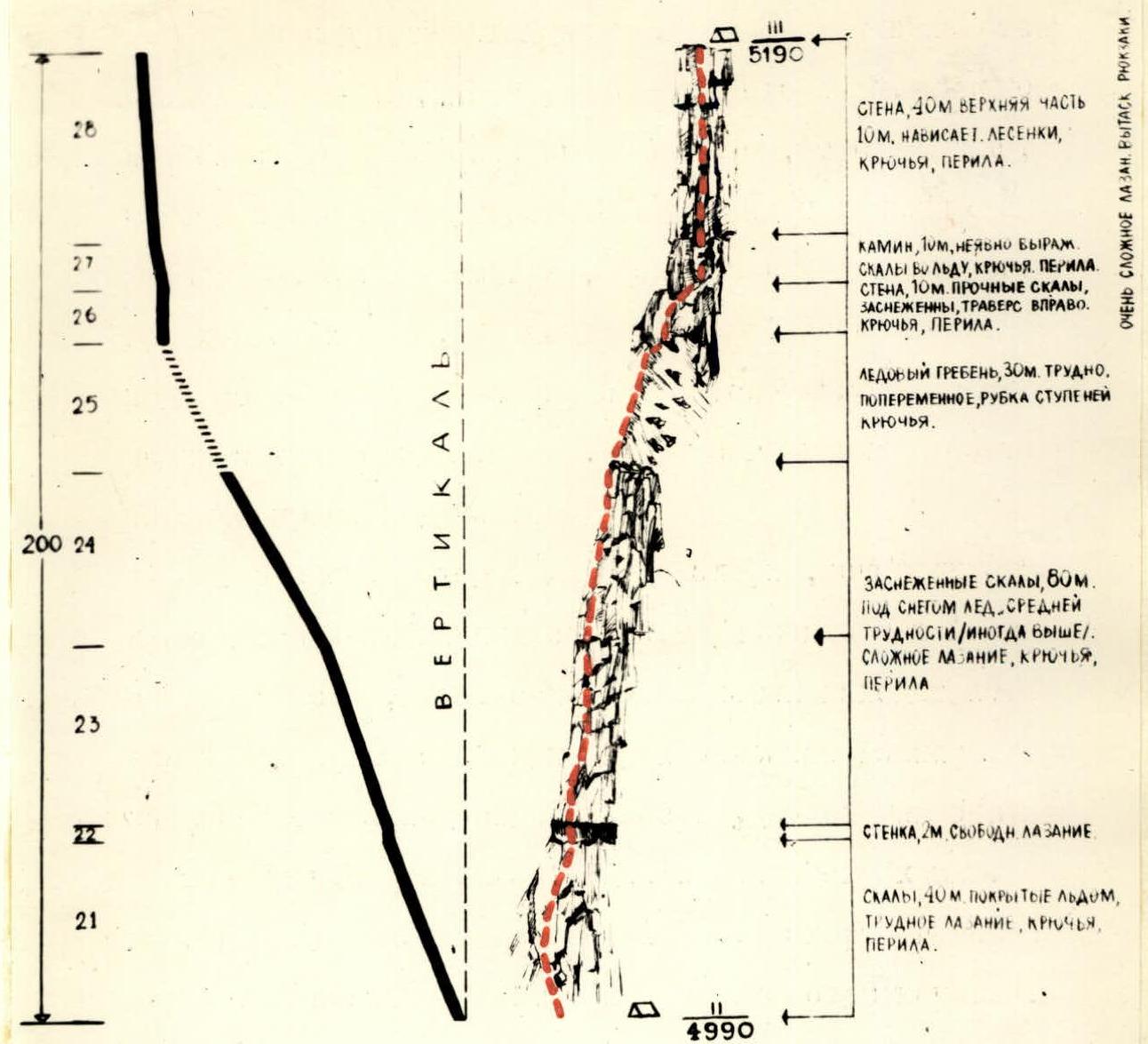
Cross-section along the path of the group
SECTIONS FROM R21 TO R28, PASSED ON THE 3RD DAY OF THE ASCENT (AUGUST 14, 1971).
- 21:00 - we sleep.
- August 14 - 3rd day.
- 8:00 - the weather is deteriorating. Strong wind, poor visibility. Fog.
- Until 10:00 - we wait for the weather to improve.
- The wind has subsided somewhat.
- We prepare to move out after talking with the observation group.
- A control tur is left on the site.
Above the overnight stay, the path goes to the left, bypassing the wall along a section that is, in fact, the same wall but with less steepness. While Yuri passes this (R21) section, we dismantle the bivouac. Insurance is hook-based. The steepness is about 70°. Again, ropes are used because we decided not to pull up the backpacks here (photo 10). It's hard, but tolerable. We reach a ledge. Then a wall 1.5-2 m high (R22) is overcome, and the path is well visible: snow-covered rocks, possibly ice, and an ice ridge that abuts into a rock wall.
The photographs are not very good. The constant complexity of the path and the impossibility of deviating a few meters to the side do not allow us to capture the section of the route to show its true complexity. Sometimes our photographer, Volodya, takes a good shot, but it takes a lot of effort and time.
Up to the ice ridge, Valery moves forward. The rocks are difficult under the snow - ice. The first 40 m of the rocks (R23) have a steepness of 70°, then the steepness of the wall (R24) decreases to 60°. Climbing is difficult, but Anatoly moves confidently and freely. Hooks are driven, and ropes are organized, and everyone approaches the ice ridge (R25) with upper insurance.
The ice ridge is steep, so steps are cut. Insurance is through ice screws. Another 30 m are passed, and we all gather under the wall. Further, we need to traverse along the wall (R26) to the right, and Yuri moves forward. The traverse is difficult, 90 m long, and then an ascent of 10 m up a chimney (R27), with rocks covered in ice. Yuri moves in crampons. It's clear how hard these meters of traverse and ascent are for him. Insurance is hook-based. The ice axe is constantly in use: ice is chipped off, a crack is searched for, a hook is driven, and so on, step by step. But everything comes to an end. And here he reaches the col. The rope is secured. Valery follows along the ropes with a backpack (photo 11). It's very difficult, he is thrown off during the traverse, so the rest go without backpacks. Everyone is on the col.
Before us is a 40-meter section of the wall (R28), with a steepness of up to 90°, and the upper part overhangs; to the right, a good ledge is visible - we saw it through binoculars, and this is where the next overnight stay was planned. The ledge, by the way, is already at 16:00, it's time to stop for a bivouac. Yuri passes the section with difficult climbing and hook insurance, the last 10 m overhang, and ladders are used. Yuri reaches the ledge. The rest climb up along the ropes. Backpacks are pulled up, and we prepare the site for the tent. The backpacks are pulled up, and the site is ready. We set up the tent and prepare dinner. The time is 21:00.
We summarize the day:
-
In 9 hours of continuous work, we covered 212 m.
-
The speed of movement this day is equal to 24 m/h.
We're moving exactly according to plan, despite the fact that the weather is not on our side. The altitude is not felt at all. Everything is fine. 22:00 - we sleep.
August 15. 4th day.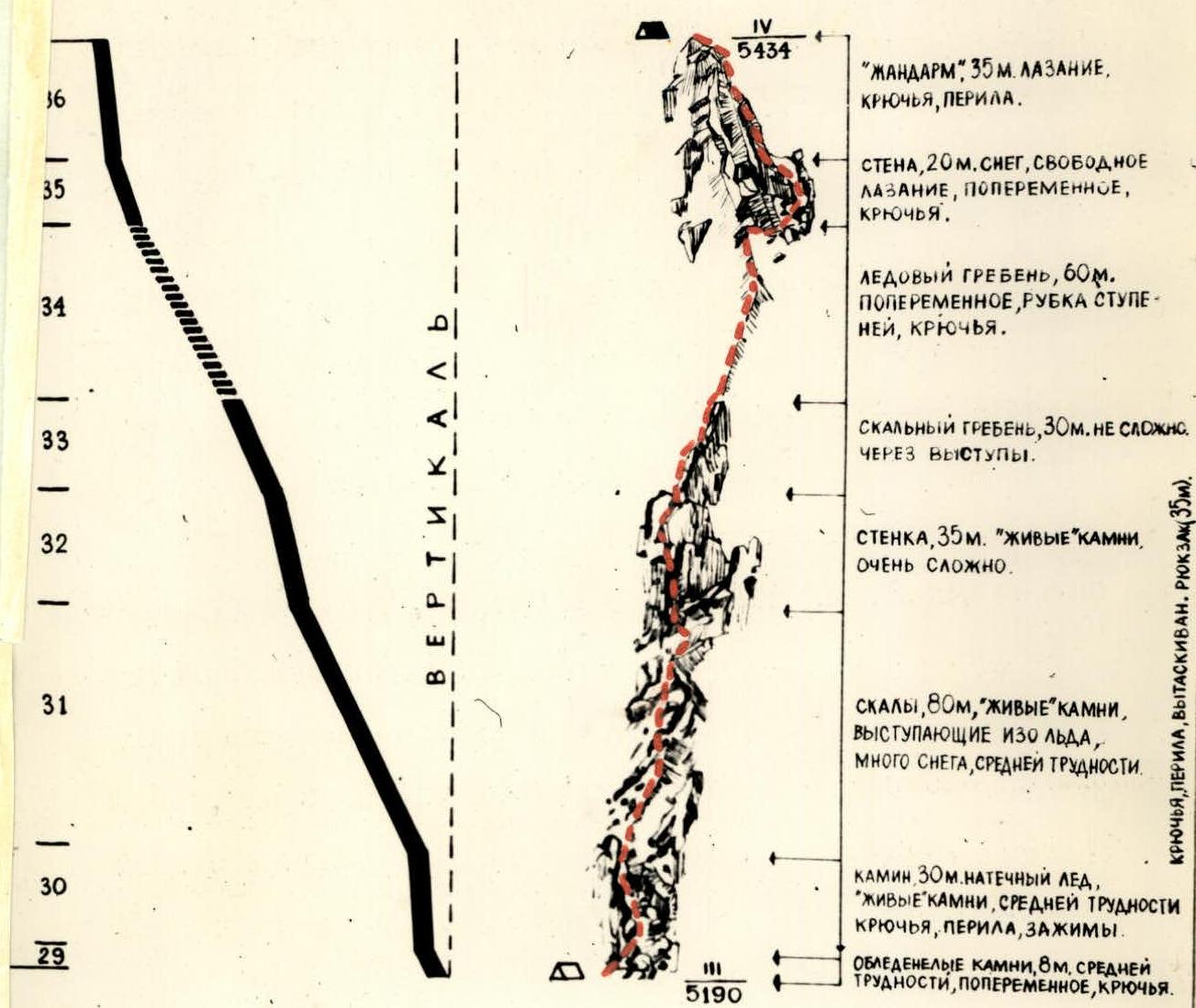
Cross-section along the path of the group
SECTIONS FROM R29 TO R36, PASSED ON THE 4TH DAY OF THE ASCENT (AUGUST 15, 1971).
7:00. The weather remains unchanged, despite the frosty night. We rested well. We quickly gather our bivouac. 8:00. The first pair, V. Bezzubkin - Yu. Andreev, is ready to move out. Yuri begins to move up to the right along icy rocks (R29), after 5 m he disappears into a chimney (R30). The sound of metal is heard - hooks are being driven. After 25-30 m, he emerges onto a ledge. Then Valery moves forward. 80 m of rocks (R31), with a steepness of 65° (photo 12), lead to the right onto a col of the ridge. The rocks are complex, with a section of ice, insurance is through hooks. Valery reaches the col and accepts Yuri. Everyone moves along the ropes with upper insurance, using clamps. There are many loose rocks, so we move cautiously. Despite the complexity of the route, we move confidently, and fatigue is not felt. Everything is normal. Valery moves slowly and confidently. The rocks are heavily destroyed but held together by ice. It's cold.
The col abuts into a sheer wall (R32), made of fragile material. The rock is loose. Valery climbs 20 m of the sheer wall, driving in ice screws; rock screws are not suitable. After 20 m, the steepness of the wall eases to 75°. There are many loose blocks. Another 15 m of difficult climbing, and Valery reaches a sharp rock ridge (R33), where he organizes the reception of all other participants. Yes! Even on ropes without backpacks, it's difficult to climb this section of the route (photo 13). Finally, the backpacks are pulled up, and we're all on the ridge. Great. Valery is already processing the further path. Next is a sharp ice ridge (R34), 60 m long, with a steepness of 60-65°. Usual ice work with step-cutting. Everyone moves in crampons. Insurance is through ice screws. The ice ridge leads us to a 20-meter wall with a steepness of 75° (R35), which is passed with free climbing. Insurance is hook-based (photo 14). The wall precedes a "gendarme" (R36). The rocks are slab-like, with an outer corner and an overhanging stone (5 m), a vertical sheer wall with smoothed holds, 10 m long - all this is covered in ice. We overcome the "gendarme" with free climbing and hook insurance. Ropes are secured, and everyone, using clamps, reaches the top of the "gendarme". Last to climb is A. Vstavsky, who is removing hooks today. We descend from the top of the "gendarme" and reach an excellent ledge, where we can organize a bivouac, which is very timely. The ledge, 5-6 m long and 50-70 cm wide, is an excellent site. Having cleaned it a bit from snow and set up the tent, driving in 6 rock screws for insurance and self-insurance, we rest. We prepare dinner.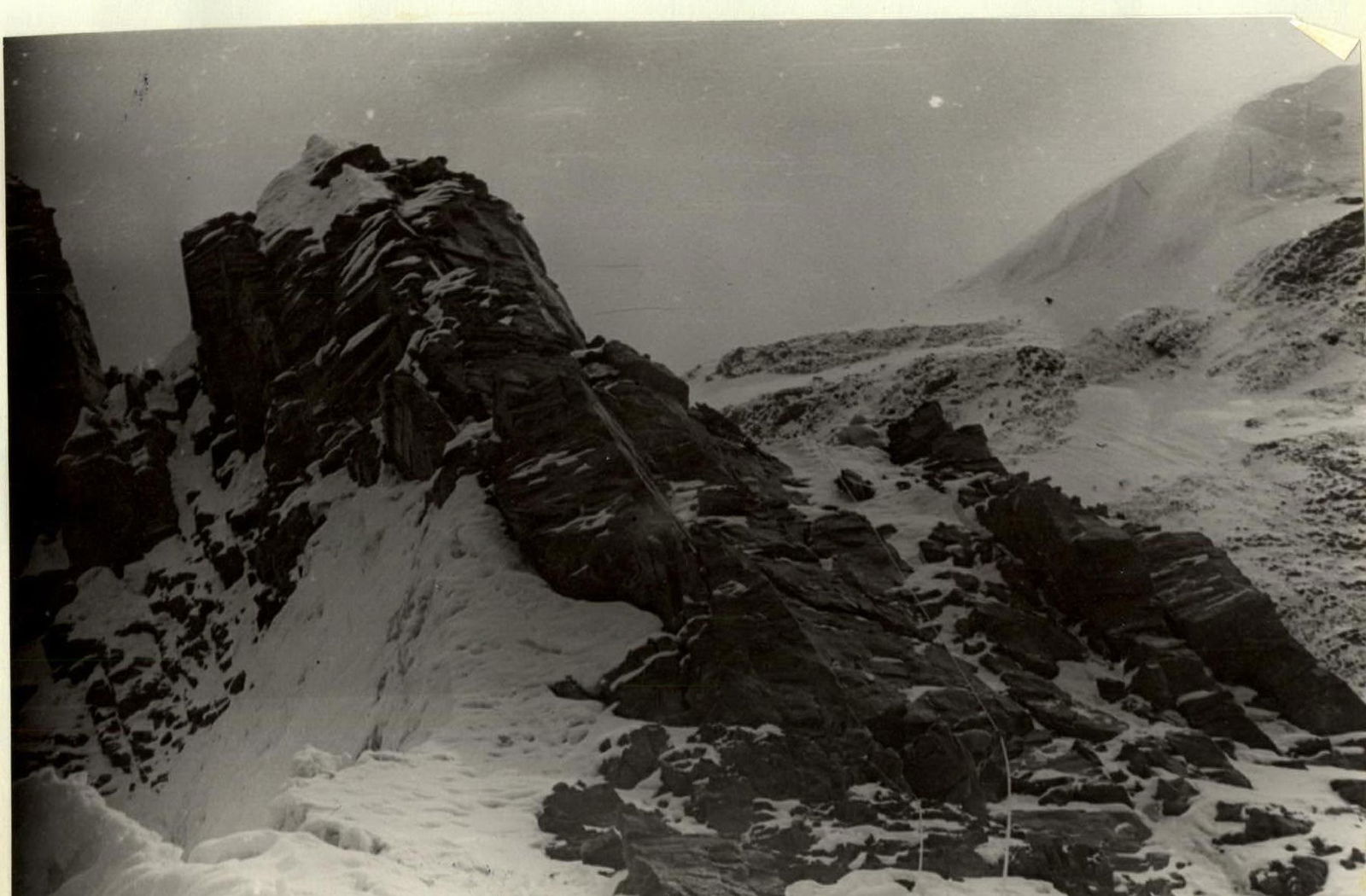
Photo 14. "Gendarme" (R35-R36).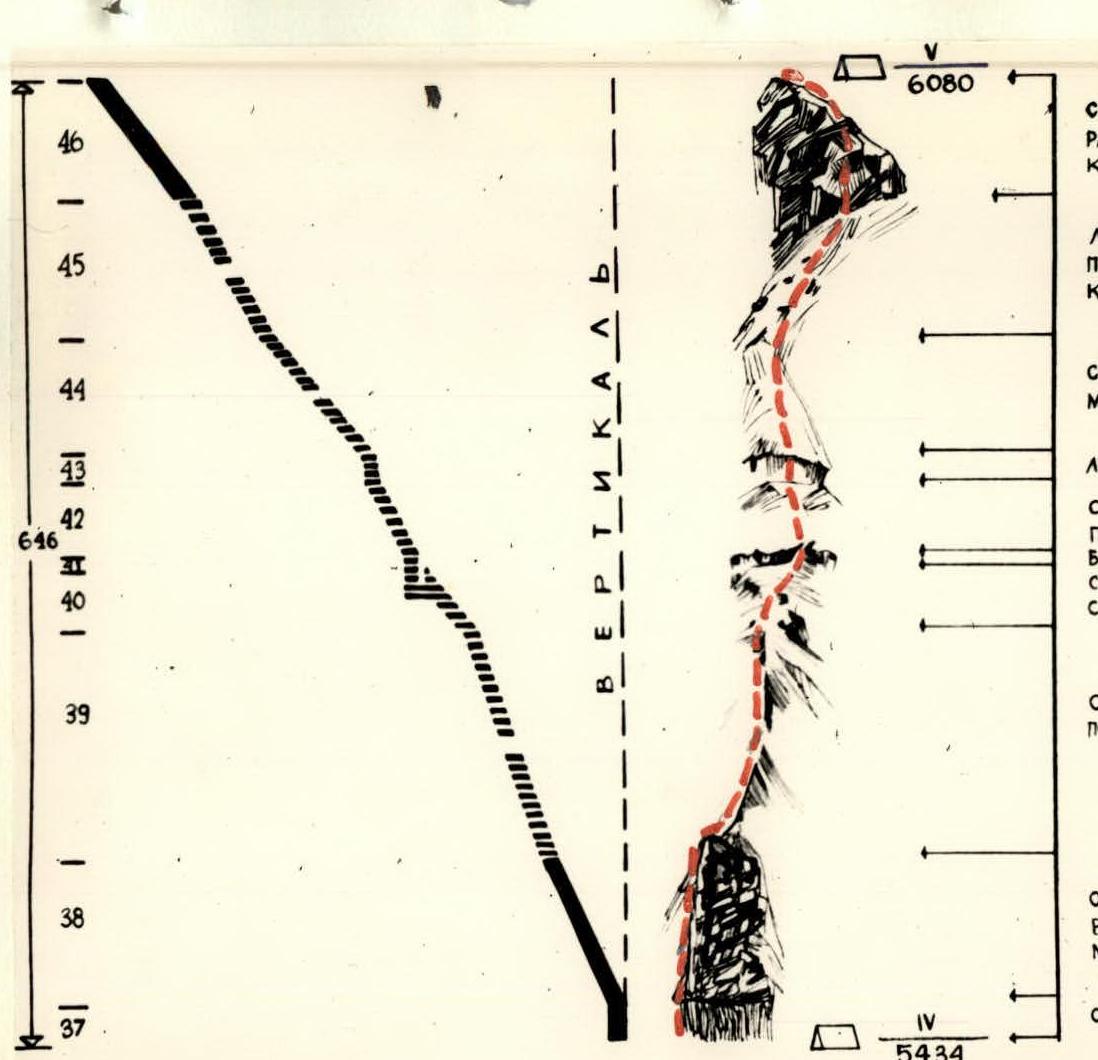
Cross-section along the path of the group
SECTIONS FROM R37 TO R46, PASSED ON THE 5TH DAY OF THE ASCENT (AUGUST 16, 1971).
ROCKS, 80 M. LEAD TO THE RIDGE OF PEAK "6701", ROCKS ARE HEAVILY DESTROYED, IN SNOW. FREE CLIMBING, COMPLEX. HOOKS, ROPES.
ICE SLOPE, 120 M. THIN LAYER OF SNOW. COMPLEX. ALTERNATE. FRONT "TEETH". STEP-CUTTING. HOOKS, ROPES.
SNOW SLOPE, 240 M. SNOW IS DENSE. NOT COMPLEX. ALTERNATE. STEPS, THROUGH ICE AXE.
ICE LEDGE, 15 M. COMPLEX. FRONT "TEETH". HOOKS, ROPES.
SNOW SLOPE, 40 M. SNOW IS LOOSE. DIFFICULT. ALTERNATE. ROPES.
BERGSCHRUND. OVERCOME ALONG A SNOW BRIDGE.
SNOW SLOPE, 40 M. SNOW IS DENSE. NOT COMPLEX. SIMULTANEOUS. STEPS IN SNOW. THROUGH ICE AXE.
SNOW-ICE RIDGE (SLOPE), 120 M. VERY DIFFICULT. ALTERNATE. CRAMPONS. STEP-CUTTING, HOOKS, ROPES.
SHARP RIDGE, 80 M. INITIALLY ROCKY, THEN SNOW-ICE. CORNICES ON BOTH SIDES. DIFFICULT. ALTERNATE. CRAMPONS. STEP-CUTTING, HOOKS.
WALL, 20 M. UPPER PART OVERHANGS. COMPLEX. HOOKS. BACKPACKS PULLED UP.
We summarize the day:
-
Despite unfavorable weather, we're moving forward, and tomorrow we should reach the ridge of Peak "6701".
-
In 10 hours of hard work, we covered 298 m.
-
The speed of movement this day is equal to 30 m/h. 22:00 - we sleep.
August 16. 5th day. 7:00. Clear sky, calm, possibly the weather has changed its attitude towards us. Well, let's hope for the best.
From the overnight stay (photo 15) (yes, we should say that when analyzing the overnight stays back on Valter Glacier, we thought we wouldn't have the strength to reach the ridge that day because the work, as we saw during the passage of this section of the path, would be very much and very hard. But apparently, the joy of the upcoming meeting with the guys and the wild desire to reach the ridge was so great that all this together excited and gave us the strength to reach the ridge).
8 m down to a ledge and up 20 m along a wall with a steepness of 85-90° (R37) (photo 16), we reach the ridge (R38). Insurance is through hooks. Valery is ahead. Backpacks are pulled up. The ridge is initially rocky, then icy. Its steepness reaches 65°, with snow-ice cornices to the right and left. The length of the ridge is 80 m. We move in crampons with step-cutting; the ridge turns into a snow-ice slope, with a steepness of 70° and a length of 120 m (R39) (photo 17). Passing the ridge and the ice slope takes a lot of effort and time. Insurance is through ice screws. Valery is replaced by Slava Lyakh. Slava, after passing the slope, reaches the top, and we all climb up to him via the ropes. Then we descend 10 m and are in a hollow. After a snack, because today we'll have to work a lot, we climb up a snowy slope (R40) to the bergschrund (photo 18). The snow on the slope is dense, steps are well-formed, insurance is through an ice axe. The length of the slope is 40 m, with a steepness of 45°. The bergschrund (R41) is filled with snow. After the bergschrund, there's a snowy slope (R42), 40 m long, with a steepness of up to 60°. The snow is loose, intermediate insurance cannot be organized, so Valery moves out to the full length of the rope. The slope abuts into an ice ledge (R43), which cannot be avoided; we overcome it head-on. The height of the ice ledge is 10-15 m, with a steepness of 75-80°. Insurance is through ice screws. After passing the ice ledge, we again reach a snowy slope (R44). The snow is dense, insurance is through an ice axe, movement is in three steps, the length of the snowy slope is 240 m, with a steepness of 45-50°.
The weather has let us down again, it's snowing with wind. It's cool. After the snowy slope, the path goes along an ice slope (R45), 120 m long, with a steepness of 60°, covered with a thin layer of snow. And again, the ice axe comes into play: step-cutting, driving in ice screws. Yes! The counterfort has surprises in store for us on its final meters. True, we expected all this, but we didn't think we'd encounter so much ice at such a height and thought there would be snow. But now we've passed the ice slope, and we're all gathered at the foot of the ridge of Peak "6701". It's already 17:30. There's still daylight, and despite fatigue, we begin to move along the ropes secured by Yuri Andreev. Yuri passes a section of rocks on the ridge of Peak "6701" (R46). The rocks are destroyed. Insurance is hook-based. To the right, a plateau is visible, and it's already below us. Hurray! Having passed another 40 m of rocks, we reached the western ridge of Peak "6701". Right below us is the plateau, and on it, we can see the tents of our guys - the meeting group. There's no end to our joy. The difficulties are behind us, and ahead is the known path of the group led by Yu. Borodkin, who passed it back in 1968. Despite the late hour and cold, everyone is excited, especially since the guys from the meeting group are climbing up to us. We set up a tent and start preparing dinner. Soon the guys arrive. There's no end to the hugs and congratulations. We're overjoyed, even tearful. Until 24:00, we talk with the guys, and then, having agreed on a meeting at the summit of Peak Kommunizma, they head down to their tents. Tomorrow we'll move along the ridge through Peak "6701", and they'll go through the "shoulder" of "6950" to our final goal. 1:00. August 17 - we sleep.
NOTE:
NOTE:
We made this overnight stay above the planned one because we thought that on the ridge, the bivouac would be more convenient than planned - under the ridge. When analyzing the overnight stays back on Valter Glacier, we thought we simply wouldn't have the strength to reach the ridge that day because the work, as we saw during the passage of this section of the path, would be very much and very hard. But apparently, the joy of the upcoming meeting with the guys and the wild desire to reach the ridge was so great that all this together excited and gave us the strength to reach the ridge.
Results of the day:
-
In 14 hours of continuous hard work, we covered 757 m.
-
The speed of movement this day is equal to 58 m/h.
August 17. 6th day.
10:00. Today we allowed ourselves to sleep in because we need to restore our strength. The weather remains unchanged - strong wind, drifting snow. After a session with the observation group on Valter Glacier, we leisurely prepare for the exit. The observation group is told that we have met the meeting group and that they can return to camp 4000 (Suloev clearing). The meeting group has already set out towards the slopes of the "shoulder" of 6950 Peak Kommunizma. We rest a bit more.
At 11:30, we begin to move. The western ridge (R47) is rocks of moderate difficulty, snow-covered. When moving, we have to:
- carefully clear the holds
- carefully clear the ledges
Movement is alternate, sometimes simultaneous, insurance is hook-based.
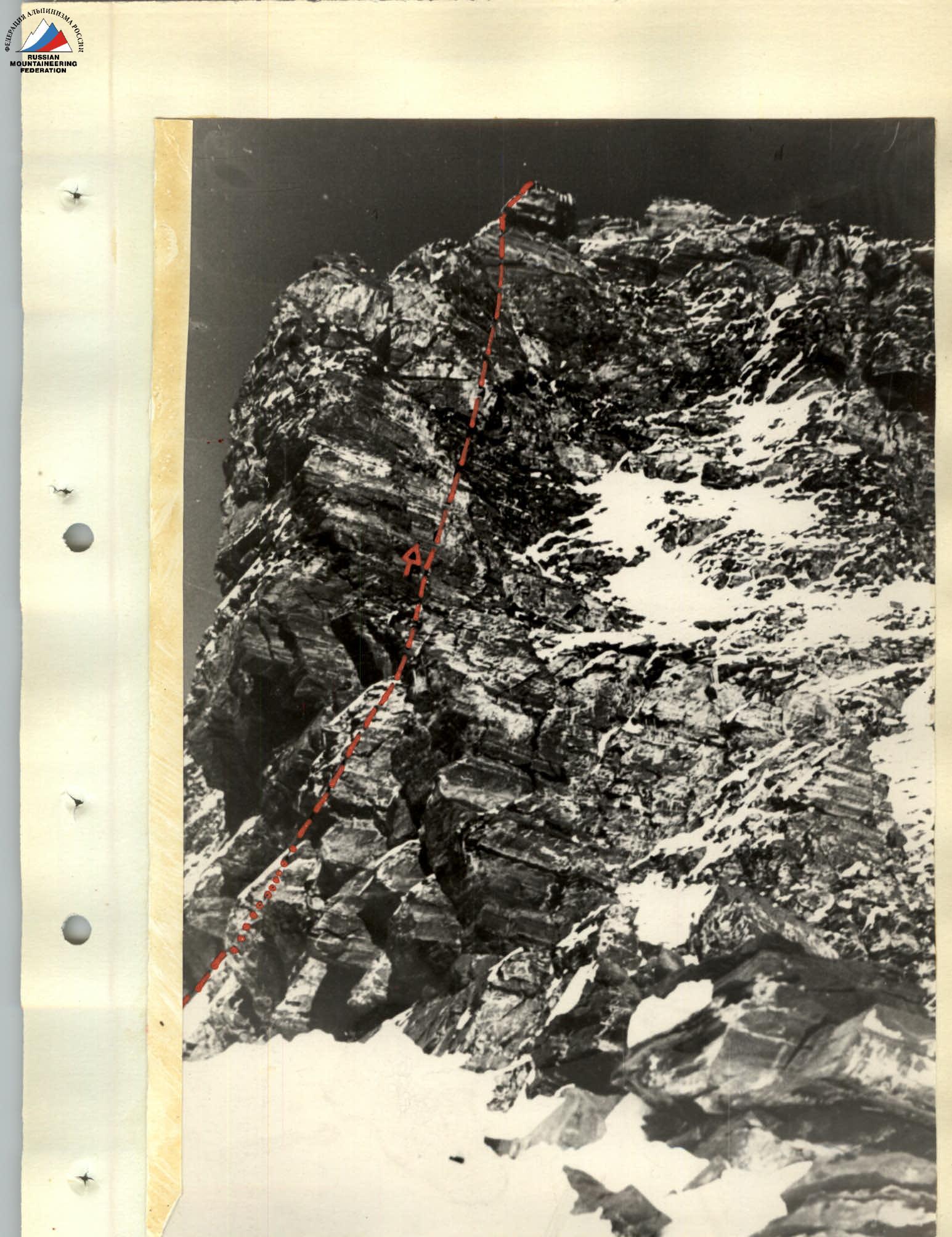
Photo 19. Bastions of the western ridge of Peak "6701". Sheer rocks with cornices at an altitude of 6300 m (R48).
Having passed 180 m of the ridge, with a steepness of 35-40°, we approached rock walls of the "bastion" type (R48). The average steepness of the bastions is about 70° (photo 19), some sections overhang. Yuri passes the bastions with difficult climbing, insurance is hook-based, ice screws work well. The most difficult are two walls, ending in overhanging sections from above. After 280 m of partly difficult climbing along the ridge, we all gather on a ledge, which is located approximately in the middle of the ridge. There's a site here. It's already 17:30, we're at the planned overnight stay. We set up a tent; we need to rest well.
Results of the day:
-
In 6 hours of work, we covered 460 m.
-
The speed of movement this day is equal to 76 m/h.
August 18. 7th day. 8:30. It's cold. Drifting snow, but we need to go. Ahead is a snowy ridge (R49), 40 m long, with a slight steepness, leading to a snowy slope (R50), which brings us to the bastions (R51). We bypass the bastions to the right along rocks, followed by an exit to the ridge. The average steepness of the walls is 70°, insurance is hook-based. Ahead are A. Vstavsky - V. Lyakh. Along the ridge (R52), we pass 200 m and reach the summit of Peak "6701". We find a tur and remove a note from R. Bozhukov, leave our note, and despite the strong wind, admire the panorama. Below us, as on the palm of our hand, is the plateau; to the northeast, two towers of Peak Izvestiya are visible; to the north, the powerful massif of Peak E. Korzhenevskaya rises; to the south, behind all the peaks, the tower of Peak Kommunizma is visible, with snow-ice slopes facing us:
- Peak Moscow
- Peak 30 Years of the Soviet State.
At 14:00, we begin our descent to the col (R53) between Peak "6701" and the ridge of Peak Kommunizma. Movement is simultaneous. Further movement along the ridge does not present technical difficulties. We move simultaneously, with a steepness of no more than 30°, initially the ridge is rocky, and after 400-420 m, it's covered in firn (R54, photo 20). Another 600 m along the snowy ridge, and we stopped at the planned overnight stay. At 17:30, we set up a tent, having previously prepared a site. From firn slabs and pieces, we made a wall against the wind and, after dinner, fell asleep.
Results of the day:
-
In 9 hours of continuous work, we covered 1390 m.
-
The speed of movement is equal to 155 m/h.
August 19. 8th day. At 10:00, we set out on the route. The altitude is 6800 m. It's cold, but tolerable. Last night's strong wind almost tore the tent, but the snow wall