
41
COMBAT TRAINING DEPARTMENT OF TURKESTAN MILITARY DISTRICT COMMITTEE FOR PHYSICAL CULTURE AND SPORTS UNDER THE COUNCIL OF MINISTERS OF UZSSR
REPORT ON THE ASCENT OF THE HIGHEST POINT IN THE USSR – STALIN PEAK (height 7495 m) VIA THE EAST RIDGE
Tashkent 1958
ROUTE SCHEMATIC OF THE ASCENT TO STALIN PEAK (Height 7495 m)
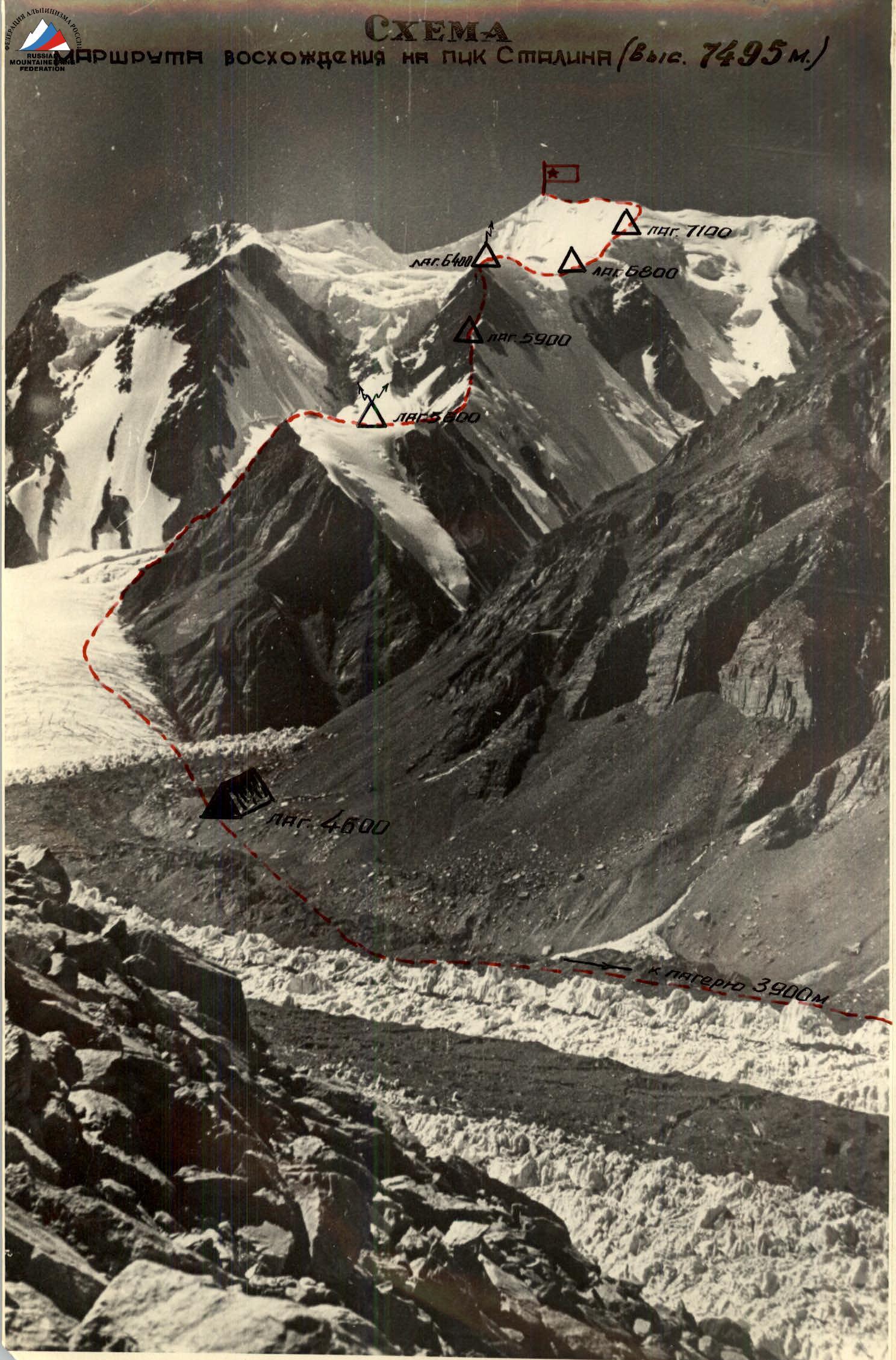
I. Geographical Location and Sporting Characteristics of Stalin Peak
Stalin Peak, the highest point in the USSR, with an elevation of 7495 m above sea level (7495 m according to new measurements), is located in the Academy of Sciences Range on the Pamir Plateau within the mountain node formed by the Academy of Sciences and Peter the First Ranges, at 72° 01′ 26″ east longitude and 33° 37′ north latitude.
The peak was discovered by the Tajik-Pamir Expedition of the USSR Academy of Sciences. According to available data, up to 1958, the following ascents to the summit were made:
| Year of Ascent | Leader of the Assault | Number Reaching the Summit | Route of Ascent |
|---|---|---|---|
| 1933 | Abolakov E.M. | 1 | Via the east ridge |
| 1937 | Beletsky E.A. | 5 | -«- |
| 1955 | Kakhiani I.G. | 4 | From the Garmo Glacier |
| 1957 | Kuzmin K.K. | 10 | Across the Pamir Firn Plateau |
The summit of Stalin Peak rises as an isolated massif (see schematic). Neighboring peaks are significantly lower (by 1000–700 m) than Stalin Peak. The slope profile exceeds 60° in steepness, with snow-ice cover.
Approaches to the foot of the peak from the east are quite complex due to the presence of the turbulent and full-flowing Seldara River, which has a discharge of 550 m³ during floods.
The motor road passes 20 km south of the Daraut-Kurgan settlement, to the Atram-Kungei tract in the Altyn-Dara River gorge. Further progress toward the foot of Stalin Peak is possible only with a caravan of pack animals and requires clear organization.
On the first day, the path lies along the Altyn-Dara River through the Ters-Agar Pass (elevation 3613 m) to the Altyn-Nazar meteorological station. The most challenging section of this path segment is the final 3–4 km — a descent to the Altyn-Nazar meteorological station, where the elevation loss reaches 300–900 m.
On the second day, the caravan crosses the Seldara River and reaches the first lake in the left lateral trough of the Fedchenko Glacier. This segment of the route is the most challenging due to the crossing of the Seldara River.
On the third day, the caravan continues along the lateral trough of the Fedchenko Glacier, then crosses the Bivachny Glacier and enters its right lateral trough, continuing for another 3–4 hours to an elevation of 3900 m to the site of the "green" camp.
Further advancement of the caravan toward the foot of the peak is impossible due to the heavily crevassed Stalin Glacier. Apparently, after 1934 and 1937, when pack animals reached the 4600 m camp, the Bivachny and Stalin Glaciers changed significantly and became impassable for a caravan.
Weather conditions in the Stalin Peak area, as in the entire Pamir region, are quite favorable for climbing. In the summer, stable good weather prevails here, with rare precipitation.
The area is remote from populated areas, difficult to access, and uninhabited.
ORGANIZATIONAL AND TACTICAL PLAN FOR THE ASCENT
Initial reconnaissance of the approaches to Stalin Peak was conducted back in August 1937 by a group from the Uzbek Committee for Physical Culture and Sports, consisting of 12 people. The group studied the approaches to the peak in detail, ascended the eastern ridge of Stalin Peak to an elevation of 6100 m, and familiarized themselves with the nature of the route. Additionally, the group climbed the opposite peaks in the Fedchenko Range, from which they were able to survey the entire route of the upcoming ascent.
The organizational and tactical plan for the ascent provided for:
- Establishing a camp at 3900 m in the right lateral trough of the Bivachny Glacier, opposite the ridge formed by a lateral spur of the Academy of Sciences Range, separating the Stalin and Bivachny Glaciers; camp supply was to be carried out by a caravan;
- Establishing a camp at 4600 m at the foot of Ordzhonikidze Peak, at the site of previous expeditions' camps. Camp supply was to be carried out by the auxiliary expedition team;
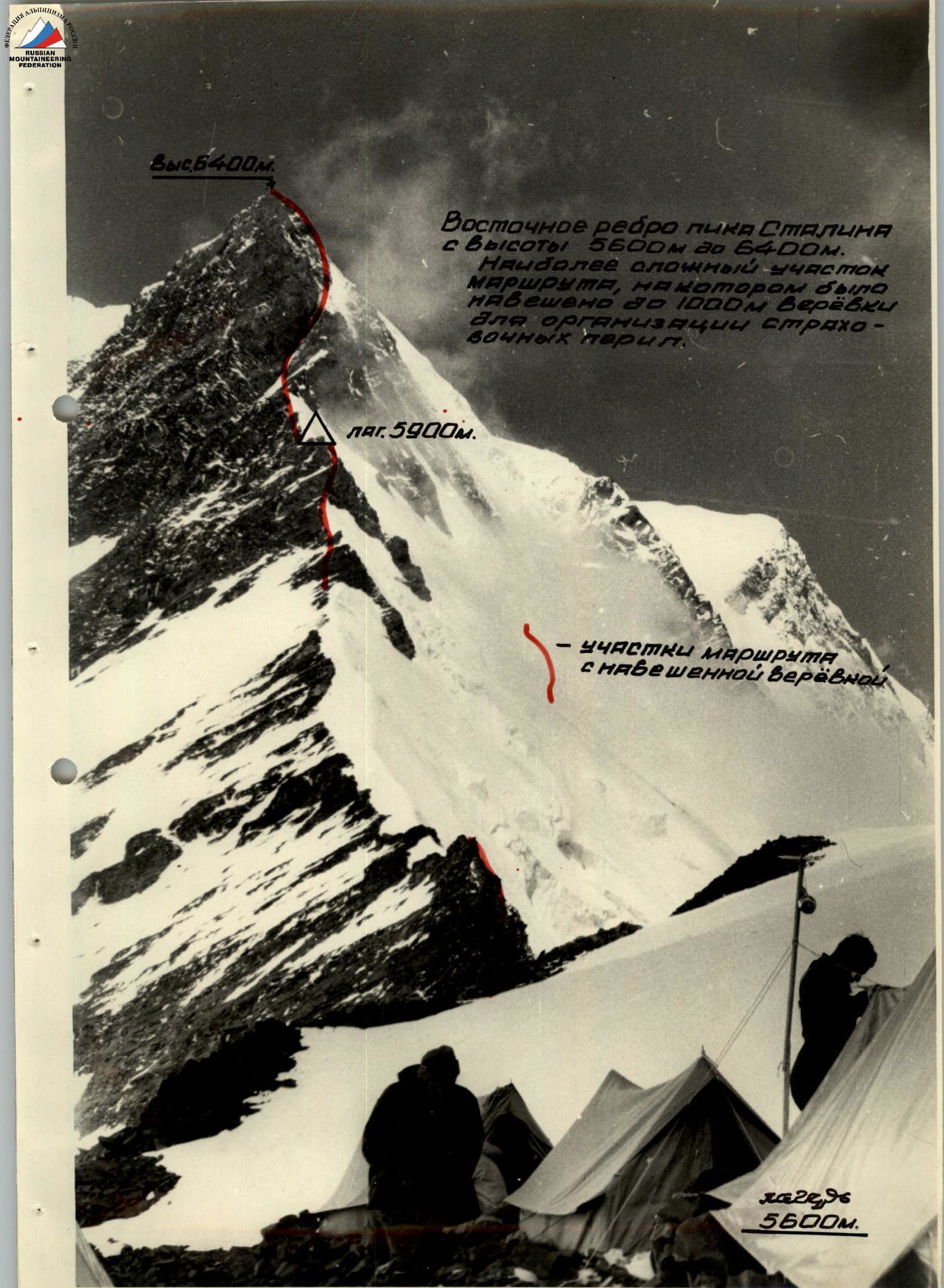
- Processing the eastern ridge of the peak between elevations 5600 m and 6400 m, with rope installation for safety and establishment of an intermediate camp at 5900 m — by the main and auxiliary teams;
- Supplying the 6400 m camp with food and high-altitude gear for the assault team.
The start of the assault on the peak was planned from the 6400 m camp, with the aim of reaching the summit in 3 days. Installation of intermediate camps was planned at elevations of 6800 m and 7100 m above sea level.
The entire organizational and tactical plan was fully executed within the following timeframe:
- Establishment of the 3900 m camp on August 14;
- Establishment of the 4600 m camp on August 16;
- Processing of the first 5 pinnacles from August 16 to 24;
- Processing of the sixth pinnacle from August 26 to 28;
- Supplying food and high-altitude gear from the 5600 m camp to the 6400 m camp from August 28 to September 1, 1958;
- Concentration of participants from lower camps and departure from the 6400 m camp for the assault on the peak by September 2;
- Establishment of intermediate camps at 6800 m and 7100 m on September 2 and 3, respectively;
- Reaching the summit on September 4, 1958, at 16:20, followed by descent to the 7100 m camp for overnight stay. The State Flag of the USSR was raised on the summit for the first time;
- Descent from the 7100 m camp to the 4600 m camp on September 6, 1958, at 2:00.
DESCRIPTION OF THE PASSAGE OF INDIVIDUAL ROUTE SECTIONS
| Time Taken (hours) | Route Section | Brief Description of the Route |
|---|---|---|
| 8 | Camp 3900 — Camp 4600 m | Heavily crevassed and serac section of the Bivachny and Stalin Glaciers. After crossing the ridge, the path proceeds along the right side of the Stalin Glacier and its lateral trough. |
| 7 | Camp 4600 — Camp 5600 m | Crossing the Ordzhonikidze Glacier involves navigating through seracs and crevasses, followed by the icefall of the Stalin Glacier. The route is avalanche-prone. The final approach to the camp site is via loose rocks. The 5600 m camp site is convenient for accommodating 10 tents. |
| 7 | Camp 5600 — Camp 5900 m | On this segment, three pinnacles are overcome. The 1st "pinnacle" is purely rocky, with crumbling rocks at an angle of 30 to 40°. The 2nd "pinnacle" consists of crumbling rocks at an angle of 40–80°; the 3rd "pinnacle" is rocky with crumbling rocks at an angle of 40–60°. Between the "pinnacles," the ridge is snow-ice, at an angle of 30–40°, requiring safety measures via fixed ropes. A camp for one tent can be established between the 3rd and 4th "pinnacles." |
| 8 | Camp 5900 — Camp 6400 m | On this section, the 4th, 5th, and 6th "pinnacles" are overcome. The 4th "pinnacle" has inclined slabs at an angle of up to 50°. A steep snowfield with cornices leads to the next rocky ledge. The 5th "pinnacle" is one of the most complex and dangerous on the route to Stalin Peak, featuring negative angles and overall route steepness from 30 to 90°. The 6th "pinnacle" is the largest on the route, with eight ropes installed for its traversal. The slope character is rock-ice, with loose rocks and sheer sections. Overall steepness is 60–80°. After overcoming the 6th "pinnacle," a camp is established with three to four tents. The section from the 5600 m camp to 6400 m was pre-processed by the main and auxiliary groups. |
| 8 | Camp 6400 — Camp 6800 m | Movement on this section occurs along the ice ridge with step-cutting and then across an inclined snow plateau. The camp is established near an icefall on the south side of the ridge leading to the next peak section. |
| 8 | Camp 6800 — Camp 7100 m | This route section is characterized by a sharp ice rise and movement along a sharp ridge, requiring step-cutting and organization of mobile safety ropes. Movement is done in crampons. Two broad bergschrunds are encountered on the route, which are crossed via snow bridges. |
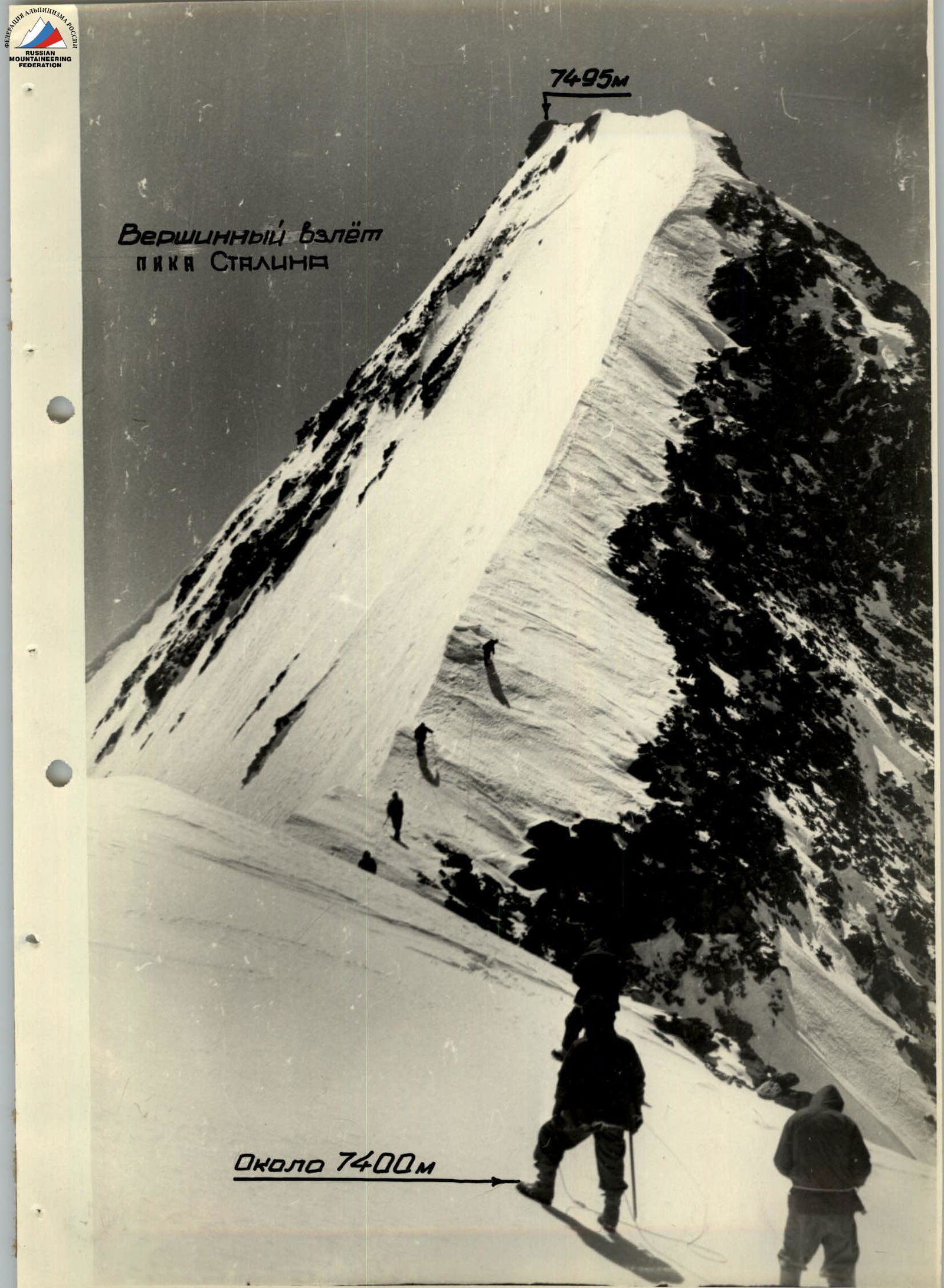
| 12 | Camp 7100 m — Summit — Camp 7100 m | On this section, movement is along a steep and avalanche-prone snow slope until reaching the north ridge of the summit. The north ridge is quite sharp, with a steepness of 40–50°, and passes through a sub-summit at 7300 m. The final ascent before the summit is a sharp, knife-like ridge section, overcome in crampons with the aid of mobile ropes. Before reaching the summit, there is a 30-meter rocky section. The summit is a significant plateau, with the southern side being snow-free and rocky, where a large cairn built by previous climbers is located. |
The assault team consisted of 9 people who successfully ascended Stalin Peak. In total, during the ascent to Stalin Peak, there were 54 people in all expedition camps.
List of Participants in the Ascent and Auxiliary Detachment by Name
Following the completion of preparatory work, 12 people were appointed to the assault team by decision of the expedition chief and coaching council. Due to illness and indisposition that arose at the 6400 m camp, three participants of the assault team — Master of Sports V.L. ELCHIBEKOV, Master of Sports V.A. KOVALEV, and 1st Category Sportsman I. NAZAROV — returned to the 4600 m camp, where they were part of the rescue team reserve.
The following reached the summit of Stalin Peak:
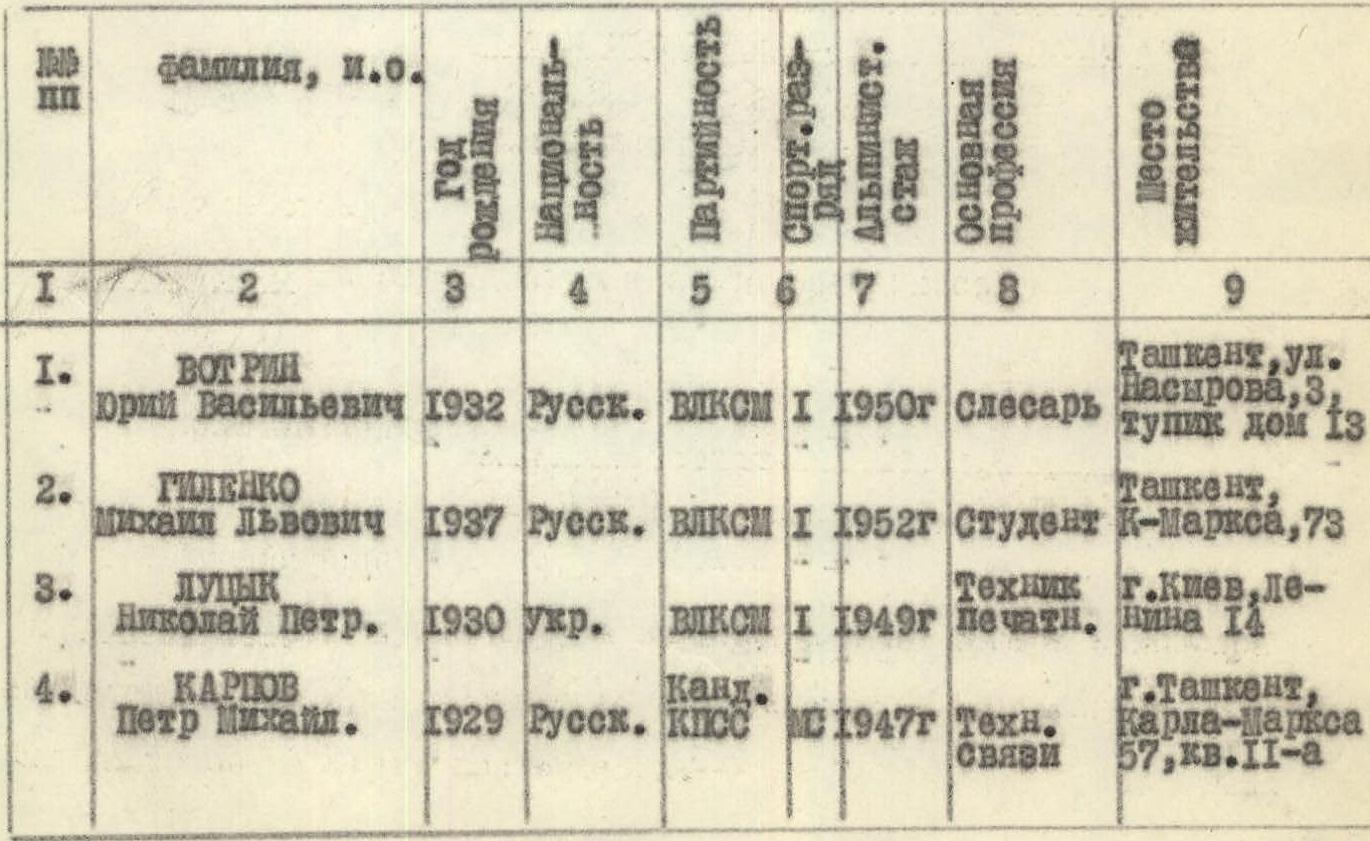
- BOTRIN Yuri Vasilyevich. Born 1932, Russian, VLKSM, 1st sports category, enlisted in 1950, Fitter, Tashkent, Nasyrova St., 3, lane, house 13.
- GILENKO Mikhail Lvovich. Born 1937, Russian, VLKSM, 1st sports category, enlisted in 1952, Student, Tashkent, K-Marks St., 73.
- LUTS Nikolai Petrovich. Born 1930, Ukrainian, VLKSM, 1st sports category, enlisted in 1949, Printing Technician, Kiev, Lenin St., 14.
- KARPOV Petr Mikhailovich. Born 1929, Russian, CPSU candidate, 1st sports category, enlisted in 1947, Communications Technician, Tashkent, Karl-Marx St., 57, apt. 11-a.
- KOROLEV Alfred Ivanov. Born 1925, Russian, CPSU member, Master of Sports, enlisted in 1949, Researcher, Tashkent, Botkina St., 1, apt. 34.
- NAGEL Eduard Ivanov. Born 1927, Russian, CPSU. CPSU member, Master of Sports, enlisted in 1950, SA Officer, Tashkent, SK TurkVO.
- NARYSHKIN Viktor Nikolayevich. Born 1926, Russian, CPSU member, Master of Sports, enlisted in 1947, SA Officer, Karshi, military unit 52857.
- NOZDRIKHIN Vitaly Konstantinovich. Born 1929, Russian, VLKSM, Master of Sports, enlisted in 1947, Head of Fedchenko Glacier wintering station, Tashkent, Transportnaya St., 8.
- STROYKOV Alexei Alexandrovich. Born 1930, Russian, VLKSM, 1st sports category, enlisted in 1949, Cameraman, Frunze, Kirpichnaya St., 37.
Composition of the Auxiliary Detachment:
| № | Surname, I.O. | Year of Birth | Nationality | Party Affiliation | Category | Year of Enlistment | Organization | Place of Residence |
|---|---|---|---|---|---|---|---|---|
| 1. | Snegirev Nikolai Anton. | 1934 | Russian | CPSU Member | 1st | 1950 | SA Officer | Frunze, military unit 55666 |
| (Detachment Chief) | ||||||||
| 2. | Kamalov Irik Iskh. | 1932 | Tatar | VLKSM | 3rd | 1957 | SA Officer | Osh, military unit 77701 |
| (Expedition Doctor) | ||||||||
| 3. | Zhideev Alexander Dmitr. | 1937 | Russian | VLKSM | 2nd | 1955 | Military Serv. | Tashkent, military unit 41177 |
| 4. | Burlyaev Sergei Al-ndr. | 1936 | Russian | VLKSM | 2nd | 1955 | Military Serv. | Tashkent, TVOKU |
| 5. | Lyapkin Alexander Alex. | 1937 | Russian | VLKSM | 2nd | 1955 | Military Serv. | Osh, military unit 77701 |
| 6. | Plotnikov Yuri Borisov. | 1937 | Russian | VLKSM | 2nd | 1955 | Military Serv. | Chirchik, military unit 41708 |
| 7. | Ovchinnikov Vladimir Vlad. | 1938 | Russian | VLKSM | 2nd | 1955 | Military Serv. | Osh, military unit 77701 |
| 8. | Dudin Evgeny Fedor. | 1938 | Russian | VLKSM | 2nd | 1955 | Military Serv. | Osh, military unit 77701 |
| 9. | Kamalov Ervat Bakshiev. | 1937 | Armenian | VLKSM | 2nd | 1956 | Military Serv. | Osh, military unit 77701 |
| 10. | Kadotchnikov Albert Nikol. | 1937 | Russian | VLKSM | 2nd | 1956 | Military Serv. | Osh, military unit 77701 |
| 11. | Sukharev Vladimir Serg. | 1939 | Russian | VLKSM | 2nd | 1957 | SA Worker | Tashkent, Proletarskaya St., 47 |
| 12. | Frolov Lev | 1939 | Russian | VLKSM | 2nd | 1956 | Fitter | Tashkent, Navoi St., 8 |
Additional Data
During the ascent, favorable weather conditions were observed. The actions of both the assault and auxiliary groups were correct, with no deviations from the established plan for the summit assault.
From the 6400 m elevation, a radio station, Aristov O.'s notebook, and several pieces of equipment were retrieved from the 1937 expedition camp: down-filled sleeping bags, sweaters, backpacks, tents, and storm jackets.
The radio station was handed over to E.A. Beletsky in Osh.
Among the climbers was 21-year-old Mikhail GILENKO, a student at SAZPI. He was born in the year of the last ascent of Stalin Peak via the route he himself later followed.

Comments
Sign in to leave a comment