RUSSIAN MOUNTAINEERING FEDERATION
ВАСПОРТ ВОСХОЖДЕНИЯ (third ascent)
- Class of ascent — rock.
- Region of ascent — Caucasus.

 |
|---|

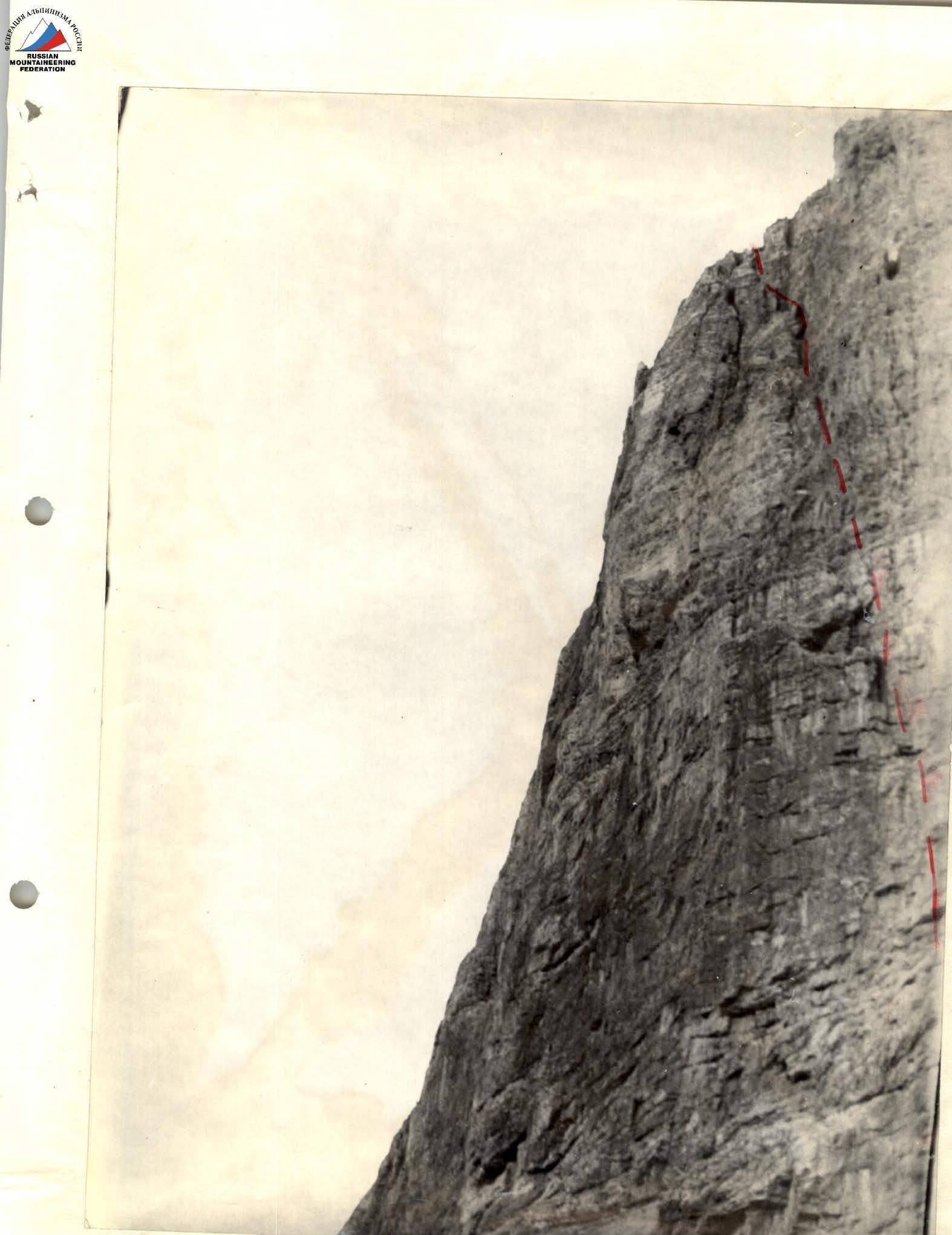
- Peak, its height and ascent route — Yarydag I-ya Zapadnaya, 4110 m, via the left part of the Western wall (Samoded route)
- Proposed category of difficulty — 5B.
- Characteristics of the route — height difference of the wall section 680 m, average steepness — 70°, length of sections: II category of difficulty – 220 m, III and IV category of difficulty – none, V category of difficulty – 590 m, VI category of difficulty – 20 m.
- Number of pitons: for belaying, for creating an intermediate belay.
| rock pitons — | 143 | II |
|---|---|---|
| ice pitons — | 2 | - |
| bolt pitons — | 1 | - |
Throughout the entire route, chocks were used. 7. Number of climbing hours — 15 h 30 min. 8. Number of bivouacs — none. 9. Full names of participants: Ivenkov A.A., CMS; Venevtsev V.N., 1st sports category. 10. Team coach: Sivtsov B.G. — Honored Coach of the Ukrainian SSR. 11. Date of departure and return: July 23, 1980.
- 1st ascent by M. Polyakov + 3 26/11–80 (марurpari ~2) 950, 75°, 525, 127/13, 34, 19 h.
Brief explanations for the table

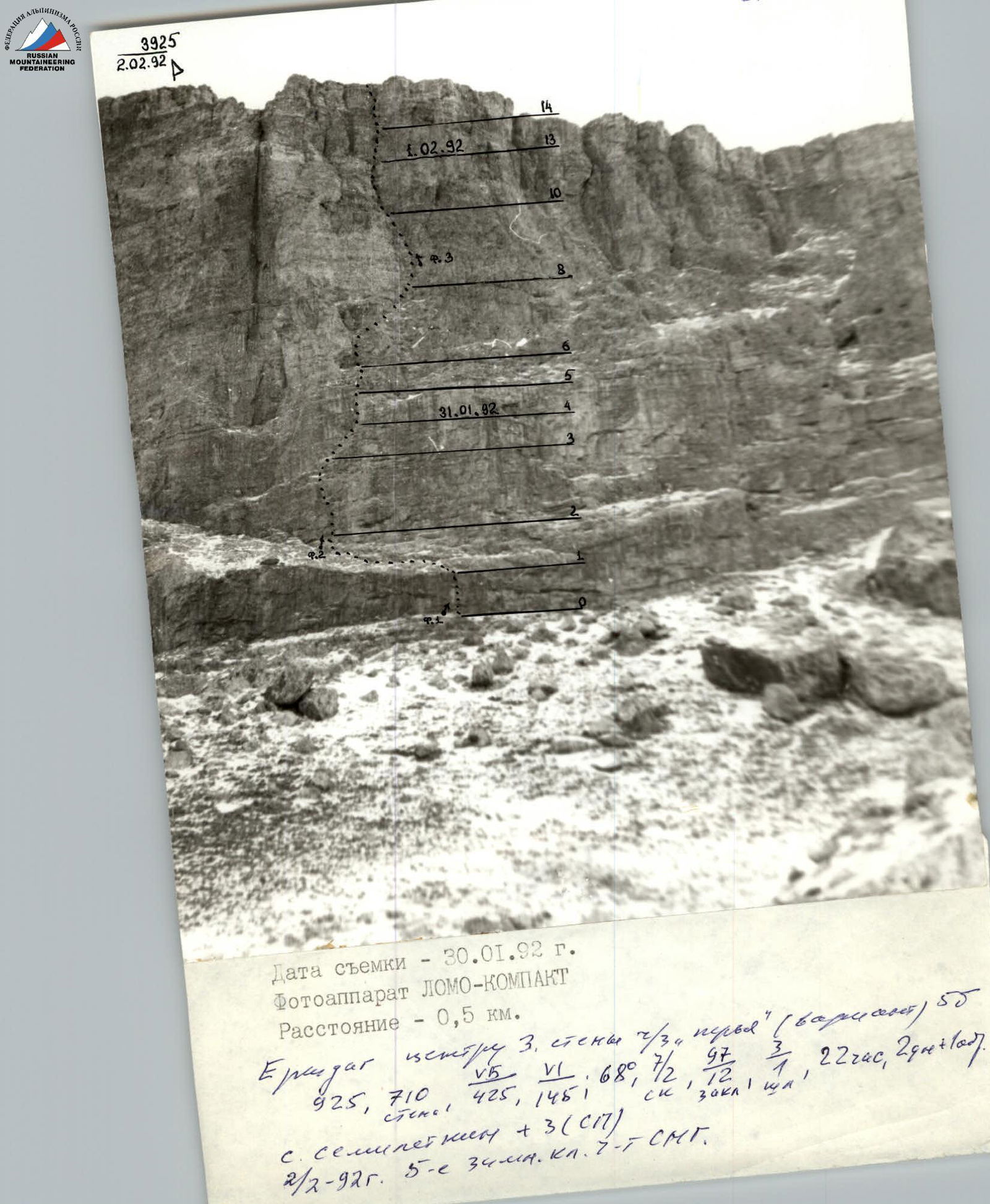
R0–R1 along the wall between the cornices to a ledge. A bolt piton was left. R1–R2 along a large ledge left-upwards to the edge. R2–R4 right-upwards into a rock amphitheater. R4–R6 left-upwards to the edge. R6–R8 up the edge to a control cairn. R8–R9 traverse right to a narrow crevice and along it upwards. R9–R11 up the crevices and internal corners to the 2nd control cairn. R11–R13 left-upwards. R13–R15 up to the ridge. R15–R16 along the scree ridge to the rocks. R16–R17 the rocky ridge can be bypassed on the right along a steep average scree, but it's faster and easier to ascend along it. R17–R18 along the scree to the summit cairn.
Descent from the summit
From the summit cairn, descend south, then southwest, bypassing the summit pinnacle on the left along the scree. Further along the scree plateau, bypass to the left the peak Yarydag 2-ya Zapadnaya. Descend into a rocky couloir with a stream and down it to the grassy slopes. Along the grassy slopes and trails, descend to the bivouac site. The descent takes 3–4 h.
The results of the visual observation of the wall and weather conditions in the winter of 1992 formed the basis for compiling a tactical plan. The planned route was to be completed with one bivouac in three days, including a day for processing. The bivouac was planned in the upper part of the wall or on the plateau. The team fully fulfilled their tactical plan, despite a sharp deterioration in the weather on the second day of the ascent. The fulfillment of the tactical plan was facilitated by an even distribution of the load among team members (each day the lead climber changed).
The ascent schedule was as follows. January 31. Processing day. Task was to pass the problematic section of the wall above the ledge. Work started at 9:00, finished at 17:00. A series of cornices were traversed through crevices using etc.
February 1. Departure on the route. Task was to reach the plateau or the upper bivouac. In the second half of the day, a sharp deterioration in weather, snowfall, hurricane-force wind. The ledges on the route, usually used for bivouacs, were not suitable, as the tent would have been immediately torn. The bivouac was set up in a crevice, where it was possible to pitch a tent and spend the night in a sitting position. At this time, below the route, the support team's tents were torn.
February 2. Very strong wind and fresh snow made movement difficult, requiring frequent stops to warm up. The descent took 6 h.
The tactical movement scheme was as follows:
- the lead climber worked without a backpack on a double rope;
- the second climber had a first-aid kit in their backpack;
- when moving along the fixed ropes, participants used two ascenders;
- the last climber moved along the fixed ropes with top-rope belay.
Safety measures during the ascent included:
- high physical, technical, tactical, and psychological preparation of team members;
- a tactical plan drawn up taking into account the winter conditions of 1992;
- good material support, including the use of modern climbing equipment;
- provision of double belay for all participants on the route, the first climber working on a double rope (UIAA+USSR);
- presence of a safety support group below the route and reliable radio communication.
There were no falls, frostbites, or injuries during the ascent.
On the route, two hot meals were planned, mainly using sublimated products to reduce weight and save fuel.