
Report
On the first ascent of the St. Petersburg team to the summit of Gaikomd Centralny, 3100 m, via the center of the southwest wall (approximately 6A category of complexity)
Leader: Ilya N. Penyaev Participant: Maxim V. Kochetkov Coach: Tatyana I. Timoshenko
St. Petersburg, 2017
Ascent Passport
- Region 2.9, from Krestovy Pass to Shaviklde Peak
- Gaikomd, 3100 m, via the center of the SW wall
- 6A category of complexity, first ascent
- Route type: rock
- Route height difference: 735 m, route length: 950 m, wall height difference: 680 m, wall section length: 830 m; sections of V category: 260 m; sections of VI category: 260 m; sections with artificial climbing aids (ICA): 265 m, including A2: 60 m; A3: 20 m. Average route steepness: 58°. Average wall steepness: 73°
- Use of protection points:
Total/including for ICA:
- 377/224 anchor hooks
- 125/63 camalots
- 115/27 chocks
- 3 ICA on fifi hooks
- 134 elements left on the route: 0
- Team's climbing hours: 23 hours Days: 2 Start of ascent: February 4, 2017, 7:40 AM Reach the summit: February 5, 2017, 9:40 PM Descent to base camp: February 6, 2017, 3:00 PM
- Leader: Ilya N. Penyaev Participant: Maxim V. Kochetkov, Candidate for Master of Sports
- Coach:
Tatyana I. Timoshenko, Master of Sports, 1st sports category. The route was climbed as part of the Russian Alpine Championship, technical class, August 15, 2017
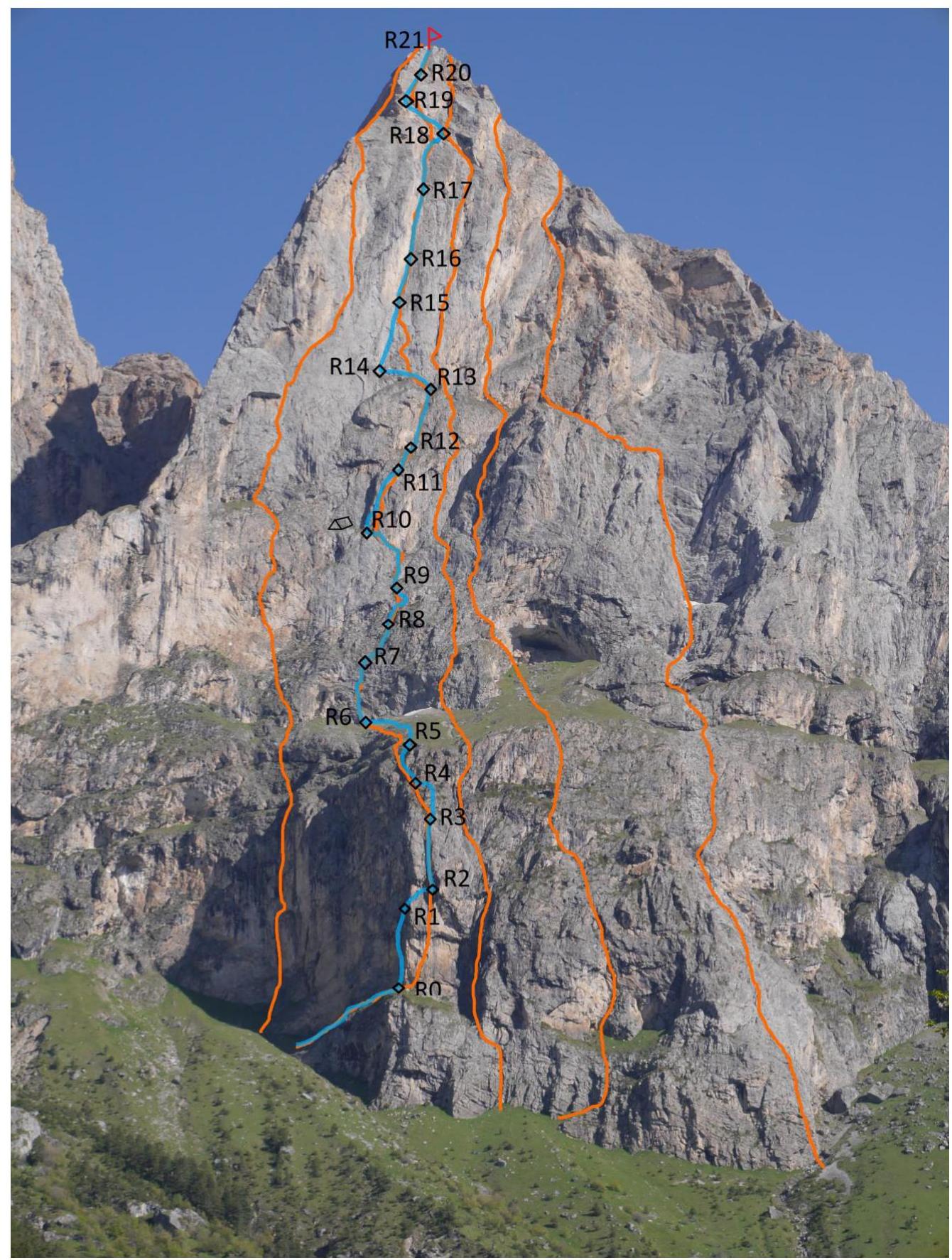
Technical photograph of the route
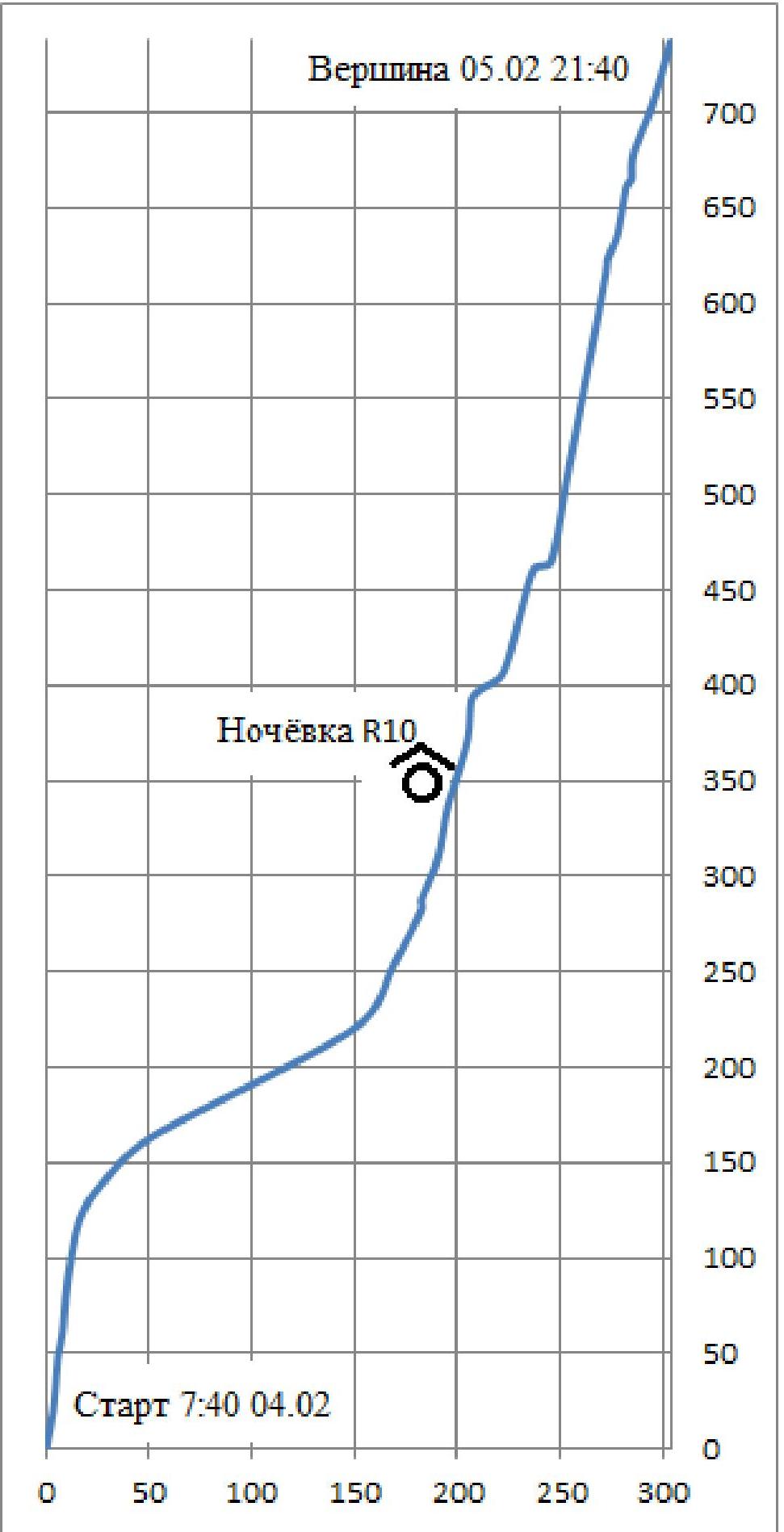
Route profile
UIAA Diagram
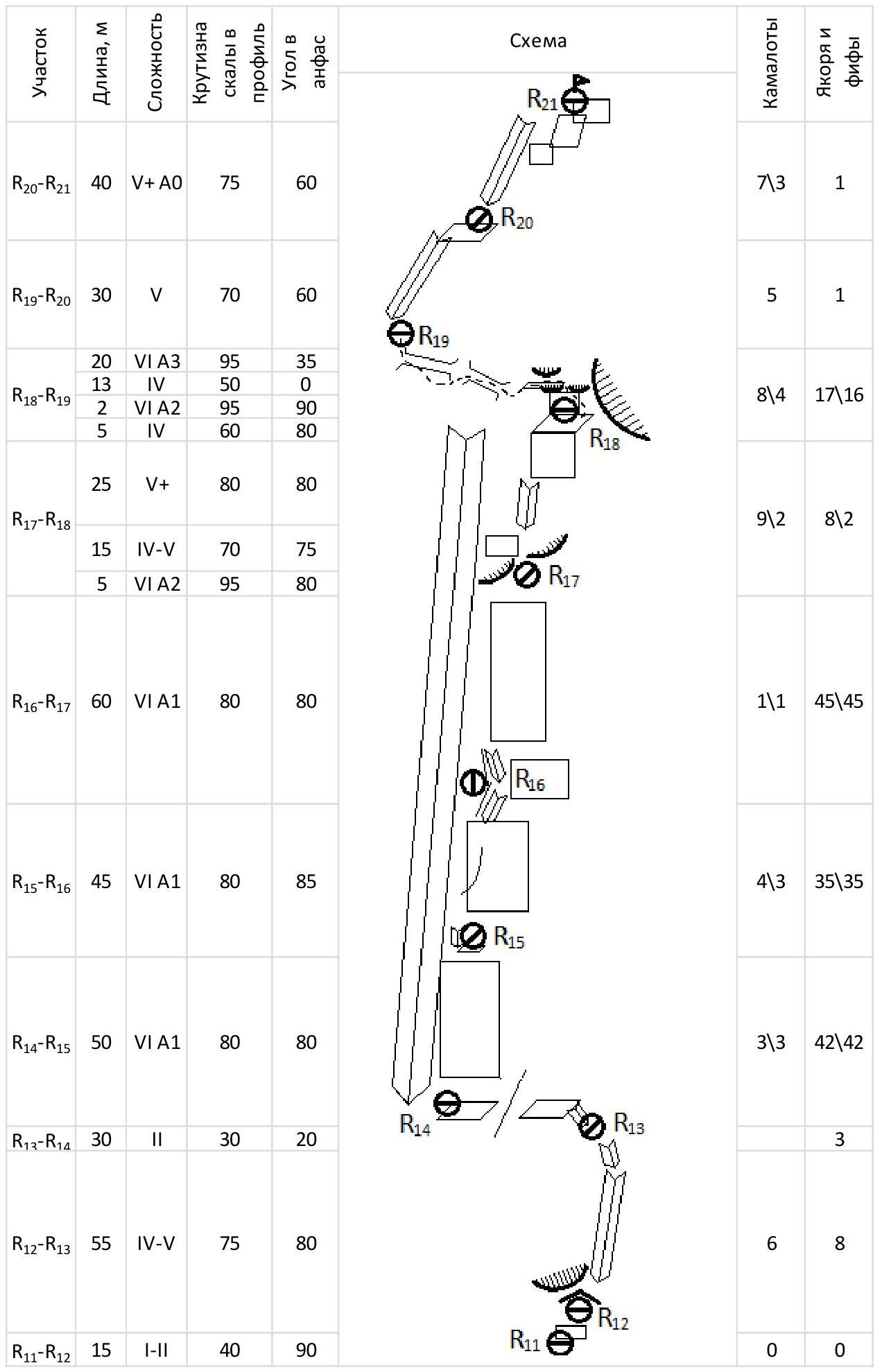
| Section | Length, m | Difficulty | Rock steepness in profile | Steepness en face | Diagram | Camalots | Anchors and fifi hooks |
|---|---|---|---|---|---|---|---|
| R20–R21 | 40 | V+ A0 | 75 | 60 | 7\3 | 1 | |
| R19–R20 | 30 | V | 70 | 60 | 5 | 1 | |
| R18–R19 | 20 | VI A3 | 95 | 35 | 8\4 | 17\16 | |
| 13 | IV | 50 | 0 | ||||
| 2 | VI A2 | 95 | 90 | ||||
| 5 | IV | 60 | 80 | ||||
| R17–R18 | 25 | V+ | 80 | 80 | 9\2 | 8\2 | |
| 15 | IV-V | 70 | 75 | ||||
| 5 | VI A2 | 95 | 80 | ||||
| R16–R17 | 60 | VI A1 | 80 | 80 | 1\1 | 45/45 | |
| R15–R16 | 45 | VI A1 | 80 | 85 | 4\3 | 35 35 | |
| R14–R15 | 50 | VI A1 | 80 | 80 | 3\3 | 42 42 | |
| R13–R14 | 30 | II | 30 | 20 | 3 | ||
| R12–R13 | 55 | IV-V | 75 | 80 | 6 | 8 | |
| R11–R12 | 15 | I-II | 40 | 90 | 0 | 0 | |
| R10–R11 | 10 | III | 55 | 50 | 11 | 9 | |
| 20 | V+ | 85 | 80 | ||||
| 30 | V | 75 | 60 | ||||
| 15 | V | 75 | 70 | ||||
| R9–R10 | 25 | VI A2 | 80 | 80 | 7\2 | 20\14 | |
| R8–R9 | 30 | IV | 70 | 50 | 5 | 10\4 | |
| 5 | VI A2 | 90 | 90 | ||||
| R7–R8 | 35 | IV+ | 65 | 70 | 8 | 3 | |
| R6–R7 | 40 | IV | 60 | 70 | 7 | 2 | |
| R5–R6 | 120 | I | 30 | 70 | 0 | 0 | |
| R4–R5 | 35 | II-III | 45 | 80 | 4 | 0 | |
| R3–R4 | 30 | IV | 60 | 50 | 4 | 3 | |
| R2–R3 | 35 | V | 80 | 75 | 11\4 | 20\14 | |
| R1–R2 | 30 | IV+ | 80 | 25 | 6 | 5 | |
| 10 | V | 85 | 90 | ||||
| R0–R1 | 20 | VI A2 | 85 | 85 | 9\7 | 30 26 | |
| 20 | V A1 | 80 | 80 |
In February 2017, the Russian Alpine Championship in the technical class took place in Ingushetia. As part of the championship, several first ascents were made on the lines proposed by the judges on the peaks of Gaikomd Main and Central. This route was listed as number "13", approximately 5B category of complexity. We, the St. Petersburg team, decided to be the first to climb it.
Route Description
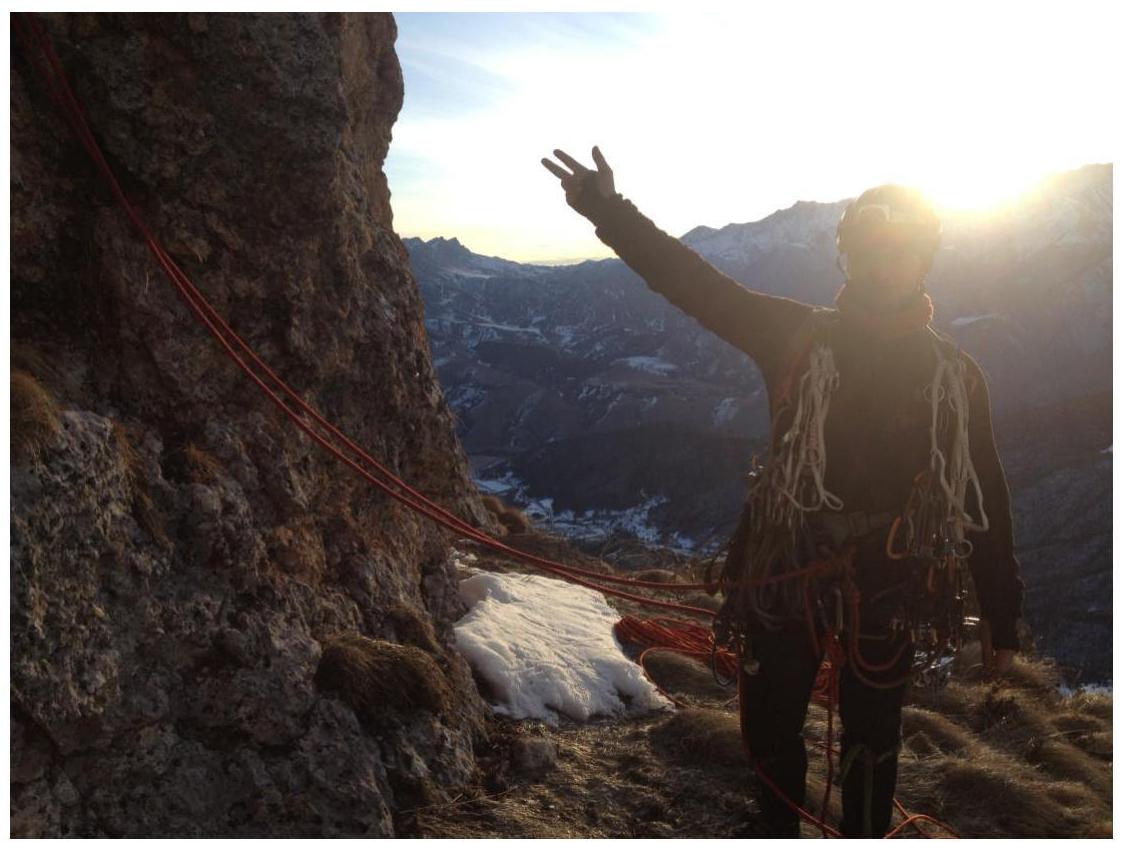
The approach to the route follows a grassy ledge at the base of the wall. It can be dangerous in wet weather. Below is a deep drop.
The route starts to the left of a small cave R0.
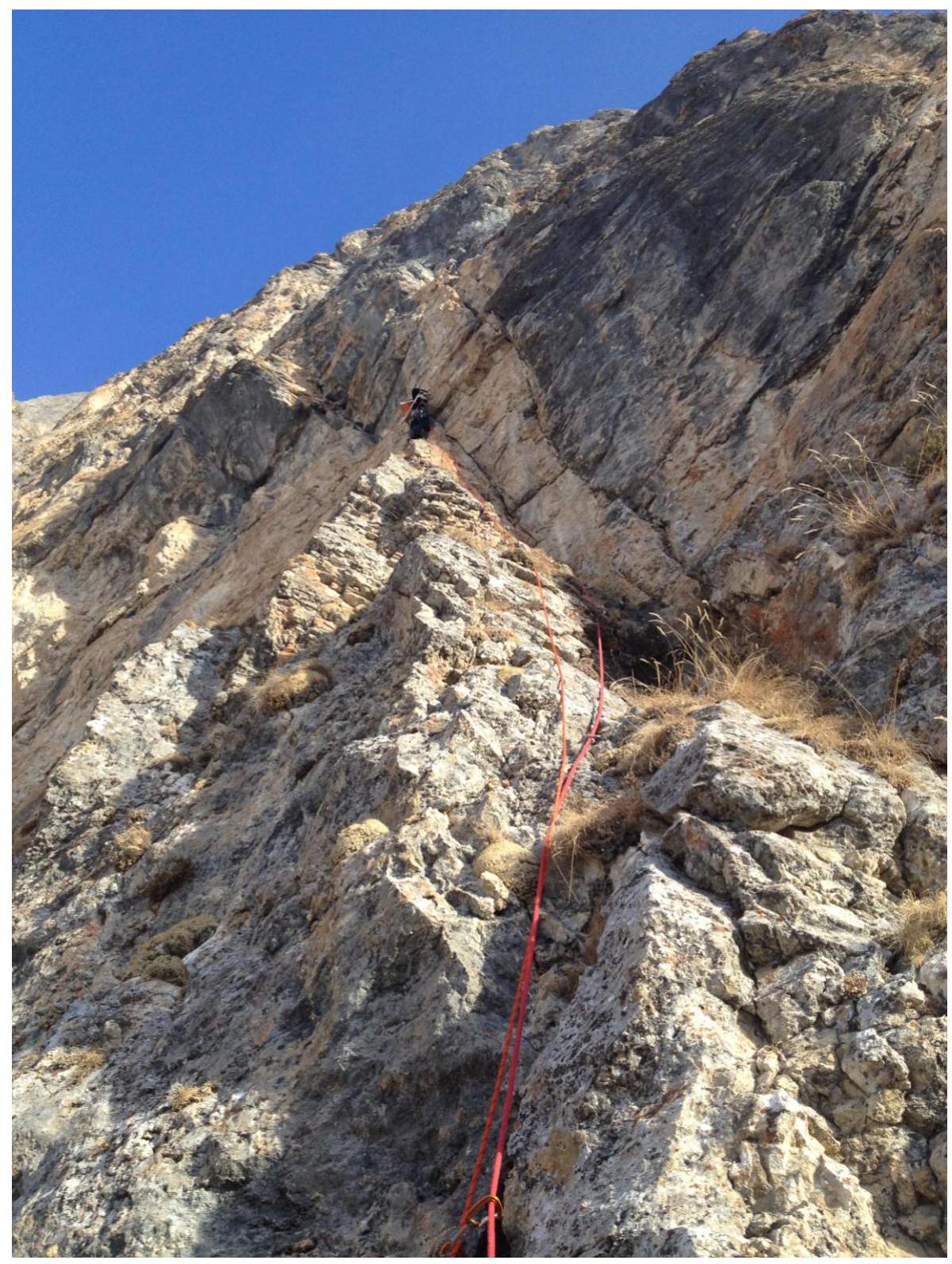
The first rope goes through destroyed internal corners and walls, first moving left, then right. Due to the unreliability of the terrain, we had to use ICA on not very difficult climbing. The belayer is better off hiding. After R1, move right along the wall over the ridge. Careful climbing. Move towards the start of a large internal corner. Along the way, you will encounter a juniper. The station is behind a large boulder under the internal corner. R2.

Up the internal corner. At the exit from it, there is a tree on the left. We went to the right to avoid its thorns, thus slightly complicating our route. R3. Up, then left (R4) onto simple rocks leading to a grassy slope crossing the entire southwest wall. R5. Move up and left along the slope to a narrow grassy ascent leading to the wall. R6. The next landmarks are white streaks on the gray wall.
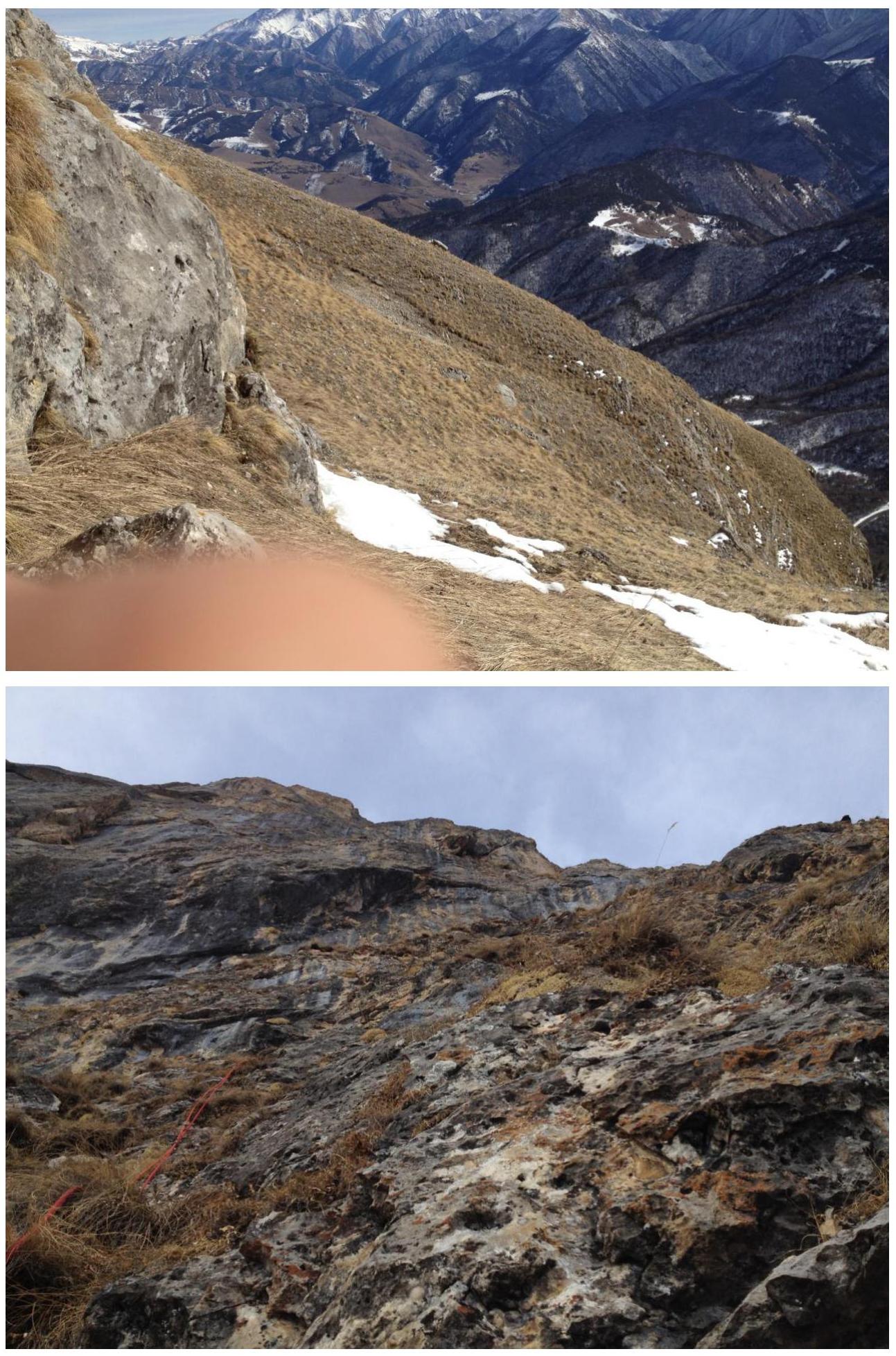
The next landmarks are white streaks on the gray wall. You need to move towards the right one. Easy climbing on destroyed terrain. In some places, it is better to climb the more complex and monolithic wall than the internal corner. The R8 station is under the right, narrower white streak. From it, over a ledge, up a complex wall with cracks into an internal corner. After it, left, traversing through a large chip. The station is offset from the line to the left in a safe place. R9. Back to the chip, then up and left along complex rocks to a grassy ledge, under characteristic relief in the form of the number "7". R10. It was getting dark at this point. We spent the night 30 m to the left on a sloping ledge with juniper. The overnight stay was in a sitting position.
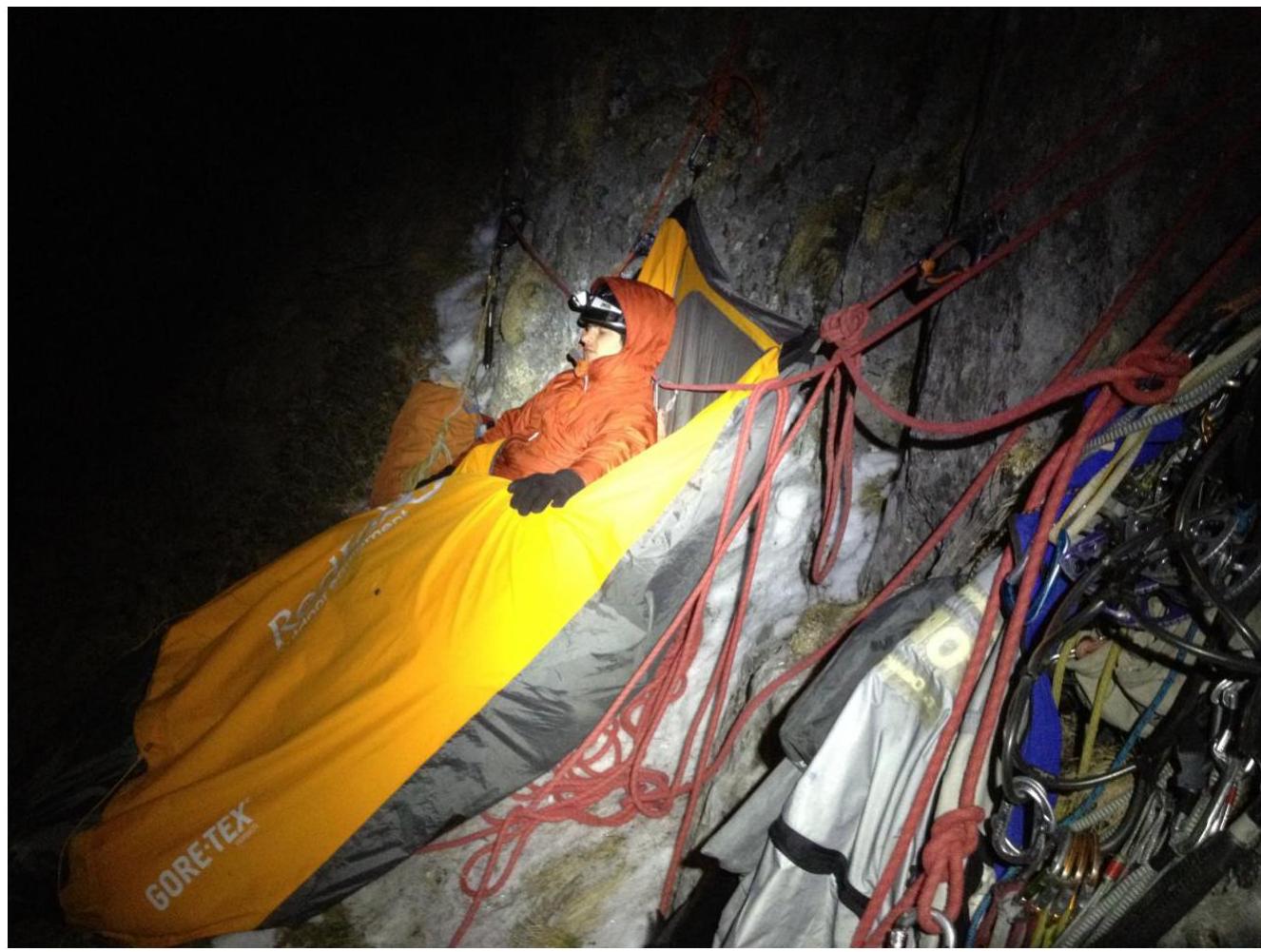
The next section starts at the base of the "seven". Move up to the right, going along ledges and walls into the neighboring internal corner. Up it. Onto the wall. Pleasant climbing.
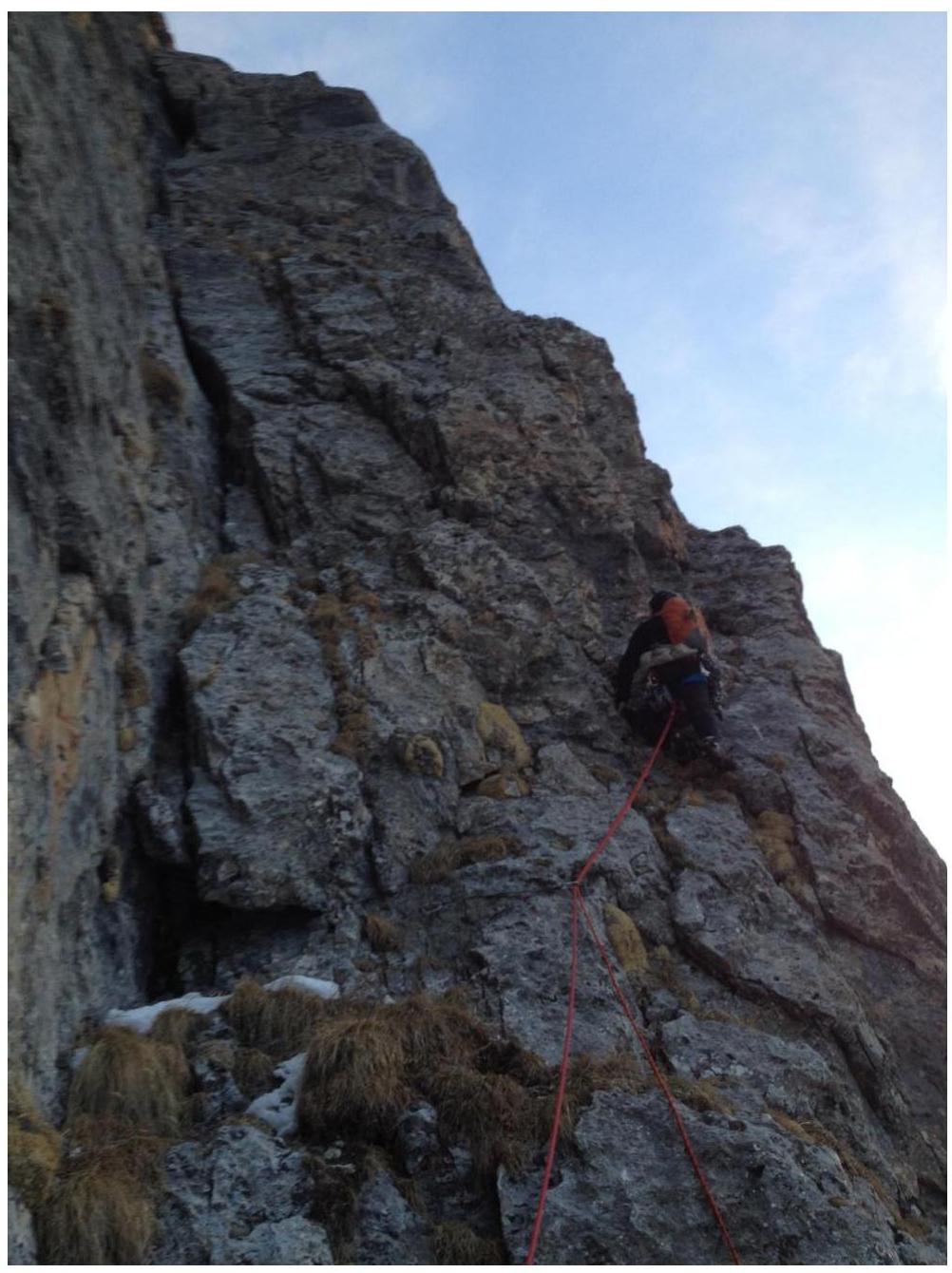
The R11 station is comfortable, on a ledge. Then approach the next wall along a steep slope with grass. Here is R12. And the most comfortable place to spend the night on the route.
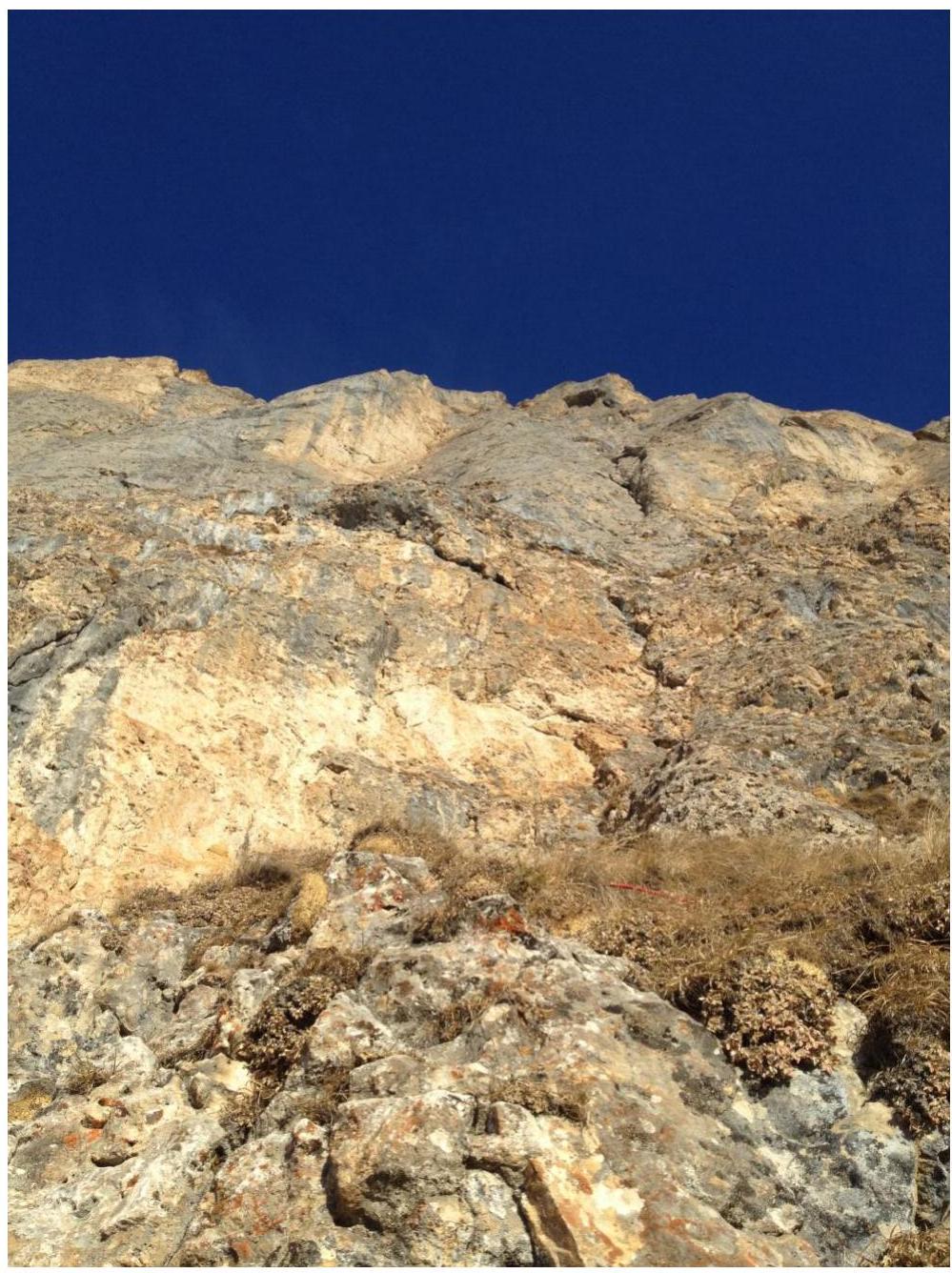
Further up the internal corner, then move left and traverse over the ridge to R14. Our R13 station was not very successful. The last ten meters are difficult to protect and not pleasant to climb due to many unreliable grassy tufts, and the rope was tight. It is better to stop somewhere earlier. From R14, there are almost three straight ropes with ICA. You need to move mainly:
- along a wall with caverns,
- to the right of a huge internal corner, which has many cracks,
- in a zone abundant with living relief.
Several times on the rope, we switched to free climbing, but returned to ladders (ICA) after a couple of meters.
The R15 station is on a small ledge.
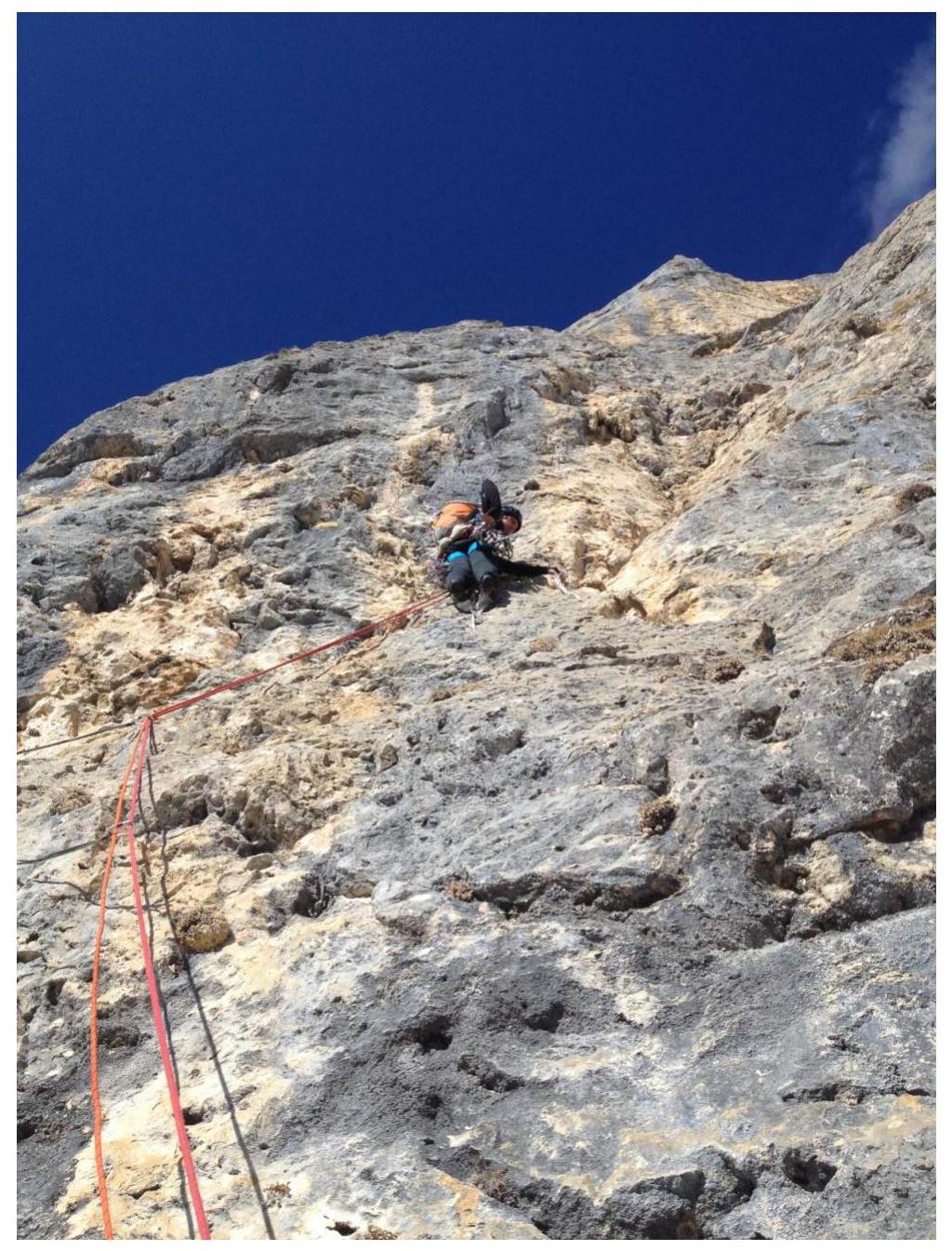
Ilya Penyaev leads
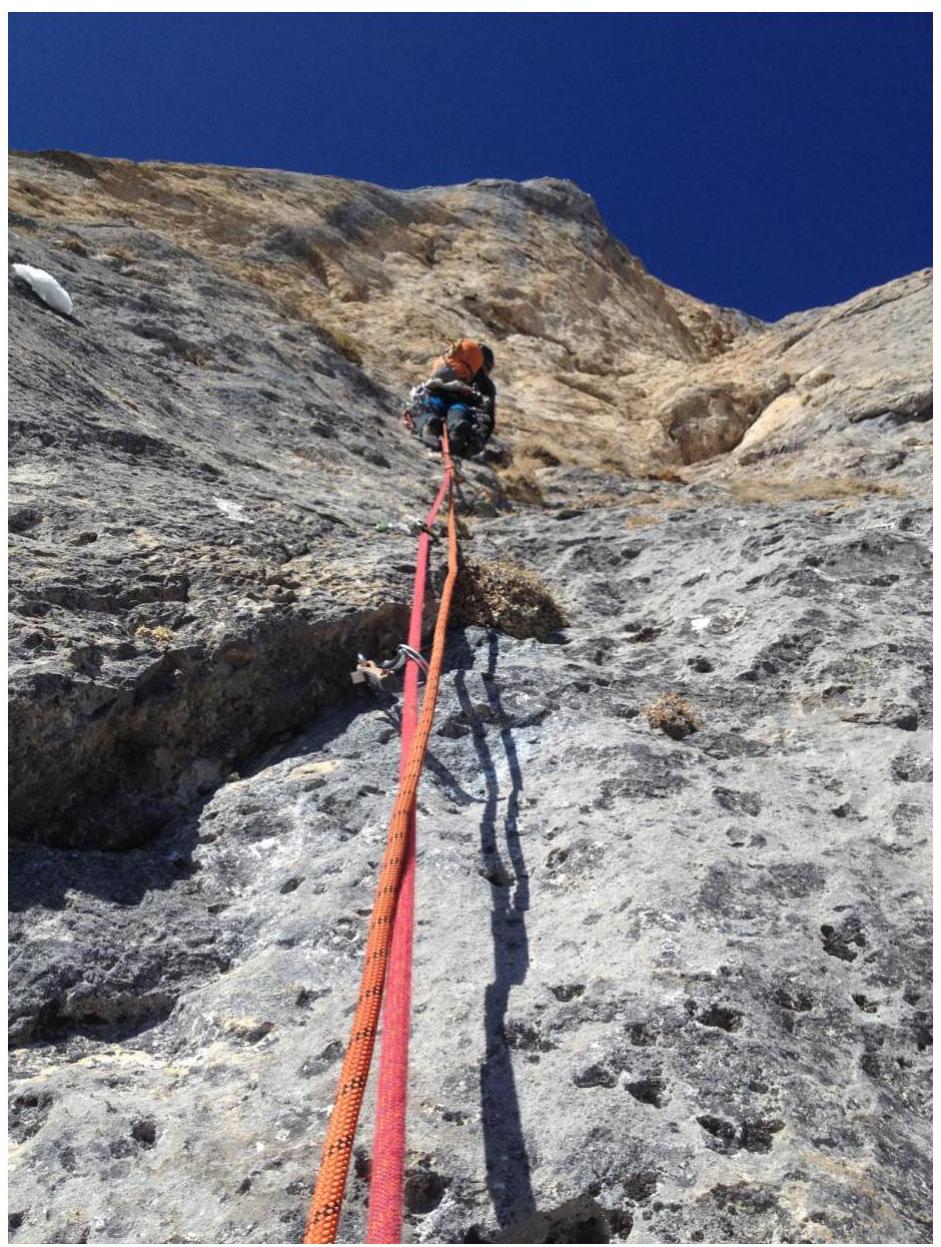
R16 is slightly to the left of the line of movement, behind a ridge, where stones won't fall. Stations on anchors, mostly hammered into caverns.
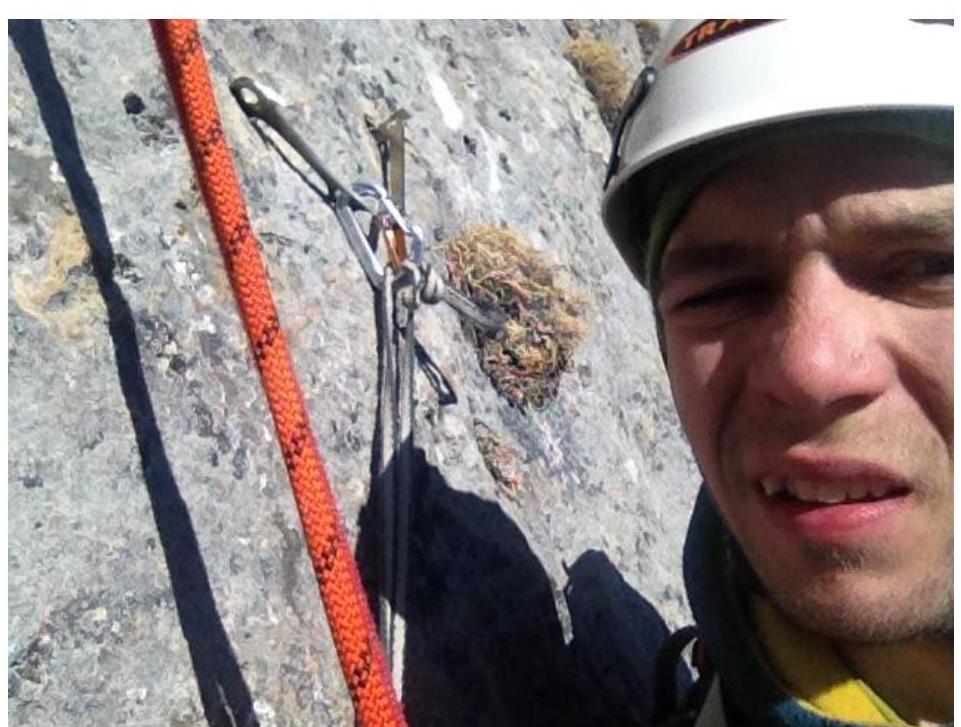
The R17 station is under a black-and-white overhang. From it, left and up along complex relief and then along an internal corner and wall onto a good ledge to the left of a very large overhang R18. At this point, our route converges with the route climbed by the Vladivostok-Krasnoyarsk team (№14). Further:
- slightly up, through rusty, crumbly terrain;
- then left into a large, slightly overhanging, inclined chimney. The first part is easy to climb;
- then the terrain becomes destroyed. Transition to ICA. Most protection points are unreliable;
- a cavern under a fifi hook found on the lower wall on the bulge made the passage easier;
- in the far part of the chimney, the ascent is vertically up for about four meters. Here is R19;
- then up and right along a wide crack. We wished we had more 3–5 size camalots here;
- exit onto a ledge. R20;
- along the continuing crack, where we wished we had even more camalots.
Move right onto the wall, and then up, exit to the summit. R21.
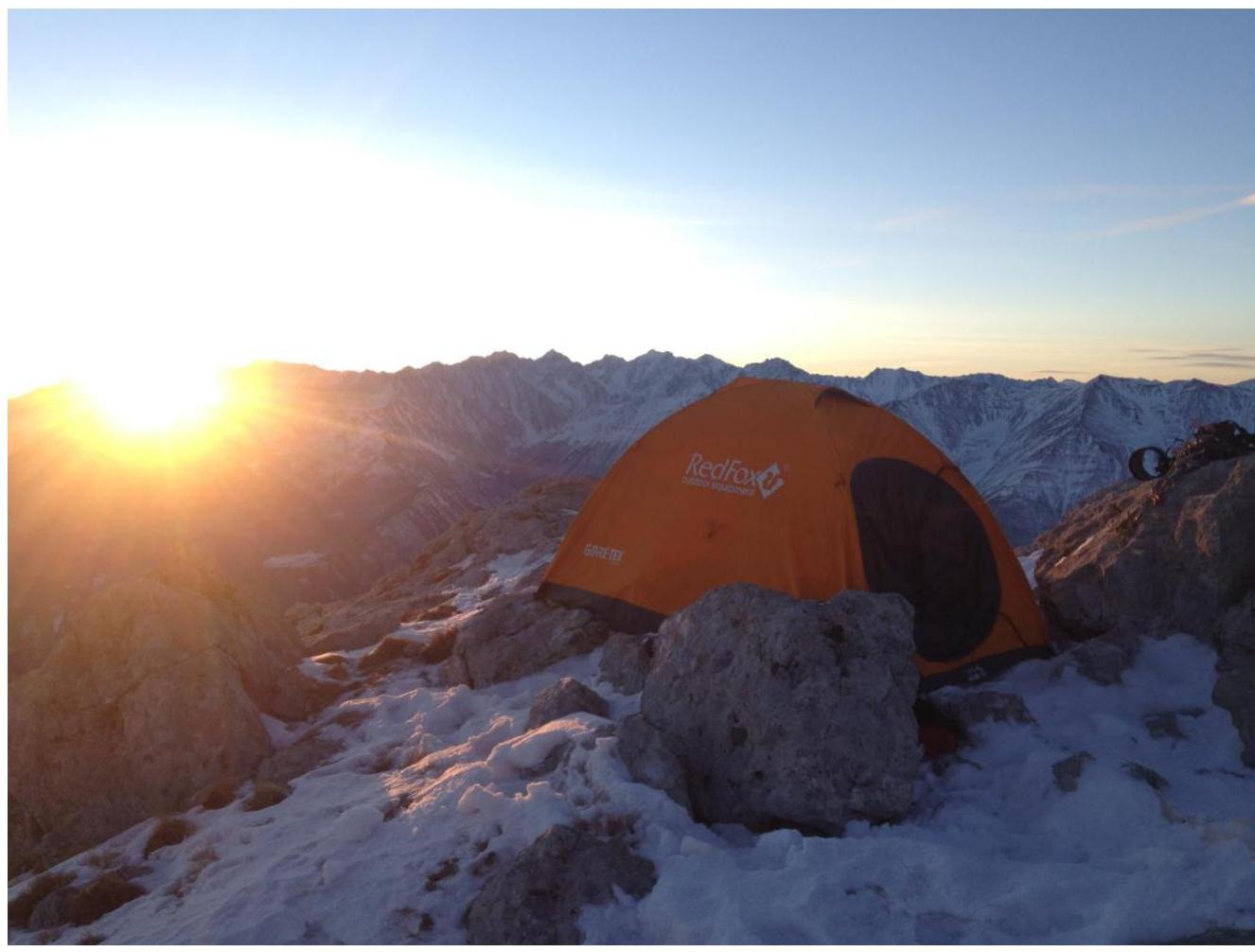
Overnight stay on the summit
Conclusion
The route turned out to be more difficult than expected. Comparing it to the 6A Dorro route, which we climbed later, we can say that it is more challenging. The amount of ICA is almost three times more. There is no need for drilling, at least for now (all stations on Dorro are drilled) neither on Dorro nor here!
There are quite large sections of destroyed terrain. This, combined with the verticality of the route, poses a high risk of dropping something on your partner if you climb carelessly!!! It's also not advisable to climb the neighboring route to the right simultaneously with this one! Particularly unpleasant sections on the route in this regard: R0–R2, R6–R9, and R18–R19. On the other hand, sections R10–R18 and R19–R21 are pleasantly monolithic.
Anchor hooks work very well for protection. We had 16 of them for two. Almost all were needed on the upper ropes.
It is possible that the upper part of the route, from R18, makes sense to go:
- straight up
- then to the right
The inclined chimney was very unpleasant!!! both for the first and the second climber.
We did not set up control points on the route. A good option would be to place one at R14.
A note from the "Gornik" alpine club team was found on the summit:
- A. Matinyan
- K. Senchenko
- V. Trikosov.
Comparing both routes, the Dorro G (6A category) and our route on Gaikomd Central (№13), we propose that our route be classified as 6A category.