

To the Judging Committee
Central Council of Physical Education
And Sports
Report
on the traverse of the North massif from Koshtantau peak to Dykhtau peak with ascent via the northern wall of Koshtantau by the "Dzhailyk" team.
Team composition: Captain — Candidate Master of Sports Mal'tsev V.F. and coach Members:
- Candidate Master of Sports Bakulin A.A.
- Candidate Master of Sports Zubov E.F.
- Candidate Master of Sports Il'in A.A.
- Candidate Master of Sports Malykhin Yu.M.
- Candidate Master of Sports Ovchinnikov M.F.
- Candidate Master of Sports Solov'ev Yu.A.
- Candidate Master of Sports Yakovlev G.S.
Senior coach of the team Master of Sports of the USSR Markov V.G.
1971
Geographical characteristics and sports overview of the ascent object
The object of the traverse is located in the Bezengi region of the Central Caucasus, in the Northern spur of the Main Caucasian Range. Between the peaks of Koshtantau 5145 m and Dykhtau 5198 m are sequentially located: Tikhonov peak 4615 m, Krumkol 4676 m, Eastern 4918 m and Western 4928 m Mizhirgi, Unnamed 4880 m peaks. Before Main Dykhtau, the tower of the Eastern peak rises. The peaks of Mises-tau and Brno close the Northern spur of the range from the west. From the north, the ridge is bounded by the Kundyum-Mizhirgi glacier with three stages of icefalls, from the south and west — by the Krumkol, Dykhsu, and Bezengi glaciers. These glaciers are fed by vast cirques formed by the peaks of the Main Range and its spurs.
The proximity of the alpinist base, good transportation links, thorough exploration of the area, and at the same time sufficient complexity of the route allowed the team to choose this route for participation in the USSR Alpine Championship.
For the first time, the traverse of the Northern spur from Dykhtau to Koshtantau was made by E.M. Abalakov and V. Miklashevsky in August 1938. Subsequently, it was repeated many times with various ascent options and in both directions. The ascent to the peak of Koshtantau via the Northern wall was first made by a group led by A. Simonik in August 1961. The traverse of the Northern spur with such an ascent had not been completed by 1971 — another factor that determined the choice of route.
Explanation for the table
On July 20, 1971, the team started the route with an overnight stay on the southern ridge of the "Utyug" gendarme. A long period of bad weather, which delayed our departure, continued on this day. From 10:00, we were forced to move in strong winds and snow grains. We had to clear every hold, every crack for a hook from snow and ice. Small avalanches of snow grains pouring down numerous couloirs of the northern wall of Koshtantau were a constant threat.
The wall is a system of implicit ridges, equal in difficulty. Therefore, there are many ascent options, and often you can see a hook or a loop left by other groups, aside from our path. The wall is technically complex, the rocks are mostly difficult, with a lot of ice. Practically nowhere, except for the ridge on section 8–9, can you not only gather everyone together but even put your foot on the entire sole without working for it. For the bivouac, we also had to cut down a lot of ice, but the tents stood well, and we slept well for the two nights spent at this bivouac. As the third day showed — we, having processed 240 m the day before, ascended to the dome of Koshtantau — there are no more convenient places for a bivouac above.
For organizing insurance on the wall, we mainly used titanium and duralumin wedges, long horizontal hooks, and tubular and screw-in hooks on ice sections. We had titanium carabiners, hooks, and jammers. All equipment was checked and certified by a commission with the participation of the authorized representative of the USSR Alpine Federation, Comrade Zak P.S. On July 23 at 9:00, we were at the summit of Koshtantau. We left some equipment there for the interaction group and began the traverse to Dykhtau peak. Here, the most challenging sections for us were the ascent to the first rocky rise of Krumkol peak (R16–17), to the shoulder of Mizhirgi peak (R20–22), the exit to the tower of West Mizhirgi (R24–25), the traverse to the saddle between East and Main Dykhtau (R32–33), and the ascent to the tower of East Dykhtau.
A diverse set of hooks allowed us to pass these sections with reliable insurance. We did not hammer in a single piton. We used ladders only once to facilitate the exit with backpacks from a chimney (R7–8).
We carried crampons with us throughout the traverse, which allowed us to pass ice sections calmly and confidently, especially on the descent from Dykhtau peak. However, three pairs would have been sufficient.
For descents, we mainly used the sports method, leaving a loop on a ledge at the top, and in three to four cases — a hook with a loop.
The set of products was quite diverse; we received approximately 4000 calories per person per day.
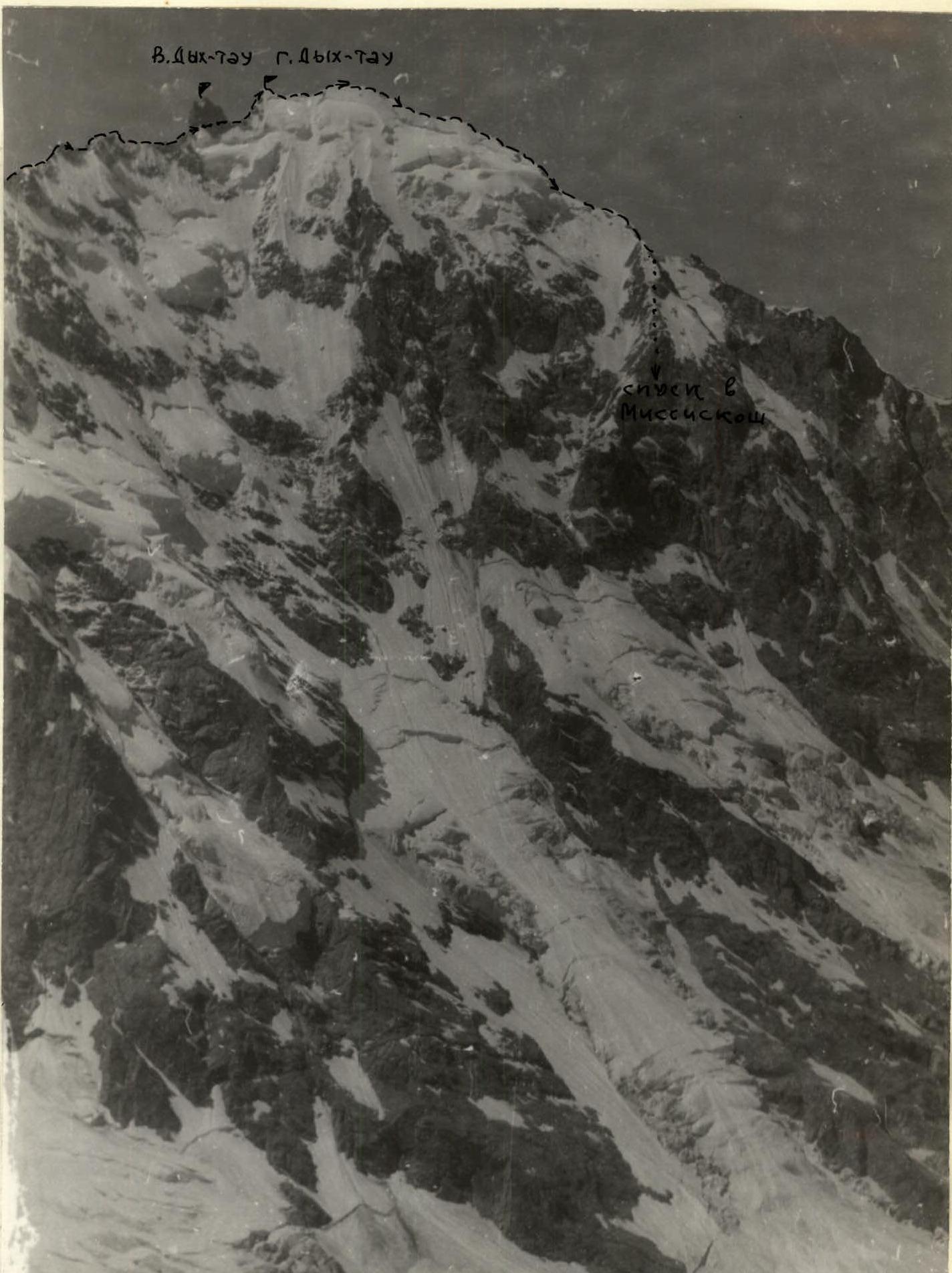
Dykh-tau from the north
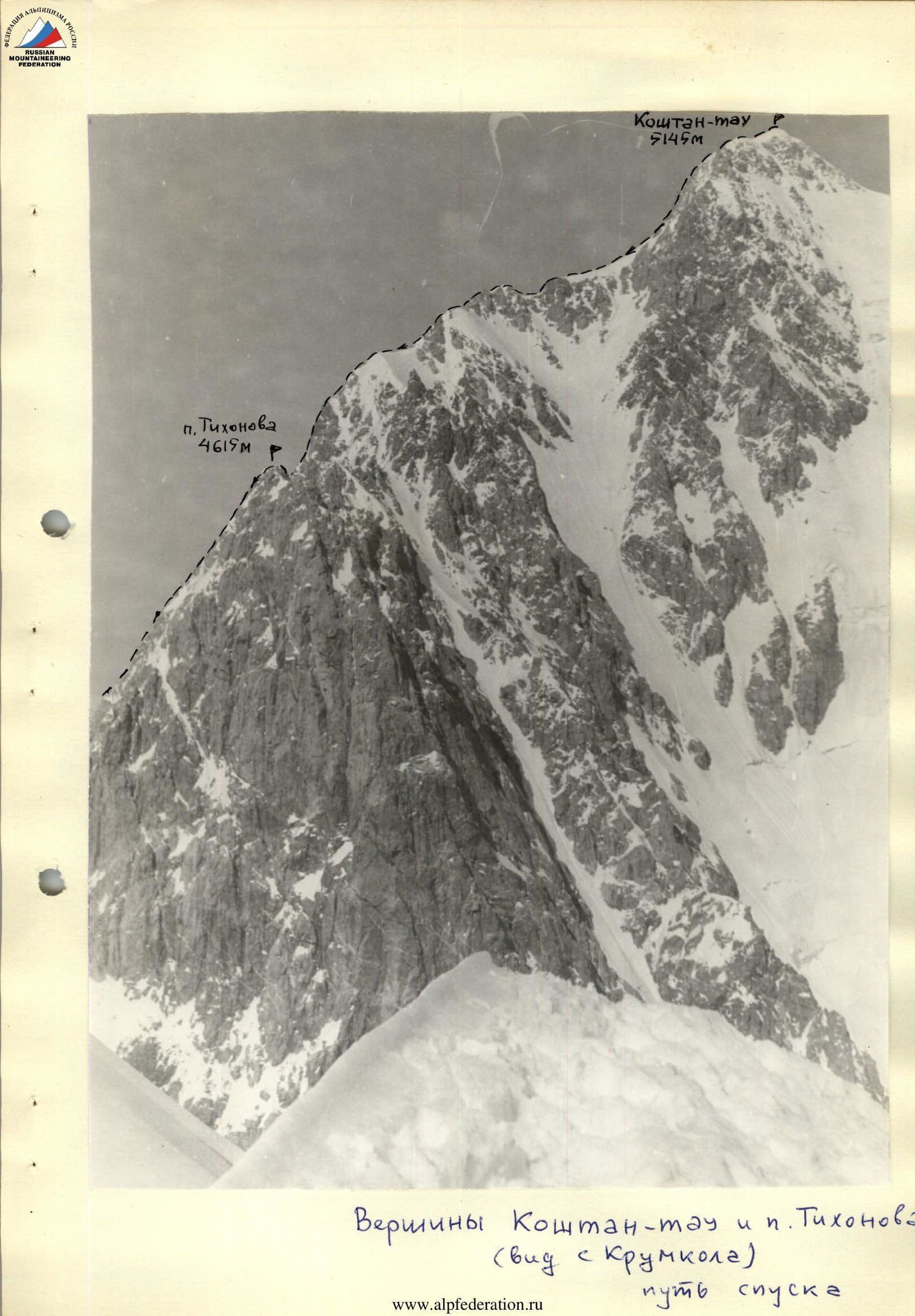
Peaks Koshtan-tau and Tikhonov peak (view from Krumkol)