
1966
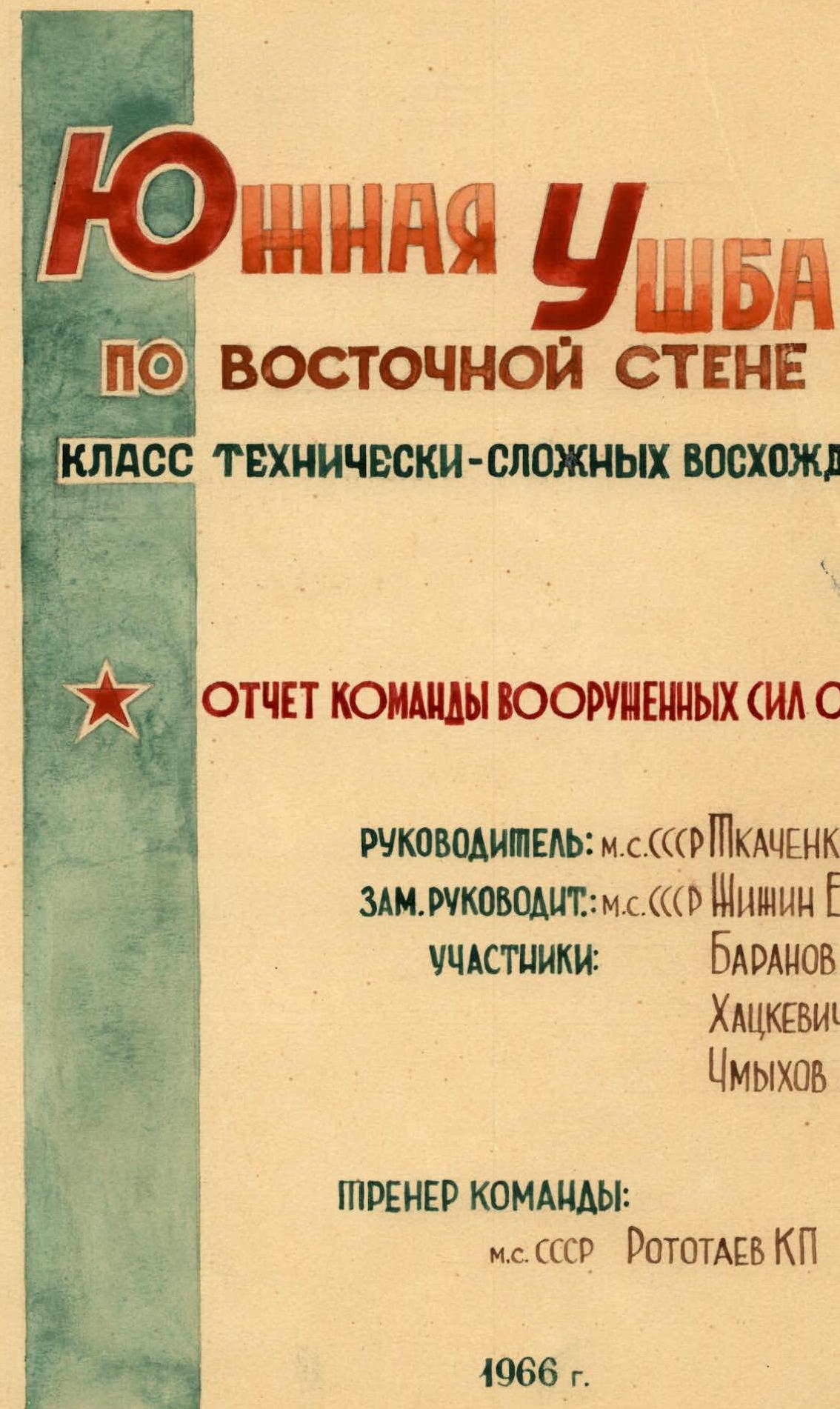
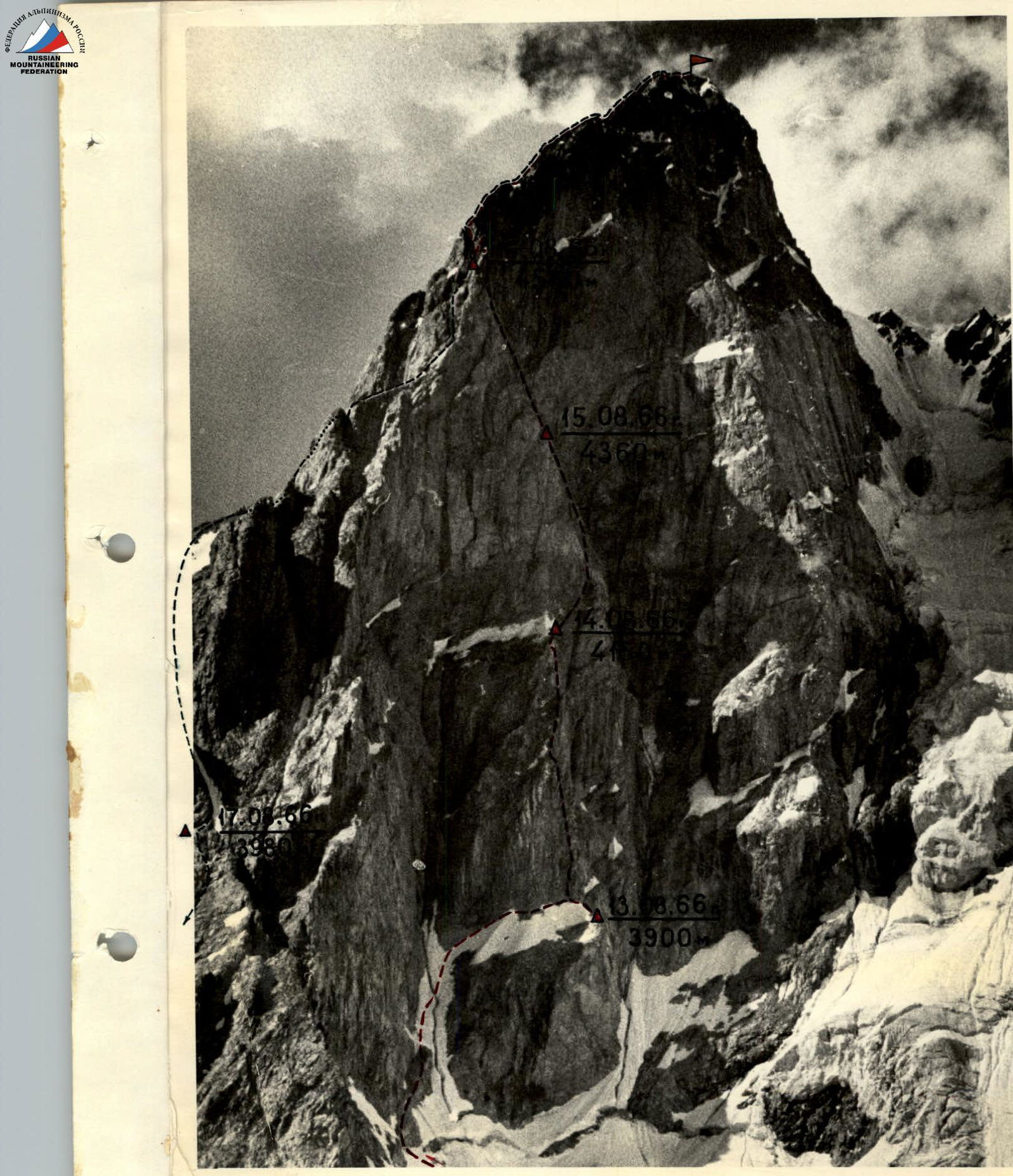 Photo 1. Approach to the wall from the base camp. Sections R1–R3.
The Ushba massif is well-known. It is located in a popular, well-studied mountaineering area.
In the last decade, climbers have worked hard to develop the harsh Ushba walls, making a series of new top-class routes. However, the possibilities for interesting first ascents on Ushba are not yet exhausted.
The team of the Armed Forces of the USSR declared and passed a route on the Eastern wall of South Ushba. This path attracted the attention of the army climbers back in 1959 during the ascent to the peak via the north-eastern wall. The route was studied carefully for a long time.
This path is logical and the only one. Passing along the protruding part of the wall, it is sufficiently protected from rockfall. The presence of two belts of steeply inclined terraces on the wall allowed for planning convenient overnight stays in advance.
The route can be conditionally divided into four major parts: three powerful steep rock climbs and the summit ridge. On the climbs of the wall, a large number of difficult sections were expected, predominantly:
- smooth overhangs;
- monolithic blocks;
- steep tiles like roof tiles;
- a significant number of overhangs and cornices.
This was due to the composition of the massif's rocks (granitoids) and the unfavorable (from a purely mountaineering point of view) southeast dip of the tectonic fracture planes cutting through the mighty Ushba massif.
The summit ridge of South Ushba is not particularly difficult.
The weather in the area of the peak is unstable - local thunderstorms are common. This required planning for a sufficient time reserve.
Before heading out on the declared ascent, the team conducted a series of training climbs in the mountains and completed several complex routes. This confirmed their good shape and preparedness.
For example:
- The ascent on the wall of the 3rd western peak of Shkhara via the "fish" required just over one day.
The organizational plan included:
- After training ascents of 5A and 5B category of difficulty, the team would head to the area of the declared ascent, fully equipped with everything necessary for the climb.
- Conducting additional reconnaissance on site with careful observation of the rockfall regime for 1-2 days.
- Followed by an immediate start on the route without preliminary cargo delivery and supplies.
A detailed scheme of directions of possible rockfall and ricochets was prepared in advance, which was to be checked under the conditions of August 1966.
Tactically, the passage of the wall was planned as follows:
1st day. Departure to the level of the first terrace:
- to the right - via the rocks;
- to the left - via the couloir (if sufficiently safe) - early in the morning.
Approach to the second climb, organization of a convenient overnight stay, and processing of the wall of the second climb along one of the two planned route options.
2nd day. Ascent along the processed sections and further movement along the wall of the second climb with an exit to the second terrace. Here - organization of an overnight stay and processing of the path on the third climb.
3rd day. Passage of the third climb if possible to the exit on the summit ridge, as organizing a convenient overnight stay on the wall of the third climb is apparently difficult. If it is not possible to reach the top of this climb in one day - searching for a place and organizing an overnight stay by 17:00–18:00.
4th day. Ascent to the summit and descent to convenient areas on the south-eastern edge.
5th day. Descent to the base camp.
The organizational and tactical plans were largely carried out as planned, although the situation introduced some adjustments.
Firstly, during the approach along the Dolra valley, an unforeseen delay occurred due to bridges washed away by floods.
Secondly, the departure from the base camp under Ushba could:
- be significantly delayed;
- or even not happen
due to the fact that the route was occupied by the "Gantiadi" group (led by G.I. Kartvelishvili), which had the same application.
Despite this, the Armed Forces team fully conducted the necessary additional reconnaissance of the wall and observations of the rockfall regime.
The day after, the situation on the route changed - an injury to the leg of one of the participants of the Georgian team (a fall above the first terrace) forced them to descend. We were able to start implementing our plan, losing only one day.
We finally chose the left option out of the two considered for ascending the wall as the safest. The tactical plan for passing the route was fully implemented by the team. However, the work on the third climb took two full days, and the summit ridge required much less time than we anticipated. The weather was favorable for the ascent. The team used equipment that had become standard for complex routes, a sufficient range of pitons, and for the second year used the "boomerang" - a convenient fixing device for lifting loads on difficult sections.
The application named the following team members:
- Team leader - Master of Sports A.V. Tkachenko
- Deputy team leader - Master of Sports E.D. Zhizhin
- Participants:
- Master of Sports K.P. Rototaev (team coach)
- 1st category L.M. Matyushin
- V.A. Baranov
- I.G. Khatskevich
- Reserve participants - 1st category:
- A.S. Chmykhov
- G.G. Vardanyan
- D.A. Makauskas
The team departed for the route in the following composition:
- Team leader - A.V. Tkachenko
- Deputy team leader - E.D. Zhizhin
- Participants - V.A. Baranov, I.G. Khatskevich, A.S. Chmykhov
K.P. Rototaev was unable to participate in the ascent due to health reasons. L.M. Matyushin was forced out due to an accident (scalded his leg with boiling water in the base camp).
The "Gantiadi" team that left the route advised us to start the ascent to the first climb via the couloir on the left - the path had been tested by them. The Georgian comrades expressed their opinion about the high difficulty of the route on the wall, especially its third climb, which, in their opinion, required lengthy piton work. They friendlily offered to:
- use their piton hooks, considering our supply insufficient;
- and cargo delivery with supplies.
We thanked them for their care but believed we were well-equipped for everything.
So, we started on the route...
August 13, 1966. Ascent at 5:00. Departure at 6:30. Initially along the moraine, then along the destroyed rocks of Gulba, we ascend to the glacier, where, bypassing crevices, drops, and exposed ice sections, we reach the bergschrund under the wall by 9:00.
The exit to the first climb goes along the couloir on the left, along the boundary of snow and rocks. Further along the inclined ice ledge, we exit into a rannkluft-pocket and along it to the Georgian comrades' site. Time - 10:45.
The Zhizhin-Chmykhov duo expands and improves the site. Tkachenko, Khatskevich, and Baranov begin processing the wall of the second climb.
It's warm.
To the right, behind the wall's bend, rocks are constantly falling.
We are reliably protected from them:
- by a huge smooth slab;
- by a semblance of an edge going vertically upwards.
The wall's relief - large smooth blocks, almost vertical slabs, walls with overhangs. Climbing is medium and difficult. Insurance is through pitons and ledges. A. Tkachenko confidently passes the difficult sections first.
There are large "live" blocks - here special caution is required since we are under each other. For work with the "lift" (a free long rope for operational transfer of necessary equipment to the leading climber), Baranov ascends on one rope.
Two rope lengths of the path have already been processed.
After the debris-covered ledge (section R9), we pass through a tile-like wall (80°). The rocks are difficult. The path leads into an internal corner with an overhang, very complex to overcome. There are almost no suitable footholds. Work on hands and friction takes a lot of effort. The slab-overhang is overcome to the left - upwards, and A. Tkachenko reaches the beginning of a steep edge 130 m above the overnight stay. From here, the path along the next section is studied in detail. Then follows a descent to the overnight stay.
August 14, 1966. Departure at 7:00. The section processed the day before is passed in 2 hours.
Further, the Zhizhin-Chmykhov-Baranov team works first. The edge (R11) is passed on the left side. Through 2.5 rope lengths, from a small oblique ledge upwards, there is a complex section of the wall. Backpacks are removed. Zhizhin goes first. Chmykhov services the "lift" work, Khatskevich and Tkachenko observe the upper part of the wall.
A 6-meter vertical chimney tapering upwards is passed. There are almost no holds or footholds.
Further, it is necessary to:
- exit to the right onto the wall;
- then onto a finger of rock separated from it by 0.5 m with a pointed top (R12).
Standing on one leg on the tip of this finger, E. Zhizhin, with difficult climbing, using a piton above for support, moves onto the smooth wall and reaches a small site a few meters further.
From here (R13), it is necessary to:
- carefully pass over large "live" boulders;
- then traverse upwards to the left along a huge, rasp-like, scaly slab that leads into a steep internal corner resting against an overhang.
The exit from under the overhang to the left along the wall (R14) leads to the inclined slabs of the upper terrace (R15).
The "boomerang" works, facilitating the ascent of backpacks along the wall.
20 m from here - a suitable place for constructing a site.
A short rest - studying the rocks of the third climb. The gaze slides along the monoliths of the wall, not finding a sufficiently acceptable path.
At 15:30, the Tkachenko-Khatskevich duo, taking everything necessary for processing, heads upwards to the right in search of "vulnerable" spots on the wall. The rest are busy constructing a site and cooking. The initially relatively simple section R16–R18 leads to a monolithic difficult wall of 80–85°. Initially, Tkachenko boosts Khatskevich, helping him reach the first crack. Pitons are used both for insurance and as supports.
Further, there is a large smooth slab of an ideal monolith (R20). The only path is along a vertical fissure formed by a detached slab. Leaning to the side, with hands on the edge of the fissure and feet against the wall, I. Khatskevich ascends. On the section of maximum steepness, it is necessary to wedge the left hand and leg into the fissure and crawl upwards another 2 m until it is possible to reach a handhold on a ledge 2–3 cm wide. There is a crack here. A piton and a ladder are used.
15 m of such a path lead to a small ledge in the middle part of the slab. It is difficult to find cracks for piton insurance.
A vertical crack in the upper part of the difficult belt of slabs-monoliths leads to the next section (R21) with smoothed blocks. There are few ledges.
Another rope length reaches a convenient ledge with a wedged 5-meter slab. By this moment, the supply of:
- ropes free for processing;
- working time
is exhausted.
At 18:00, we descend to the site on the second terrace.
August 15. We start work at 7:15. By 9:30, the first team, Chmykhov-Baranov-Zhizhin, passes the processed section of the wall. The further path does not promise to be easier. Zhizhin goes first.
To the right, beyond the outer corner, after 4 m, there is an approach to a smooth sheer wall (R22). It is necessary to use a ladder. Above are smoothed rocks, quite difficult, but they can be passed without artificial supports. After one rope length, a slab with a fissure is reached, covered from above by overhanging blocks. There is no other path. It is necessary to go up the slab to the left (R23). This is difficult but completely protected from being shot from above. The slab leads to a not clearly expressed internal corner, leading to a small ledge.
The next section (R24–R25) is more complex than all previous ones. Its structure:
- an overhanging 3-meter wall;
- a monolithic wall with two cornices;
- above - a steep internal corner formed by a smooth slab and a huge block with a cornice.
There are almost no holds, and cracks are extremely rare.
From the very first step, the wall "repels." One by one, ladders come into play. The first overhanging belt is overcome. There are fewer and fewer cracks. It is necessary to move to the left side of the hanging pfeiler. A few meters up, there is a second large cornice above. Now, a right traverse of the faces of two almost vertical monolithic blocks resting against the cornice is necessary. For over an hour, E. Zhizhin slowly but persistently moves away from us, higher and higher, engaged in "self-suspension." He is already in the internal corner.
- There are no holds at all.
- But cracks are still found.
Stretched to the limit to the right, Zhizhin exits from under the upper cornice onto a slab and, with difficulty finding cracks, hammers in piton after piton. Finally, the last ladder is hung, and after another 3 m, the two-hour climbing ends on a not very wide but sufficiently convenient ledge.
16 pitons are hammered in, 15 ladders are hung. The path is prepared.
Gradually, the rest climb up. It is heavy going for A. Chmykhov here. He goes last, and extracting, hanging, pitons under himself is not an easy task.
He grumbles:
- "It would have been worth hammering in a couple of piton hooks, or skeptics won't believe the route is really difficult!"
Everyone gathers on the ledge. The mood is excellent. We decide to set up a bivouac here - it's unlikely to find another suitable place soon.
Further, only a section of two rope lengths is visible (R26). It did not require mandatory preliminary processing but made sense to thoroughly scout the upper part of the path. The Tkachenko-Khatskevich duo heads out at 16:00 with a light pack to tackle this task.
An 80-meter section of rough rocks with few cracks and small ledges is overcome with careful insurance. Two ropes are hung here.
At the end of the section, a chimney with a plug, resembling a card house, is successfully passed by Tkachenko (R27).
Further, the left variant of the path is scouted with an exit under the tower. Sections of difficult "disheveled" rocks are passed under a narrow vertical slit 15 m long. The ascent along it by complex climbing leads to a ledge.
Further, very difficult rocks requiring the use of ladders.
The duo descends back to the bivouac, leaving a free rope, hammer, and supply of pitons on the ledge.
August 16:
- In the morning, it snows, and the blue sky is not visible.
- We depart at 7:45 - there is hope that the weather will improve.
- Will the rockfall regime change in the new weather situation?
The Tkachenko-Khatskevich duo had not yet passed half of the first rope length when a rumble was heard - several blocks broke off from the top of the tower and, gaining speed, rushed down. After two or three impacts on the wall, they turned into one large charge of rock debris.
We are under the protection of the walls. The charge passed by, with only rock fragments rattling on our helmets.
This was the first and only unexpected rockfall on the wall for us, apparently caused by:
- a sharp change in weather conditions;
- strong gusty wind.
We knew or anticipated the possibility and paths of the others in advance.
After discussing the situation, we decided to move to the right, away from the treacherous tower, rejecting the left variant of the path taken the day before.
I. Khatskevich heads out on a reconnaissance mission with a light pack. The chimney is passed by him along the previous rope. Further, upwards to the right, 15 m of monolithic rocks (up to 70°) with good holds (R28). After an unpleasant outer corner of live blocks, there is an exit along rocks with slabs (R29) onto the ledge where we left a whole arsenal of pitons the day before, much further to the left. We retrieve them, and they immediately come into use.
The further path is complex (sections R30–R32).
8 m of smoothed rocks at 80° lead to a very difficult spot - a 6-meter smooth slab at 75–80°.
- A ladder is hung.
- The slab turns into a 1.5-meter cornice at the top and is overcome by a small traverse to the left, where the cornice is cut by an internal corner-gutter (20 m), very smooth, as if licked in granite.
- There are extremely few holds and cracks for pitons.
- Movement is with maximum use of friction.
The exit from the corner is blocked by a 0.5-meter cornice, which is the lower edge of an 8-meter slab (75°). The cornice is passed with difficulty, using a ladder. The slab has small holds. It leads to a ledge where the entire team can gather. The first to reach it is at 14:30. The rest follow the rope. Backpacks are pulled out.
Above the ledge, the wall of the tower overhangs - protection from rocks is reliable. From here, along a slab to the right (R33), Khatskevich exits to a pile of "live" stones-blocks and detached slabs. It is necessary to climb with great caution:
- along swaying boulders to a tile-like wall;
- move along it under the wall;
- further follow the wall along which the path to the tower goes.
Here is a very difficult section for climbing (R35). Steepness up to 85°, monolith with a large number of faces differing from each other by several degrees in inclination and conjugated along well-visible lines.
I. Khatskevich climbs very well here, using inclined ledges-splits and smoothed ledges for support. The rocks are dry, friction is maximally utilized. On wet rocks, it would hardly be possible to pass here without expanding pitons. The "lift" works, replenishing the assortment of pitons for the leading climber. One more effort... the failure at the tower is reached.
The exit to the tower from the failure is complex (R36). It is necessary to move to the left and then upwards, hanging over a smooth sheer wall when bypassing a strongly protruding outer corner.
Behind it:
- a smooth slab leading to the top;
- to the left and down - failures for many hundreds of meters;
- to the right - a sheer wall without holds.
Very slowly, carefully, only on friction - with feet and hands on the slab, and with shoulder and side against the wall - there is movement upwards. Slipping is unacceptable. Two cracks are encountered.
- Pitons are hammered in, allowing for a short rest.
Finally, the slab is passed, and a few more meters of rocks of medium difficulty...
That's it! The wall is passed! All the most difficult is behind, but the work is not finished. The rest climb up one by one. Backpacks are pulled out with breaks. Everyone is noticeably tired.
A. Tkachenko climbs last, extracting pitons. It's harder for him - other pitons are firmly seated, but the taut rope leads to the side. But even this comes to an end. We descend along slabs and destroyed rocks to a site for a tent already on the route of G. Khergiani.
At 18:30, everyone is in the tent, discussing options for the future descent, and Ushba is shrouded in clouds.
Today, in 11 hours of work, 7 rope lengths were passed, 4 of which were along difficult and very difficult rocks.
August 17. We depart lightly at 7:15. From the site:
- along a couloir to the ridge;
- initially to the left of it;
- then along the ridge itself;
- passing sections of snow and ice;
- we approach the summit.
After the wall, it's very easy here. In an hour, we are at the summit of South Ushba. We take a note from the team of G. Kartvelishvili, who passed the route of G. Khergiani. We leave our own.
Returning to the tent, we begin the further descent. Initially, a rope length and a half sportively, then a 40-meter rappel with a "shower." Then 35 m of sport climbing and an exit along debris to the "balda." From here, the descent is by climbing to the right to the red destroyed rocks on the ridge. From the ridge to the left onto ledges and large debris, and further into the couloir. After passing two rope lengths sportively, we continue moving along the couloir alternately. Exiting the couloir to a wide field of cracked slabs, we turn to the right under the overhangs. Here are several sites. We build another, large one, closed from rocks and wind. We rest in comfort.
August 18, 1966. Departure at 5:00. We continue the descent and by 10:00 approach the site of our base camp, where, to our surprise, the Georgian climbers arrange a warm friendly meeting for us.
The team did not have a special auxiliary group since it managed with its own forces. The functions of the observation group were partially performed by the interaction group led by V. Nekrasov, who was making an ascent on South Ushba via the route of G. Khergiani. Racket communication was established and carried out with this group according to the established scheme.
The team believes that the route they passed on the eastern wall of South Ushba deserves a rating of 5B category of difficulty and is one of the complex ascents in this category.
We consider it our duty to express our hot gratitude and appreciation to all participants of the Georgian teams who showed us so much attention and friendly care.
In conclusion, it is necessary to note that in wet rocks and bad weather, the difficulty of the route can increase many times due to:
- the smooth texture of the rocks;
- too small, smoothed holds;
- slippery slabs.
The rockfall regime will also change significantly in bad weather. All this should be taken into account by subsequent climbers on the eastern wall.
 www.alpfederation.ru ↗
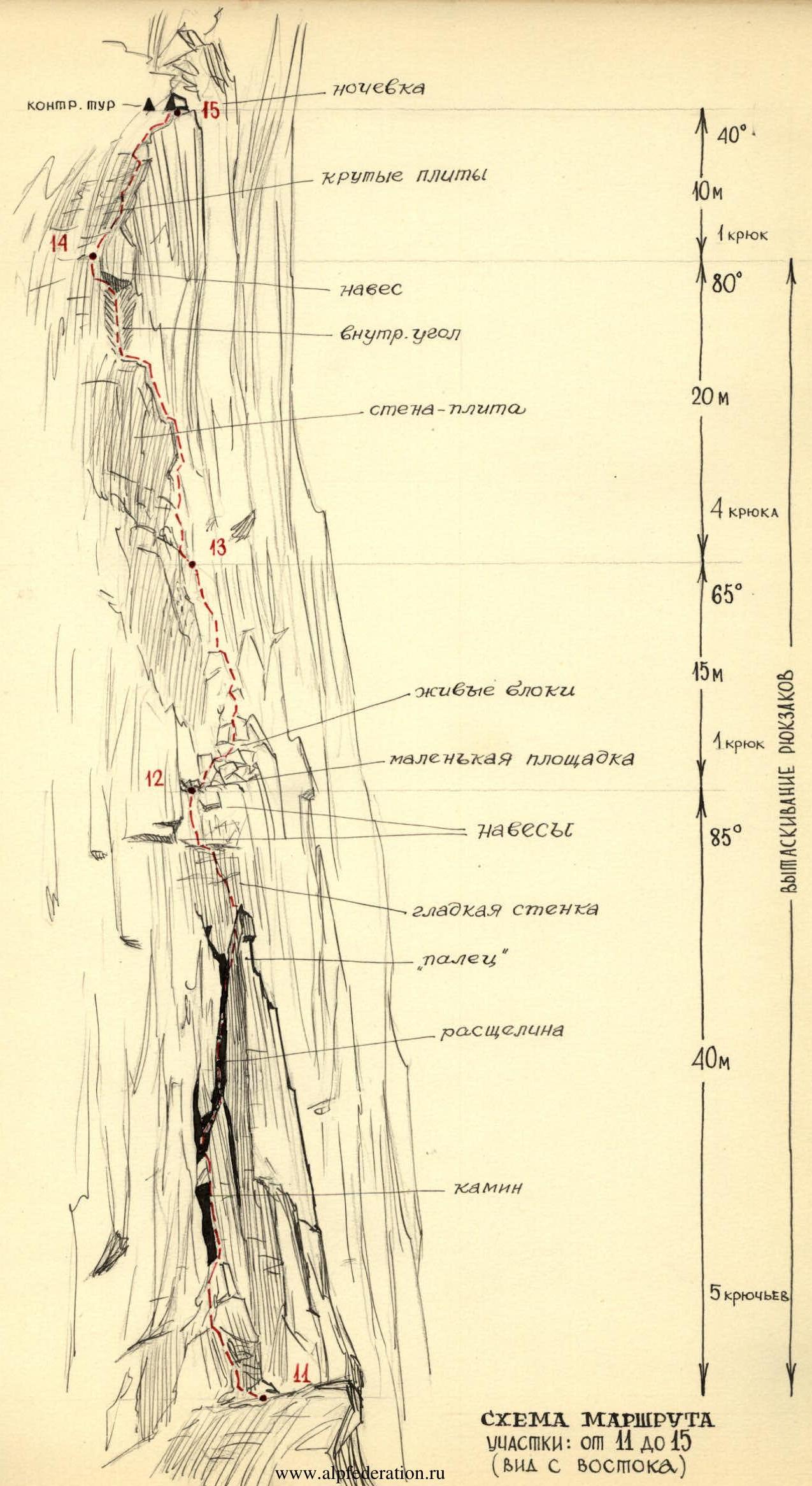
ROUTE SCHEME. SECTIONS: FROM R4 TO R11 (VIEW FROM THE EAST)
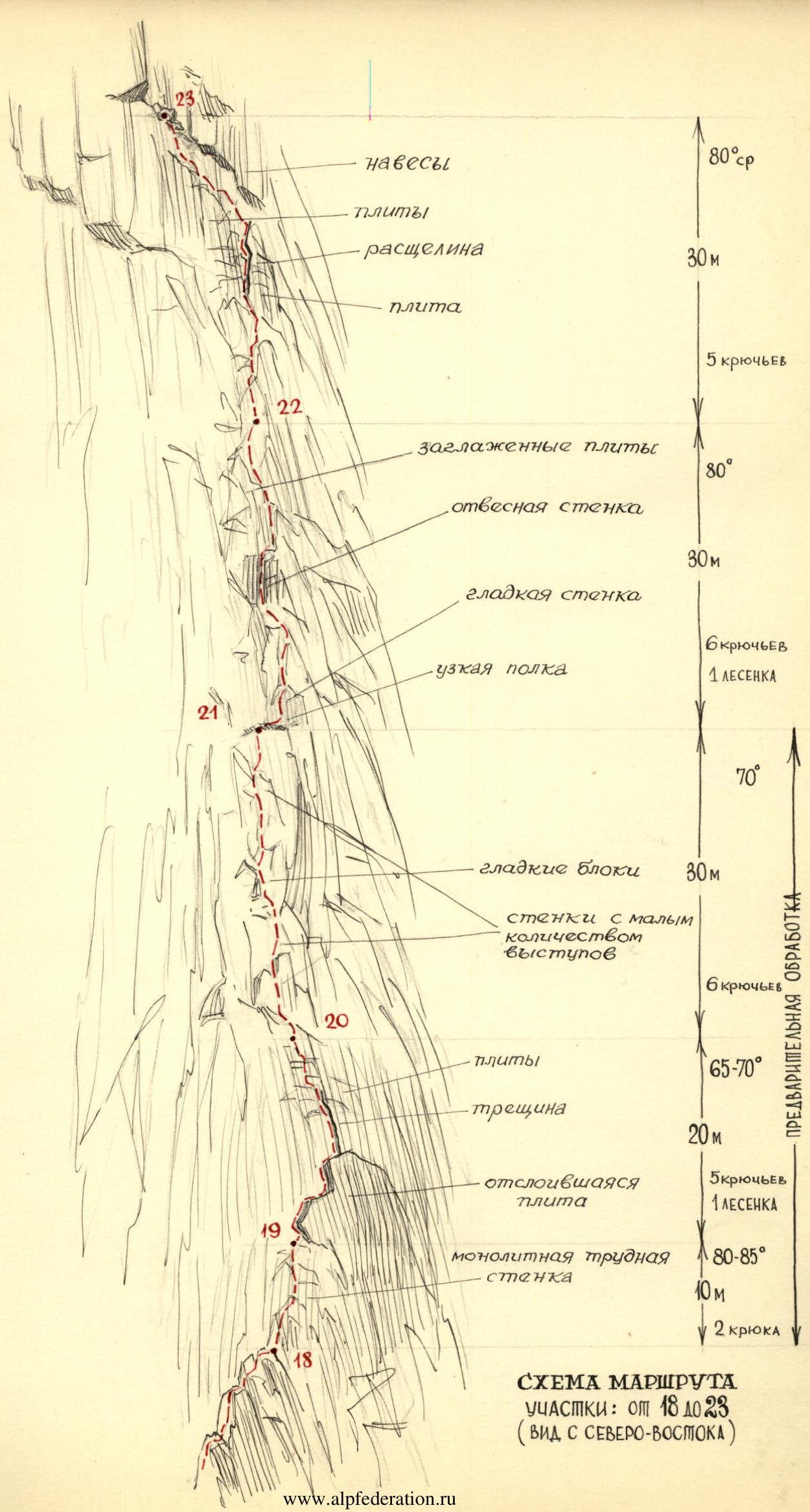
Route Scheme
Sections: from R18 to R23
(VIEW FROM THE NORTHEAST)
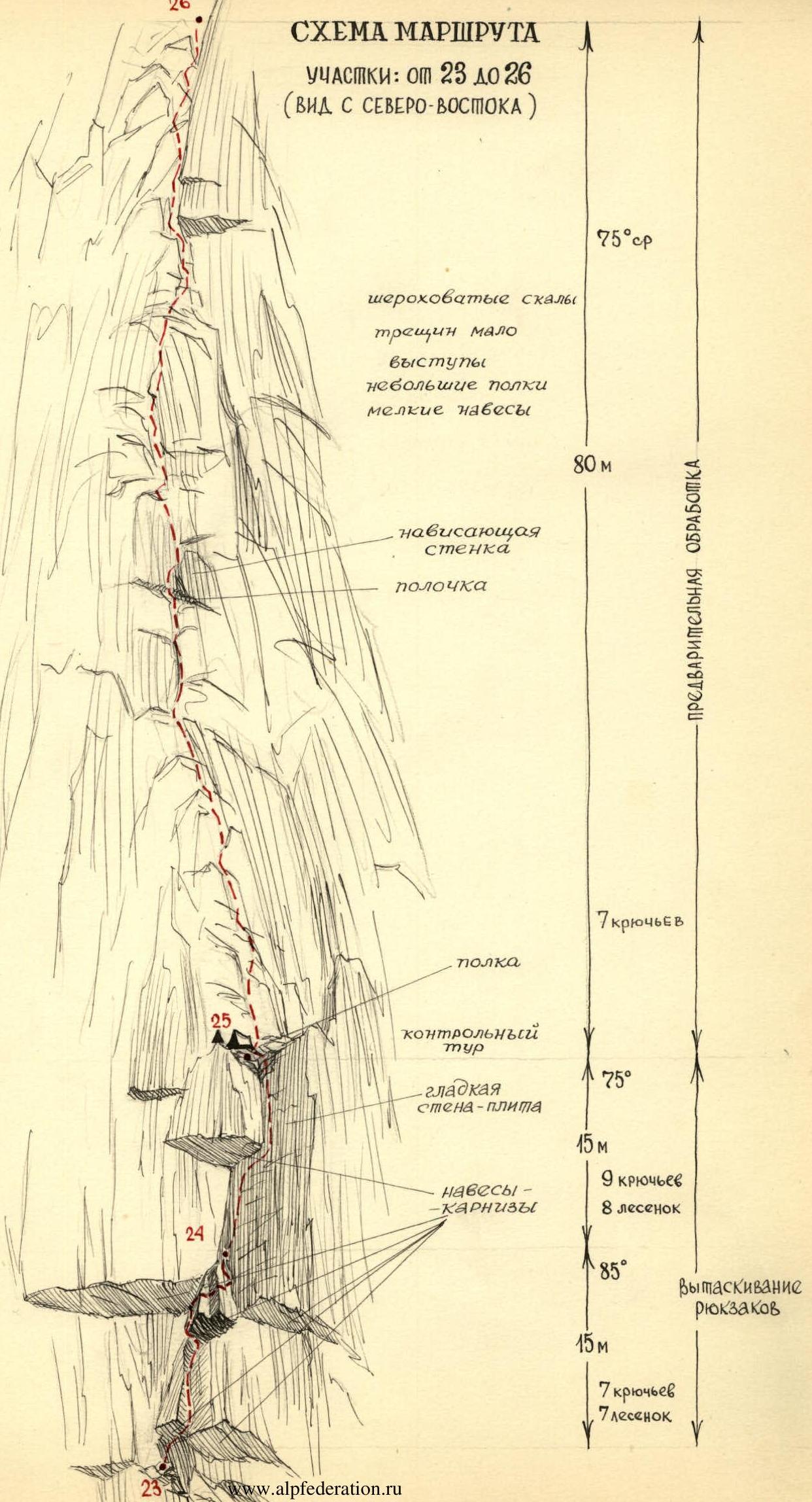
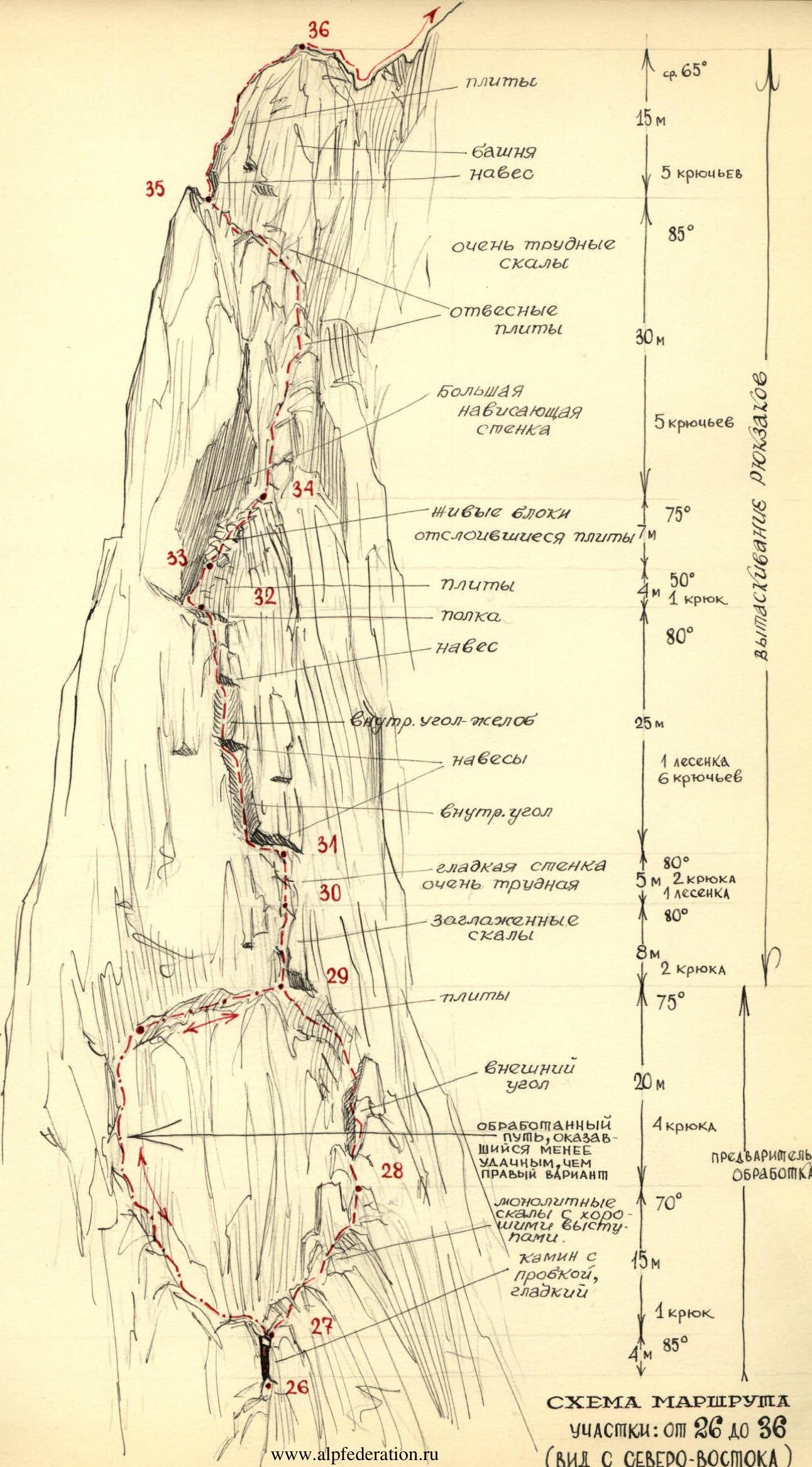
ROUTE SCHEME. The team successfully coped with the route, demonstrating good mastery of complex climbing techniques, the ability to correctly use modern equipment and techniques when necessary. The team members are well-prepared for climbs of this class. The team worked in a friendly and coordinated manner, was well-trained and prepared for the route:
- technically;
- tactically;
- physically;
- morally.
There were no cases of falls or violations.
Captain of the Armed Forces of the USSR team: Master of Sports of the USSR A.V. Tkachenko
The route was passed by the team tactically correctly, in the required style and tempo. Undoubtedly, the overall success of the team was significantly influenced by:
- the great experience and skill of A. Tkachenko, who led the ascent;
- the calm persistence and technical skill of E.D. Zhizhin;
- the significantly grown individual technique of I.G. Khatskevich, who passed a number of complex sections first.
A. Chmykhov worked well on the route, participating in the competition for the first time. V. Baranov also showed good preparation, although it is desirable for him to be more proactive in his work. These minor comments do not detract from the team's excellent performance on the ascent, which is another step in the sporting development of Ushba. The tasks set before the team were successfully completed, in accordance with the specific situation on the route, independently and maturely.
TRAINER OF THE ARMED FORCES OF THE USSR TEAM: Master of Sports of the USSR K.P. Rototaev
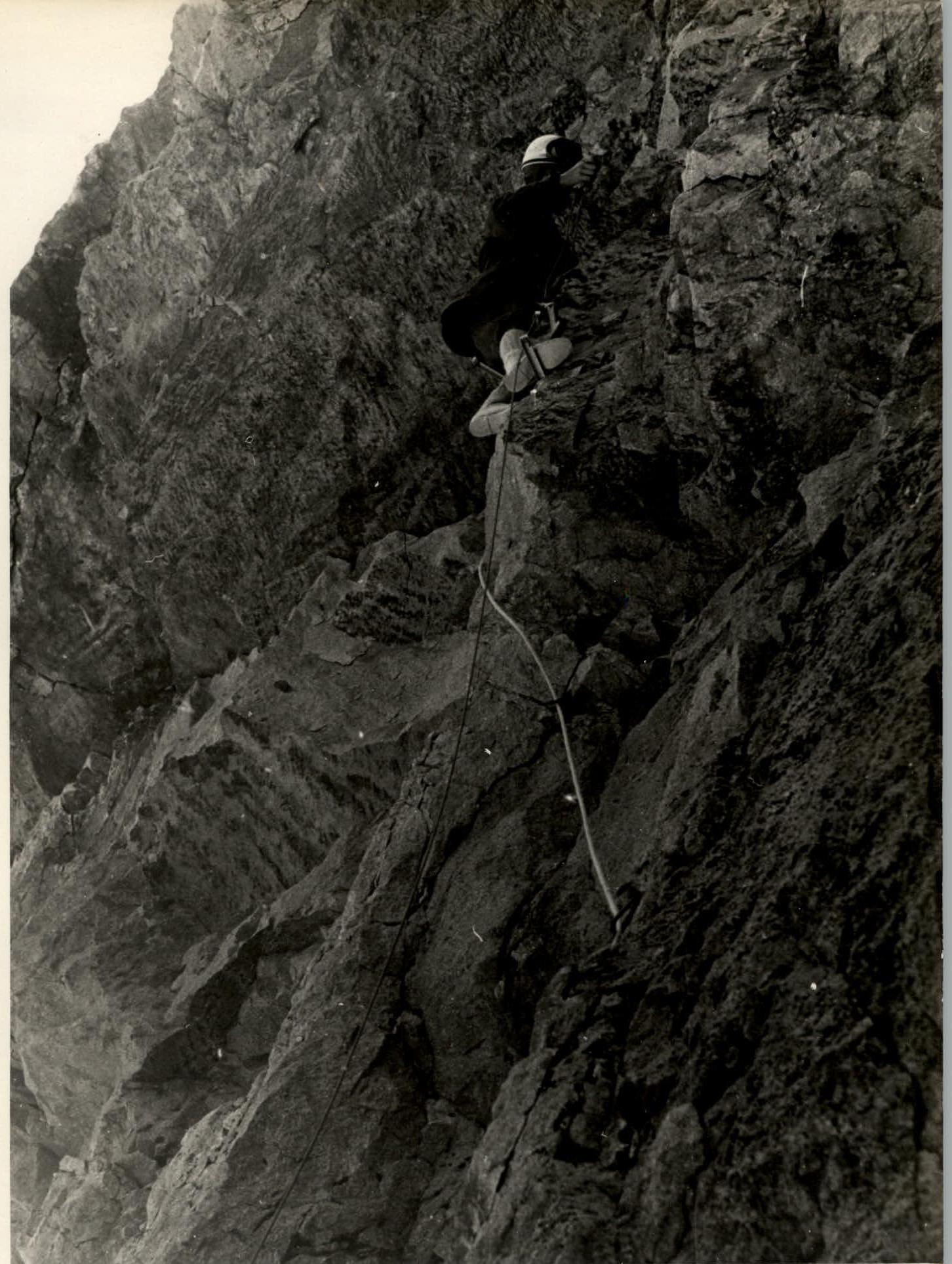
Photo 8. The first overhanging belt of section R24 has been passed. E. Zhizhin has reached the left side of the pfeiler. He is holding a piton with a carabiner on a piton catcher. A "lift" (free rappel rope) is going down. Above, in the background, is the second belt of overhangs. Photo taken from below upwards.
Table
Main characteristics of the ascent route
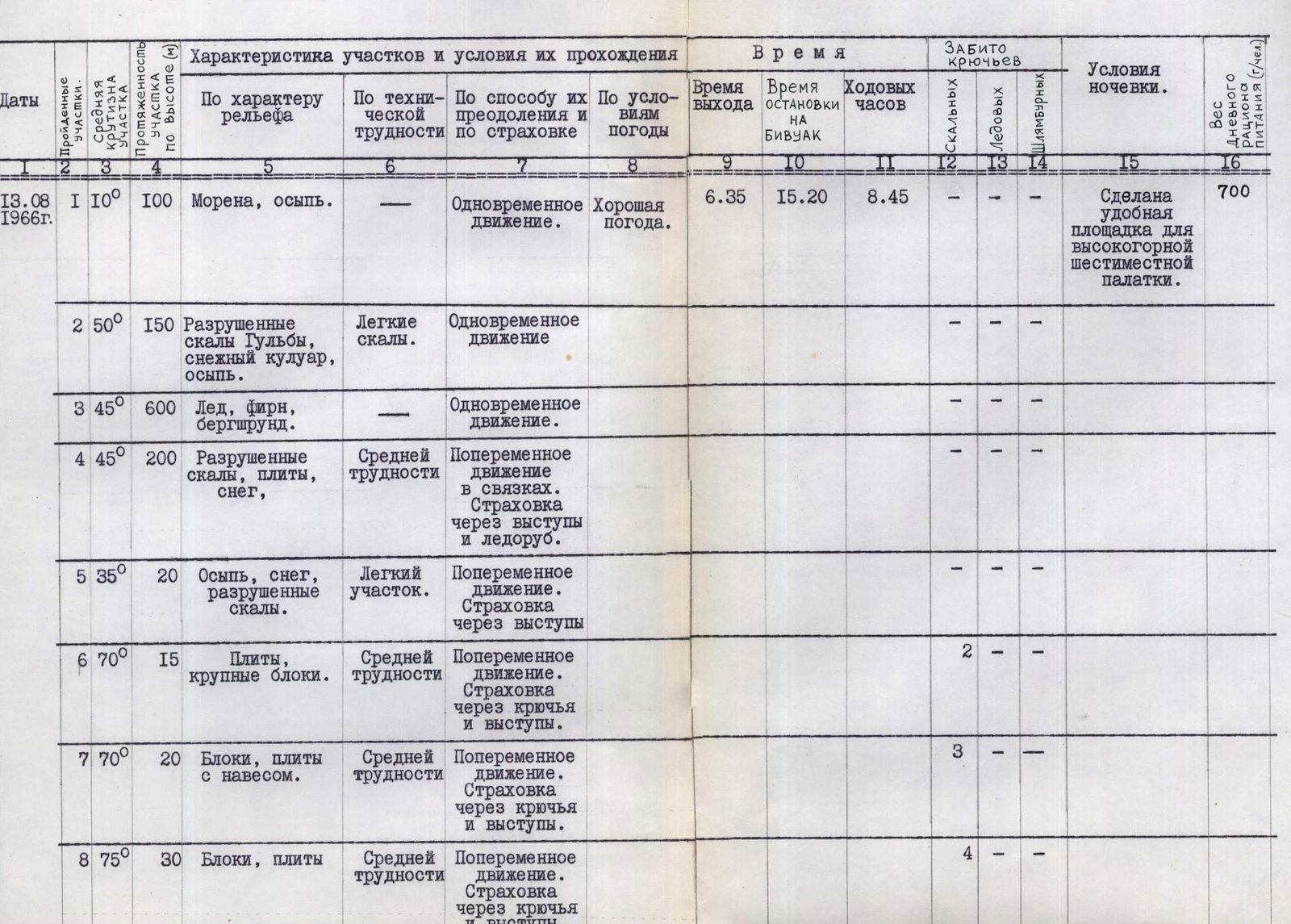
| 1 | 2 | 3 | 4 | 5 | 6 | 7 | 8 | 9 | 10 | 11 | 12 | 13 | 14 | 15 | 16 |
|---|---|---|---|---|---|---|---|---|---|---|---|---|---|---|---|
| August 13, 1966 | R1 | 10° | 100 m | Moraine, scree. | Easy section. | Simultaneous movement. | Good weather. | 6:35 | 15:20 | 8:45 | – | – | – | A convenient site for a high-altitude six-seater tent has been made. | 700 |
| R2 | 50° | 150 m | Destroyed rocks of Gulba, snow couloir, scree. | Easy rocks. | Simultaneous movement. | – | – | – | – | – | – | ||||
| R3 | 45° | 60 m | Ice, firn, bergschrund. | Simultaneous movement. | – | – | – | – | – | – | |||||
| R4 | 45° | 20 m | Destroyed rocks, slabs, snow. | Medium difficulty | Alternating movement in teams. Insurance through ledges and ice axe. | – | – | – | – | – | – | ||||
| R5 | 35° | 20 m | Scree, snow, destroyed rocks. | Easy section. | Alternating movement. Insurance through ledges. | – | – | – | – | – | – | ||||
| R6 | 70° | 15 m | Slabs, large blocks. | Medium difficulty | Alternating movement. Insurance through pitons and ledges. | – | – | – | 2 | – | – | ||||
| R7 | 70° | 20 m | Blocks, slabs with overhang. | Medium difficulty | Alternating movement. Insurance through pitons and ledges. | – | – | – | 3 | – | – | ||||
| R8 | 75° | 30 m | Blocks, slabs | Medium difficulty | Alternating movement. Insurance through pitons and ledges. | – | – | – | 4 | – | – | ||||
| R9 | 20° | 10 m | Scree-covered ledge. | Easy section. | Alternating movement. Insurance through ledges. | – | – | – | – | – | – | ||||
| R10 | 80° | 35 m | Wall of tile-like type and internal corner with overhanging wall. | Difficult section. | Alternating movement. Insurance through pitons and ledges. | – | – | – | 5 | – | – | ||||
| August 14, 1966 | Sections R6–R10 passed along hung ropes. | Good weather. | 7:00 | 18:00 | 11 | – | – | – | A good site has been built. | 700 | |||||
| R11 | 50° | 60 m | Dissected rocks. | Medium difficulty. | Alternating movement. Insurance through ledges. | – | – | – | – | – | – | ||||
| R12 | 85° | 40 m | Steep rock wall with fissure, chimney, separate standing stone (finger). Holds are bad. | Difficult rocks. | Complex climbing. Insurance through pitons and ledges. | – | – | – | 5 | – | – | ||||
| R13 | 65° | 15 m | Steep poorly lying blocks. Destroyed rocks. Live stones. | Difficult section. | Passed by climbing. Insurance through ledges and pitons. | – | – | – | 1 | – | – | ||||
| R14 | 80° | 20 m | Slab with crack, internal corner with overhang. | Difficult rocks. | Complex climbing. Insurance through pitons and ledges. | – | – | – | 4 | – | – | ||||
| R15 | 40° | 10 m | Smoothed slabs with ledges. | Easy rocks. | Alternating movement. Insurance through piton. | – | – | – | 1 | – | – | ||||
| R16 | 30° | 20 m | Scree, steep open ledges, slabs with freely lying small stones. | Easy rocks. | Simultaneous movement. Insurance through ledges. | – | – | – | – | – | – | ||||
| R17 | 70° | 35 m | Destroyed rocks. | Medium difficulty | Alternating movement. Insurance through ledges. | – | – | – | – | – | – | ||||
| R18 | 40° | 10 m | Destroyed rocks. | Easy section. | Alternating movement. Insurance through ledges. | – | – | – | – | – | – | ||||
| R19 | 80° | 10 m | Monolithic wall with few holds. | Difficult rocks. | Complex climbing with gymnastic insurance and insurance through pitons. | – | – | – | 2 | – | – | ||||
| R20 | 65–70° | 20 m | Smooth slab with fissure. | Difficult rocks. | Complex climbing. One ladder used. Piton insurance. | – | – | – | 5 | – | – | ||||
| R21 | 70° | 30 m | Small smoothed blocks alternating with walls. Few ledges. | Medium difficulty | Alternating movement. Piton insurance. | – | – | – | 6 | – | – | ||||
| August 15 | Sections R16–R21 passed along hung ropes. | Good weather. | 7:15 | 18:15 | 11 | – | – | – | A site has been built on a ledge. | 700 | |||||
| R22 | 80° | 30 m | Smoothed slabs, sheer wall. | Difficult rocks. | Alternating movement. One ladder hung. Insurance through pitons. | – | – | – | 6 | – | – | ||||
| R23 | 80° | 30 m | Slab with fissure under overhanging blocks, ledge. | Difficult rocks. | Complex climbing. Piton insurance, in lower part through ledges. | – | – | – | 5 | – | – | ||||
| R24 | 85° | 15 m | Overhanging wall, monolithic wall with two cornices. Few holds. | Very difficult rocks. | Section passed using seven ladders. Piton insurance. | – | – | – | 7 | – | – | ||||
| R25 | 75° | 15 m | Internal corner with cornice. Smooth slab without holds. | Very difficult rocks. | Section passed using eight ladders. Piton insurance. | – | – | – | 9 | – | – | ||||
| R26 | 75° | 80 m | Rough rocks with few cracks. Small ledges, small overhangs. | Medium difficulty | Alternating movement. Insurance through ledges and pitons. | – | – | – | 7 | – | – | ||||
| R27 | 85° | 4 m | Internal corner-chimney with plug. | Difficult section. | Alternating movement. Insurance through ledge. | – | – | – | – | – | – | ||||
| August 16 | Sections R26–R27 passed along hung ropes. | Morning sleet, good weather during the day. | 7:45 | 18:30 | 10:45 | – | – | – | A site has been built on the tower. | 700 | |||||
| R28 | 70° | 15 m | Monolithic rocks with good ledges. | Medium difficulty | Alternating movement. Insurance through ledges and piton. | – | – | – | 1 | – | – | ||||
| R29 | 75° | 20 m | Wall with smoothed ledges. Outer corner. Ledge. | Rocks of medium difficulty | Alternating movement. Insurance through ledges and pitons. | – | – | – | 4 | – | – | ||||
| R30 | 80° | 8 m | Steep smoothed rocks. | Difficult section. | Complex climbing, piton insurance. | – | – | – | 2 | – | – | ||||
| R31 | 80° | 5 m | Smooth slab. | Very difficult section. | Complex climbing. Piton insurance. Ladder hung. | – | – | – | 2 | – | – | ||||
| R32 | 80° | 25 m | 1.5-meter cornice, internal corner, 0.5-meter overhang, smoothed slabs. Exit to ledge. | Very difficult section. | Complex climbing. Ladder hung. Piton insurance. | – | – | – | 6 | – | – | ||||
| R33 | 50° | 4 m |

Comments
Sign in to leave a comment