up. 595 dated 13.11.90 2.4.445
N 34 RSFSR CHAMPIONSHIP IN ALPINISM 1990 6A and/or TECHNICAL CLIMB CLASS
REPORT
REPORT ON THE ASCENT TO THE SUMMIT OF USHBA SOUTH 4711 m VIA THE BASTIONS OF THE SOUTHWEST WALL (FIRST ASCENT) BY THE TEAM FROM THE SPORTS CLUB "RODINA" OF THE KIROV REGIONAL SPORTS COMMITTEE
TEAM LEADER ZHOLOBOV M.P. TEAM COACH MASHKOVTSEV V.I. Sports Club "RODINA": 610006, Kirov, ul. Lepsse, 4A, tel. 30310, 36592.
Team Leader: ZHOLOBOV Mikhail Pavlovich, Kirov, ul. Surikova, 9, apt. 54, tel. 42303. Deputy Team Leader: SHABALIN Pavel Eduardovich, 610000, Kirov, ul. Nekrasova, 6A, apt. 36, tel. 41034. Team Coach: MAKOVTSEV Vladimir Ivanovich, Kirov, ul. Lenina, 63/12, apt. 3.
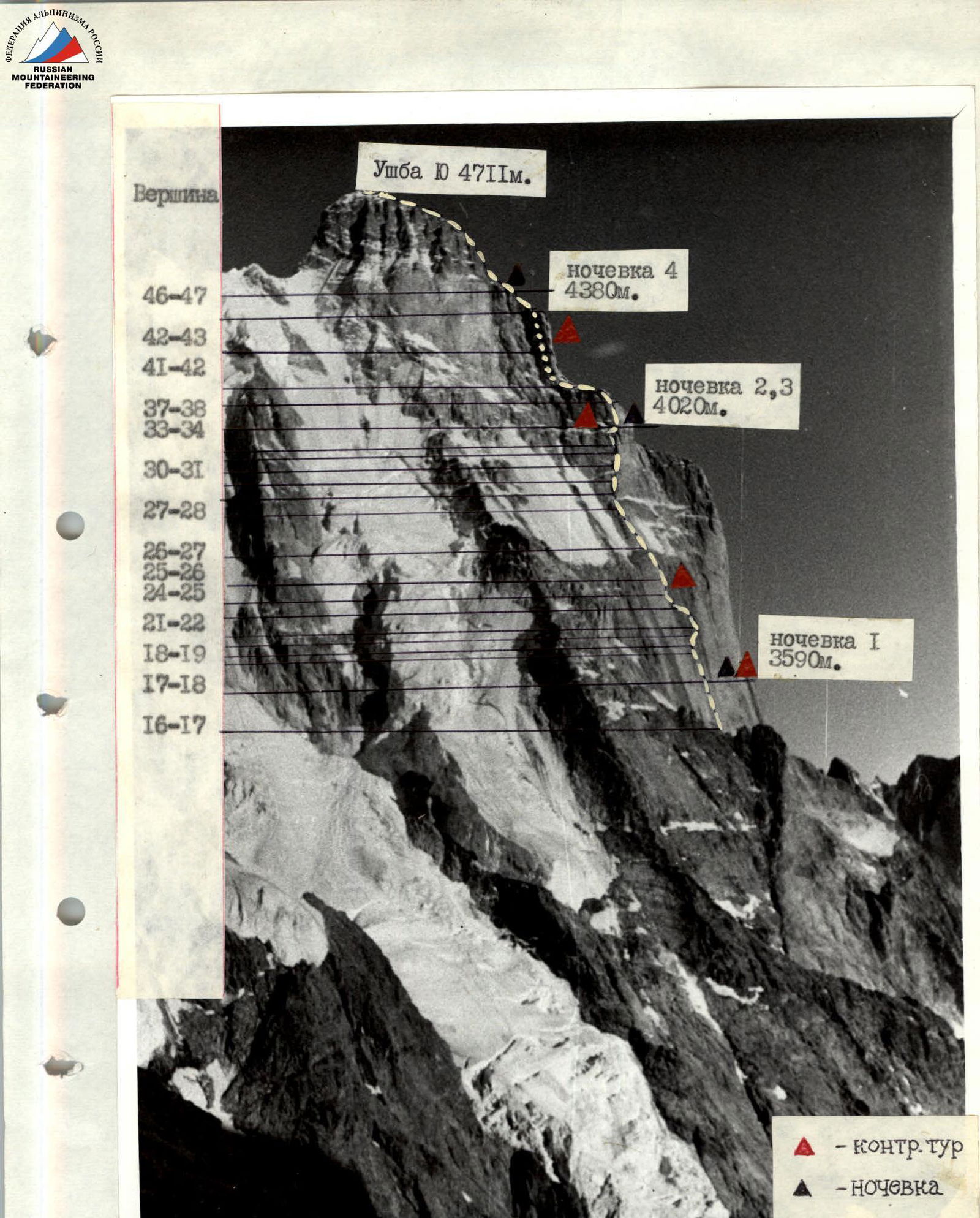
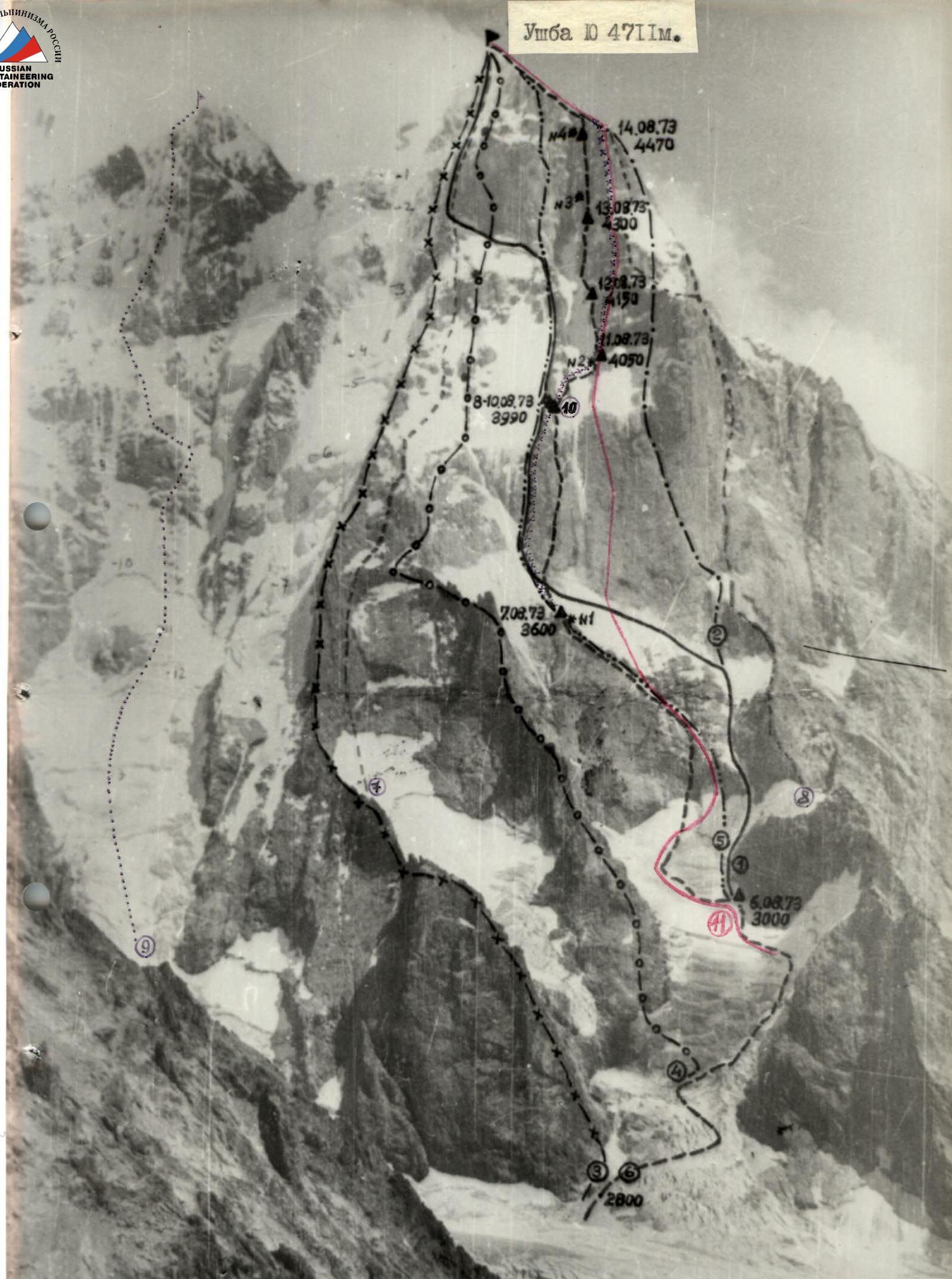
PHOTO OF THE WALL PROFILE FROM THE LEFT. Taken on 24.07.1990 at 18:00 from the slopes of Helda. Lens "HELIOS" from a distance of 2.5 km. Height 2900 m. Point of shooting No. 2. Camera "ZENIT".
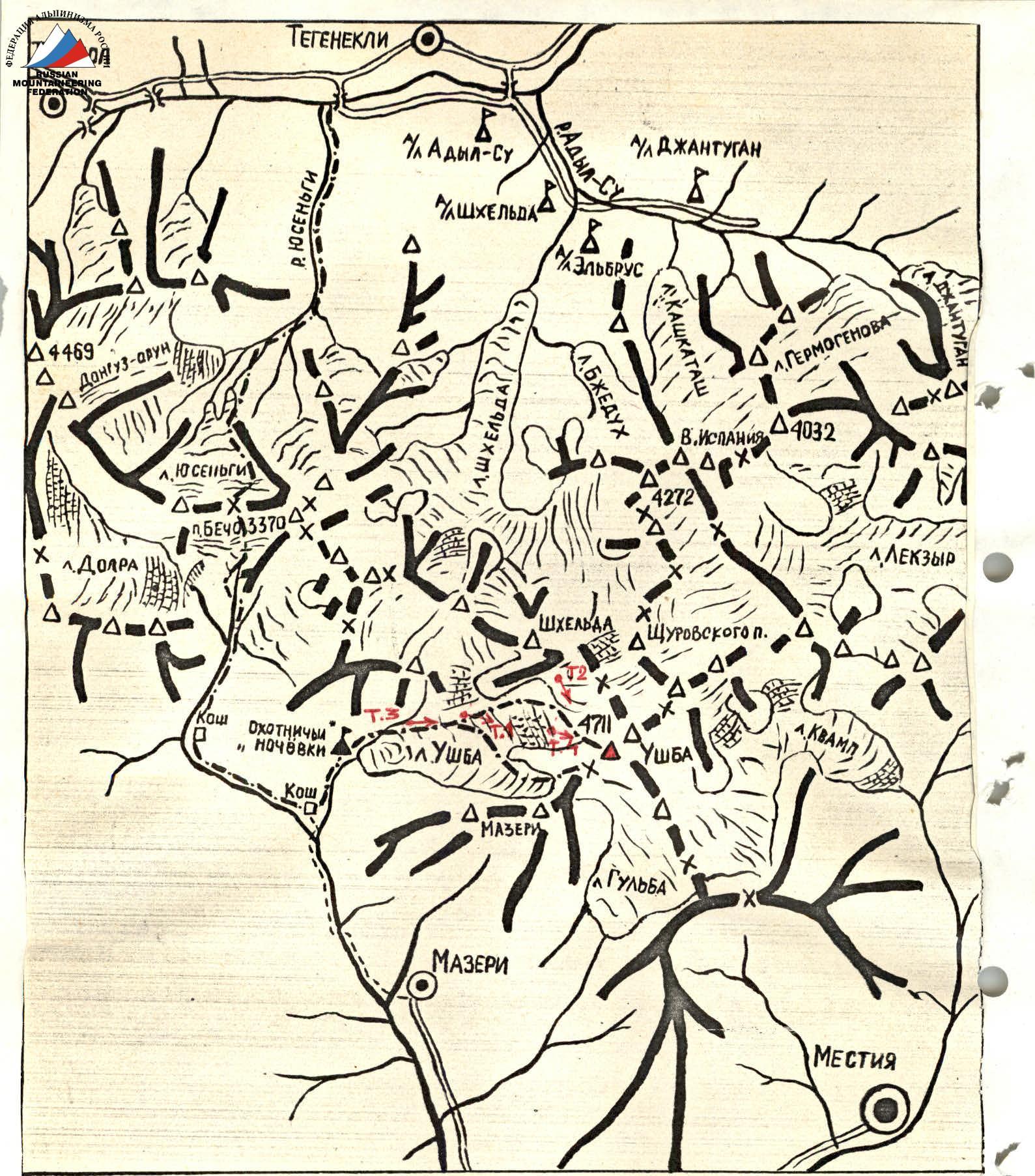
MAP-SCHEME OF THE ASCENT AREA M 1:100000.
— base camp.
— points of photo shooting.
— path of the group.
Brief Overview of the Ascent Area
The Ushba massif is located in the southern spur of the Main Caucasian Range and consists of two peaks — North (4690 m) and South (4711 m). Being a technically challenging object (the easiest route to South Ushba is 5A category), the massif is well освоened by climbers. More than 20 routes have received prizes in the USSR Championships.
The overview of the area is widely covered in the reports by Monogarov, Grigorenko–Prigoda, Arcishevsky, Myshlyaev, Shalaev, and others.
Preparation for the Ascent
The route to South Ushba via the bastions of the Southwest wall is not our discovery, as teams led by Kensitsky and Gorodetsky attempted it in previous years but were forced to retreat due to various reasons. Gorodetsky completed a variant of the route, including the second and third bastions. Kensitsky, having climbed 1.5 pitches of the first bastion, turned back.
The route attracted significant attention due to its logical, direct line that includes all the most challenging sections of the wall. The path goes between the routes of Grigorenko–Prigoda, 6A category — to the left, and Myshlyaev, 6A category — to the right, and is independent from start to finish. Shalaev's route is considered a variant of Grigorenko–Prigoda's, and its complexity is not high; moreover, it is rockfall-prone in the upper part. We claim the route as a first ascent because Gorodetsky's route, despite the complexity of the second bastion, is still considered a variant of Grigorenko–Prigoda's route and matches it in complexity. The passage of the first bastion makes it possible to distinguish the route as independent and to petition for assigning it 6B category, as the first bastion is undoubtedly the determining factor on the route in terms of both the complexity of the sections and its length.
The team began preparing for the route in 1987. In 1988, an attempt was made to climb it within the framework of the RSFSR Championship. By the end of the third day, the first bastion was virtually climbed. However, a fall of the first participant followed by an injury prevented the continuation of the ascent. Two years later, the team decided to repeat the attempt. The experience and mistakes of 1988 were carefully considered. The tactical plan was drawn up taking into account the available information in Gorodetsky's report and the team's own experience. Particular attention was paid to the team's actions in conditions of prolonged bad weather. Visual observation of the route was conducted for two days using 10x binoculars. Based on the experience of local veterans and their own observations, the optimal start date for the ascent to South Ushba was chosen as the end of July. At this time, the route is cleared of snow, the rocks are less likely to be wet, there is less ice, and the weather is more stable.
All team members were in the mountains from June 10. The time was planned so that:
- They could climb routes of high categories, mainly of rock climbing orientation.
- They could recover for the main start of the season.
Four team members climbed routes of 6th category. The duo Zholobov—Shabalin participated in the RSFSR Championship in the rock climbing class, and all other participants had ascents of 5B–6A category in their records.
Over the previous years, the team had made a large number of climbs together with varying categories of difficulty, and the participants had "rubbed shoulders" with each other, developing a joint tactics for ascents.
Preparation for the ascent throughout the year was carried out by each athlete independently according to individual plans. All team members were full-time workers in alpine and rock climbing (coaches) and active rock climbers with CMS rank, so training 6–10 times a week became the norm, and thus they passed fitness tests with excellent marks only. Throughout the year, all team members, in addition to summer and winter mountain outings, had 6–8 more outings to the rocks of the Urals, Crimea, and Kislovodsk lasting 10 days or more. In the gym and athletics arena, simulators with a variable angle of 6 and 12 m were installed, and winter training was conducted on them. In the spring, on their own rocks (s/m "Kamen"), routes for climbing with bottom rope were equipped with anchors, and a 5-day team training was conducted in early June to practice new climbing and belaying techniques. Training included simulated falls.
The problematic sections of the route are all three bastions, each with its own characteristics:
- The third bastion is characterized by steep, very crumbling rocks, constantly wet with ice.
- The second bastion is composed of large, solid granite blocks, slabs with minimal holds but good friction.
- The key section of the route is the first bastion.
The 1988 ascent showed that the bastion, consisting almost entirely of sections of VI category (smooth walls, cornices, and internal corners), and particularly its upper part, is constantly in very poor condition. In the first half of the day, it is icy, and afterwards, there are waterfalls. Previously, problems with such walls were solved simply — with bolted routes (example: Kensitsky's route on peak Shchurovsky through Surka — 100 m). Here, such tactics are difficult to apply due to the large extent of the bastion (370 m), its being wet, and its location at the beginning of the route. Moreover, we believe that hammered pitons for artificial climbing (ITC) spoil the route, devaluing its complexity. Therefore, the main emphasis in preparing for the ascent was on the individual technical skill of the athletes, the coherence of their teamwork, and the use of new samples of mountaineering equipment, allowing the route to be climbed without leaving it "clean" from pitons ("sky-hook," "ice-fifi" were used on icy rocks along with "sky-hook," "friends," thin petal pitons "semerki," hook-nogs, a wide variety of pitons and sling elements). The first person worked on the bastion in "SKY-WALKER" rock shoes. The use of all these means, as well as lightweight duralumin imported carabiners and "Elita" and "Anaconda" ropes, allowed the bastion to be climbed in one and a half days, leaving behind only pitons on the stations.
For climbing the second and third bastions, the team prepared by including training in rock climbing in crampons. All participants have experience climbing routes of 5th category in the Bezengi and Central Caucasus regions.
Among the tactical safety measures, the following were considered crucial:
- Clear planning;
- Strict adherence to the team's temporal layout of the tactical plan, taking into account the most favorable hours for passing rockfall-prone areas;
- Selection of the most convenient and safe places for overnight stays.
The decision to climb the complex sections of the bastion, which are wet from water, in the morning — over icy rocks — played a very significant role. In 1988, after the first overnight stay, all team members' gear was wet due to incorrectly chosen tactics. This time, during the entire passage of the first bastion, only one person got wet once. All others climbed over frozen waterfalls in the morning using fixed ropes.
The decision to frequently change the lead climber was also correct. With the close technical preparation of all team members, the time taken to climb individual sections did not vary significantly. However, psychological relief for the lead climbers on such a route is of paramount importance. The use of a double rope also increased the safety of the ascent.
Options for abandoning the route in case of injury or prolonged bad weather were considered. The descent path down the bastion (via the ascent route) was known from the 1988 experience (they descended the injured participant on their own through the entire bastion).
The material support for the ascent was also planned with the experience of 1988 in mind. A specially made balloon tent weighing 1.5 kg and a hammock were prepared; each participant had a polyurethane foam pad in case of bad weather. For heating and cooking, a gas stove with "EPI-GAZ" cylinders was used.
Food products:
- All were sublimated, quick-dissolving, and did not require cooking;
- High-calorie and quickly digestible;
- Gas and products were taken with consideration for bad weather, and a reserve remained after descent.
Clothing included:
- A spare set of woolen underwear (for the first participant to change after working under waterfalls);
- 2 spare pairs of woolen socks and gloves (very useful during descent!).
Plastic boots from "KOFLACH" and "Brixie" were used. They were very satisfied with the piton set as well.
To measure angles and sections of the route and to orient themselves in fog during descent, a mountain compass with a goniometer was used.
To measure the length of sections, marks were made on the "Elita" rope every 5 and 10 m from each end.
Communication was carried out using "Lastochka" radio stations. There were no communication breaks. A spare power kit with Japanese batteries was taken.
For emergency communication, they took:
- Emergency signal cartridges — day and night (red flare and red smoke);
- Light communication using a flashlight was also planned.
The rescue team was fully present in the base camp at the "Hunting" overnight stays.
All members of the rescue team had ascents of 5B–6A category that year.
The doctor of the rescue team equipped first-aid kits for the team, rescue team, and base camp.
The scheme of action for the rescue team in the most severe scenario — an injury at the top of the first bastion — was practiced in 1988. Then, the team members descended the injured participant to the base of the first bastion, where the rescue team members were already present, having rigged ropes for further descent.
The rescue team was fully equipped with gear and food supplies in case of rescue operations.
The head of the rescue team had arranged for a vehicle to be available in the village of Mazeri in case of necessity.
The tactical plan for the ascent was drawn up with the experience of 1988 in mind.
All overnight stays (photos No. 8, 12, 19) were planned in relatively safe and convenient locations, ensuring full rest for the team members.
The only adjustment was made due to bad weather — a whole day on August 27, 1990 (a day of waiting and an unplanned second overnight stay on the second bastion). In bad weather, they managed to process two complex pitches to the top of the second bastion (photos 1/2–15), so the next day, the team managed not only to climb the third bastion and reach the "roof" but also to ascend to the summit (according to the tactical plan — only reaching the "roof").
This decision was absolutely correct, as it was clear that the weather was deteriorating (photos No. 18–20), and ascending to the summit followed by descent to the base camp in one day in stormy conditions would have been problematic.
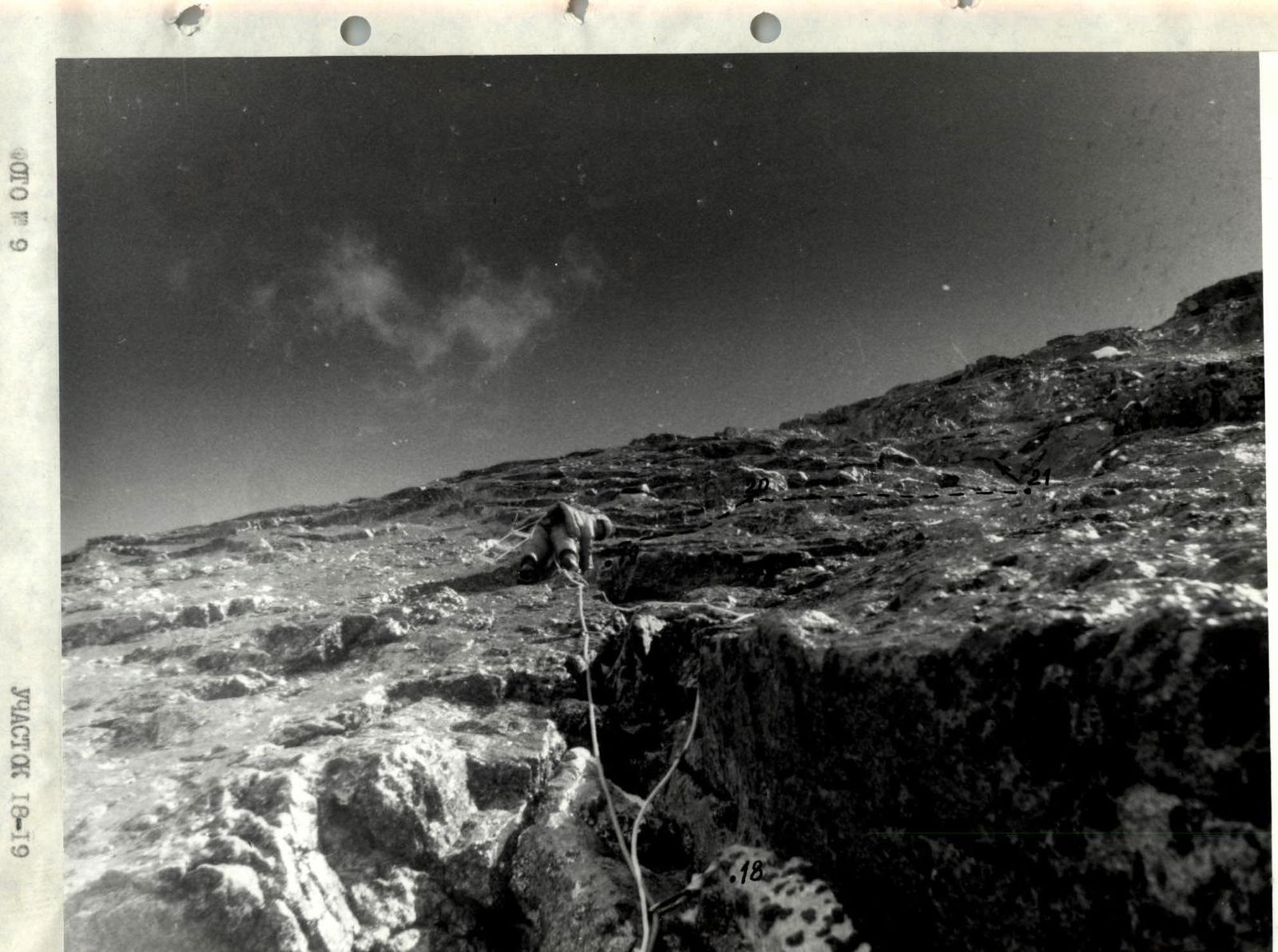
The organization of the team's movement on routes of this level generally represents a purely fixed rope scheme. Exceptions were relatively simple sections R0–R1, R2–R8, R40–R41, R46–R47, where movement was carried out in teams consisting of: Zholobov–Shabalin, Antonov–Perevoshchikov–Tat'yankin, and processed sections R17–R21 (photo No. 9) (Zholobov–Shabalin) and R34–R40 (photos No. 15–15) (Antonov–Perevoshchikov). The first to work on different sections were: R0–R10 — Zholobov, R10–R26 — Shabalin, R26–R34 — Perevoshchikov, R34–R43 — Antonov, R43–R47 — Tat'yankin.
Much has been said in other sections of the report about the use of various technical means. We would like to highlight the use of sky-hooks, friends, and rock shoes, which opened up new possibilities for climbing extremely difficult sections using free climbing. At the same time, on icy and snowy rocks, ITC was often used — a set of pitons and sling elements was quite suitable for this purpose (photo No. 11). Considering the experience of 1988, special attention was paid to ensuring the safety of the first climber. A double rope, one of which was "Elita-I" UIAA (considering the rockfall hazard of the route, an "Anaconda" rope was taken as a backup in case of damage to "Elita" by stones), slings made of dynamic rope LTKП-1200, and organization of belaying through an "eight" — all this allowed the lead climber to work with a large margin of safety. There were no falls on the route. Belay points on the bastions were mostly hanging; it was rare for the whole team to gather together. On the first bastion, there was only one more or less suitable place for an overnight stay, about five pitches from the start (photo No. 8). Three people were in a hammock, and two were on rock ledges. Above, everything was wet, and below, it was hit by stones in the evening. Above the first bastion, it was possible to organize an overnight stay after passing the "ridge" at the base of the 2nd bastion or at the "standard" place — after traversing the ledge before the cornices, two pitches from the top of the bastion (a safe, lying, paved area under the cornice). The next place for an overnight stay was the top of the second bastion, and then only on the "roof" (photo No. 19), a convenient, lying, paved area, as the entire bastion was rockfall-prone. On descent, it was possible to spend the night in the "Red corner."
Organization of nutrition:
- Hot meals — 2 times a day: in the morning and evening;
- All team members had individual snacks for each day.
The route required a very large expenditure of physical and mental strength; however, clear planning and strict adherence to the tactical plan allowed the team to complete the route with a reserve of strength.
Among non-standard technical climbing techniques, the following can be highlighted:
- Use of "ice-fifi" in combination with a ladder on icy rocks;
- Application of "sky-hook";
- Pendulum swing across an icy internal corner;
- Climbing on complex rocks in bad weather in crampons (photos No. 11, 13).
We would like to particularly highlight the confident actions of the team in bad weather, which allowed them to complete the ascent without accidents. In conditions of very poor visibility, radio communication was faultless. On rare occasions when the weather cleared, the team's movement was monitored using 10x binoculars. During the ascent, the rescue team was in the base camp at the "Hunting" overnight stays.
Table of Food Products and Fuel
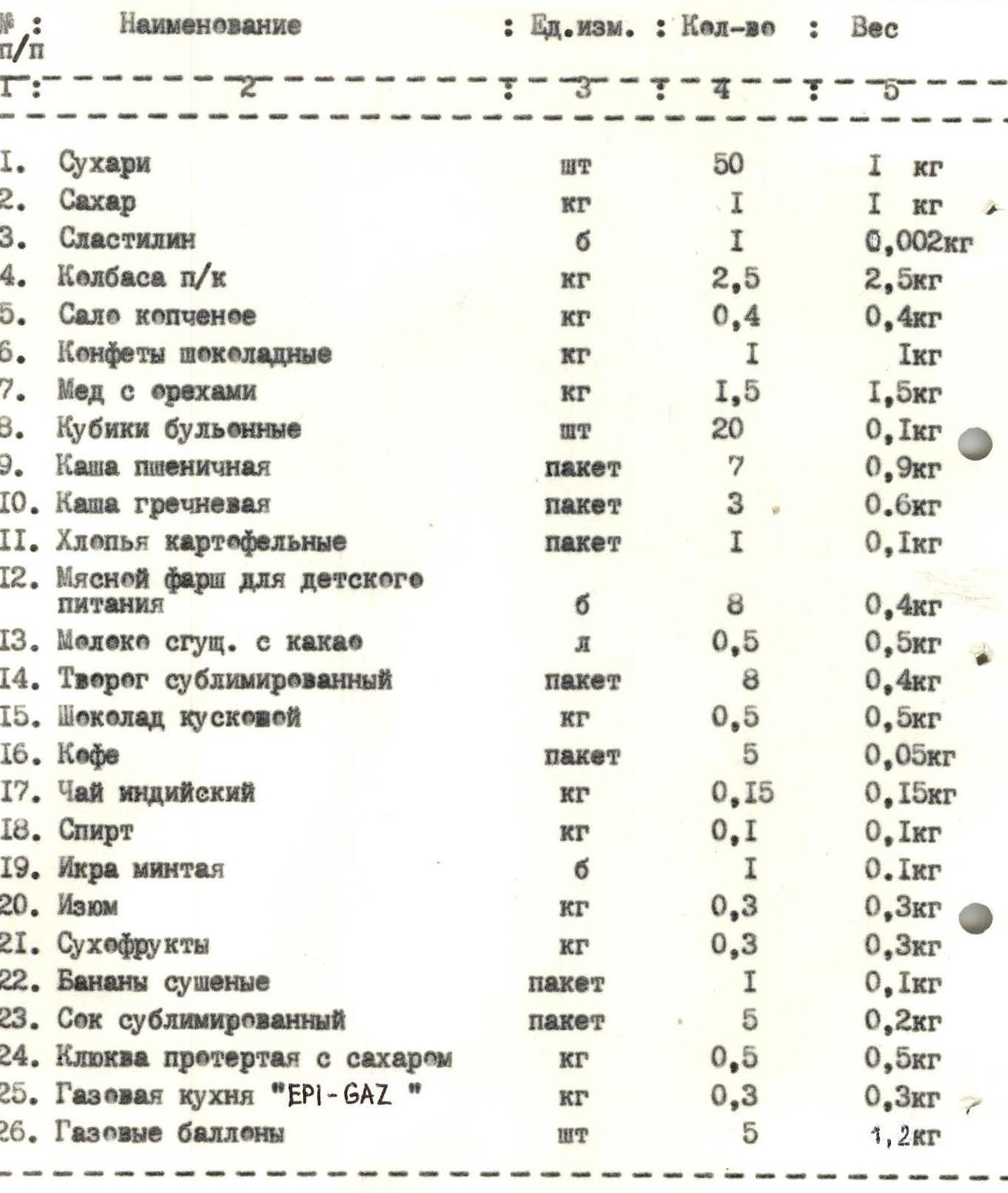
The total weight of food products and fuel was 13.8 kg.
| Product Name | Unit of measurement | Quantity | Weight (kg) |
|---|---|---|---|
| Crackers | pcs | 50 | 1 |
| Sugar | kg | 1 | 1 |
| Slastilin | g | 1 | 0.002 |
| Semi-dried sausage | kg | 2.5 | 2.5 |
| Smoked bacon | kg | 0.4 | 0.4 |
| Chocolate candies | kg | 1 | 1 |
| Honey with nuts | kg | 1.5 | 1.5 |
| Bouillon cubes | pcs | 20 | 0.1 |
| Wheat porridge | packet | 7 | 0.9 |
| Buckwheat porridge | packet | 3 | 0.6 |
| Potato flakes | packet | 1 | 0.1 |
| Meat puree for baby food | can | 8 | 0.4 |
| Condensed milk with cocoa | l | 0.5 | 0.5 |
| Freeze-dried cottage cheese | packet | 8 | 0.4 |
| Block chocolate | kg | 0.5 | 0.5 |
| Coffee | packet | 5 | 0.05 |
| Indian tea | kg | 0.15 | 0.15 |
| Spirit | kg | 0.1 | 0.1 |
| Minced fish | can | 1 | 0.1 |
| Raisins | kg | 0.3 | 0.3 |
| Dried fruits | kg | 0.3 | 0.3 |
| Dried bananas | packet | 1 | 0.1 |
| Freeze-dried juice | packet | 5 | 0.2 |
| Cranberries with sugar | kg | 0.5 | 0.5 |
| Gas stove "EPI-GAZ" | kg | 0.3 | 0.3 |
| Gas cylinders | pcs | 5 | 1.2 |
| Section | Category (UIAA) | Length (m) | Steepness (°) | Rock pitons | Slings | Bolts | Ice | Notes |
|---|---|---|---|---|---|---|---|---|
| TOTAL | 128 | 99 | 17 | 21 | 9.5 hours, 46 pitons | |||
| R46–R47 | III | 500 | 30 | |||||
| R45–R46 | III | 20 | 30 | 2 | ||||
| R44–R45 | V | 80 | 70 | 6 | 5 | |||
| R43–R44 | V-A2 | 20 | 80 | 4 | 3 | 2 | ||
| R42–R43 | IV-A3 | 40 | 90 | 8 | 5 | 3 | 1 | |
| R41–R42 | IV+ | 40 | 80 | 6 | 5 | |||
| R40–R41 | III | 200 | 40 | 5 | ||||
| R39–R40 | V-A1 | 5 | 90 | 1A | 1 | 3 hours, 25 pitons, processing | ||
| R38–R39 | V | 8 | 80 | 2 | 1 | |||
| R37–R38 | V+ | 25 | 80 | 4 | 1 | |||
| R36–R37 | V | 25 | 80 | 2 | 5 | |||
| R35–R36 | V-A3 | 8 | 90 | 5/5 | ||||
| R34–R35 | V-A2 | 5 | 80 | 14 | 2 | 1 | ||
| R33–R34 | IV+ | 50 | 50 | 2 | 2 | 1 | 4 | Tooth |
| R32–R33 | IV+ | 40 | 75 | 2 | 2 | |||
| R31–R32 | V+ | 16 | 90 | 2 | 3 | |||
| R30–R31 | V | 30 | 70 | 1 | 3 | |||
| R29–R30 | IV+ | 40 | 65–70 | 2 | 2 | X | ||
| R28–R29 | IV | 40 | 65–70 | 2 | 3 | |||
| R27–R28 | IV | 35 | 60–70 | 2 | 4 | |||
| R26–R27 | III | 80 | 50 | 5 | 3 | |||
| R25–R26 | V-A1 | 40 | 75 | 5 | 2 | 1 (1) | ||
| R24–R25 | V+ | 25 | 80 | 4 | 2 | |||
| R24 | 31 | 2 | ||||||
| R22–R23 | V-A1 | 31 | 90–95 | |||||
| R22–R23 | IV | 15 | 80 | Sky-hook! | ||||
| R21–R22 | V-A1 | 97 | 65–70 | 6 | 5 | 1 | Sky-hook! | |
| R20–R21 | V-A1 | 14 | 90 | 1 | 1 | Sky-hook! | ||
| R19–R20 | V-A2 | 24 | 90 | 2 | 2 | |||
| R18–R19 | VI | 42 | 90 | 4 | 2 | 2 | ||
| R17–R18 | V | 5 | 80 | 5 | 4 | 3 | ||
| R16–R17 | V-A3 | 72 | 85 | 3 | 1 | Sky-hook! | ||
| R15–R16 | V-A3 | 62 | 85 | 2 | 1 | Sky-hook! | ||
| R14–R15 | V+ | 25 | 80 | 2 | 5 | |||
| R13–R14 | V-A1 | 10 | 80 | 1 | 1 | Sky-hook! | ||
| R12–R13 | V-A2 | 10 | 80 | 3 | 1 | Sky-hook! | ||
| R11–R12 | V-A1 | 41 | 75 | 4 | 1 | 4 | ||
| R10–R11 | V-A2 | 52 | 70 | 5 | 2 | 3 | 1 | |
| R9–R10 | III–IV | 120 | 50 | 2 | 5 | |||
| R8–R9 | IV+ | 25 | 40–50 | 1 | 1 | 2X | ||
| R7–R8 | III | 25 | 40–50 | 1 | 2 | |||
| R6–R7 | III–IV | 40 | 40–50 | 4 | ||||
| R5–R6 | III | 40 | 20–30 | 2 | ||||
| R4–R5 | II | 40 | 30 | 1 | 1 | X | ||
| R3–R4 | III | 40 | 50 | 3 | 1 | |||
| R2–R3 | III | 40 | 40 | 4 | 1 | |||
| R1–R2 | IV | 120 | 50 | 7 | ||||
| R0–R1 | II–III | 300 | 30 |
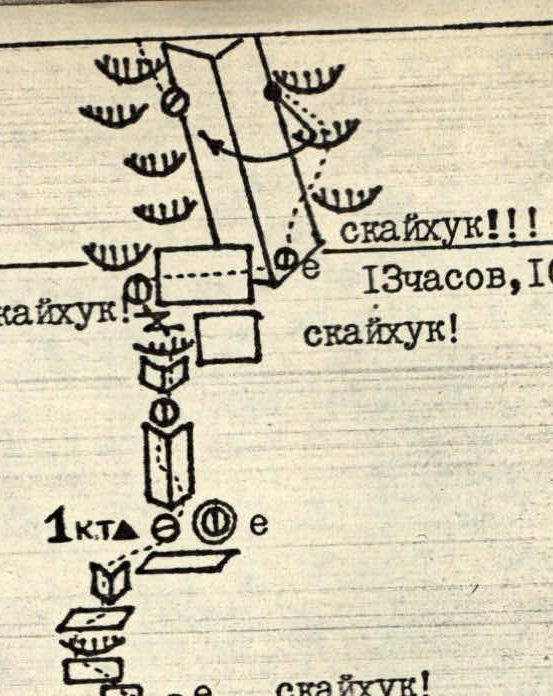
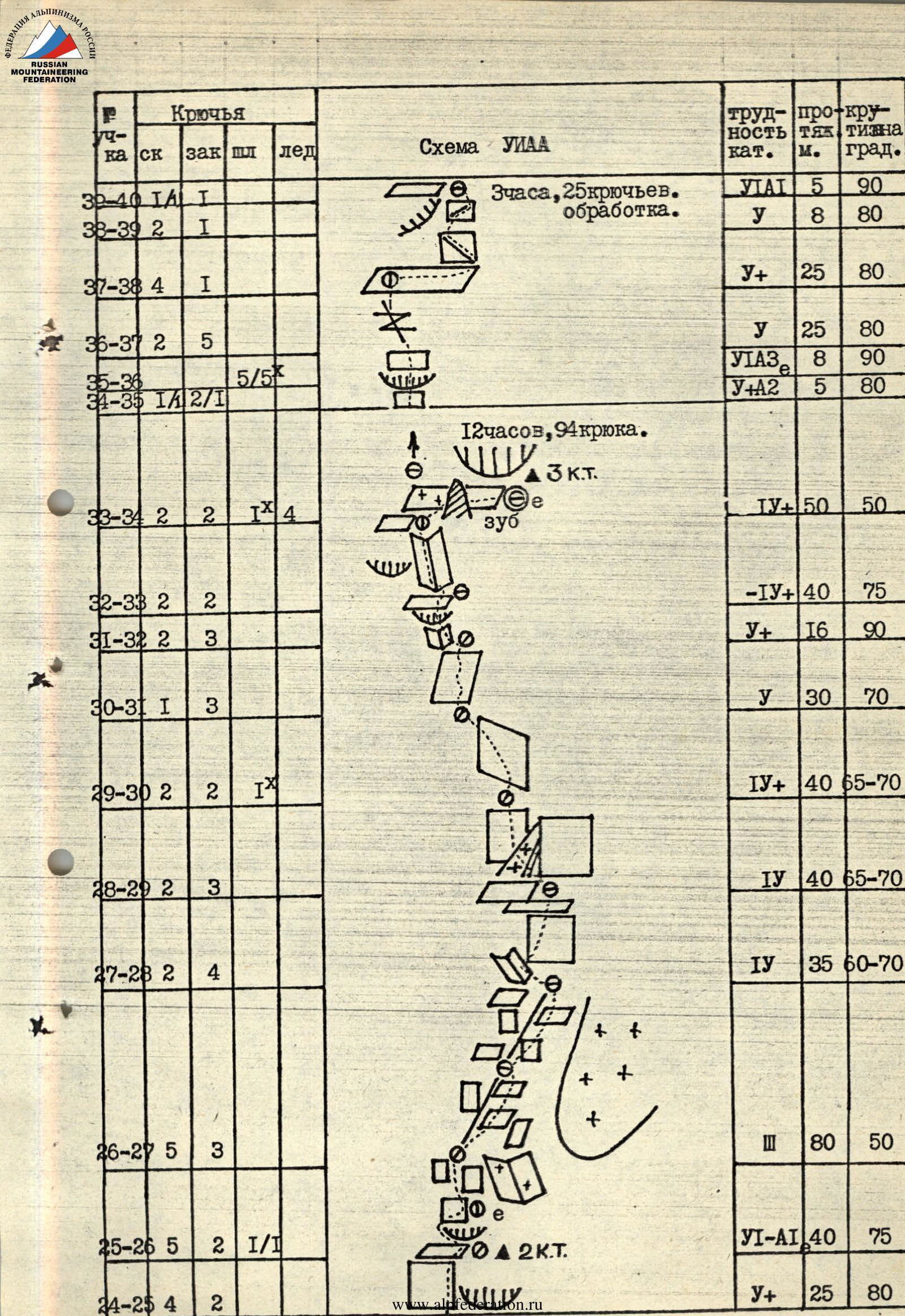
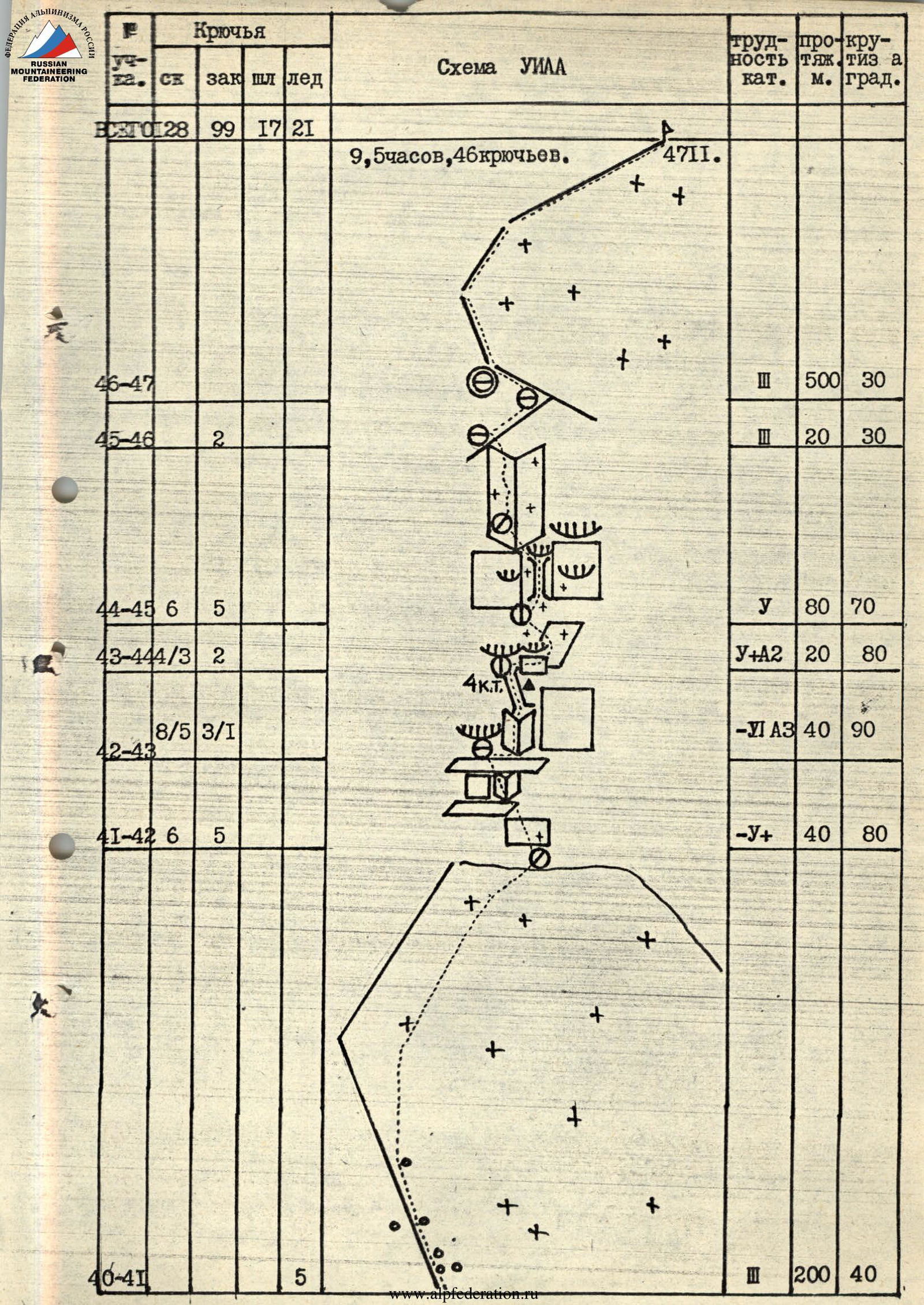
Table of Equipment
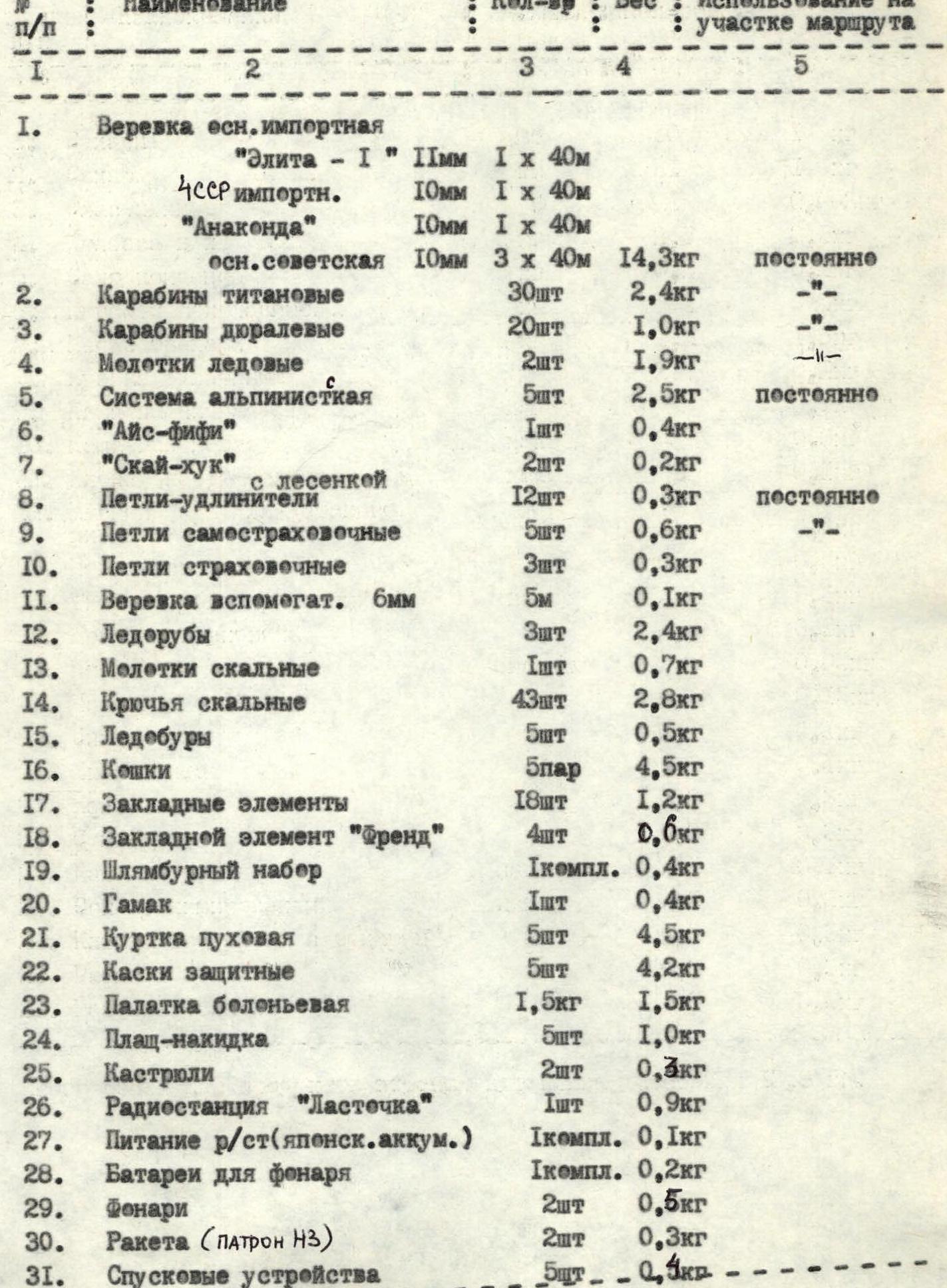
| Equipment Name | Quantity | Weight (kg) | Use on route section |
|---|---|---|---|
| Main rope import "Elita-I" 11 mm | 1 x 40 m | ||
| USSR import 10 mm | 1 x 40 m | ||
| "Anaconda" 10 mm | 1 x 40 m | ||
| Main Soviet 10 mm | 3 x 40 m | 14.3 | constantly |
| Titanium carabiners | 30 pcs | 2.4 | |
| Duralumin carabiners | 20 pcs | 1.0 | |
| Ice hammers | 2 pcs | 1.9 | |
| Climbing harness | 5 pcs | 2.5 | constantly |
| "Ice-fifi" | 1 pc | 0.4 | |
| "Sky-hook" | 2 pcs | 0.2 | |
| Slings with ladders | 12 pcs | 0.3 | constantly |
| Self-belay slings | 5 pcs | 0.6 | |
| Belay slings | 3 pcs | 0.3 | |
| Auxiliary rope 6 mm | 5 m | 0.1 | |
| Ice axes | 3 pcs | 2.4 | |
| Rock hammers | 1 pc | 0.7 | |
| Rock pitons | 43 pcs | 2.8 | |
| Ice screws | 5 pcs | 0.5 | |
| Crampons | 5 pairs | 4.5 | |
| Slings elements | 18 pcs | 1.2 | |
| "Friend" sling element | 4 pcs | 0.6 | |
| Piton set | 1 set | 0.4 | |
| Hammock | 1 pc | 0.4 | |
| Down jacket | 5 pcs | 4.5 | |
| Protective helmets | 5 pcs | 4.2 | |
| Balloon tent | 1 pc | 1.5 | |
| Rain cloak | 5 pcs | 1.0 | |
| Pots | 2 pcs | 0.3 | |
| Radio station "Lastochka" | 1 pc | 0.9 | |
| Radio power (Japanese batteries) | 1 set | 0.1 | |
| Flashlight batteries | 1 set | 0.2 | |
| Flashlights | 2 pcs | 0.5 | |
| Emergency signal cartridge | 2 pcs | 0.3 | |
| Descenders | 5 pcs | 0.4 | |
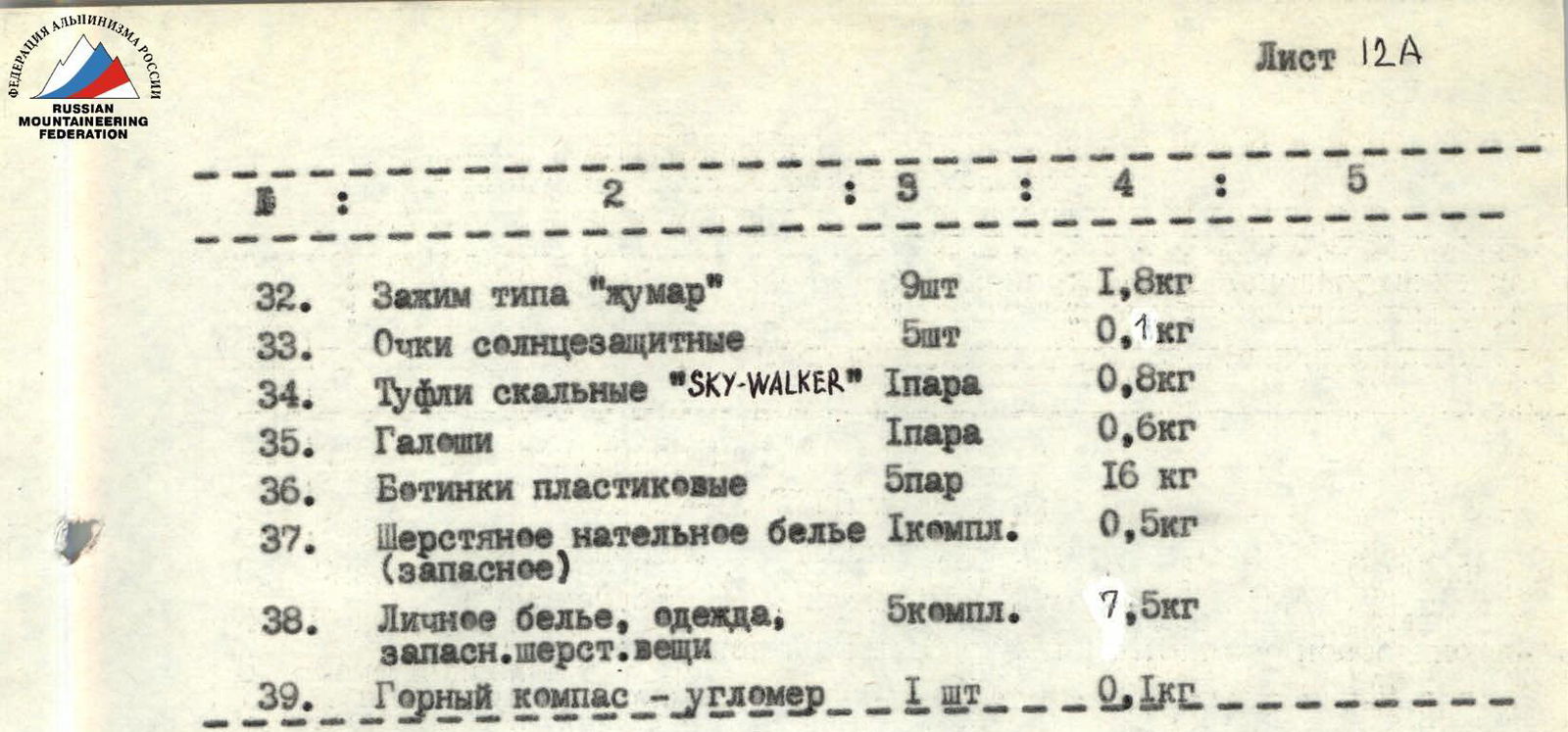
| "Jumar" clamp | 3 pcs | 1.8 | |
| Sunglasses | 5 pcs | 0.1 | |
| Rock shoes "SKY-WALKER" | 1 pair | 0.8 | |
| Galoshes | 1 pair | 0.6 | |
| Plastic boots | 5 pairs | 16 | |
| Woolen underwear (spare) | 1 set | 0.5 | |
| Personal underwear, clothing, spare woolen items | 5 sets | 7.5 | |
| Mountain compass-goniometer | 1 pc | 0.1 |
Total: the total weight of the equipment was 65 kg. The total weight of food products and fuel was 13.8 kg. The total weight of backpacks on the approach was 78.8 kg (15.8 kg per person). The total weight of backpacks at the route start was 52 kg. The first person worked on the route without a backpack. The starting weight of the backpack on the route was 13 kg.
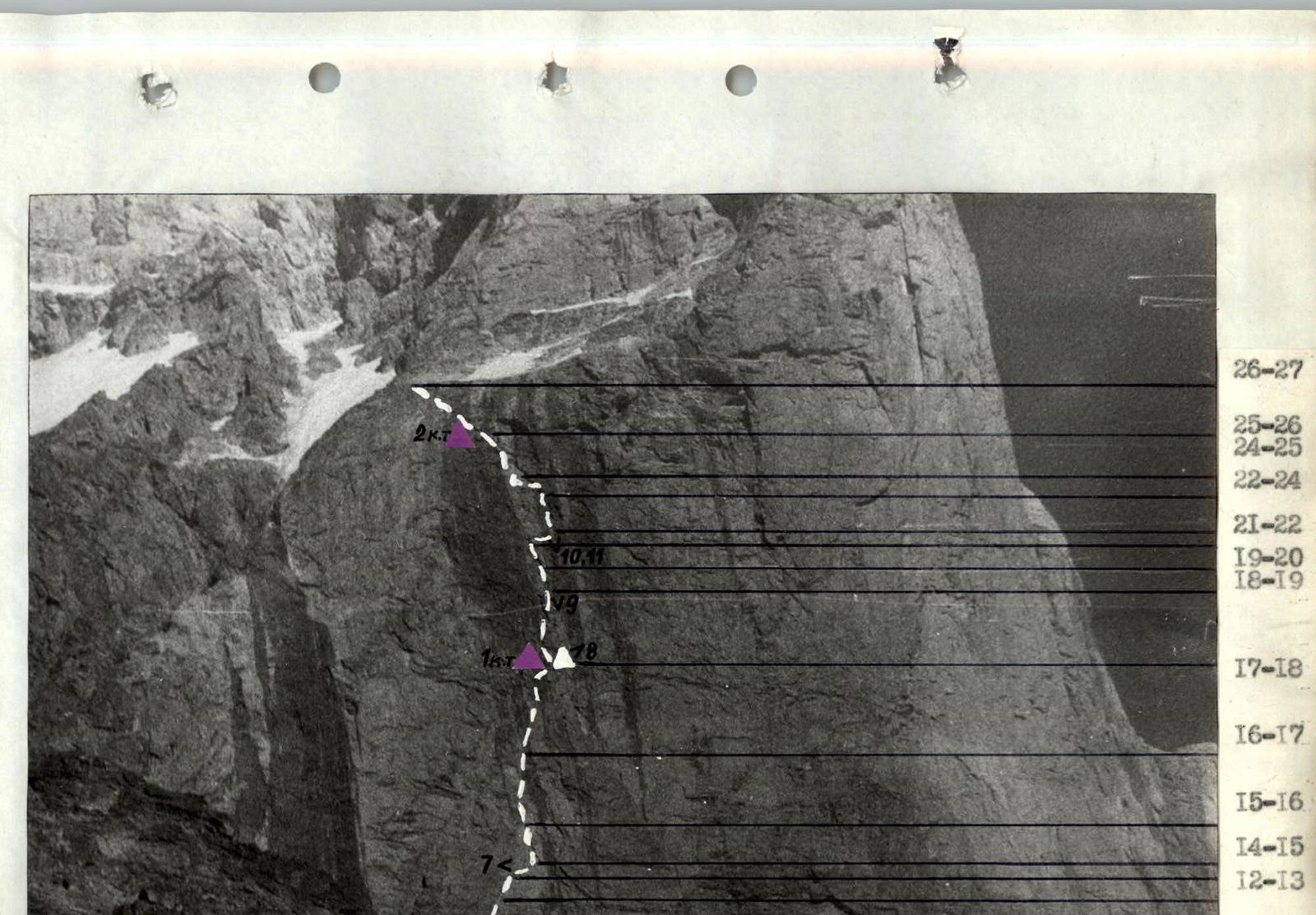
TECHNICAL PHOTOGRAPHY OF THE ROUTE / I and 2 BASTIONS. 24.07.1990 at 18:40. Taken with a "Zenit" camera, lens: "Japan Takumar" 1/3.5 135 mm, from a distance of 1000 m. Height 2500 m. Point of shooting No. 4.
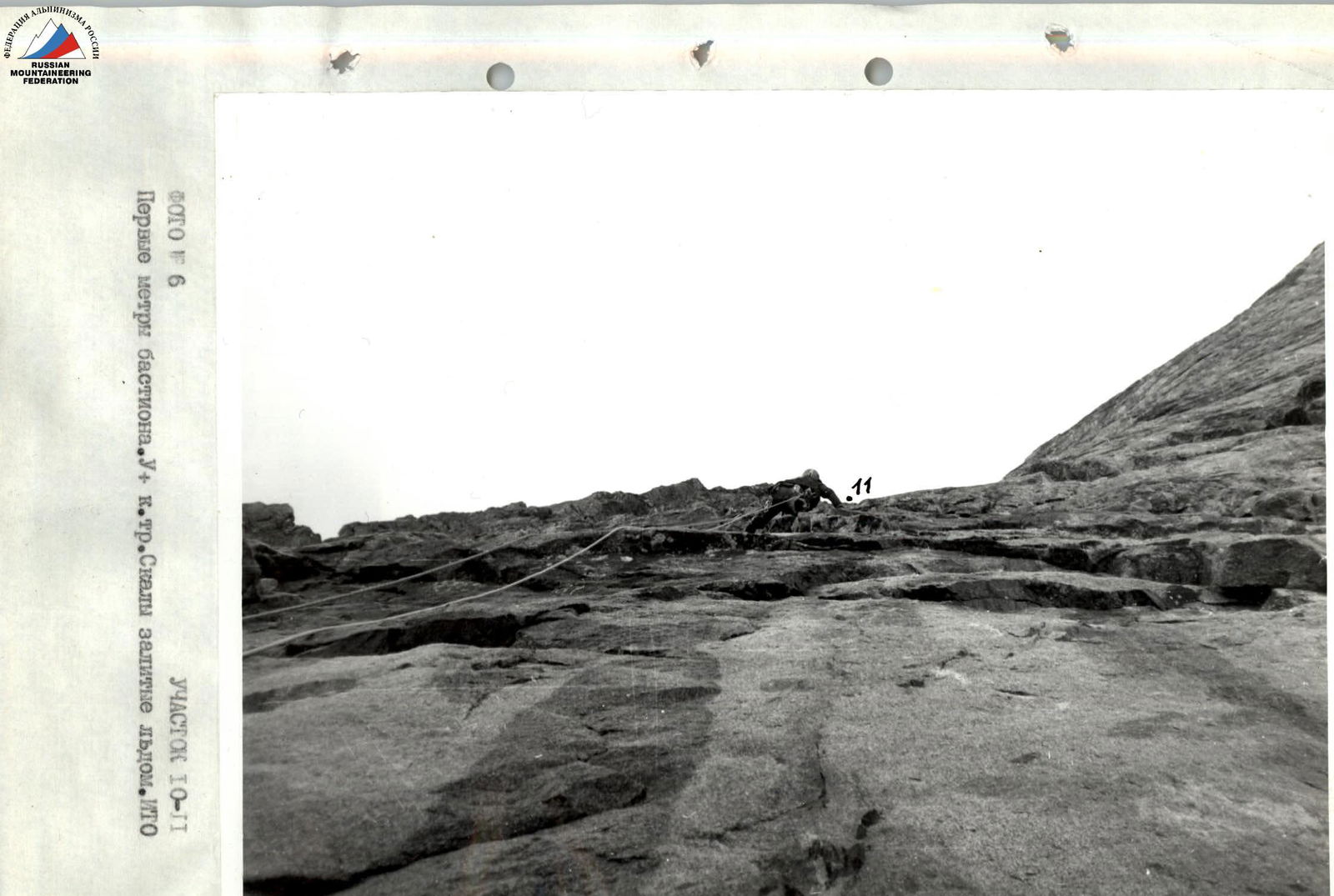
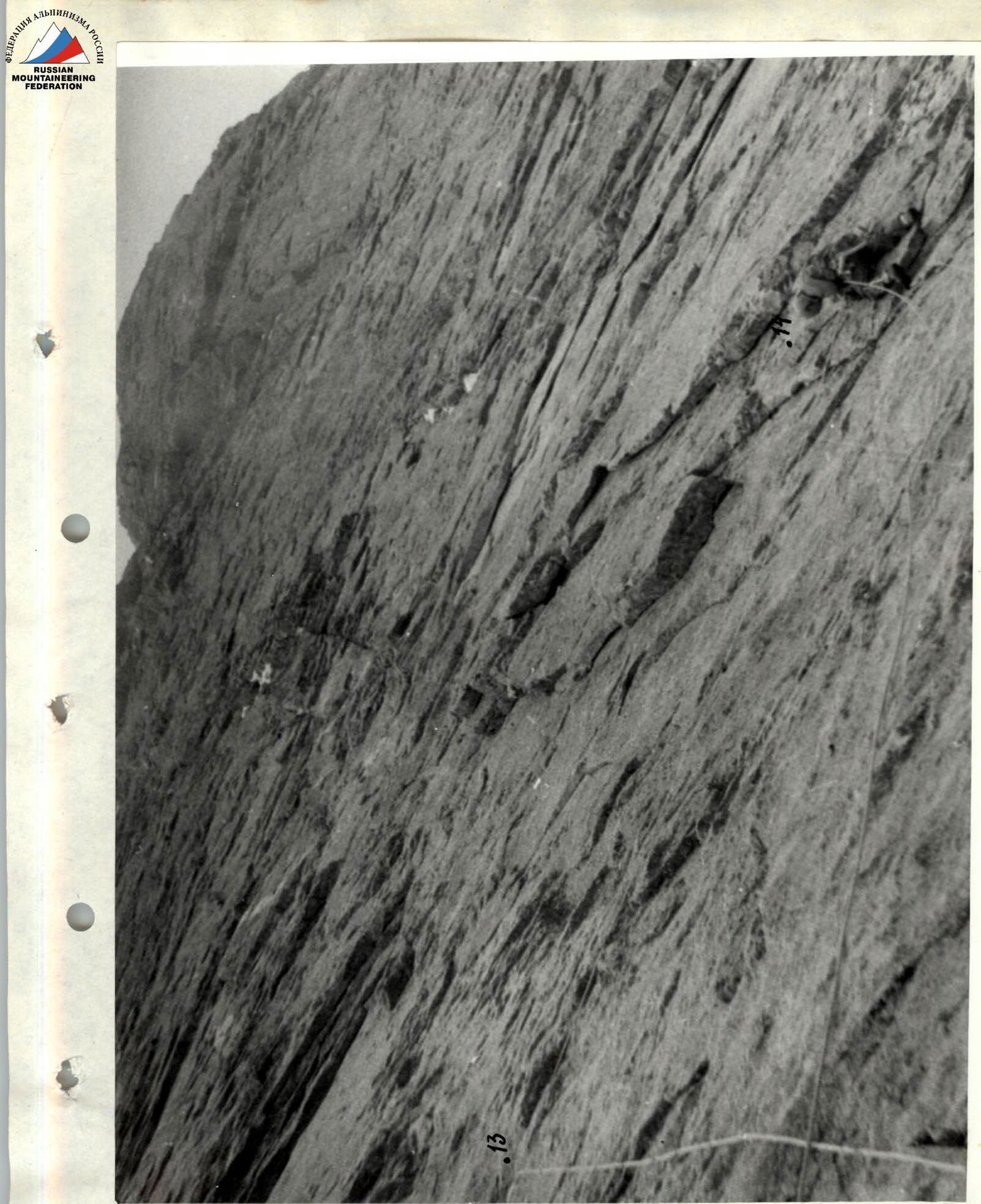
PHOTO P7 SECTION R13–R14
— Traversing right to detached plates. — Monolith. — V+ category.
Using a "sky-hook."
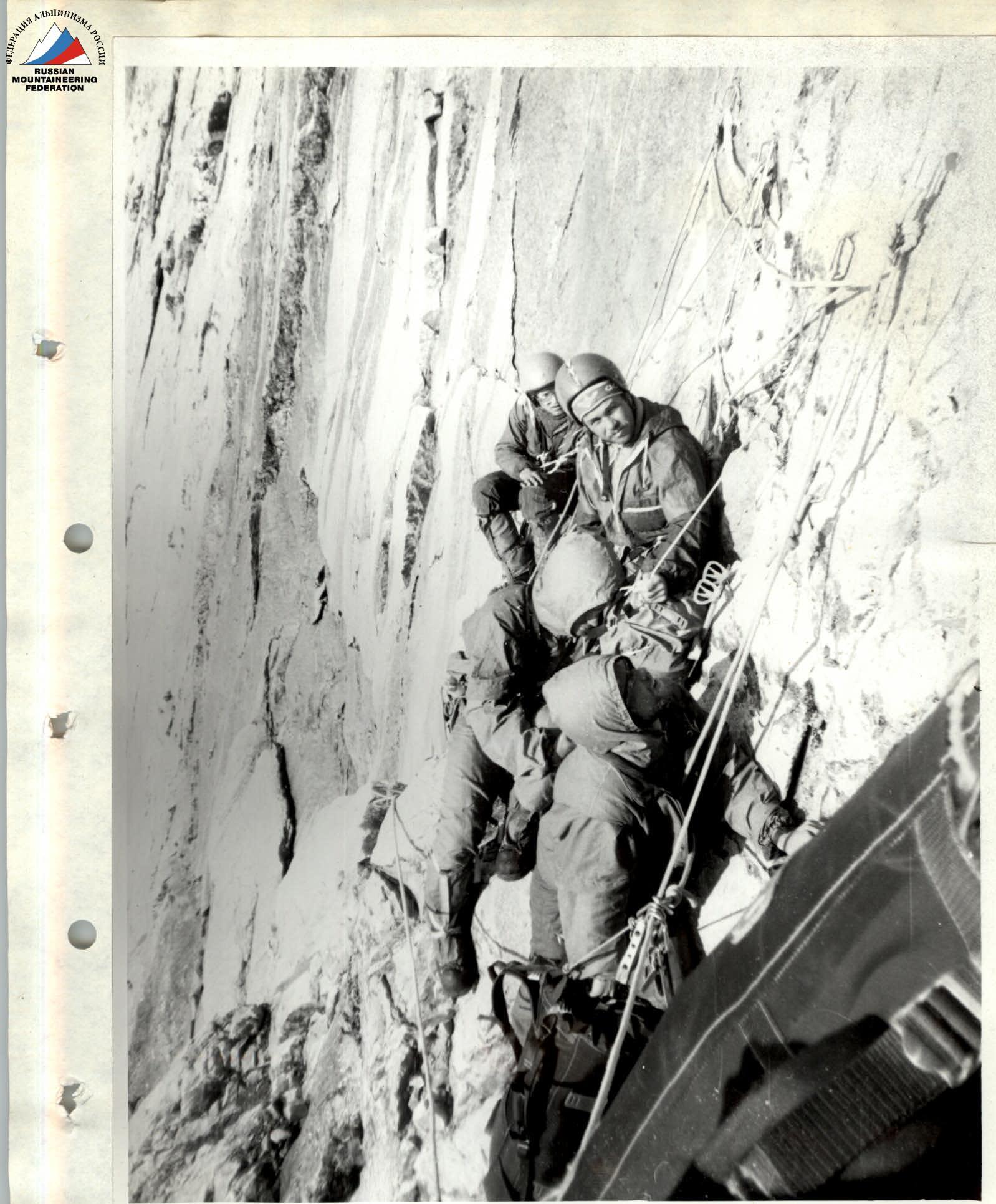
PHOTO P8 SECTION R16–R17. First overnight stay in the middle of the bastion. Three people are in a hammock, two are on rock ledges.