
71 72
Description of the ascent route to Donguz-Orun via the northwest wall (counterfort) — 1962
The Donguz-Orun massif (4468 m) is located in the Main Caucasian Range, in the upper reaches of the Baksan valley, and is quite familiar to mountaineers. The ascent route to Donguz-Orun via the northwest wall (counterfort) has been traversed twice, but there is no description of the route, and it is not known exactly where the climbers' paths lay, whether they coincided for both groups, or what variations these groups took.
We embarked on the route, considering the wall to have sufficient difficulty both technically and tactically, and the route to be: — logical, — interesting, — deserving of the most serious consideration and evaluation, and likely to gain wide sporting popularity in the future. It was necessary to study the most expedient paths for its traversal and compile a more or less stable description.
The Donguz-Orun massif is composed of ancient rocks, predominantly gneisses, layered in such a way that the slopes of the northern sector of the massif, with their great steepness, have the character of smooth wall sections interspersed with very steep slabs of tiled structure.
The route via the northwest wall is combined, with large sections of formed ice. The height difference from the foot of the wall to the summit is about 1900 m.
The ascent via the northwest counterfort of the wall leads to the central rise of the northeast ridge of the summit, to the beginning of the most complex part of the 4A category route. Thus, after the complex wall section, with a height difference of about 1500 m, the most difficult part of the route along the northeast ridge follows to the summit.
Day 1
Approach through the Donguz-Orun valley, ascent to the Donguz-Orun glacier. Overnight stay under the wall in the upper part of the moraine.
Day 2
Departure on the route at 3:30 am. Onto the ice, roping up, crampons on. Ascent is made via the left branch of the hanging Donguz-Orun glacier. Initially not too steep, further on steep (up to 60°) ice with falls, large crevasses, thin bridges, and huge seracs. It is necessary to move at a high pace to avoid being on open sections during the period of intense morning rockfall. After 350 m of such movement, the route leads to a wide and deep bergschrund, whose walls overhang. This is a very difficult spot, taking about an hour of complex work. The next part of the route — a smoothed wall with sections of formed ice, about 450 m long, with an average steepness of around 80°, and in places up to 85–90°. The path goes almost straight up and slightly to the right through small indentations in the wall. There are sections of heavily destroyed, 'live' vertical slabs, small overhangs, and occasionally very narrow, destroyed ledges. It is not possible to deviate left from the line of the counterfort starting higher up the wall — there is a zone heavily exposed to rockfall throughout the day. Constant piton protection, with almost no natural protection features. Climbing is difficult, with individual sections very difficult. Especially challenging is working on sections with formed ice. On the wall, a large assortment of pitons is necessary, along with clear work with the rope and skillful choice of piton or suitable crack. With coordinated, efficient work by the group, excluding unnecessary time loss, traversing this part of the route takes 7–8 hours.
Further on follows the exit to the not clearly defined start of the steep counterfort. Here, there are large overhanging blocks and vertical slabs, many 'live' blocks. At three spots, there are difficult-to-pass small overhangs. Climbing is medium and difficult. Protection is via pitons and natural features. The total length of this section is about 250 m. It requires around 2.5 hours to traverse. The next major section of the route (about 200 m) passes along the left part of the counterfort and represents steep slabs transitioning into sheer walls with heavily destroyed small ledges. Climbing is medium and in places difficult, with many 'live' rocks and natural features. The entire section demands extreme caution and attention during traversal. Overcoming it takes about 2 hours of work.
Before the next two-hundred-meter section in the counterfort, there is a small shoulder where, if necessary, it is possible to set up an overnight bivouac site. There is water here. The section above the shoulder is initially of medium difficulty, but then becomes significantly more complex, transitioning into a very steep wall, almost completely lacking in natural features, covered in formed ice. Here, there are more than a hundred meters of very difficult terrain. Further on follows a 150-meter exit to the central rise of the northeast ridge of Donguz-Orun, rocky, with ice and névé at the top, with a steepness of around 65–70°, predominantly of medium climbing difficulty. From the shoulder in the counterfort to the ridge, the ascent takes 3–3.5 hours. Particularly challenging is the traversal of the iced wall. Considerable effort is required to organize reliable protection on this section. To traverse the northwest wall to the ridge, a set of 35–40 diverse rock pitons and 3–4 ice screws is necessary.
If the group manages to ascend to the ridge via the northwest wall in one day (18–19 hours of work), then on the third day of the ascent, it is possible to reach the summit and descend to the southwest. From the exit from the wall onto the northeast ridge, the further path follows route 4A category of difficulty, for which there are sufficiently detailed descriptions.
All participants of the Central Sports Club of the Army (CSKA) team that accomplished the ascent to Donguz-Orun via the northwest wall have sufficient experience in complex ascents and, comparing the traversed route with other routes of similar order, unanimously consider it deserving of a 5A category of difficulty rating, because: — the route requires not less than 3–4 days to traverse in excellent weather and good conditions; — it is highly technical and saturated; — it demands high tactical maturity from the climbers; — it has a height difference of about 2000 m (not counting the approach) on the most technically serious part.
Team leader and coach of the Central Sports Club of the Army: Master of Sports of the USSR
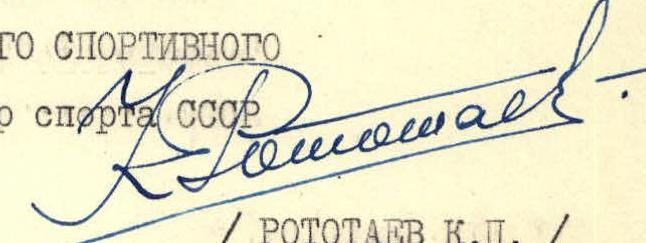
Group composition:
- Rototaev K. — team leader
- Autsokin S.
- Tkachenko A.
- Zhilin E.
- Sorokin I.
- Solodovnikov.
- Runevsky V.
- Shatsky S.