
Team Composition
The MGS DSO "Spartak" team was formed in 1961. During 1961-1963, team members completed a series of climbs up to category 5B difficulty.
Already in 1963, the team considered it possible to participate in the All-Union team competitions in the class of technically complex ascents. In July 1963, the team completed part of the declared route, but an earthquake forced the group to return.
They completed a route on East Dombay-Ulgen via the south wall, which took 1st place in Moscow.
The team composition, as per the application submitted to the judging committee, was determined to be 10 people. As a result of training ascents, the following group composition was determined:
- Kavunenko V. D. — Master of Sports of the USSR — leader
- Shataev V. N. — 1st sports category
- Polyakov L. D. — 1st sports category
- Magomedov Kh. K. — 1st sports category
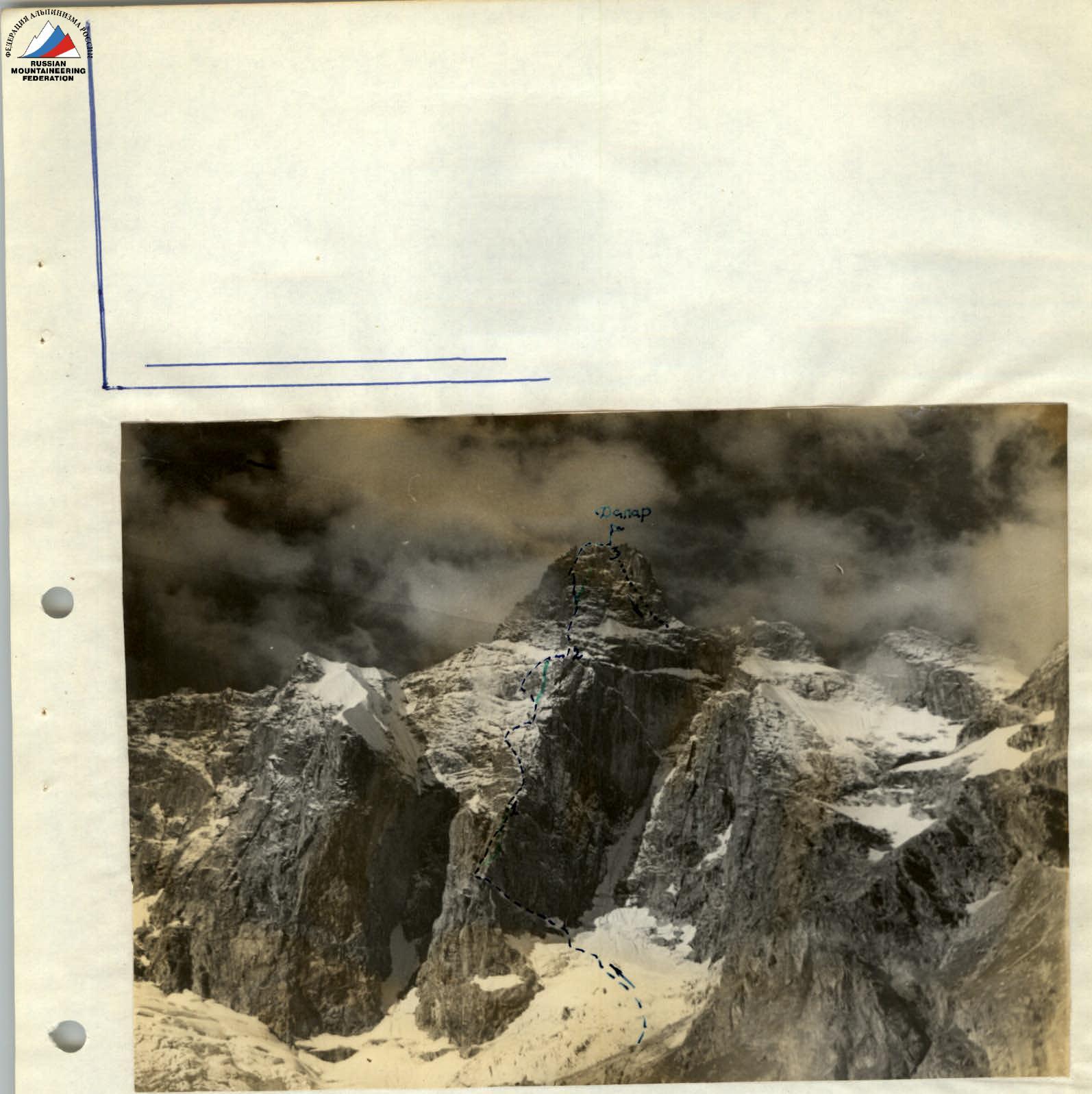
Dalar Peak
- Bivouac — June 24
- Bivouac — June 25
- Bivouac — June 26
Reconnaissance, Tactical Plan, and Organization of the Ascent
The first acquaintance with the wall was through photographs from different angles and detailed consultations. However, this only provided a general impression. Therefore, one of the very important tasks was a detailed study of the wall.
The first reconnaissance sortie to the wall took place on June 15, 1964. A 15x stereotube and descriptions from the first ascenders familiarized us with the wall in minute detail. We knew that this route was significantly more complex than the usual 5B category difficulty routes, but we were ready for the second assault on the wall.
The tactical plan envisaged the simultaneous passage of the route by both rope teams. On the most difficult sections, there was interaction between the rope teams, movement without backpacks, and pulling up the backpacks separately, for which an additional 40-meter Reepschnur was taken.
The significant steepness of the wall and the limited number of good bivouac sites required clearly marking the locations of possible overnight stays to ensure good rest lying down, which was subsequently adhered to during the ascent.
The group had a "Nedra" type radio station and made daily contact directly with the Uzunkol alpine camp. We moved along the route at a good pace, confidently and clearly passing the most complex sections, using all the techniques of modern mountaineering.
Equipment and Provisions
The main part of the equipment was manufactured in Moscow from light but fairly durable materials. The group had hammers with VK-15 inserts for processing rocks. Specially stamped ladder steps proved to be very convenient in work. The weight of the "forge" was significantly reduced — lightweight carabiners made from light alloys. Titanium rock hooks performed very well.
The set of rock hooks was diverse, and with any crack, the organization of protection did not cause delay.
"Breeches" type trousers made of durable cloth greatly facilitated work on rocks. The advantage of such trousers is particularly noticeable when the first climber has a large number of hooks of various assortments. They are laid out in patch pockets sewn on the back and front and do not hinder movement. It is very easy and quick to select a hook of any size. The list of equipment is given in Table No. 2.
One of the most important issues during wall ascents is the question of nutrition. Completing wall routes requires a lot of nervous and muscular energy. Products were selected as much as possible according to personal taste preferences, and despite the limited assortment available at the camp store, the selection of products during the ascent can be considered good.
We managed to deliciously prepare fresh meat, crackers:
- sweet
- salty
according to B. Utkin's recipe. Chocolate, black caviar, and roach increased the already large appetite.
Table No. 2
Group Equipment
- Main rope 9 mm — 2 × 40 m
- Auxiliary rope — 1 × 40 m
- Disposable Reepschnur — 10 m
- 3-step ladders — 4 pcs.
- Rock hammers — 2 pcs.
- Ice axes — 2 pcs.
- Drill bits — 2 pcs.
- Drill hooks — 20 pcs.
- Rock hooks — 60 pcs.
- "Pamirka" tent — 1 pc.
- Down sleeping bag — 2 pcs.
- Standard carabiners — 12 pcs.
- Lightweight carabiners — 30 pcs.
- "Nedra" radio station — 1 pc.
- "Febus" primus stove — 1 pc.
- "Pavlodar" primus stove — 1 pc.
- Cookware — 1 set
- Gasoline — 4 l
- First aid kit — 1 set
- "Golf" trousers — 4 pcs.
- "Vibram" boots — 2 pairs
- "Orikon" boots — 2 pairs
- Slippers — 4 pairs
- Down suits — 4 sets
- Backpacks — 4 pcs.
- Protective glasses — 5 pairs
- Gloves — 4 pairs
- Helmets — 3 pcs.
- Woolen sweaters, gloves, hats, leggings — 4 sets
- Headlamps — 2 pcs.
Ascent
June 23 — Day I
At 16:00, the group left the Uzunkol alpine camp for the first ascent of the season of the highest category of complexity in the area. At 18:00, there was dinner together with the badge-hunters' team, and the final preparations for selecting hooks and products were completed. Shataev weighed everything on a miniature spring scale.
June 24 — Day II
Excellent weather! Cloudlessness and generous sun promise us a good day. We ascend via the Big Kichkinekol glacier and then turn right onto the "ram's foreheads" that lead to the middle of the North Dalar glacier. Along the glacier, bypassing a series of crevasses, we ascend towards a ledge on the north wall. At the beginning of the inner corner, we found a note from N. Semenov — a pleasant surprise.
The ledge is largely composed of heavily destroyed rocks, but there are also monolithic vertical walls, particularly at the end, which are complex to pass. Sections of steep snowfields on the ledge are traversed either by traversing them or along the boundary between snow and rocks.
The ledge ends at a platform where there's another cairn — this time Stepanov's. The sun "exposed" us. Further ascent is directly upwards with minor traverses, mostly along rocks of medium difficulty with short 3–5 m vertical difficult sections.
We exit to the right, past a cave (where an overnight stay is possible). From it begins difficult climbing. First, a smooth vertical wall (section R7), then a smoothed vertical inner corner (section R8), and finally, one of the key points of the entire route — an inclined inner corner of smoothed slab-like rocks filled with water (section R9). The rope teams work clearly and calmly. "Vibram" greatly helps — Kavunenko uses the smallest footholds. By 17:00, we reach the control cairn, but to create a platform, we had to clear 2 m of the snow ridge. Above us is the beautiful tower of Dalar, lit by the setting sun.
June 25 — Day III
Today's task is to pass the middle part of the peak. It represents three blocks of vertical smoothed rocks separated by three snow belts. Initially, we move along stepped rocks with good footholds, which are welcoming — warm.
Sometimes Dalar is not joking, sending "gifts" — stones that fall left into the couloir.
We ascend, occasionally traversing, mainly to the left, using fissures and irregularities of the slabs. The path to the I, and then to the II snow belt is of medium difficulty.
The third block of rocks proves to be the most difficult, and the weather has significantly deteriorated.
We are often shrouded in clouds. We pass a vertical fissure and vertical slabs (section R20), over which water flows. 10 m below the III snow belt, under the rocks, we again clear a platform of snow. Khadzhik reports via radio to the camp that everything is going according to schedule. With what pleasure we drink chicken broth!
On our wall, it's a celebration — Volodya Kavunenko's birthday. They congratulate him from the camp. And we worry about the weather, wondering if we'll have to go down via N. Semenov's route.
June 26 — Day IV
Early in the morning, we woke up, but... white "flies" swirl around us. And then sometimes the sun weakly starts to break through. Quick gathering. Today is the decisive day. The rocks from the bivouac lead to a snow slope. We quickly pass it and exit onto rocks. We traverse left-upwards 15 m to a wide, not clearly defined groove. Fingers freeze from searching for footholds in the freshly fallen snow.
We exit onto smoothed rocks, like slabs and "ram's foreheads," with few footholds and supports, and instead, driven hooks are used. A vertical smooth wall (section R26) is passed with the help of ladders. Above, the steepness of the slabs somewhat decreases.
A pleasant smile is caused by the rare hooks of Stepanov's group — not pulled out in difficult places, meaning we're on the route. A pendulum to the left, and we're in a fissure going upwards, all the way to the ridge! Passing it without ladders is impossible!!. Chunks of ice often fly by — Kavunenko is searching for footholds. Then pulling up the backpacks and again vertical walls (of the inner corner and chimney), smoothed with a small number of footholds.
Magomedov is the first to reach the ridge, and we see Svaneti from Dalar for the first time.
It gets dark and very cold. The sky clears of clouds.
- We clear the platform of ice for an hour.
The summit! Below, we envied those who had previously been on Dalar, having completed such a difficult and beautiful route.
And now we've repeated it!
June 27 — Day V
The sun welcomed us, and we didn't hurry down — we needed to dry out. Descent via the 3B category difficulty route, and by 17:00, we were met by friends at the first koshi.
General Conclusion on the Route and Characteristics of the Participants
The route via the northeast wall of Dalar peak is original, logical, and beautiful. The height difference of the route is 1000 m, including the most complex sections — 400 m. The average steepness is 60–65°, and the most complex sections — 80–85°. Almost throughout its entire length, the route passes along steep vertical rocks where complex free climbing is combined with the need to use artificial support points.
The route is rock-based, but it includes overcoming steep snow slopes up to 40 m long and snowy rocks.
For our group, the route was significantly complicated by its early passage from June 23 to 27, when most of the labor-intensive sections of the rocks were snowy or wet.
The steepness of a considerable number of sections does not allow movement with a backpack. They have to be pulled up separately.
The route requires specially selected equipment, excellent mastery of modern rock climbing techniques, good physical and moral preparation, and sufficient experience in wall ascents.
The group completed the route in 3 days, spending 33 walking hours and driving 80 hooks, of which:
- 2 were drill hooks,
- 16 were petal hooks.
Comparing the route (Dalar peak) with wall routes of the highest category of complexity completed by group members, it can be concluded that the route via the northeast edge of the peak belongs to the most difficult wall routes of 5B category difficulty.
The ascent showed that the group possesses the entire arsenal of technical means necessary in modern mountaineering. Throughout the ascent, there were no disagreements within the group, which significantly contributed to the success of the ascent.
Shataev Volodya — excellently physically prepared, knowledgeable, and an exceptionally calm mountaineer. A good organizer, very hardworking.
Polyakov Lenya — physically and technically well-prepared. Proven himself to be a good mountaineer.
Magomedov Khadzhik — confidently works on rocks. Attentive and kind comrade. On the route, he performed difficult and complex work, driving hooks.
Group leader, Master of Sports of the USSR, V. Kavunenko
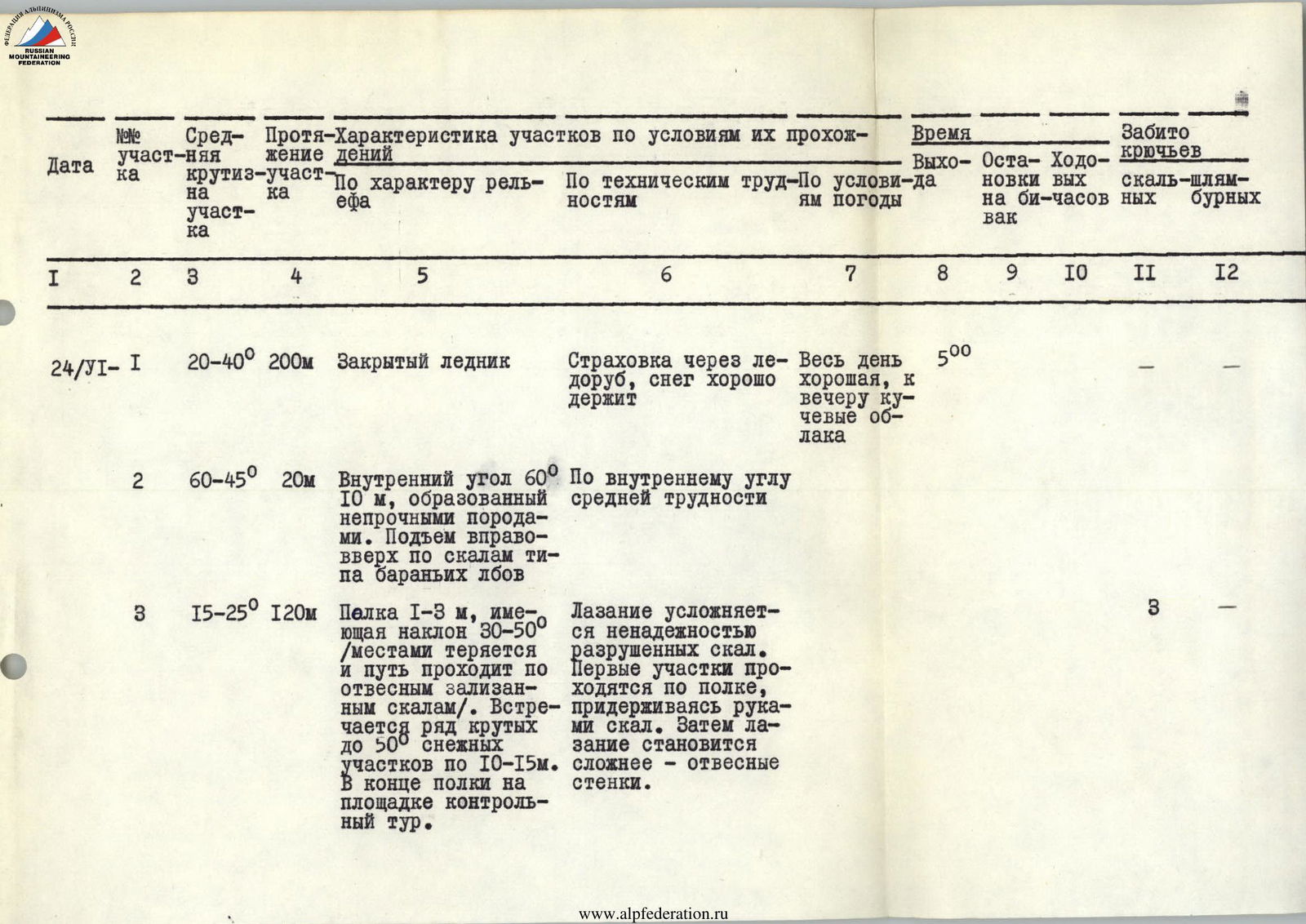
| Section No. | Date | Steepness | Length | Description of the Section | Technical Difficulty | Weather Conditions | Exit Time | Stop Time | Walking Hours | Rock Hooks | Drill Hooks |
|---|---|---|---|---|---|---|---|---|---|---|---|
| R1 | June 24 | 20–40° | 200 m | Closed glacier | Protection via ice axe, snow holds well | Good all day, cumulus clouds in the evening | 5:00 | 1 | |||
| R2 | 60–45° | 20 m | Inner corner 60°, 10 m, formed by unstable rocks. Ascent to the right-upwards along rocks like "ram's foreheads" | Ascent along the inner corner is of medium difficulty | |||||||
| R3 | 15–25° | 120 m | Ledge 1–3 m, with a slope of 30–50° ( местами теряется and the path goes along sheer smoothed rocks). There are several steep snow sections up to 50° and 10–15 m long. At the end of the ledge, on a platform, there's a control cairn. | Climbing is complicated by the unreliability of destroyed rocks. The first sections are passed along the ledge, holding onto the rocks with hands. Then climbing becomes more complex — sheer walls. | 3 | ||||||
| R4 | 75–80° | 50 m | Sheer monolithic rocks 80° with good footholds. Ascent upwards 10 m; left along a ledge 2 m × 20 m, ascent upwards 15 m along rocks 80° with a small number of footholds, exiting to the right along a ledge 0.5 m × 5 m | Pleasant climbing of medium difficulty along monolithic rocks. In the upper part, climbing becomes more complex. | 1 | ||||||
| R5 | 70° | 25 m | Ascent left-upwards along rocks with a small number of footholds — bypassing overhanging rocks. 10 m to the left, there's a cave. | Difficult climbing. | 2 | ||||||
| R6 | 30° | 15 m | Sour snow lies on smoothed rocks | — | 1 | ||||||
| R7 | 75° | 20 m | Smoothed rock wall of the inner corner. Footholds are very scarce and only for the front phalanges of fingers. A ledge for one. | Very difficult climbing | 3 | ||||||
| R8 | 85° | 50 m | Inner corner of strongly smoothed rocks, exiting upwards onto a rib. Steep rocks — 10 m. | Very difficult free climbing | 4 | 1 | |||||
| R9 | 75° | 40 m | Inner corner ascending from left to right. The walls of the corner are slab-like, almost without footholds. The angle's solution is more than 120°. The left wall of the corner is vertical, even overhanging in places. The right wall, 2 m wide, is inclined at an angle of 75°. Its right edge overhangs the vertical. Rocks are slab-like, smoothed, and filled with water. There are few cracks, and they are narrow and short. At the top — a vertical stone 5 m. | Very difficult climbing. This is one of the key sections of the entire route. Passed using ladders and petal hooks. Pulling up backpacks is complex as they are "thrown" by a pendulum to the right-down under the overhanging rocks. | 8 | ||||||
| R10 | 50° | 3 m | Rocks are snowy and icy. Exit to a platform. Control cairn. | Difficult climbing | 17:00 | 12 | |||||
| R11 | June 25 | 50° | 4 m | Snowfield exiting onto an inclined ledge under overhanging rocks | Ascent in three steps using additional ice axes as supports | Good until 15:00, then continuous fog, graupel at 16:00. Thunderstorm in the evening. | 7:00 | ||||
| R12 | 70–75° | 120 m | Sheer stepped rocks like "ram's foreheads" with a sufficient number of footholds. Overhanging rock sections are bypassed to the right. | Climbing of medium difficulty. The first climber without a backpack. | 3 | ||||||
| R13 | 60–65° | 60 m | Inclined fissure with smoothed walls to the right-left. At the top, onto the left edge of the fissure | Climbing of medium difficulty on friction, using supports | 2 | ||||||
| R14 | 20 m | Traverse to the right towards a rib under an overhanging light "bald head" along osypny rocks covered with snow. | Easy climbing | ||||||||
| R15 | 45–80° | 30 m | Snowfield with a steepness of 40°, 15 m, traverse of a rock wall to the left 6 m along the edge of snow and rocks. Inclined fissure 9 m to the left-upwards in the wall with a steepness of 80°. | Climbing of medium difficulty | 2 | ||||||
| R16 | 75–80° | 40 m | Inner corner with rough walls without protrusions for footholds and supports. | Difficult climbing mainly due to friction and using supports. | 3 | ||||||
| R17 | 35° | 50 m | Snow slope exits to a sheer belt of rocks | Medium difficulty | |||||||
| R18 | 40° | 15 m | To the left-upwards along a ledge 0.5 × 15 m to a large protrusion before a fissure | Medium difficulty, rocks are wet | |||||||
| R19 | 85° | 30 m | Vertical fissure in a smooth sheer wall with a steepness of 85–90°, 15 m. Edges of the fissure are rough but without protrusions. The fissure exits onto a smoothed wall, after which there's a ledge for two, all flooded with water from above. | Very difficult climbing in the fissure using supports, the body doesn't fit. Exit to the wall on ladders. Backpacks are pulled up separately. | 7 | ||||||
| R20 | 85° | 30 m | Sheer rocks like slabs. Water flows over the rocks. Footholds are smoothed, scarce, and only for the front phalanges of fingers. There are few cracks — shallow and narrow. A key point of the route. | Very difficult climbing — using petal hooks, ladders. Backpacks are pulled up separately. | 5 | ||||||
| R21 | 40 m | Traverse to the right along an osypnaya ledge to a platform under an overhanging wall | Easy difficulty | 16:00 | 9 | ||||||
| R22 | June 26 | 45° | 50 m | Rocks with a steepness of 60°, 7 m, leading to a snow slope | Ascent in places in three steps along the snow | Light snow until 8:00, then fog throughout | 8:00 | ||||
| R23 | 75–80° | 40 m | Inner corner 7 m, bypassing overhanging rocks to the left-upwards, not clearly expressed groove | Climbing of medium difficulty, complicated by freshly fallen snow | 2 | ||||||
| R24 | 70° | 80 m | Stepped rocks with short sheer walls 1.5–2.5 m with a sufficient number of footholds | Climbing of medium difficulty. Short walls are difficult. | 3 | ||||||
| R25 | 70° | 70 m | Monolithic rocks like slabs and "ram's foreheads," strongly smoothed, with few irregularities and footholds. | Very difficult climbing | 5 | ||||||
| R26 | 70° | 40 m | Sheer smooth wall with a steepness of 85–90°, 8 m, transitions into rocks like slabs 60–70° with small ledges | Wall is passed on ladders — difficult climbing | 6 | ||||||
| R27 | 20 m | Traverse to the left along a ledge 1.5 × 20 m under overhanging rocks along the snow | Medium difficulty | ||||||||
| R28 | 85° | 40 m | Traverse of a smooth wall and bypassing a protruding rib of a vertical fissure. Ascent along the fissure with smoothed walls | Pendulum to the left along the wall on a fixed rope 10 m. Very difficult climbing in the fissure. Backpacks are pulled up separately. | 5 | ||||||
| R29 | 90° | 15 m | Bypass to the left of overhanging sections of the fissure covered with ice. No footholds. Cracks only for petal hooks. A key point of the route. | Very difficult bypass, passed on ladders | 8 | ||||||
| R30 | 80° | 30 m | Vertical chimney 7 m without protrusions, wall 5 m transitions again into a chimney 15 m with smooth walls | Very difficult climbing. Backpacks are pulled up separately. | 4 | ||||||
| R31 | 70° | 40 m | Rocks like slabs with a sufficient number of footholds on the first 10 m. Strongly smoothed at the top | At the beginning, medium difficulty, transitions into difficult | 2 | ||||||
| R32 | 60–65° | 35 m | Snow ridge 15 m — very sour snow 40°. Slabs of the inner corner 10 m, snowy without footholds. Smooth sheer wall 2 m, easy rocks lead to the ridge. | Difficult climbing, especially the smooth 2 m wall. | 2 | ||||||
| R33 | 20° | 100 m | Ospyipnaya ledge 60 m bypassing the ridge and further along easy rocks on the ridge | Easy climbing | 20:00 | 13 |

Comments
Sign in to leave a comment