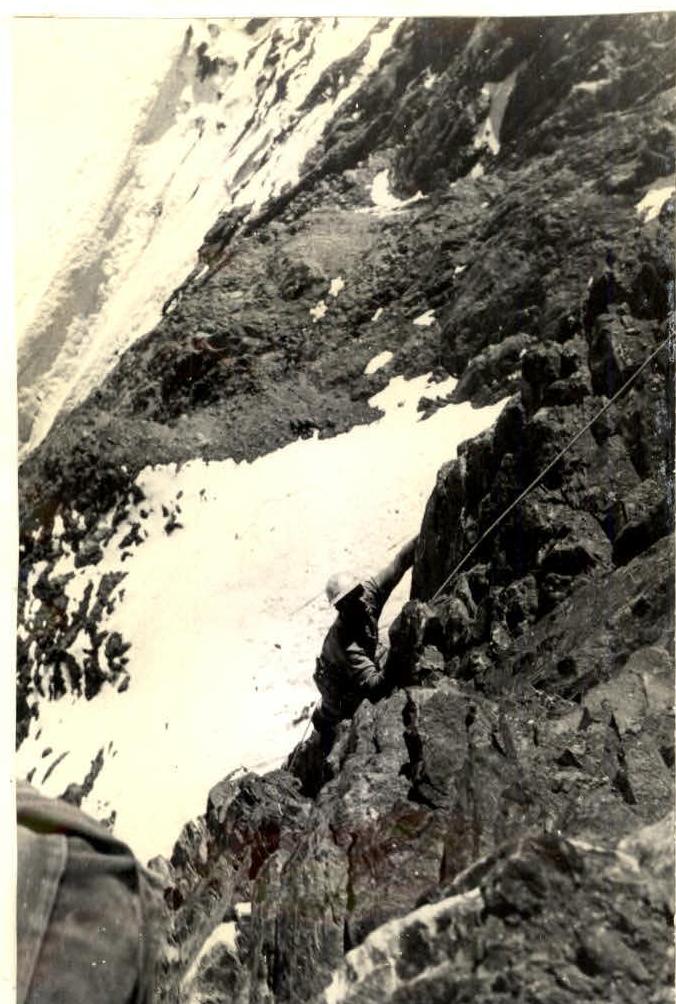
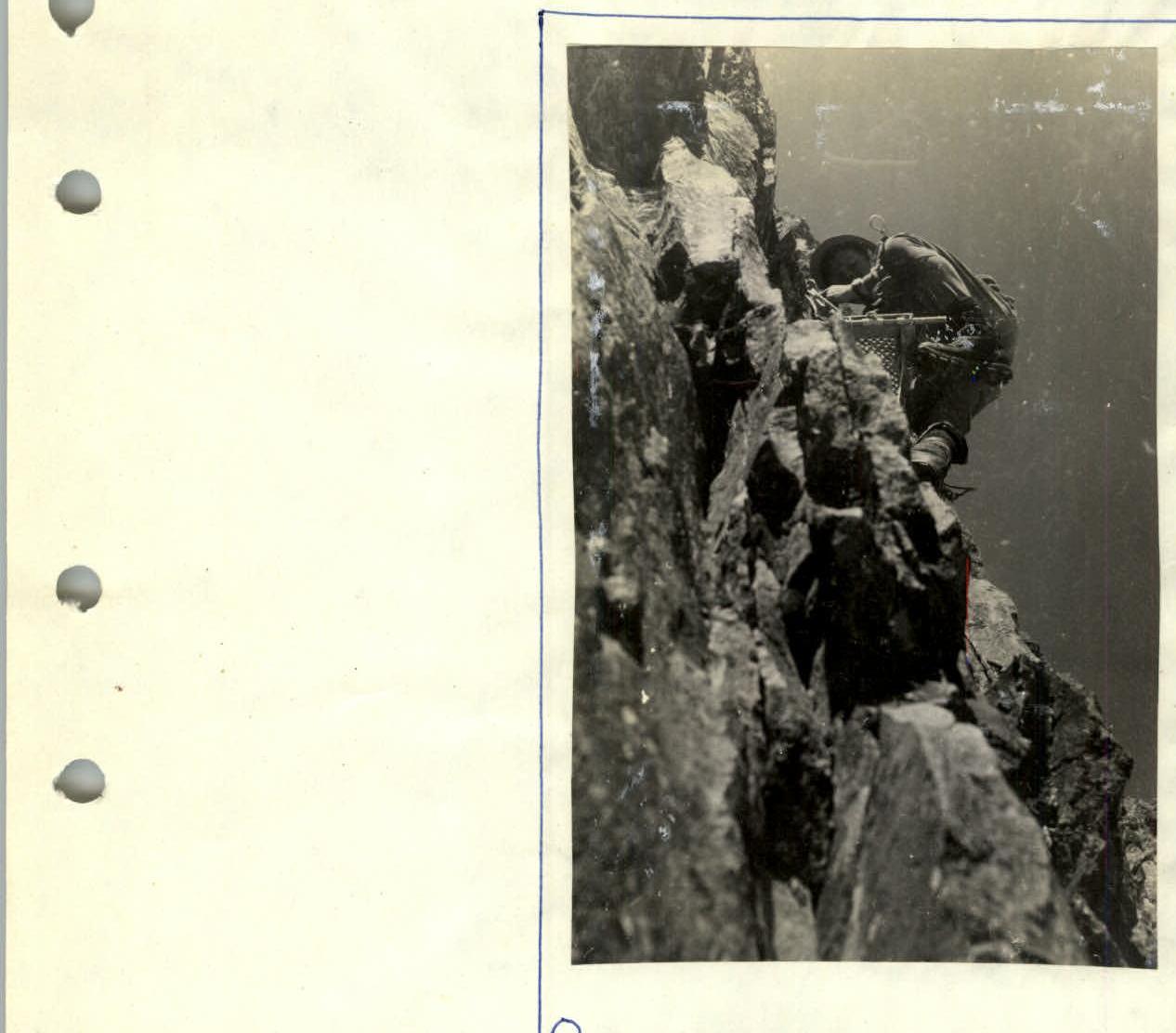
Traverse
of the Amanauz and Sofrudju massif with ascent to Dvuzubka via the East wall 6A
Team of the Moscow City Council of the DSO "Spartak"
Coach and team leader - Master of Sports of the USSR Kavunenko V.D.
Moscow 1964
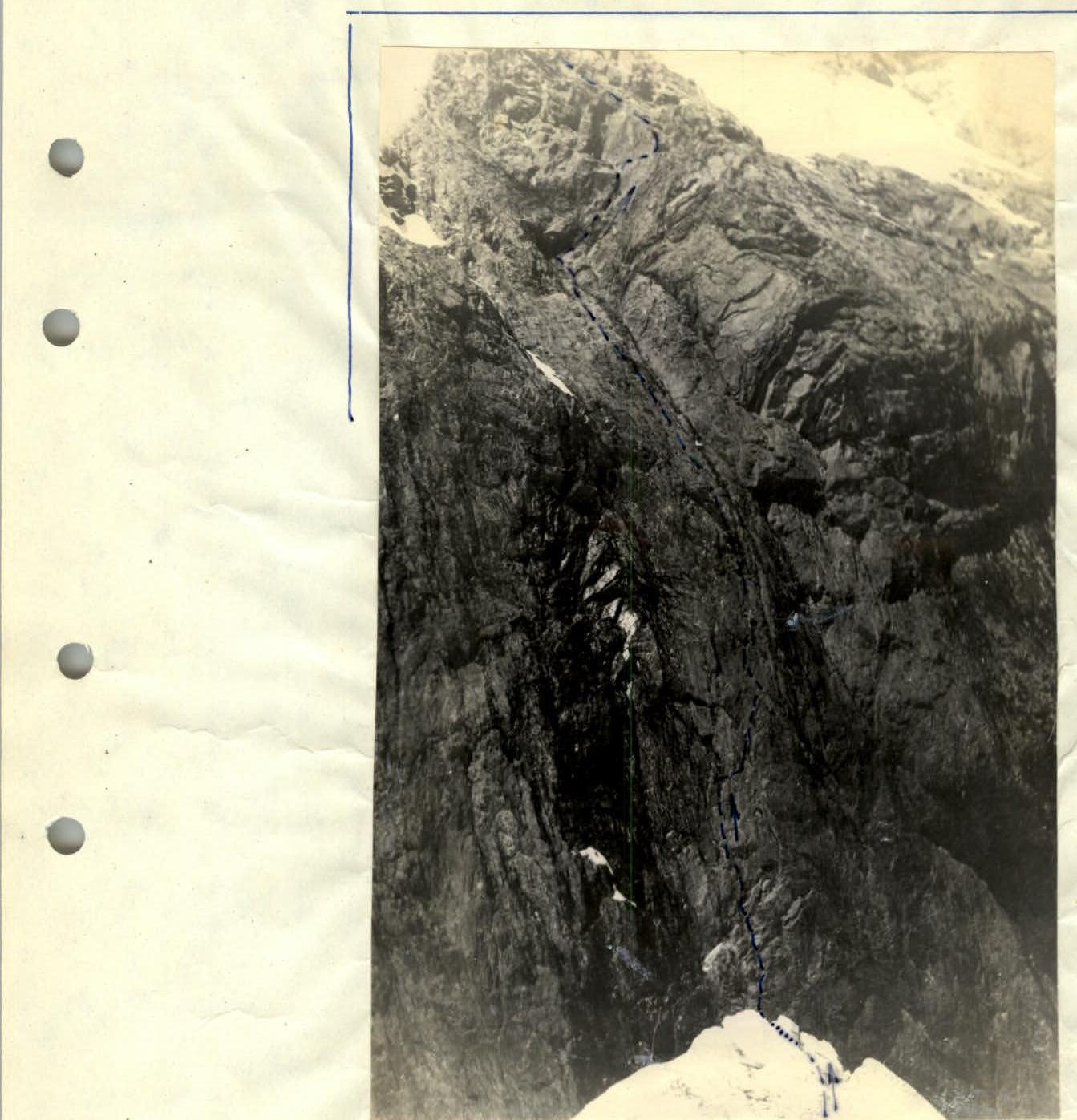
Brief geographical and sporting characteristics of Dvuzubka peak
Dvuzubka peak is located in the mountainous part of the Karachay-Cherkess Autonomous Region of Stavropol Krai.
To the east of the Sofrudju snow dome, a sharp decline begins towards the Amanauz Pass saddle, then the ridge rises by more than 250 m, forming a huge three-peak massif:
- Main Amanauz
- Uzlovoy Amanauz
- South Amanauz
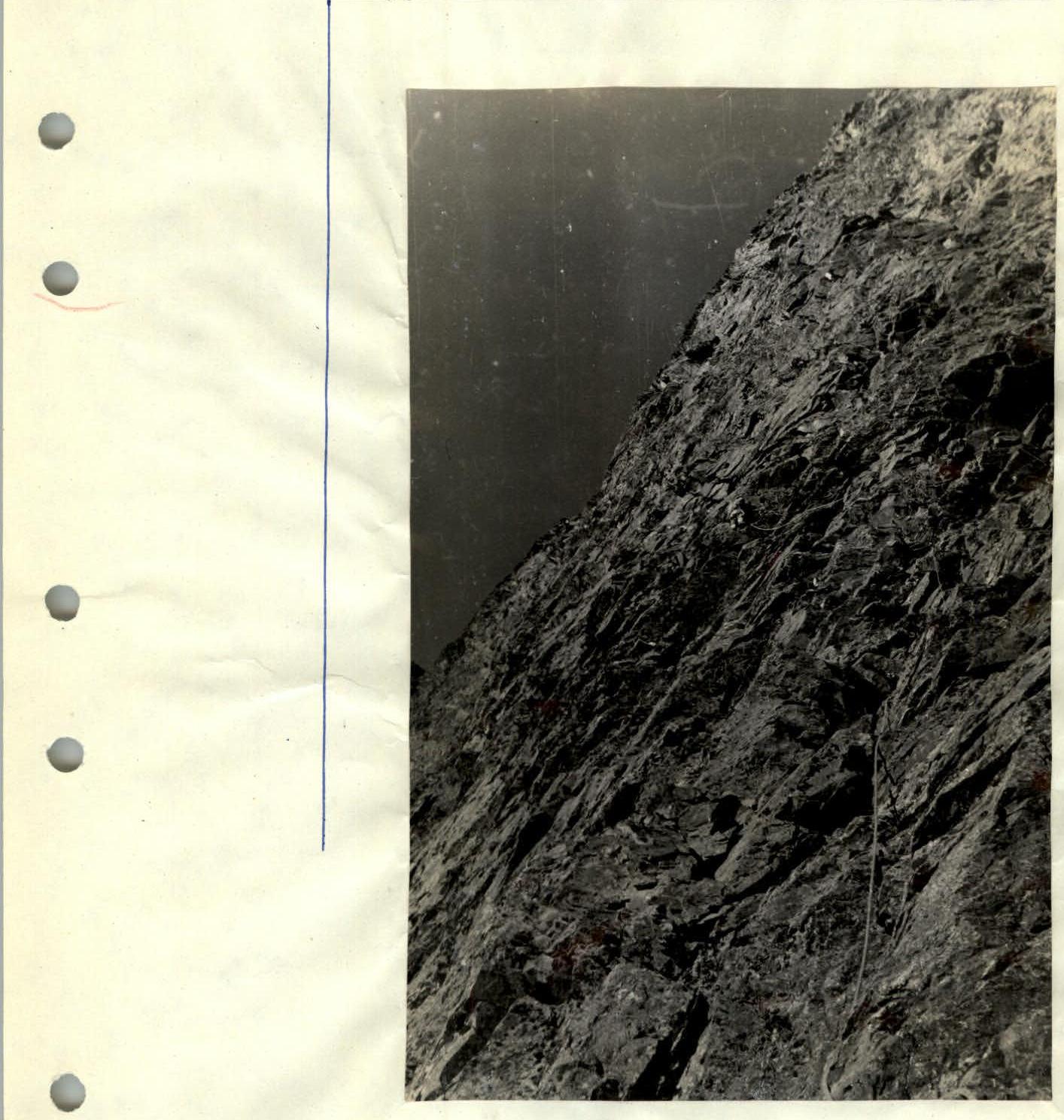
Between the Main and Uzlovoy Amanauz peaks lies Dvuzubka, its East wall dropping 700 m to the North Amanauz glacier.
The East wall of Dvuzubka has long attracted the attention of leading Soviet mountaineers. Much of the wall is visible directly from the Dombay plain. While working at the camps in the Dombay region, the participants repeatedly observed the wall. In 1963, teams from the Central Council of the DSO "Burevestnik" and the Moscow City Council of the DSO "Spartak" announced their intent to climb Dvuzubka for the championship title. That year, the East wall of Dvuzubka was also announced by two teams:
- ours
- the team of the DSO "Avangard" (led by Monogarov)
Composition of the sports team
The team of the Moscow City Council of the DSO "Spartak" was formed in 1961. During 1961-1963, the team members completed several joint ascents up to Category 5B inclusive.
After completing challenging routes in 1964 (Dalar via the North-East edge, Dalar via the bastion), the Spartak team considered it possible to attempt the Dvuzubka wall.
The team composition was as follows:
- Kavunenko V.D., Master of Sports - team leader
- Utkin B.M. - Master of Sports
- Shataev V.N. - 1st sports category
- Balashov A.M. - 1st sports category
Information about the assault team members
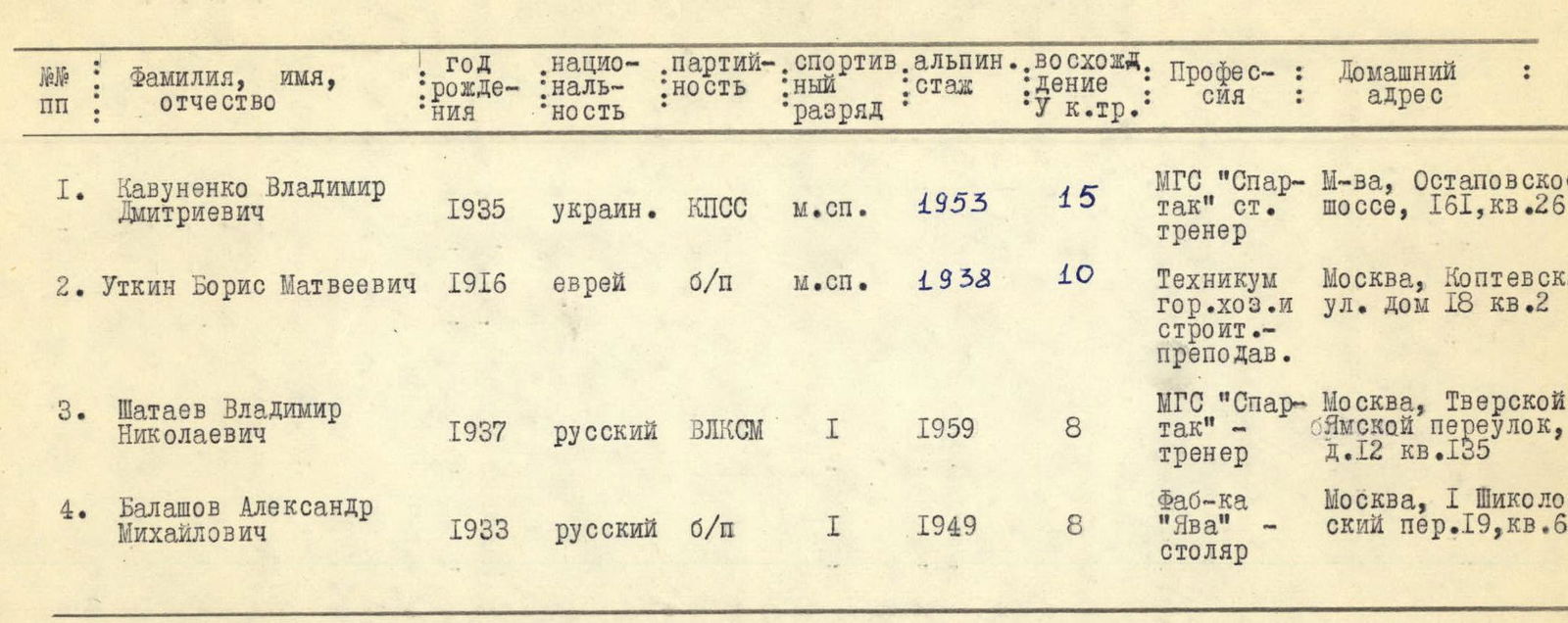
Table № 1
| № | Full name | Year of birth | Nationality | Party affiliation | Sports category | Mountaineering experience | Ascents of category 5B | Profession | Home address |
|---|---|---|---|---|---|---|---|---|---|
| 1. | Kavunenko Vladimir Dmitrievich | 1935 | Ukrainian | CPSU | Master of Sports | 1953 | 15 | MGS "Spartak", senior coach | Moscow, Ostapovskoe shosse, 161, apt. 26 |
| 2. | Utkin Boris Matveevich | 1916 | Jewish | non-party | Master of Sports | 1938 | 10 | Technical school for municipal economy and construction, lecturer | Moscow, Koptevskaya str., 18, apt. 2 |
| 3. | Shataev Vladimir Nikolaevich | 1937 | Russian | Komsomol | 1st sports category | 1959 | 8 | MGS "Spartak", coach | Moscow, Tverskoy-Yamskoy per., 12, apt. 135 |
| 4. | Balashov Alexander Mikhailovich | 1933 | Russian | non-party | 1st sports category | 1949 | 8 | "Yava" factory, carpenter | Moscow, 1st Shkolov per., 19, apt. 6 |
Reconnaissance of the wall
On June 20, 1963, Shataev and Verbovoy, as a duo, went to the wall area for reconnaissance of a possible ascent route. The reconnaissance revealed that there is only one possible path up the wall, presenting significant difficulty and sporting interest. An earthquake in Dombay in the summer of 1963 prevented the MGS "Spartak" team from completing the ascent that season.
Organizational and tactical plan for the ascent
Despite prior reconnaissance, the team considered it necessary to observe the wall's regime for another half day.
Convinced that falling stones would not hit their route due to the wall's overhanging or sheer nature, the team decided to start processing the route that same day. The duo - Kavunenko and Shataev - processed 80 m and returned to the glacier for the night.
Scheme of movement along the route
- The first climber processes the route, leaving a rope or a large ladder for the others
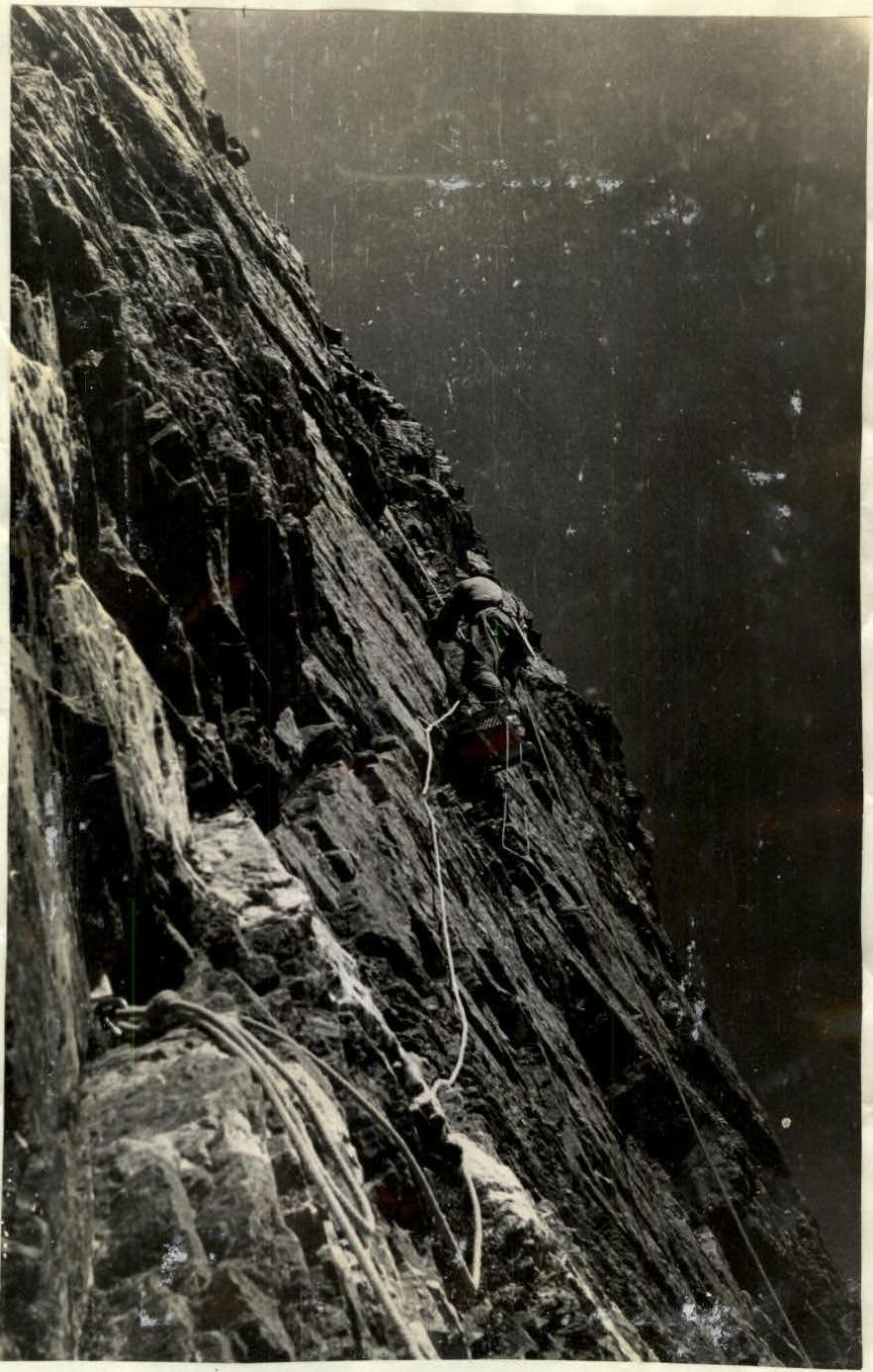
- The 2nd and 3rd climbers pull up the backpacks
- The 4th climber removes the pitons
A distinctive feature of the tactical plan was the twice use of the same location for overnight stays (the best option for relatively good rest). The team mostly traversed the route without backpacks (pulling them up added extra difficulty). The necessary gear was distributed among 3 backpacks.
For communication with the KSP, the team had a DR-3 radio set and flares. The DR-3 radio operates only with direct visibility between the communication objects. The first two days, communication was established directly through the group of Polyakov L., who was traversing Dzhugeturlugat, and Polyakov's group traversing Amanauz. The next three days, communication was maintained with KSP via radio and flares.
Equipment and food supplies
Most of the metal equipment was manufactured in Moscow from lightweight yet durable materials.
The pitons with a slightly offset sharpening line and edges ground to 1.5-2 mm worked well. They did not jam in any rock type and allowed drilling a hole in 10-12 minutes even in very hard rock.
Simple, lightweight, and reliable were the piton hooks. The titanium hooks with two horizontal holes for carabiners were very convenient.
Specially stamped ladder steps proved to be very convenient.
Lightweight carabiners made from light alloys significantly reduced the weight of the "forge" and withstood a static load of 1100-1200 kg.
Titanium rock pitons performed very well. The set of rock pitons was diverse, and with any available crack, insurance organization did not cause delays.
A working platform with adjustable legs allowed adjusting the body position according to the wall's steepness.
"Golf" type pants made from durable wool significantly eased the work on the rocks. The additional pockets for hooks sewn on the back and front did not hinder movement.
The "Vibram" boots proved superior to boots with tricouni.
The list of equipment is provided in Table № 2.
One of the most critical aspects during wall ascents is nutrition. Completing wall routes requires expending a significant amount of nervous and muscular energy. Replenishing energy occurs through food intake. For wall routes lasting up to two days, the body's energy reserves are sufficient, but longer routes require high-calorie foods to restore energy reserves.
Foods were selected based on personal taste preferences whenever possible. Despite the limited assortment at the camp store, the food selection during the ascent was considered good. We managed to prepare tasty fresh meat, sweet and salty biscuits according to B.M. Utkin's recipe. Chocolate, black caviar, dried roach, and cured fish increased the already significant appetite.
After a hard day's work, it was a treat to enjoy a genuine Hungarian goulash.
Ascent
August 5
Early in the morning, the group departed from the "Uzunkol" alpine camp under heavy rain and, accompanied by thunder, arrived at the Dombay plain by the afternoon.
August 6
Departing at 13:00 from the Dombay plain, they approached the wall that same day and set up a bivouac on the North Amanauz glacier.
August 7
The group observed the wall from morning, expecting overhanging sections and sheer cliffs. Despite this, they considered the path passable.
During observation, the wall was hit by falling stones twice within 1.5-2 hours, which went into the couloir on the left or flew over the wall without touching it.
They were pleased to find two snow patches on the wall (remnants of bad weather) - a source of water.
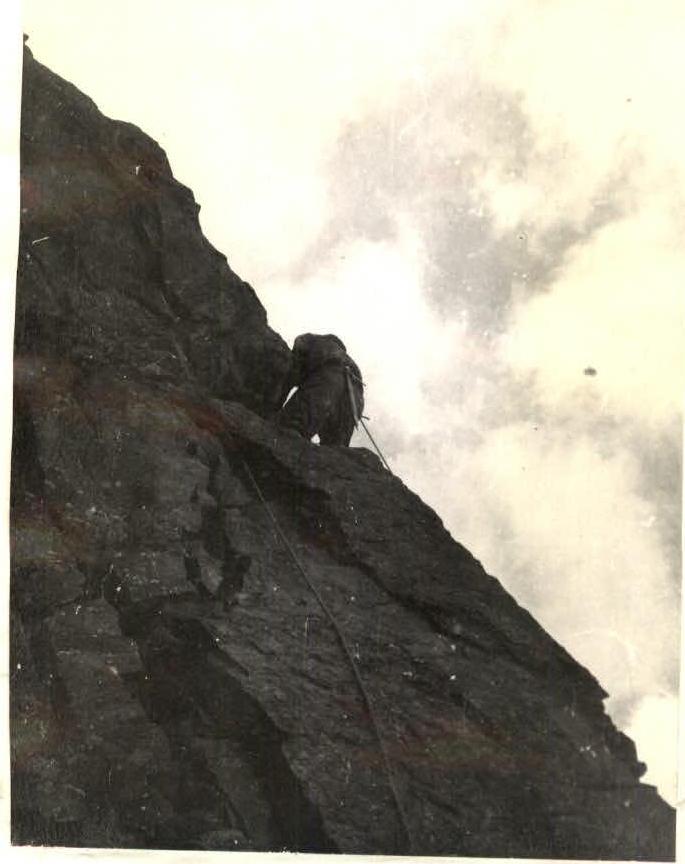
That same day, the duo Kavunenko - Shataev began processing the wall. Within 4 hours, they managed to ascend 80 m of very difficult sheer cliffs. Utkin and Balashov observed their work and warned about falling stones. After leaving the fixed ropes for the night, they descended to the bivouac by 18:00, where a hot dinner awaited them.
August 8
As soon as the sun illuminated the wall, they began ascending the processed section. This section was challenging even with fixed ropes due to smooth rocks and lack of footholds.
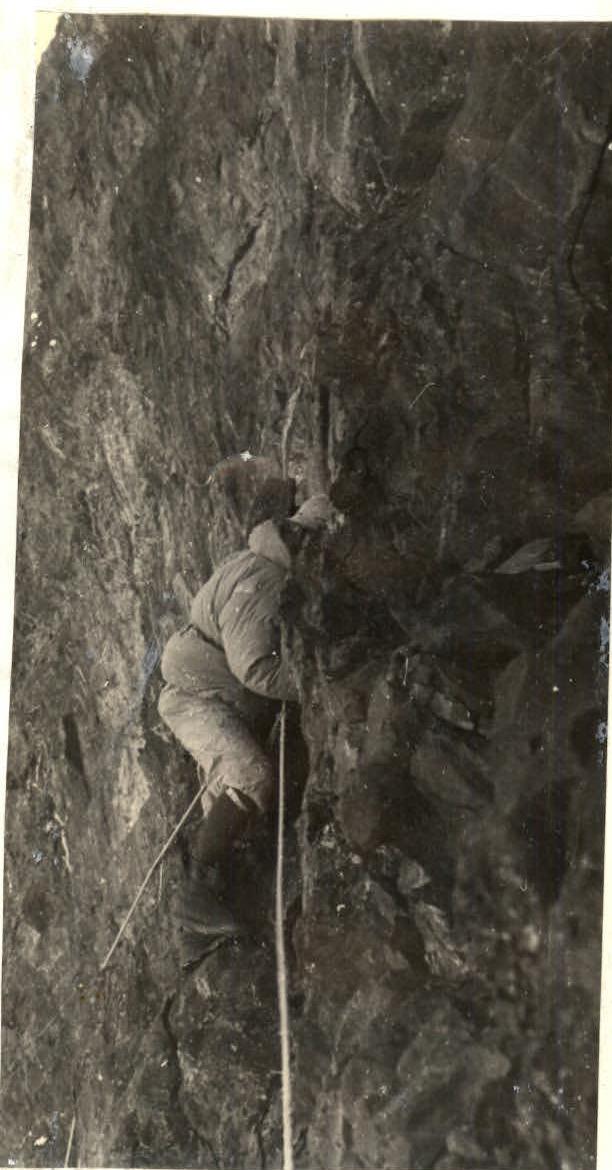
A 10-meter ladder was used on the first rope. Wind dripped water from a stream on the left. Kavunenko continued upward, aiming to cross the couloir. Although rare, stones flew by.
Sheer red rocks presented challenges:
- Backpacks were heavy due to the need to pull them up.
- 300 m were covered from the glacier bivouac in one day.
- They had to bivouac sitting, as there was no place to set up a tent.
They placed a four-person sleeping bag inside the tent, climbed in, and tied themselves to pitons, sleeping in their helmets.
August 9
An even more challenging day. There were fewer places to hammer in pitons, and more overhanging sections. Shlyambr pitons were used more frequently.
Everyone found it tough:
- Volodya Shataev struggled with the backpacks
- Sasha Balashov found removing pitons exhausting
Kavunenko continued higher, aided by his Vibram boots, but rested after each difficult section. Everyone progressed with great strain, utilizing any opportunity to rest. A small snow patch provided a convenient and safe bivouac after removing a 200-250 kg stone from the wall. They managed to stretch one slope of the tent roof and settle in for a semi-reclined night. After 10 minutes, they enjoyed the aroma of Hungarian goulash.
August 10
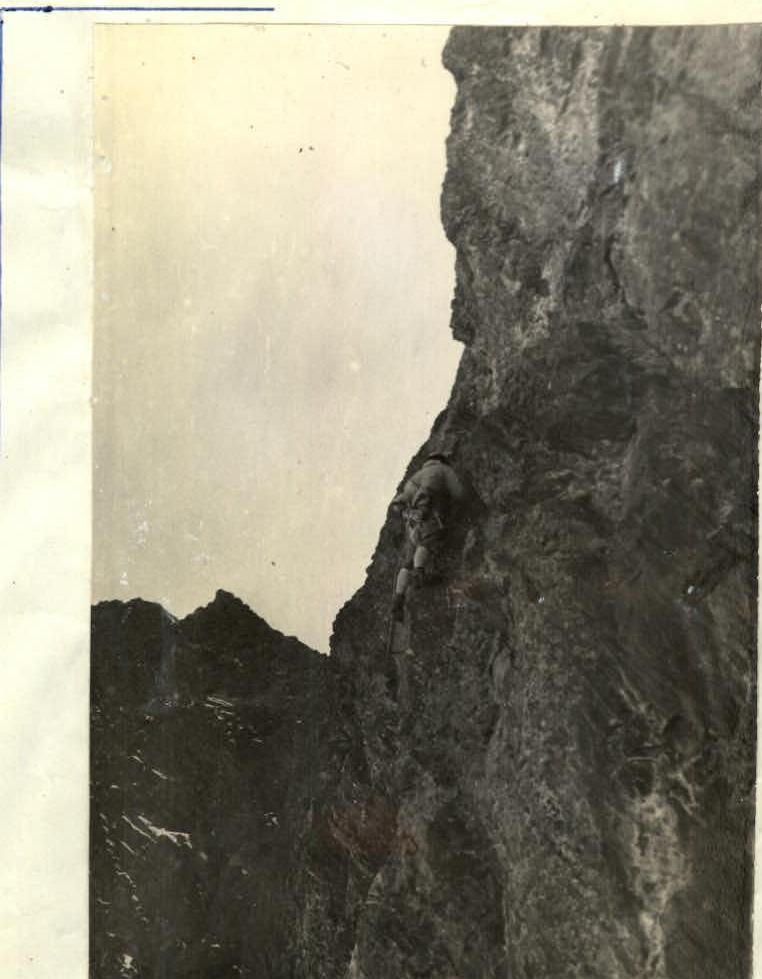
The most challenging day. They had to navigate 65 m of overhanging rock. Kavunenko began by climbing a difficult smooth slab, then wedged himself into a sheer crack, and again, shlyambr pitons were used. An 8-meter overhanging section was passed. For the others, a 10-meter ladder was hung, its lower end 1 m away from the wall, making it hard to reach.
Then came an overhanging ledge, challenging to pass, after which Utkin and Shataev barely fit on a slab detached from the wall. The ledge was protected by a steeply overhanging wall section; moving up and right was impossible - the only option was left and down. Balashov waited for over three hours on the bivouac site while the group didn't even cover 40 m.
On the next 40 m, Kavunenko spent 5 hours "in weightlessness" - ladders hung in the air, making it very hard to work.
There were no suitable bivouac sites, and ahead lay more complex climbing. The group decided to descend to the previous bivouac for rest. Although they lost altitude, the rest was more substantial.
August 11
They were lucky with the weather - the radio reported a drop in pressure for the third day, but they were warmed by the sun's rays. They traversed the processed section, with backpacks hanging on the sheer wall on pitons. The belayer often stood on a ladder or on one leg. Again, "industry" - ladders and shlyambr pitons. As the wall's steepness decreased, they entered a couloir. Another 100 m on snow-covered slabs, 2-4 sheer sections - and they were on the summit. At 21:00, they set up a bivouac site 10 m below the summit.
The stormy weather was felt - the rope sparkled when touched.
The challenging route was behind them.
August 12
6:30 AM. They hurried - storm clouds were gathering in the south. The rocky ridge led them to the Main Amanauz peak within 1.5 hours, and they descended to the pass via a familiar path. They finally found water, which they drank avidly. Ahead lay the Sofrudju peak and a descent to the Bear's glade. By 20:00, they were greeted by friends at the KSP of the Dombay region.
General conclusion on the route
Comparing the route to other wall ascents (e.g., South Uzhba via the D-3 wall, Dalar via the North-East edge, Dalar via the bastion), the team concluded that the route on Dvuzubka via the East wall surpassed them in difficulty and should be categorized as higher than 5B.
Analysis of many ascents shows that the pace and total time taken by the same group are good comparative indicators of the ascent's difficulty. Such characteristics (see Table № 3) allow concluding the relative difficulty of the ascent.
The route requires not only mastery of modern rock climbing techniques but also excellent physical and mental preparation.
Evaluation of the group's movement tempo on various routes of the highest category of difficulty
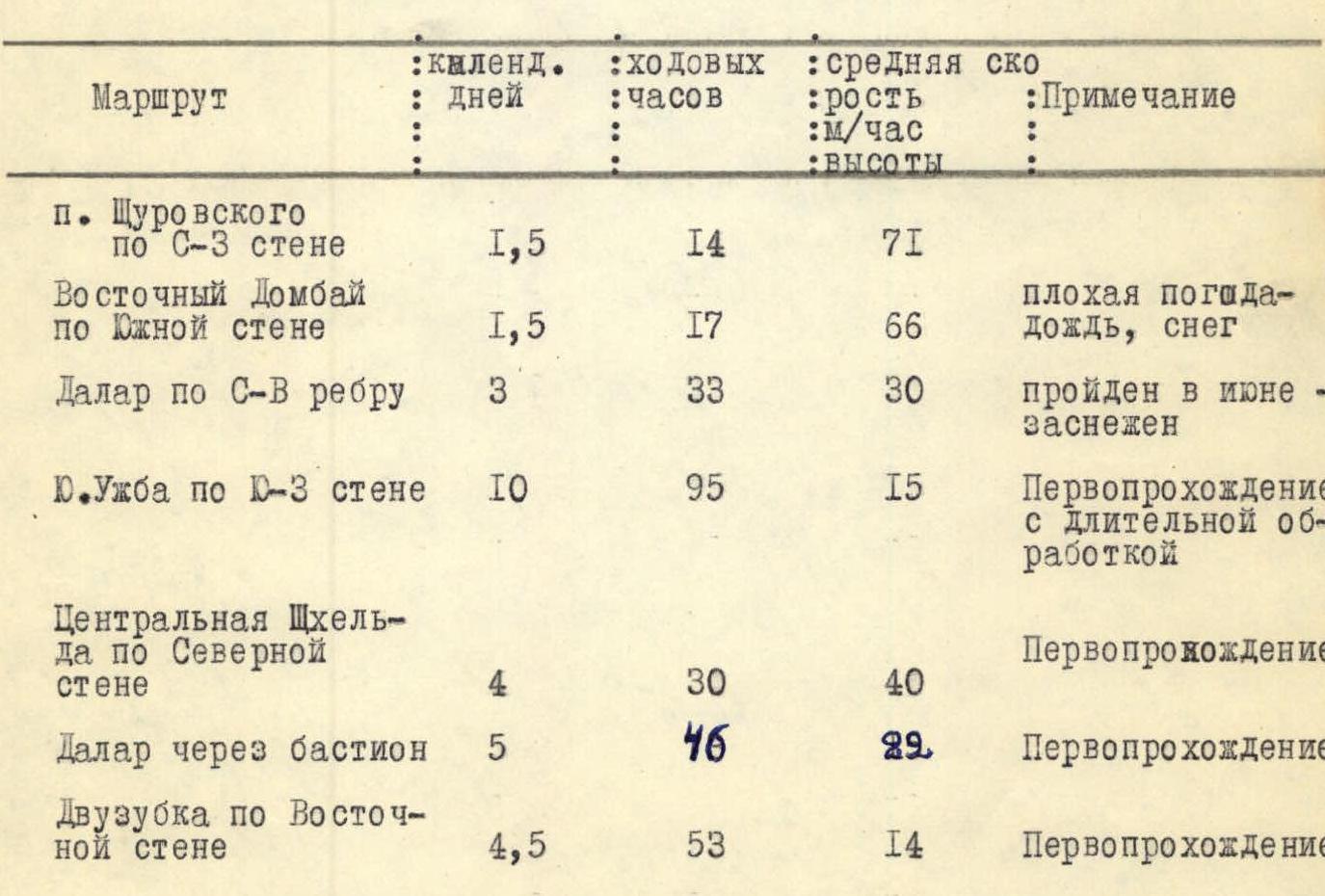

| Route | Calendar days | Working hours | Average speed m/h height | Remarks |
|---|---|---|---|---|
| p. Shchurovskogo po S-Z стене | 1.5 | 14 | 71 | |
| Vostochny Dombay po Yuzhnoy stene | 1.5 | 17 | 66 | Bad weather: rain, snow |
| Dalar po Severo-Vostochnomu rebru | 3 | 33 | 30 | Snow-covered, done in June |
| Yu. Uzhba po 2-3 стене | 10 | 95 | 15 | First ascent with prolonged processing |
| Centralnaya Shkhelda po Severной stene | 4 | 30 | 40 | First ascent |
| Dalar cherez bastion | 5 | 46 | 29 | First ascent |
| Dvuzubka po Vostochnoy stene | 4.5 | 53 | 14 | First ascent |
Characteristics of the sections
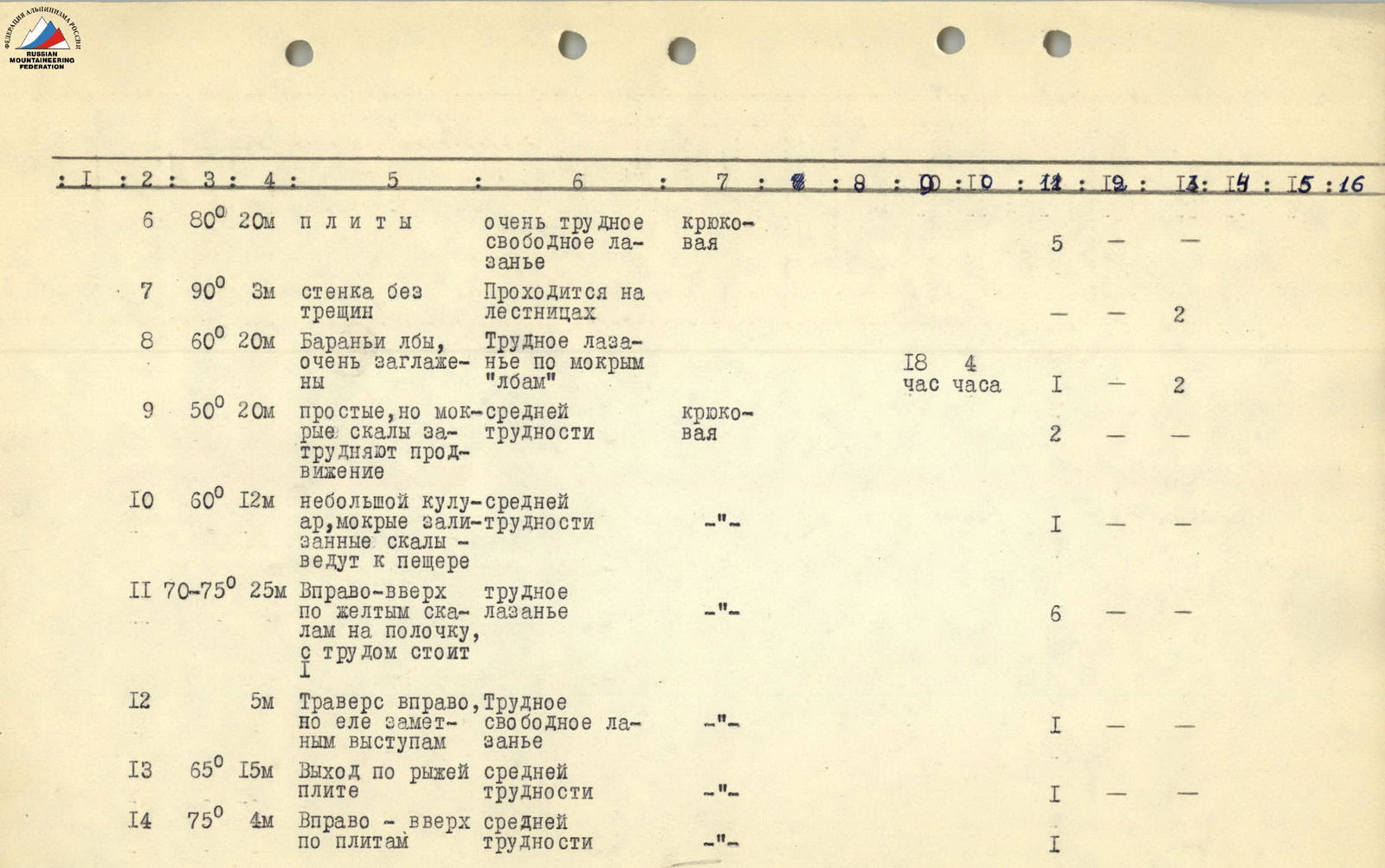
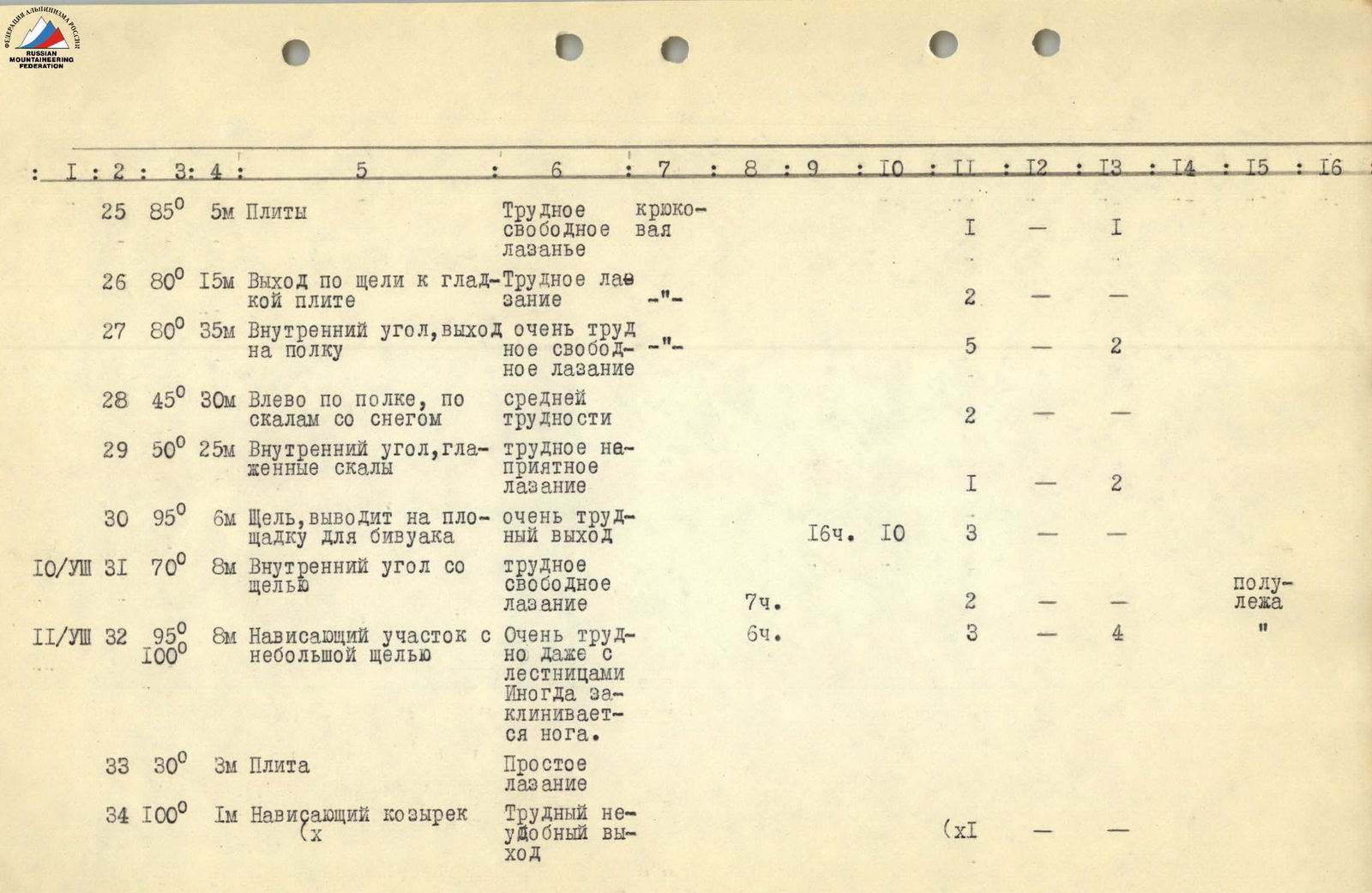
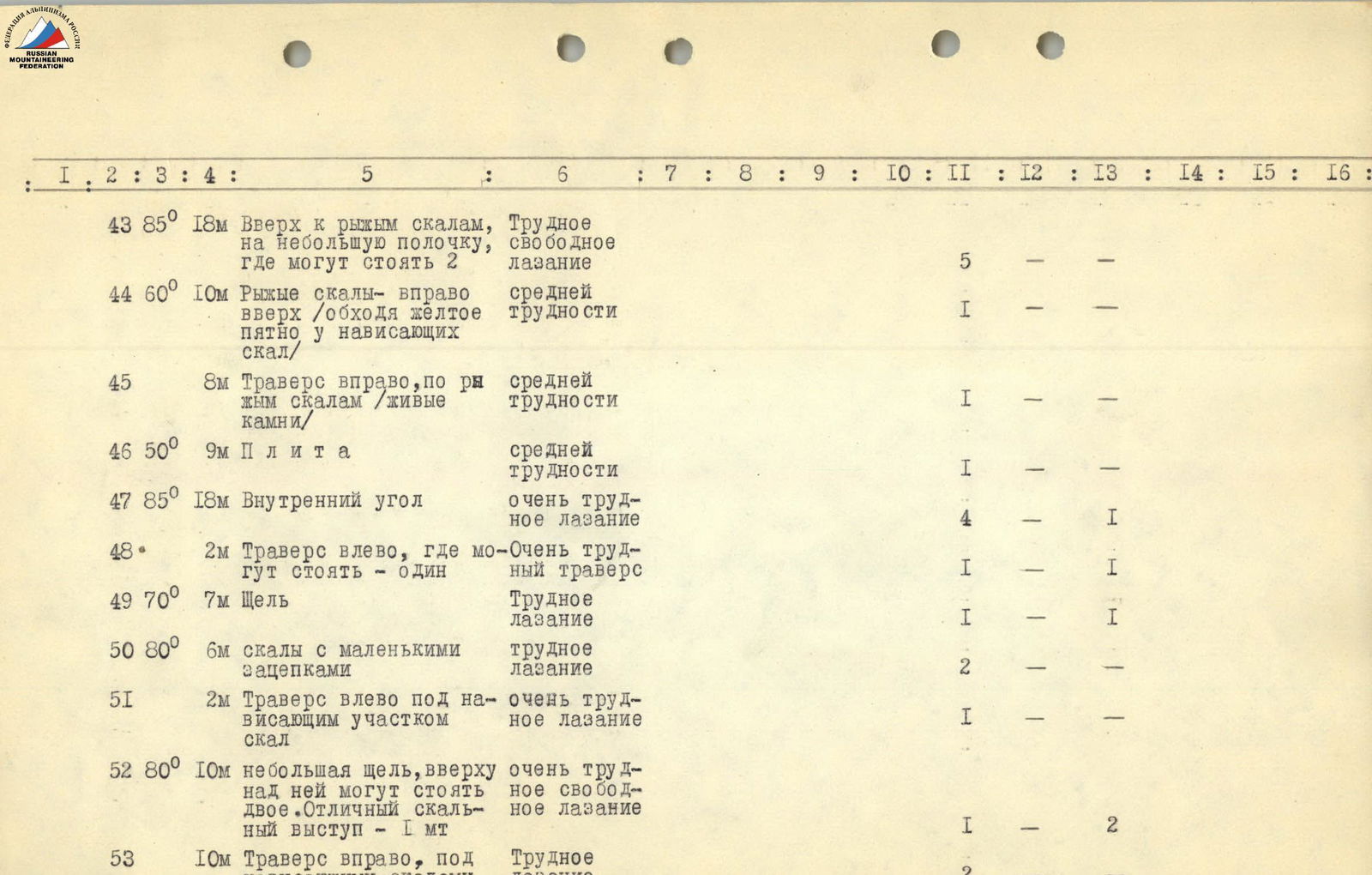
| Date | Section № | Steepness | Length | Terrain characteristics, difficulty, special conditions | Insurance method | Departure time | Stop time at bivouac | Working hours | Pitons: rock | Pitons: ice | Pitons: shlyambr | Bivouac conditions / Remarks |
|---|---|---|---|---|---|---|---|---|---|---|---|---|
| 7/8 August | R1 | 85° | 4 m | Smoothed rocks with an exit to a ledge, difficult climbing | Piton insurance | 14:00 | 1 | – | – | good | ||
| 8 August | R2 | 85° | 20 m | Smoothed rocks with few holds, difficult free climbing | Piton insurance | 8:00 | 7:00 | 3 | – | – | ||
| R3 | 85° | 5 m | Slab without holds, requires ladders | Piton insurance | 2 | – | 2 | |||||
| R4 | 90–85° | 5 m | Traverse right to a crack - one of the route's key points, very difficult with freely hanging ladders | Piton insurance | 3 | – | – | |||||
| R5 | 90–85° | 8 m | Crack - 1 m overhangs at the end, can stand two, very difficult free climbing | Piton insurance | 2 | – | – | |||||
| ... | ... | ... | ... | ... | ... | ... | ... | ... | ... | ... | ... |