
Mshatka — Kaya — 10. «Genofond Selection» — (F6c E4), A3
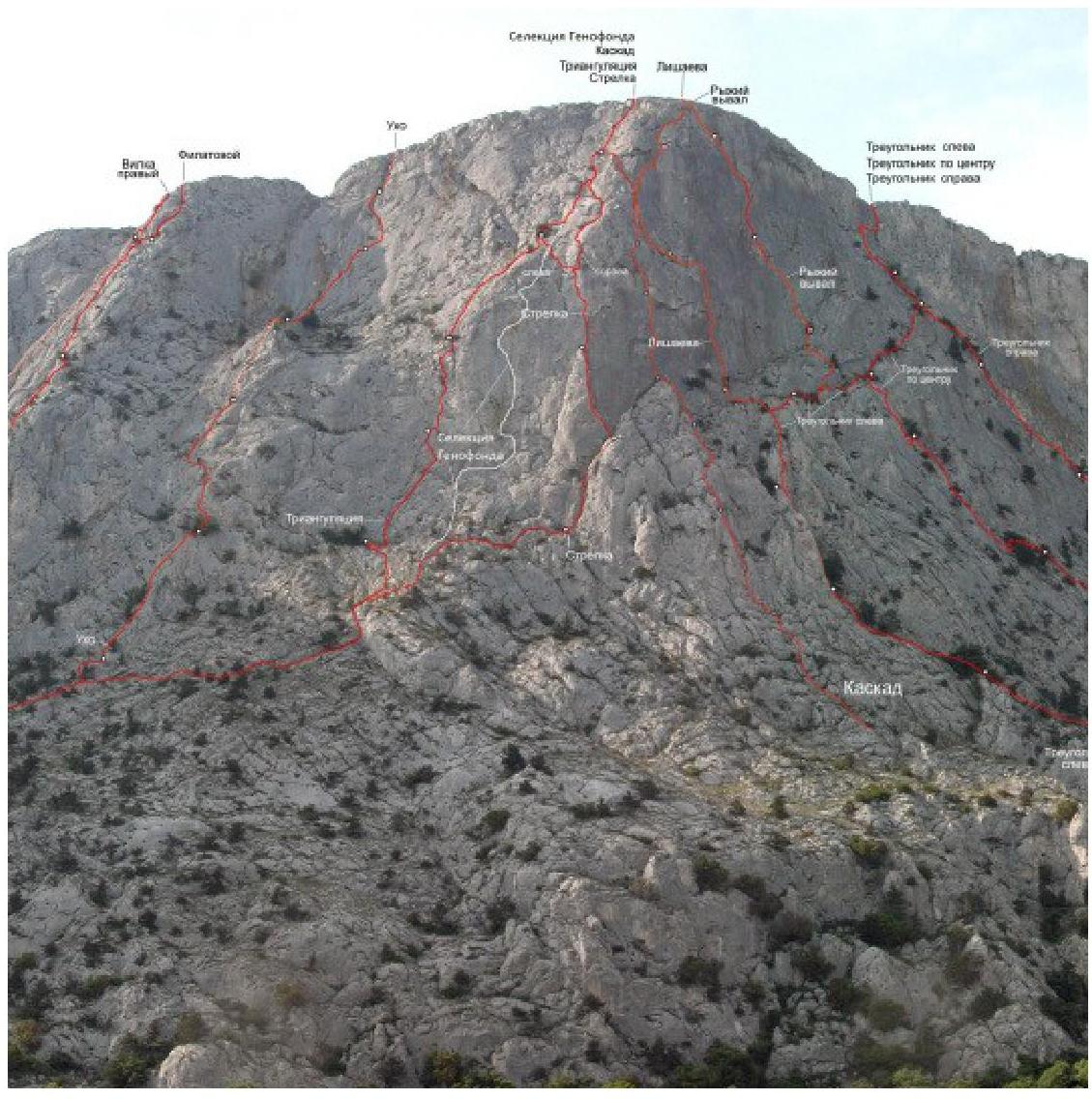
The route "Genofond Selection" is indicated by a white line. Photo by A. Zhilin
The route is located on the Mshatka bastion between the routes "Triangulyatsiya" and "Strelka" and has been considered for a long time. To begin with, Vova Odoyev and I decided to conduct a reconnaissance. On October 15, 2023, we approached the wall, climbed two ropes, received ambiguous impressions, took several photos, and descended.
Upon reviewing the photographs, I saw an opportunity for a route that was logical, bypassing the living sections and areas lacking relief for natural protection, but it required a fresh look.
For the second reconnaissance, I was joined by Kyiv resident Yevgeny Brusko — we climbed the same part of the wall up to the first overhang. The second time, it was a third faster, and the areas that were previously climbed using artificial aids were successfully passed by free climbing, which was a pleasant surprise.
The further route line became clear...
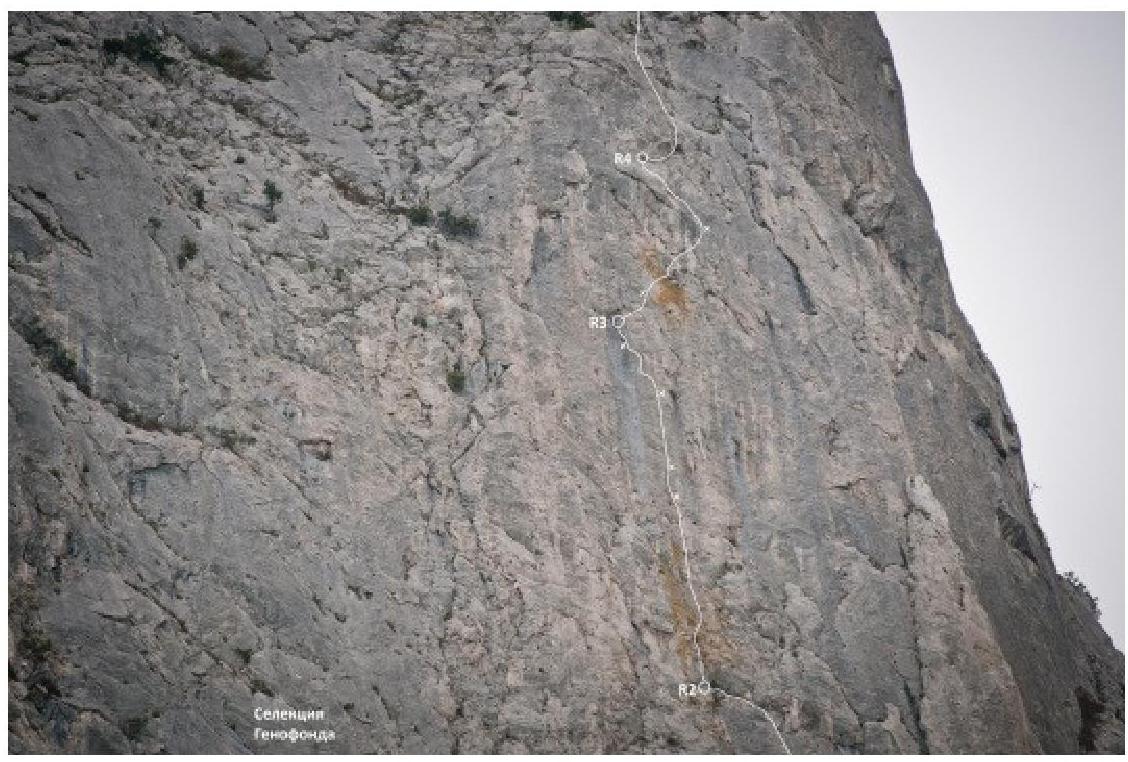
Route "Genofond Selection". Sections R2–R4. Photo by E. Alekseeva
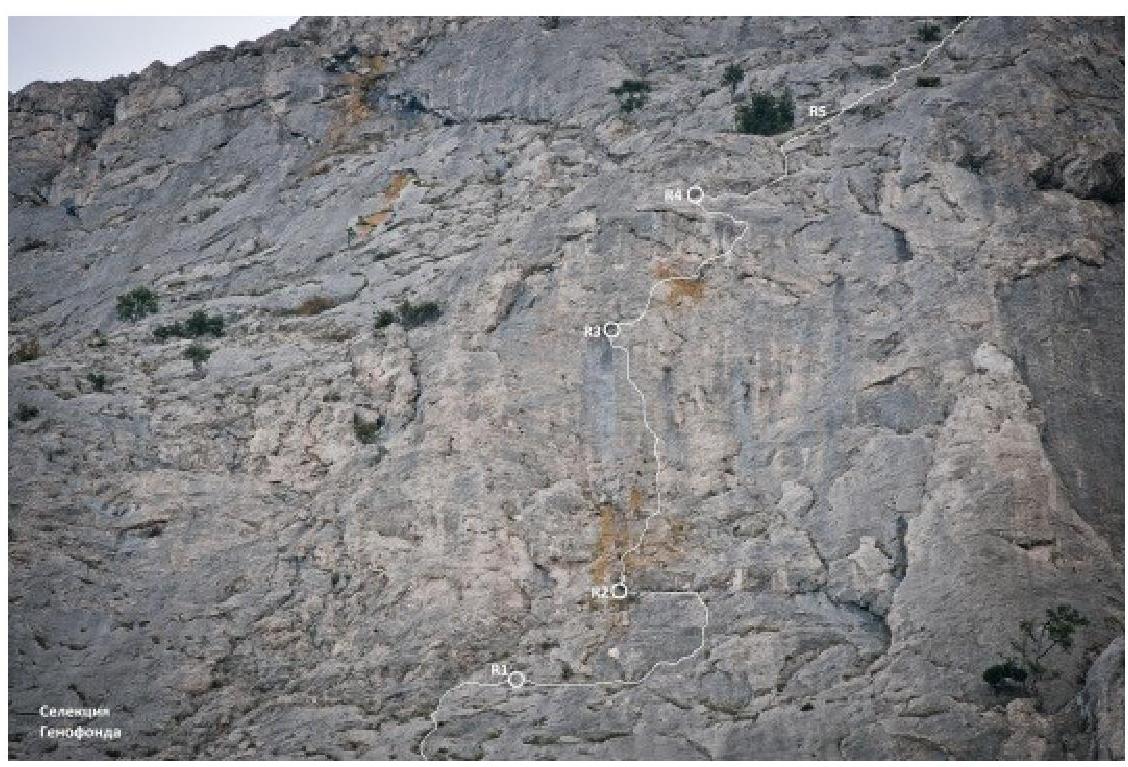
Sections R1–R5
We managed to return for the first ascent in November when the daylight hours noticeably decreased — it got dark at 16:30. The weather was varied, with rain, cold, and heat. It took three attempts — on Sundays.
My partner was Vladimir Odoyev from Sevastopol, except for half of the section R2–R3, when Vova couldn't make it due to flooding, and I was joined by Maxim Kashirsky from Simferopol.
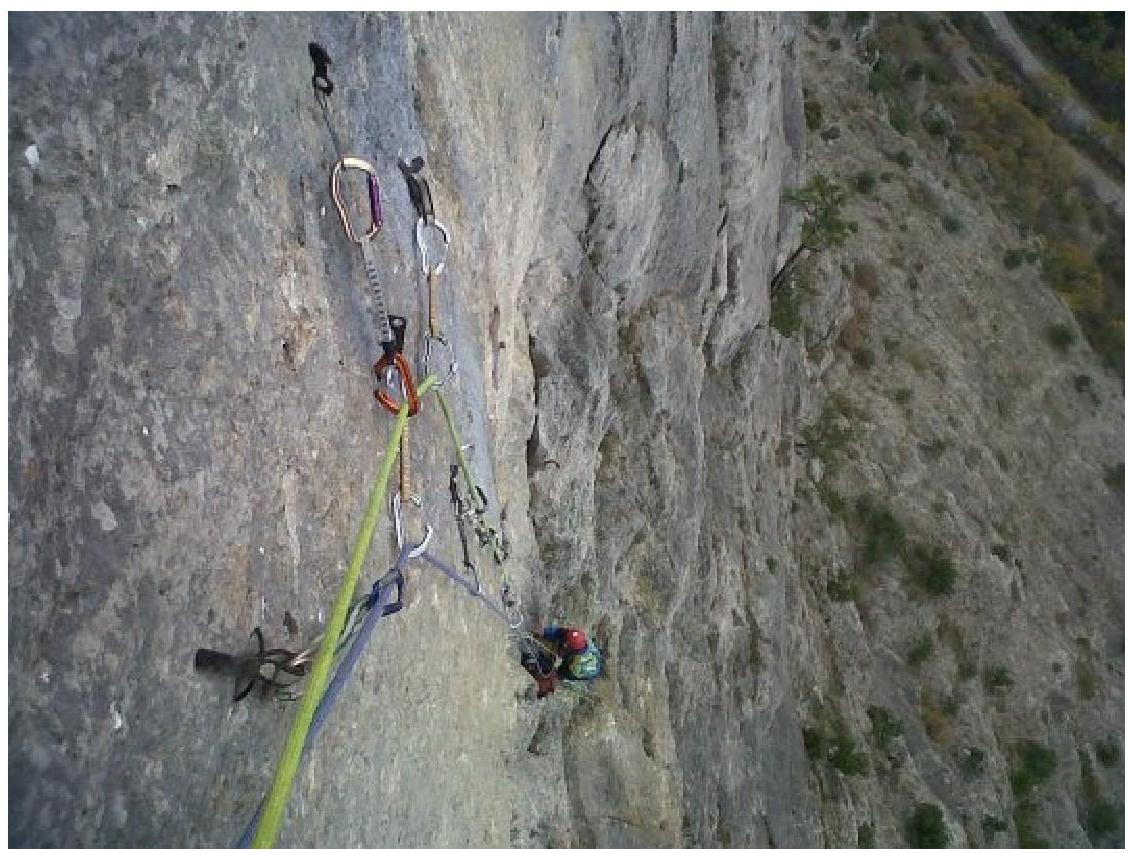
The upper part of section R2–R3. Below, Maxim Kashirsky gets wet in the rain at an intermediate station.
A control passage of the route with an exit to the summit was made on December 1. The result was a good, logical route on the pristine bastion, although in the upper part of the route, traces of two naked women were discovered (judging by the number of remains found).
"Genofond Selection" — (F6c E4), A3, 290 m.
First ascenders:
- Yuri Kruglov (Sevastopol)
- Vova Odoyev (Sevastopol)
The route was climbed in classic style from bottom to top without prior processing (reconnaissance) from above. Time spent — 25 hours.
The approach to the route is the same as for the route "Strelka", via Class I rocks, stopping 40 m short. Then, up to a small ledge with earth to the right of a tree.
R0–R1
Difficult climbing upwards on a slab. General direction:
- Upwards and slightly left towards a somewhat pronounced internal angle — 25 m.
- Further climbing upwards to the right — 5 m along the angle.
- Then, traverse to the right — 3 m onto a small inclined ledge.
Here, belay station R1 on a stationary point (bolted) + own. 35 m, 75–80°, V "Genofond Selection". Lower part
R1–R2
From R1, climb 3 m traversing to the right to a tiny tree, then continue traversing right-upwards 10 m along a crack with the possibility of good intermediate protection. Further, upwards-left, difficult climbing on a slab with an intermittent crack, approach under an overhang, and then traverse under the overhang to the left onto a small ledge. The landmark is a juniper slightly below the ledge. Here, belay station R2 on a stationary point (bolted) + own.
35 m, 75–80°, VI, A1
R2–R3
Upwards 3 m on the overhang with a thin crack using artificial aids. After passing the overhang, difficult climbing mixed with artificial aids on an inclined slab with a thin vertical crack 10 m upwards towards the overhanging wall. Further, 25 m upwards and slightly left — difficult artificial aids on relief holds and micro-anchor hooks towards a grey streak. There are 4 intermediate bolts.
Local features:
- Between the first and second bolts, there are 2 holes for anchor hooks — nowhere else on the route.
Belay station R3 in a niche above the grey streak on two bolts. 40 m, 95°, VI+, A3+
R3–R4
Upwards using artificial aids 5 m to a bolt. Further, difficult climbing upwards-right 5 m on mossy rock into a niche with a tree under a cornice with a horizontal crack.
From the niche, continue movement:
- Climbing and then using artificial aids upwards-right on the overhang 5 m,
- bypassing the cornice on the right, pass the overhang to a bolt.
Further, 13 m upwards-left on relief holds and anchors on a slab to a niche in an internal angle. Here, belay station R4. 28 m, 95°, VI, A2
R4–R5
From R4, traverse a couple of meters to the right and then climb upwards 50 m along the internal angle using difficult climbing, after which traverse left to a large tree. Here, belay station R5. 50 m, 80°, V
R5–R6
10 m upwards-right (III) to a "mirror", then on the left side of the "mirror" upwards 5 m (V) and further upwards on simpler large-block relief (III–IV) 45 m. Belay station on an inclined ledge on own points. 60 m, 75°, III–IV
R6–R7
30 meters upwards on large-block rocks to the exit onto the yayla (II). For stationary belay points, proprietary 10 × 55 mm bolts were used.