
Castle Rock — 7
Description prepared by: Max Kostrov and Olga Kostrova
Castle Rock, "Sokoliny" route, 6A, F7a+ (or VI, A3), 370 m — Crimea
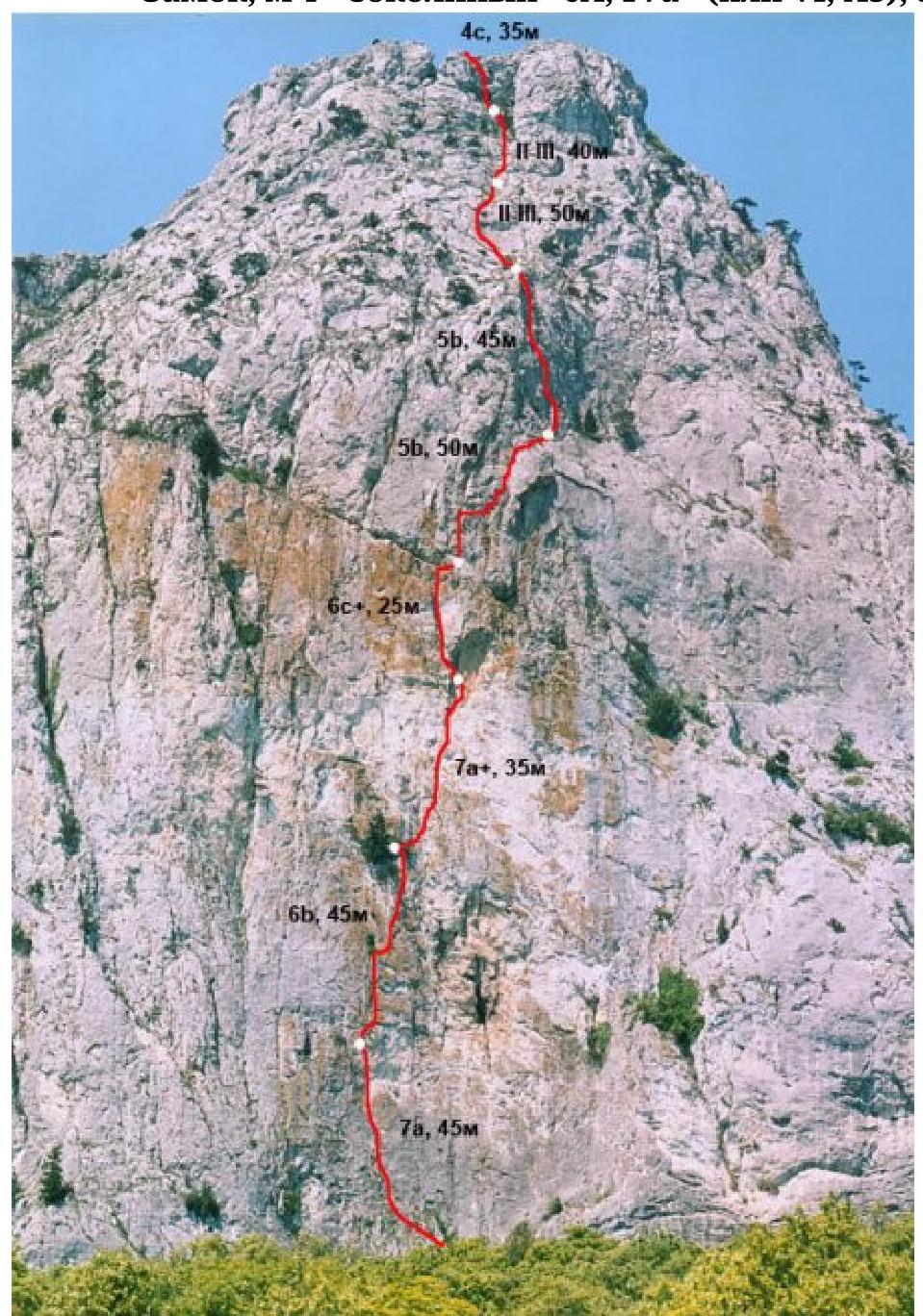
Castle Rock, "Sokoliny" route
Photo by: Alexey Osipov, 1999
We all climb and belay on rocks differently. And what is written in the "gray footnotes" should be considered.
The "Sokoliny" route was first ascended 20 years ago in 1985 by Yuri Lishayov ("Fantik"). The line of the route beautifully and practically crosses the sheer wall of Castle Rock along its center. In previous descriptions, the route was presented as 6A, VI, A3 (see Alexander Lavrinenko's description "Odessit"). In January of this year (2005), Olga and I ascended "Sokoliny" via free climbing and would like to clarify its description. Consider this our subjective view on climbing and belaying on certain sections of the route. Perhaps these notes will be useful to someone. If you have questions about the route, please write. The insurance on the route includes:
- friends,
- nuts,
- pitons.
Occasionally, old pitons are encountered — sometimes with torn ears, and old bolts — usually no more than two per section and more like "stumps" from a rusty tin can. From the "upper" path, through a copse and a low rock wall, ascend to a large "open" meadow under the South Wall of Castle Rock. The "Sokoliny" route begins directly under a well-noticeable cave located in the center of the wall.
R0–R1: From the trees under the wall, ascend leftwards and upwards through simple, ruined rocks to a crack heavily overgrown with grass (III, 15 m). Up the crack to "bleached rocks" (5c/6a, 20 m) — an old bolt.
Climbing the crack is not difficult and is complicated only by the fact that it is heavily clogged with earth and grass. The crack is quite wide in places — friends #4 fit well.
Further, through "deaf" grooves and "shells" (another old bolt) leftwards and upwards to a station (7a, 10 m). The station is on two rusty bolts and a 12 mm Petzl piton (driven in 2000 by Lekha Osipov). 7a (obbl.* 6b+), 45 m (in previous descriptions VI, A3)
*obbl. — abbreviation for obligatory — mandatory climbing level
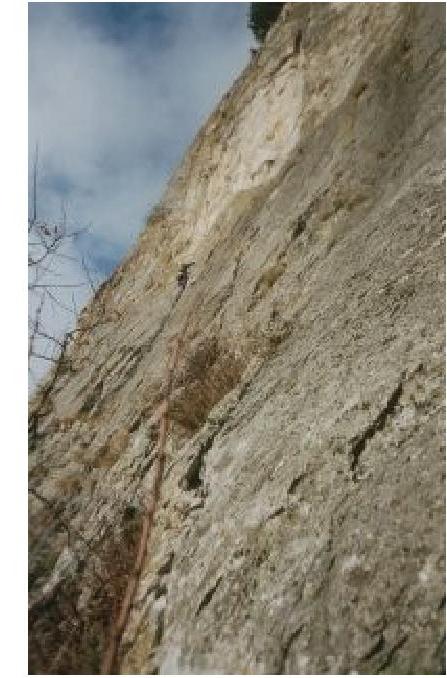
First rope. Approaching the "bleached rocks".
On the R0–R1 section, difficult climbing begins approximately 10 meters before the station: previous climbers have quite thoroughly destroyed the rock in this place — thereby making the existing "shells" on the wall even more "shell-like" and "deepened" :), which greatly facilitates climbing. Therefore, before placing a friend or driving a V-shaped piton into these depressions, think — perhaps you are depriving yourself of a convenient hold. Good holds can be found on the right on the wall.
R1–R2:
- From the station upwards and to the right into the "right crack" (which crack is the right one is clear on site)
- Up the crack to a grotto (20 m)
- The grotto is not too high but quite deep and cozy
- From the grotto, traverse rightwards and upwards (4–5 m) into a "ruined" crack
In the depth of the grotto, a piton is driven, and a long " motyavka" is tied to it; 1–1.5 m after exiting the grotto, an old piton is driven.
Up the crack to a ledge with trees (20 m). Having ascended to the ledge, turn leftwards to a large tree on which the station is located.
6B (obligatory 6A), 45 m (in previous descriptions VI, A2)
Caution! "Live" stones throughout the section!
R2–R3: From the tree, along the ledge to the right into a ruined internal corner. Up it to a "deaf" slightly overhanging crack (5c, 15 m). Up the crack to a slab — an old bolt with the inscription "Fantik" (7a+, 10 m). From the bolt upwards and slightly to the right to red "quite fragile" rocks. From them, leftwards back into the crack and up it to a station under a large cornice (6a, 10 m). The station is on three old bolts, plus a "carrot" is driven into the crack on the left.
7a+ (obligatory 6c/6c+), 35 m (in previous descriptions VI, A3)
The "deaf" overhanging crack is the key section of the entire route. To the left and right of the crack, there are relatively few holds, but they exist. Be careful — the rocks are quite "fragile" — a couple of holds on the left of the crack broke off for me. The crack is deaf, but organizing intermediate protection is possible without particular difficulty.
Caution! Rocks in the lower and upper parts of the section are heavily
destroyed!
R3–R4: From the station, slightly upwards and then through a flake leftwards "spill" onto the wall. Up the wall to a ruined wide crack, up which ascend to a deepening under an overhang (6a/6a+, 15 m). Along the crack, two bolts with the inscription "Fantik" are encountered. The overhang is passed on its right part — at the exit, there are a couple of old pitons (6c+, 5 m). Further, rightwards and upwards through simple rocks (II–III, 5 m) exit to a station. Here, the "Sokoliny" route joins Yuri Lishayov's neighboring route "Through the cave" 6A.
Recently, this route was restored by Odessits Alexey Zhilin and Vladimir Mogila, so, starting from this station, new "sound" Petzl bolts will delight your eyes on each subsequent station.
- 6c+ (obligatory 6a+), 25 m (in previous descriptions VI, A2)
- Caution! "Live" stones on the section!
R4–R5: From the station, up an internal corner 10 m, then traverse rightwards and further up a large fracture rightwards and upwards to exit onto a small ledge. The station is on bolts.
- 5b, 50 m (in previous descriptions V+)
- Caution! "Live" stone blocks on the section!
R5–R6: Along the ledge rightwards and upwards to a small "crooked" pine, from it upwards through a crack with a large and "slender" :) pine exit onto sloping rocks into a huge bowl in the upper part of the wall. The station is on bolts. 5B, 45 m (in previous descriptions IV–V)
R6–R8: Through simple rocks, move towards a large fracture located directly above. Stations are on bolts. II–III, 90 m (in previous descriptions II–III). To the base of the fracture, you can approach:
- from the left
- from the right
We approached from the left — it seemed simpler.
R8–R9: From the station in the upper part of the fracture, ascend leftwards and upwards to overhanging blocks and through them exit onto the yayla. The station is on bolts. 4c, 35 m (in previous descriptions IV+)
"Sokoliny" 6A, VI, A3 (Lishayov's route)
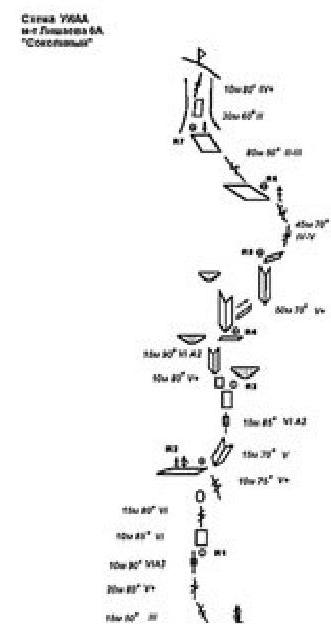
R0–R1: From the tree upwards and leftwards through simple, ruined rocks 15 m, further upwards through a crack, difficult climbing under an overhang 20 m, further on aid climbing through "deaf" cracks 10 m to a station (3 bolts) IV, A3, 45 m
R1–R2: From the station, difficult climbing rightwards and upwards 10 m, further upwards in the direction of a grotto — difficult climbing 10 m. From the grotto — a difficult traverse rightwards 5 m to a crack with ruined edges. Up the crack, exit onto a ledge with large trees.
VI, A2, 35 m
R2–R3: From the tree to the right 5 m and up an internal corner 10 m, then up a discontinuous deaf crack on aid climbing, местами лазание 15 м. The station is on 2 bolts under an overhang.
VI, A3, 30 m
R3–R4: From the station upwards and rightwards — difficult climbing up an overhanging internal corner with "live" stones 20 m. Exit onto a ledge. Along the ledge 5 m to the right. The station.
VI, A2, 25 m
R4–R5: Up an internal corner 10 m upwards, then rightwards 8 m, and up a corner — a chimney exit onto a ledge. The station is on a bolt.
V, 50 m
R5–R6: Along the ledge 5 m to the right, then upwards through a crack with a large pine — exit onto sloping rocks.
V–, 45 m
R6–R7: Through simple rocks, move in the direction of a large fracture.
II, 80 m
R7–R8: Up the fracture, through a small overhang, exit onto the yayla. IV+, 40 m
Time to complete: 6–8 hours