
Ai-Petri — 11
Author: Sergey Dashkevich, Yekaterinburg. Photos: Sergey Dashkevich, Yevgeny Novoseltsev
The weather was quite harsh, but that's what makes it more interesting.
The route goes up the right part of the wall almost vertically. The start of the route is 15 meters to the right of a clearly visible sport climbing multi-pitch line. The rock here is very similar to the rocks at Koshka in Simeiz. It features the same honeycombed cavities, which provide excellent friction and allow for free climbing in many places.
The first five pitches of the route are the key ones:
- Very steep
- With rare relief
- It's impossible to move by free climbing, organizing self-belay,
The result is quite complex rock ledges, sometimes with bolted rock features into small cavities. They are left for belay. Further on, the relief appears, and the rocks become much simpler, allowing for quick movement by free climbing.
The route turned out to be very interesting, not weaker than "Machombo" or "Twenty Years Later" on the famous Morcheka. The category of difficulty is undoubtedly 6A.
As before, the team chose the maximum lightweight alpine style for the ascent. Only one pitch of the route was processed the evening before to speed up the subsequent ascent, as we didn't want to spend the night on the wall. Accordingly, we used two ropes, which we recommend to subsequent climbers, as the rock is very sharp, and rope cutting is possible in case of a fall.
We also took with us:
- one pair of hookah gear for two people
- one ladder
- two hammers
- a set of stoppers
- hexes
- 6 anchors
- 4 petal hooks
- relief and hole skyhooks
- stationary bolts for stations
- removable 8 mm (2.5 cm and 1 cm) for the ascent
This is a fairly small set for a first ascent, but experience shows that it's sufficient.
On the first five pitches, the stations are reinforced with stationary bolt anchors. Next to them, either something is placed, or a removable 8-mm 2.5 cm bolt is hammered in. On subsequent pitches, stations are easily organized without using bolts.
We wish you good luck!
Ascent Passport
Region — Crimea, 8.2 Peak — Ai-Petri, route "Blik" via the right part of the SW wall through cornices. Proposed:
- 6A category of difficulty
- first ascent Character of the route — rock climbing
Route Characteristics:
height difference of the route — 440 m. Route length — 540 m. Average steepness of the route — 73°. Length of sections with 6B category of difficulty — 155 m, 5B category of difficulty — 150 m. Left on the route: stationary bolt anchors — 4
Hooks used on the route:
stationary bolt anchors — 4, removable bolt anchors — 9, anchor hooks — 28, petal hooks — 3. Total ITO used — 77, including relief skyhooks — 40, hole skyhooks — 6. Number of climbing hours — 18, days — 2. Number of nights — 1.
In a Team of Two
Participants:
Dashkevich Sergey Aleksandrovich, Candidate Master of Sports.
Novoseltsev Yevgeny Leonidovich, Master of Sports.
Team Coaches:
Pershin Valery Nikolaevich, Honored Master of Sports, Honored Coach of Russia
Date of Departure:
for the ascent — May 6, 2007 on the summit — May 7, 2007 return — May 8, 2007 Organization: FAiS of Sverdlovsk region.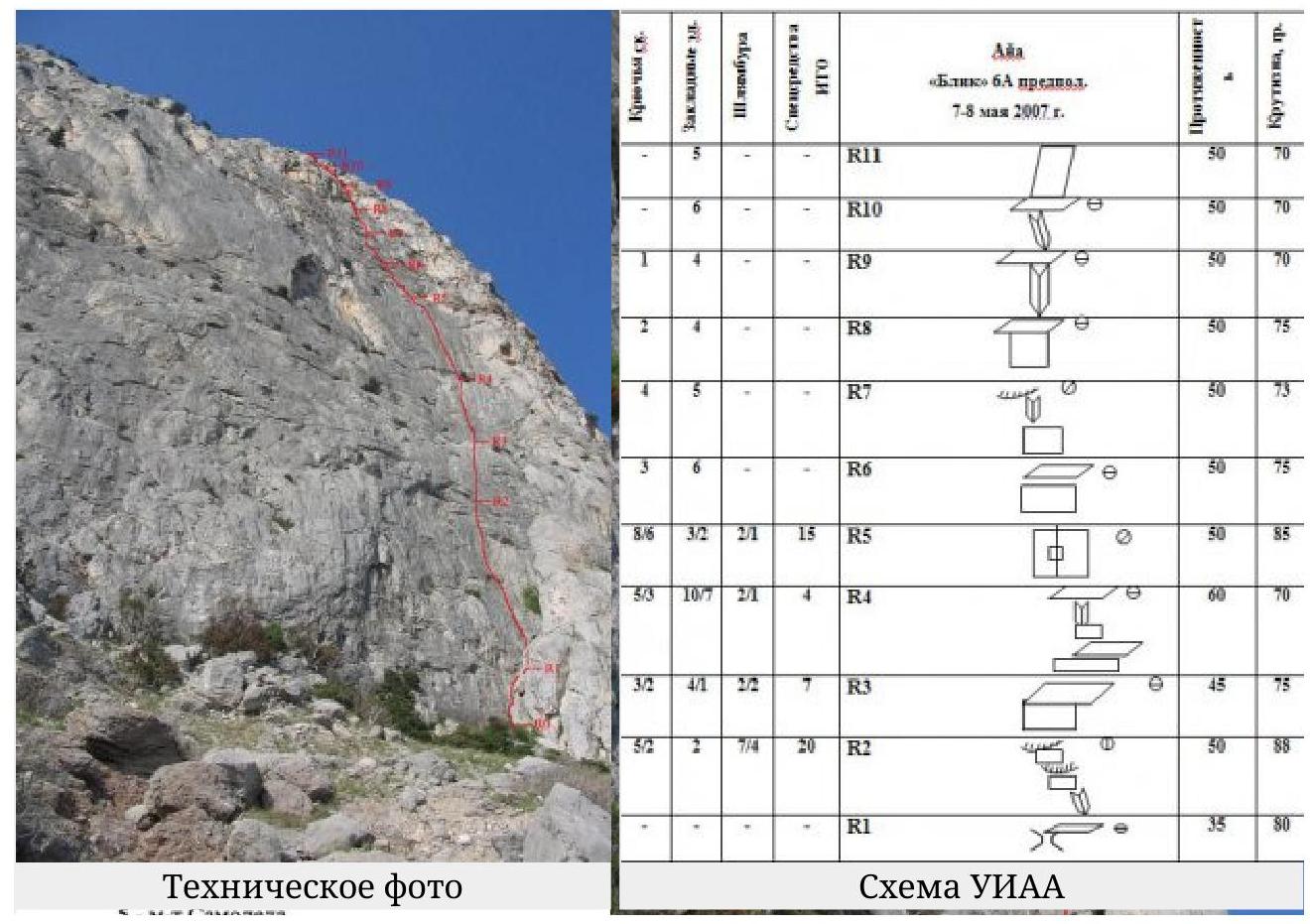 Section
R2–R3. Length 45 m (75°). Move up and to the right along the slabs to a large ledge. Station on a tree. VI (fr 6b), A3. Movement is mainly on relief skyhooks, removable bolts are used for belay. After 30 m of belly — it's possible to move by free climbing.
Section
R2–R3. Length 45 m (75°). Move up and to the right along the slabs to a large ledge. Station on a tree. VI (fr 6b), A3. Movement is mainly on relief skyhooks, removable bolts are used for belay. After 30 m of belly — it's possible to move by free climbing.
Section R3–R4. Length 60 m (70°). Move up the slab by climbing to a ledge and then along the internal corner to a clearly visible tree. In the corner, the crack is not constant, but there are places where hexes of different sizes fit well. From the ledge to the start of the corner, A3 on hole and relief skyhooks. A hole skyhook is left for belay. Along the corner, A2–A3, with some free climbing V–VI. Station on a tree (which turned out to be not very strong) on two stoppers and a stationary bolt. You have to approach an intermediate ledge.
Section R4–R5. Length 50 m (85°). From the ledge, straight up along a narrow crack to the left of a clearly visible black streak. Initially, 7 m is traversed along poor rock to the base of a monolithic slab. On it, a removable bolt is hammered in with balance. Then move up to the crack. On relief skyhooks. The crack is poor. Anchors fit in half a centimeter. Rarely, 1 cm — then left for belay. At the end of the crack, move left by traversing and climbing. 7 m. A relief skyhook is left for belay. VI (fr 6b+), A3–A4. Station on a stationary bolt, anchor, and a nut.
Section R5–R11. Further on, the relief becomes much simpler (it appears). Easy climbing IV–V follows. Move up and to the left along logical relief.
- 300 m
- 70 g.
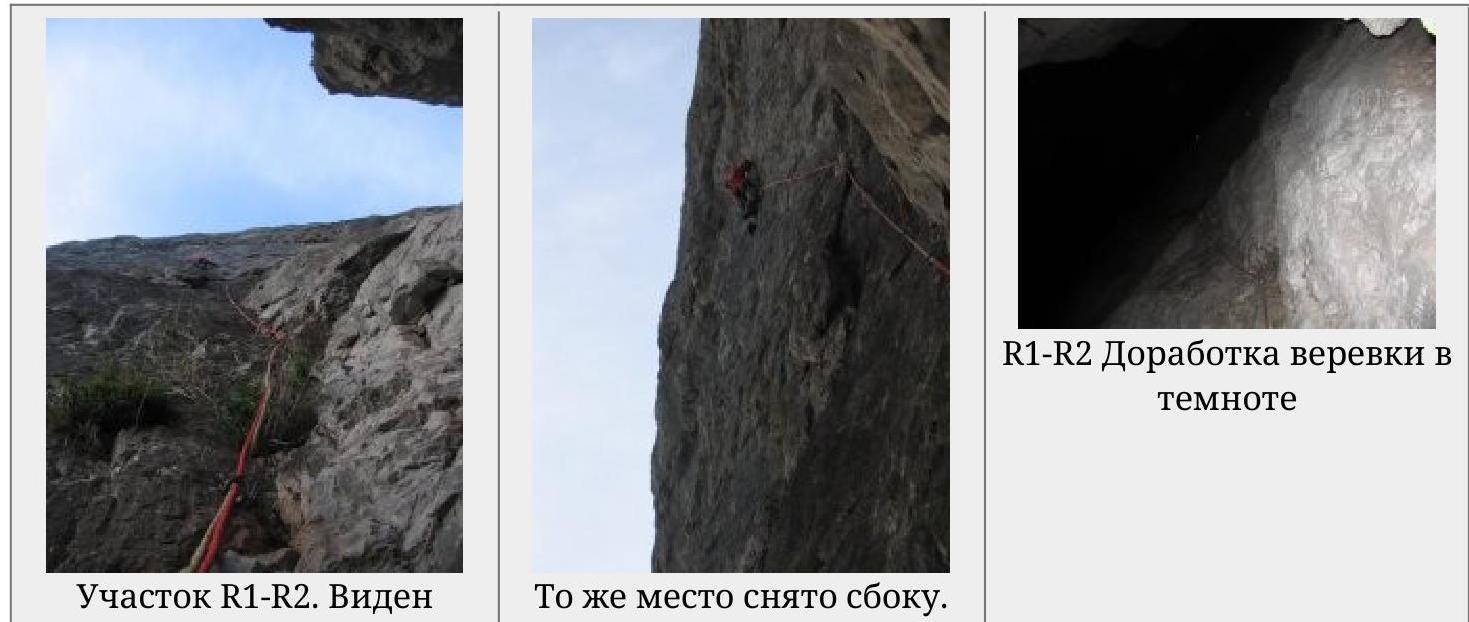
| internal corner, passed by climbing. | ITO on relief skyhooks | |
|---|---|---|
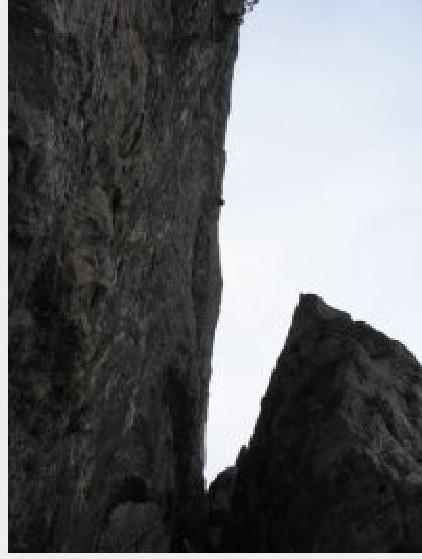 | 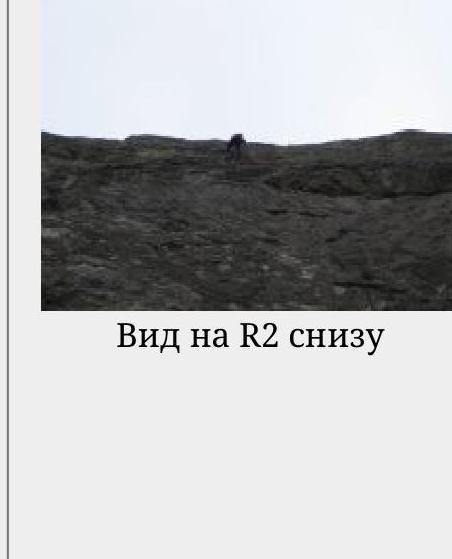 | View of R2 from below |
| Novoseltsev approaches R2 via the rope. | Start of movement on R2–R3 | |
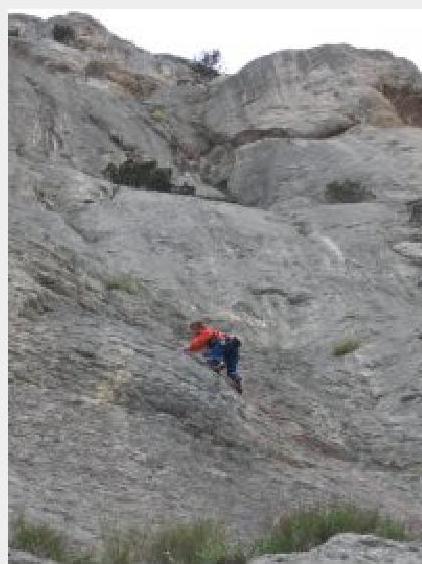 | R3–R4. Movement on hole and relief skyhooks along the internal corner. Station on a clearly visible tree in the photo. The photo shows a black streak to the left of which the movement on R4–R5 goes. | R4–R5. ITO along a narrow crack on relief skyhooks. At the bottom, a belt of poor rock is visible |
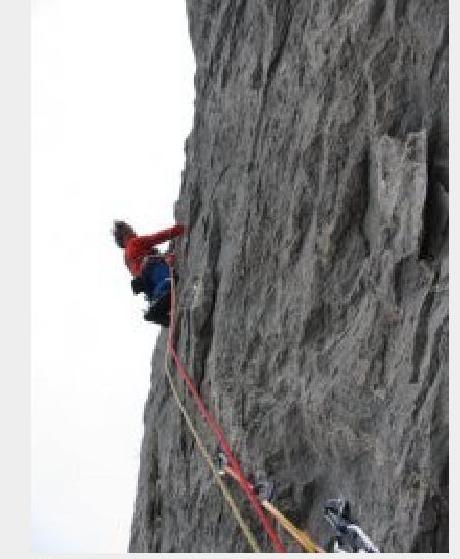
Start of movement on R2–R3
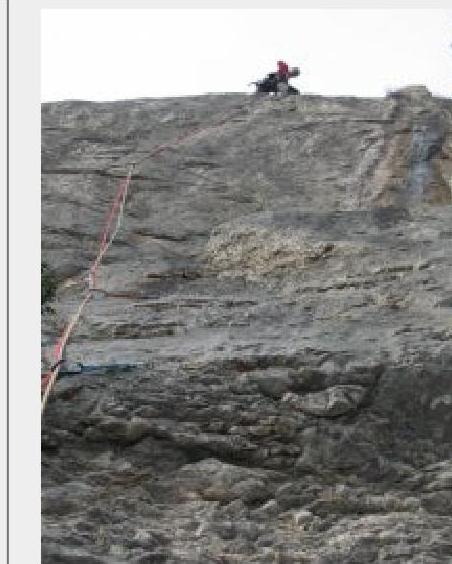
Climbing up the rope to R4–R5. View of the wall below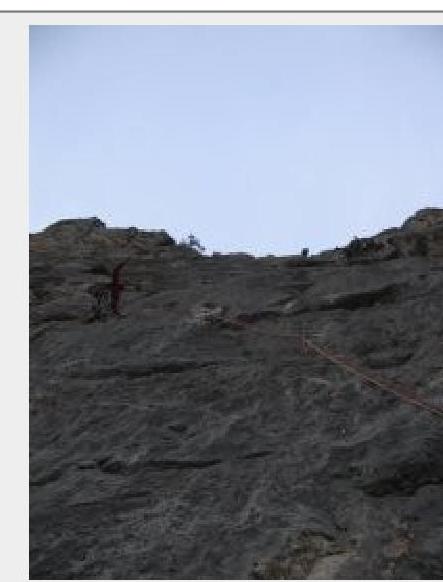
Sergey Dashkevich on station R5. Further movement is up along simple relief.
Twilight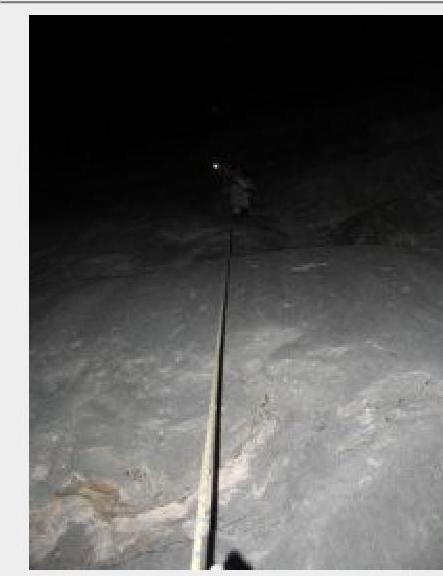
Novoseltsev on R8. Familiar climbing with headlamps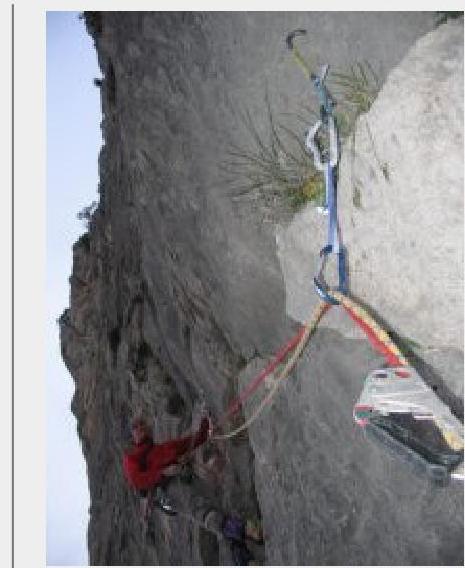
Skyhook left for belay before climbing to R5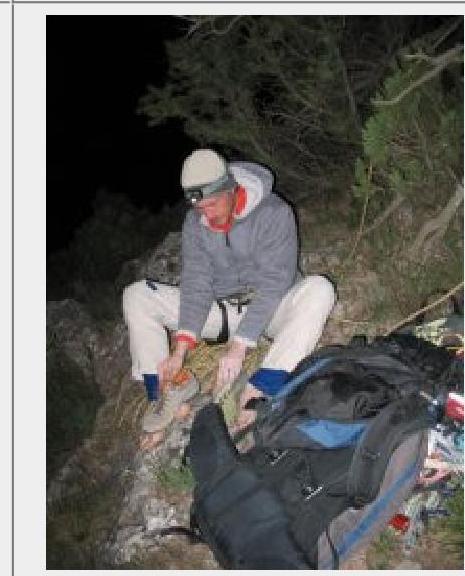
Exit to the yayla after 15 hours non-stop
Novoseltsev on R5–R6. The relief has become much simpler, but it's getting dark. To speed up, we climbed with one rope.


