
Arkhangelsk Region Climbing and Rock Climbing Federation
REPORT
On the first ascent to the summit of Aikuaivenchorr C. (1075 m) via the "3D" route, category 4A, by the Arkhangelsk region team on March 23, 2018.
Leader: Dmitry A. Shpilevoy
Members:
- Dmitry A. Rybalchenko
- Dmitry O. Dolzhenkov
Coach: Sergey K. Penzov
Responsible for the report: D. A. Rybalchenko [email protected]
Severodvinsk 2018
1. Ascent Passport
- Region: Kola Peninsula. Khibiny mountain range. VMF Cirque. Classification table section number: 8.6.2.
- Summit name: Aikuaivenchorr C. 1075 m
- Route name: "3D"
- Summit coordinates: 67°36′32″ N 33°46′17″ E
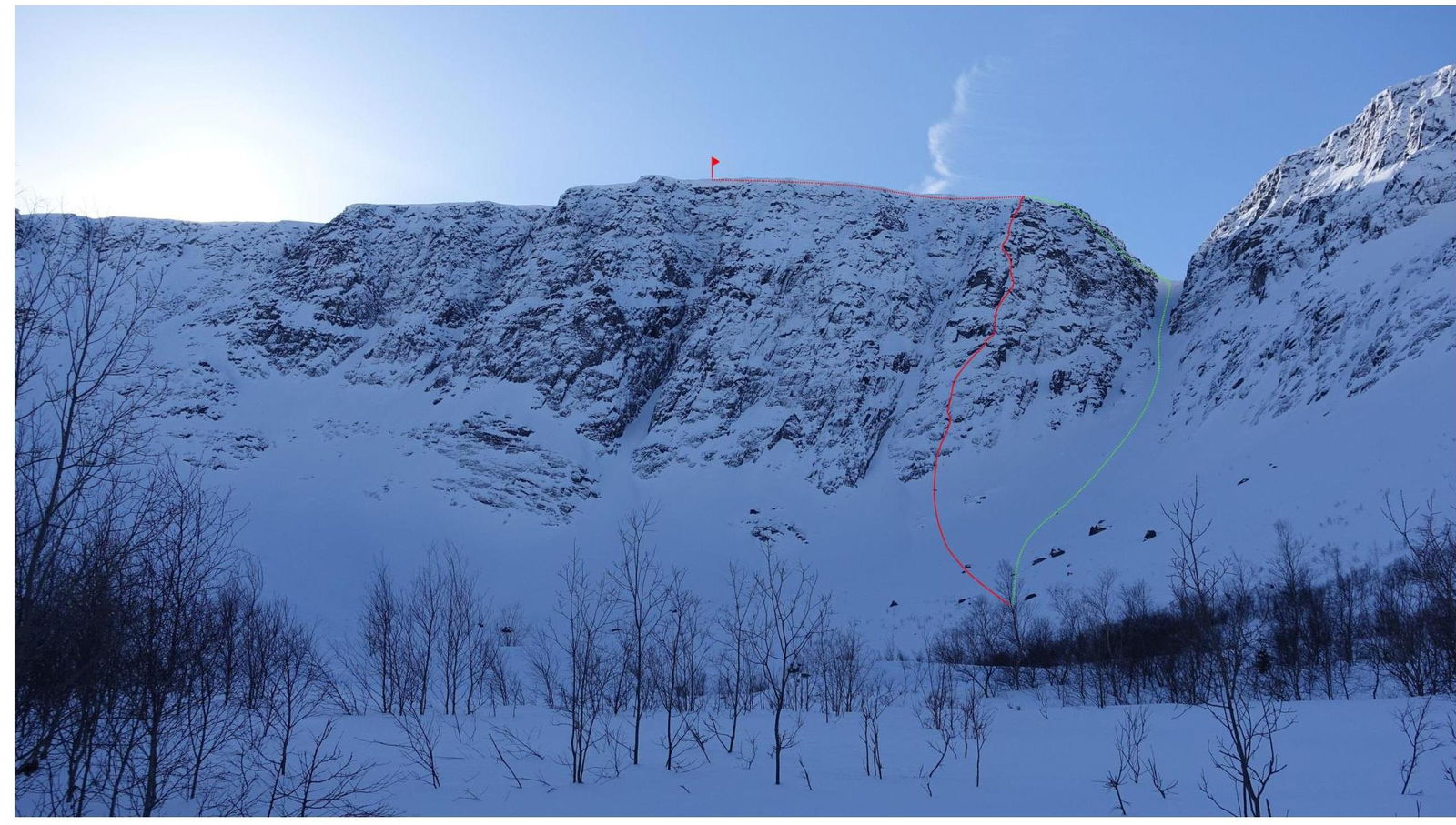
- Route: via the seventh rib of the northern wall Proposed: category 4A
- Route type: rock
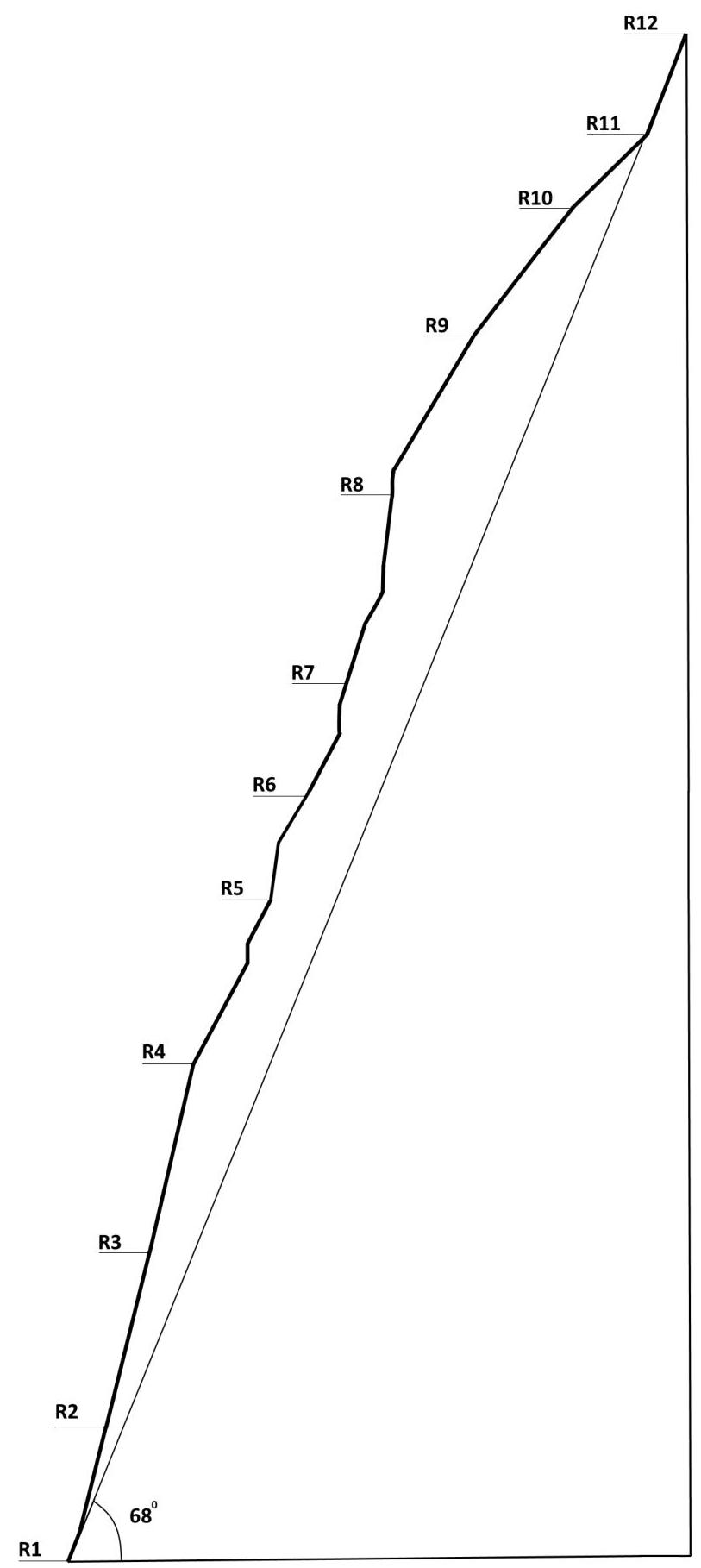
- Route height difference: 606 m Route length: 1163 m Wall height difference: 400 m Wall section length: 453 m Section lengths: category I 710 m, category II 30 m, category III 298 m, category IV 75 m, category V 50 m Average steepness of the wall section: 68° Anchors used on the route: 24. Friends: 25. Stoppers: 14. Artificial support points (ASP) used: 0. Bolts: 0. Hooks left on the route: 0.
- Team's climbing hours: 10 h 02 min. Days: 1.
- Leader: Dmitry A. Shpilevoy CMS Members:
- Dmitry A. Rybalchenko CMS
- Dmitry O. Dolzhenkov 2nd sports category
- Coach: Sergey K. Penzov MSMS
- Route entry: 08:35 March 23, 2018 Summit reached: 18:37 March 23, 2018 Return to base camp: 20:10 March 23, 2018
2. General photo of the area
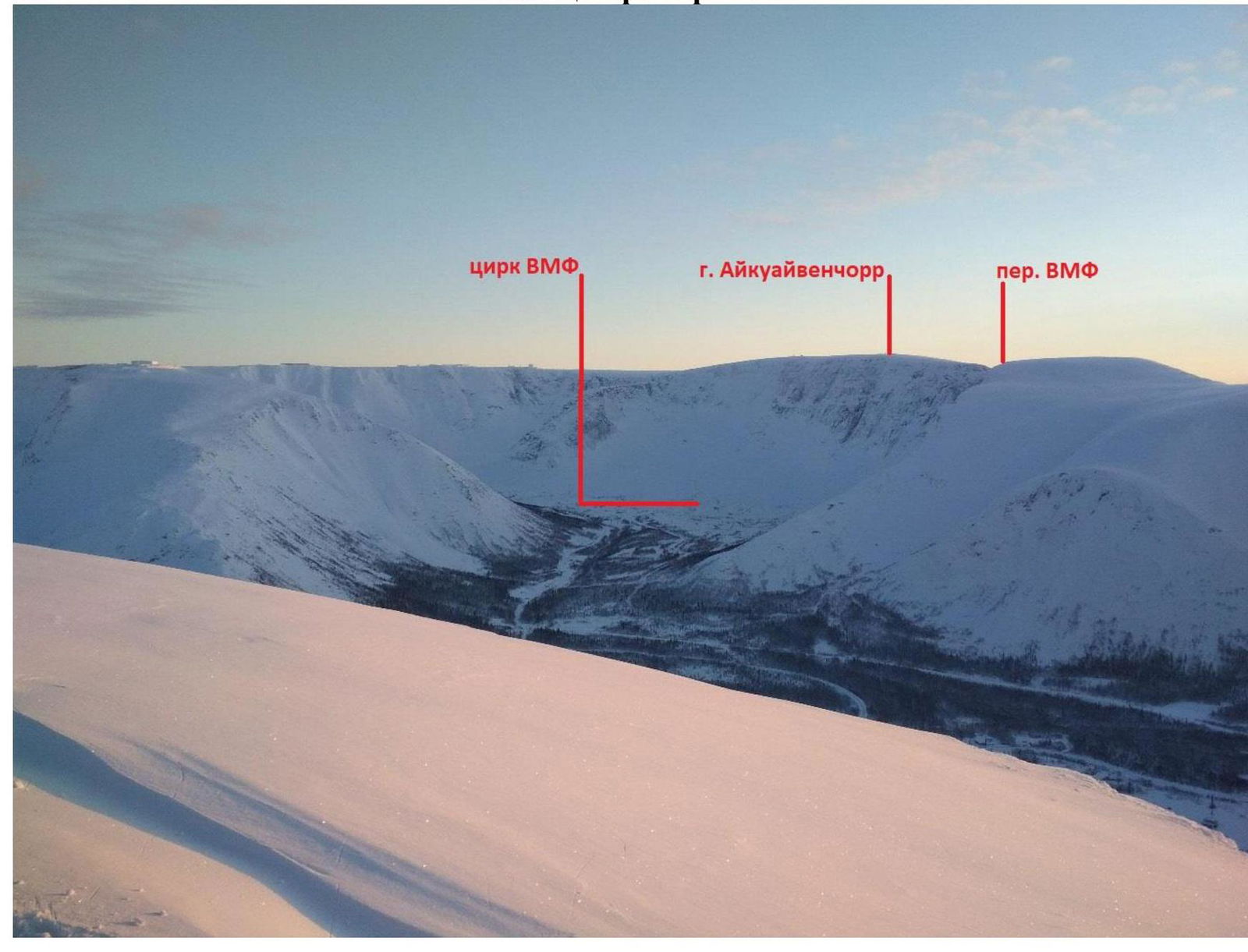
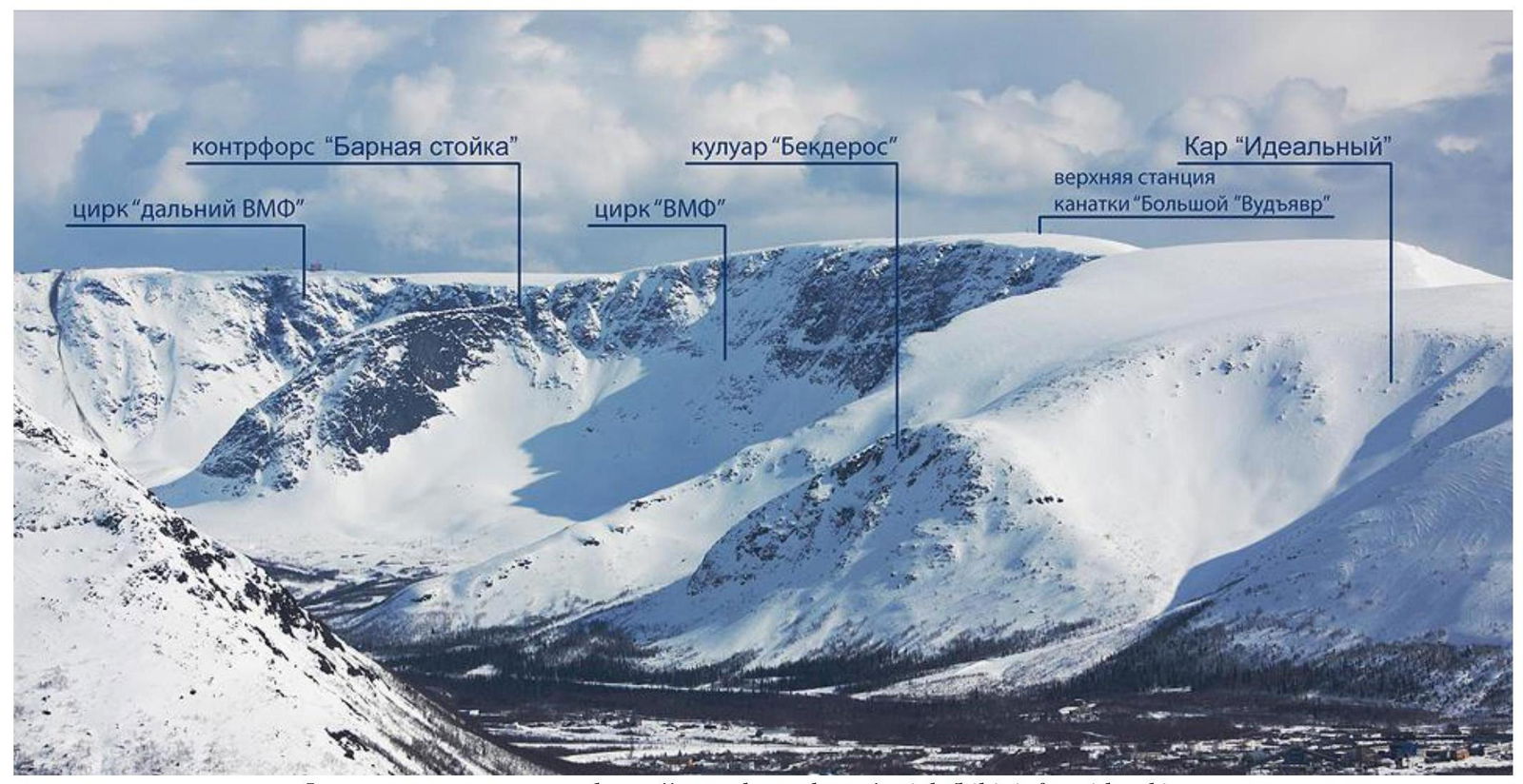
Photo taken from the article: (https://www.densurka.ru/article/hibini_freeride_ski-tour ↗)
3. Area Overview
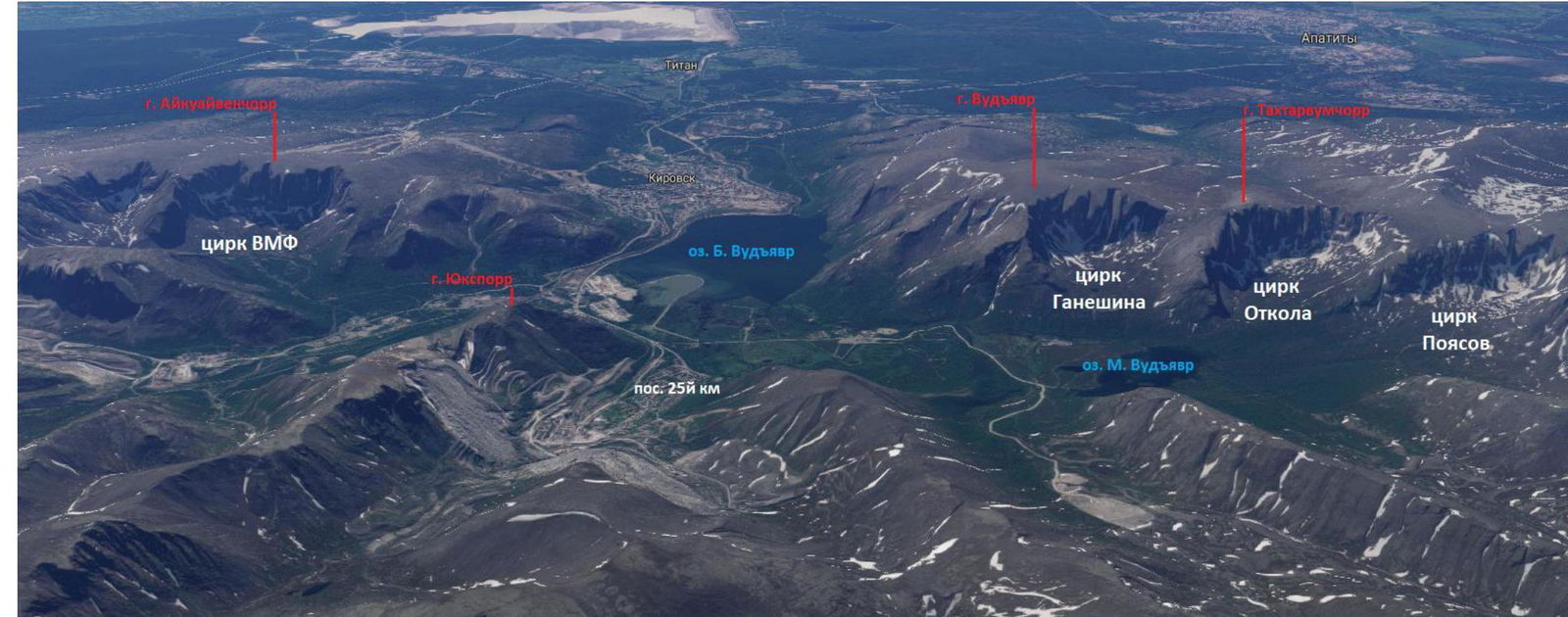 Khibiny is the largest mountain range on the Kola Peninsula, located 150 km north of the Arctic Circle. It is an alpinist and ski "Mecca" for the entire north-west of Russia. The highest point is Mount Yudyuchvumchorr (1200 m). The prevailing heights of the plateau-like peaks range from 900 to 1100 m, with steep slopes covered in glaciers and snowfields. The Kuniyok — Kukisjok — B.Belaya valley divides the range into Western (Small) and Eastern (Large) Khibiny. The eastern edge of this valley, consisting of the Lyavochorr, Rischorr, Kukisvumchorr, Yukspor, Rasvumchorr, and Aikuaivenchorr plateaus, is the main watershed of Khibiny, from which other watersheds branch off, delimiting the main valleys: Vuonemiyok, Tulok, Kaskasnyuyok, Mayvaltioyok, Kalyok to the east, and M.Belaya, Goltsovka to the west. The upper reaches of the valleys end in one or a system of cirques, which, along with numerous corries, are the most characteristic features of the Khibiny mountains. Another feature of Khibiny is the gorges — cracks with sheer walls, reaching 60–70 m in width and several tens of meters in depth. The slopes are even, almost devoid of sharp ridges and protrusions, due to the relief-forming processes during the glacial period.
The compact mountain area is close to populated areas. Khibiny is currently the world's largest deposit of apatite-nepheline ores. A huge industrial complex for mining and processing apatite ore has been built in the southern part of the range. The cities of Apatity and Kirovsk are located at its foot. At the foot of Mount Vudyavrchorr is the Polar-Alpine Botanical Garden-Institute (Botanical Garden). One can reach Apatity by train from Moscow, St. Petersburg, and other cities. There is also an airport in Apatity. Another option is the E105 highway towards Murmansk.
Khibiny combines regional and local mountain climate features. The outer slopes of the mountains are significantly influenced by the climate of the surrounding plains, while the microclimate of the central part of the range is much harsher. The average annual air temperature in the Kirovsk-Apatity area is -0.1 °C, with an average annual precipitation of 481 mm. At the Khibiny weather station, the annual precipitation is 650 mm, on the Yukspor plateau — 1340 mm, and on the even higher Rasvumchorr plateau — 1600 mm. On the plateaus, the average annual wind speed exceeds 5 m/s. Gusty winds prevail; instantaneous wind gusts on the Yukspor plateau reach 60 m/s, and on the Rasvumchorr plateau — 80 m/s. The polar day lasts from May 31 to July 13, and the polar night from December 10 to January 3. A stable snow cover forms in early October, lasting 240–280 days; 80% of snow reserves in Khibiny accumulate in February. The weather in Khibiny is unstable, and snowstorms can follow sunshine almost instantly (even in summer!), along with wet snow, wind, and fog. Visibility during a blizzard is minimal, and the wind can blow a person off the edge of the plateau. Khibiny is quite avalanche-prone in winter. From August to mid-April, one can observe northern lights. The traditionally favorable winter season for ascents is March and early April, and the favorable summer season is August and early September.
More than 37 routes have been classified in Khibiny, ranging from category 1B to 5A. Many routes have been traversed but not yet classified, and there are many opportunities for first ascents. The classified routes are mainly concentrated in three cirques: Ganechina, Otkola, and Poyasov. They lead to the peaks of Vudyavrchorr and Takhtarvumchorr. One can reach these cirques on foot in 1–1.5 hours from the "Tirvas" sanatorium or the Botanical Garden, which is located nearby. The sanatorium can be reached by car from Kirovsk (30 minutes), Apatity (1 hour), and the 25 km settlement (10 minutes). It is also possible to walk directly from the 25 km settlement if you follow the path towards Mount Vudyavrchorr from the lower part of the settlement, which leads to the Botanical Garden. Accommodation can be easily found in Apatity, Kirovsk, the 25 km settlement, and the Botanical Garden.
The VMF Cirque was previously closed due to mining activities, but now the developments have ceased, and the cirque has become accessible to climbers. The cirque is located close to Kirovsk and the 25 km settlement, and the Khibiny UNS of the MSU Geography Faculty (MSU base) is nearby, where accommodation can be rented. The cirque offers many opportunities for first ascents of almost all difficulty categories. The logical and convenient approach (2 hours from the MSU base) and the powerful and diverse relief make this corner of Khibiny very promising for both sports teams and training groups.
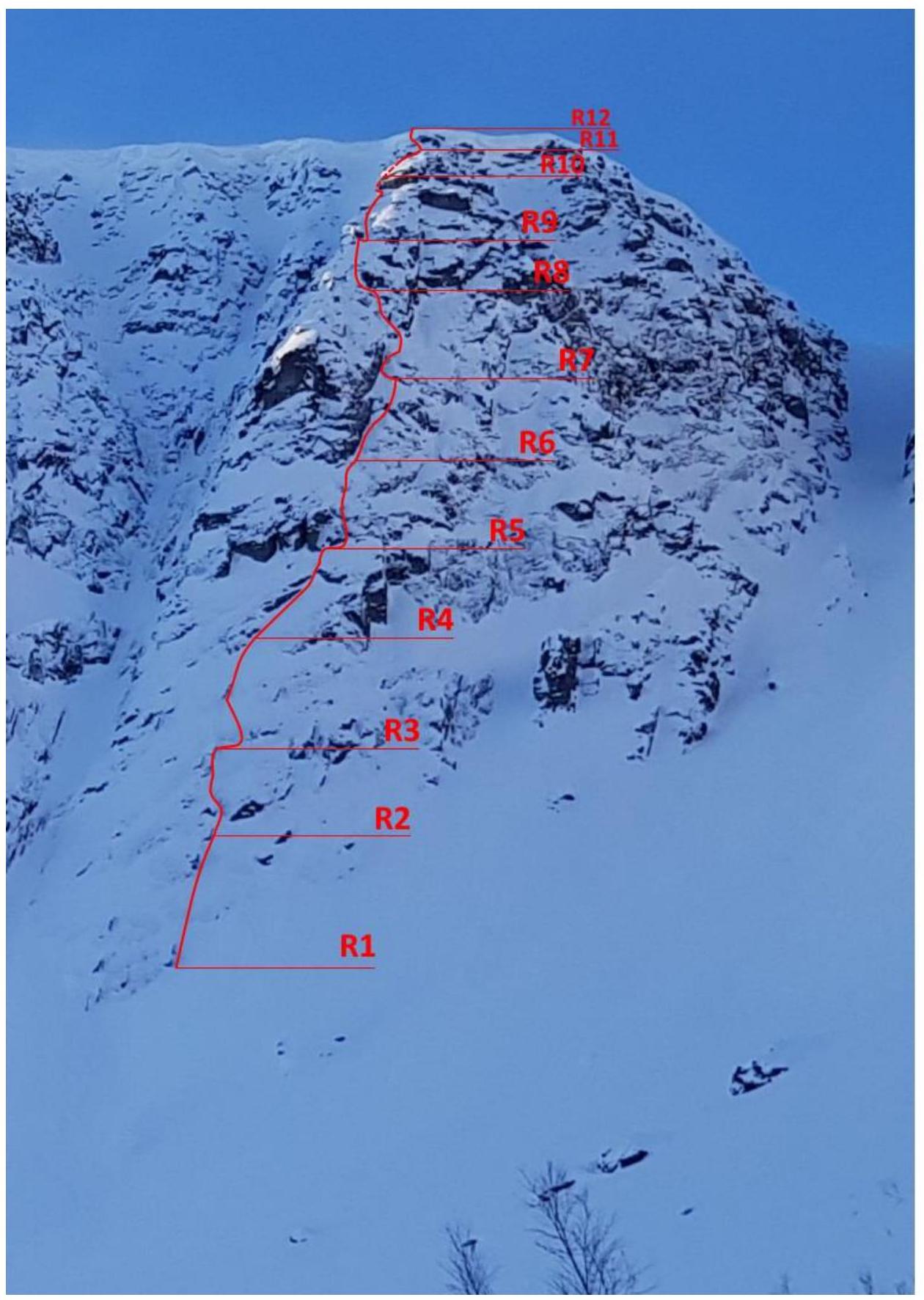
4. General view photo with the route thread
5. Wall section profile
6. Technical route photo
7. UIAA symbol scheme
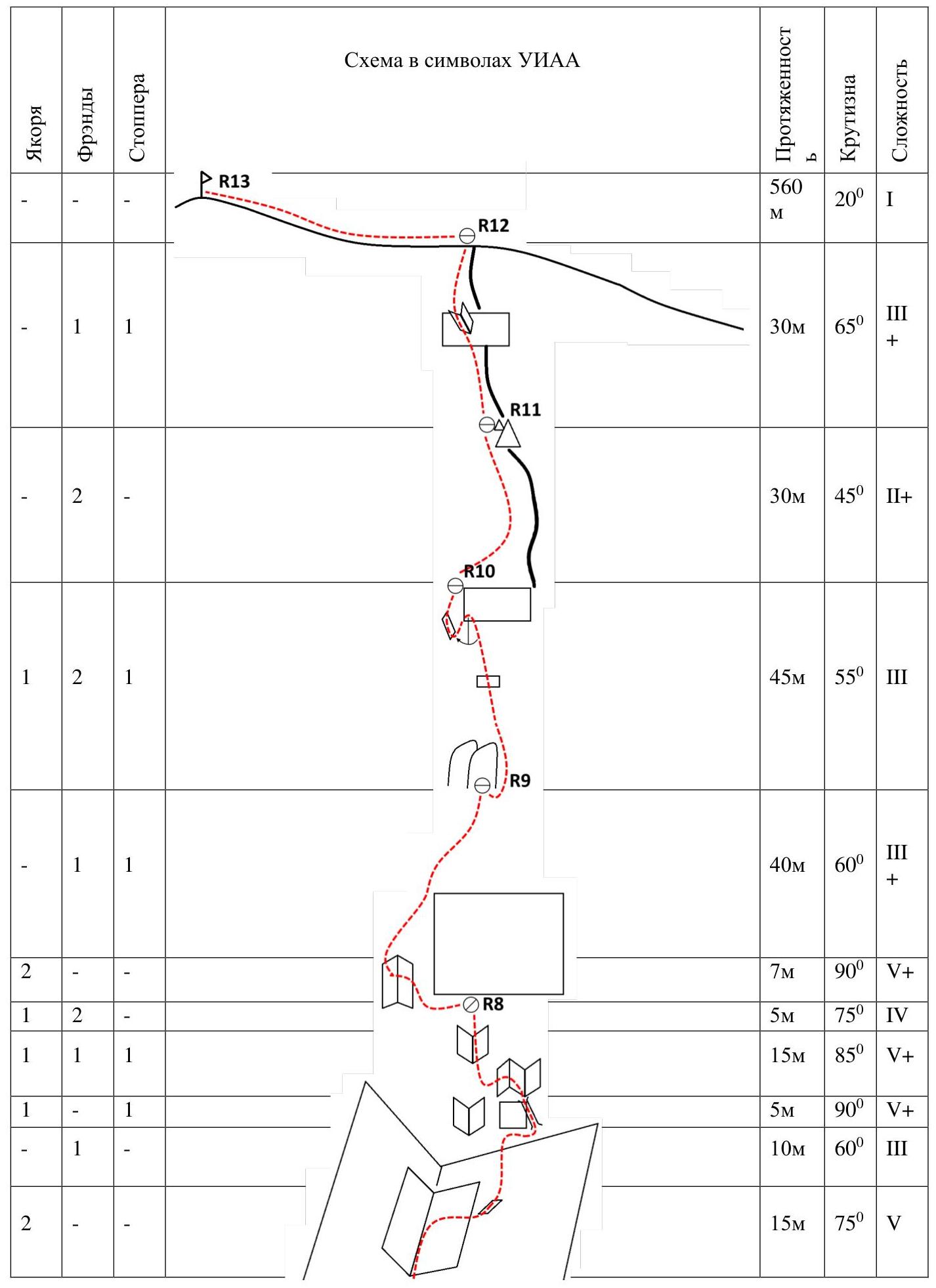
| Anchors | Friends | Stoppers | Section | Length | Steepness | Difficulty |
|---|---|---|---|---|---|---|
| - | - | - | R13 | 560 m | 20° | I |
| - | - | - | R12 | 30 m | 65° | III+ |
| - | - | - | R11 | 30 m | 45° | II+ |
| 1 | 2 | 1 | R10 | 45 m | 55° | III |
| - | 1 | 1 | R9 | 40 m | 60° | III+ |
| 2 | - | - | R8 | 7 m | 90° | V+ |
| 1 | 2 | - | 5 m | 75° | IV | |
| 1 | 1 | 1 | 15 m | 85° | V+ | |
| 1 | - | 1 | 5 m | 90° | V+ | |
| - | 1 | - | 10 m | 60° | III | |
| 2 | - | - | 15 m | 75° | V | |
| 1 | 2 | - | R7 | 10 m | 75° | III |
| 1 | - | 1 | 5 m | 90° | V | |
| - | 1 | 1 | 20 m | 65° | III+ | |
| - | 3 | - | 15 m | 60° | III | |
| 2 | 2 | 1 | R5 | 15 m | 80° | IV+ |
| 1 | 2 | - | 15 m | 65° | III | |
| 2 | - | - | 3 m | 90° | V+ | |
| 1 | - | - | 30 m | 60° | III | |
| 3 | 1 | - | R4 | 45 m | 75° | III+ |
| 1 | 1 | 2 | R3 | 5 m | 75° | III |
| 2 | - | 1 | 40 m | 75° | IV+ | |
| 1 | - | - | R2 | 3 m | 75° | III |
| - | 2 | 1 | 20 m | 75° | III+ | |
| 1 | - | 1 | R1 | 15 m | 75° | IV+ |
| - | 1 | 1 | 10 m | 70° | III | |
| - | - | - | R0 | 150 m | 45° | I+ |
8. Route description by sections
R0–R1. Follow a steep snow-firn slope to approach the start of the route — a pronounced internal corner. The first station is here.
R1–R2. Up the internal corner, then across a smoothed slab with cracks. Next, we enter the next internal corner, where the station is located at the exit.
R2–R3. From the station, move slightly right and then left up into a small internal corner. Then, there's a complex smoothed wall. First, go up, then traverse right up and left towards the next internal corner. Climbing is complex, with poor relief. The station is here.
R3–R4. Then, move up and right along the "ram's foreheads" to a vertical wall.
R4–R5. Next, move up and right along a steep snowy slope (ram's foreheads) to approach a vertical wall and traverse along it towards a small internal corner (chimney). Pass a complex vertical internal corner and follow an inclined ledge to a vertical wall. The station is here.
R5–R6. From the station, move right into an internal corner. Climbing is complex. Then, move straight up to the base of a huge internal corner. The station is here.
R6–R7. From the station, follow the large internal corner, then move right towards a chimney. Pass the chimney — climbing is complex. After that, move up to a wall, where the station is located.
R7–R8. Key rope. Move left into a large internal corner, straight up, then traverse right. Climbing is complex, with poor relief. Then, we emerge onto an inclined ledge. To the left is a complex, slightly overhanging internal corner — we don't go that way. We bypass it on the right, up a chimney, and enter a smoothed internal corner. From here, through the left edge of the corner, we move left and up into a neighboring internal corner. Climbing is still complex with poor relief. Further up, we follow a series of internal corners under a vertical, slightly overhanging wall. The station is here.
R8–R9. Then, move left into an internal corner, then left and up through the left edge of the corner to transfer onto an inclined ledge. Through a vertical wall, we exit onto easing relief. We move towards the "Sails" rocks. The station is here.
R9–R10. Next, move straight up through a small wall to approach a large vertical wall. Here, it's necessary to descend left and down onto an inclined ledge. Along the ledge, we climb up onto a pronounced ridge. The station is here.
R10–R11. From the station, follow the ridge to a large gendarme, behind which there's a notch — the station is on it.
R11–R12. Then, move up to a vertical wall, which is passed left up through an internal corner. After that, follow the ridge onto the "roof". The station is on ice axes.
R12–R13. Left along the ridge to the summit. Be cautious! Powerful cornices are forming to the left.
The descent initially follows the ridge along the ascent path, then further down the ridge along the steel poles to the VMF pass. From the pass, descend right along the line of water flow (possibly avalanche-prone!) and exit onto the ascent tracks.
9. Group's tactical actions
We left the MSU base on March 23, 2018, at 06:30 and approached the route at 08:35. The snow was knee-deep. We reached the pre-summit ridge at 17:54 and were on the summit at 18:37. We descended via the VMF pass and were back at the base at 20:10. The weather was favorable in the morning but started to deteriorate from R3 onwards: snow began to fall, and the wind strengthened.
The team had equipment: 6 anchors, a set of stoppers, a set of friends, slings and carabiners, ice tools — which turned out to be too scarce for a reliable passage of this route. We strongly recommend subsequent climbers to add anchor hooks, friends, and an ASP kit.
The R7–R8 section, where we bypassed a slightly overhanging internal corner on the right, might be worth climbing "head-on". Climbing is more difficult, but the line is somewhat shorter. For strong sports groups.
Communication via the "Baofeng" radio on the wall section with the MSU base was absent due to the ridge of Mount Aikuaivenchorr East obstructing the signal. However, "Megafon" mobile phone coverage was excellent throughout the route.
The descent from the VMF pass can be avalanche-prone! One should consider weather conditions and the degree of avalanche danger (can be checked with the Kirovsk EMERCOM).
The route is logical. Orientation issues may arise on the pre-summit ridge and during the descent to the VMF pass when visibility on the plateau is less than 100 m.
Despite the relatively high speed of passage, the route turned out to be very complex and labor-intensive. The overall slope of the wall is quite high — 68°. On this route, it's very challenging to find and clear reliable belay points because all cracks are either in moss, or in rime ice, or covered with a layer of frost and snow. Our team did not use artificial support points, and completing such a complex route with free climbing was only possible due to the high individual technique and experience of its members. The participants of the first ascent, comparing this route with other traversed routes in this area:
- category 4A "Honest Girl", category 4B "Hammer", category 3B "Gendarmerie", category 3B via the 4th col on Mount Vudyavrchorr;
- category 4B "Gulf Stream" (ascent time 10 hours for a duo), category 3B "Reindeer Herders" on Mount Takhtarvumchorr — unanimously agree that the route undoubtedly corresponds to category 4A.
10. Photo appendix
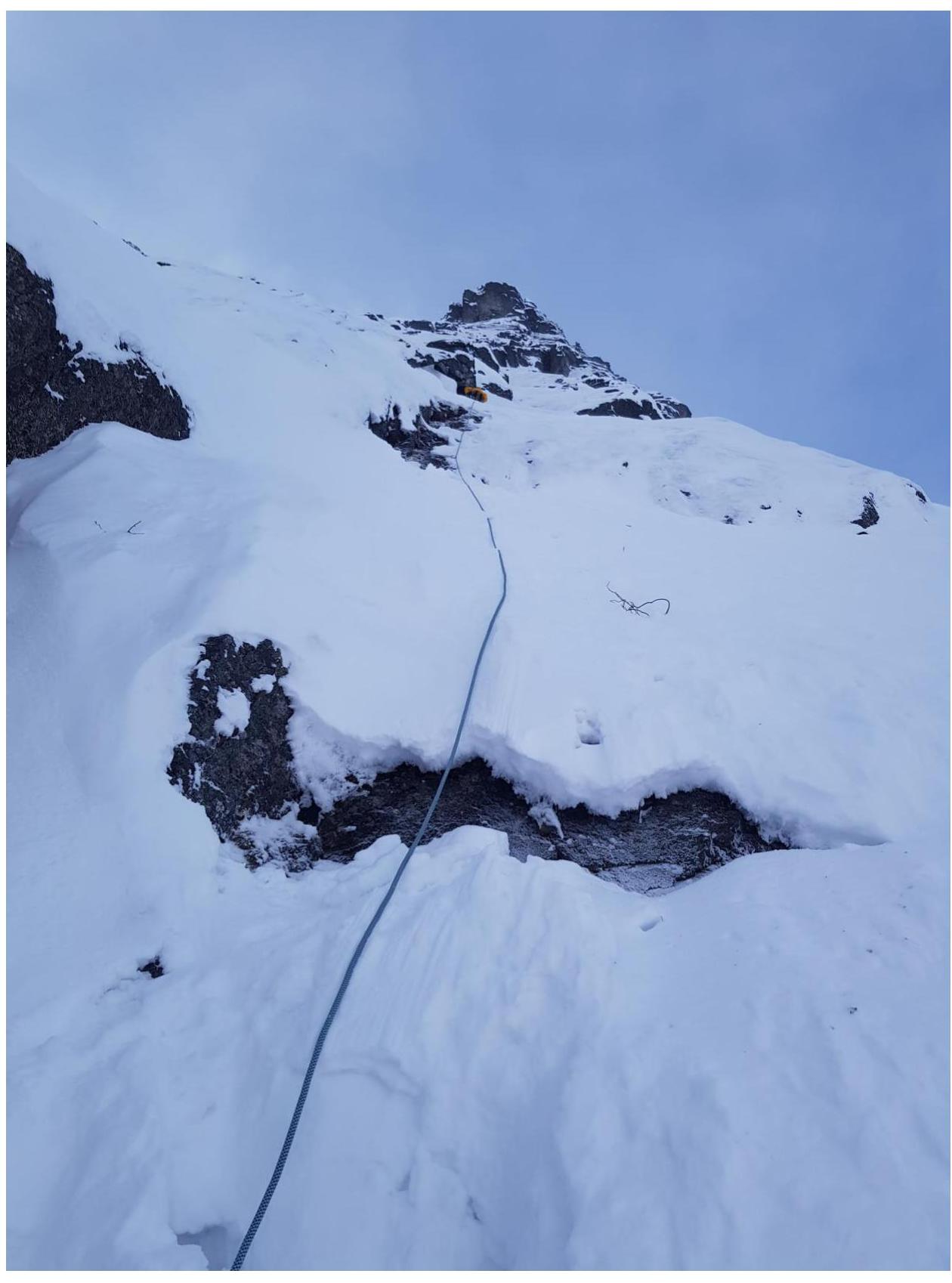 View from R1
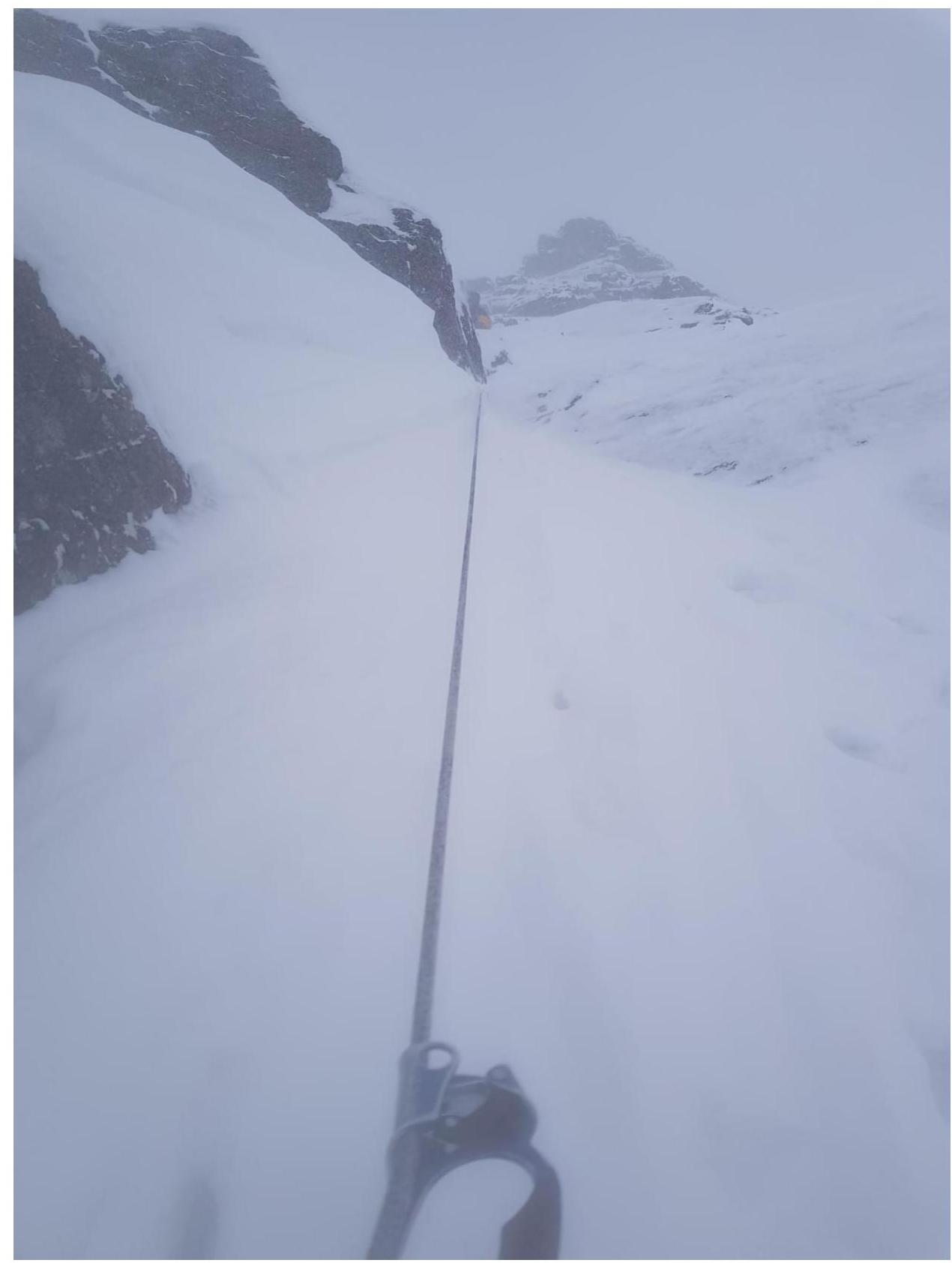 Section R2–R3
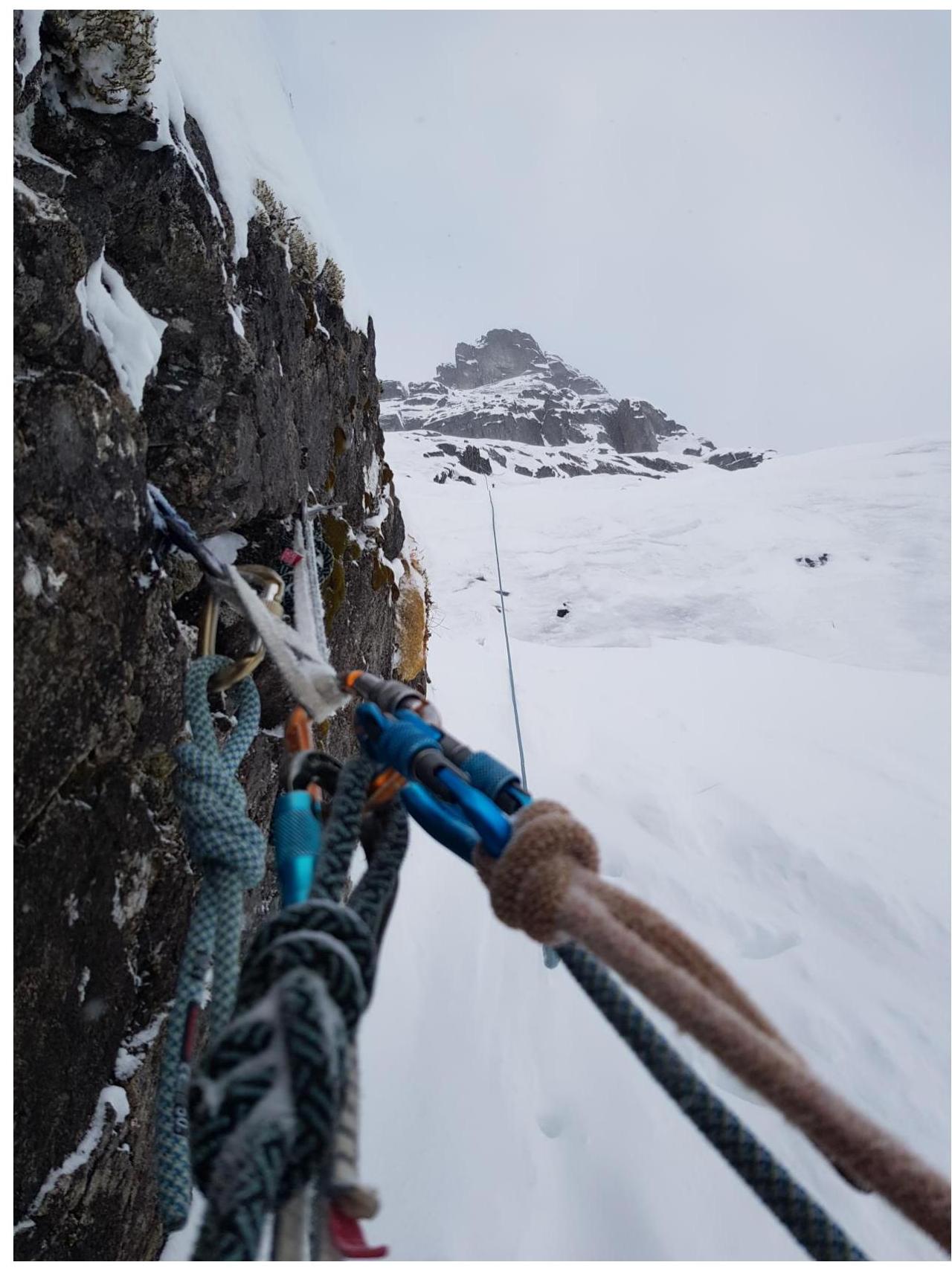 View from R3
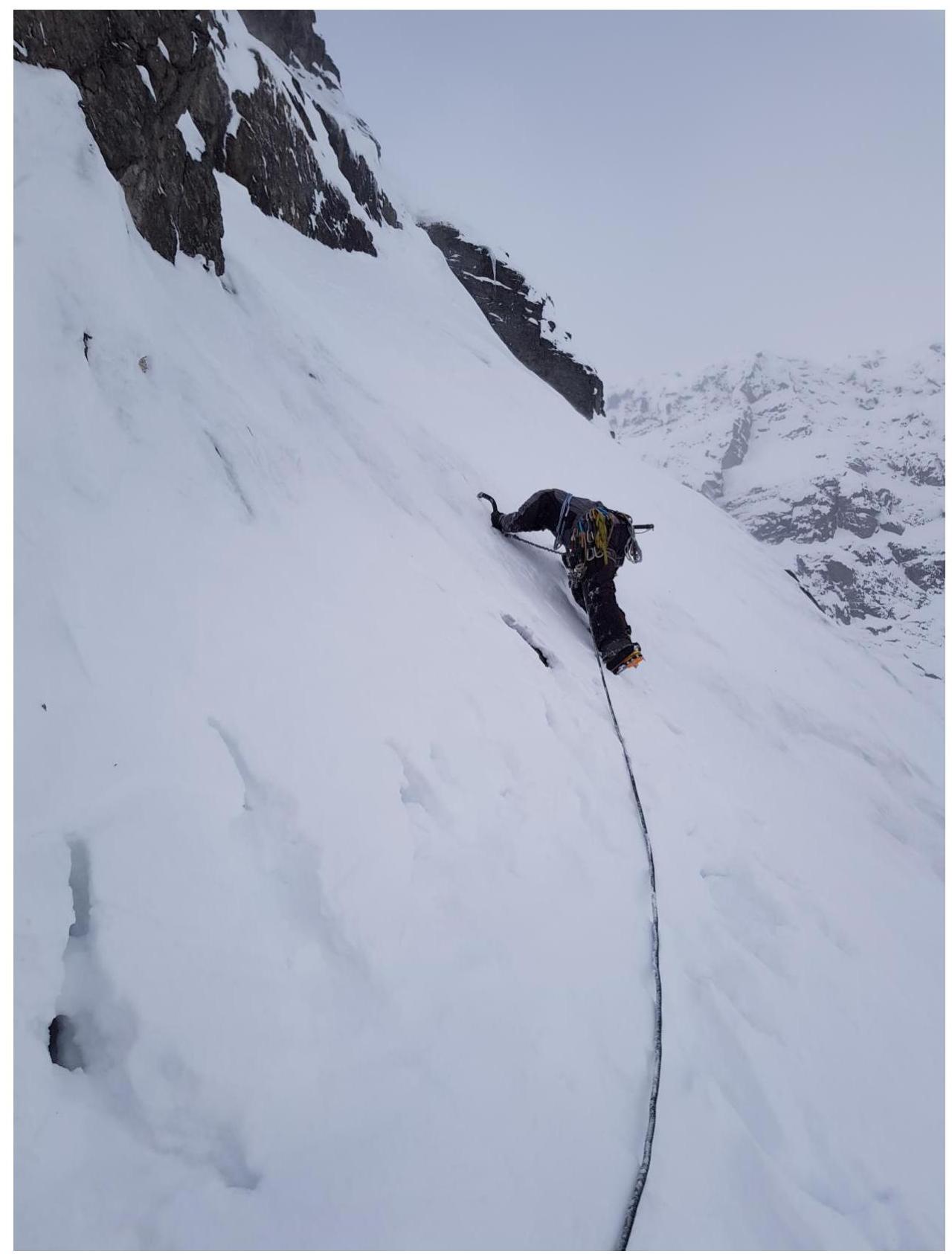 View from R4
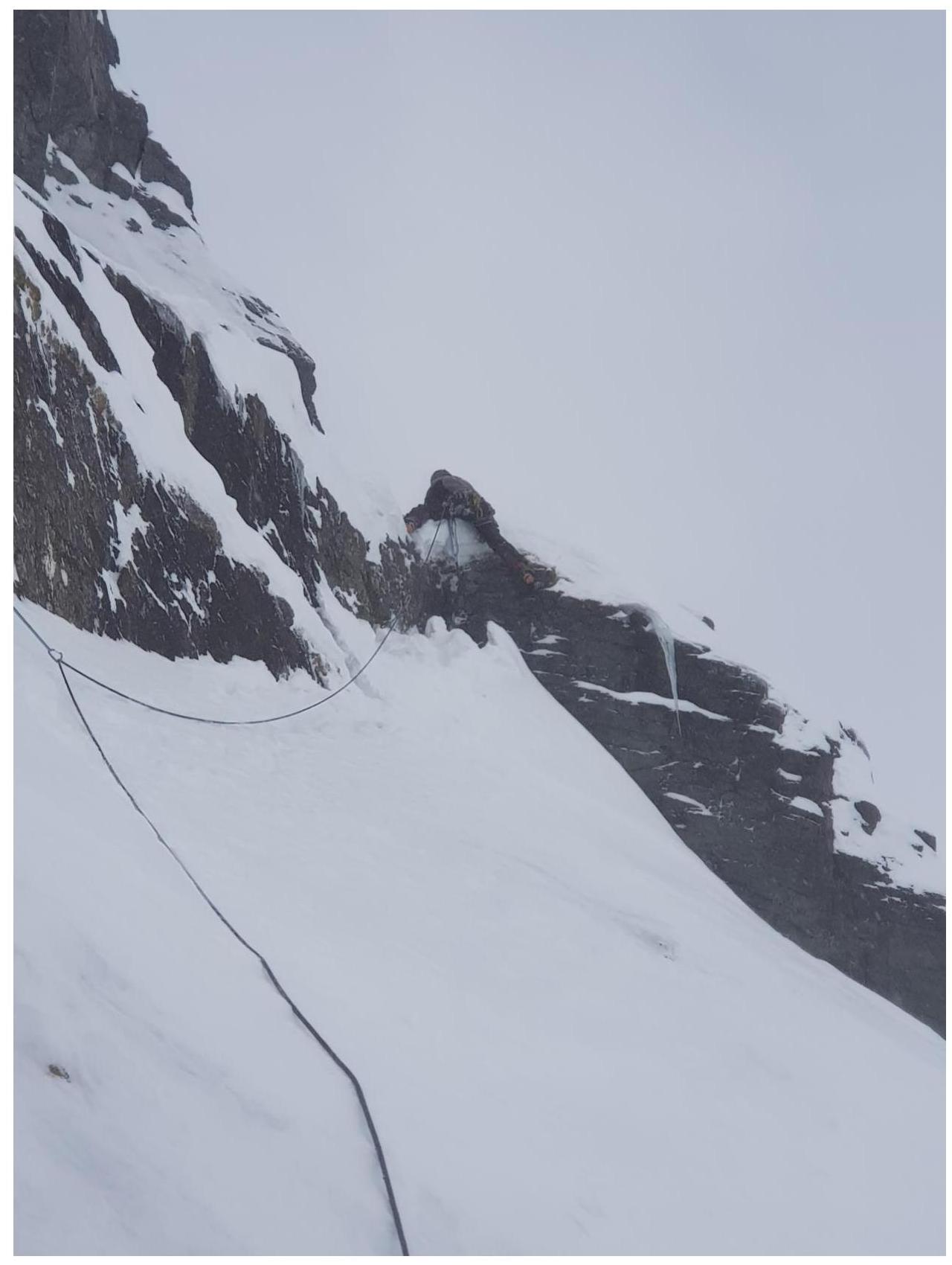 Section R4–R5
 Section R5–R6
 Section R6–R7
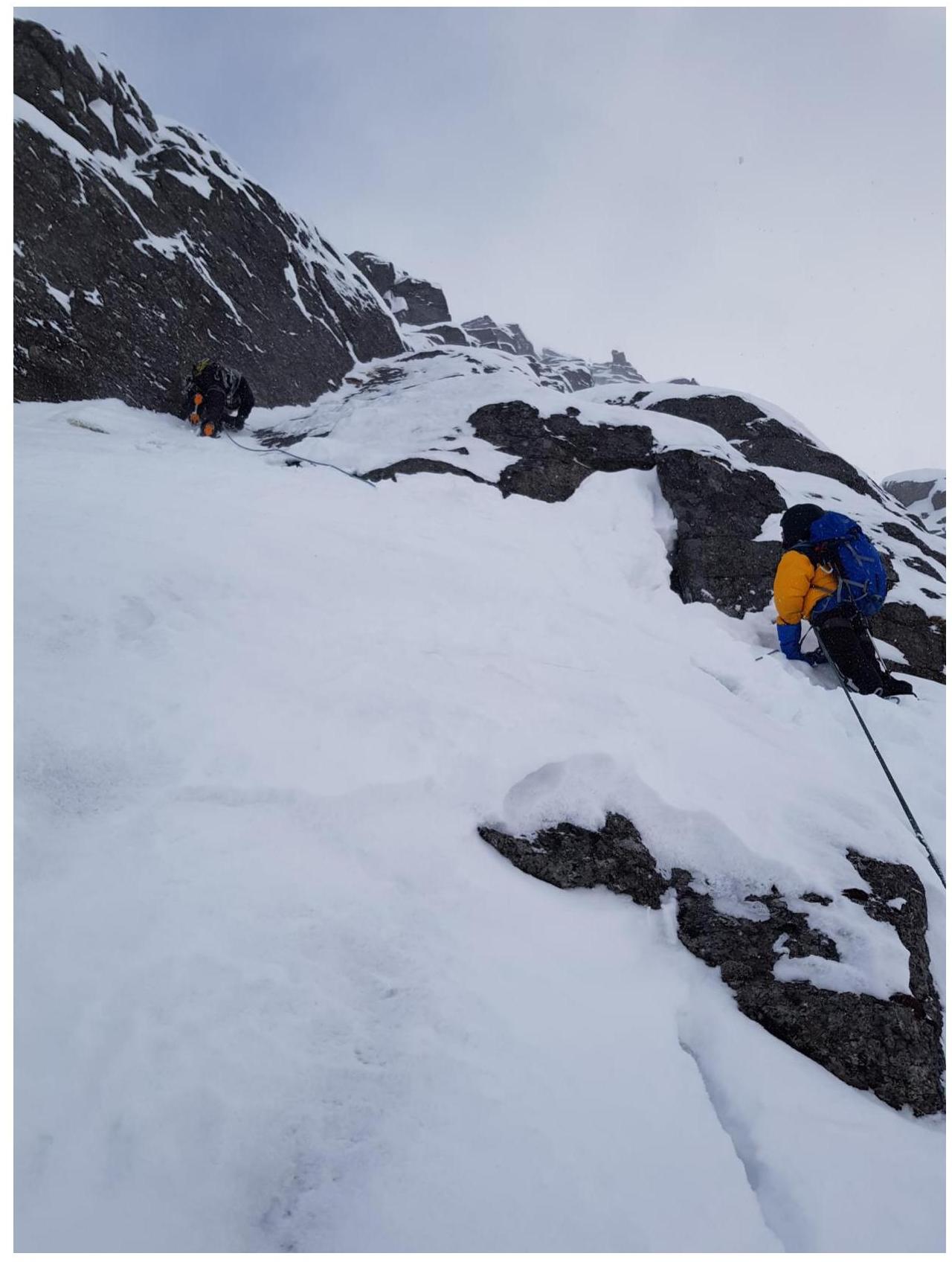 View from R7
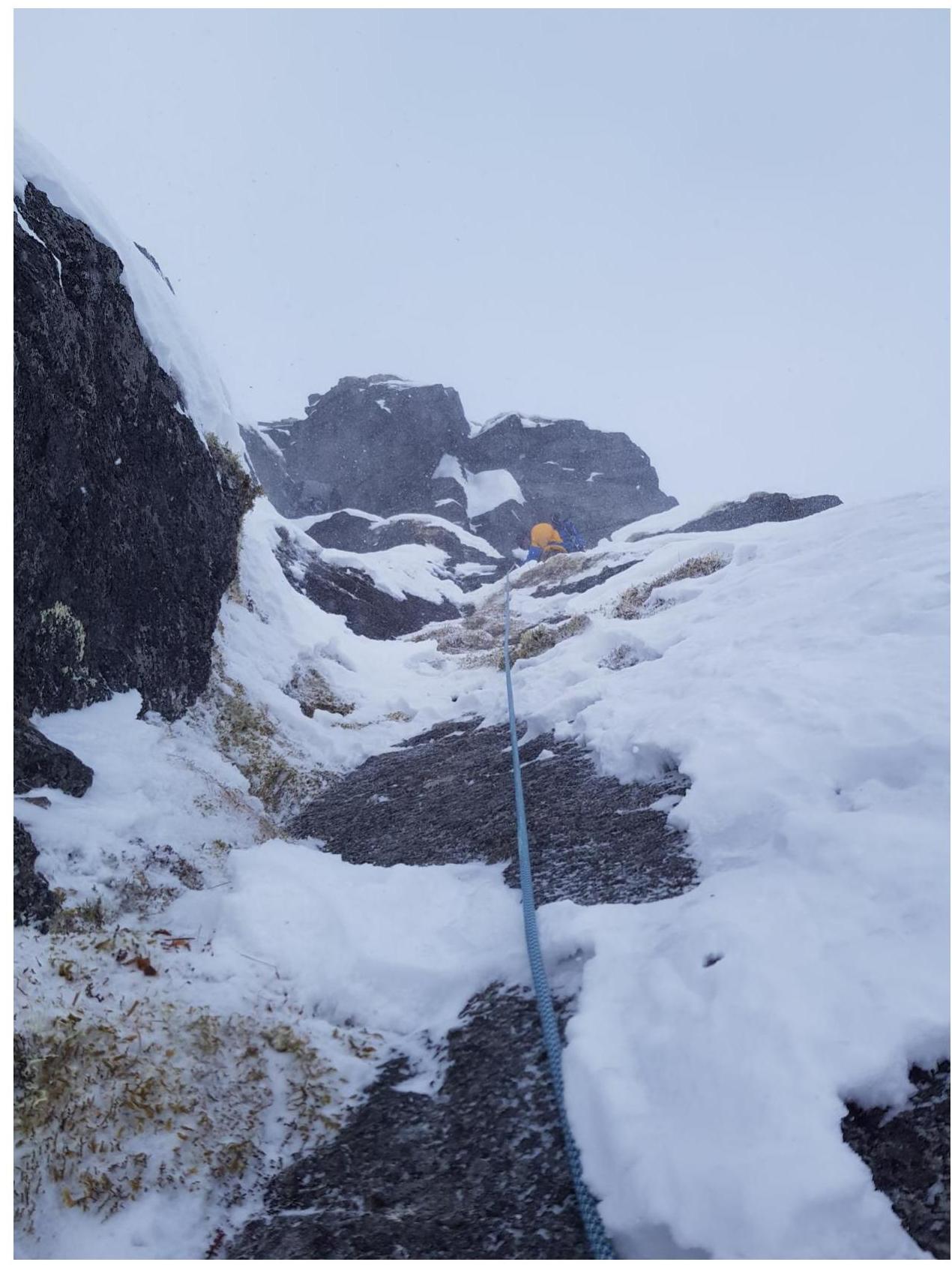 Section R7–R8
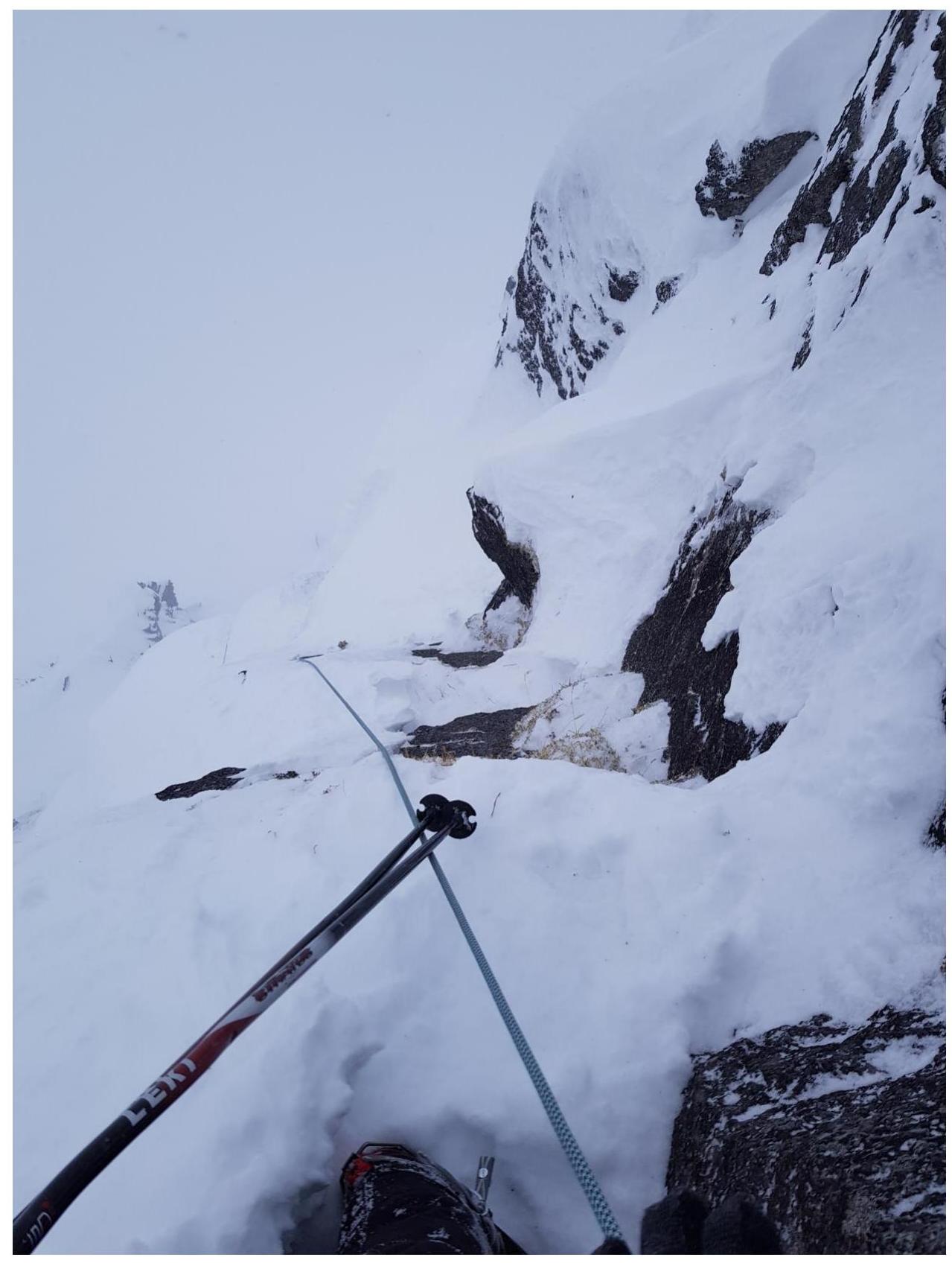 Section R7–R8
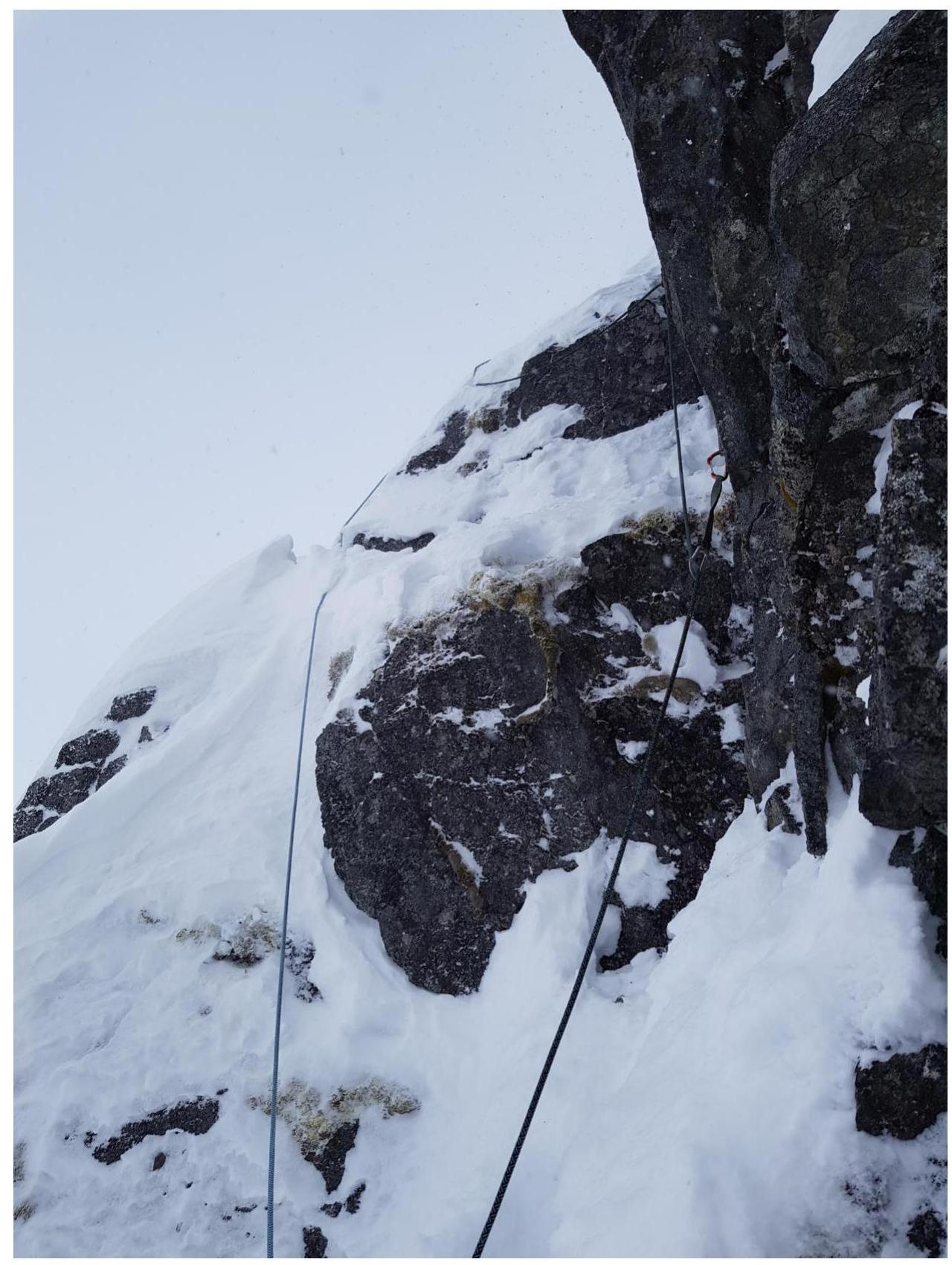 View from R8
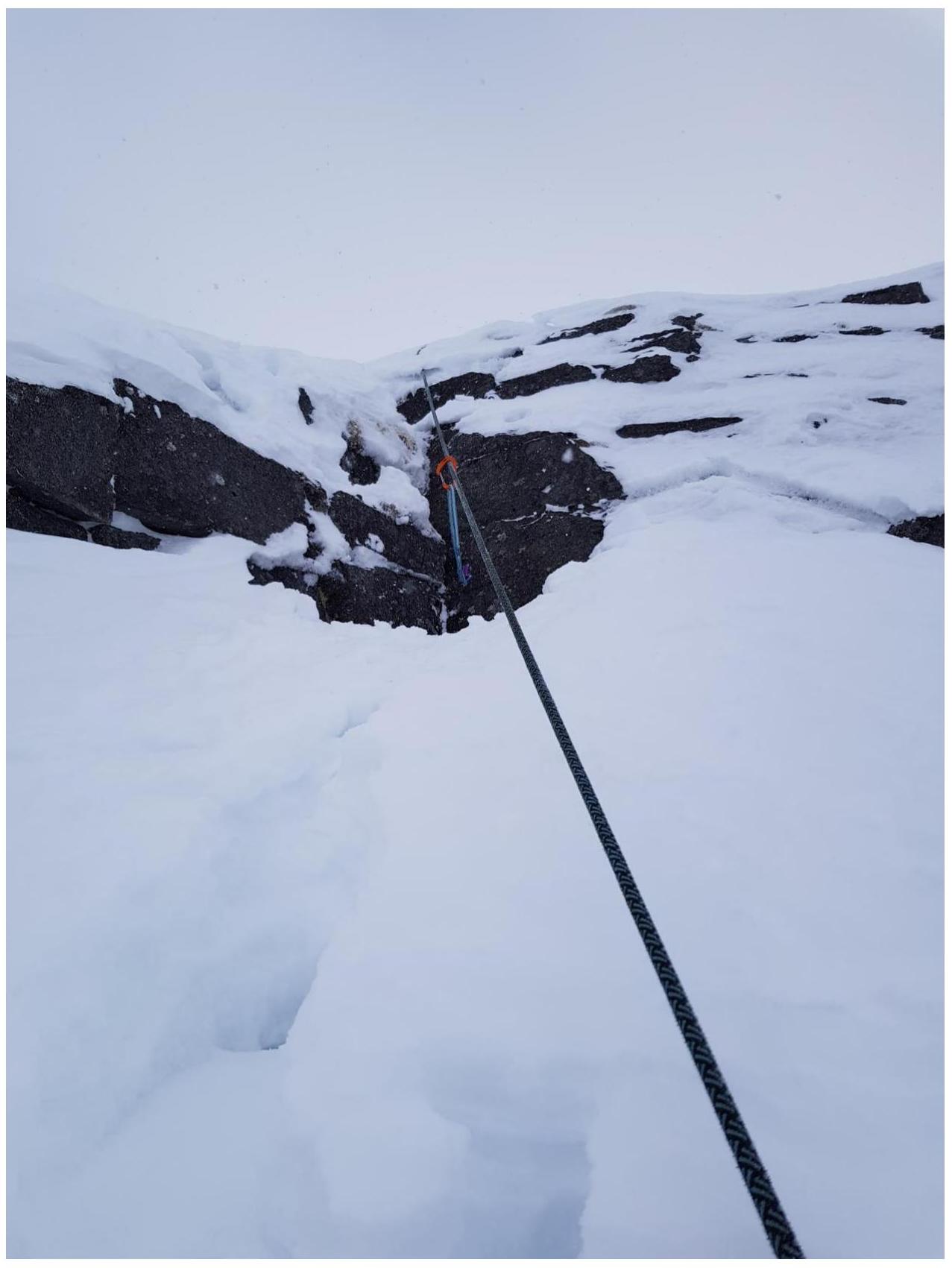 Section R8–R9
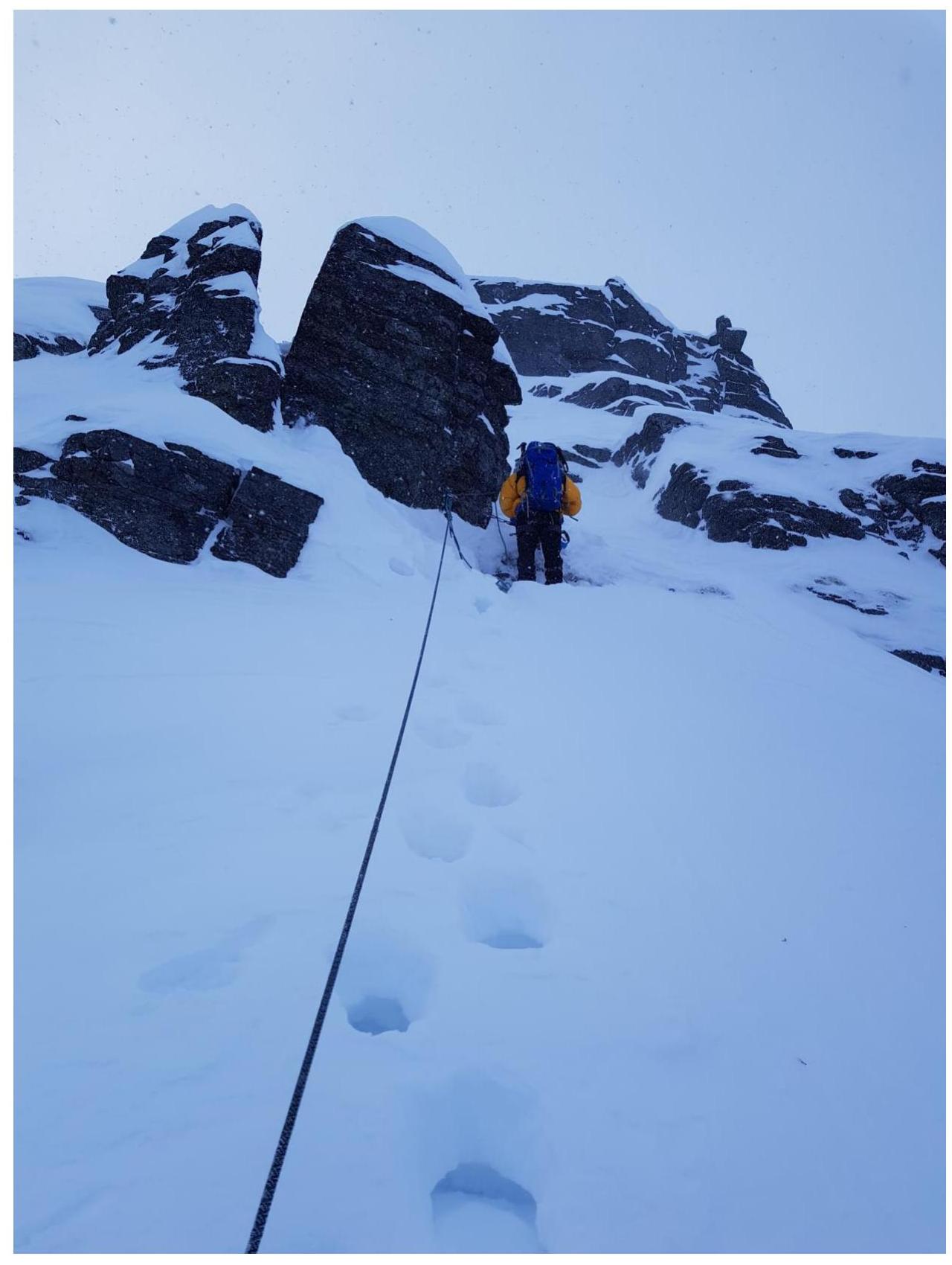 On R9
On R9
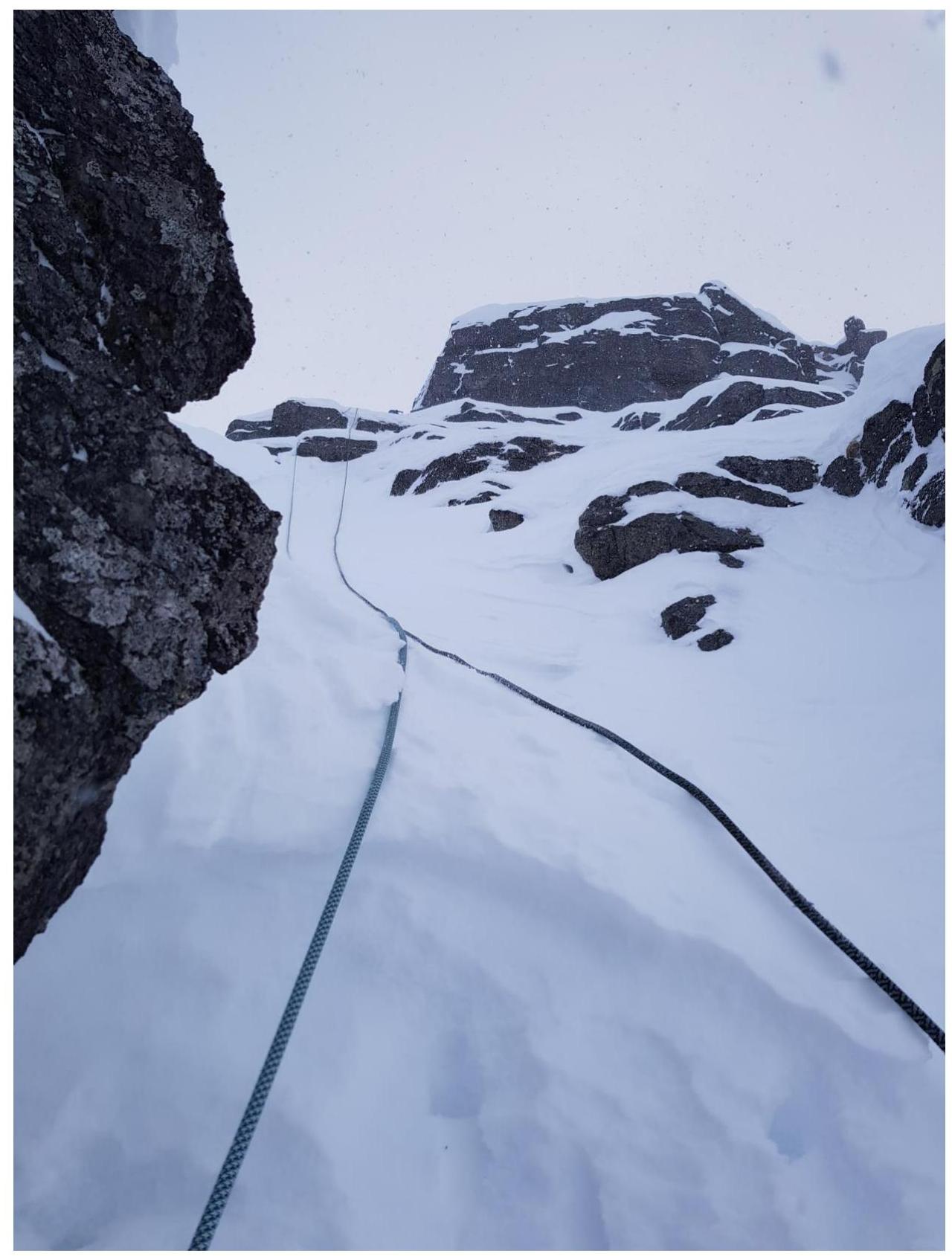 Section R9–R10
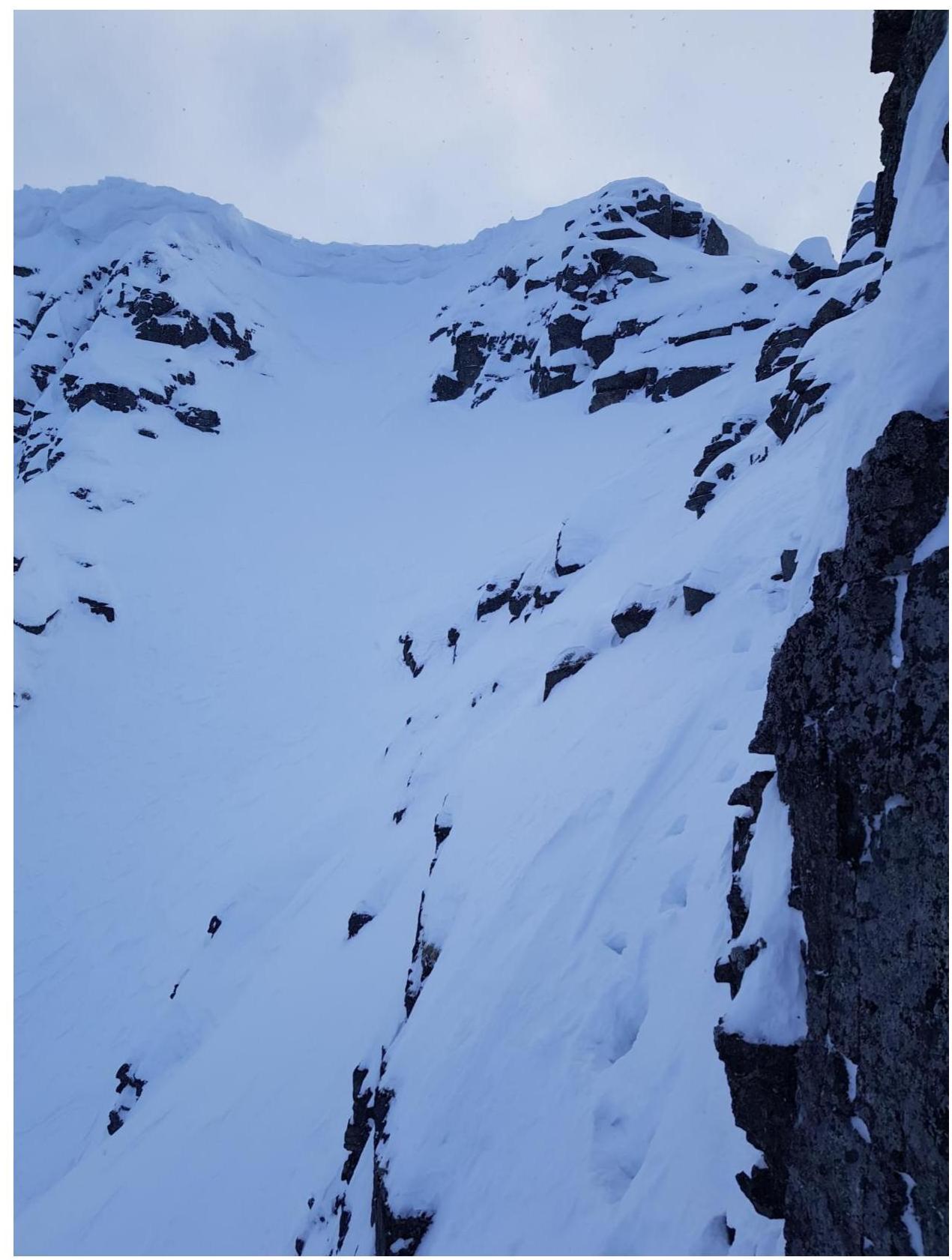 Ledge on section R9–R10, onto which it's necessary to pendulum down
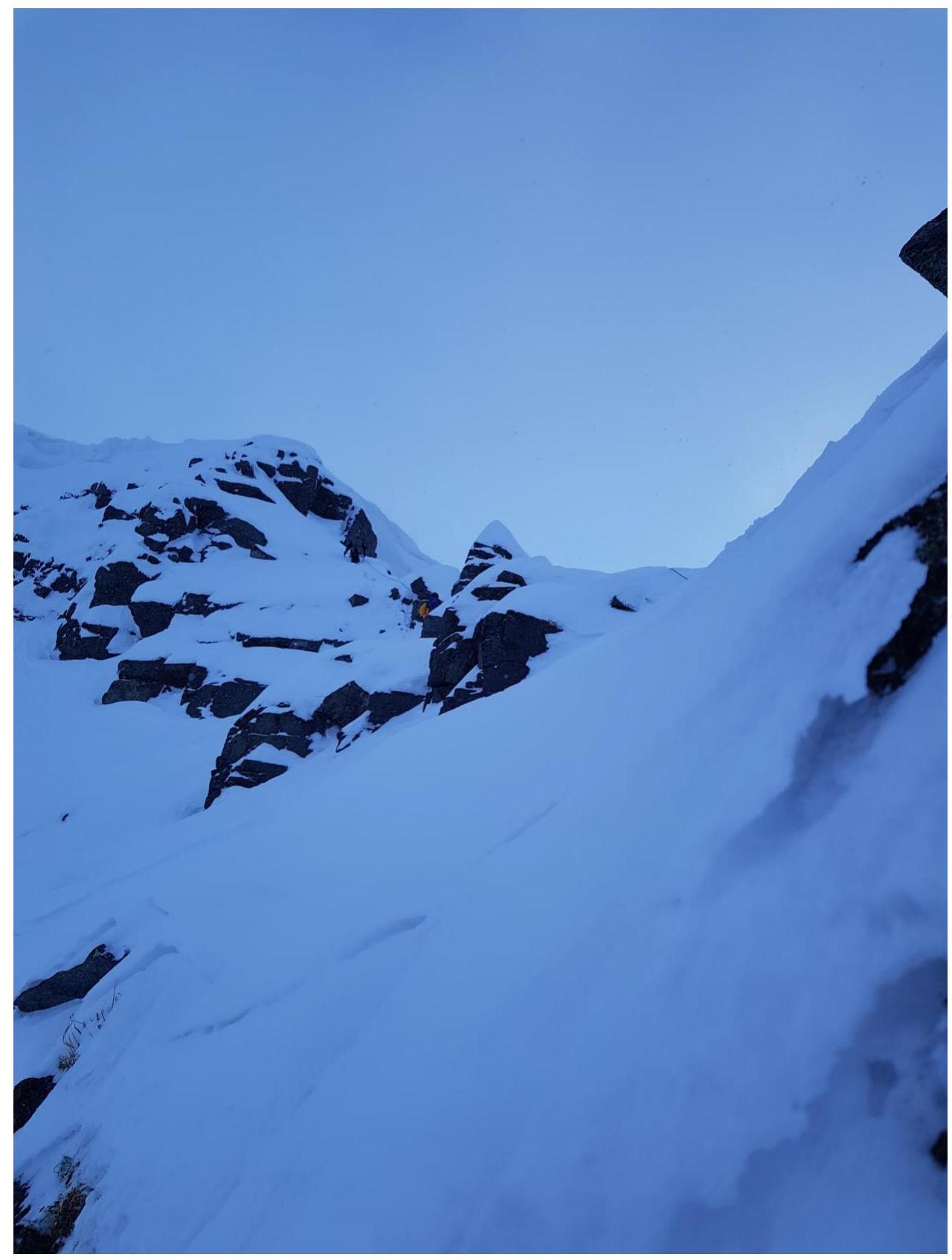 View from R10
 View from R11
 On the summit

Comments
Sign in to leave a comment