
Ascent Passport
- Ascent class — high-altitude.
- Ascent area: China, Tibet — Himalayas, Rongbuk gorge.
- Peak: Everest (8848 m) via the Northeast ridge through the North Col.
- Complexity category — 5B.
- Elevation gain (from ABC camp) 2450 m, distance (from ABC) 6000 m. Length of sections with 5th cat. complexity — 25 m 6th cat. complexity — none
6. Number of pitons driven:
rock placements ice screw pitons snow anchors
| 0 | 0 | 19 | 0 | 35 |
|---|---|---|---|---|
| 3 | 0 | 0 | 0 | 0 |
| 0 | 0 | 0 | 0 | 0 |
14 ice screws, 21 snow anchors, and 1350 m of rope were left on the route for subsequent climbers.
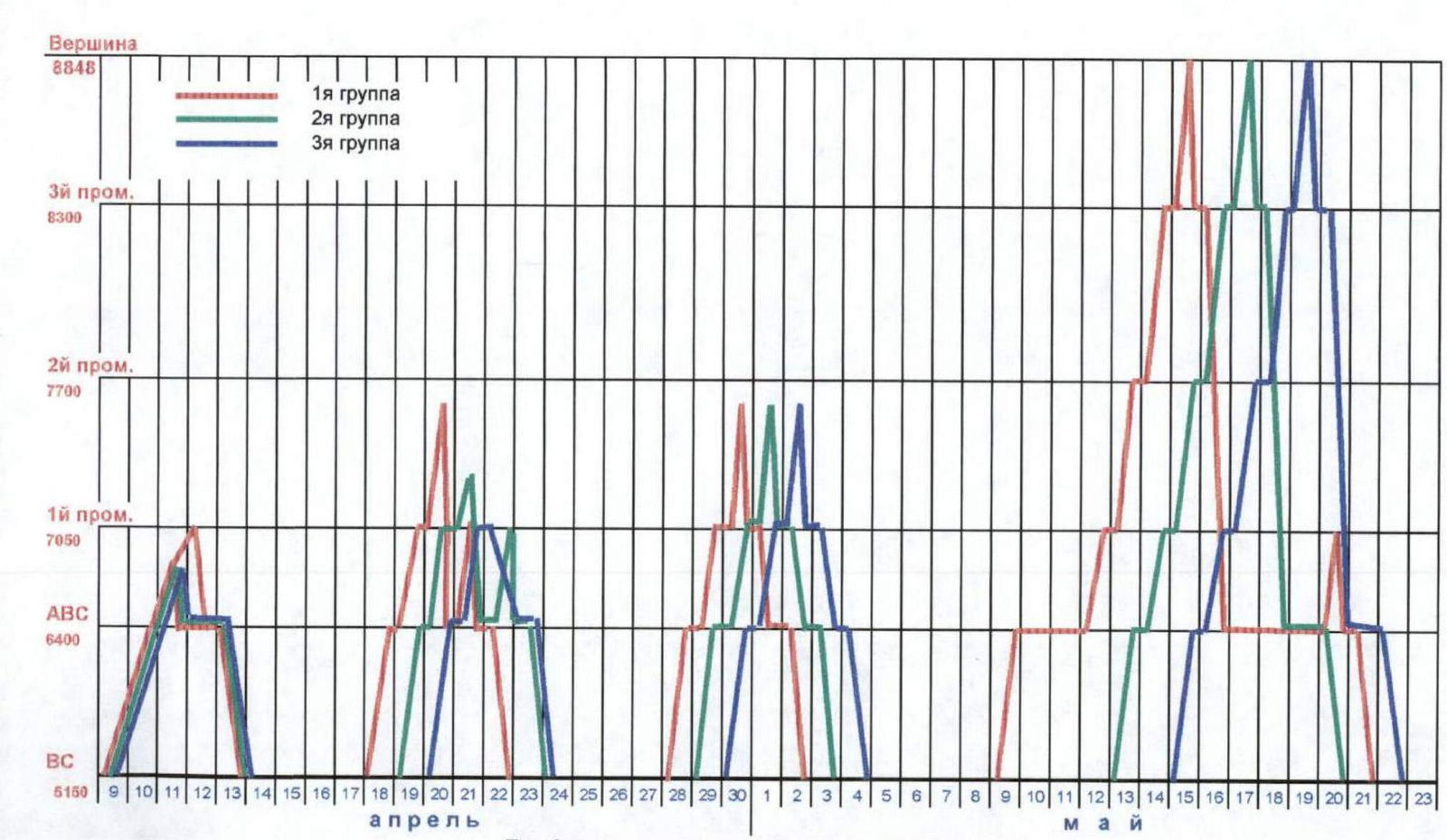
- Team's travel days (from ABC to ABC) — 5 for each group of four. Considering the 4-day difference in departure between the first and third groups — a total of 9 days.
- Overnights: 1st — North Col — Camp 1 — a platform carved into the snow-ice slope. 2nd — 7800 m — Camp 2 — a platform cleared on the rocky ridge. 3rd — 8300 m — Camp 3 — a platform carved into the snow-ice slope. 4th — 8300 m — Camp 3.
9. Team composition:
| Last name, First name | Sports rank | Home address |
|---|---|---|
| Expedition leader | ||
| Agafonov Yu.A. | 2nd sports rank | Krasnodar, ul. Yaroslavskogo, 128 |
| Team coach and captain | ||
| Aristov I.E. | CMS | Krasnodar, ul. Priozernaya, 13, apt. 89 |
| Participants | ||
| Aleksandrov A.A. | CMS | Krasnodar, ul. Atarbekova, 29, apt. 80 |
| Afanasiev O.G. | CMS | Armavir, ul. Komsomolskaya, 142, apt. 31 |
| Bershov S.I. | MS | Kharkov, Prospekt Pobedy 50a, apt. 28 |
| Bokov A.S. | CMS | Kharkov, ul. Askharova, 23, apt. 138 |
| Zakharov N. | IMS | Krasnoyarsk, ul. Metallurgov 55/38 — 298 |
| Kadoshnikov N.G. | CMS | Krasnodar, kh. Lenina, ul. Michurina, 74 |
| Kravchenko O.V. | CMS | Krasnodar, ul. Gidroстроиtelei, 40, apt. 4 |
| Sedusov B. | MS | Perm |
| Nedelkin V.I. | CMS | Krasnodar, st. Elizavetinskaya, ul. Naberezhnaya, 172 |
| Fukolov A.V. | CMS | Krasnodar, kh. Lenina, ul. Umanskaya, 45 |
| Yakimov A.N. | CMS | Krasnodar, ul. Zhloby 1/1, apt. 60 |
-
Departure to the route (from ABC): May 12, 2000. Return (to ABC): May 20, 2000.
-
Expedition organizers Krasnodar Law Institute — ul. Yaroslavskogo, 128. Mountain club "Extrem" — ul. Kommunarov, 221
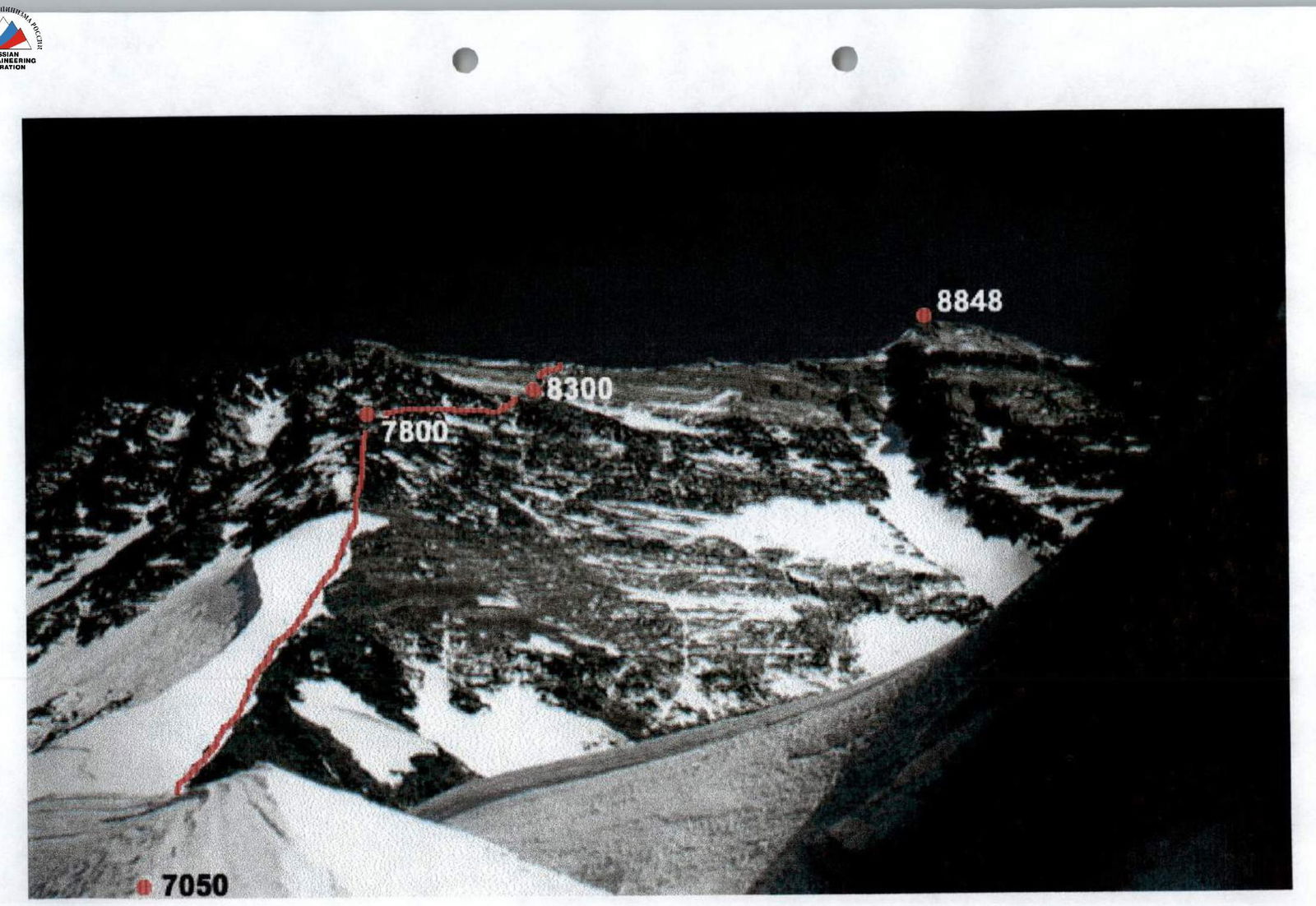
GENERAL PHOTO OF THE ROUTE. View from the North Col (intermediate Camp 1)
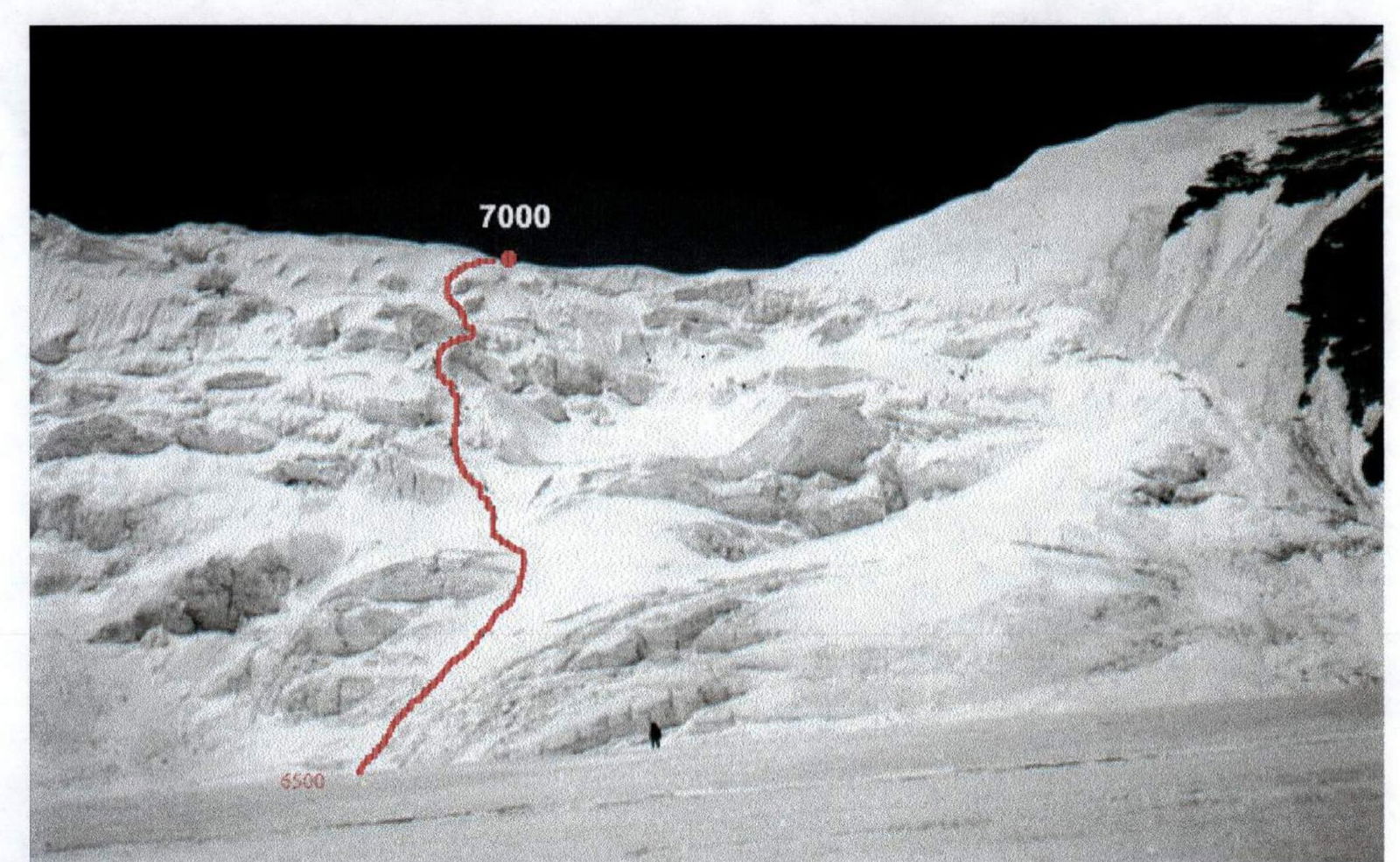
START OF THE ROUTE
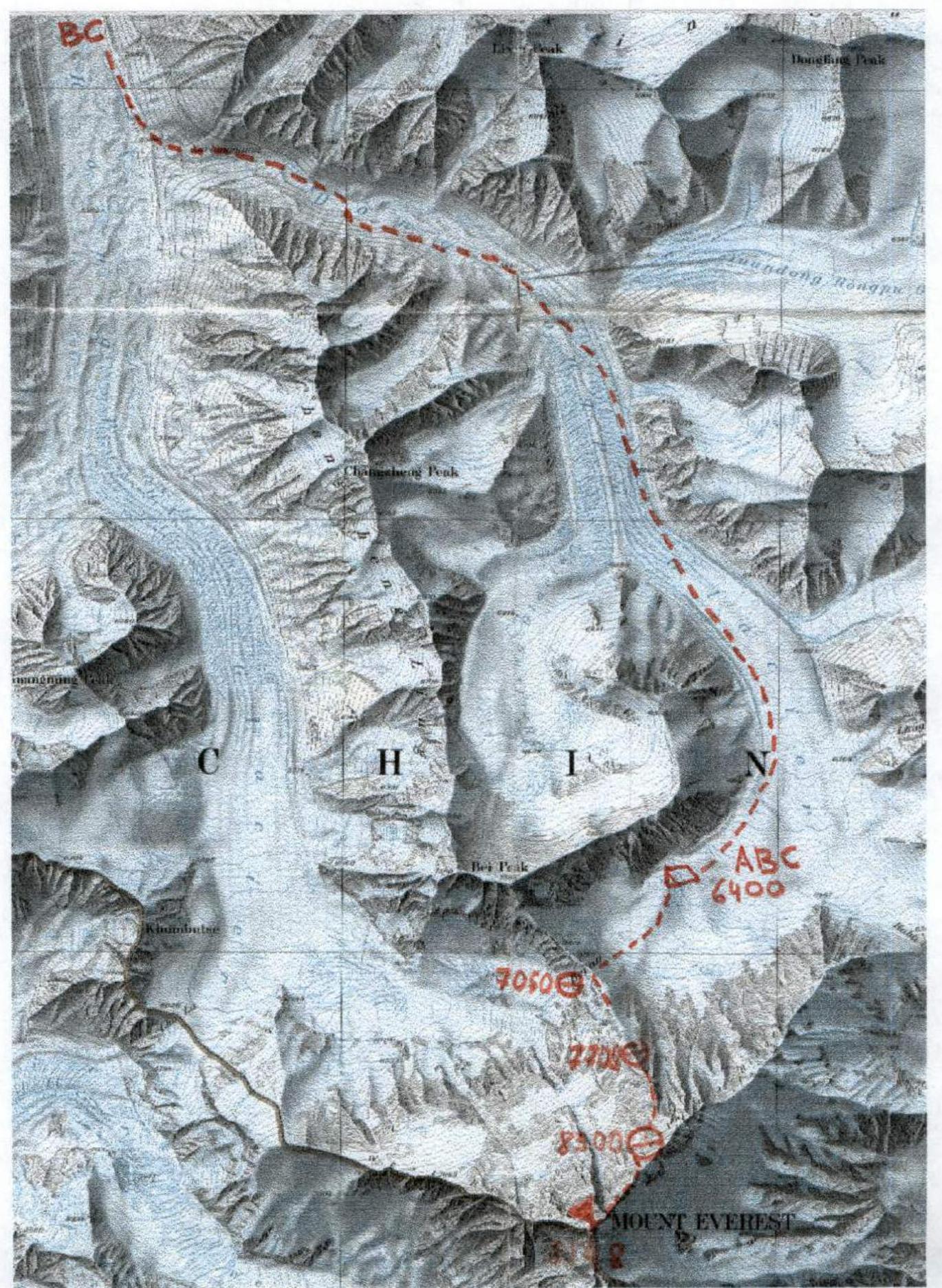
MAP-SCHEME OF THE ASCENT AREA
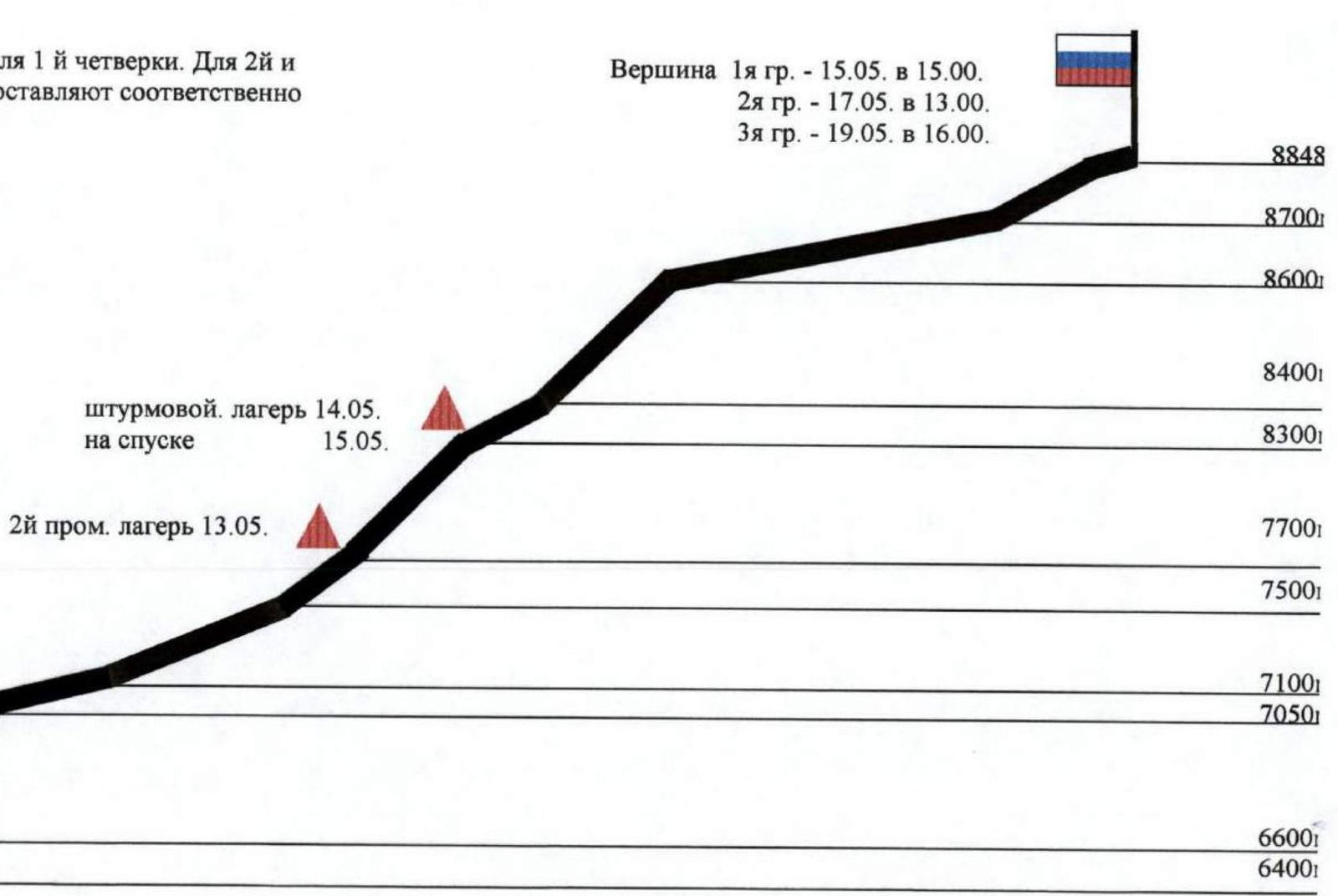
Profile
of the ascent route to Mt. Everest via the Northeast ridge through the North Col 5B complexity category
Note:
- Dates of overnight stays are indicated for the 1st group of four. For the 2nd and
3rd groups of four, the adjustments are plus two and four days, respectively.
Tactical actions of the team
The tactical plan for the ascent was based on the following factors:
- consultations received
- personal high-altitude experience of the expedition members
- visual assessment of the route's character and complexity
The ascent was planned as the main event of a 2.5-month expedition, with the following main stages:
- Pre-expedition preparation lasted approximately 1.5–2 years. During this time, the main team composition was determined, and the team underwent sports and technical training for a high-altitude ascent in the Himalayas. Equipment for the ascent was purchased and tested, and main food products for the expedition were acquired and packed.
- The expedition itself took place from March 24 to May 31, 2000:
- travel from Krasnodar — Moscow — Kathmandu on March 24–26, 2000;
- purchase of missing products and equipment for the base camp on March 27–31, 2000;
- travel from Kathmandu to the base camp (BC) on the Rongbuk glacier (altitude 5150 m) with stops along the way for acclimatization on April 1–5, 2000;
- establishment of the base camp and acclimatization exits on April 5–9, 2000;
- 3 exits by the team to higher altitudes for high-altitude acclimatization and installation of the advanced base camp (ABC) and high-altitude camps, as well as transportation of equipment and products to these camps.
- 4th exit — ascent of the entire team to the summit, liquidation of all intermediate camps, and descent of all equipment to the base camp.
- return home to Krasnodar.
Equipment and products were transported from the base camp to Camp ABC at an altitude of 6400 m and back using yaks and local porters.
Team tactics on the mountain: The entire team of 12 people was divided into three groups of 4 people each. The composition of the groups changed from exit to exit, taking into account:
- physical condition
- level of acclimatization of the participants.
The first exit to Camp ABC was made by all three groups simultaneously, with an intermediate overnight stay at an altitude of 5900 m — a tent was set up there for subsequent overnight stays when traveling from the base camp to ABC. However, it was used little, as most team members traveled from the base camp to ABC in one day.
On April 12, 2000, the team reached an altitude of 6400 m and established Camp ABC. On April 13, 2000, all team members went on an acclimatization exit towards the North Col. They carried all necessary equipment to the start of the ascent and were able to process 4 ropes on the route. The Kadoshnikov — Yakimov team led the way. After an overnight stay in ABC, the next day they processed another three ropes on the route and carried equipment to an altitude of approximately 6800 m. Most of the group descended to ABC, and the Aleksandrov — Fukolov team carved out a platform and spent the night in a tent at an altitude of 6800 m. The next day, leading alternately, this team fixed 7 ropes to Camp 1 on the North Col at an altitude of 7050 m. Insurance and fixing of ropes were done using 50 cm long duralumin ice screws. Despite the planned work in this area on this route by more than 20 expeditions from around the world, our team hung a section of ropes to the North Col autonomously, being the first to reach an altitude of 7050 m this season. Then the entire team descended to the base camp for rest. In the future, the plan for work on the mountain was as follows: 5 days of rest, followed by seven days of work on the mountain. A feature of the rest between team exits was that it was active — almost every day, all team members made 2–3 hour exits to nearby areas and routes. As a result, thanks to this, as well as the presence of a Russian bath in our expedition, none of the team members became seriously ill, and the entire sports composition was ready for the summit ascent.
On the second exit, all team members made one or two cargo trips to Camp 1, and the first group of four managed to climb to an altitude of 7500 m and carry some equipment there. The exit of the remaining participants above 7000 m was hindered by bad weather conditions — abundant snowfall complicated the situation on the route.
On the third exit, the team carried all necessary cargo to Camp 1 and made a trip to 7500 m — further weather conditions did not allow for an exit — a very strong wind interfered.
For the decisive 4th exit, the team formed the following groups of four: 1st — Aristov, Kadoshnikov, Aleksandrov, Fukolov; 2nd — Bershov, Kravchenko, Nedelkin, Yakimov; and 3rd — Zakharov, Sedusov, Afanasiev, Bokov. The first group of four leaves the base camp for ABC on May 9. On the 10th and 11th, they had to stay in ABC due to bad weather. On May 12, the first group of four ascends to the North Col. The others follow with a 2-day interval — this is done for optimal placement at overnight stays in high-altitude camps and for mutual insurance. On May 13, the first group establishes Camp 2 at an altitude of 7700 m. On May 14:
- By 16:00, the first group reaches an altitude of 8300 m and carves out a platform in the ice for Camp 3.
- By the end of the day, high-altitude porters bring 24 oxygen cylinders.
- Each participant brings one more cylinder.
- The overnight stay at 8300 m and further ascent are done using oxygen. On May 15:
- At 3:00, the first group begins the ascent.
- The group takes 3 ropes with them.
- 2 ropes are fixed when exiting onto the ridge to facilitate descent and passage for the following groups.
- The Aristov — Kadoshnikov team leads alternately.
- Complex sections are passed with alternate insurance, simple ones — simultaneously.
- By 15:00, all members of the first group gather at the summit.
- No signs of other teams are found — our group of four was the first to ascend to the summit this season. On May 16:
- At 20:00, the first group descends to 8300 m, and by 15:00 on May 16 — to Camp ABC.
With a 2-day interval, the second and third groups — on May 17 and 19, respectively — ascend to the summit and descend to ABC, where the 1st group waits for them as insurance. On May 20, the 1st group ascends to Camp 1 and helps the 3rd group dismantle the camp and lower it to ABC. Over the next three days, all participants and all cargo are transported to the base camp using yaks and porters.
Stable radio communication between groups, ABC, and the base camp was maintained using Vertex and Motorola radios. To ensure uninterrupted communication between the base camp and ABC, special base antennas were designed.
To ensure safety and insurance of the groups' work on the mountain, two high-altitude doctors worked as part of the expedition — Alexey Bokov in the 3rd group and Andrey Aleksandrov in the 1st. All groups and high-altitude camps were equipped with first-aid kits with all necessary medications for providing first aid. The main first-aid kit, located in ABC, was fully equipped with everything necessary for providing qualified medical assistance, including resuscitation measures. Each participant had a first-aid kit with them in case of frostbite.
On the route, the team used high-altitude tents designed by Efimov, as well as high-altitude tents and modern equipment from the company "Marmot".
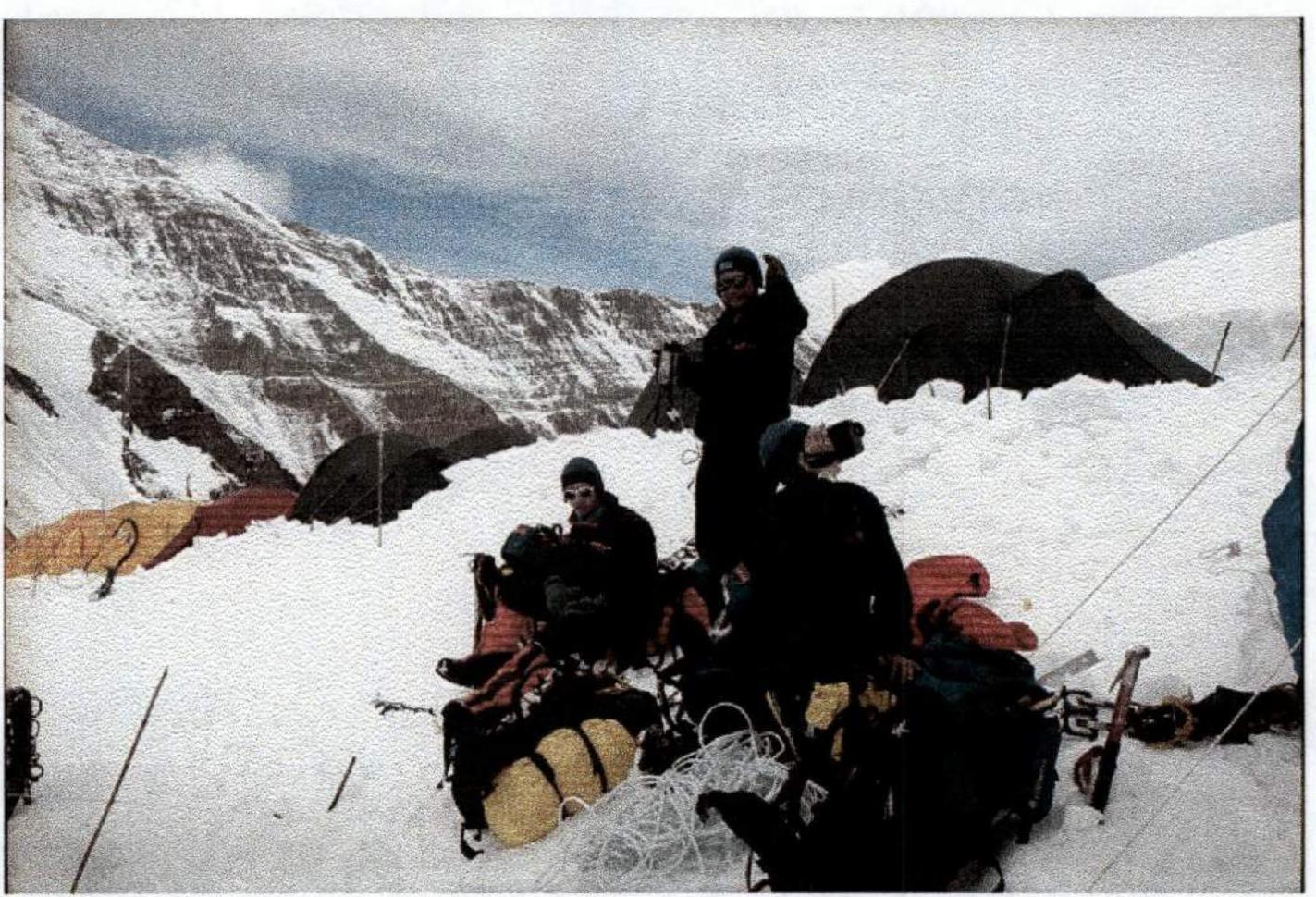
Installation of intermediate Camp 7050 m.
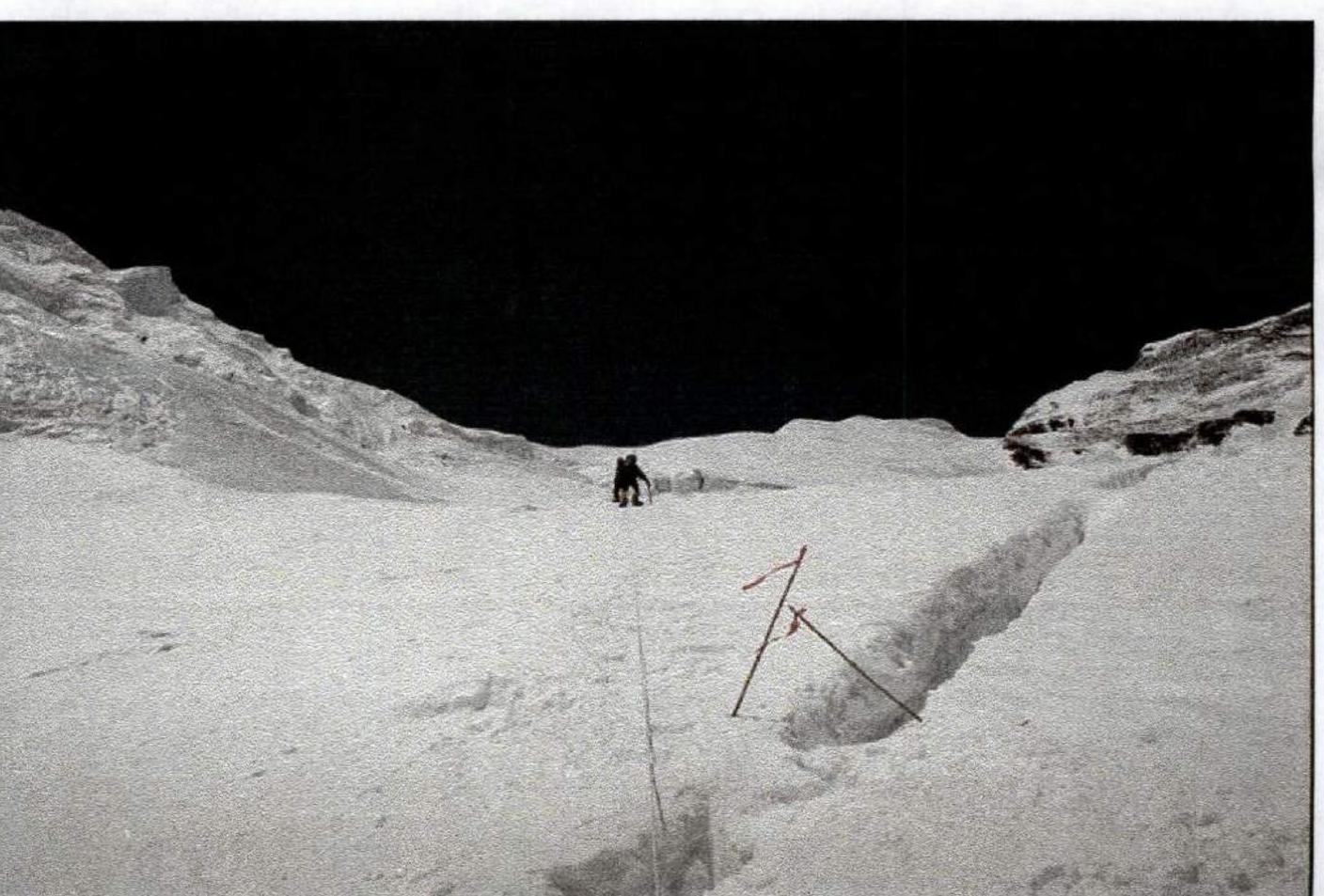
Start of ascent to the North Col (altitude 6500 m).
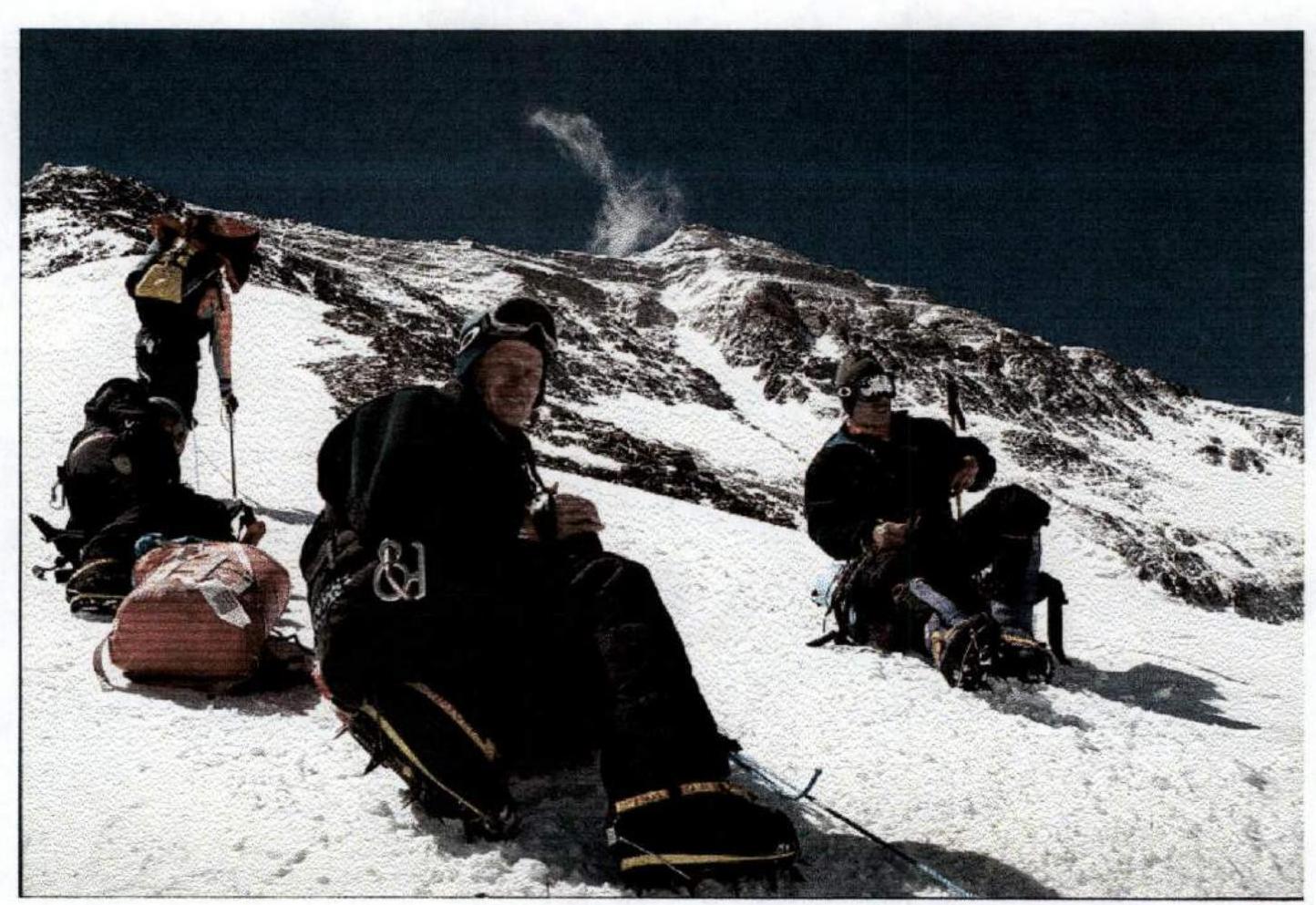
Transition 7050–7700 m.
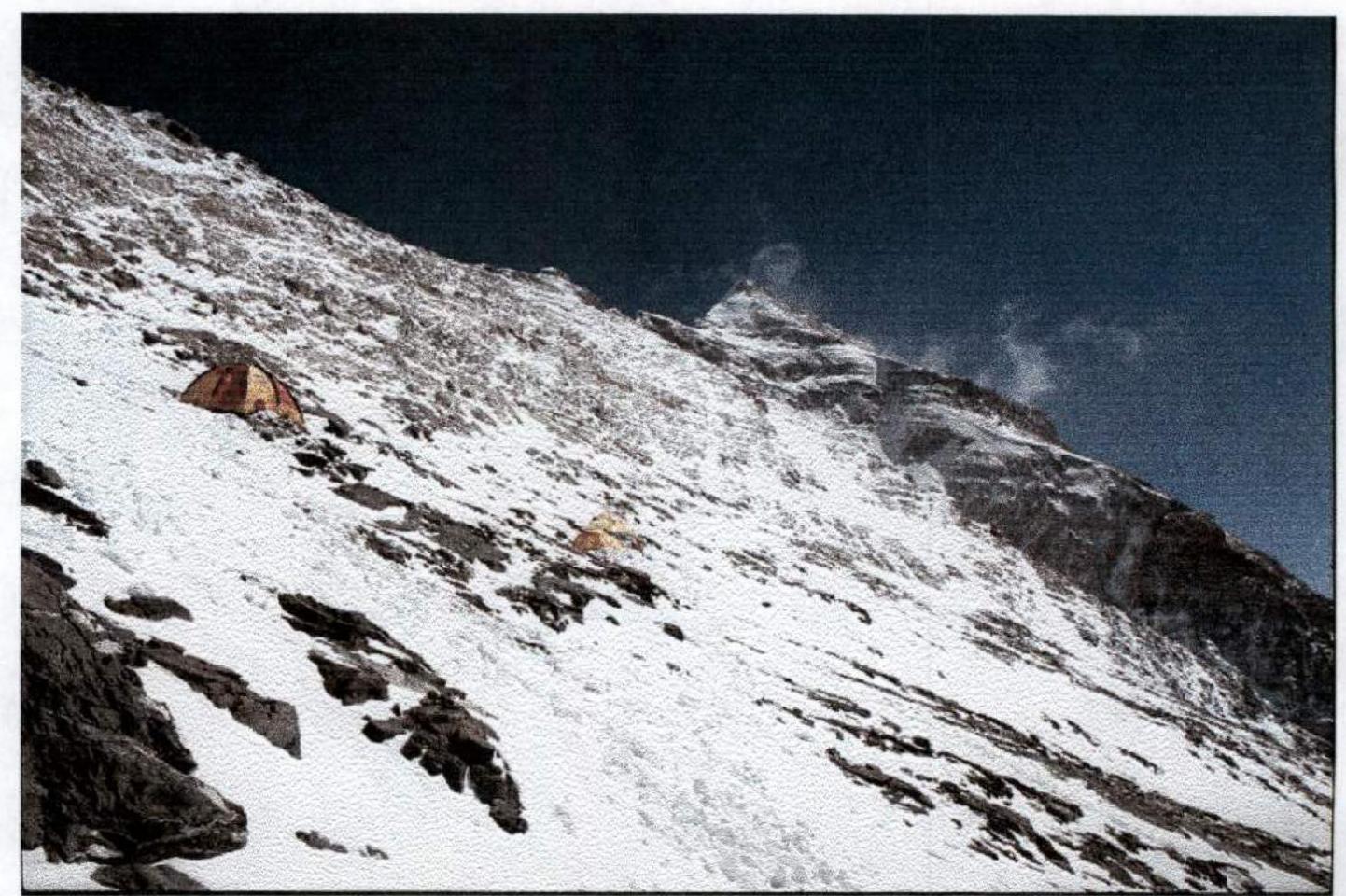
Intermediate camp at an altitude of 8300 m.

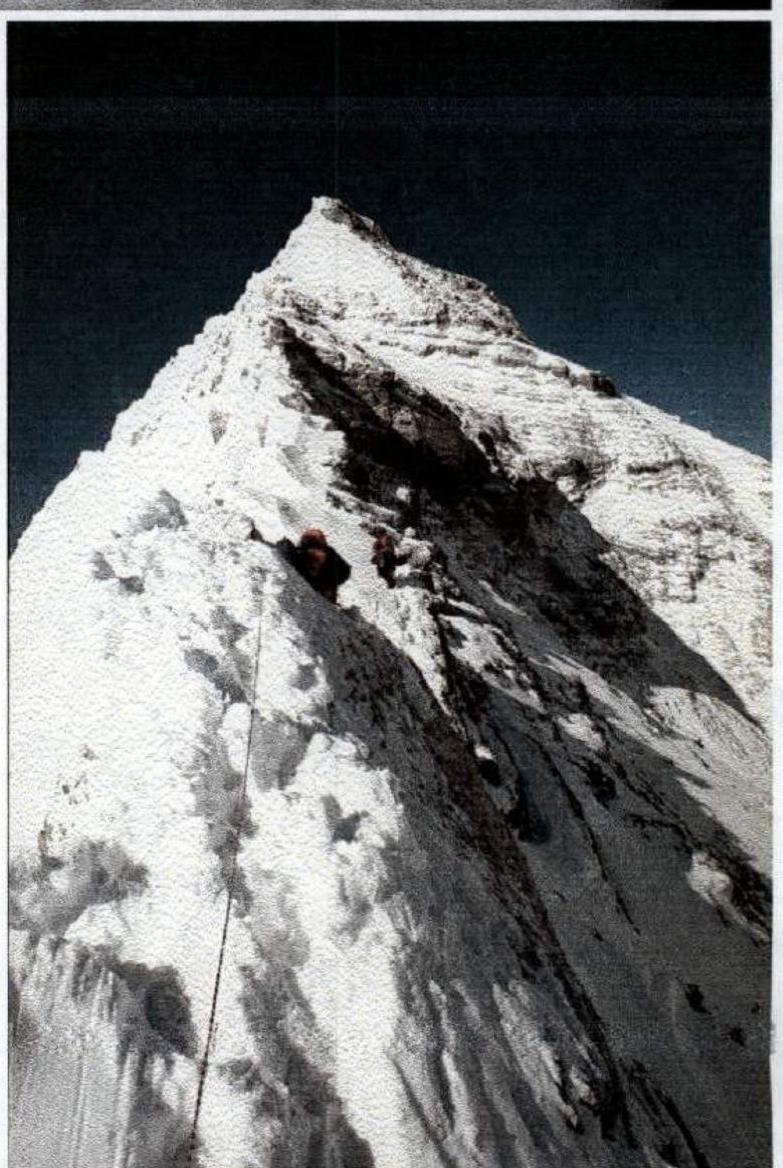
Ridge above 8500 m.
Approaching the 2nd step

Comments
Sign in to leave a comment