
Passport
I. Rock climbing category.
- Spurs of the Turkestan Range, Ak-su gorge.
- Peak 4240 m, center of the North face.
- Proposed 6B category of complexity, first ascent.
- Height difference 830 m, length 968 m
length of 6B sections — 583 m, 5B — 267 m
average slope of the route — 75°, average slope of the wall section — 81°
- Driven pitons:
rock placement elements bolt ice 112/59 191/85 39/39 0/0
- Team's working hours: 73 h 45 min, 5 days and one processing day.
- Overnights: 1, 2, 3 — in hammocks; 4 — five people on a shelf half-lying, one by one, and one — in a hammock.
- Leader: Moroz Sergey Andreevich, Master of Sports
Team members:
- Timofeev Vladimir Nikolaevich, Master of Sports
- Khitrikov Vladimir Andreevich, Master of Sports
- Lebedev Gennady Igorevich, Master of Sports
- Kozachok Petr Vasilyevich, Master of Sports
- Portyanko Grigory Andreevich, Candidate for Master of Sports
- Coach: Moroz Sergey Andreevich, Master of Sports.
II. Exit to the route: June 18, 1988.
summit — June 23, 1988, return — June 24, 1988.
- Organization — Dnipropetrovsk alpinist club of Dnipropetrovsk regional council of the All-Union Voluntary Sports Society of Trade Unions.

Photo #1. General photo of the summit. Date and time of shooting: June 15, 1988, 15:00. Lens type — Industar-50. F = 50 mm. Distance to the object 2000 m. Shooting point number C. Height of the shooting point 3500 m. alpfederation.ru
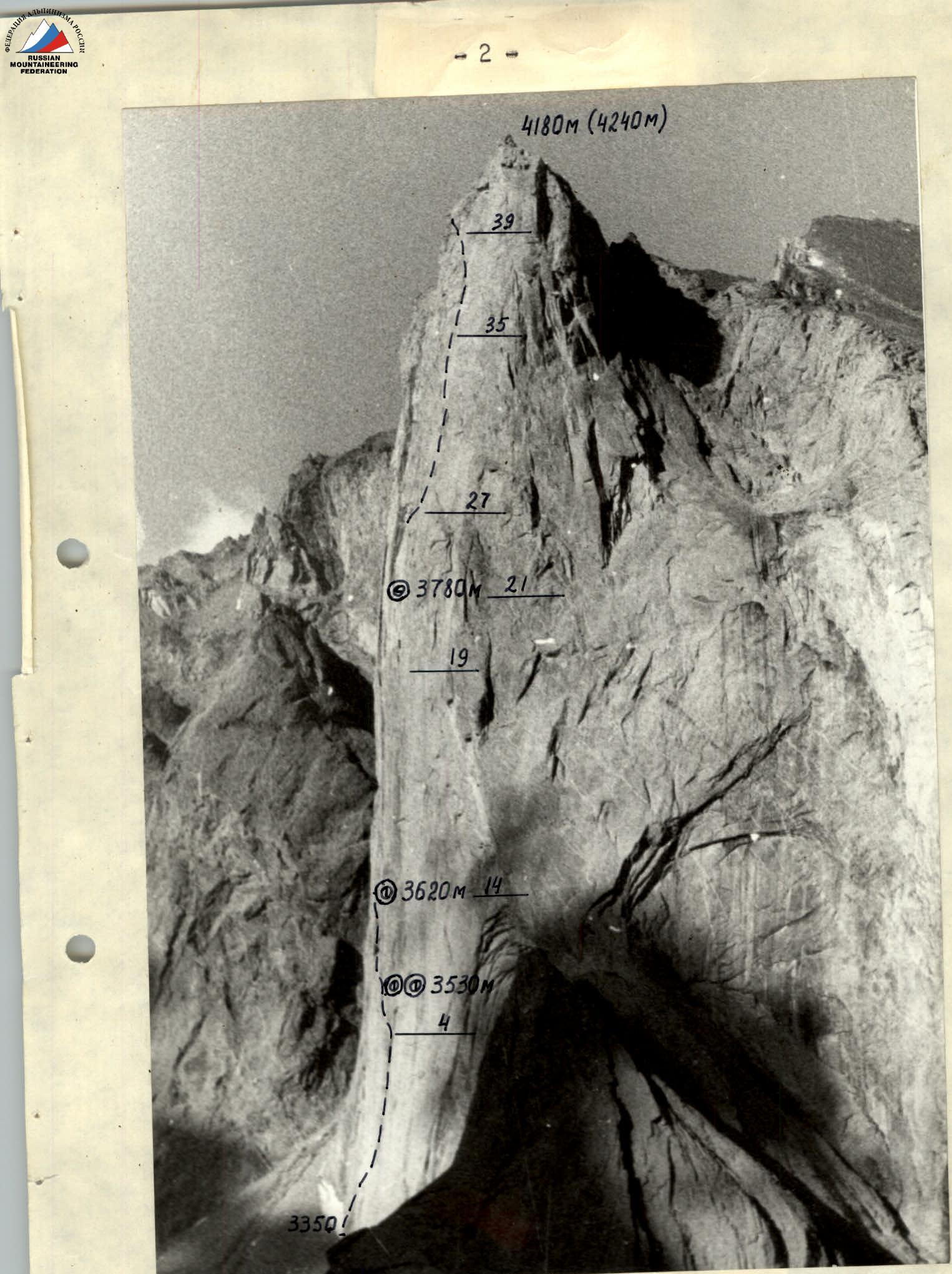
Photo #2. Profile of the wall on the right. Date and time of shooting: June 30, 1988, 17:00. Lens type — Industar. F = 50 mm. Distance to the object 2000 m. Shooting point number C2. Height of the shooting point 3700 m.
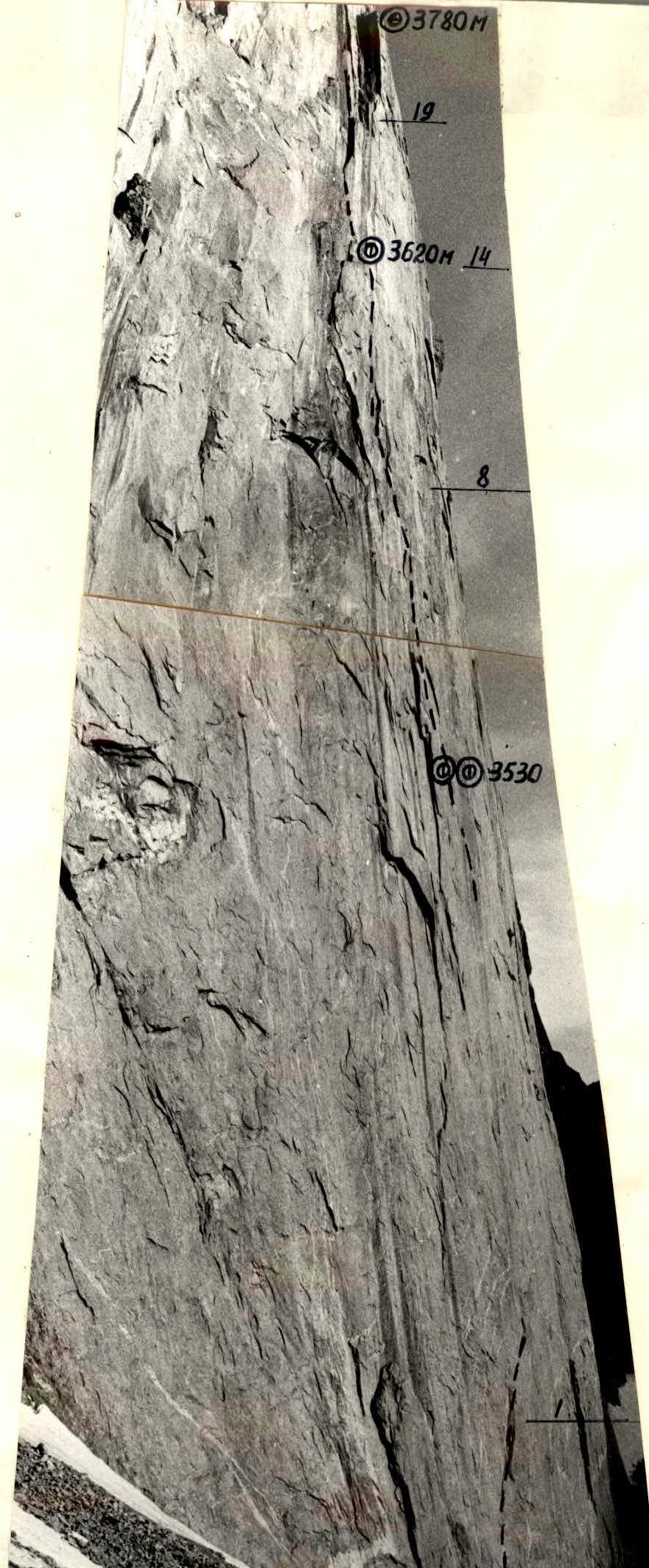
Photo #3. Profile of the wall on the left. Date and time of shooting: June 19, 1988, 18:00. Lens type — Industar. F = 50 mm. Distance to the object 200 m. Shooting point number — C3. Height of the shooting point — 3300 m. The profile of the wall on the left is also technical photo #5, 6.
8a
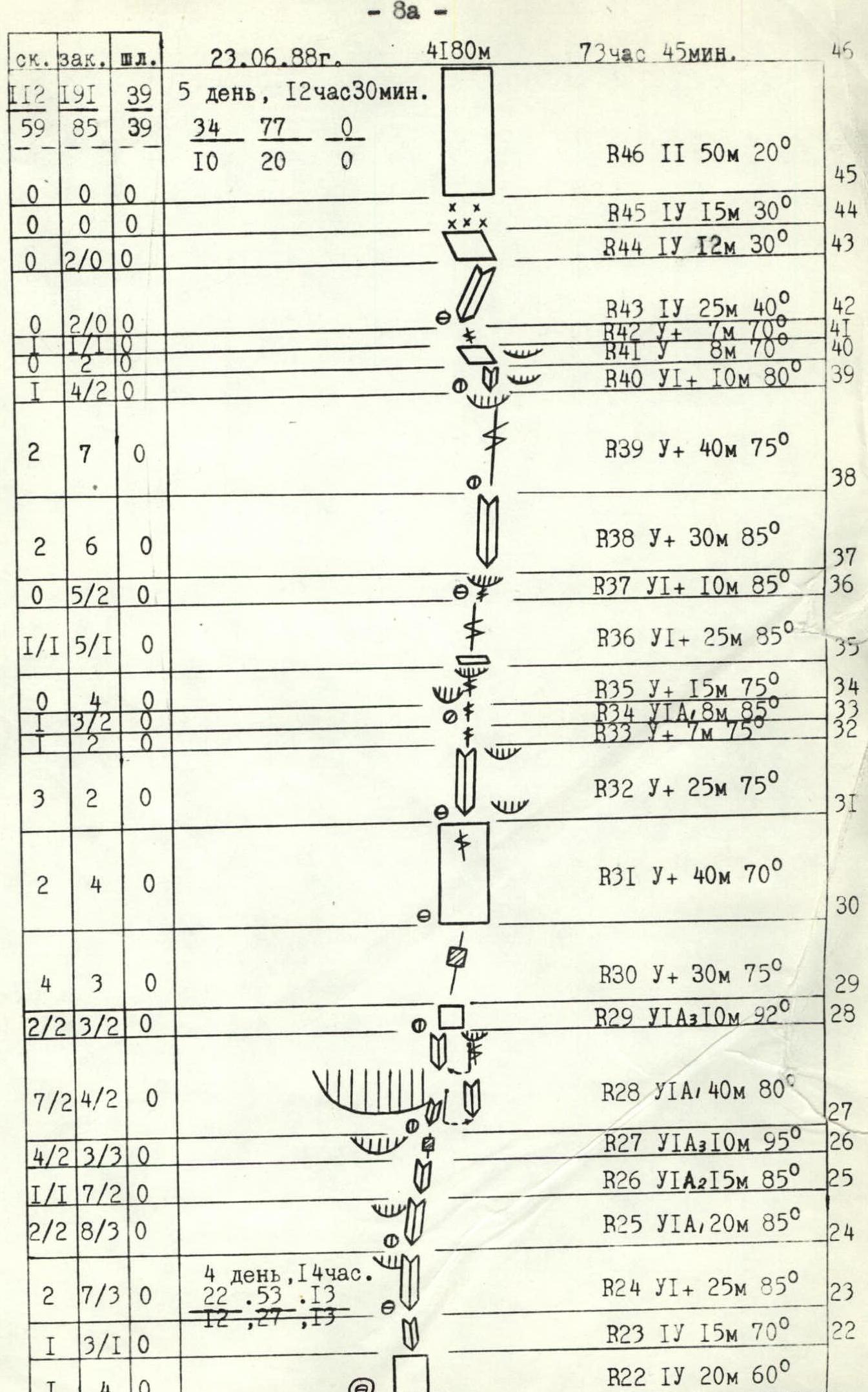
9. Description of the route by sections
Processing day: R0–R2. Large steepness of the section, lack of relief for free climbing. Passing many places on artificial terrain (ITO), but the reliability of belay points allows for free climbing. During the day, three lead climbers rotated. The end of the rope was secured under the beginning of the internal corner with an overhang.
I day: R3. Beginning of a large internal corner. Kozachok climbs freely. Belay point on a small ledge on the left.
R4. The difficulty of passing the internal corner is associated with the overhanging left part and smoothed edges. Kozachok has to make a "pendulum" to move to the right wall, where a thin crack runs, and along it, first free climbing, and then on ITO — approach to the chimney.
R5. Having passed several meters along the chimney, Kozachok crosses over a cornice to the wall on the left, and then along a "deaf" crack, and then, making several meters of very difficult traverse, comes out onto small ledges.
R6. Internal corner, at the base of which, under small overhangs, overnight stay in hammocks.
R7. Chimney formed by a huge thin plate with a monolithic base, but standing 0.2–0.5 m away from the wall.
II day: R8–R9. Leading team — Portyanko — Timofeev. Portyanko starts working, passing a steep internal corner, comes out onto a small ledge, after which, along the wall with a crack, onto a triangular ledge. He climbs freely, using large-sized placement elements and "friends" for belaying.
R10. Steepness increases, and 8 m are passed along a very narrow crack with an overhang, using only "petals" and small placements for creating ITO.
R11. The wind picked up, and water spray started blowing onto the route. The wall became wet, and water began to flow down it.
Timofeev continued working, replacing the wet Portyanko, and by the end of the day, they managed to pass another 20 m, drilling a bolted route under the overhangs. Overnight stay at the same spot.
III day: R12. Timofeev works first. Along the crack, free climbing, then through a cornice onto a smooth, vertical slab, and using ITO, exit onto a ledge.
R13. Another 10 m of very difficult climbing along the wall with micro-footholds.
R14. Traverse along a narrow shelf with a slight gain in height. Timofeev is replaced by Moroz. Having passed a few more meters of the wall, they decided to organize a snack and change clothes, as the wind was blowing water onto the route in the form of rain (photo #16).
R15. Internal corner, along which they exit onto a shelf. Convenient place for belaying. Rain started, followed by snow and hail. Streams run along the corner and the wall. Overnight stay in hammocks.
IV day: R16. The flow of water did not allow moving left into the chimney, and Khitrikov, who worked first, had to drill 30 m with bolts along a steep, smoothed wall.
R17–R18. Further along the internal corner, flooded with water, which greatly complicates passage. Having passed the internal corner, and then a small chimney, Khitrikov exits to the right onto a shelf.
R19. Khitrikov, soaked, is replaced by Kozachok. In two hours, he managed to pass 20 m of difficult climbing to the beginning of the chimney. The first climber is hit by streams of water, very cold. Kozachok was replaced by Timofeev, who managed to pass under the flow of water part of the large chimney, turning into an internal corner. Extremely difficult climbing is compounded by:
- wind
- streams of cold water.
R20–R21. Timofeev is replaced by Portyanko. Difficult climbing, first along the chimney, and then along the internal corner with snow plugs, flooded with water. Very few footholds. They use:
- large placements
- "friends"
By the end of the day, Portyanko reached a "balcony".
R22–R24. Having passed to the right corner of the balcony along simple, but initially destroyed rocks, Portyanko processed another two ropes of the route. Steepness decreased slightly. Streams of water pass to the left and right of the "balcony". Overnight stay on the "balcony".
V day: R25. Vertical smooth wall with a crack, along which Portyanko climbs freely.
R26. Very difficult climbing under large cornices. Medium-sized placements work well.
R27. Difficult cornice with a crack is passed on ITO, then transition from one crack to another under a large cornice.
R28. From under the cornices, transition further to the right onto the 3rd wall, but the nature of the route does not change. Portyanko makes a pendulum, a difficult smoothed crack, and then another pendulum.
R29. Having passed the overhanging wall, exit onto a small ledge, where you can rest a bit.
R30. Slightly veering to the right, along smoothed slabs with shallow cracks, the first climber has to move very carefully, as:
- placements and pitons may be unreliable.
R31. Steepness of the rock decreased slightly, a varied and convenient relief for climbing appeared, and this allows for a noticeable increase in the pace of passage for both the first climber and the entire group. Several parallel cracks lead to the roof. Along one of them, the middle one, bypassing small overhangs on the left, Portyanko reliably uses medium-sized placements for belaying.
R32–R35. The crack passes through several cornices, overcoming which with free climbing, Portyanko exits onto a small ledge, very convenient for belaying.
R36. Small wall and then up along a thin, steep crack, using medium-sized placements for intermediate belaying.
R37. Cornice with a crack in the middle is passed with free climbing, but it is necessary to organize many intermediate belay points.
R38. The crack widens slightly and becomes more like an internal corner, leaning on the outer walls of which, Portyanko approaches the base of a long crack. Climbing up the crack is very convenient, and there are places for belay points.
R39. Along a wide internal corner, using "friends" for passage, Portyanko approaches under the cornices.
R40. Along a wide internal corner, using "friends" for passage, Portyanko approaches under the cornices.
R41–R42. A small, but steep wall under the cornices, with good footholds, is passed quickly, but further, a non-steep, but wet crack caused some difficulties for passage. It is necessary to:
- hammer in another piton
- exit onto large slabs, from which the summit is already visible.
R43–R46. Veering left, along the internal corner and snow-covered slabs, exit onto the summit.
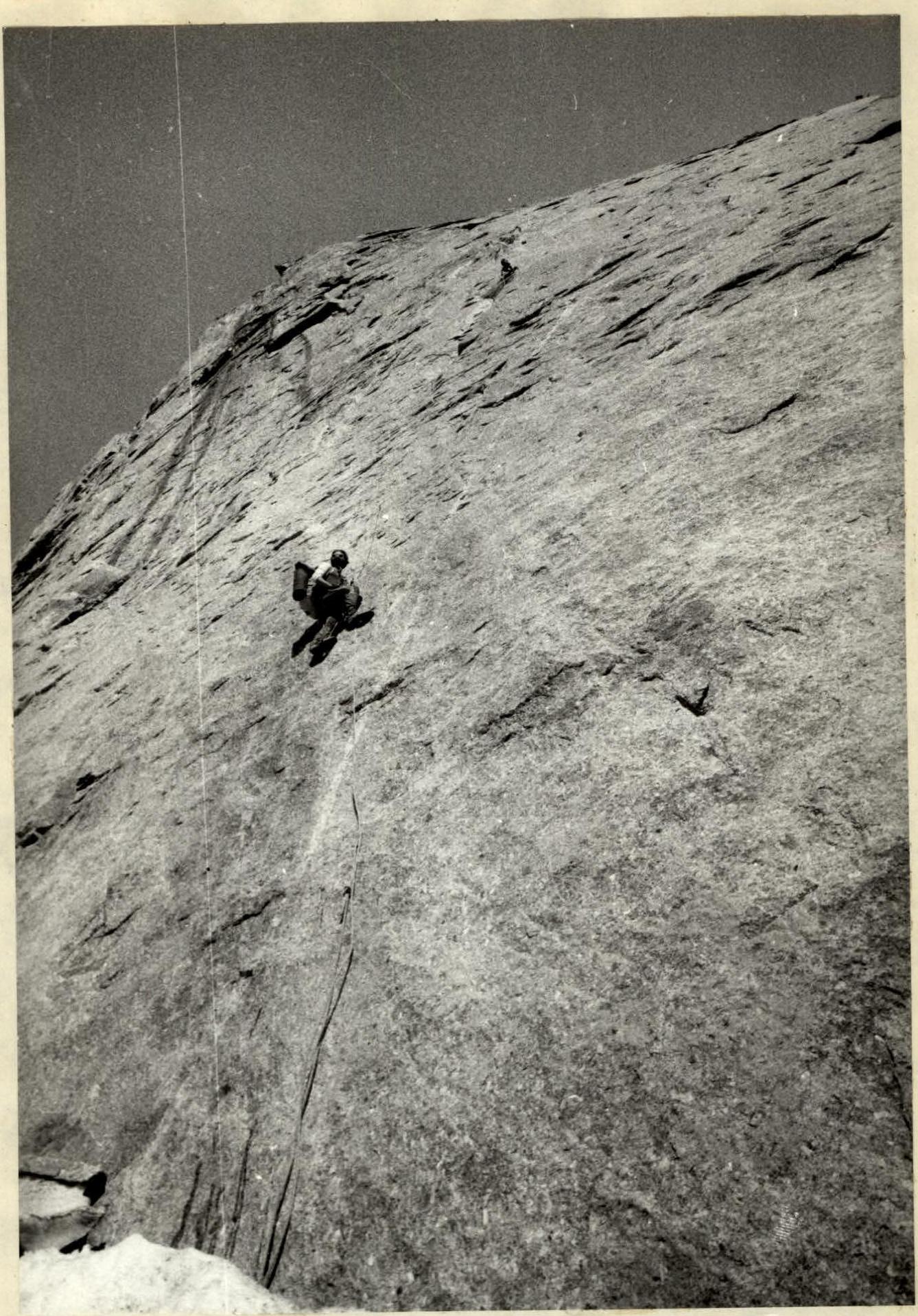
Photo #7. Section R1–R21. The photo was taken on June 19, 1988, at 10:00 from under the start of the route, the water flow is small. Lens — Russar. F = 20 mm.
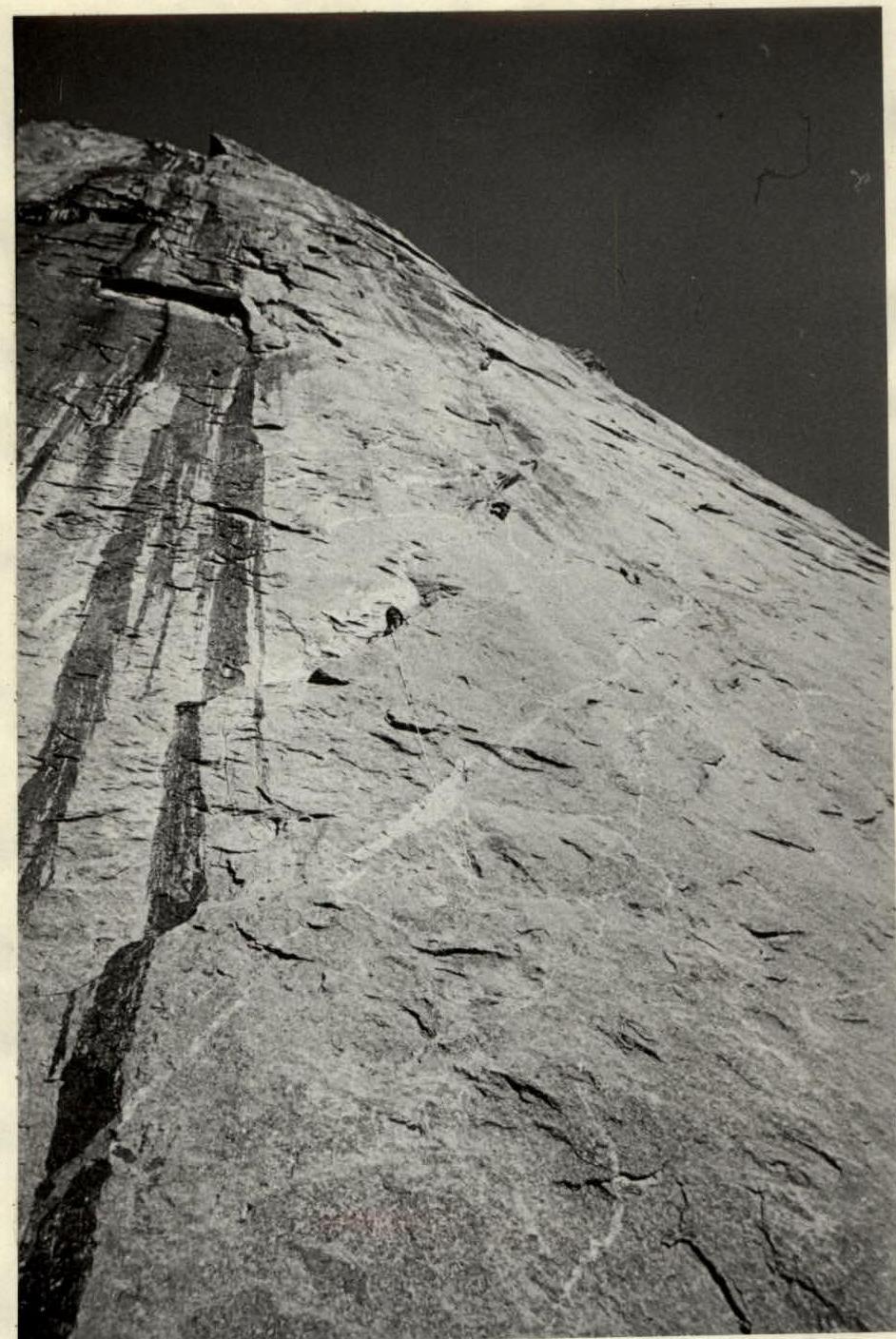
Photo #8. Section R1–R21. The photo was taken on June 19, 1988, at 16:00 from under the route, the water flows cross the start of the route. Lens — Olympus. F = 35 mm.

Comments
Sign in to leave a comment