
Pamir-Alay
- Type — rock.
- Pamir-Alay, Turkestan Range, Ak-Su gorge (upper reaches of the Karavshin river).
- Slesova peak via the center of the North face (Pogorelov's route).
- Category 6B.
- Height difference — 940 m.
Length — 1065 m. Length of sections with category 5–6 difficulty — 960 m. Average steepness of the main part of the route — 79°.
- Number of pitons used:
rock pitons, drilled holes for skyhooks
| 69 | 1+45 * | 268 | 41 |
|---|---|---|---|
| 49 | 44 | 146 |
- Team's climbing time — 34 hours, days — 4.
- Overnight stop — 1 seated bivouac on a rock shelf.
- Team leader — Klenov Alexander Valerievich, Master of Sports (MS) Bruk Mikhail Alexandrovich, MS Borisov Sergey Viktorovich, MS Bugachevsky Igor Borisovich, Candidate for Master of Sports (CMS) Donskikh Mikhail Fedorovich, CMS Solodovnikov Anatoly Petrovich, CMS
- Coach: Honored Coach of the RSFSR Mikhailov Alexander Alexandrovich.
- Departure to the route — July 9, 1991. Summit — July 12, 1991. Return — July 13, 1991.
- Organization — SKA-16, Sverdlovsk, PriUrVO.
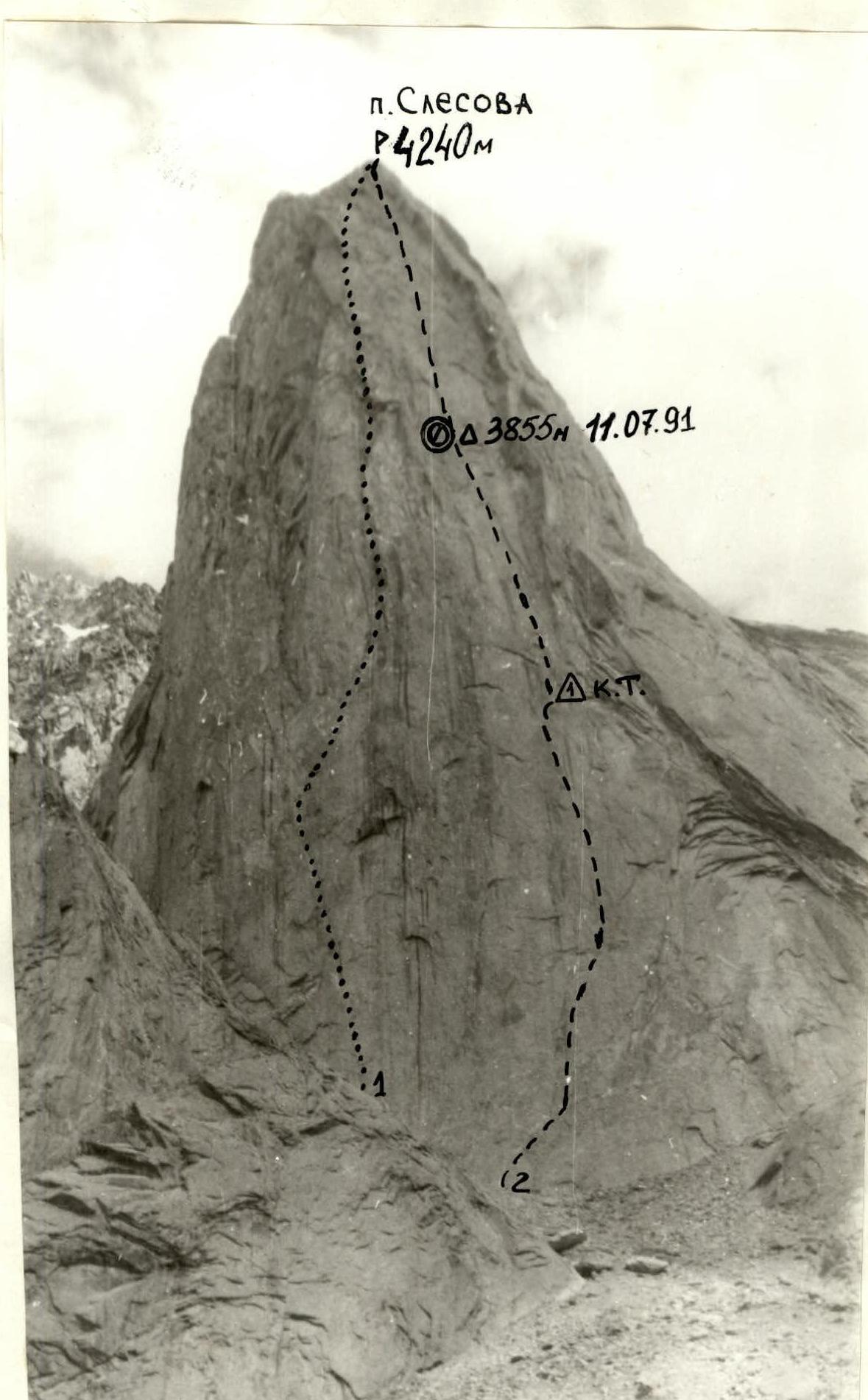
General photo of Slesova peak, July 1991. All photos were taken with a Zenit-E camera, Helios-44-2 lens, distance 1 km.
1 Moroz's route, 2 Pogorelov's route
Tactical Actions of the Team
When drawing up the tactical plan for the ascent, the team relied on the time schedule of the Magnitogorsk team and on the experience of passing rock routes of the 6th category of difficulty in this area. Three days were allocated for the passage of the route according to the main plan. Significant weather deterioration from the first day of processing forced the team to act according to the second version of the tactical plan, which was accurately executed during the ascent.
After two days of processing, the team started the route in full force; they reached the overnight stop and processed two ropes further up. On the fourth day at 20:15 the team reached the summit.
In terms of physical fitness, the team composition is quite even, which allowed each rope team to lead on the route. The first person climbed on a double rope, one of which was marked UIAA, and the second was later used as a handrail. All other participants climbed on a fixed rope with two ascenders and additional (upper or lower) insurance. Backpacks were attached to the harness and carried on themselves. All days the first climber wore rock shoes. For insurance and climbing, the team used the entire arsenal of modern mountaineering equipment:
- friends,
- skyhooks,
- various types of chocks,
- removable drilled and normal rock pitons.
The team started moving along the route from 6:00 to 7:00 am and finished no later than 20:00, ensuring a full rest for the overnight stop. Hot meals were provided in the morning and evening; for the whole day, all team members received high-calorie snacks.
Throughout the ascent, stable radio communication was maintained with observers using the R-147 radio station. Part of the rescue team was under the route. The main rescue team was in the base camp, with which there was reliable communication.

Comments
Sign in to leave a comment