
Passport
- Technical class
- Northern spurs of the Turkestan Range, Kara-Su gorge
- Peak 4810 m, along the right edge of the NW wall
- 6A category of difficulty
- Elevation gain: 950 m. Length: 1080 m.
Length of sections with 5–6 category of difficulty – 820 m. Average steepness of the route: 70°. Average steepness of the wall section: 80°.
-
Number of pitons driven: Rock: 47/28 Bolted anchors: 141/44 Sky hooks: 0/0
-
Team's working hours: 232 hours.
-
Overnight stays:
- 1st — on a ledge
- 2nd — 3rd on a platform, one on a ledge
- 3rd — at the summit, a convenient platform
-
Leader: Sakharov Konstantin Alekseevich — Candidate Master of Sports Vinokurov Anatoliy Filippovich — Master of Sports Komarov Viktor Vasil'evich — Candidate Master of Sports Butov Leonid Viktorovich — 1st sports category
-
Coach: Vinokurov Anatoliy Filippovich, 1st sports category.
-
Start of the route: July 20, 1990. Summit: July 22, 1990. Return: July 23, 1990.
-
Moscow Oblast Sports Committee
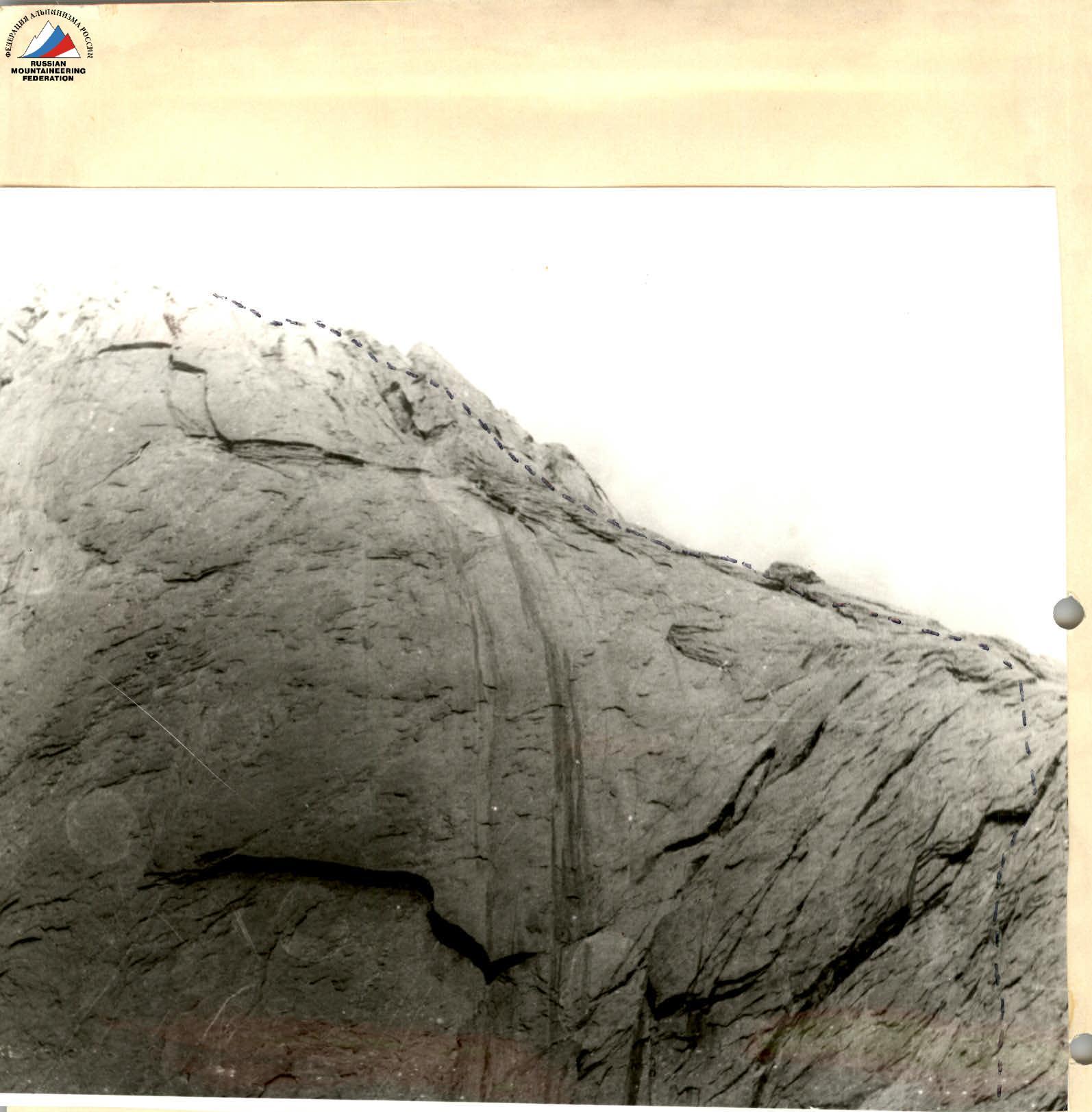
General photo of the summit
Date: July 20, 1990. Time: 15:00. Lens — Shooting point: #1 Routes: Team's route
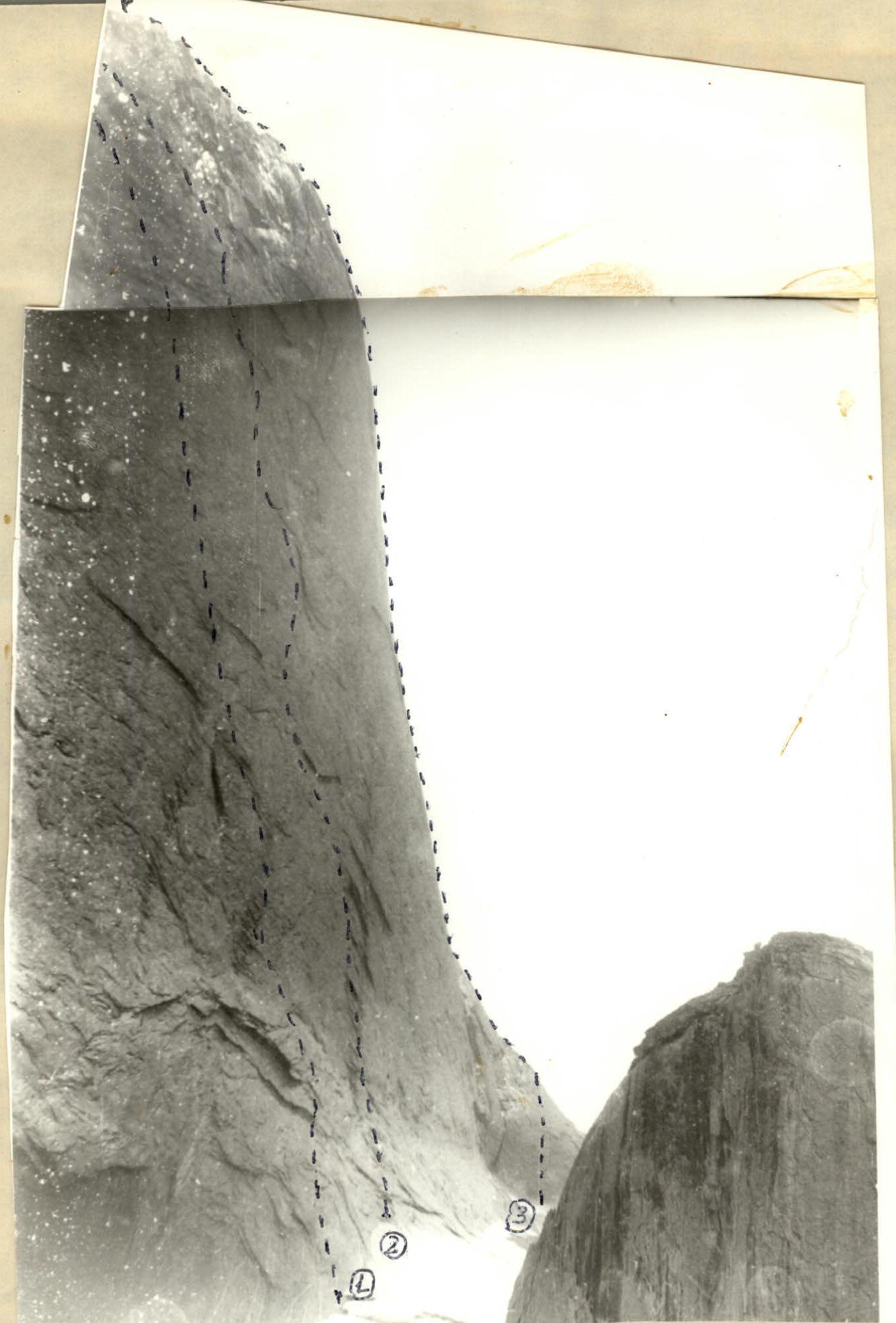
Profile of the wall from the left
Date: July 20, 1990. Time: 13:00. Point: #2. Lens —
- Rusyaev 88
- Solonnikov 88
- Moscow Oblast Sports Committee
Tactical actions of the team
The team based their actions on a tactical plan. The preceding bad weather complicated the passage of the route (especially the upper part) — the rocks were covered with ice and snow. However, there were no deviations from the planned time for the control tour and overnight stays. During the day, each participant worked according to the tactical plan. The first to work on the route were: Komarov V.V. — sections R1–R4, R15–R21 Vinokurov A.F. — R5–R7 Sakharov K.A. — R8–R14 Butov L.A. — R8–R12
Group movement scheme:
- The first worked on a double rope.
- The second, with top rope, brings the rope and straightens the "perils" along the way.
- The third and fourth ascend with top rope.
For safety, belay points were organized on at least three blocked points. The overnight stays were chosen for comfort, lying down — the team had a full rest. Upon arrival at the overnight stay, two organized a bivouac, two worked on processing.
Nutrition regime: Hot meals in the morning and evening, dry rations during the day. Interchangeability of each participant, technical and rock climbing preparation, and even distribution of loads over the days allowed the team to overcome problematic sections without delaying the group. There were no injuries during the ascent.
Communication with the base camp was regular. The rescue team was at the base camp during the ascent, had the appropriate qualifications and equipment to exit onto the given route. The rescue team included a doctor.
Familiarization with the routes of Peak 4810 began with studying the reporting documentation, consulting with the Odessa gathering, and continued with exits to neighboring peaks to visually study sections of the route and clarify overnight stay locations.
Table of food products and fuel
| № | Name | Quantity | Weight | Notes |
|---|---|---|---|---|
| 1. | Crackers | 0.5 | ||
| 2. | Tea | 1 pack | 0.1 | |
| 3. | Biscuits | 0.3 | ||
| 4. | Sugar | 0.8 | ||
| 5. | Smoked sausage | 0.8 | ||
| 6. | Chocolate | 6 bars | 0.6 | |
| 7. | Candies | 0.3 | ||
| 8. | Meat filling (in packets) | 4 | 0.4 | |
| 9. | Buckwheat | 0.4 | ||
| 10. | Potatoes (subl.) | 1.2 | ||
| 11. | Smoked lard | 0.4 | ||
| 12. | Milk (dry) | 0.5 | ||
| 13. | Bouillon cubes | 5 | ||
| 14. | Soup in packets | 4 | 0.3 | |
| 15. | Gasoline | 2.5 | 2.0 | |
| Total: | 9.0 |
Above the second overnight stay, the rocks were covered with snow and ice, so the real difficulty of the sections became one category higher. The scheme indicates the category of difficulty in good weather.
| Section № | Rock pitons | Anchors | Section length | Category of difficulty | Steepness |
|---|---|---|---|---|---|
| 21 | 0 | 0 | 20 m | 2 | 70° |
| 20 | 5 | 0 | 90 m | 5 | 70° |
| 19 | 3 | 0 | 30 m | 3 | 40° |
| 18 | 8 | 3 | 20 m | 5 | 90° |
| 17 | 7 | 0 | 80 m | 5 | 60° |
| 16 | 9 | 8 | 10 m | 6 | 90° |
| 15 | 5 | 0 | 30 m | 5 | 80° |
| 14 | 3 | 0 | 70 m | 5 | 70° |
| 13 | 7 | 2 | 5 m | 6 | 90° |
| 12 | 3 | 0 | 50 m | 4 | 70° |
| 11 | 8 | 3 | 10 m | 6 | 90° |
| 10 | 53 | 2 | 40 m | 5 | 80° |
| 9 | 12 | 6 | 25 m | 6 | 90° |
| 8 | 3 | 0 | 40 m | 4 | 45° |
| 7 | 7 | 0 | 40 m | 5 | 90° |
| 6 | 3 | 2 | 70 m | 4 | 60° |
| 5 | 3 | 7 | 80 m | 5 | 80° |
| 4 | 12 | 0 | 70 m | 5 | 80° |
| 3 | 4 | 0 | 50 m | 4 | 70° |
| 2 | 0 | 0 | 150 m | 2 | 40° |
| 1 | 34 | 3 | 100 m | 5 | 90° |
Description of the route by sections
R1 — slabs with good small holds, "stoppers" go well.
R2 — simple sloping scree shelves, exit to a ledge where a tent can be set up.
R3 — sloping slabs, friction climbing.
R4 — inner corner with rich relief, leading to a wide ledge suitable for overnight stay.
R5 — vertical slab with a small number of holds.
R6 — monolithic large-block relief.
R7 — vertical inner corner with a small number of holds, leading to a ledge for one tent (platform inconvenient for four).
R8 — simple sloping slabs.
The entire path above the second overnight stay is covered with snow and ice, so the real difficulty of the sections became one category higher. However, the description gives the category for good weather.
R9 — vertical slab leading to the right couloir. At the time of passage, it was covered with ice.
R10 — traverse left from the snowy couloir onto icy slabs, bypassing a rock cornice (on ITO).
R11 — after a short vertical chimney, a snowy-icy couloir is crossed.
R12 — due to icy sloping slabs becoming impassable, the route goes through a cornice and an inner corner, leading to a snowy ledge.
R13 — traverse left into a couloir filled with ice.
R14 — through the right part of the couloir, along "ram's foreheads," passage to the vertical right wall (on ITO).
R15 — through the right part of the couloir, along "ram's foreheads," approach to the left wall of the couloir.
R16 — up a vertical crack (difficult climbing) exit under the left cornice (passed by climbing).
R17 — snowy couloir, up to a "ram's forehead."
R18 — further left onto the wall via slabs. Then large-block relief.
R19 — belay from protrusions.
R20 — exit to the summit via broken rocks.
R21 — exit to the summit via broken rocks.
Section R7–R8
Second overnight stay.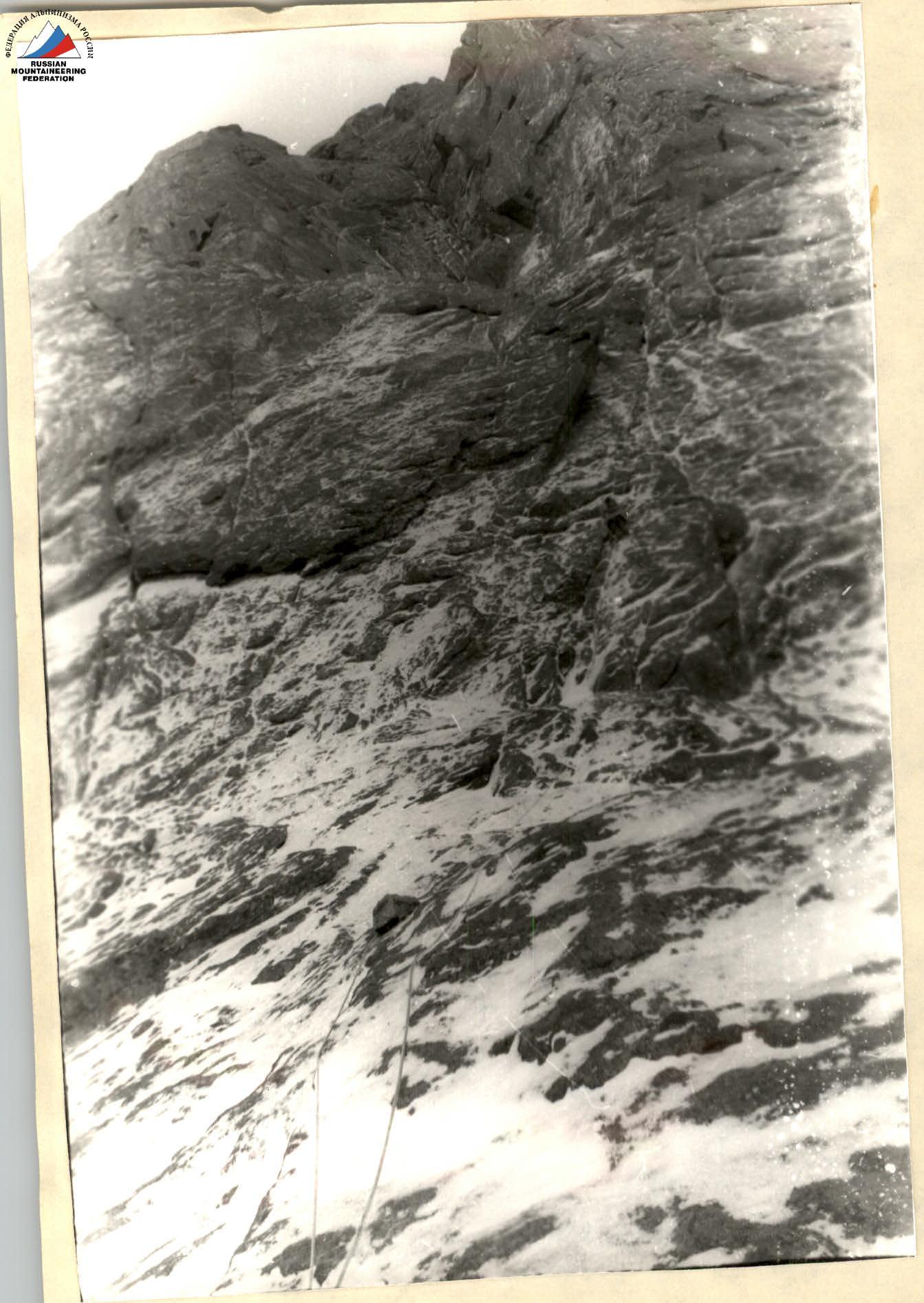
View of sections R9–R11 After bad weather: R10 chimney at the top.

Comments
Sign in to leave a comment