
Ascent Passport
-
Traverse class.
-
Pamir-Alay, Turkestan Ridge, Karavshin river basin.
-
Peak 4507 m, 1000th Anniversary of Baptism of Rus via SE wall, 6A cat. diff. (3rd ascent); peak 4300 m via NE edge, 5A cat. diff. (approximately, first ascent); peak 4810 m via N wall, 6A cat. diff. (approximately, first ascent).
-
Proposed category complexity: 6B cat. diff.
-
Route characteristics:
length 4016 m, ascent — 2608 m, descent — 1498 m. average traverse length — 4116 m. length of sections with V cat. diff. — 565 m, VI cat. diff. — 813 m.
-
Pitons driven:
| rock | nuts | bolt. | ice |
|---|---|---|---|
| 57 | 355 | 0 | 1 |
| 2 | 19 | 0 | 0 |
-
Team's total climbing hours: 61, ascent — 43, descent — 18, duration — 8 days.
-
Overnight stays: lying, sitting, shared and separate.
-
Leader: Kotelnikov A.I. — MS
Participants: An P.V. — MS Bukreev V.V. — MS Zaikin A.A. — CMS Kolabushkin V.A. — CMS Selyaev V.V. — MS
Coaches: Shabanov A.V. Kudakaev T.Z.
-
Departure to the route — July 12, 1992.
-
Return to base camp — July 20, 1992.
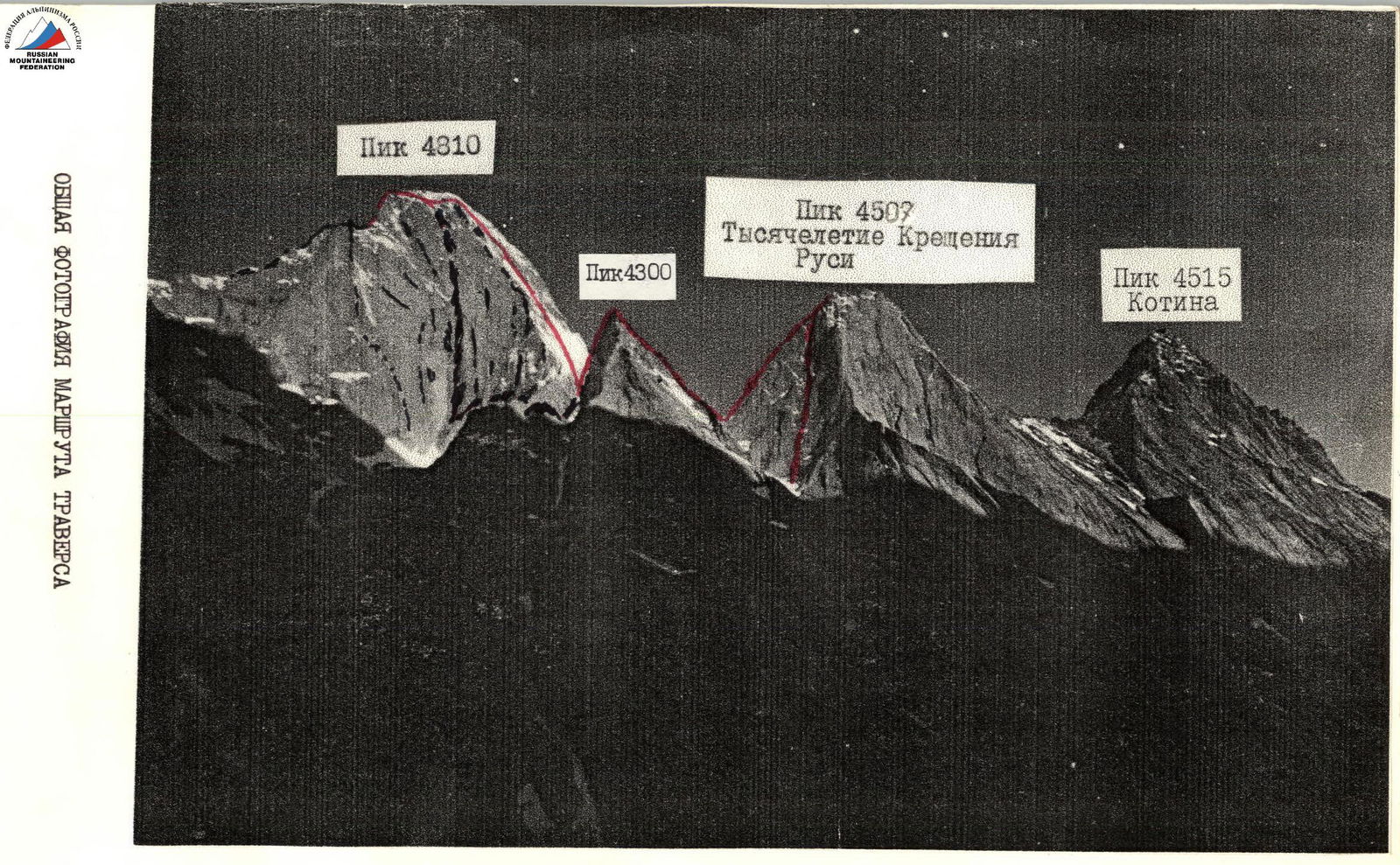
GENERAL PHOTO OF THE ROUTE
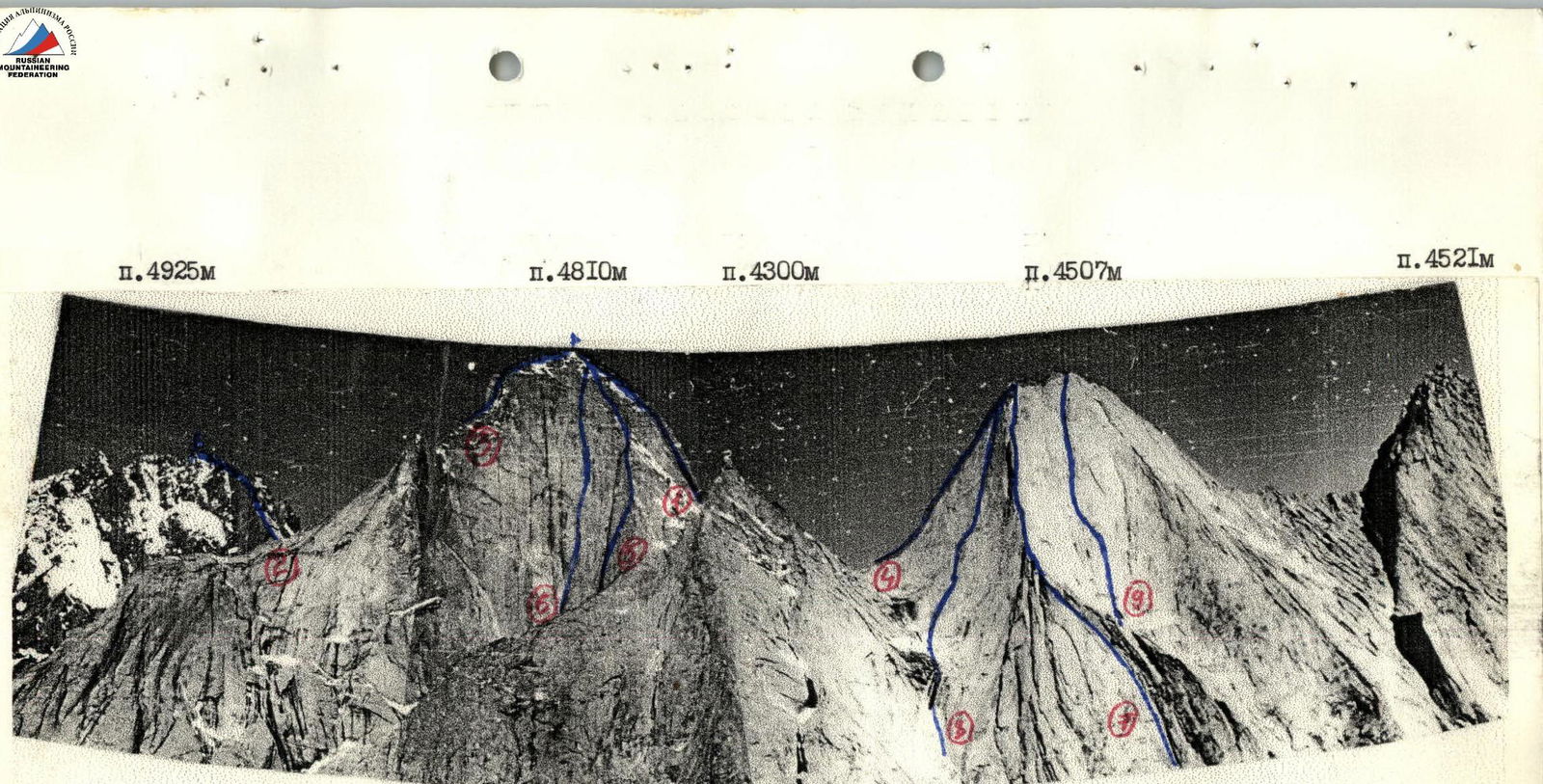
PHOTO PANORAMA OF THE ASCENT AREA
- Team of sports club "Odessa", 1986.
- Team of sports club "Gornik", Leningrad, 1988.
- Team of sports club "Vysota", Leningrad, 1988.
- Team from Dnepropetrovsk, 1988.
- Team of sports club "Vysota" via E face of peak 4810 m, 1989.
- Team of sports club "Odessa", 1989.
- Team of sports club "Vysota", 1991.
- Team of sports club from Moscow, 1989.
- Team of sports club RSCAAS, Uzbekistan, 1992.
PROTOCOL
of the ascent made by the team of the Republic of Uzbekistan, participating in the CIS Alpine Championship in the traverse class on the peaks: 4507 m, 1000th Anniversary of Baptism of Rus via SE wall, 6A cat. diff. (third ascent); peak 4300 m via NE edge, 5A cat. diff. (approximately, first ascent); peak 4810 m via N wall, 6A cat. diff. (approximately, first ascent). The overall traverse route, completed by the team from July 12 to July 19, 1992, is approximately 6B cat. diff.
Team Composition
| Kotelnikov A.I. | MS | leader |
|---|---|---|
| An P.V. | MS | member |
| Bukreev V.V. | MS | --//-- |
| Zaikin A.A. | CMS | --//-- |
| Kolabushkin V.A. | CMS | --//-- |
| Selyaev V.V. | MS | --//-- |
The debriefing is conducted by releasing coach T.Z. Kudakaev. Present: gathering leader O.E. Grigoriev, head of the rescue team N.M. Solovtsov, members of the rescue team, and gathering participants.
Speeches
Kotelnikov A.I. This ascent was preceded by thorough preparation. This area is technically the most challenging in the CIS: sheer walls about a kilometer long, an abundance of extended sections of the highest category of complexity, dehydrated routes, and unstable climatic conditions.
Having studied the route theoretically and visually, the team concluded that they could complete the route in 7 working days. However, considering the sharp change in weather conditions, they were prepared for a 9–10-day ascent.
The tactical plan was structured as follows:
July 12 — departure from base camp, approach to the route, work on the route until the ledge where Ginzburg's team had their second overnight stay. The first rope team to work is Kolabushkin–Kotelnikov.
July 13 — ascent to Ginzburg's 4th overnight stay and further processing of the route along the нависающей расщелине until the cornice. Processing was required due to the absence of suitable overnight stay locations above this section. The first rope team to work is Kotelnikov–Bukreev.
July 14 — ascent to the summit of 1000th Anniversary of Baptism of Rus. The first rope team to work is An–Selyaev. July 15 — descent to the saddle between peak 4507 m and peak 4300 m via a 5B cat. diff. route. July 16 — ascent to peak 4300 m and descent to the saddle between 4300 m and 4810 m. The first rope team to work is Selyaev–An. July 17 — ascent to peak 4810 m. The first rope team to work is Zaikin–Bukreev. July 18 — descent to base camp. July 19–20 — reserve days.
The tactical plan was largely executed during the ascent. The only changes were due to bad weather, which they had to wait out after descending from the summit of 1000th Anniversary of Baptism of Rus. Rain and snowfall continued without interruption for more than two days: from the afternoon of July 14 to the evening of July 16.
Day I — July 12. The team departed from base camp at 5:00. The approach to the wall took 8 hours and 30 minutes due to encountering rock sections of IV–V cat. diff. totaling about 200 m along the way. They began working on the wall at 14:00. The terrain that day consisted of smooth rocks with some slabs, internal corners. They covered 200 m that day and processed 130 m of the route above the overnight stay. They set up a platform. The overnight stay was comfortable, lying down, with access to water.
Day II — July 13. They started working on the route at 7:30. They passed the previously fixed ropes and continued along a vaguely defined edge, with steepness reaching 90° in some places. They reached the overnight stay location. The second rope team continued working further while the rest prepared the platform. The further route consisted of a sheer wall transitioning into a нависающая щель. The terrain was challenging. Climbing was of the highest category of complexity — ITO, skyhooks. By evening, they processed 100 m above the overnight stay.
Day III — July 14. They started at 7:00, passed the fixed ropes. An worked first. After two sections of difficult climbing, the terrain eased, and they reached the summit at 10:00. They didn't linger, as the weather was deteriorating. On the descent, after the first ropes, it started raining. The descent was complex along a sharp ridge (5B cat. diff. route) with a transition across the ridge. Besides the wet rocks, the descent was complicated by descending fog. They reached the saddle by 19:00, soaked to the bone. The overnight stay was sitting.
Day IV — July 15. The rain didn't stop. They decided to descend further. Two ropes below the saddle, there was a large debris ledge. They set up a comfortable platform, pitched a tent. They sat, waiting for the weather to improve. Snow started falling in the evening and continued until morning.
Day V — July 16. The rain continued. They tried to work but found that the rocks were covered in wet lichen and didn't hold at all. They were also snow-covered. They had to return and wait. By evening, the rain stopped. At night, they could even see stars.
Day VI — July 17. They started at 7:00. The route, although simpler than the one to 1000th Anniversary, had slippery, moss-covered rocks. Climbing was difficult. As the sun rose, the snow began to melt, and they had to navigate between streams and, in some places, through water. Selyaev Viktor worked first, climbing reliably and relatively quickly. They reached the summit at 14:00. Since it was a first ascent, there was no existing summit marker; they built their own. They descended to the saddle by 17:00. They were very tired that day and decided not to work further, especially since all their gear was wet. They set up a platform and dried their clothes.
Day VII — July 18. They started as usual, at 7:00. The beginning was to the left of the saddle, about 100 m. They climbed rock sections of VI–V cat. diff. to approach a large 200 m slab. Kotelnikov A. – Kolabushkin V. worked first. They mostly used bridging techniques. The slab ended in a cornice, which they passed on the right side. Climbing was V–VI cat. diff. It led to a small edge where they could set up an overnight stay. They decided to stop for the night as they couldn't see any further suitable locations, and they prepared the platform. The second rope team worked further. The route consisted of smooth walls with cracks. In some places, they had to use ITO.
Day VIII — July 19. This time, they departed at 6:00. They were eager to complete the route and descend. Zaikin worked first. He climbed complex sections very confidently. They reached the summit at 15:00. After a 30-minute rest, they began descending towards peak Lomo (4750 m). They made 15 rappels and reached the saddle by dusk. The platform was comfortable, lying down.
On the morning of July 20, they gathered their gear and began their leisurely descent to the camp. They arrived at the base camp at 14:00.
Thus, they largely followed their planned route. The route they completed was characterized by numerous highly complex sections; it was logical, interesting, safe, and of the highest category of complexity, consisting of:
- The third ascent of Ginzburg's route to 1000th Anniversary of Baptism of Rus, 6A cat. diff.
- The first ascent to peak 4300 m via a route of approximately 5A cat. diff., although it seemed more challenging than 5B cat. diff. routes after the bad weather.
- The first ascent to peak 4810 m via the N wall, 6A cat. diff. approximately.
All team members performed positively. They worked reliably and quickly on the route, maintaining a good psychological climate, which is crucial for such a complex and prolonged ascent. Such a team is capable of tackling technical routes of any category of complexity.
Bukreev V. The route is indeed very serious, diverse in technical requirements. The steepness and complexity required working on a double rope, which they did throughout the route. The route was further complicated by the scarcity of drinking water on the wall. When planning their tactical approach, they took this into account and stocked up on water in advance. The route turned out to be very interesting, logical, and safe. Having climbed in this area before, although not on traverses of such complexity, I can compare it to Timofeev's 6B route on Асан, but the length of complex sections here is twice as long. Additionally, the descents from the peaks were complex. The team's work was satisfying, and I derived immense pleasure from the ascent.
An P. I would like to note that the team began preparing for the ascent well in advance. During training, they practiced coordination and tested various tactical ascent schemes depending on weather conditions and route complexity. All participants were well aware of their roles and executed them clearly. The workload on team members was evenly distributed; each participant worked as both the first and last on the rope. The serious attitude of all participants enabled the team to complete the route in good style and, most importantly, safely, with a significant reserve of strength and resilience. The team was pleasant, friendly, and attentive — the kind of team suited for routes of the highest category. Therefore, the set goal was achieved. Like the previous speakers, I believe the route corresponds to the highest category.
Selyaev V. I concur with the technical characterization of the route provided by the previous speakers; the route is interesting and complex. I want to emphasize that the preparation for the ascent was thorough, allowing each member to work at a good pace in any position within the group, ensuring full interchangeability without compromising the speed of progression. All belay points were organized competently and reliably, despite the fatigue towards the end of the ascent. The route remained demanding throughout, quite steep, so most belay stations were hanging. Despite the difficulties, the team maintained a productive atmosphere and complete mutual understanding.
Zaikin A. The rapid completion of the route was largely facilitated by the correct selection of equipment, both domestic and foreign: latest model friends, adjustable nuts "PIRIN", "MAMMUT" ropes — very elastic and strong, clips, lightweight titanium and aluminum carabiners, and a wide range of pitons. The good selection of food products, very lightweight and high-calorie, also contributed. Therefore, the backpacks were not too heavy at the start, allowing them to maintain a good pace.
Kolabushkin V. I would like to highlight the high technical and physical preparedness of the team. All participants were capable of working effectively as the first on the rope. They were ready for the wall ascent. For convenience during belaying, they used a lightweight platform. They had sufficient equipment in a variety of types, allowing them to organize belay points without issues. The route is good because it is a climbing route with no bolted sections. It's extremely steep and complex but climbable. In some places, the first on the rope had to use skyhooks. I believe this route is of the highest category of complexity, i.e., 6B cat. diff.
Solovtsov N.M. How did the two-day bad weather affect the team's psychological climate?
Kotelnikov A. As mentioned, the team was morally strong. They calmly waited out the bad weather. Routes like this aren't climbed in bad weather. They had enough supplies and fuel, so there was no cause for concern.
Grigoriev O. How was the situation with water on the route?
Bukreev V. Water issues arise primarily during the ascent to 1000th Anniversary of Baptism of Rus. However, it's possible to plan the ascent in a way that mitigates these issues. They had water at their bivouacs.
Solovtsov N.M. How many belay points were organized on the route?
Kotelnikov A. Approximately 450 belay points. Mostly nuts and friends. The ratio of nuts to pitons is roughly 7:1.
Kudakaev T. What is the length of the route?
An P. V cat. diff. — about 600 m. VI cat. diff. — 800 m.
Grigoriev O. How many climbing hours did the ascent take?
Kotelnikov A. The ascent took 43 hours, descents — 18 hours.
Releasing coach T.Z. Kudakaev's conclusion: The team prepared very seriously for the ascent and completed it successfully. The route was traversed competently and in good style. All participants were well-prepared for complex, prolonged wall climbs. The team's leadership was competent. The ascent was conducted in accordance with the "Rules" and regulations of alpine competitions. The leadership and participation are acknowledged. The route is recommended for credit in the CIS Championship in the traverse class.
Releasing secretary — judge T.Z. Kudakaev, U.N. Baskakova

Comments
Sign in to leave a comment