
- Climb category — technical
- Climb area — Pamir-Alay, Turkestan Range
- Goryak Peak (5013 m) — via the Center of the NE wall. KTMG category 5.4.
- Proposed complexity category — 6B, First ascent
- Height difference — 1123 m, including: wall — 1060 m. Length — 1257 m. Length of sections with 5–6 category complexity — 1167 m, including: 6 category complexity — 887 m (3955–3965, 3975–4070, 4115–4205, 4220–4430, 4460–4500, 4590–4650, 4675–4930, 4970–5005) Average steepness of the route — 75°, including: wall — 78°
- Pitons used:
| Rock | Chocks | Bolts | Ice screws |
|---|---|---|---|
| 149+5ˣ | 164 | 10+3ˣ | 25 |
| 42 | 22 | 3 | 0 |
- Team's total climbing hours — 38.5 days
- Overnights: 1st — separate, sitting (1+4) 2nd — separate, sitting (1+1+3) 3rd — in a tent, semi-sitting
- Team of the Committee for Physical Culture and Sports under the St. Petersburg City Administration (MP "Alp-Poisk")
- Leader — Sidorov Dmitry Valerievich — CMS
Participants:
- Bernatsky Sergey Igorevich — CMS
- Grigoriev Mikhail Gennadievich — CMS
- Klimentiev Dmitry Alekseevich — CMS
- Kirgirin Valery Anatolievich — CMS
- Coach — Honored Master of Sports of the USSR Glushko Vyacheslav Ivanovich
- Start of the climb — July 31, 1992 Summit — August 4, 1992 Return — August 4, 1992
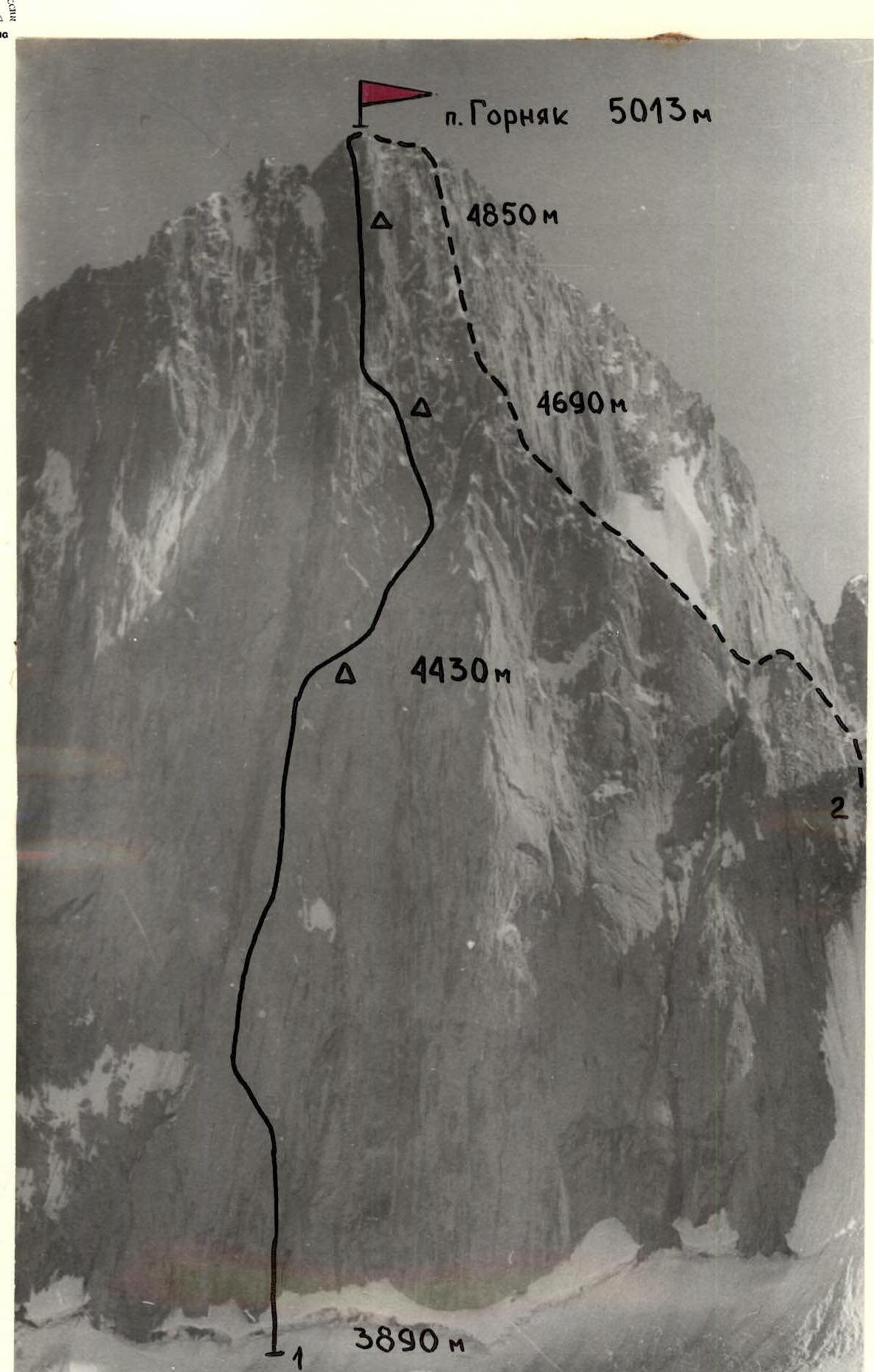
Photo — 1. Date taken — July 31, 1992. Lens — Industar 61L/3.
Distance — 1.5 km. Shooting height — 4000 m. Shot number — 1.
1 — route of the Committee for Physical Culture and Sports team under the St. Petersburg City Administration via the Center of the NE wall, 6B category complexity (Sidorov 1992)
2 — route via the right edge of the NE wall, 5B category complexity (Lenivkova 1992)
 www.alpfederation.ru↗
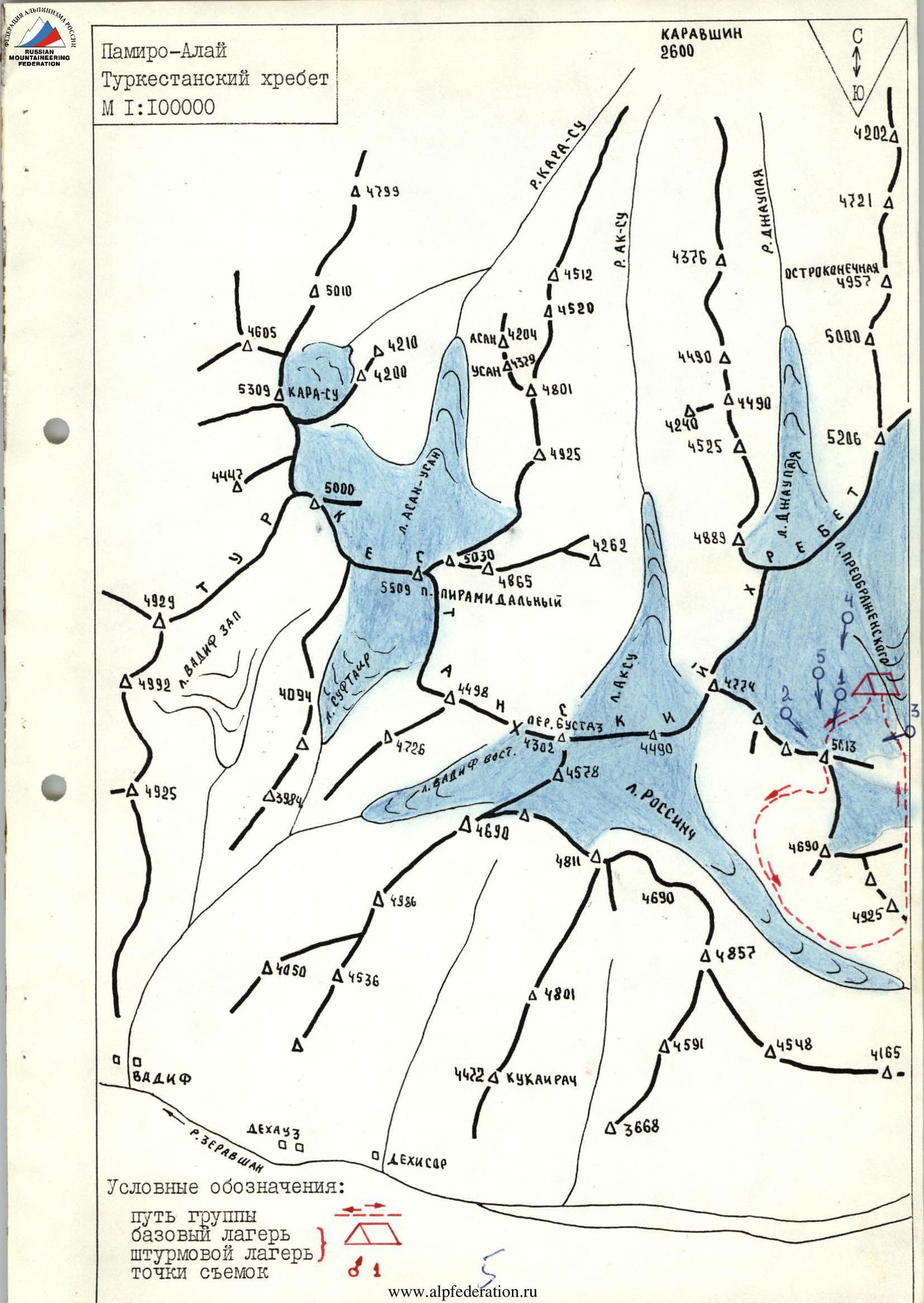
PHOTO PANORAMA OF THE AREA
www.alpfederation.ru↗
PHOTO PANORAMA OF THE AREA

Photo — 4. Date taken — August 1, 1992. Lens — Industar 61L/3. Distance — 3 km. Shooting height — 4300 m. Shot number — 4.
- Route via the Center of the NE wall, 6B category complexity (Sidorov 1992)
- Route via the right edge of the N wall, 5B category complexity (Lenivkova 1990)
Tactical Actions of the Team
The results of the reconnaissance and study of photographic materials formed the basis for drawing up a tactical plan. It was planned to ascend the route with 3 overnight stays during the ascent, one day for processing, and one reserve day for bad weather. The team fully implemented their plan. The route was completed from July 31 to August 4, 1992, in 38 climbing hours. The descent from the summit took 8 hours.
Team composition: Sidorov D.V. — CMS, captain; Bernatsky S.I. — CMS; Grigoriev M.G. — CMS; Klimentiev D.A. — CMS; Kirgirin V.A. — CMS.
The movement of the rope team was organized as follows:
- The lead climber worked without a backpack on a double rope (UIAA+USSR), setting up fixed ropes;
- The rest of the team members ascended on the fixed rope using jumar or petsel devices;
- The second climber ascended with a lightened backpack, carrying crampons, a first-aid kit, and a thermos, straightening and dividing the fixed ropes;
- The 5th and 4th participants carried the main weight of the equipment taken on the climb;
- The 5th participant worked with a lightened backpack, "cleaning" the route.
According to the plan, the lead climber worked first throughout the day; in case of fatigue or change in terrain, they were replaced by the 2nd climber. The leaders changed every day.
The use of high individual climbing skills and modern mountaineering equipment (chocks, friends of various modifications, rock and bolt pitons, etc.) allowed minimizing the use of artificial technical means (IT). Belay points along the entire route were mostly inconvenient, semi-suspended, organized on 3 elements linked by sling loops.
Preliminary observation of the wall and study of rockfall and avalanche traces allowed identifying and planning the safest places for overnight stays on sections 20, 22, 31, 32, 39, 45, 51, 53, 59.
Three overnight stays were implemented on sections 31, 45, 53.
The ascent schedule was as follows:
-
July 31: Processing the route by the trio Sidorov–Kirgirin–Klimentiev. Task of the day — reaching the top of the bastion of the NE wall. Problems and solutions:
-
- Overcoming the bergschrund and snow cornice on sections 1–2. Solution: movement in crampons with an ice axe and ice hammer, piolet anchor.
-
- Passing the lower belt of cornices on sections 5, 8–10, 15, 18. Solution: using individual technique, experience, and necessary equipment.
From 10:00 to 17:15, 330 m were covered, including 6 pitches of the wall, with the lower ones being very difficult. Descent to rest in the base camp.
-
-
August 1: Departure at 8:15. Task of the day — reaching a safe overnight location on sections 31–32, setting up a bivouac. Problems and solutions:
- Passing the "mirror" of the NE wall (about 100 m/sections 22–28/). Solution: passing the "mirror" with limit free climbing, alternating with work on skyhooks.
The lead rope team Kirgirin–Bernatsky solved the problem by 19:00 and processed 30 m of fixed ropes from the overnight stay. The overnight stay was uncomfortable, separate, and sitting.
-
August 2: Started work at 8:15. Main task of the day — reaching the huge cornice — the "bow of the ship" at the base of the summit tower. Problems and solutions:
- Passing a series of very steep ice streams-gullies. Solution: movement in crampons with a hammer and ice axe, belay through ice screws and rock pitons in the gully sides.
The Bernatsky–Sidorov rope team reached the beginning of the ice sections 40–46 by 12:00. After a hot lunch and changing the lead, the team reached the 2nd overnight stay on section 45 by 18:00. The overnight stay was safe under a cornice, sitting, and separate. 30 m were processed from the overnight stay.
-
August 3: Started work at 9:00. Weather deteriorating: warm, cirrus clouds, gusty wind. By 11:30, the weather sharply worsened — fog, snow, visibility about 30 m. Task of the day — reaching the overnight stay at the base of the rock spire. Problems and solutions:
-
- Bad weather, wet and snowy rocks.
-
- Poor visibility and difficulty orienting in bad weather. Solution — extreme caution during movement, possibility to contact the base every hour and receive necessary advice.
The Kirgirin–Sidorov rope team reached the planned overnight stay by 16:00, having passed 4 pitches. Further processing of 2 pitches was done. The overnight stay was in a tent, semi-sitting. The bad weather continued throughout the night.
-
-
August 4: Started work at 10:00. No weather. Visibility mostly less than 30 m, wet snow falling. Task of the day — reaching the summit and descending to the base camp. Problems and solutions:
-
- Passing the ice gully in the upper part of the summit tower.
-
- Lack of landmarks, scales. Solution: using ice equipment, observations, photographic materials, intuition, based on extensive climbing experience.
As a result, the Sidorov–Kirgirin rope team, having passed 1 pitch!

-
| Section | Length (m) | Steepness (deg) | Category complexity | Pitons (rock) | Chocks | Bolts | Ice screws |
|---|---|---|---|---|---|---|---|
| R0 | 80 | 45 | III | – | – | – | 5 |
| R1 | 10 | 85 | VI | 1 | 10 | – | – |
| R2 | 15 | 50 | V | 3 | 2 | – | – |
| R3 | 3 | 95 | VI | 3 | 1 | – | – |
| R4 | 10 | 90 | VIA1 | 2 | 9 | 1+1 | – |
| R5 | 20 | 95 | VIA2 | 2/2 | 1 | – | – |
| R6 | 15 | 90 | VIA2 | 4/3 | 3 | – | – |
| R7 | 45 | 80–85 | VIe | 1/1 | 2 | – | – |
| R8 | 8 | 95 | VIA1 | 3/3 | 1 | – | – |
| R9 | 20 | 85 | VI | 1 | 5 | – | – |
| R10 | 3 | 95 | VI | 3 | 1 | – | – |
| R11 | 15 | 80 | V+ | 2 | 3 | – | – |
| R12 | 30 | 80–85 | V+ | 1 | 6 | – | – |
| R13 | 15 | 85 | VI | 3 | 2 | – | – |
| R14 | 30 | 90 | VIA1 | 6/2 | 2 | – | – |
| R15 | 5 | 95 | VI | 1 | 2 | – | – |
| R16 | 10 | 85 | VI | 4 | 2 | – | – |
| R17 | 20 | 80 | VI | 2/2 | 2 | – | – |
| R18 | 3 | 95 | VIA1 | 2 | 4 | – | – |
| R19 | 20 | 70 | V+ | 2 | 4 | – | – |
| R20 | 15 | 80 | VI | 6 | 3 | 1 | – |
| R21 | 30 | 80 | VI | 4/2 | 1 | – | – |
| R22 | 20 | 85 | VIA1 | 3 | 3 | – | – |
| R23 | 15 | 90 | VI | – | – | – | – |
| R24 | 10 | 80 | VI | – | – | – | – |
| R25 | 40 | 75–80 | VIA2 | 6+2/2 | 4 | 1+1 | – |
| R26 | 5 | 90 | VIA1 | 1/3 | 1/1 | – | – |
| R27 | 40 | 75–80 | VIA1 | 2+2/2 | 6/1 | – | – |
| R28 | 5 | 95 | VIA2 | 2/2 | 4/2 | – | – |
| R29 | 25 | 80 | VI | – | 6 | – | – |
| R30 | 20 | 75 | VI | – | 2 | – | – |
| R31 | 10 | 70 | V+ | 1 | 3 | 1ˣ | – |
| R32 | 30 | 70 | VIA1 | – | 4 | – | – |
| R33 | 20 | 80 | VI | 2 | 1 | – | – |
| R34 | 5 | 95 | VIA1 | 3 | 6 | – | – |
| R35 | 15 | 80 | VI | 5 | – | – | 5 |
| R36 | 10 | 85 | VIA1 | 6 | – | – | 4 |
| R37 | 20 | 75 | V+ | 3/2 | – | – | – |
| R38 | 10 | 80 | V+ | 1 | 10/8 | – | – |
| R39 | 40 | 85–90 | V+ | 4 | 1 | – | 3 |
| R40 | 45 | 65 | V+ | 2/1 | 2/1 | – | 1 |
| R41 | 40 | 70 | VI | 1 | 4 | – | – |
| R42 | 5 | 95 | VIA | 5/2 | 3 | 1 | – |
| R43 | 15 | 90 | VIA2 | – | – | – | – |
| R44 | 30 | 60–70 | V+ | – | – | – | – |
| R45 | 15 | 85–95 | VI | – | – | – | – |
| R46 | 20 | 80 | VI | – | – | – | – |
| R47 | 30 | 70 | VIA1e | – | – | – | – |
| R48 | 45 | 80–90 | VIA2e | 9/2 | 4/2 | 2 | – |
| R49 | 15 | 85 | VIA1 | 3/1 | 2 | – | – |
| R50 | 30 | 70 | VIA1e | 2/1 | 4 | 1/1 | – |
| R51 | 25 | 80 | VI | – | – | – | – |
| R52 | 20 | 85 | VIA1e | – | 4 | – | – |
| R53 | 45 | 75 | VIA1e | 8/3 | 8/4 | 1/1 | – |
| R54 | 25 | 90 | VIA1 | 4/3 | 2 | 2 | – |
| R55 | 10 | 80 | V+ | – | 2 | – | – |
| R56 | 40 | 45–55 | V+ | 3/2 | 4/1 | – | – |
| R57 | 40 | 60–70 | VI | 5 | 1 | – | 3 |
| R58 | 10 | 15 | III | 1 | – | – | – |
| R59 | – | – | – | – | – | – | – |
TOTAL: The route was completed in 38 climbing hours.
Description of the Route by Sections
Section R0–R1. The route begins on a snow-ice slope, traversed in "3 beats". 80 m, 45°, III category complexity.
Section R1–R2. Overcoming the bergschrund is done by climbing vertical ice, with piton protection. 10 m, 85°, VI category complexity.
Section R2–R3. A snow cornice of dense compacted snow. 3 m, 95°, 6 category complexity.
Section R3–R4. A snow-ice slope leading to the start of the wall section. Belay point on a ledge. 15 m, 50°, V category complexity.
Section R4–R5. From a narrow ledge, ascent vertically up the wall with a crack. 10 m, 90°, 6 category complexity.
Section R5–R6. From the wall, move right into an internal overhanging corner, then an overhanging chimney. Climbing is extreme with the use of IT. 20 m, 95°, 6 category complexity.
Section R6–R7. Exit through a cornice to the left onto the wall. Belay point on rock pitons, hanging. 15 m, 90°, 6 category complexity.
Section R7–R8. Ascent to the right of an overhanging oblique flake via a series of walls. Climbing is extremely difficult. Belay point on a foreign bolt and chocks. 45 m, 80–85°, VIe.
Section R8–R9. Through an overhang (piton nos. 4–5), exit into a vertical internal corner. 8 m, 95°, VIA1.
Section R9–R10. Internal corner (partially covered with rime ice, huge icicles hanging), transitioning into an overhanging chimney. Large chocks, friends, and hexes are used. 20 m, 85°, VI.
Section R10–R11. Transition through a cornice closing the chimney. To exit, it is necessary to chop off ice icicles. 3 m, 95°, VI.
Section R11–R12. A relatively gentle internal corner leading left and up to a narrow ledge. Belay point on a ledge. 15 m, 80°, V+.
Section R12–R13. Traverse left with a slight gain in height to the base of a giant flake. A foreign station was used for a pendulum. 30 m, 80–85°, V+.
Section R13–R14. Complex free climbing on the left wall of the flake. Belay point hanging. 15 m, 85°, VI.
Section R14–R15. Transition to the right wall of the flake and up steep monolithic walls. 30 m, 90°, VIA1.
Section R15–R16. Exit to the edge of the flake through an overhang. 5 m, 95°, VI.
Section R16–R17. Steep wall with small holds. Climbing is extreme, free, with a hanging belay point. 10 m, 85°, VI.
Section R17–R18. Vertical wall with a crack in the upper part. Bent pitons — channels are used. 20 m, 80°, VI.
Section R18–R19. Through a cornice, move left to a narrow ledge. 3 m, 95°, VIA1.
Section R19–R20. System of inclined slabs and ledges covered with ice. Very wet. Exit to the bastion on a 1.5 m × 1 m ledge. Belay point on a ledge. End of processing. 20 m, 70°, V+.
Section R20–R21. Complex internal corner with a crack. Belay through medium-sized chocks. 15 m, 80°, 6 category complexity.
Section R21–R22. Steep wall with small holds. Thin pitons are used. In the upper part, a ledge. Station on an old bolt and pitons. Control cairn. 30 m, 80°, 6 category complexity.
Section R22–R23. Smooth wall with a crack, partially traversed on IT. 20 m, 85°, VIA1.
Section R23–R24. Vertical wall with micro-relief. Belay through petals and stoppers of the first numbers. 15 m, 90°, 6 category complexity.
Section R24–R25. The wall becomes slightly gentler and leads to the base of a giant internal corner. 10 m, 80°, VI.
Section R25–R26. The left wall of the "open book I" is traversed using IT through small deep cracks. Petal pitons and axe-pitons are used. 40 m, 75–80°, VIA2.
Section R26–R27. On the wall, a small G-shaped crack appears. Traversed on IT. Belay point hanging on pitons. 5 m, 90°, VIA1.
Section R27–R28. Wall under the right edge of "open book I", transitioning into an overhang. Extreme climbing. 40 m, 75–80°, VIA1.
Section R28–R29. Overcome the overhang to the right. Narrow ledges are available. 5 m, 95°, VIA2.
Section R29–R30. Internal corner composed of blocks. 25 m, 80°, VI.
Section R30–R31. The wall becomes slightly gentler, but climbing does not become easier. Internal corner with ice and icicles. Overnight spot for 1 person. 20 m, 75°, VI.
Section R31–R32. Internal corner leading to a system of ledges. 1st overnight stay. 10 m, 70°, V+.
Section R32–R33. Traverse right without gaining height, bypassing the cornice belt. 30 m, 70°, VIA1.
Section R33–R34. Wall with an overhang at the top. Rocks are monolithic, pleasant complex climbing. 20 m, 80°, VI.
Section R34–R35. Through an overhang, via an internal corner, move left to right in a spiral. 5 m, 95°, VIA1.
Section R35–R36. Slab with small relief. 15 m, 80°, VI.
Section R36–R37. Monolithic slab. Belay through a bolt. 10 m, 85°, VIA1.
Section R37–R38. Move right through a destroyed, partially iced gully. 20 m, 75°, V+.
Section R38–R39. Wall in the right part of the gully under overhanging flakes. A huge snow cap remains on the right. 10 m, 80°, V.
Section R39–R40. Ascent up the wall to a crack in the flake and along it to the right onto a ledge above the snow cap. Further, a small rib with a shoulder at the top. 40 m, 85–90°, V+.
Section R40–R41. Ascent up an ice stream in an internal corner closed by a rock cornice. Belay through pitons in the corner walls. Belay point on ice screws screwed in 1/3 of their length. 45 m, 65°, V+.
Section R41–R42. From under the cornice, a pendulum left through a rock island into the mouth of another ice stream. Further up the ice crust (thickness 2–15 cm). 40 m, 70°, VI.
Section R42–R43. Ice is broken by a rock cornice. In the cornice, there are cracks for channels. Belay point hanging on an ice axe stuck in ice. 5 m, 95°, VIA.
Section R43–R44. Wall with a crack, top covered with ice. Traversed on IT. 15 m, 90°, VIA2.
Section R44–R45. Ascent up the ice to the right, towards a giant cornice — the "bow of the ship". 30 m, 60–70°, V+.
Section R45–R46. Through a snow drift, left and up onto a series of small iced ledges. Overnight spot. 15 m, 85–95°, VI.
Section R46–R47. Monolithic rocks with deep wide cracks lead to a ledge. 20 m, 80°, VI.
Section R47–R48. Two complex pendulums, 15 m and 8 m, along an iced slab to the left. Belay point hanging on a bolt and pitons. 30 m, 70°, VIA1e.
Section R48–R49. Wet internal corner (snow is falling, water is pouring from the "bow of the ship" like from a bucket), partially iced. Belay on bolts and pitons. 45 m, 80–90°, VIA2e.
Section R49–R50. Rock shoulder. Here is a control cairn on a piton. Further, a wall with a crack. Very wet. Rocks are iced. 15 m, 85°, VIA1.
Section R50–R51. Passage between an ice overhang and a rock cornice and further along a smoothed slab. 30 m, 70°, VIA1e.
Section R51–R52. Wall with large holds, all covered with ice and sprinkled with snow grains. 25 m, 80°, VI.
Section R52–R53. Along the right destroyed slab of "open book", up through an overhang to the right onto a snow-covered balcony 1 × 3 m. Overnight spot. Semi-sitting. 20 m, 85°, VIA1e.
Section R53–R54. Wall with smoothed relief, extreme climbing on IT. Pendulum on a bolt. 45 m, 75°, VIA1e.
Section R54–R55. Heavily dissected belt of cornices with chimneys and cracks. 25 m, 90°, VIA1.
Section R55–R56. Traverse through a rocky "drum", iced, to the right onto a ledge at the base of an ice gully. 10 m, 80°, V+.
Section R56–R57. Ascent up the gully to the left, belay through ice screws, pitons are hammered into the right rock side. Belay point on a convenient ledge. 40 m, 45–55°, V+.
Section R57–R58. Steepness of the ascent increases, ice thickness decreases to 10–15 cm. Climbing is extremely difficult, using the full range of ice equipment. Belay point on the ridge through a ledge. 40 m, 60–70°, VI.
Section R58–R59. Along the ridge to the right to the summit cairn. 10 m, 15°, III.
NOTE: On sections R0–R4, R40–R46, R56–R58, a 1st class discharge used crampons, an ice hammer, and an ice axe.
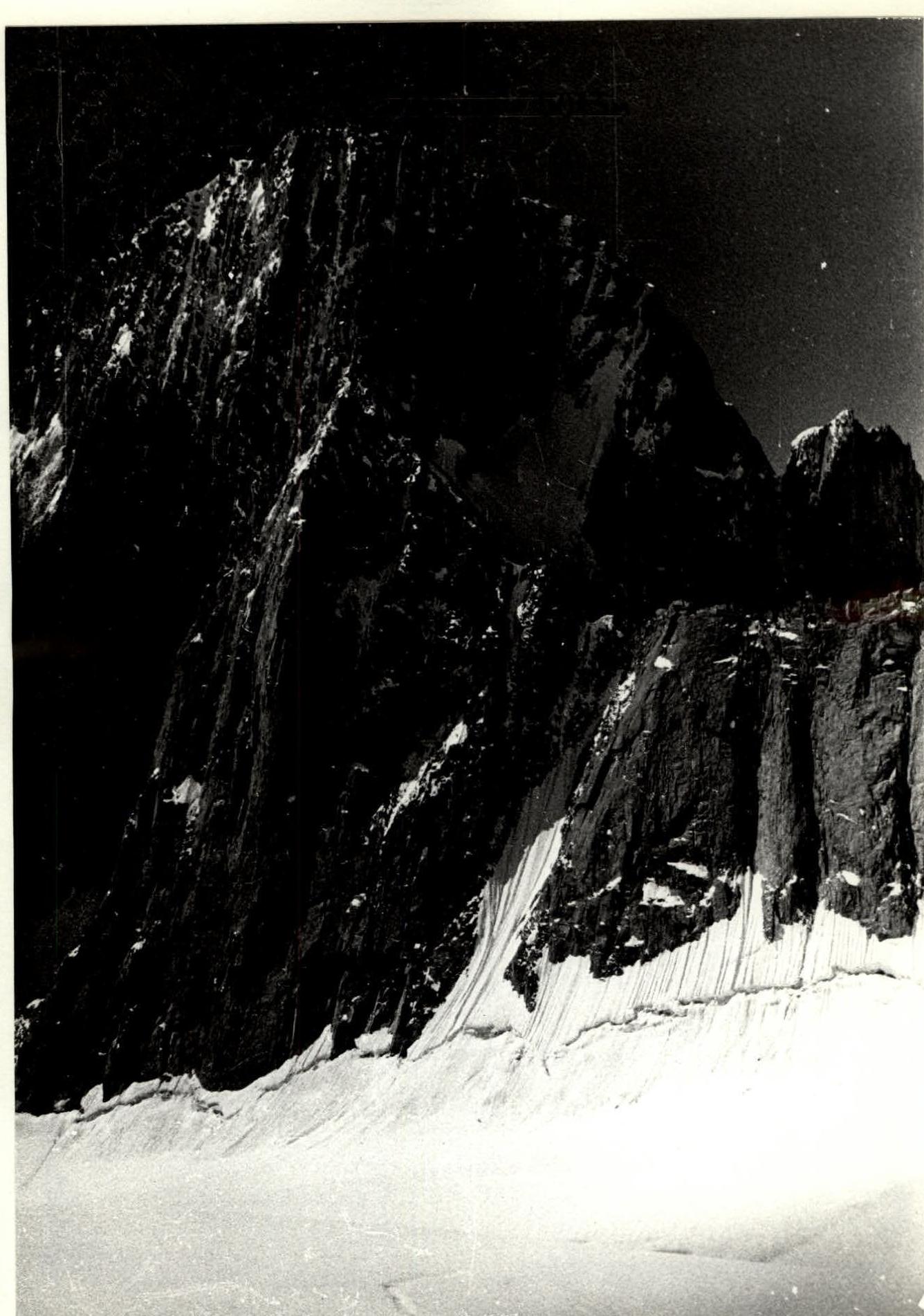
Photo — 6. View of Goryak Peak — 5013 m from the Preobrazhensky glacier.
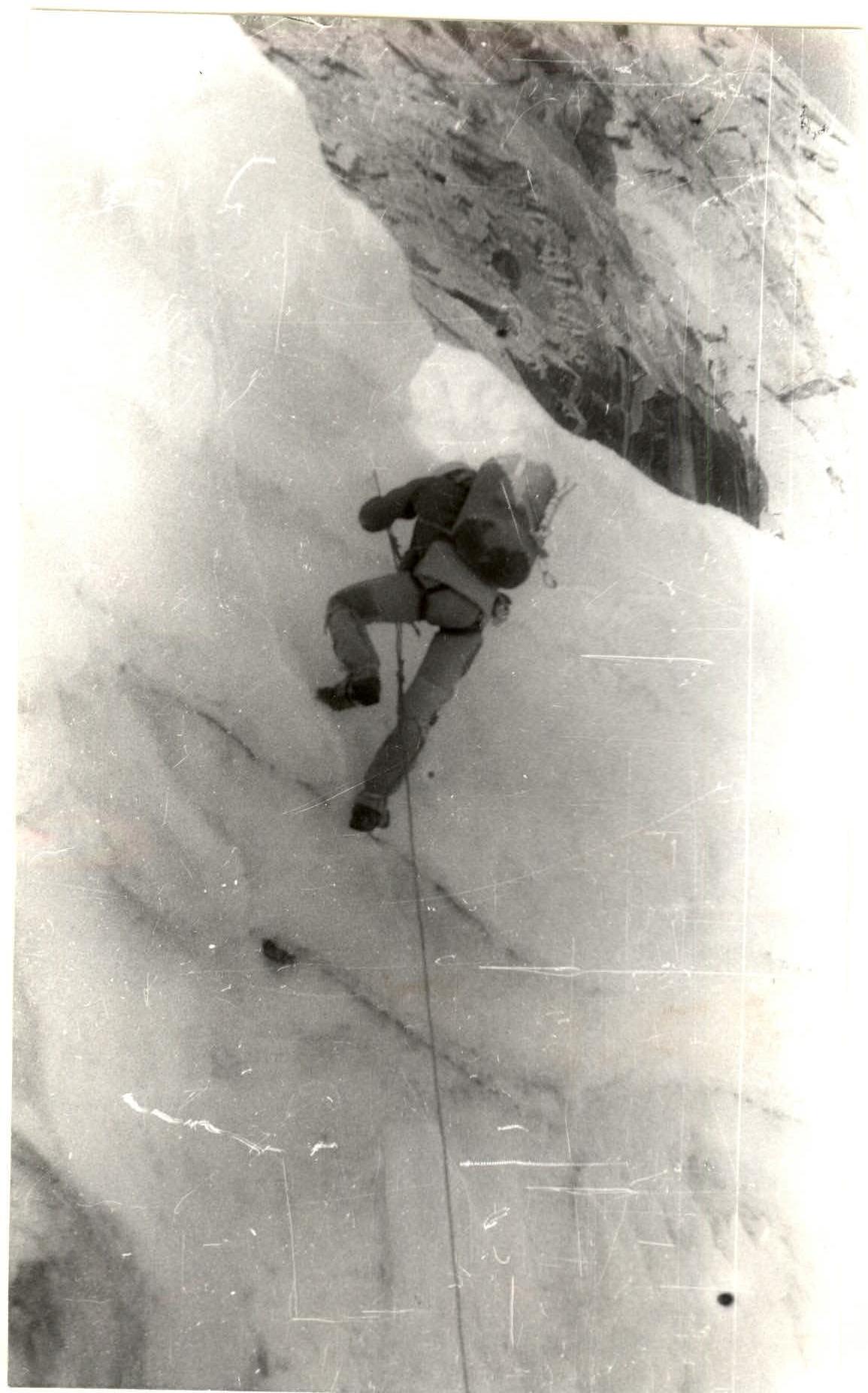
Photo — 7. Passing the bergschrund.
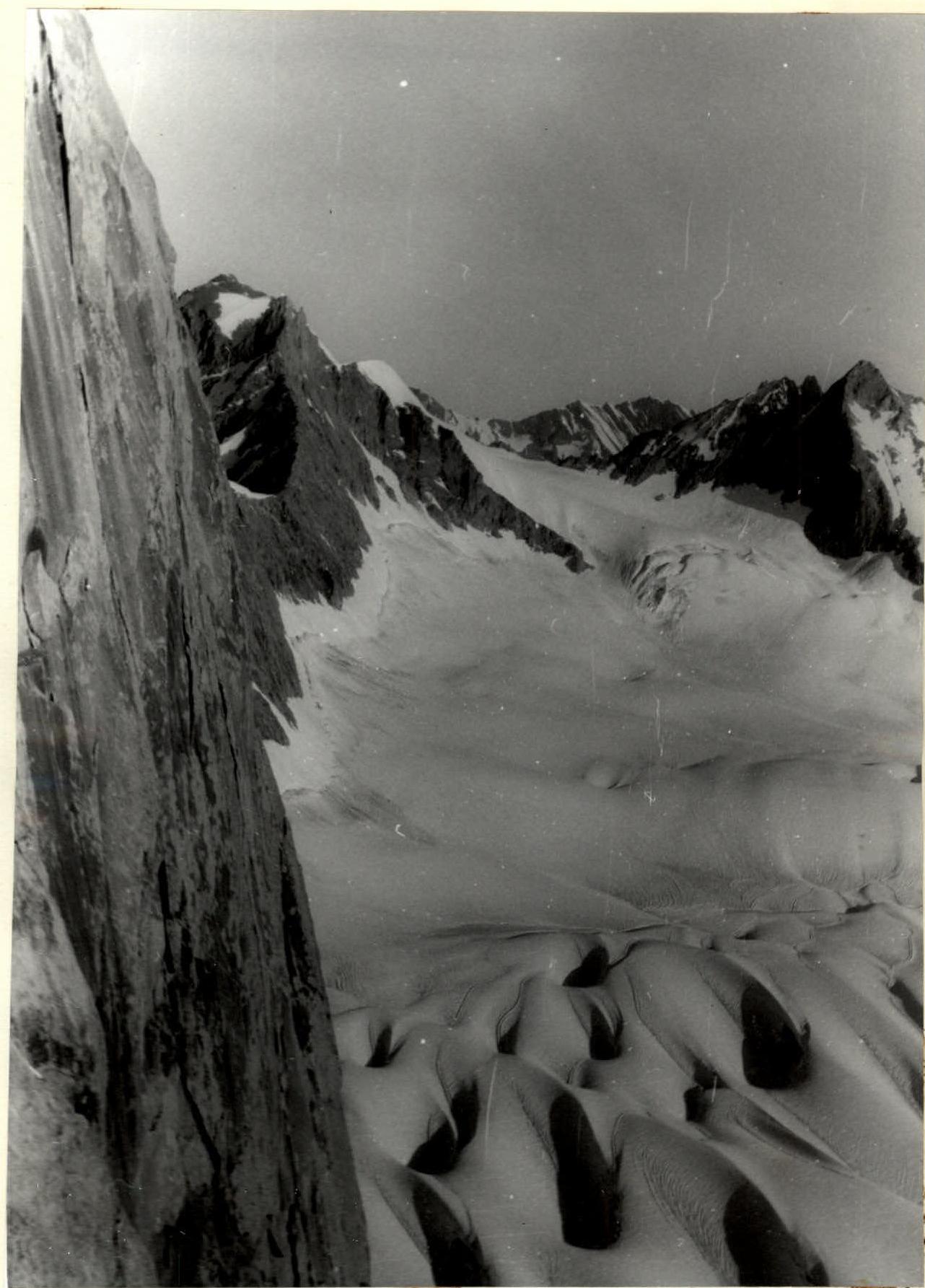
Photo — 8. View from the "mirror" towards the upper reaches of the Preobrazhensky glacier.
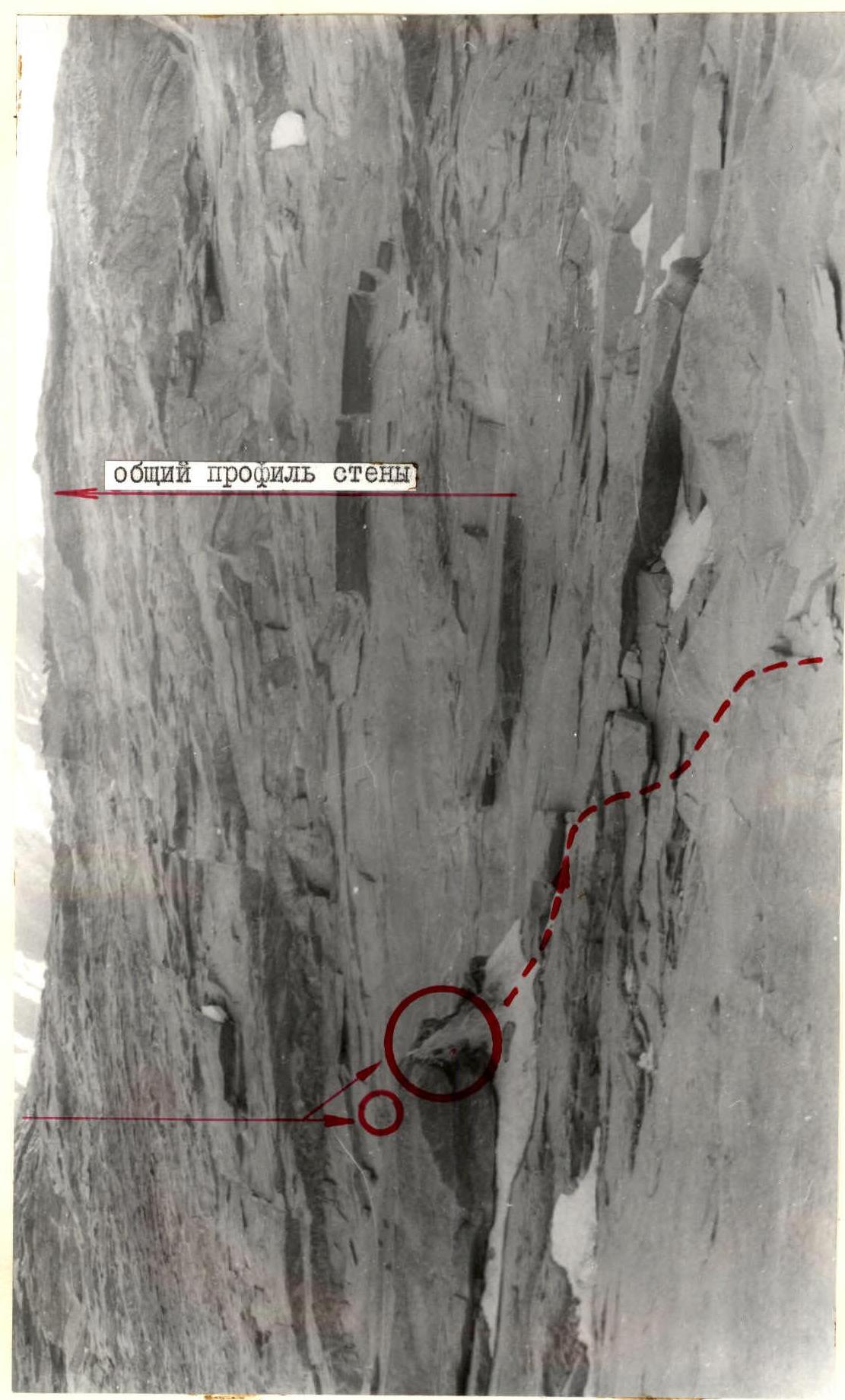
Photo — 9. View of the 1st overnight stay after the traverse.
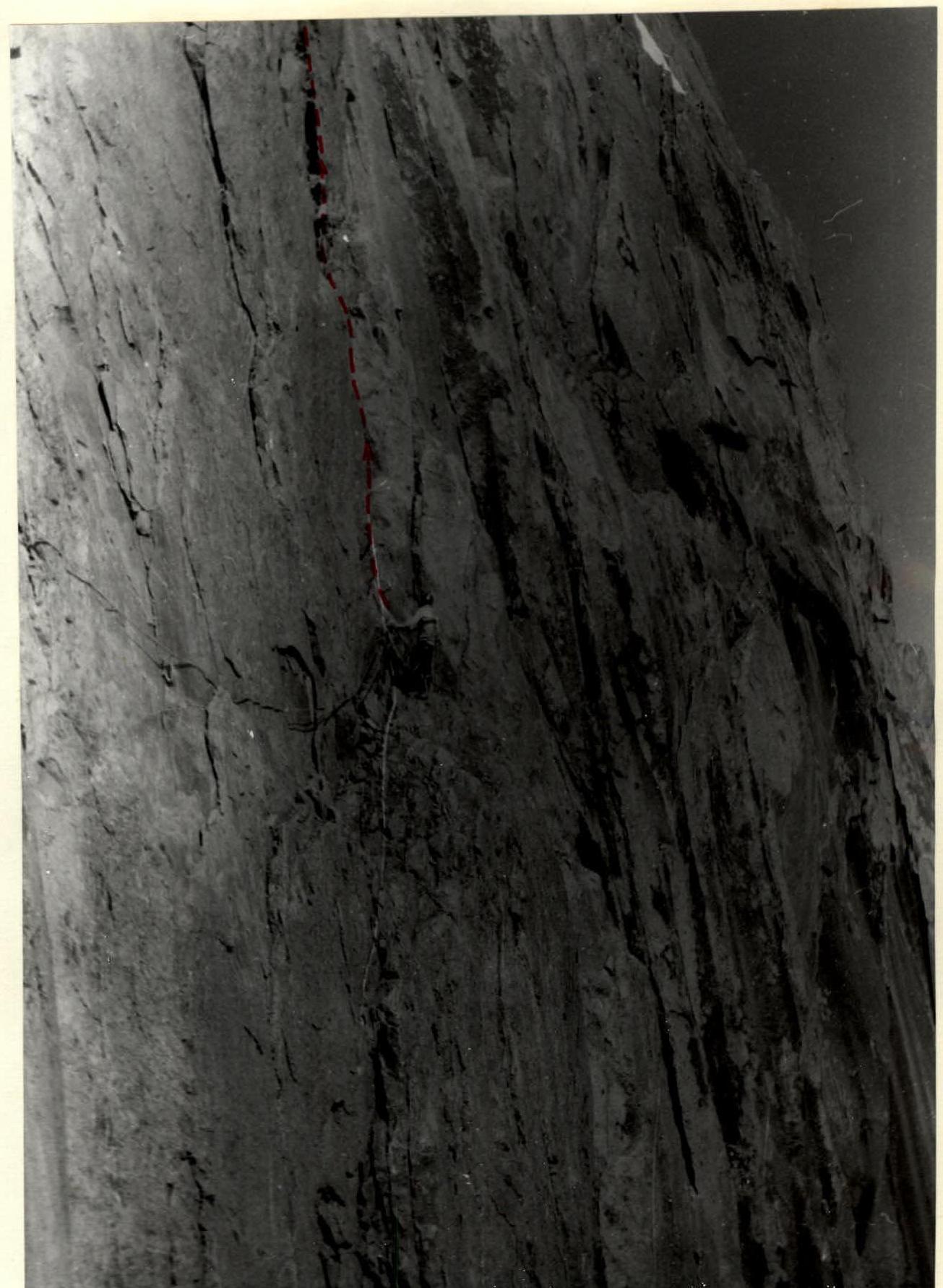
Photo — 10. Wall on sections R33–R36.

Photo — 11. Section R40–R41.