
Passport
- Class — rock
- Pamir-Alay, Turkestan Ridge, Kara-Su gorge
- Peak Asan (4230 m), along the center of NW wall
- 6B cat. difficulty
- Height difference 830 m, length 1045 m, length of sections 5–6 cat. difficulty 880 m, of which 6B cat. difficulty — 450 m. Average steepness of the route 78° (3400–4230), of which 6B cat. difficulty 85° (3540–3800, 3800–4060)
- Driven pitons:
| rock | bolt | chocks |
|---|---|---|
| 95/31 | 25/25 | 161/55 |
- Team's working hours 30.5, days — 4
- Overnights:
1st — comfortable on ledges 2nd — two in hammocks, four lying on ledges 3rd — all lying on ledges
- Leader: Timofeev Sergey Vladimirovich
Participants:
- Pinus Alexander Mikhailovich (CMS)
- Zimin Sergey Trofimovich (CMS)
- Gerzha Sergey Lvovich (CMS)
- Khabibullin Salavat Zagitovich (CMS)
- Manirov Valery Amirovich (CMS)
-
Coach: Lebedikhin Alexey Veniaminovich (MSMK)
-
Departure to the route July 6, 1988, summit — July 9, 1988, return — July 9, 1988
-
Organization — Sverdlovsk Regional Sports Committee
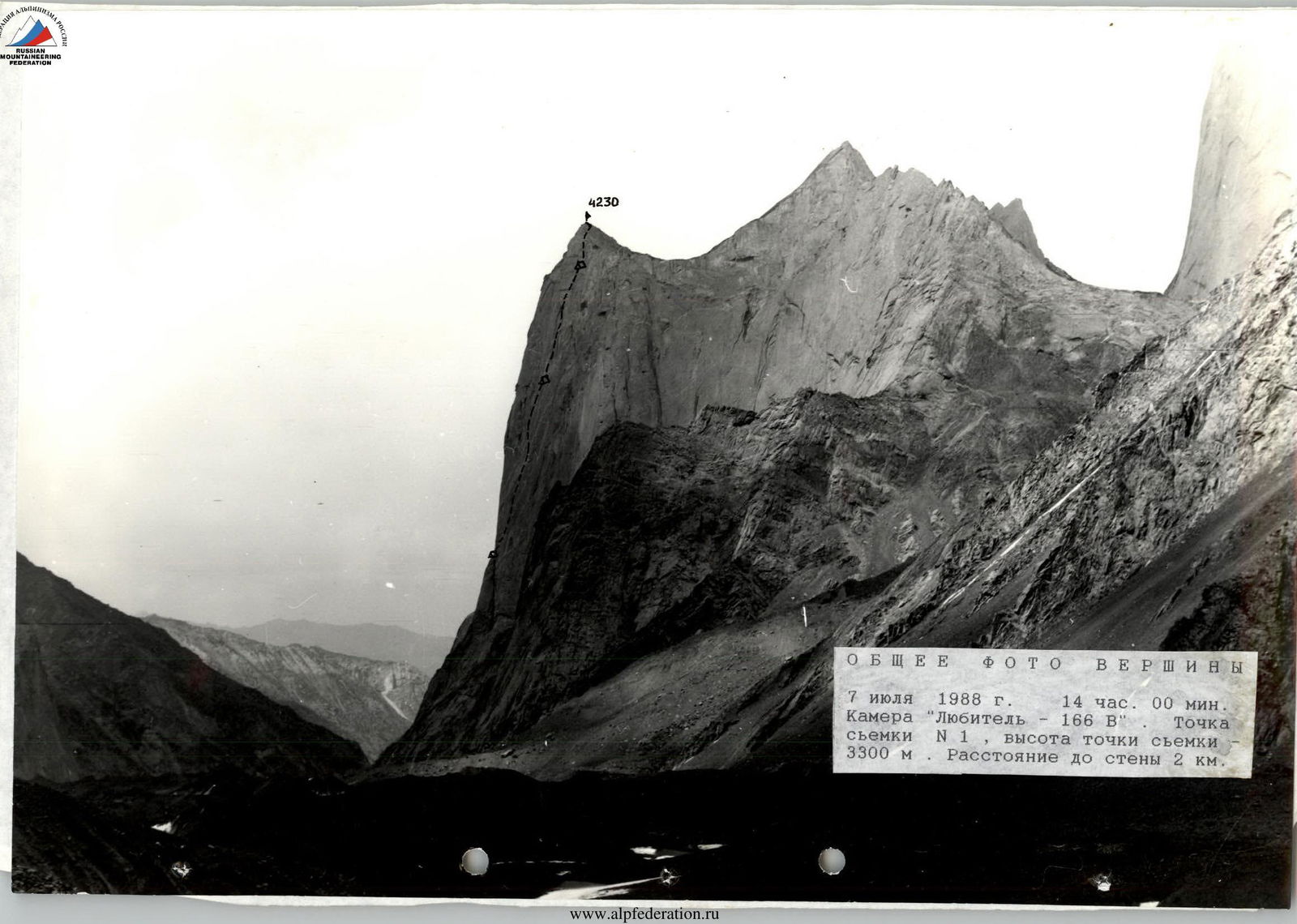
When drawing up the tactical plan, it was planned:
- to pass the route in good weather with two overnight stays;
- in bad weather, it was planned to double the time schedule.
The group's departure to the route was planned for the morning of July 6. The rain that started on the evening of July 5 intensified by morning, which led to a delay in the group's departure. It wasn't until lunchtime that it brightened up, the rain almost stopped, and the team set out on the route at 14:30.
On the first day, the "pillar" was passed and 15 m were processed on the "mirror" above the overnight stay on top of the "pillar". The next day, July 7, after passing the "mirror" in four ropes above the niche, the group's movement was interrupted by heavy rain with snow and a thunderstorm that began. At 18:00 the group stopped for the night.
On July 8, the group, leaving the overnight stay at 8:00, by midday:
- overcame the first cornice,
- passed most of the inner corner,
- reached the key section.
The second cornice was passed in a new way, more logical and safer with regard to the likelihood of falling stones, although more difficult. Instead of bypassing the cornice to the right along destroyed and stone-hazardous rocks, they moved:
- straight up along the waterlogged overhanging crevice,
- then transitioned to the smooth sheer left wall.
Very difficult climbing on this section was further complicated by the rain that began. The rocks immediately became very slippery. The overnight stay was organized on ledges above the ice-filled couloir, three ropes from the summit.
The group was at the summit on July 9, 1988 at 9:30.
The first to work on the route were (in shifts):
- on the 1st day — Gerzha — Zimin rope, passed sections R0–R4;
- on the 2nd and 3rd day — Timofeev — Pinus rope (R4–R13, R13–R22);
- on the 4th day — Khabibullin — Manirov rope (R22–R26).
The key places were passed by S. Timofeev — the strongest rock climber on the team. Throughout the entire route, the first moved on a double rope, one of which was marked UIAA. The second rope was used to secure the belay. The third climbed the fixed rope with lower belay (UIAA rope), clicking the safety rope into already organized belay points. The remaining participants climbed the belay ropes with top rope. Backpacks were not pulled, but lifted on themselves, attached to the harness, thanks to the use of two jumar. The first on the route worked without a backpack — in galoshes or rock shoes, the rest of the participants — in sneakers. There were no failures during the ascent.
Hot meals were provided in the morning and evening, during the day all team members received high-calorie "snacks".
Given that the wall is "dry", two 8-liter flasks of water were taken on the route. It was planned to replenish water supplies at the expense of:
- ice in the ice couloir in the upper part of the route;
- precipitation in bad weather and delayed group progress.
When one of the flasks was emptied, it was dropped and picked up by observers below the route. On the second overnight stay, water supplies were replenished during a thunderstorm. On the third overnight stay, ice from the ice couloir was used.
Overnight stays were:
- lying or semi-reclining on separate ledges;
- in hammocks.
Throughout the ascent and descent, stable radio communication was maintained with observers. A rescue team from the Kharkov gathering was constantly present in the base camp below the route.

Comments
Sign in to leave a comment