
I. Rock Class
- Northern spurs of the Turkestan Range, Kara-su gorge
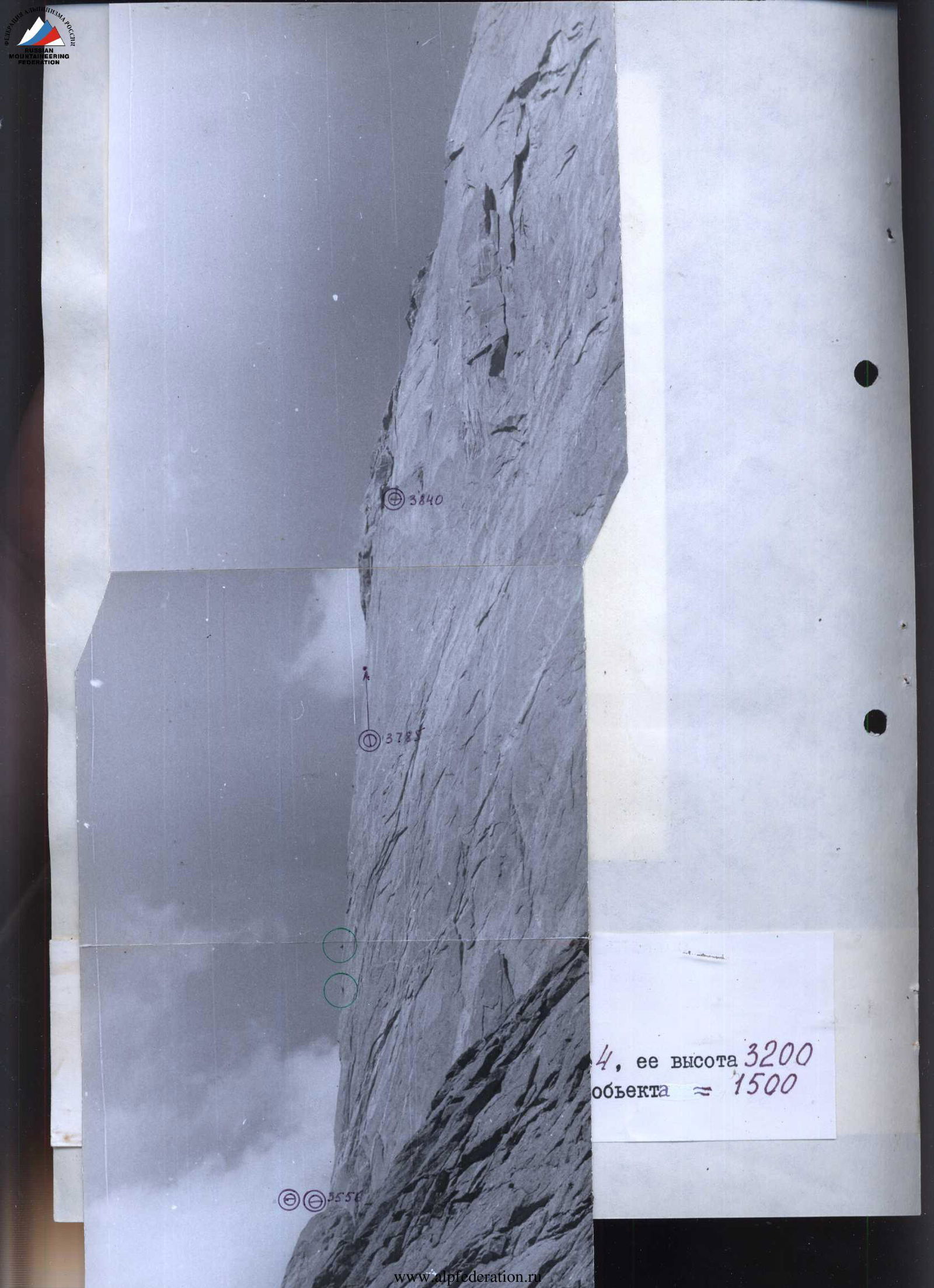
- Peak "4230", via the Northwest wall
- Proposed — 6B category of difficulty, first ascent
- Height difference 880 m, length 1153 m
- Length of sections with 6B category of difficulty 713 m, 5B category of difficulty 100 m
Average slope of the route 70°, average slope of the wall part 80°
- Number of driven pitons:
rock 148/35, chocks 253/72, bolt 14/10, ice 0/0
- Number of climbing hours 65, days 5
- Overnights: I, 2nd on a ledge, lying; 3rd — hanging: 4 people, two in hammocks, 2 one each on "platforms"; 4th — on a ledge, lying, one by one.
- Leader: Moroz Sergey Andreevich Master of Sports
Participants: Timofeev Vladimir Nikolaevich Master of Sports/Master of Sports (rock climbing) Kozachek Petr Vasilievich Candidate for Master of Sports/Master of Sports (rock climbing)
Lebedev Gennadiy Igorevich Master of Sports Prikhodko Yuriy Pavlovich Candidate for Master of Sports Khitrikov Vladimir Andreevich Master of Sports
Coach: Kozak Leonid Romanovich Master of Sports
Departure to the route: July 7, 1986 Summit: July 11 Return: July 12, 1986
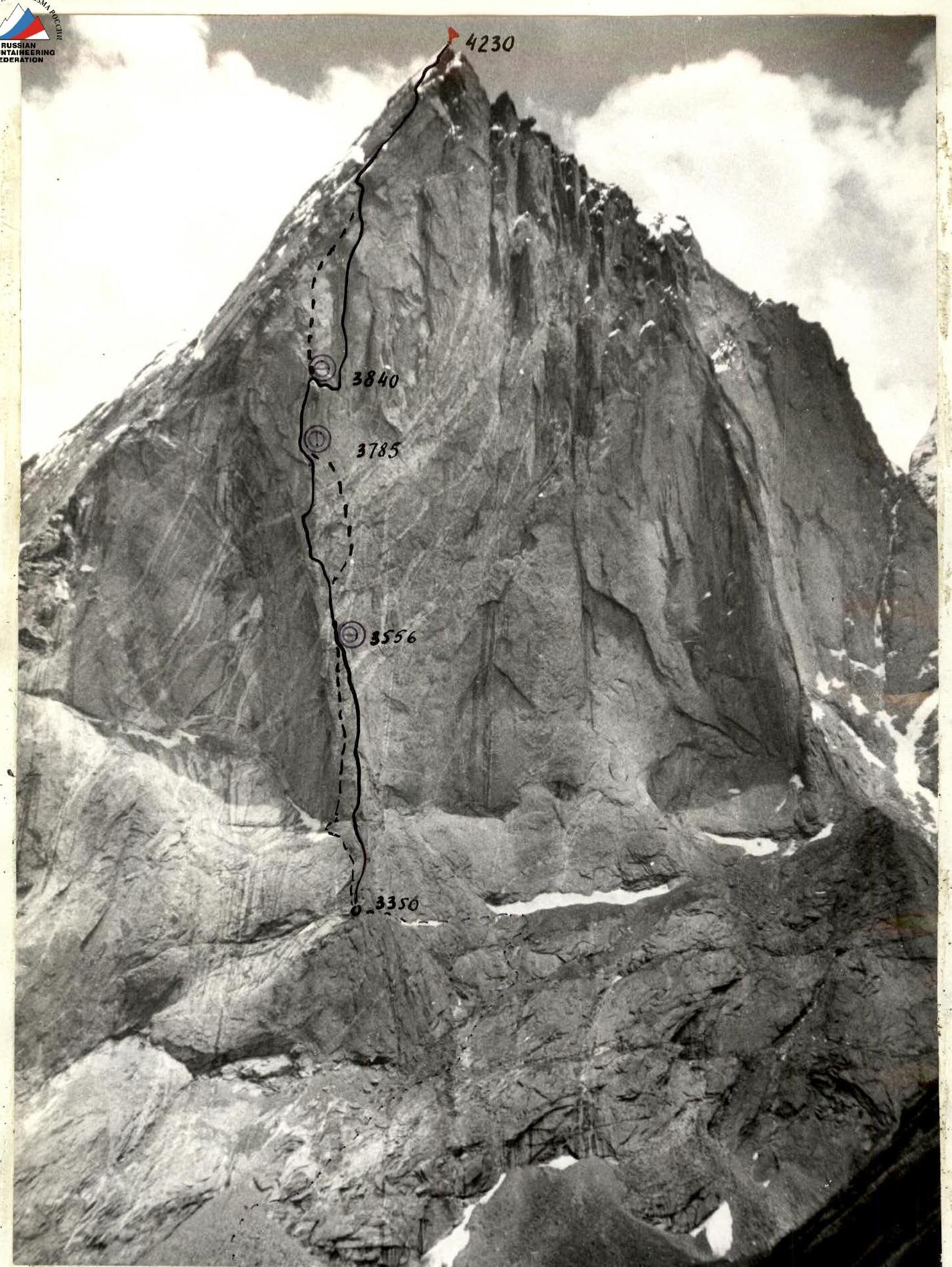
Photo 1
Lens type: Industar-50. Shooting point: # 2. Its height: 3450 m. Date, time of shooting: July 9, 1986, 00:00. Distance to the object: 2200 m. Team route: —. Route of the "Planeta" group: —.
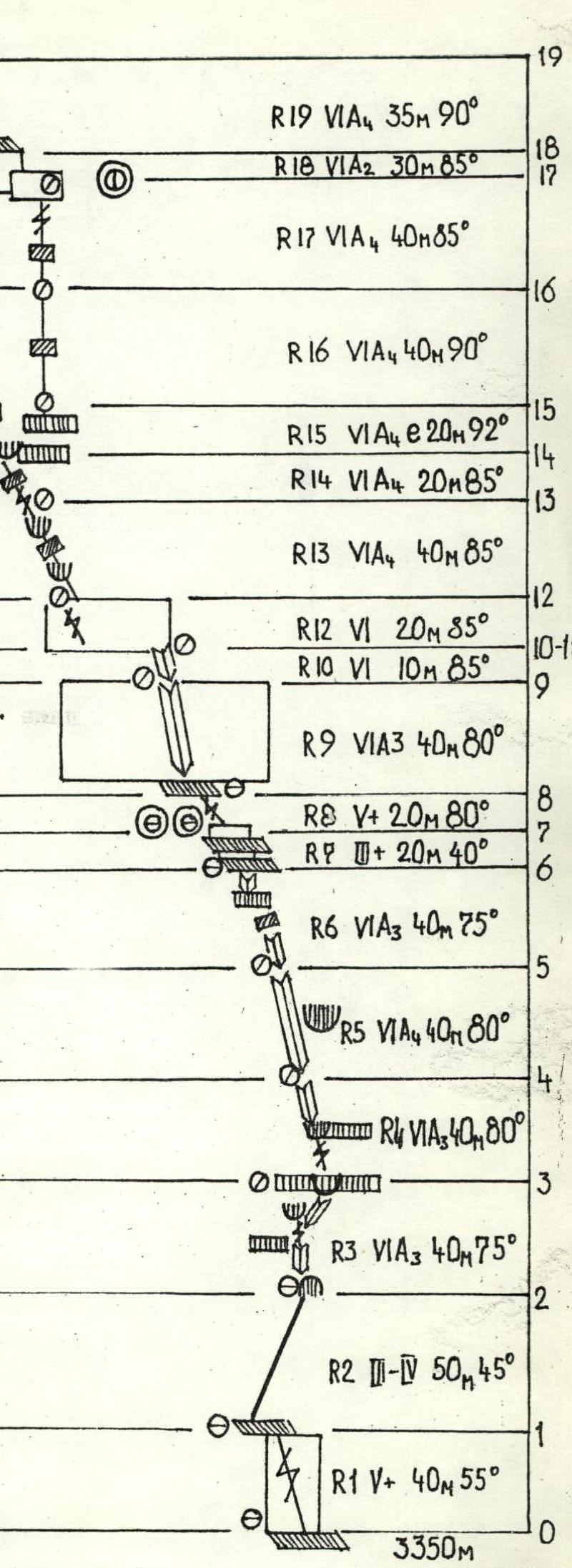

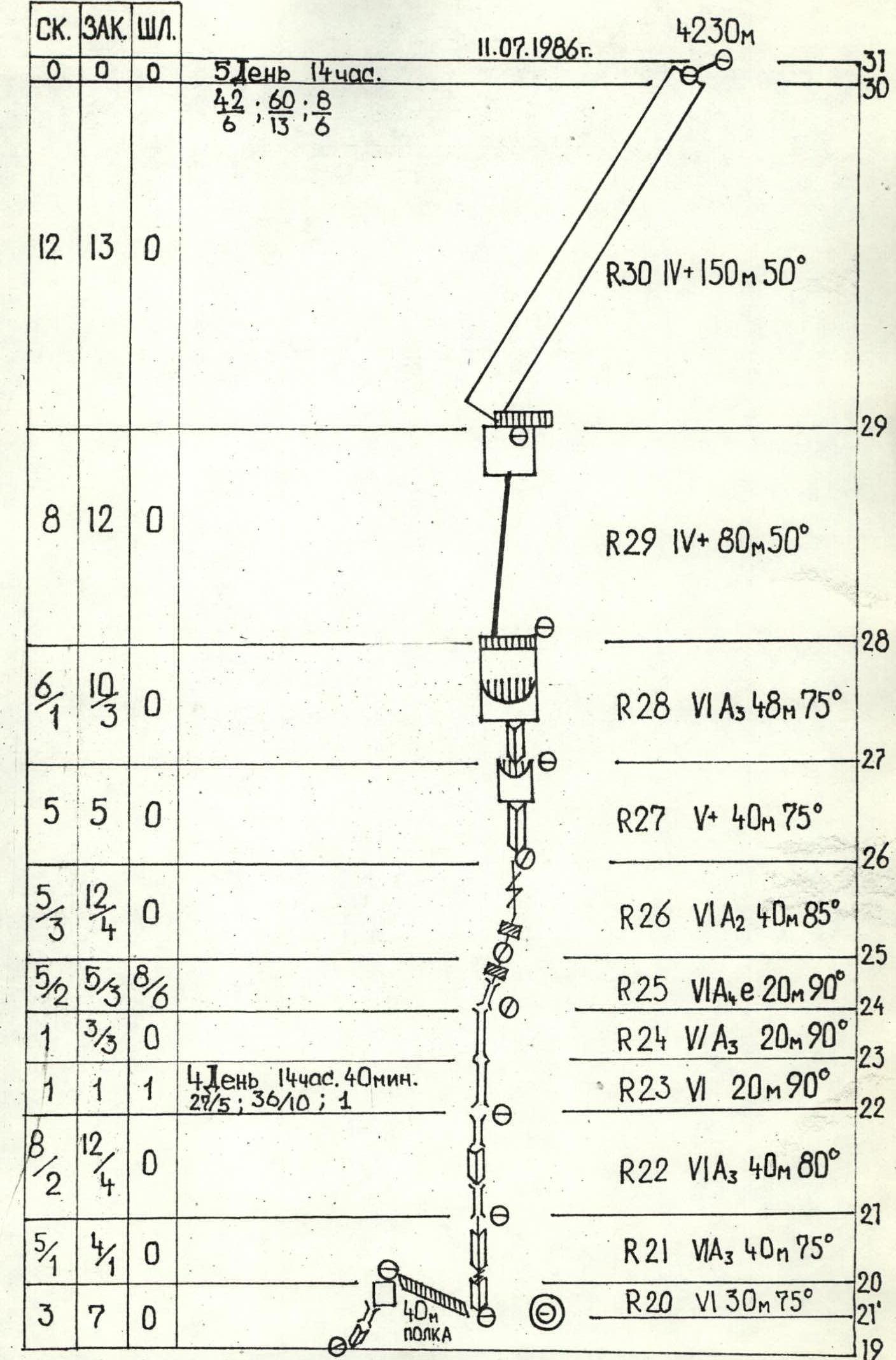
Route description by sections
The team left the base camp on the arch meadow at 16:00 on July 6, 1986. On July 7, early in the morning, they left the observers' bivouac under the route.
Approach to the start of the route:
- along the scree cone to the beginning of inclined slabs
- along the slabs
- then along an oblique ledge to a horizontal wide ledge
- along it to the left, approach to a small niche in the wall
The route begins from here.
Day I R1–R2 has a total length of 90 m, of which 50 m are 3–4 category of difficulty and does not present particular difficulties. The first rope team works first.
R3 Insurance point in a niche at the beginning of the "finger", an inner corner goes to the left. The lead climber Timofeev bypasses the cornices on the left along cracks and moves in the direction of a series of small cornices along an indistinct inner corner.
R4 From them to the left under a large cornice and to the right along cracks and along the inner corner approaches under an overhang. Passes it on artificial climbing techniques (AID) and further to the left into the inner corner.
R5 Along the inner corner, movement is initially free climbing, and then:
- the overhang in its left part is passed on AID,
- further again movement by free climbing.
R6 Along the inner corner in the direction of a crack and a cornice, which is overcome on the left part on AID. Further along the inner corner — exit to an inclined ledge. Here you can relax a bit and rest after extremely difficult climbing and hanging transfers.
R7 — does not present difficulties, leads to the top of the "finger". A small ledge, suitable for organizing a bivouac for 6 people. While the other rope teams are catching up, Timofeev rests and looks further along the route.
R8 Leaving some pitons and adding chocks, Timofeev passes the crack by free climbing and exits onto a small ledge under a large chip with a wide crack.
R9 Still very steep, the wall of the chip overhangs and "drops to the right onto a slab". There is no microrelief on the slab. Timofeev goes, wedging his legs into the crack of the chip, and holding onto its edge with his hands; in places he goes on tension.
It started raining, climbing became impossible. He descends down into the tent.
After the rain, the wall dries quickly, and the third rope team moves forward. The lead climber Khitrikov very slowly, in places using AID, approaches under the overhanging part of the chip.
R10. The edge of the overhang is sharp, microrelief appeared on the wall, and the chip is passed by free climbing. Khitrikov secures the rope and descends to an overnight stay.
Day II. At night, the wind rose, it got sharply colder. In the morning, the temperature is below zero, the second rope team, with Kozachek leading, starts working, but returns: in the wind, hands freeze instantly, fingers lose sensitivity.
We wait for the sun to rise higher and warm up.
After 9:00, the leading rope team climbs up the fixed ropes.
R11–R12: Along small, sloping, in places invisible holds (Photo 14) Kozachek moves left by traverse to the beginning of a wide crack (very difficult climbing on balance). Further movement along the crack by free climbing to the place of its narrowing.
R13–R14: up goes a deep crack of almost constant width, there are almost no holds on the right and left. Moving along the crack, sometimes by free climbing, sometimes using AID, Kozachek organizes intermediate belay points on chocks, and since the crack is almost constant in width, chocks of almost the same size are used in the work. Kozachek has to descend and remove some of the chocks, and then continue moving further. Still very cold, Kozachek works, wearing a down jacket and a windproof suit. Often stops and warms his hands. By lunchtime, having passed 35 m, the second rope team descends, it is replaced by the third rope team.
Khitrikov continues to move along the crack, which in places overhangs. Again, we have to descend and remove some of the chocks — "Friends". The last meters of the rope are passed by climbing, the crack leads under a cornice. Having organized a belay point and having blocked the pitons with a separate loop made of webbing, Khitrikov and Lebedev descended to an overnight stay.
Day III R15. The first rope team works. The lead climber Timofeev moves to the right and up and passes the cornice, having driven in 4 bolts. Climbing is extreme. After exiting onto the wall above the cornice — a traverse on balance to the right onto a crack (very difficult place). When driving in bolts, as planned, a stand from one of the backpacks is used.
R16 A vertical smooth slab with a crack, along which Timofeev moves on AID extremely carefully and carefully, since the crack is shallow and wedges, chocks and pitons may be unreliable.
- After 40 m, a step of half a foot
- Insurance point, you can rest a bit.
R17 The nature of the relief does not change, the last 10 m Timofeev passes by climbing.
R18 Again a traverse on balance and further along the crack comes out onto an inclined ledge to the place of a hanging overnight stay. While the group organizes an overnight stay, Timofeev passes another 30 m.
Day IV R19. The night is warm, the first rope team resumes work early in the morning. Along cracks and chips, in places AID, under an overhang at the beginning of the inner corner. The cracks are wet, overgrown with grass, moss.
R20 Relief appeared, allowing climbing to pass the inner corner, turning into a chimney with slots, and then to the right along the slabs to exit onto a "balcony".
R21 A narrow ledge, descending down to the beginning of the chimney, here is a short rest. The third rope team continues to move. Khitrikov moves along the system of inner corners and cracks in the direction of the chip and small chimneys. AID.
R22 The first one enters the chimney, and then along the flakes reaches the big chimney, climbing is extreme, AID. Then the third rope team is replaced by the second.
R23–R24 Kozachek enters the chimney and moves in it in a stem, the walls are smooth, there are no holds, great difficulties in organizing intermediate belay points on chocks and pitons. Kozachek often:
- stops
- gets stuck
- rests
Having passed 20 m, secures the fixed ropes and descends to an overnight stay.
Day V. R25 In the morning, the second rope team starts working. Further, the chimney narrows and turns into a wide crevice with absolutely smooth sides. Exit from the chimney and entrance to the crevice through a cornice on AID. For further movement, Kozachek has to drive in bolts (7 pieces).
R26 Further movement along the crack on AID, and then by free climbing.
R27 Continuing to move along the crack, Kozachek approaches the inner corner and along its left face through a cornice again into the inner corner.
R28 Along the inner corner through an overhang, an approach under the next cornice and an exit to the inflection between the N and NW walls. AID.
R29–R31 Further, the first rope team works first. Along the right border of the N wall to the cornices, then a traverse to the left and along the slabs exit to the summit. Descent along the E ridge to the beginning of rappels.
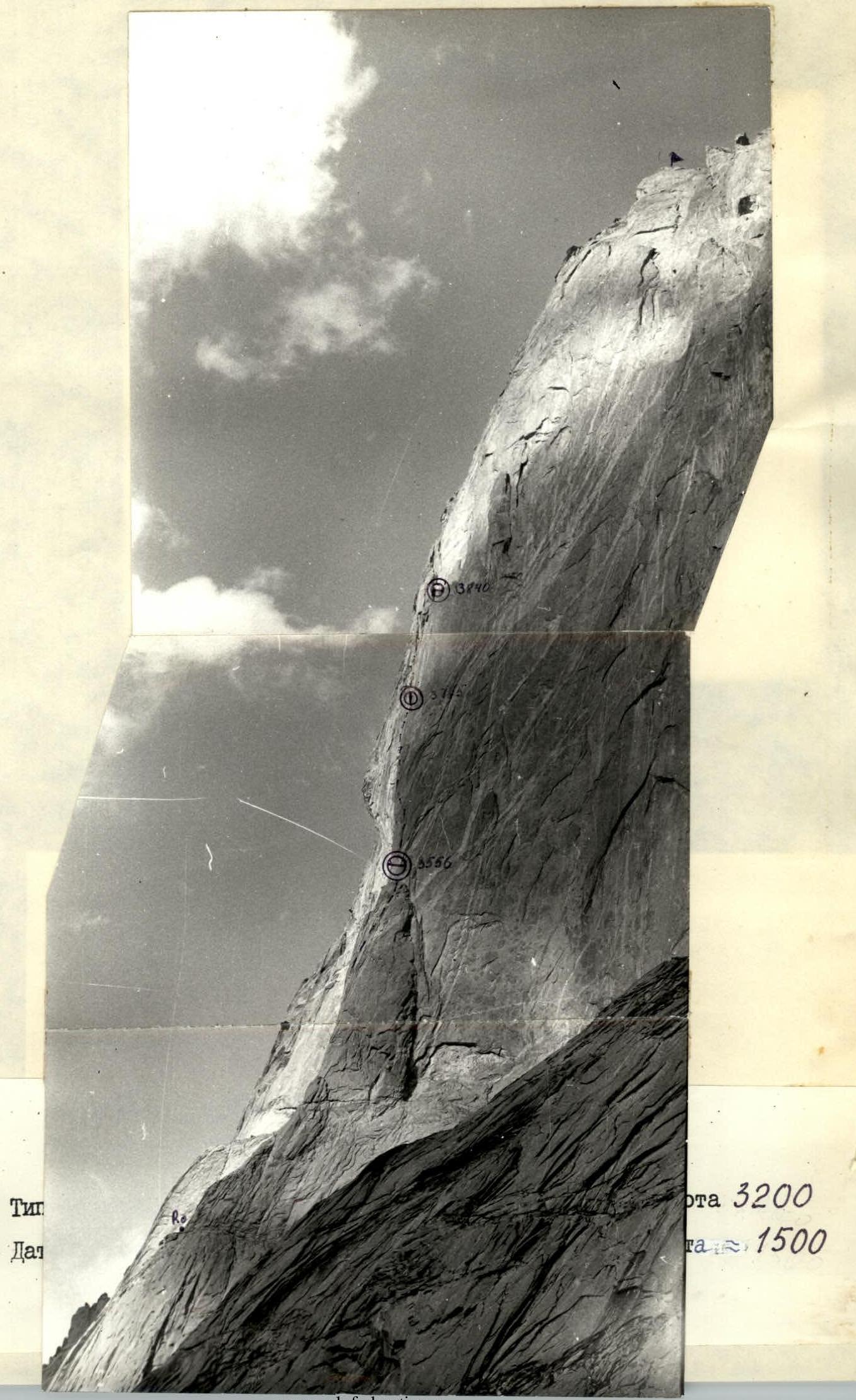
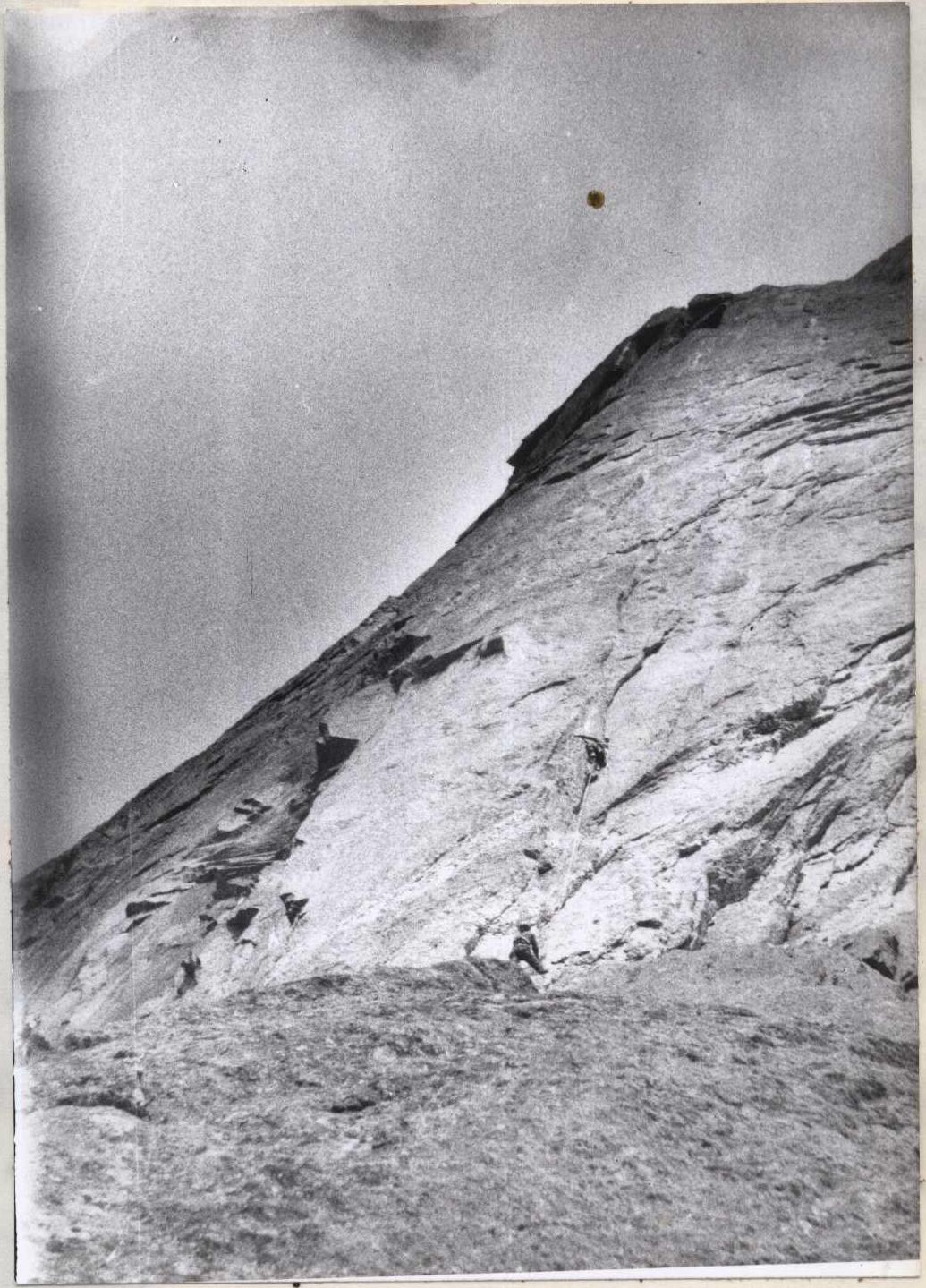
Photo # 12, section R7–R8. Lens type: T-40. Shooting point: # 8a. Its height: 3540 m.
Date of shooting: July 7, 1986. Distance to the object: ≈ 20 m.
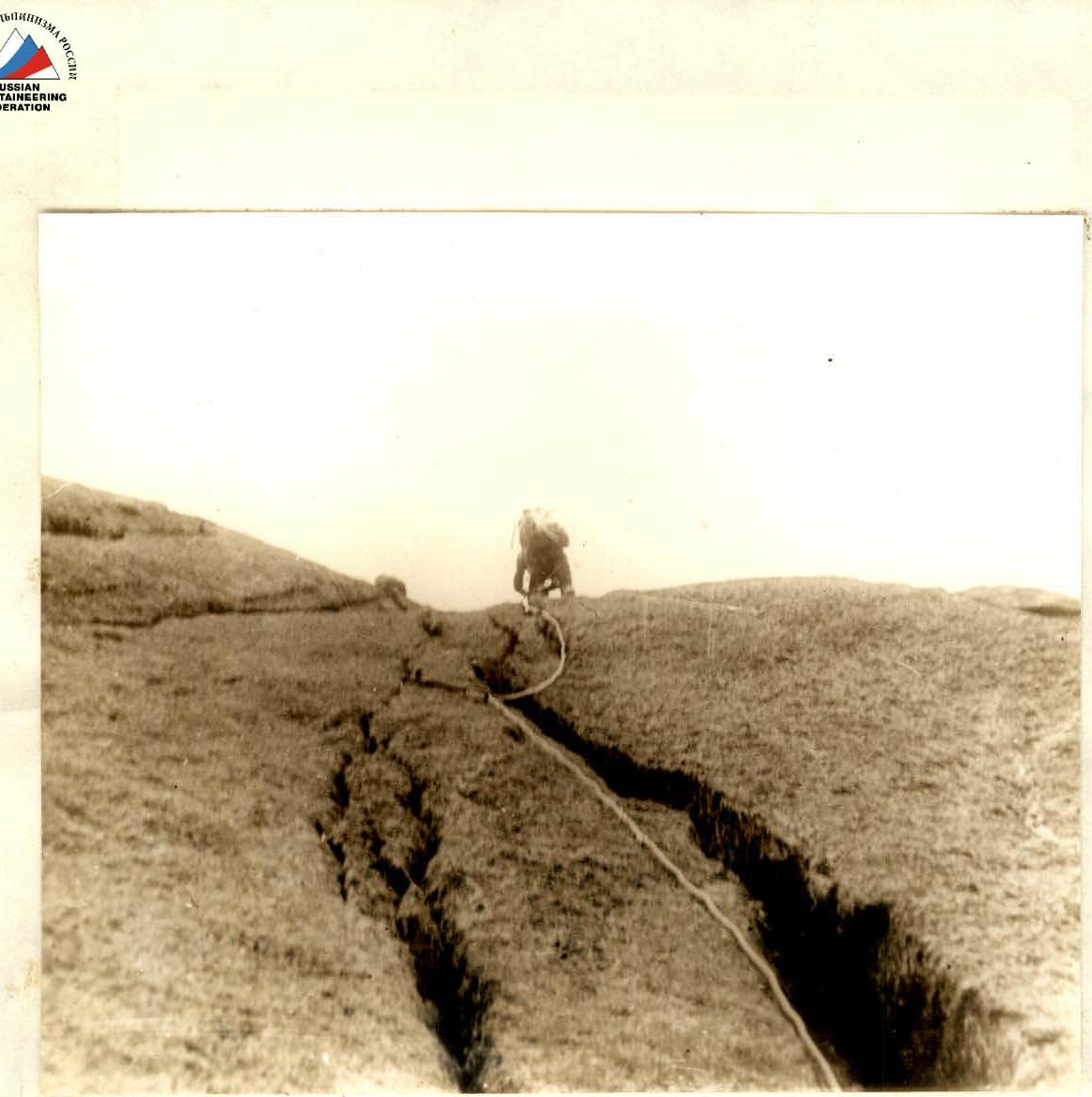
Exit from the chimney. Movement along the fixed ropes.
Photo # 23, section R24–R25. Lens type: T-40. Shooting point: # 14. Its height: 4000 m.
Date of shooting: July 11, 1986. Distance to the object: 30 m.

Comments
Sign in to leave a comment