
PASSPORT
- ROCK CLASS
- NORTHERN spurs of TURKESTAN range, KARA-SU gorge
- ASAN peak 4230 m via NORTH-WEST face
- 6B cat. diff.
- ELEVATION: 840 m, LENGTH: 965 m
LENGTH OF 5–6 cat. diff. sections — 695 m. AVERAGE STEEPNESS OF THE ROUTE — 69° (3390–4230), including 6 cat. diff. — 81° (3560–3920)
- PITOONS HAMMERED:
| rock | bolt | chocks |
|---|---|---|
| 110/14 | 19ˣ | 142/43 |
ˣ — use of previously hammered pitons
- TEAM'S MOVING HOURS: 18 h 40 min and days — 2
- OVERNIGHT STAYS: I — lying down, on a rock shelf
- TEAM LEADER: Shevchuk Alexander Denisovich — MS
Sibaev Mingalim Minsalimovich — CMS, Borisov Alexander Vasilievich — CMS, Ivashchenko Alexey Sergeevich — MS, Oleinikov Yuri Vladimirovich — CMS, Soldatov Sergey Yurievich — CMS
-
COACH: Retyunsky Yuri Dmitrievich — MS
-
APPROACH TO THE ROUTE: June 19, 1988
SUMMIT: June 20, 1988 RETURN: June 20, 1988 12. RSFSR STATE COMMITTEE FOR SPORT
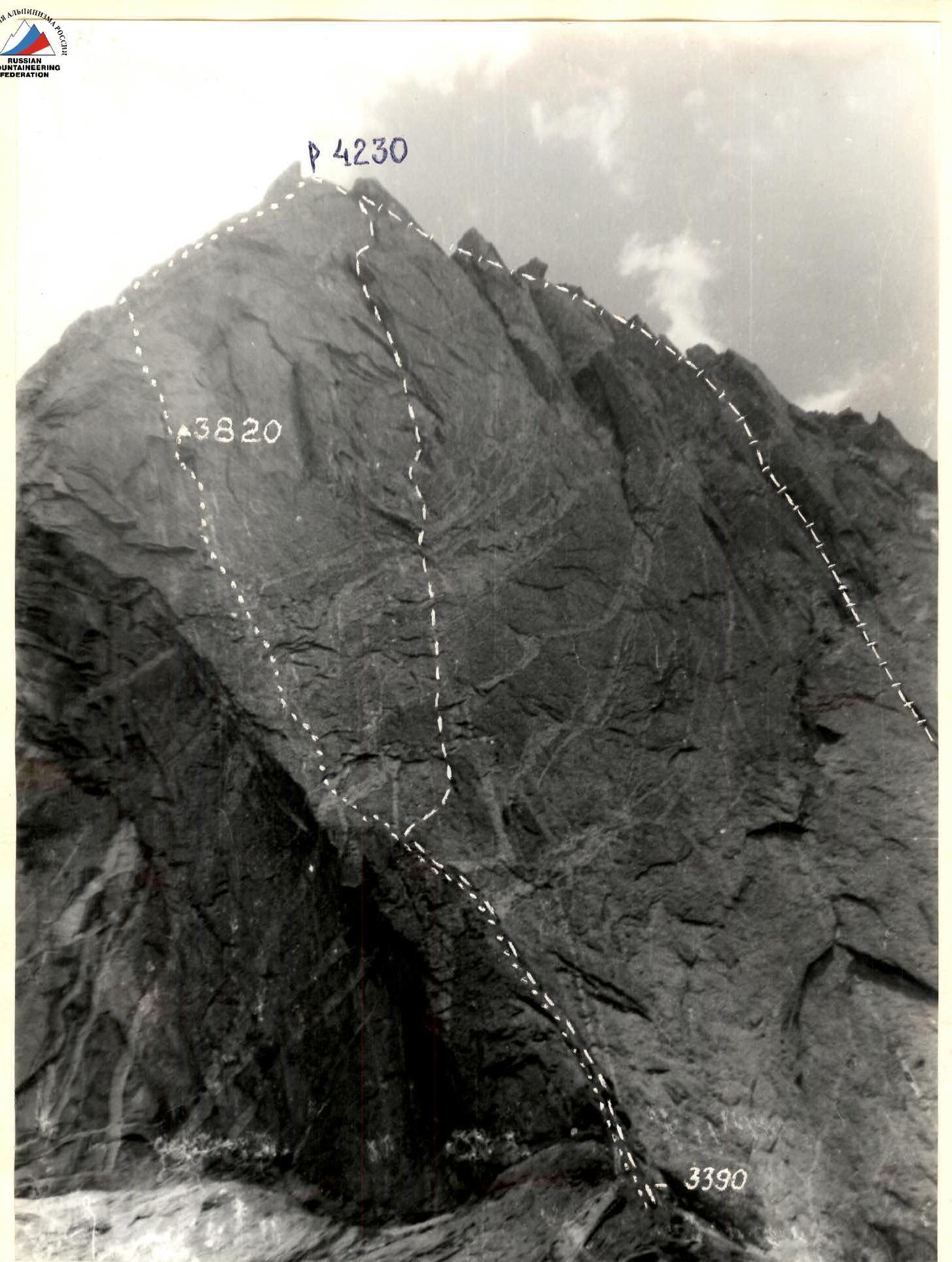
GENERAL PHOTO OF THE PEAK
… team's route
-
-
- "Odessa" ac route — RSFSR-2 team's route
-
16.06.88., 15:00, "Helios-44", F.r. — 58 2 km, No. 1, 3000 m.
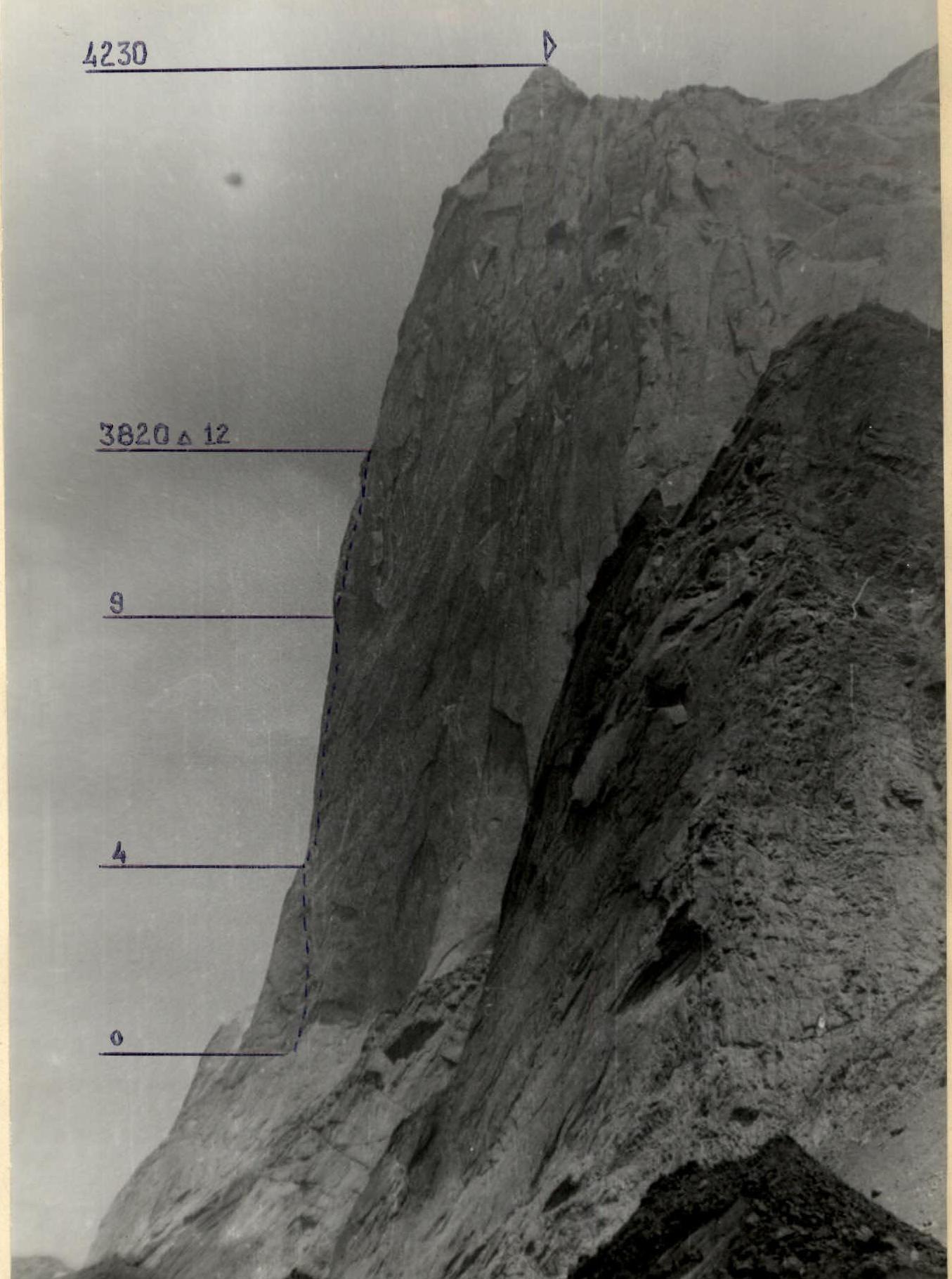
PROFILE OF THE RIGHT WALL 18.06.88., 16:00, "Helios-44", F.r. — 58 2.5 km, No. 2, 3200 m.
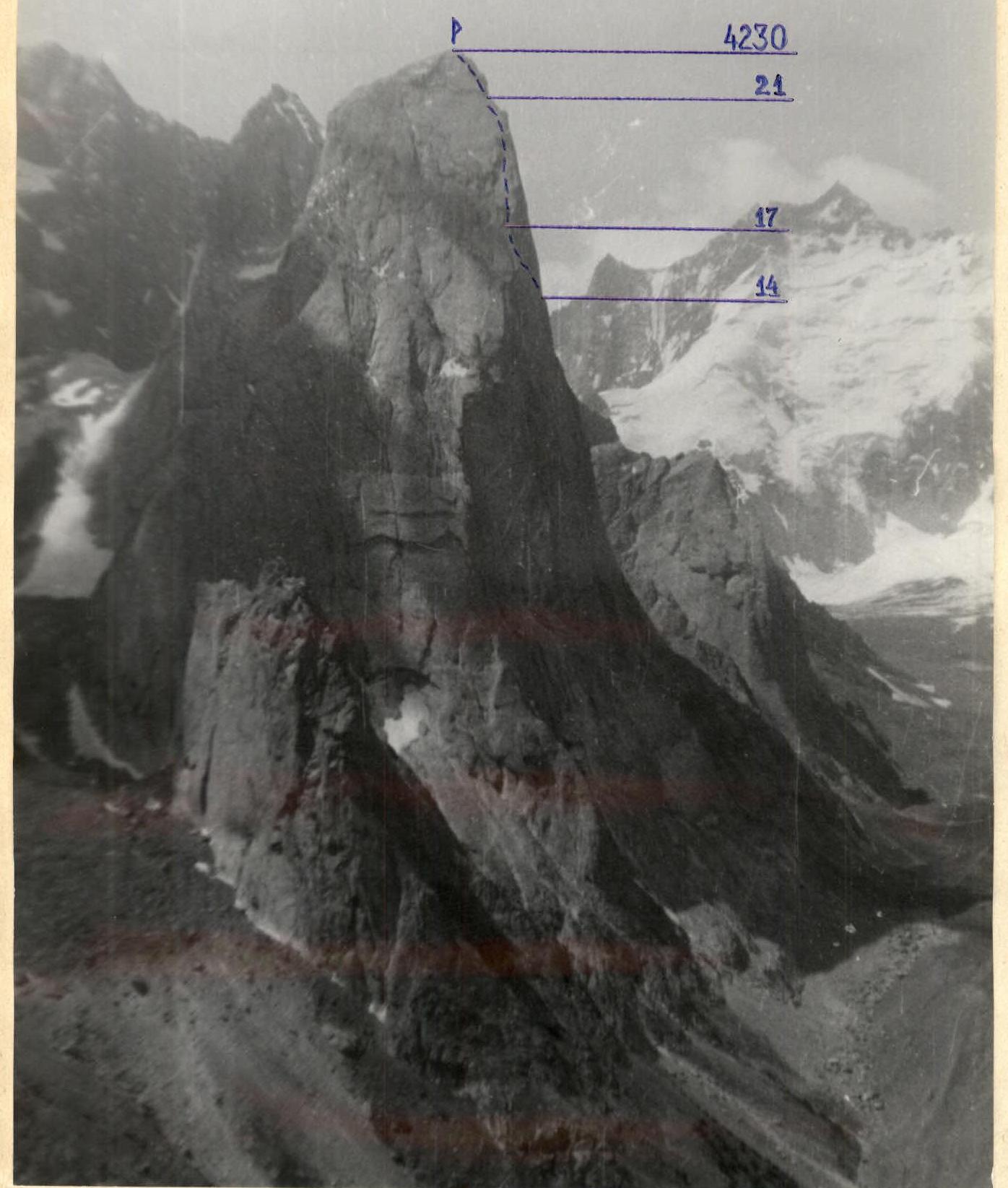
PROFILE OF THE LEFT WALL 17.06.88., 14:00, "Helios-44", F.r. — 58, 4.5 km, No. 3, 3600 m. The team followed the route based on the tactical ascent plan. There were no deviations from the planned time schedule for the designated control sections and overnight stays. The team completed the ascent without deviating from the route.
Throughout the day, the lead climber was rotated. Each participant worked as the lead climber on their previously assigned section of the route.
The group's movement scheme: the first worked on a double rope with a shock absorber; the second — with top rope, carrying two free ropes and, as they progressed, removing pitons and straightening the "fixed ropes"; the third and fourth followed the double ropes; the fifth and sixth followed the "fixed ropes" with top rope.
To ensure safety, belay stations were organized on three linked anchors: under overhangs or on hangovers.
The overnight stay location was chosen for its convenience: lying down under an overhang — thus the team had a full rest on the route.
Upon arrival at the bivouac site, four team members organized the campsite, while two went ahead to prepare the next section.
Diet regimen:
- morning and evening — hot meals;
- daytime — high-calorie dry rations.
There were no falls or injuries during the ascent. The qualification, technical preparedness, and experience of the participants allowed them to overcome challenging sections of the route without delaying the entire group's progress. Tactical decisions were made based on this.
The team's passage of the complex route with one overnight stay demonstrated that the team had a significant reserve of physical and technical preparedness, which was comprised of:
- high overall physical fitness;
- even distribution of daily loads among team members;
- interchangeability at any position;
- high individual rock climbing skills;
- mastery of diverse technical techniques by each team member.
Modern equipment was used on the route: "friends", "hook-nuts", ring ladders, sky-hooks, etc.
In case of bad weather, in addition to the primary route, three alternative routes and additional bivouac sites were planned.
Communication with the base camp was maintained regularly using RPT-20 radios. In case of radio failure, backup signaling options were available.
The rescue team was stationed at the base camp during the ascent. It was formed from athletes qualified to tackle routes of 6B cat. diff. The rescue team included a traumatologist who was not an alpine climber.
Familiarization with the routes on Asan peak began with:
- studying the route reports of the first ascenders;
- consultations with previous groups (V. Balezin, A. Odintsov) and continued with reconnaissance and observations to:
- assess the rockfall danger of the wall at different times of day;
- study and inspect the route;
- identify potential bivouac sites under the wall and on the route.
TABLE OF FOOD AND FUEL
- NAME — quantity — weight in kg — notes —
- Crackers
- Tea
- Sugar
- Sausage
- Chocolate
- Canned stew
- Soup in bags
- Nuts
- Dried apricots
- Raisins
- Petrol
1.5 2 0.2 1.0 1.5 11 0.9 5 2.0 8 0.9 0.6 1.2 2.0 2 l 2.0
Total weight of products — 13.8 kg. Total weight of backpacks — 81.0 kg.

Comments
Sign in to leave a comment