
I. Altitude-technical category
- Pamir-Alay, Turkestan Ridge
- Pik Sabah, 5300 m, via the North wall
- Proposed at 6th cat. diff., first ascent
- Elevation gain: 1500 m, length 2120 m
Length of sections with 5-6 cat. diff. — 1250 m
Average steepness of the wall section of the route (3800-5200 m) — 69°
Sections with steepness of:
- 85° — 4130-4360 m, 4420-4470 m (6th cat. diff.)
- 80° — 4360-4420 m, 4760-4870 m
- 75° — 5040-5140 m
- Pitons hammered in:
rock — 200, 103
drilled — 12, 8
chocks — 138, 80
ice screws — 84 (9)
- Team's travel time 108 hours and 8 days
- Overnights:
- 1 — two in hammocks;
- 2 — two in hammocks, six — sitting;
- 3 — lying down, four in a tent, four on shelves in different places;
- 4 — four sitting in a tent, four sitting on a shelf;
- 5 — sitting, four in a tent, four on shelves;
- 6 — four lying in a tent, four sitting.
- Team leader: Vladimir Leonidovich Bashkirov, Master of Sports
- Team members:
- Vladimir Georgievich Kolomyitsev, Master of Sports
- Vasily Igorevich Elagin, Master of Sports
- Sergey Alexandrovich Ginzburg, Candidate for Master of Sports
- Evgeny Fedorovich Klinetsky, Candidate for Master of Sports
- Vladimir Konstantinovich Koroteev, Candidate for Master of Sports
- Sergey Vladimirovich Mikhailov, Candidate for Master of Sports
- Yuri Vladimirovich Khokhlov, Candidate for Master of Sports
- Team members:
- Coach: Igor Evgenievich Grebenshchikov, Master of Sports
- Departure to the route: August 4, 1985
- Summit — August 11, 1985
- Return — August 12, 1985
- Organization — Moscow City Committee for Physical Culture and Sports
Pik Sabah, 5300 m
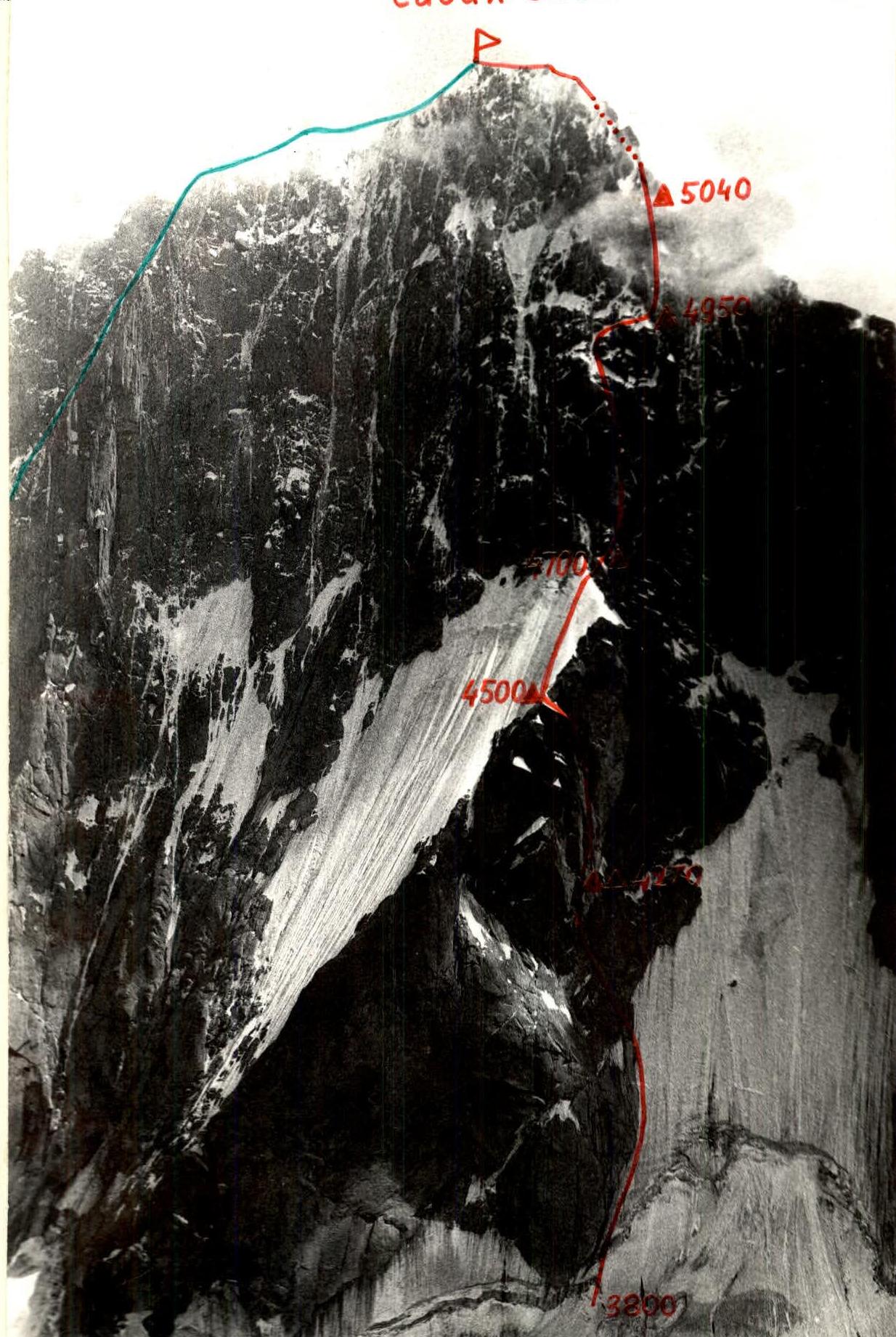
General photo of the summit
- route of the team from Novosibirsk
- team's route
Taken on August 6, 1985 at 15:00, lens "Mir-1", F=37 mm, D=2 km, T. No.1, H=4500 m.
Team's tactical actions
August 4. At 6:00, the rope team Elagin — Koroteev started processing. By 14:00, they had passed the ice and two ropes of rocks of the "triangle" (sections R0-R1, R1-R2, R2-R3). They were replaced by the rope team Bashkirov — Ginzburg, which hung another 60 m of ropes under the cornices by 21:00 (R3-R4 and the beginning of R4-R5). After 17:00, water was flowing almost everywhere on these sections, which significantly slowed down the work.
August 5. The rope team Kolomyitsev — Khokhlov continued processing. At 11:00, the weather deteriorated sharply. Heavy snowfall began, and streams of water flowed down the wall. The pace of movement slowed down sharply, and by 22:00, only 40 m of very difficult rocks had been passed. The rope team reached an inclined slab above the cornices, where the first overnight stay was planned. In bad weather conditions, the rope team used skyhooks and drilled pitons to move across the smoothed, water-soaked slabs. Due to bad weather, it was decided not to have the entire team start the route on August 5, and the processing team was to stay at overnight stay No. 1 and continue processing on the morning of August 6.
August 6. In the morning, the entire group began to ascend from the bivouac under the wall along the ropes, dropped the lower ropes, and Kolomyitsev — Khokhlov continued processing and passed another 30 m on ITO by the time they were relieved at 14:00. They were replaced by the rope team Klinetsky — Mikhailov, which hung about 4 ropes by 22:00.
August 7. While the group was ascending along the ropes hung the day before, the rope team Elagin — Koroteev hung another 1.5 ropes on ice and reached the top of the "triangle" to the site of overnight stay No. 2. While the rest of the group was organizing a bivouac, Elagin — Koroteev hung another 5 ropes on the ice of the "knife," and Bashkirov — Ginzburg, who replaced them, hung another 2.5 ropes in the lower part of the first bastion.
August 8. The rope team Kolomyitsev — Khokhlov started processing the internal corner of the first bastion and passed 2 ropes by 17:00, using skyhooks. The rope team Klinetsky — Mikhailov, which replaced them, passed another 1.5 ropes by 22:00 and descended to the site of overnight stay No. 3.
August 9. The rope team Elagin — Koroteev started processing the upper part of the first bastion. By lunchtime, the weather began to deteriorate, the route was shrouded in fog, and heavy snowfall began. Despite this, the group continued to move along the ice slopes and by 20:00, with visibility not exceeding 30 m, they managed to reach the site of bivouac No. 4, where a sitting overnight stay was organized, and wet clothing was partially dried.
August 10. It was cold in the morning. The thermometer showed −7°. The ropes that got wet the day before were frozen, except for two, which were slightly dried. At 8:00, the rope team Bashkirov — Ginzburg began processing the second bastion. The rocks were almost completely covered with ice. Movement was possible only in crampons. By 15:00, 3.5 ropes were hung.
Then Koroteev — Mikhailov moved forward and continued processing the exit to the ridge along the internal corner. At this time:
- visibility decreased to 20 m;
- snowfall began.
The group, which had ascended along the ropes from below, began to organize a bivouac on a snow-ice "mushroom" three ropes below the ridge. In conditions of zero visibility, the leading rope team hung ropes to the ridge only by 22:00 and descended to the prepared sitting bivouac No. 5.
August 11. It was again very cold in the morning — −10°C. The rope team Kolomyitsev — Khokhlov started at 7:00 to hang ropes along the ridge "gendarmes." At this time, the entire group ascended to the ridge. A very strong cold wind was blowing. It was visible how a huge cloud front was approaching from the south, and by lunchtime, it covered the entire ridge. By 14:00, 5 ropes were hung along the ridge, of which 3-5 cat. diff. At this time, a thunderstorm began. The group stopped under a sharp "gendarme," which served as protection from lightning, and waited until 16:00 for the thunderstorm to pass. The rope team Klinetsky — Mikhailov moved forward, hung another 2 ropes on rocks of 4-5 cat. diff., and reached a gentle ridge of 2 cat. diff., along which the entire group ascended to the summit. Time — 20:00, the group hurried to descend a few ropes. Overnight stay here.
August 12. In the morning, the thermometer showed −15°C. The group descended using rappels to the S. ridge and reached steep ice by 12:00, along which they descended to a scree ridge and, crossing it, found themselves in the northern cirque of Sabah.
Thus, the group, considering the reserve day for bad weather, fit into the tactical plan in terms of time, reaching the summit on the eighth day. There were no deviations from the planned route line. Bivouacs were organized in the planned locations, except for the sixth overnight stay, which was organized three ropes lower than planned due to lack of visibility that day.
As assumed in the tactical plan, the route was carried out with alternating work of the rope teams, resulting in each participant working as the first. When planning the order of the rope teams, their tendency to pass certain types of terrain and their physical condition were taken into account.
During the ascent, all safety measures planned in the tactical plan were implemented. There were no falls or injuries.
The main challenge of the route was passing smoothed steep walls, often covered with ice. This problem was solved by rationally alternating free climbing and using ITO on:
- pitons,
- chocks,
- friends,
- skyhooks,
- drilled pitons,
- ice screws.
Despite very bad weather, the group did not stop moving and fulfilled the tactical plan. During the ascent, communication with observers was regularly carried out (3 times a day) using the "Karat" radio set. Intra-group communication was constantly maintained using the "Vitalka" radio set.
PROFILE OF THE WALL ON THE RIGHT Taken on August 3, 1985 at 16:30, lens I-6ILZ, F=50 mm, D=1 km, T. No.2, H=4200 m.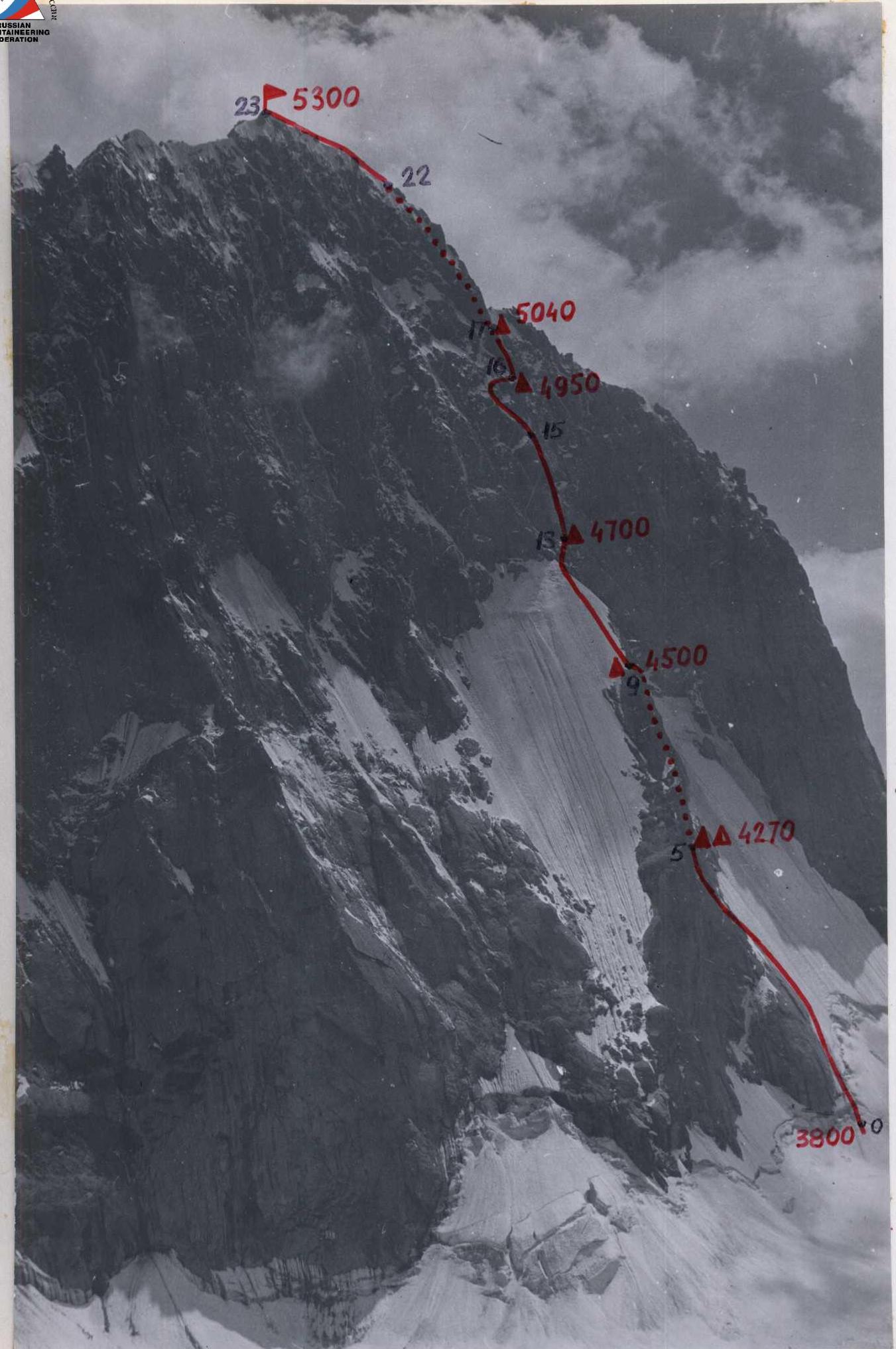
PROFILE OF THE WALL ON THE LEFT Taken on August 7, 1985 at 15:30, lens "I-6ILZ", F=50 mm, D=2.5 km, T. No.3, H=3800 m.
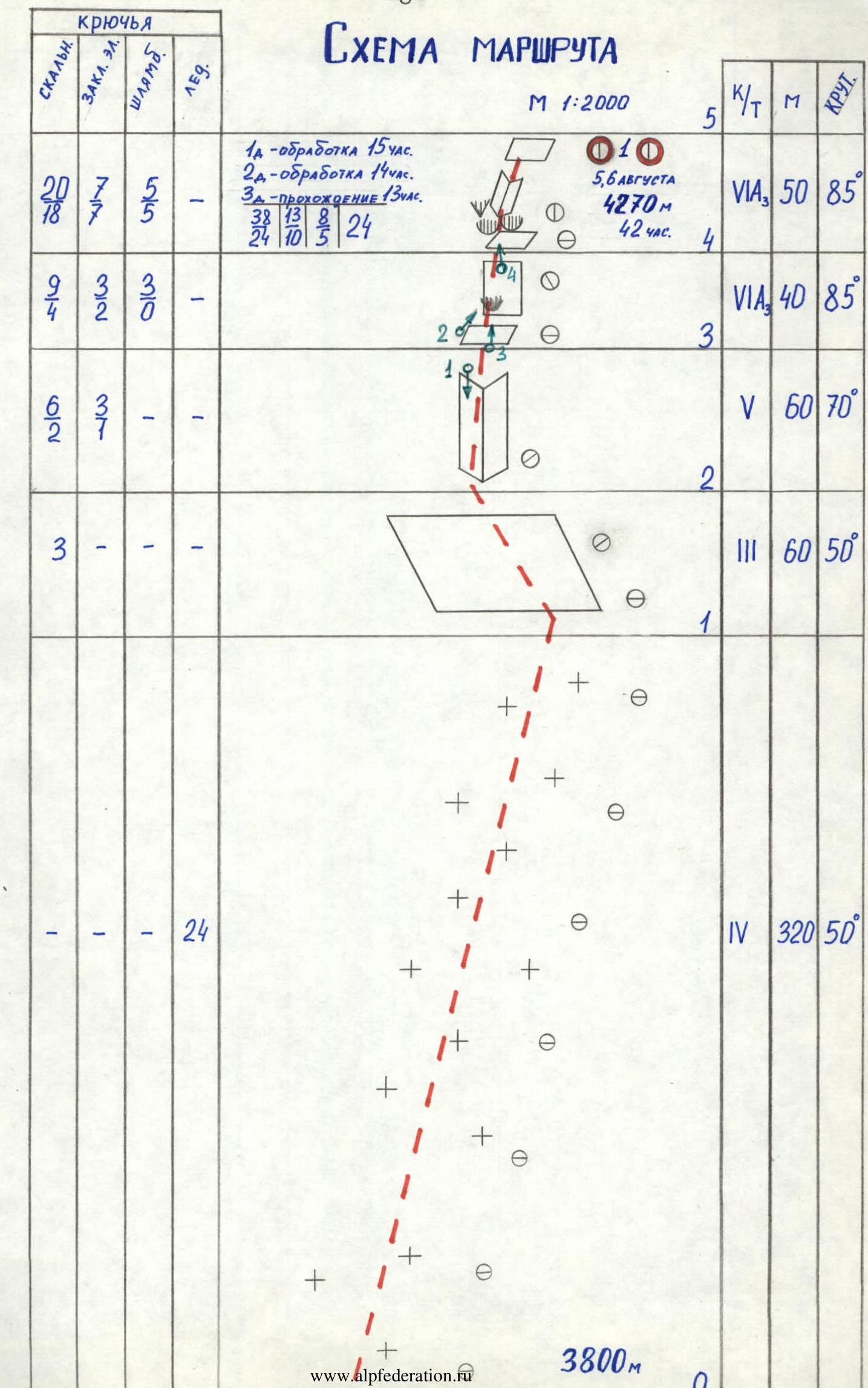
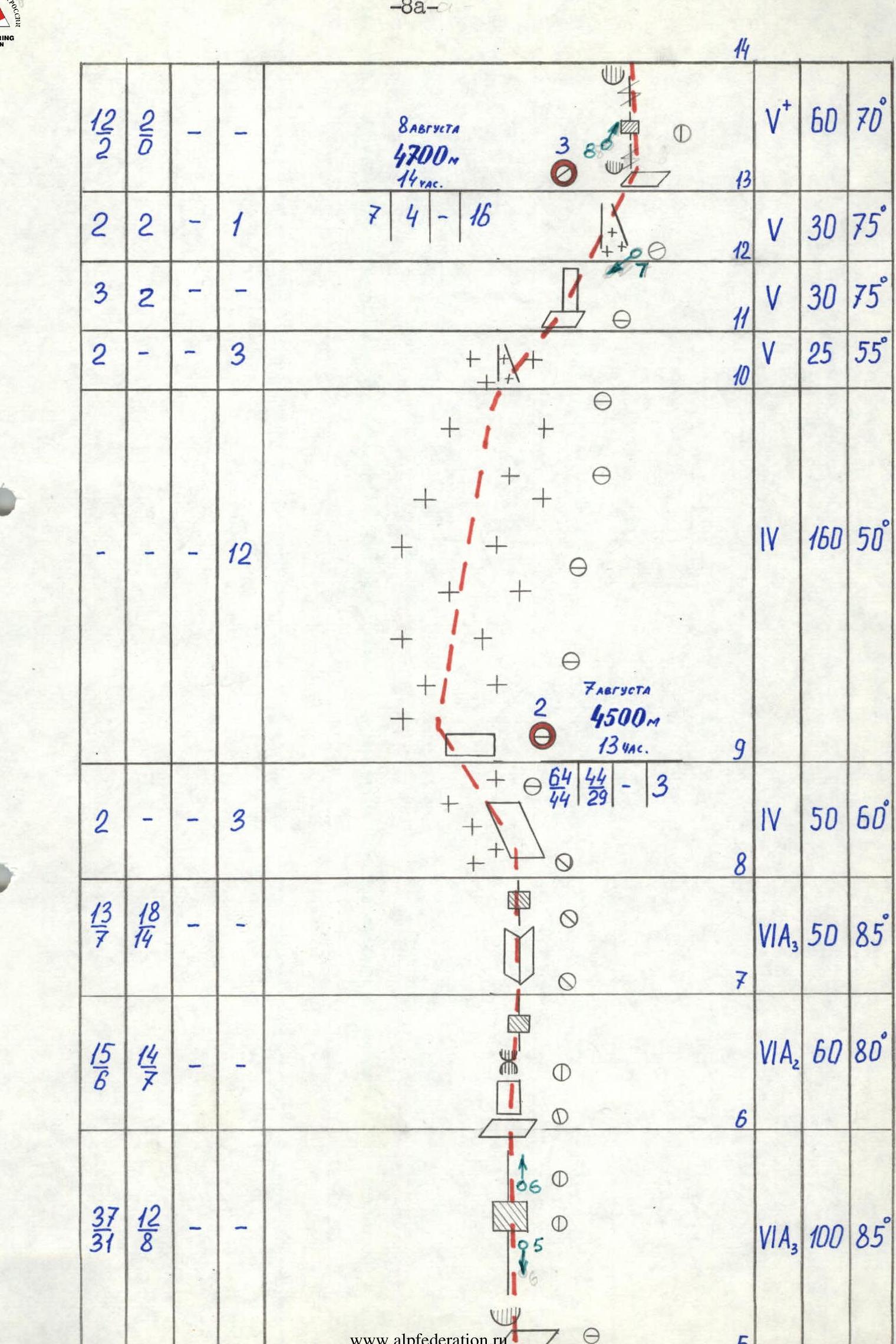
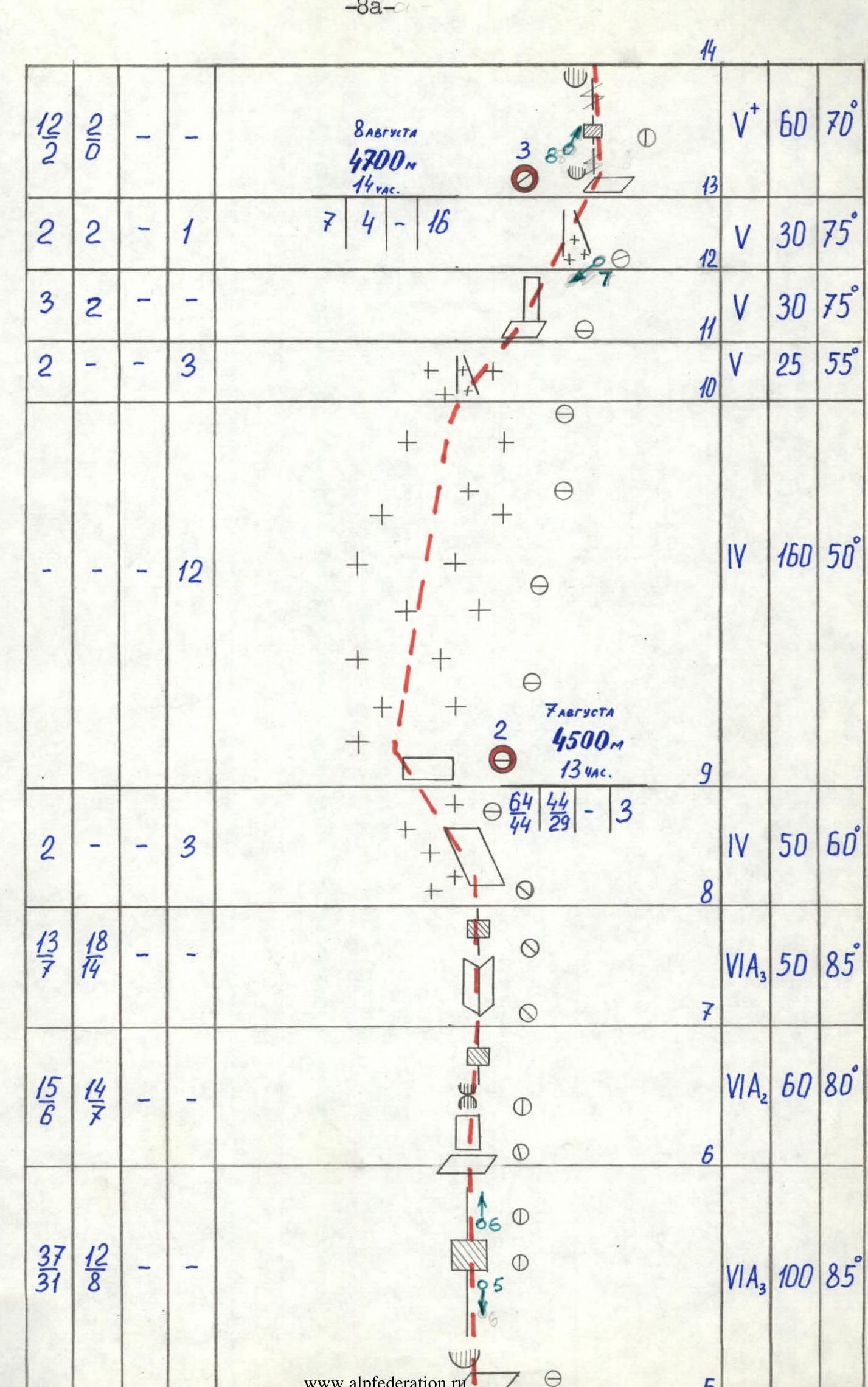
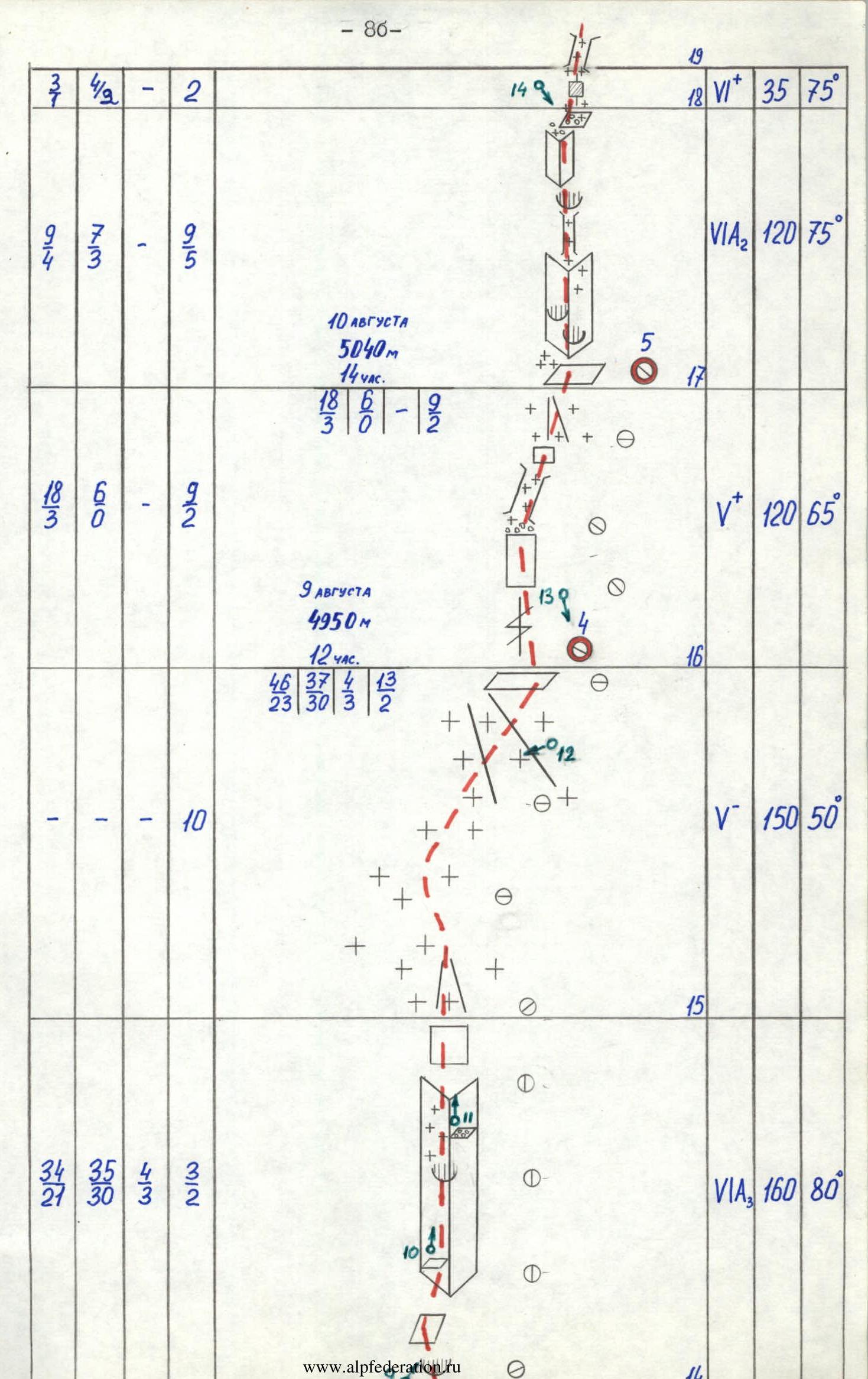

Section R0-R1. Ice slope with rigid ice lenses. Section R1-R2. Very broken rocks. It is safer to pass this section in the morning when individual stones are frozen. Section R2-R3. Internal corner with gradually increasing steepness, reaching 90° in the upper part. At the end of the section, there is a small shelf that can accommodate one person. Section R3-R4. From the shelf, right-upwards through a smooth slab — exit to the right wall of the internal corner. Huge individual stones are wedged in the internal corner. Along the right wall of the internal corner upwards 20–25 m to a spall. Then left-upwards along the spall — exit to a small rocky area under the cornices. In the second half of the day, water flows abundantly onto the area. Section R4-R5. Along a vertical smooth 5-meter forehead — exit left-upwards into an internal monolithic corner with a slit. Upwards along the corner through a small cornice. The slit is partly blind. ITO is used almost everywhere. At the end of the section, there is an overhang, which is passed using large chocks. Then — exit to an inclined (up to 30°) slab. Here is the site of overnight stay No. 1. Section R5-R6. From the overnight stay upwards-right along a blind crack — exit to an internal corner (peeling slabs!). Then, transition along the slits to the right side of the corner and along it — ascent upwards. Alternating free climbing and ITO. Section R6-R7. Along dissected rock relief to the right of huge red vertical rocks — exit under an internal corner. Section R7-R8. The internal corner is bounded on the right by a smooth gray wall. Upwards along it, partly using ITO, to a small shelf. Then upwards along a wet slit — exit to a large inclined slab with snow. Section R8-R9. Along ice and snow lying on the slab — traverse left. Belay on rocks. Exit to an ice slope. Here, on the border between rocks and ice, is overnight stay No. 2. Section R9-R10. Ice slope with rigid ice. Section R10-R11. Crossing a steep ice gully and exit to broken rocks. Section R11-R12. Ascent along a slab straight upwards under a vertical wall. Free climbing. Section R12-R13. Crossing a narrow ice gully to the right and along iced rocks — exit to a small shelf. Site of overnight stay No. 3. Section R13-R14. Ascent upwards-right along a vaguely expressed broken crack leading to the beginning of a large internal corner of the first rock bastion. Section R14-R15. Entry into the internal corner through a 3-meter cornice with a slit. In the corner, there is a wide slit with ice. Using this slit and the right side of the corner, 30 m upwards — to a small shelf. Almost everything is passed using ITO on chocks, friends, and drilled pitons. From the shelf, 20 m upwards along the internal corner — under a 5-meter overhang with a wide slit filled with ice. Then — exit to a shelf with loose rocks. From here, the internal corner starts to ease. Upwards along the internal corner, using its left wall, another 90 m. Exit to ice slopes under the second rock bastion (there are many loose blocks and slabs on this section). Section R15-R16. Along ice walls and gullies — movement first left-upwards, then right-upwards — under the base of the second rock bastion. On a small platform cut out in the ice — sitting overnight stay No. 4. Section R16-R17. Along a vertical, ice-filled slit — straight upwards 30 m to easing. Then — under ice-filled rock slabs and along them — exit to broken rocks under an internal corner leading to the ridge. Here, on a platform cut out in a snow-ice "mushroom," is overnight stay No. 5. Section R17-R18. Along an internal corner with overhanging blocks and then — along an almost sheer 20-meter gully with very rigid ice — exit to an ice-filled cirque. Section R18-R19. Along a vertical, cracked, 5-meter wall — left into a large fracture with ice, then — along a 10-meter chimney filled with ice — exit to a large scree area on the ridge. Section R19-R20. Bypassing a vertical smoothed "gendarme" on the right along shelves (80 m). Section R20-R21. Along smoothed monolithic rocks (good friction) — exit by free climbing to the ridge above the vertical smoothed "gendarme" (80 m) — to a large flat area. Section R21-R22. The next ascent of the ridge — bypassed right-upwards (80 m) by free climbing. Exit to a simple gentle ridge. Section R22-R23. Along a wide ice ridge with individual rock outcrops — exit to the summit (300 m).