
Ministry of Sports and Tourism of the Krasnoyarsk Krai
KRASNOYARSK REGIONAL FEDERATION OF ALPINISM
Russian Championship in Alpinism
2014
Class: High-Altitude Technical
Report
On the ascent of the Krasnoyarsk Krai team to Peak Parus Western 4850 m via the north wall. First ascent, 5B category of difficulty. Krasnoyarsk 2014.
Ascent Passport
- Region — Turkestan Range, Lyaylyak gorge area, Ashat gorge
- Summit — Parus (3), 4850 m, via the center of the north wall
- Category of difficulty — 5B
- Route characteristics — combined
5. Route characteristics:
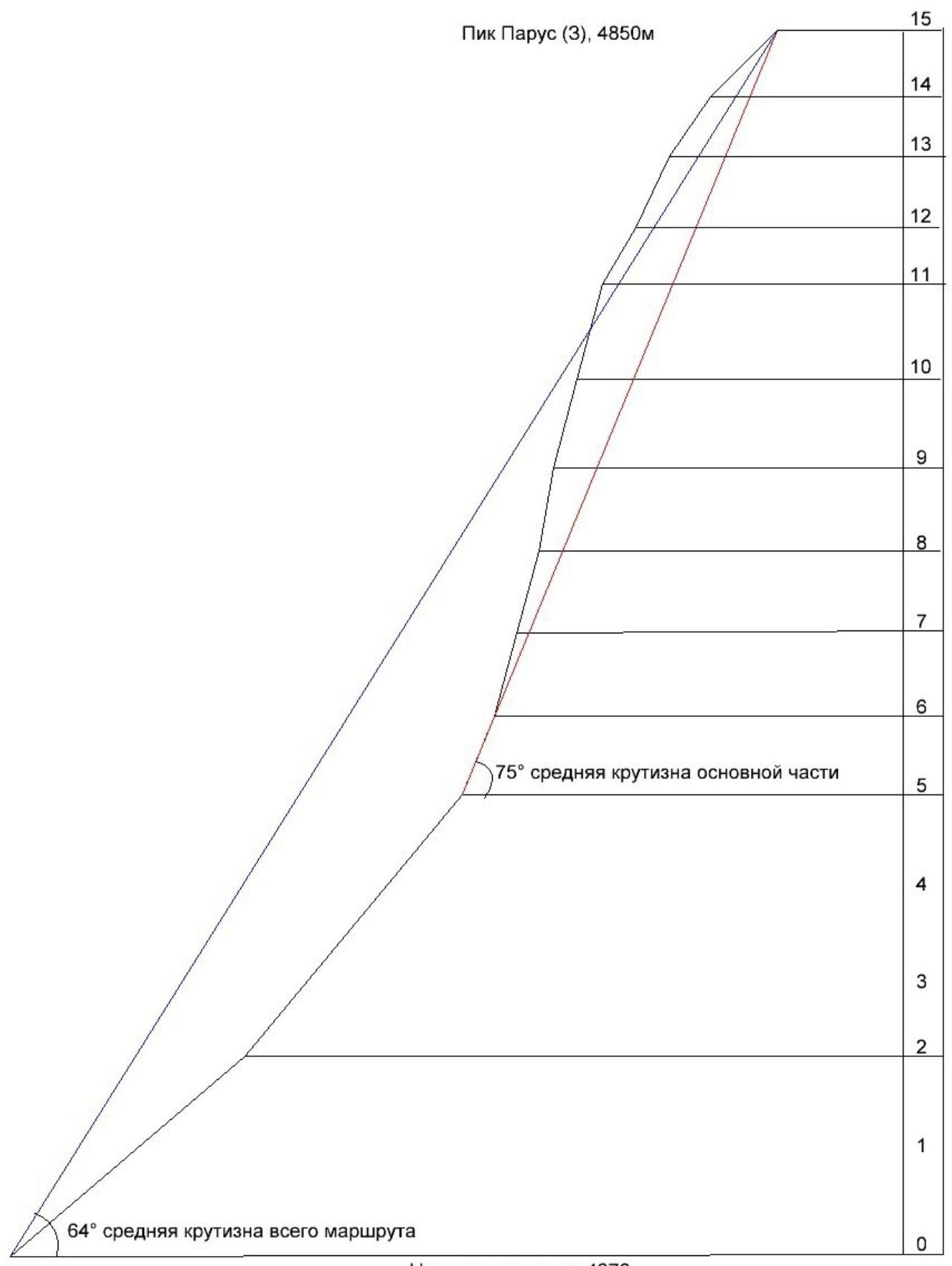
Elevation gain of the main part — 580 m,
route length — 727 m.
length of sections with 6th category of difficulty — 214 m, 5th category of difficulty — 103 m
average steepness of the main part — 70°
- Equipment used on the route: anchor hooks — 51/42, cam hooks — 47/28 pcs, ice screws — 24 pcs, sky hooks — 3 pcs, bolt hangers — 1 pc, + about 48 ITO on "fifas", left on rappels — 13 anchor hooks, 1 bolt hanger
- Total climbing time — 18+6 hours of descent at night, via the ascent route, Days — 1.
- Team leaders: Zigalov Alexander Vladimirovich, 1st hour sports category
Vlasenko Pavel Sergeevich, 1st hour sports category
- Team coaches:
Balezin Valery Viktorovich, Master of Sports of International Class, Honored Trainer of Russia
Zakharov Nikolay Nikolaevich, Master of Sports of International Class, Honored Trainer of Russia
- Departure date:
From the storming camp located at 4270 m — March 1, 2014, 5:30
Route start via ice — 6:00. Start of the wall section — 11:00. Summit — 23:59. Return to the storming camp — March 2, 2014, 8:00
- Ascent organized by — Ministry of Sports and Tourism of the Krasnoyarsk Krai
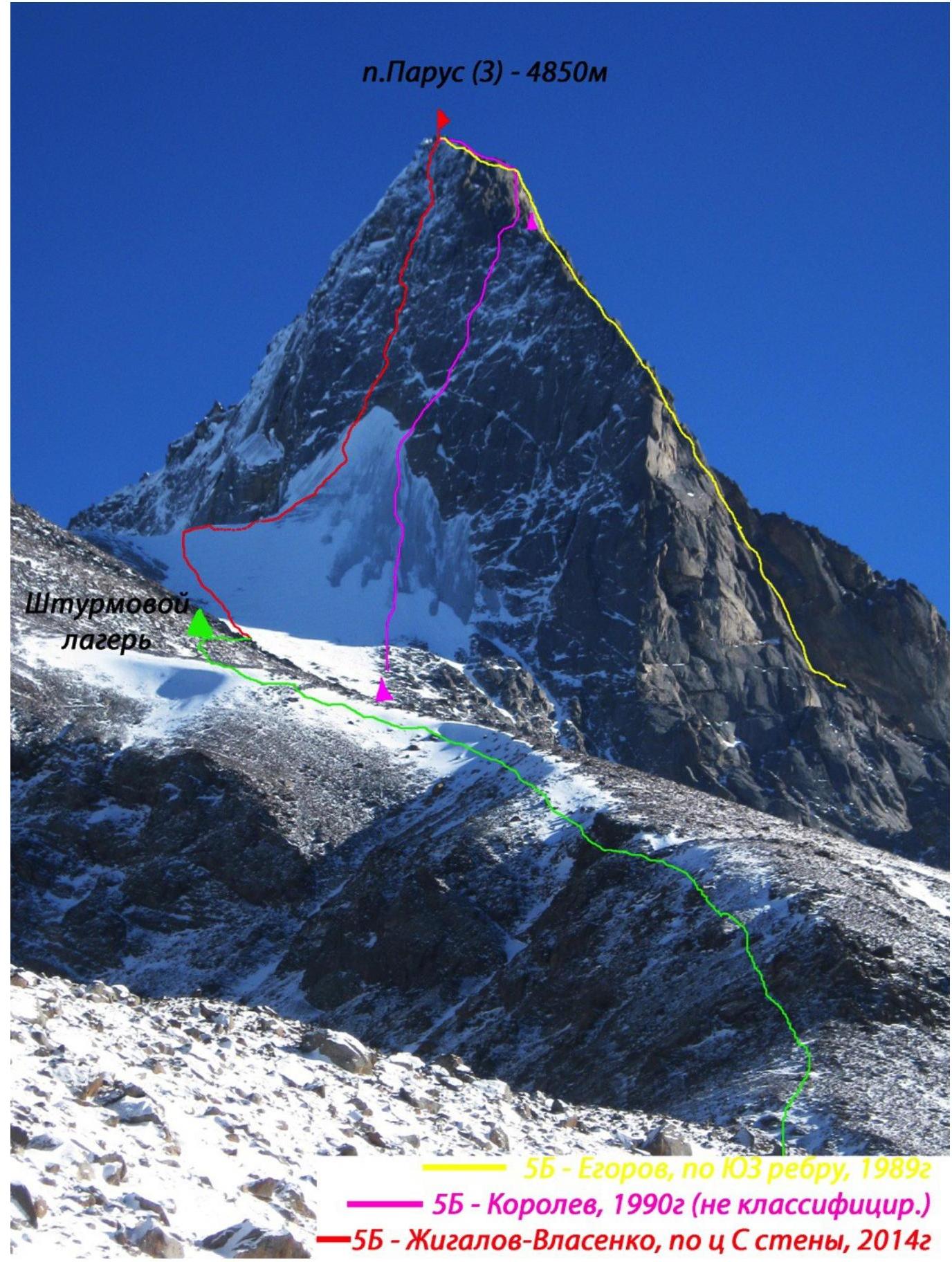
55 — Egorov, via the SW ridge, 1989; 55 — Korolev, 1990 (unclassified) — 55 — Zigalov-Vlasenko, via the center of the N wall, 2014.
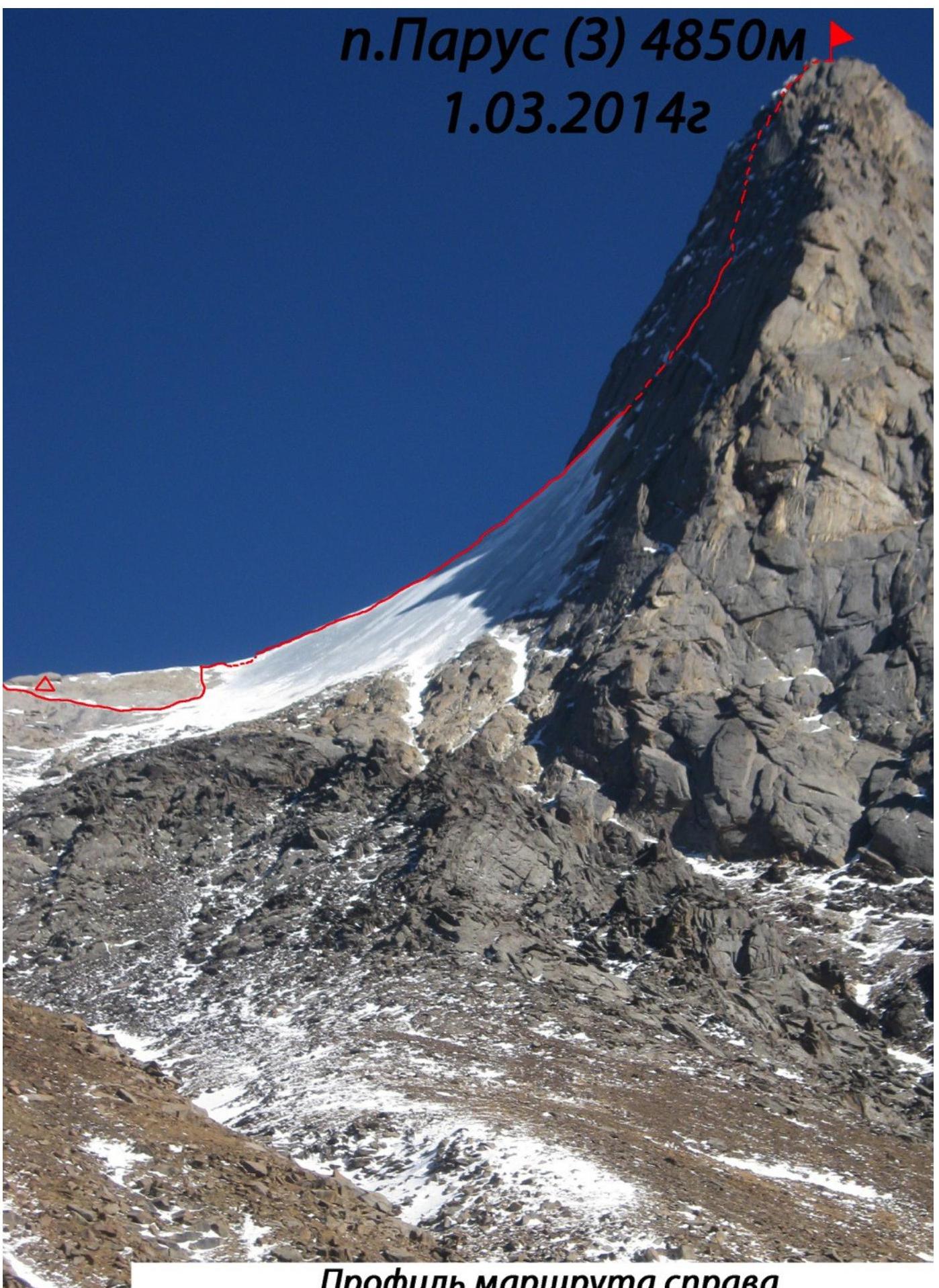
Profile of the route on the right. Taken on the approach to the Yu. Koshelenko bivouac.
Start of the route, 4270 m.
Hand-drawn profile of the route.
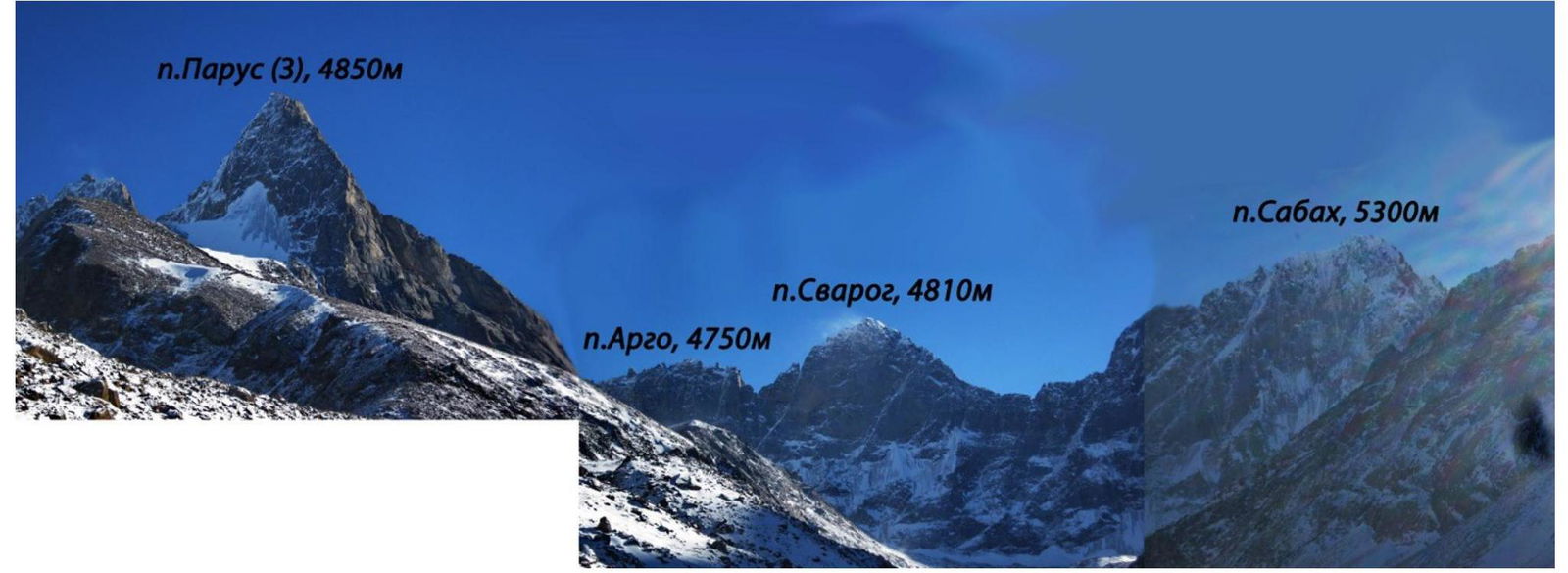
Photo panorama of the area.
Tactical actions of the team
In February 2014, a Krasnoyarsk expedition was organized in the Ashat gorge, Turkestan Range. The main goal was to achieve a first ascent on Peak Svarg by the center of the north wall.
After a long, gradual acclimatization, on February 25, the team from Krasnoyarsk, consisting of 5 people:
- Efremov I.,
- Kalita G.,
- Vlasenko P.,
- Loginov I.,
- Zigalov A. attempted an ascent on Peak Svarg. Due to illness of one of the participants, on the second day of the ascent, the team decided to descend from 1/3 of the wall. The same night, the team returned to the base camp in full.
Part of the equipment and supplies were left at the Yu. Koshelenko bivouac, the rest was transferred to the base camp.
The next day, February 27, 2025, further plans were discussed. There were 5 days left until the end of the expedition.
Finally, on February 28, it was decided to attempt a new objective. During the approach under Svarg, our attention was drawn to the north wall of Peak Parus Western with a large snow-ice "spoon" at the foot.
Vlasenko Pavel and Zigalov Alexander decided to climb the route via the center of the wall. It was decided:
- To complete the route without bivouacs
- In case of not reaching the summit on time — to descend via the ascent route.
On February 28, at 13:00, the duo Zigalov — Vlasenko, with necessary equipment, headed to the storming camp. Efremov Ilya and Kalita Georgy assisted them.
They also brought down the remaining equipment from the Yu. Koshelenko bivouac to the base camp.
At 21:30, Zigalov — Vlasenko reached the site of the storming camp under the "spoon" of Parus (3), 4270 m above sea level. Efremov — Kalita returned to the base camp.
On March 1, at 5:30, the duo departed from the storming camp, starting work on the route at 6:00. Using a simultaneous movement scheme, the team reached the rock part of the route by 10:30. Zigalov A. worked on the lower part of the route, on snow and ice. Then, according to the tactical scheme, the leading climber changed. At 11:00, Vlasenko P. started working on the wall section of the route. On station R6, they left a control turret, a plastic bottle with a note. On section R10–R11, a bolt hanger was hammered due to very poor, unreliable terrain. From it — a pendulum to the right.
At 21:00, they reached the "roof" of the route. It is not much weaker than the wall section. Alternating "ram's foreheads", mixed terrain, and snow took a lot of strength and time.
At 23:59, the duo reached the summit of Peak Parus (3), immediately contacting the base and transmitting information.
On March 2, at 1:00, they began descending via the ascent route, leaving expendable loops and anchor hooks on the route.
They were under the route at 7:00, arrived at the storming camp at 8:00, had breakfast, and went to sleep.
At 14:00, they dismantled the storming camp and began descending to the base camp. On the way, they met Efremov Ilya, who helped carry part of their equipment.
At 21:00, all participants were at the base camp. The next day, March 3, 2014, the entire team descended to Lake Gurush, marking the end of the Krasnoyarsk expedition to Sabakh 2014.
Ascent graph to p. Parus (3) 4850 m, via the center of the N wall.
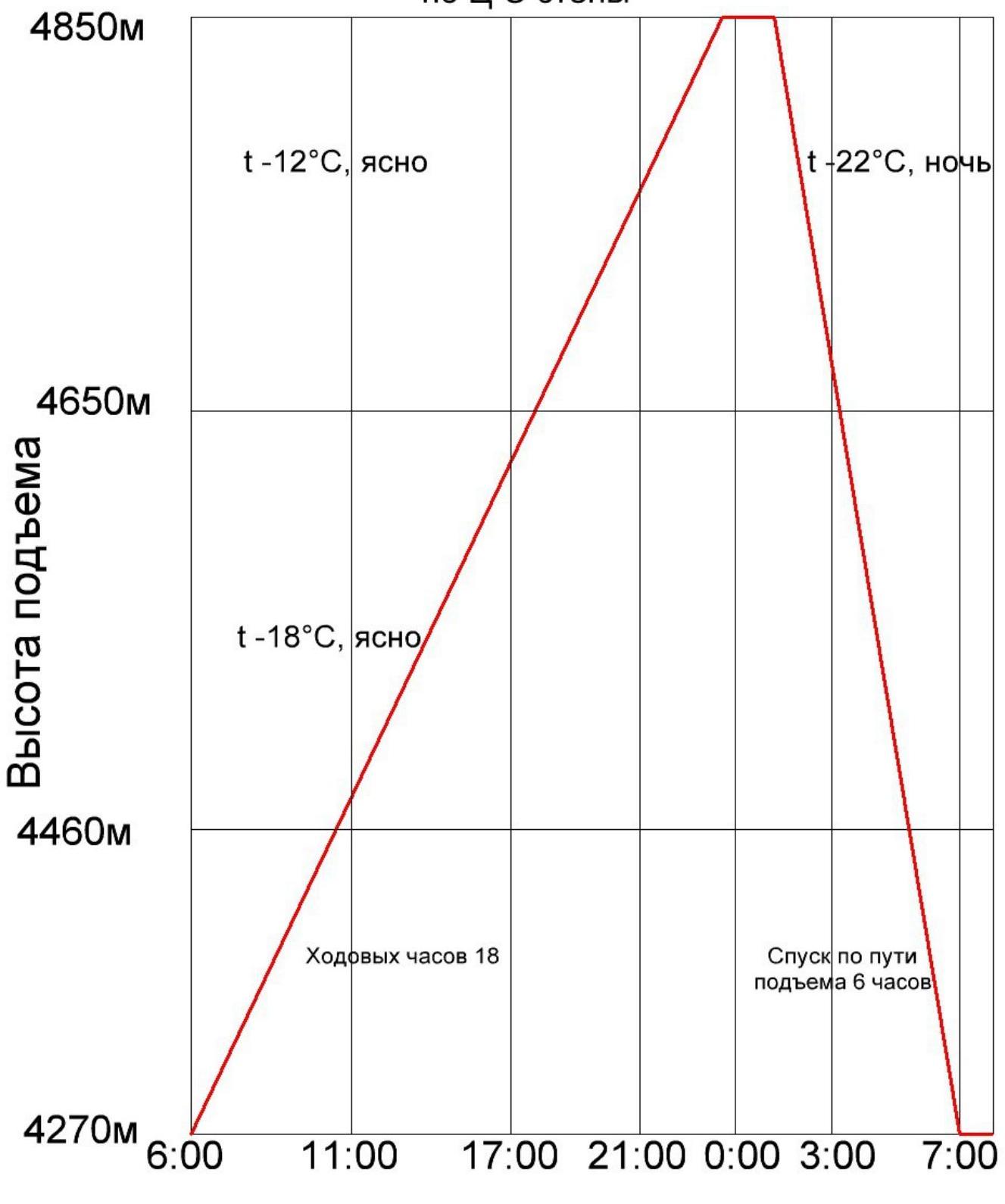
Ascent hours on March 1–2, 2014.
UIAA scheme.
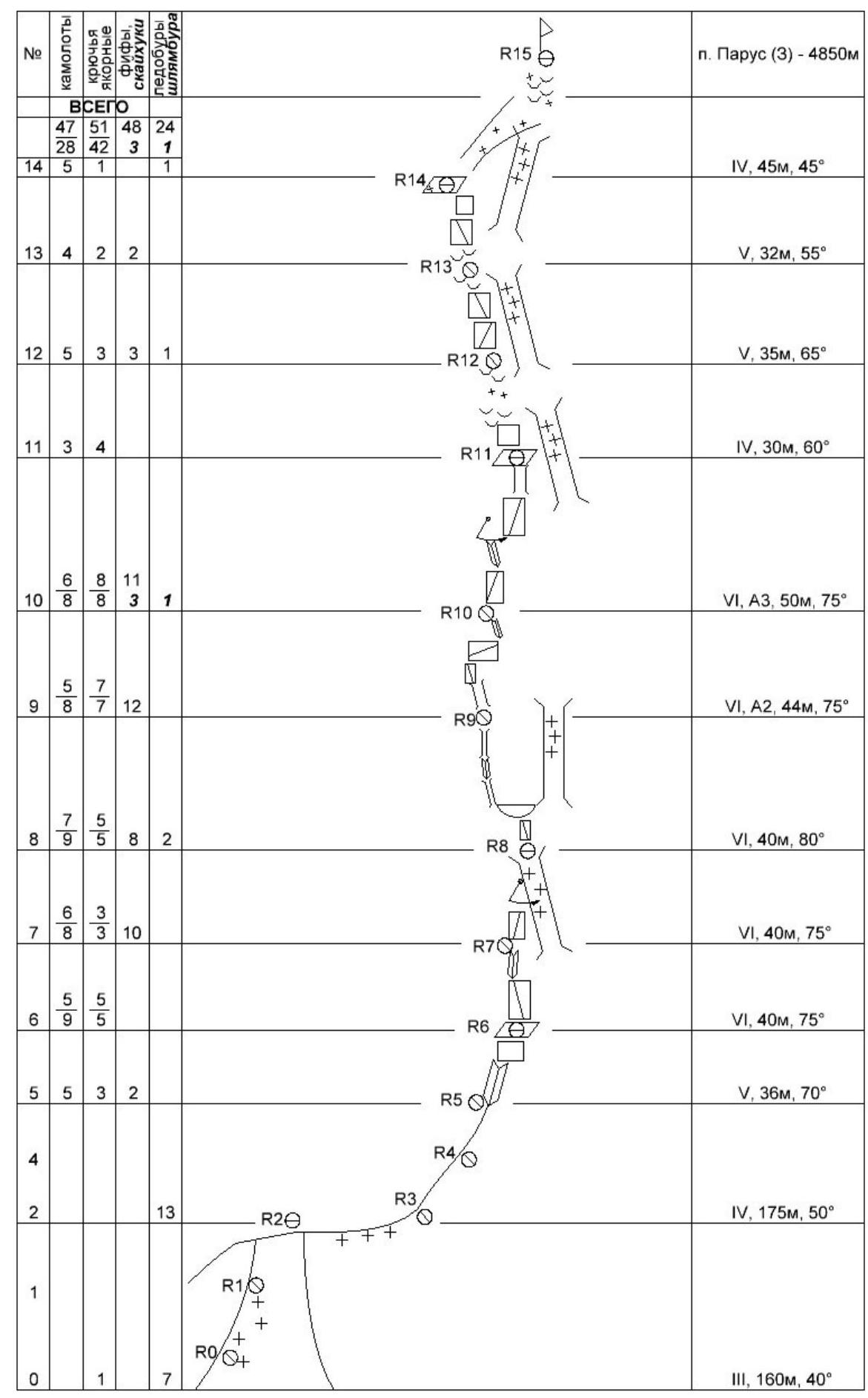
Route description by sections
Approach to the storming camp — 4270 m from the base camp, located near a cowshed at 2550 m, takes about 6–7 hours for acclimatized athletes.
The trail passes along the left slope of the gorge. General direction — south, up the gorge. After passing the first lake, move along the left edge of the moraine, gradually gaining height towards the "ice spoon" of Peak Parus (3).
Just before the ice, there are small ledges on the scree for setting up 2–3-person tents. The route starts from firn fields, transitioning into ice.
Section R0–R2 — 160 m, 40°, III category of difficulty. Firn transitioning into ice. Exit to a sharp ridge, ending in a 2 m snow cornice. Station behind the bend on a snow cushion, on ice screws.
Section R2–R5 — 175 m, 50°, IV category of difficulty. Up the snow knife to the rock. The angle of inclination increases, snow gives way to ice. Ice screws were used for protection. Station under the start of an internal angle on screws.
Section R5–R6 — 36 m, 70°, V category of difficulty. Destroyed internal angle, transitioning into a small wall with cracks.
Station on a convenient ledge, with a control turret and a bottle on a rope.
Section R6–R7 — 40 m, 75°, VI category of difficulty. Wall with a thin crack under anchors, then — a non-obvious internal angle.
Station is hanging.
Section R7–R8 — 40 m, 75°, VI category of difficulty.
- Wall with cracks
- After the cracks — a small pendulum to the right, into a snow couloir
- On snow, on tools, under a cornice
- To the right, an orientation point — a wide vertical chimney with mixed terrain
Section R8–R9 — 40 m, 80°, VI category of difficulty. Through deep cracks, approach under a destroyed cornice. Under it, possible accumulated snow. Under the snow, the relief, traverse left — points are unreliable, rock crumbles. Then, a vertical chimney, alternating with an internal angle, местами mixed. Station is semi-hanging on a screw and anchors.
Section R9–R10 — 44 m, 75°, VI category of difficulty, A2. Chimney with mixed terrain approaches a snow patch. After — a series of walls with cracks. First key section. Much debris, points are unreliable. Station is hanging, recommended to be reinforced additionally.
Section R10–R11 — 50 m, 75°, VI category of difficulty, A3. Second key section. On the wall with deep cracks to the right, towards an internal angle. Then, along an inclined internal angle with poor relief to the wall, up the wall on "toporiks" and sky hooks to the only bolt hanger on the route. From the bolt hanger — a pendulum to the right, 5 m to the wall, on it to "fifas" to a vertical chimney. The chimney ends with a snow ledge.
Station is convenient, also accessible via a wide chimney to the right, visible on the wall.
Section R11–R12 — 30 m, 45°, IV category of difficulty. Start of the roof. Gentle wall, climbed by free climbing. Series of "ram's foreheads", alternating with mixed terrain.
Section R12–R13 — 35 m, 50°, V category of difficulty. Several options:
- Go right via an ice "brook" with embedded stones.
- Go via the left part, alternating inclined walls with relief and "ram's foreheads".
Section R13–R14 — 32 m, 45°, V category of difficulty. "Ram's foreheads", transition to low walls, местами snow. Station on a large snow ledge, under a stone.
Section R14–R15 — 45 m, 40°, IV category of difficulty. Up a snowy couloir to the right. Via mixed terrain, bypassing "ram's foreheads", exit to the ridge. Here, a rappel loop, and 5 meters left, a cairn with a note.
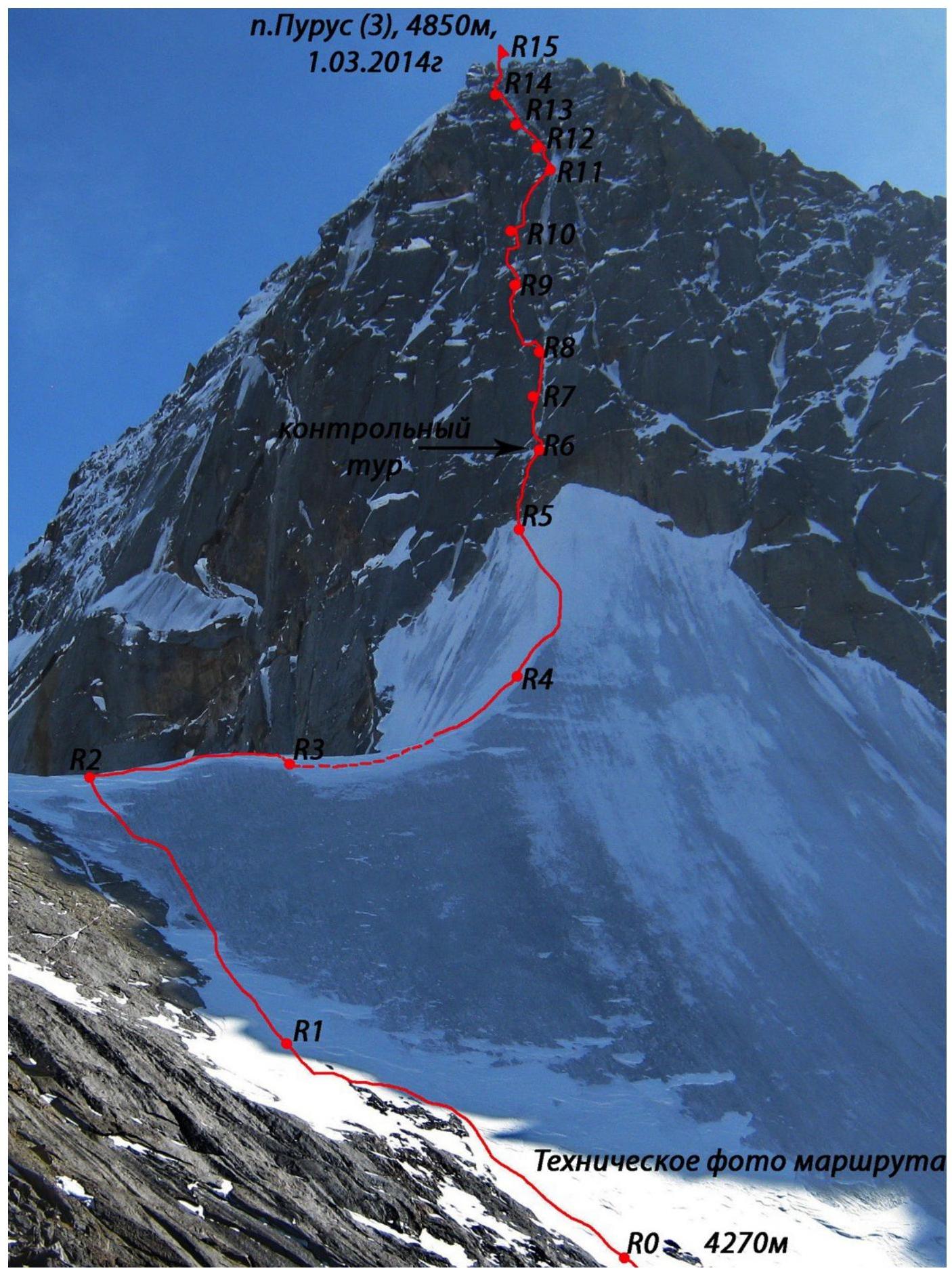
Technical photo of the route.
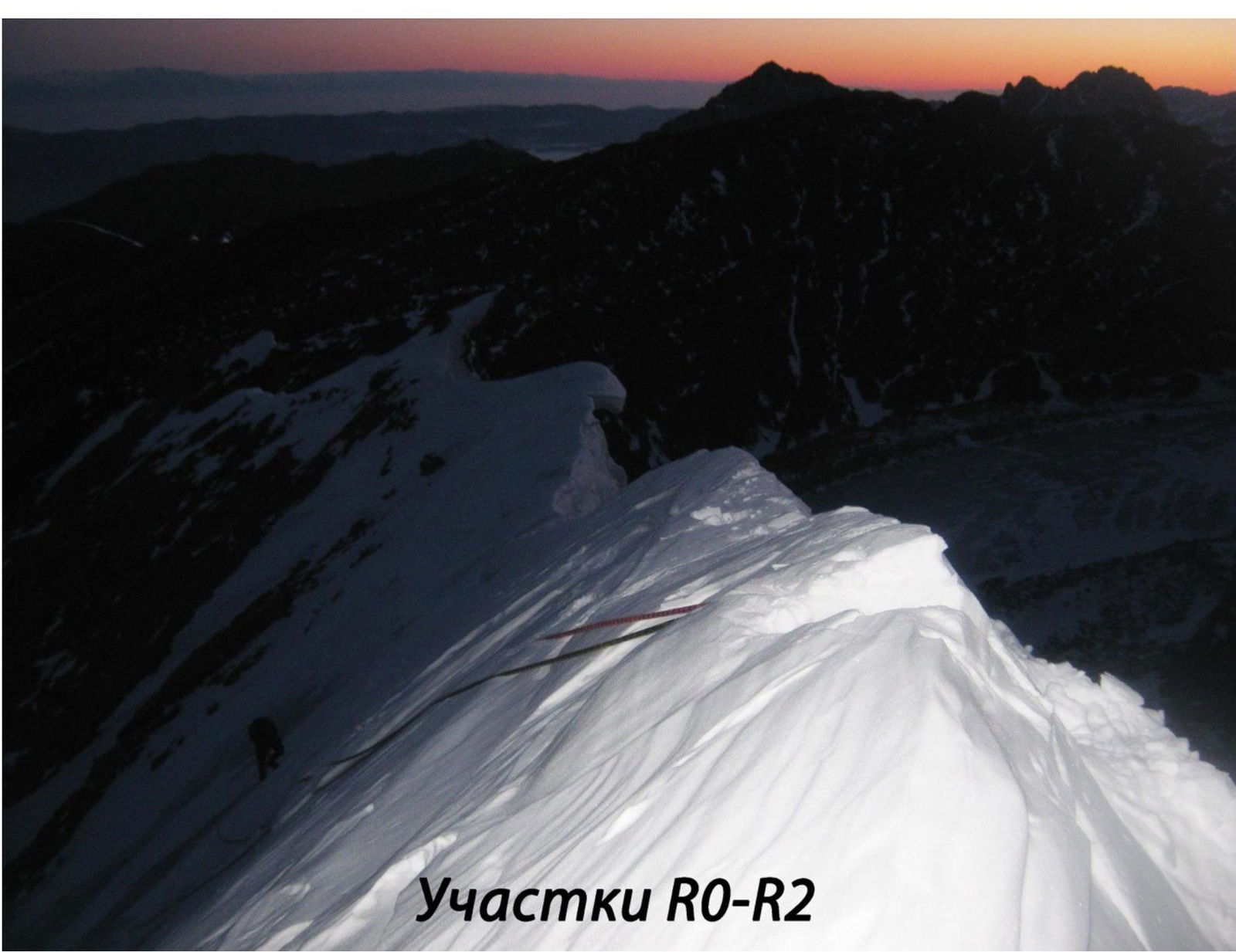
Sections R0–R2
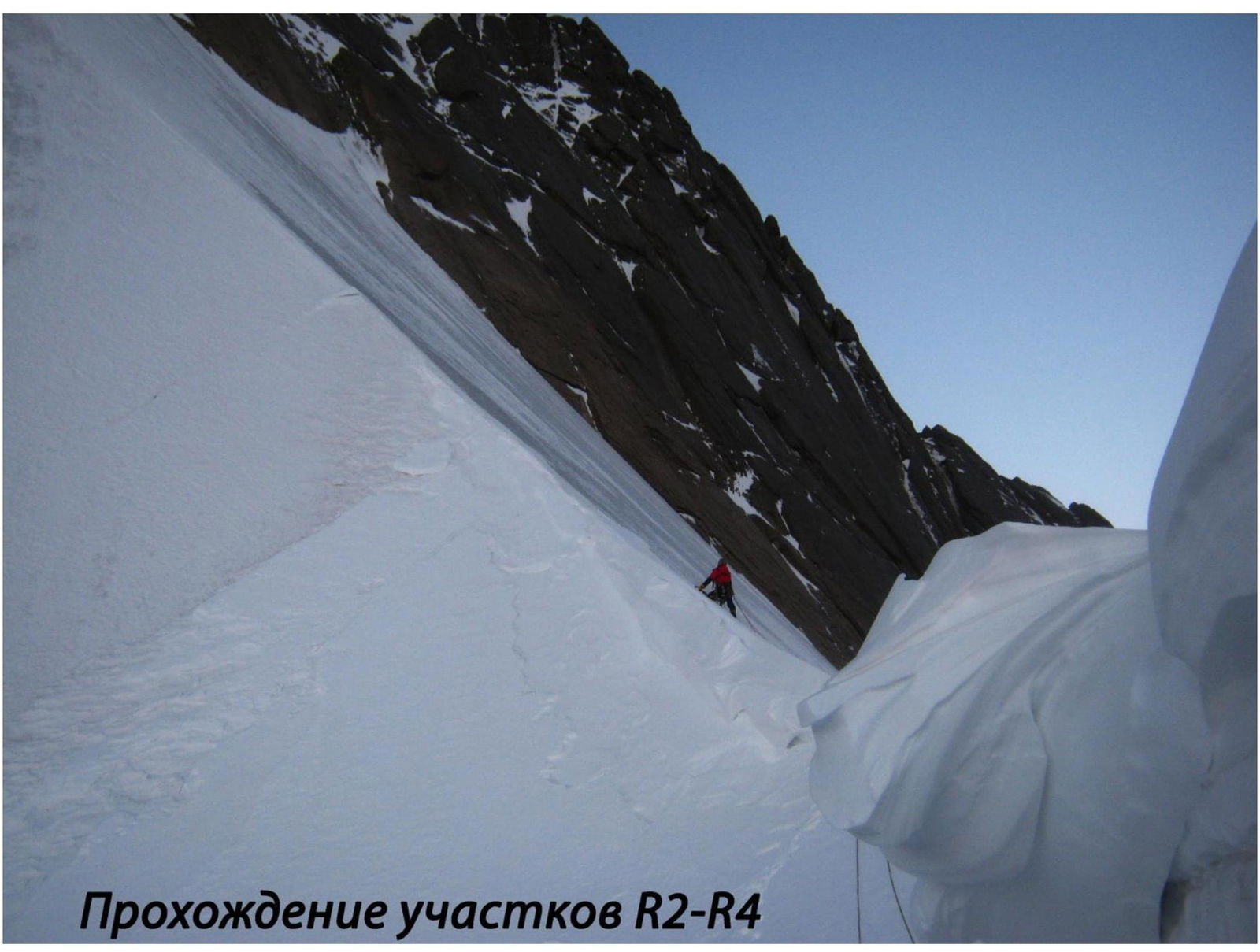
Passage of sections R2–R4
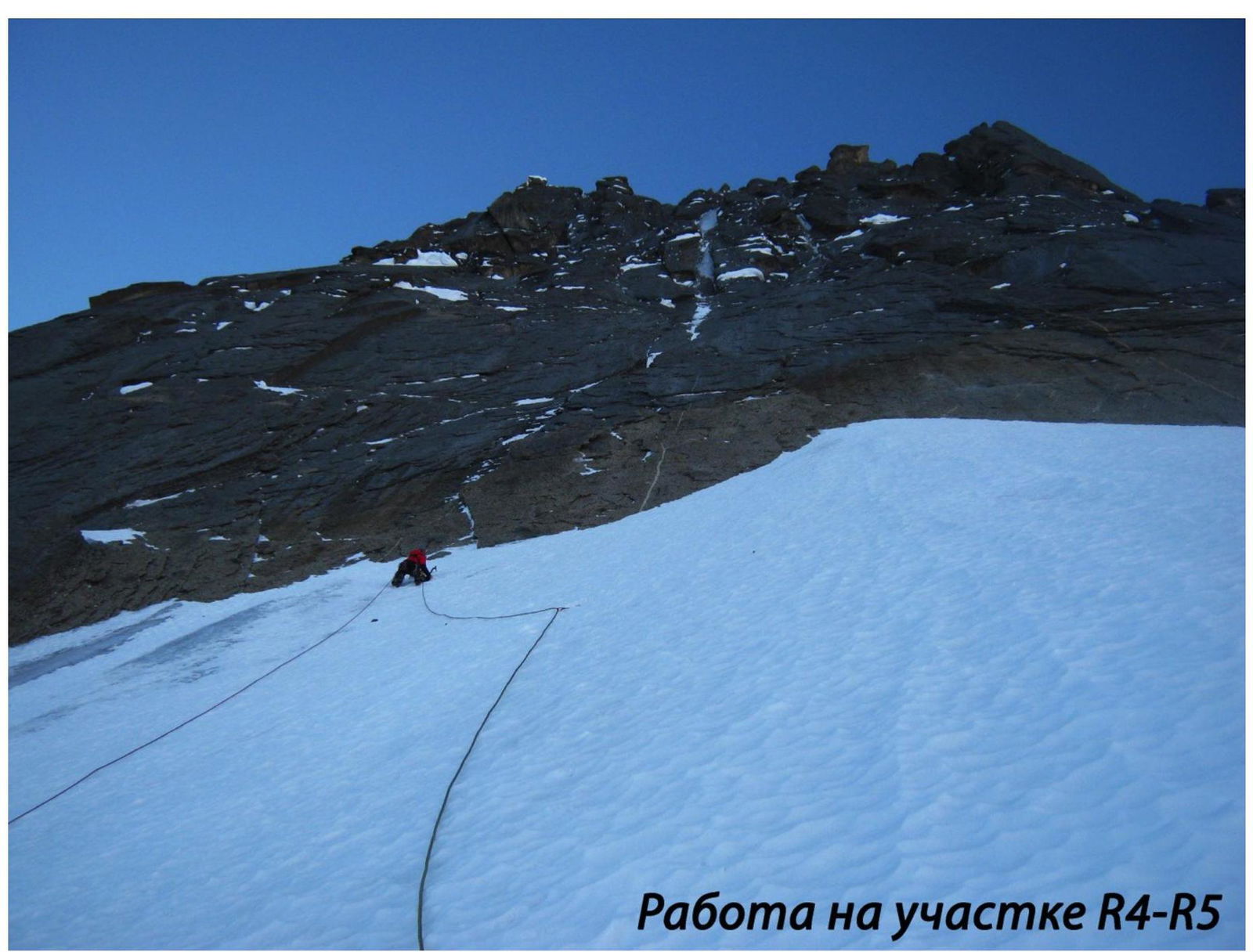
Work on section
R4–R5
Sections R0–R5, view from above.
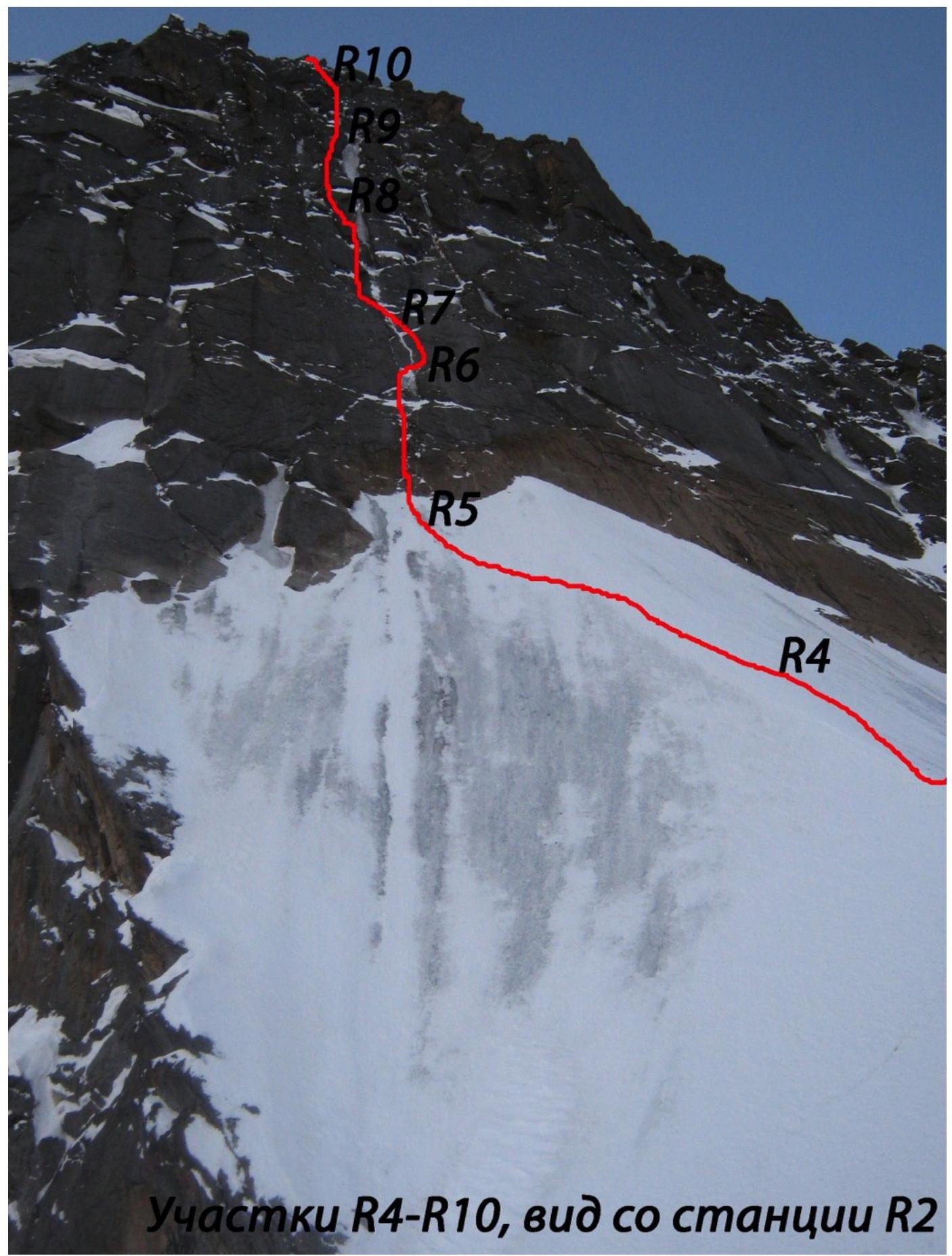
Sections R4–R10, view from station R2.
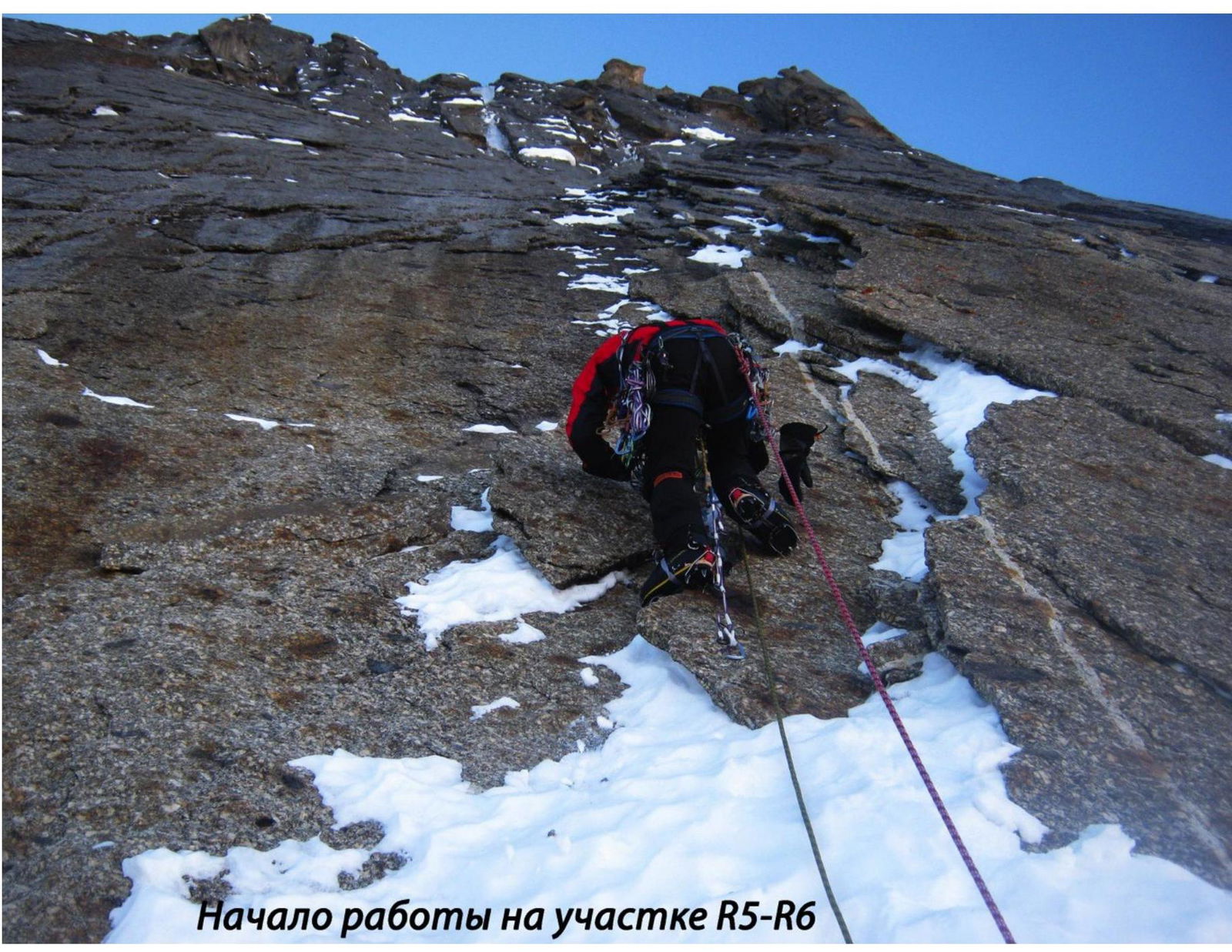
Start of work on section R5–R6.
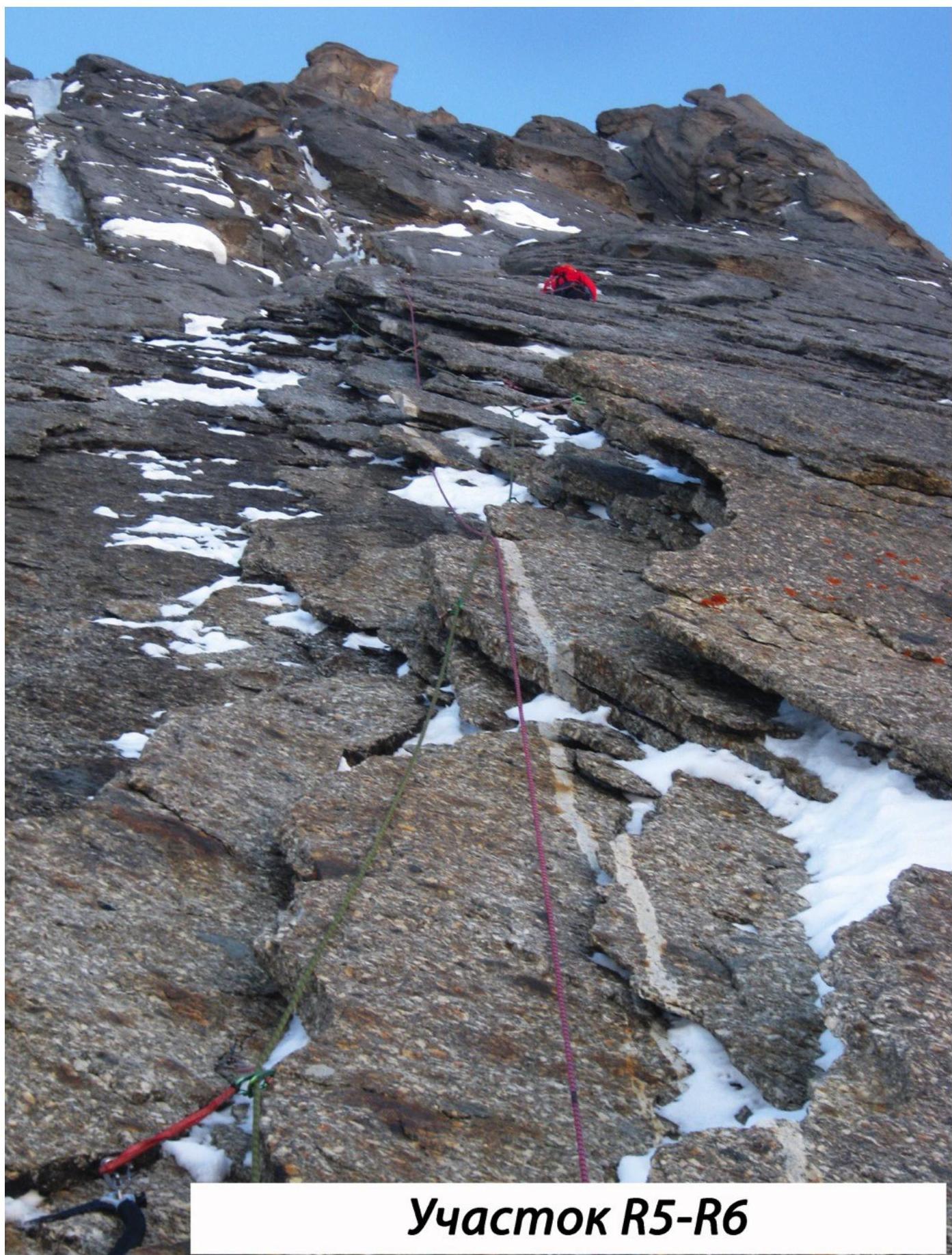
Section R5–R6.
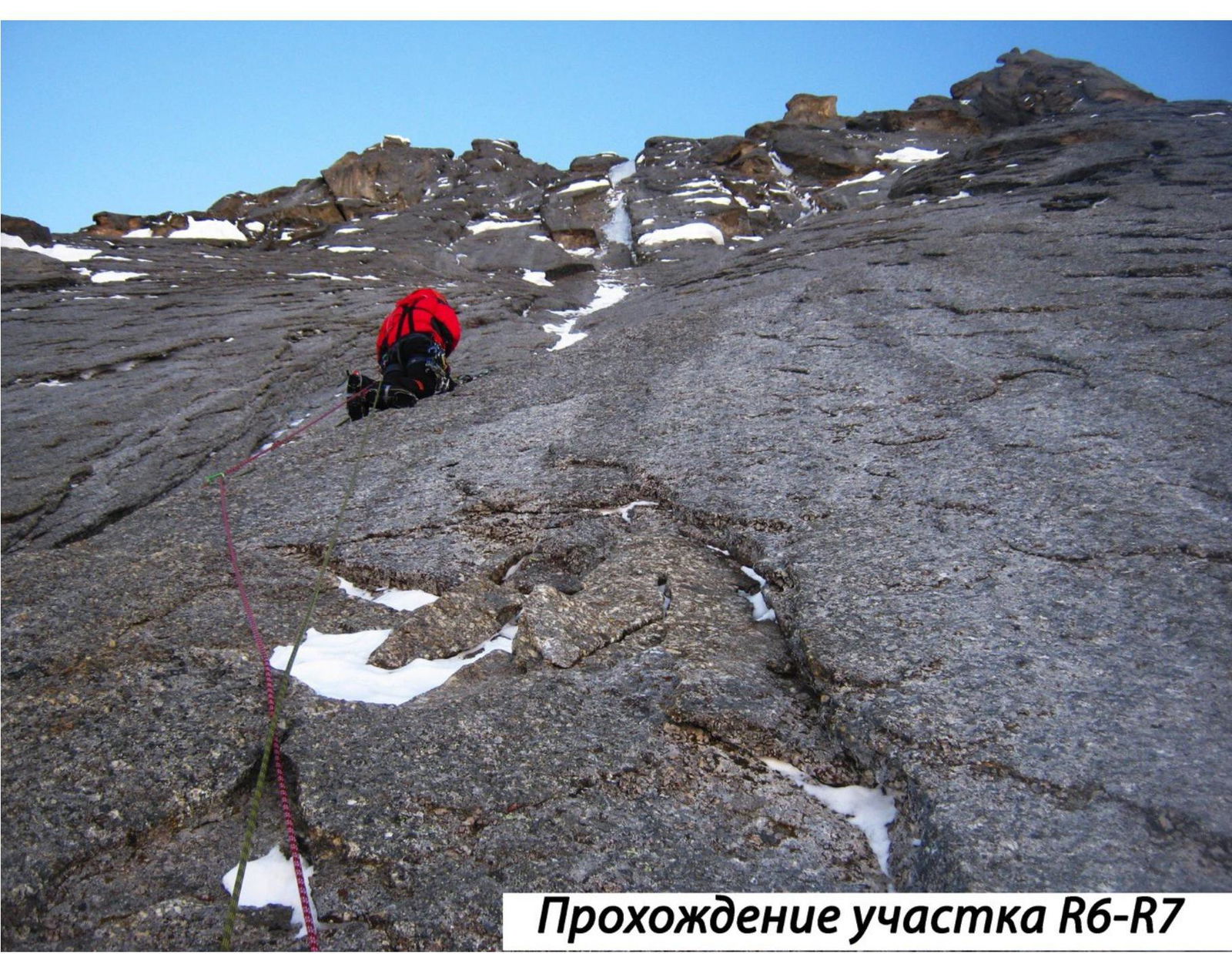
Passage of section R6–R7.
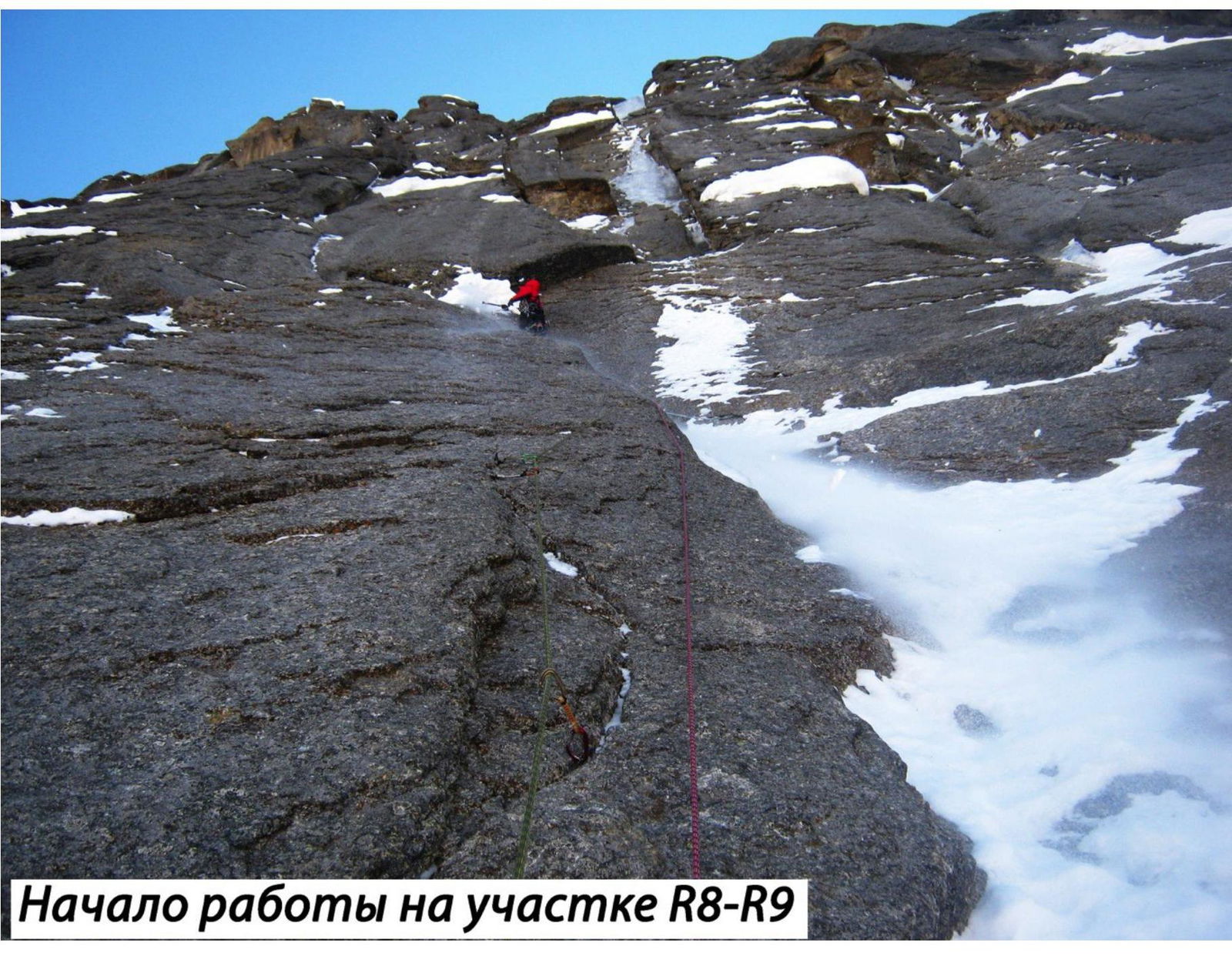
Start of work on section R8–R9.
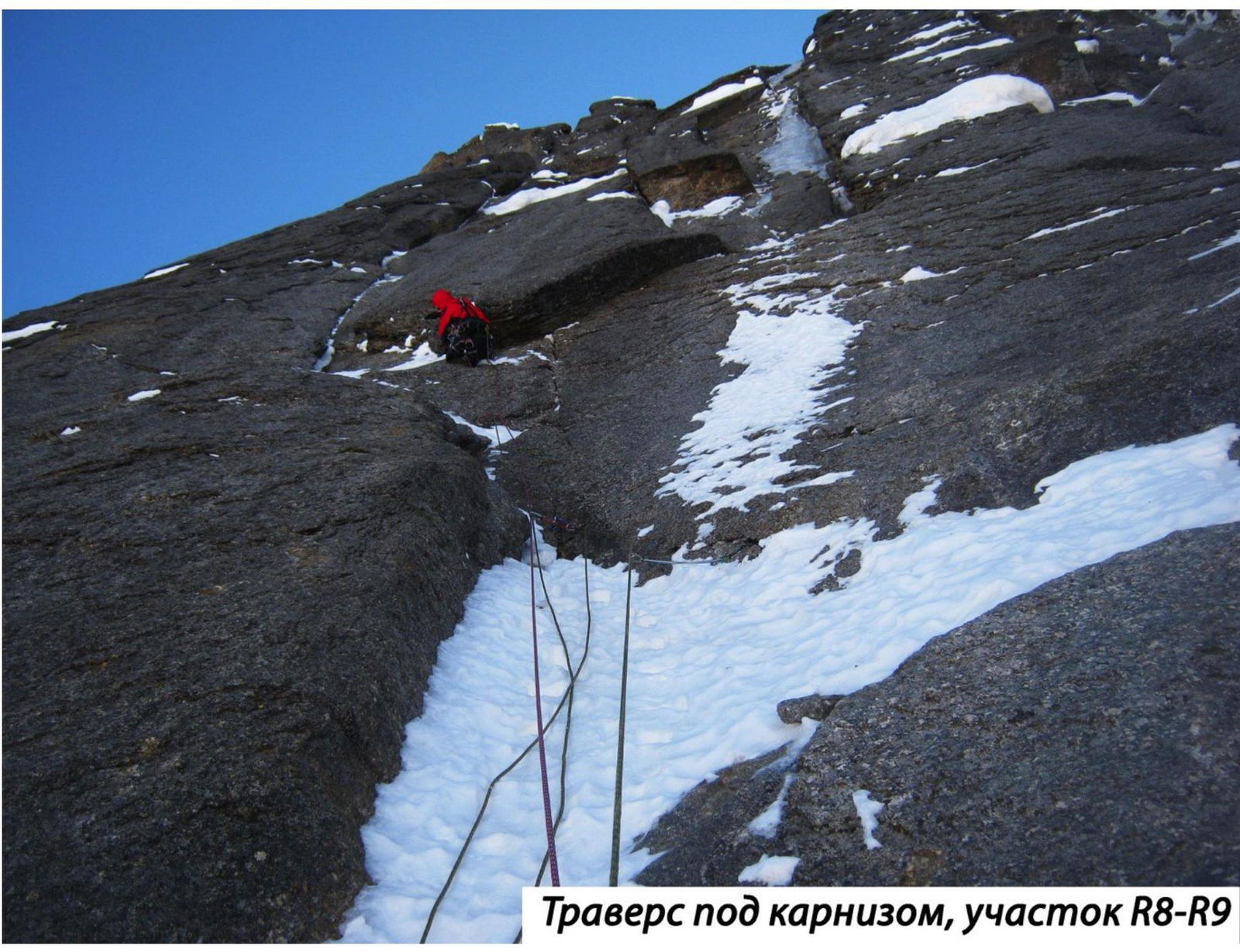
Traverse under the cornice, section R8–R9.
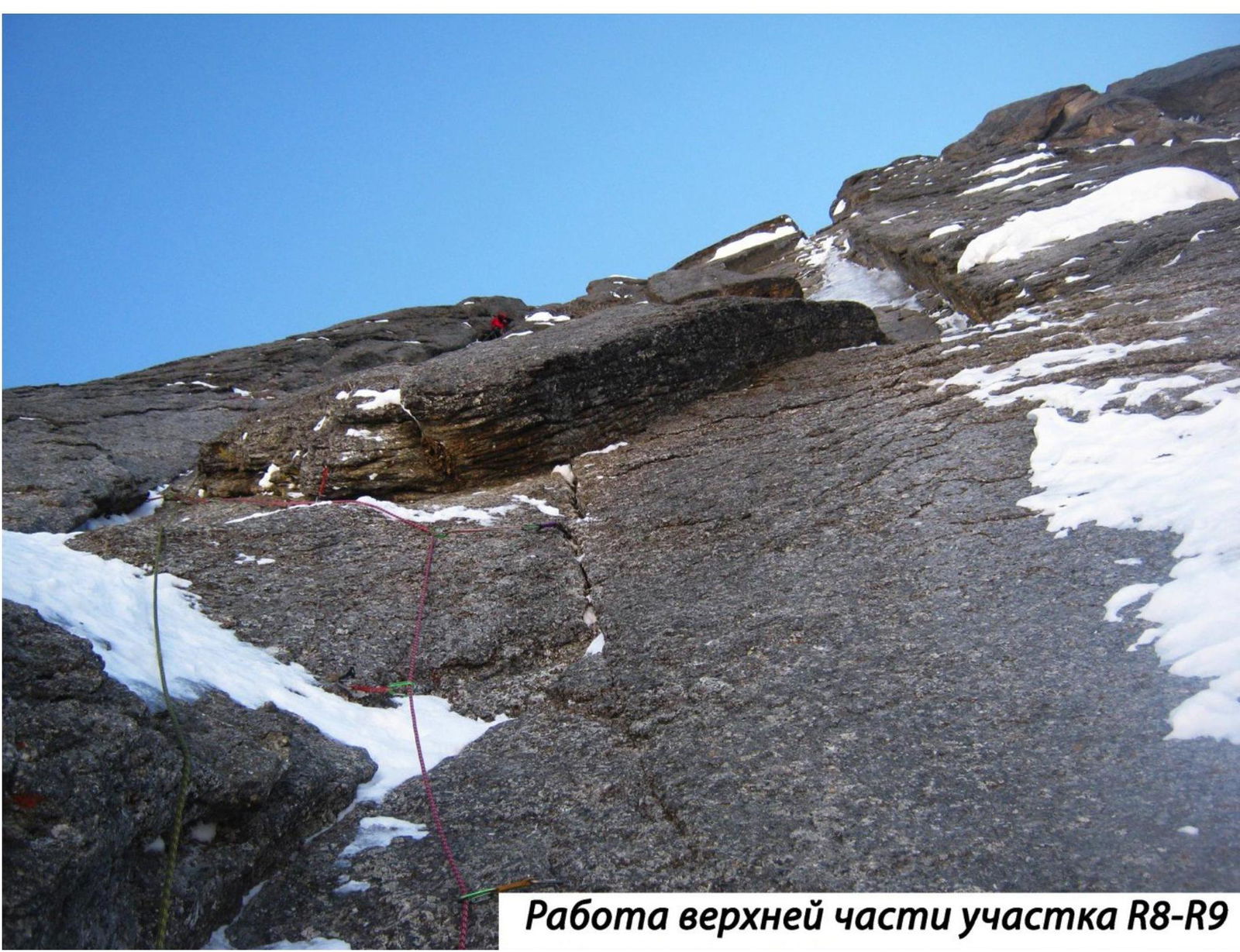
Work on the upper part of section R8–R9.
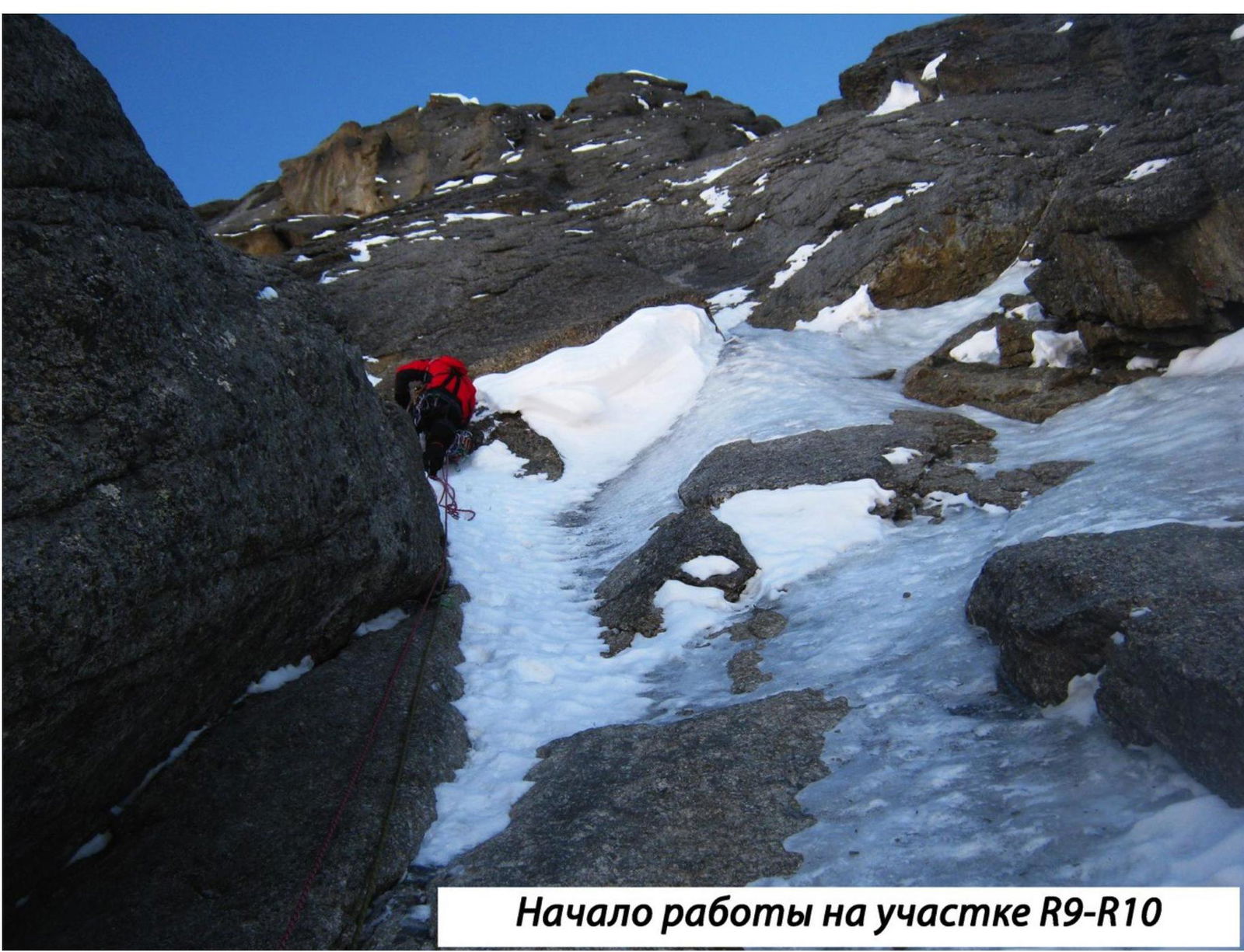
Start of work on section R9–R10.
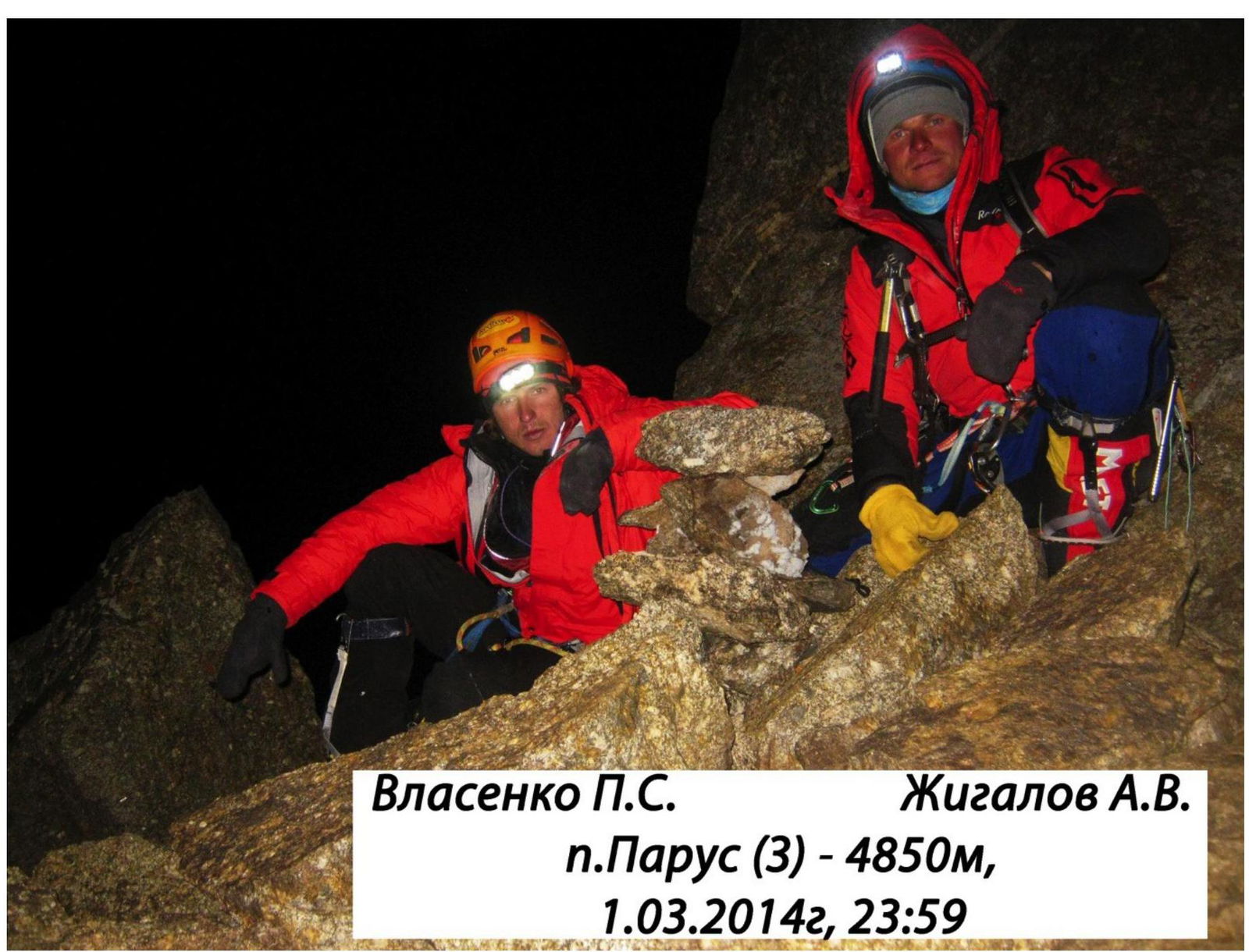
Vlasenko P.S.
Zigalov A.V.
p. Parus (3) — 4850 m, March 1, 2014, 23:59.
Map-scheme of the area.
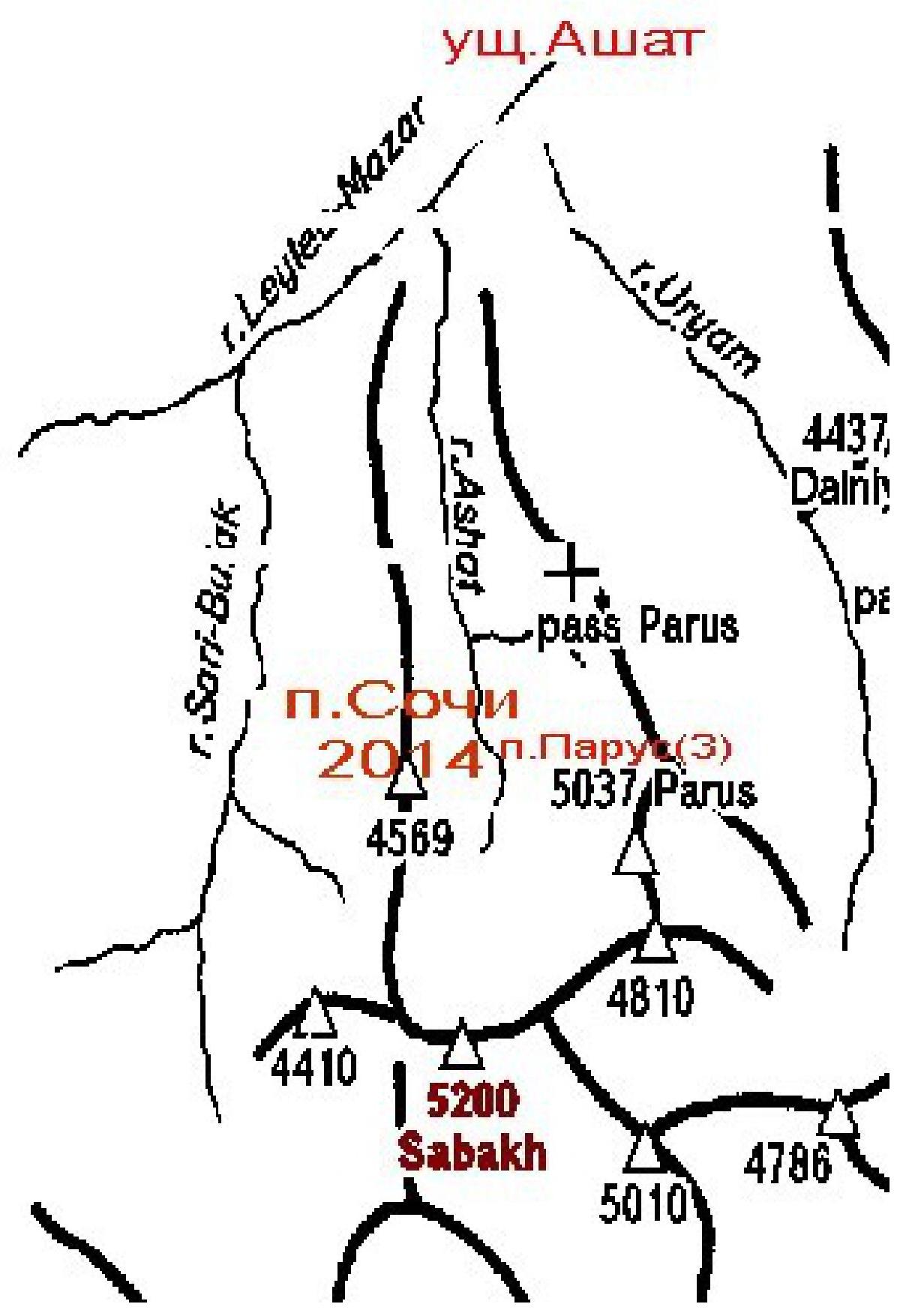
From Uzgorush to the mouth of the Uryam gorge — 5 hours, plus 1 hour 20 minutes to the mouth of the Ashat gorge.
Up the Ashat gorge — 4–4.5 hours, elevation gain from 2220 to 3350 m.
The Ashat gorge is unique: narrow at the mouth, it widens towards the sources, beautiful and original.
The base camp is better located above the cowshed by 200 m, near the glacier (fewer mosquitoes and horseflies) and closer to the routes by an hour.
The first ascent on p. Sabakh (the highest point in the area, 5300 m) was made in 1985 by a team from Novosibirsk as part of the Russian Championship (2nd place). With guidance from V. Kavunenko. The route was via the counterfort in the center, exit near the summit.
According to Andrey Komolov's stories: Moscow "Spartak" in 1989–1990 actively developed the area — helicopter drop-off from Aksu, then on donkeys through Uryam, through a 2-pass.
Climbed almost all peaks from 2 to 6 category of difficulty:
- t. Parus (w) — Sverdlovsk team via the south wall, 1985
- Western ridge 6A — Egorov, 1989
- North wall 5B (via the "spoon") — team leader Korolev, participants Kolomyitsev, V. Shibanov A., and Andrey Komolov himself.
Central Parus — first ascent via the south ridge, approximately 4A, team leader Moskvich E.
Eastern Parus — first ascent via the north ridge from the saddle, approximately 4B, team leader Shorokhov S.
Vladimir Bashkirov attempted an ascent on p. Svarg with a giant cornice (they passed the cornice but didn't succeed further).
In 1990, they completed a traverse of the Ashat wall, USSR Championship in the traverse class.
Many ascents on v. Ashat from 2B to 5A, team leaders Klinetsky, Shibanov, and others. Anatoly Moshnikov in 1989 climbed the main peak of the Ashat gorge — p. Sabakh — a direct route via the north wall.
After 1990, the area was not developed as actively. Many routes on the walls of the Parus and Sabakh massif, but most routes were not submitted to the classification commission, so they remain unclassified.
In 1997, Yuri Koshelenko reviewed the FAR archives and found several reports on this area, and learned that the area is legendary due to having a cornice with the largest overhang in the USSR (about 15 m). In memory of Bashkirov and Moshnikov, in the summer of 2012, he decided to organize a small expedition to this, long-forgotten by climbers, area.
In 2013, another expedition by Yuri Koshelenko with a team from Rostov. They completed a first ascent on p. Sabakh via the N wall as part of the Russian Championship in the high-altitude technical class. Parus Western (4850 m) and its sufficiently monolithic south and west walls with many cracks and fissures — an excellent object for many rock ascents (so far, only two routes are classified on this summit:
- Egorov's 1989 route via the SW ridge, 5B
- SSW counterfort, 5A.
Information obtained from internet resources and from Yuri Koshelenko.