
I. Technical Class
- Pamir-Alay, Ak-Su gorge.
- Peak Sev. Iskander 5000 m via NE wall.
- Assumed – 6B, first ascent.
- Height difference 700 m, length 850 m.
- Length of sections: VI cat. diff. — 400 m.
V cat. diff. — 215 m. Average steepness of the main part of the route — 77° (sections R0–R16, 4300–4870 m).
- Pitons driven:
rock 93/33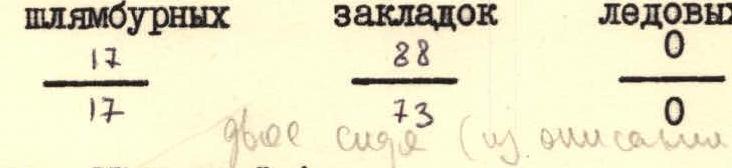 Bolt pitons: 17/17. Nuts: 88/73. Ice screws: 0/0.
- Climbing hours: 37 and days 4.
- Overnights: 1st and 2nd in hammocks, 3rd – four sitting, three in hammocks.
- Leader: Vladimir L. Bashkirov MS Team members:
- Vladimir D. Kavunenko MSMK
- Alexander N. Zybin CMS
- Andrey G. Hankevich CMS
- Evgeny F. Klinetsky CMS
- Mikhail A. Nagoga CMS
- Alexey N. Korolev 1st sports category
Coaches:
- V.D. Kavunenko
- A.N. Zybin
Approach to the route – July 8, 1984.
Summit – July 11, 1984.
Return – July 12, 1984.
12. MGS DSO "Spartak".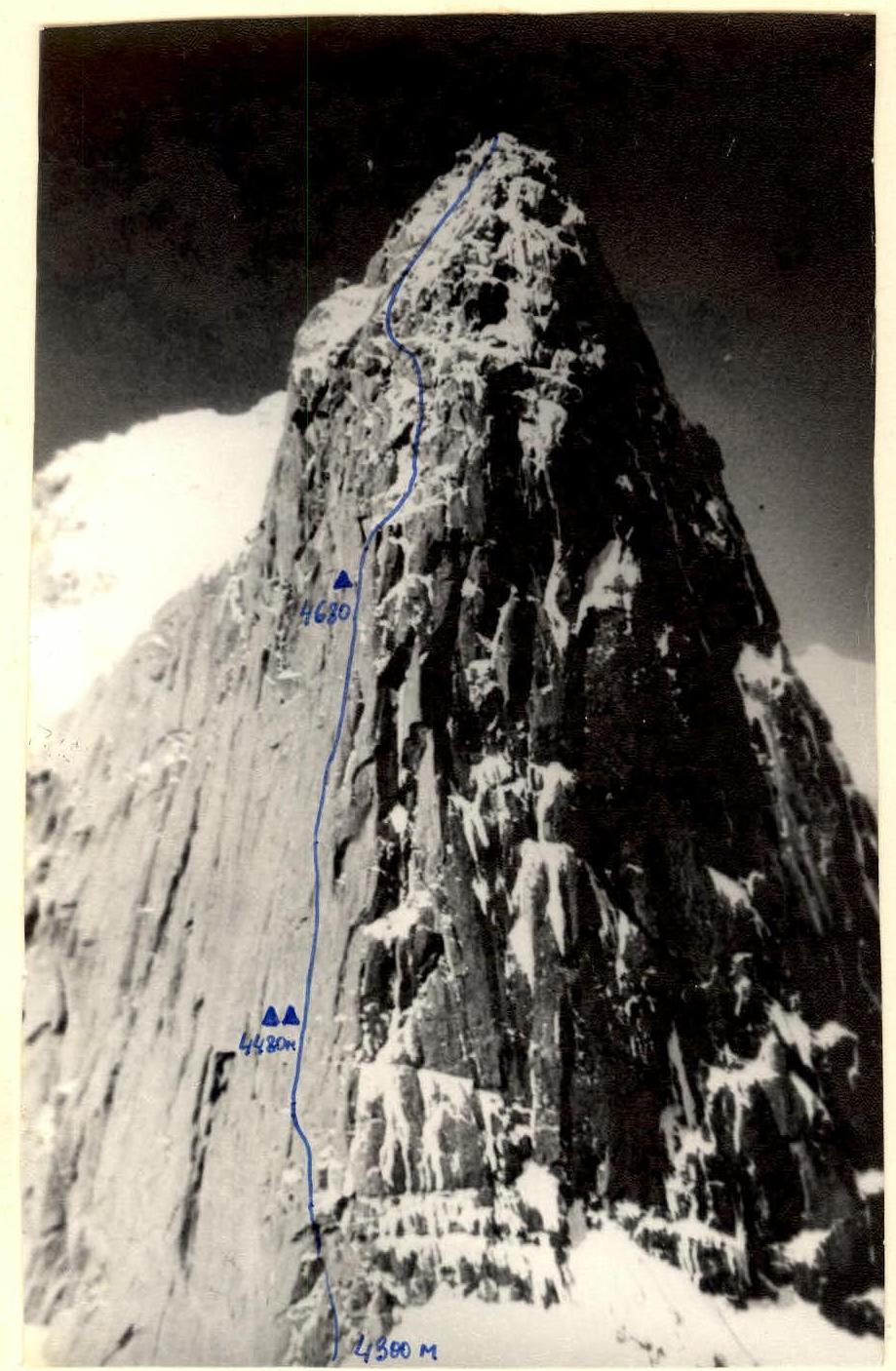
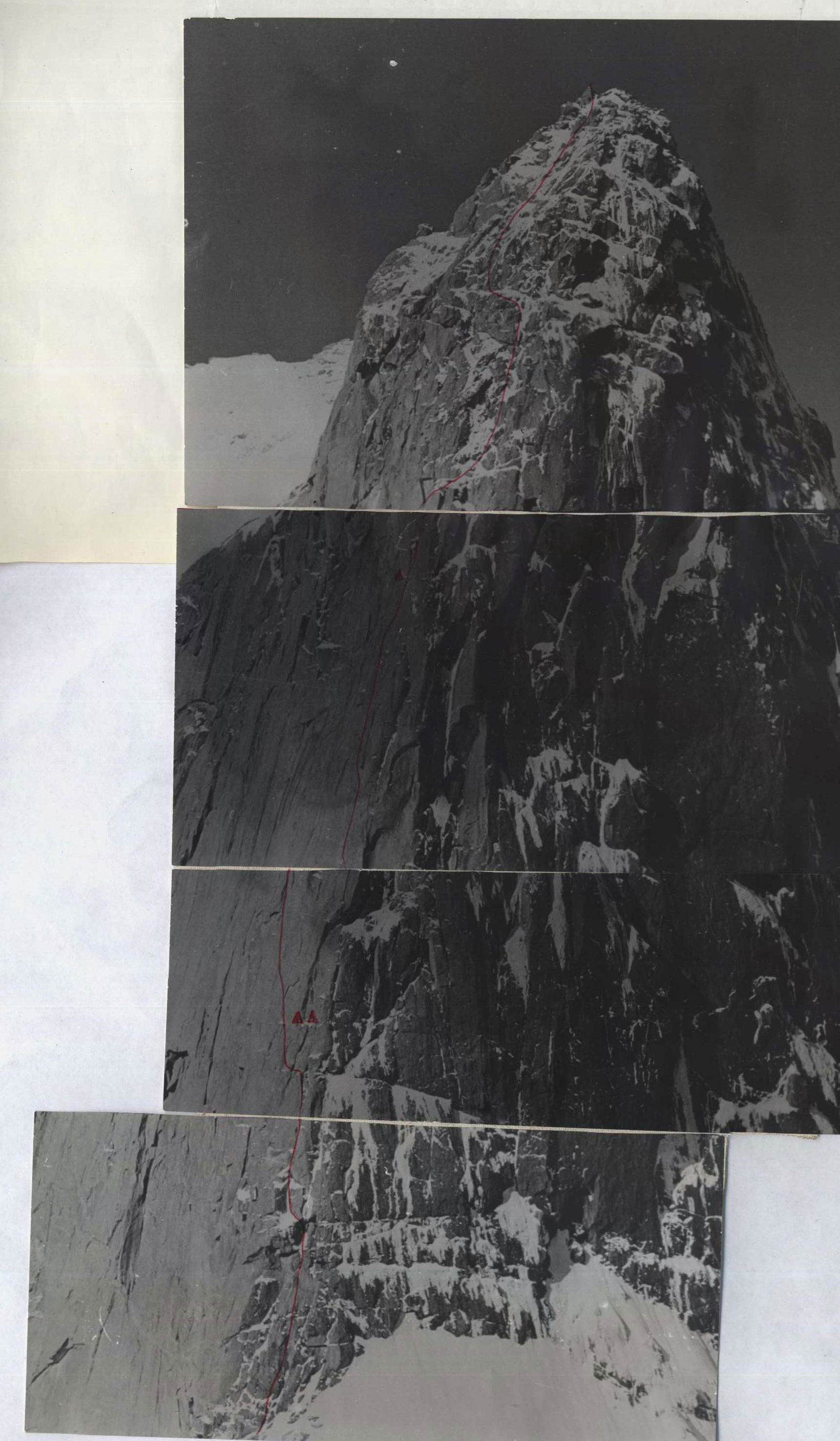
General photo of the summit. Taken on July 2, 1984, 9°0′, height of the point about 4400 m.
Tactical Actions of the Team
The tactical plan предусматривал approaching the key section of the wall in one day (sections R0–R4). Then, over the next three days, climbing the smooth overhang and, on the fifth day, reaching – passing the summit tower. In case of lack of time for descent, the team planned to spend the night near the summit and descend the next day via the ascent route. Another descent option – through the main summit and then down the couloir – was considered more dangerous due to frequent rockfalls in the couloir.
On the first day, the team followed the tactical plan strictly. However, the key section (R4–R2) was completed one day earlier than planned because a previously unseen crack was discovered, reducing the number of bolt pitons needed.
On the fourth day, the summit tower was climbed, and a descent was made using pre-drilled pitons to the foot of the wall.
Overall, the tactical plan was adhered to, and there were no deviations from the planned route line. The route turned out to be remarkably logical – the cracks "led" the team up the wall.
The tactical plan included a uniform workload distribution among team members. Each rope team worked at the front for half a day. The others spent their time:
- carrying loads,
- preparing the bivouac,
- handing over necessary equipment to the lead team.
The schedule for changing leads was as follows (the first surname is the lead in the rope team):
-
1st day
- (sec. R0–R2) Klinetsky – Zybin
- (sec. R2–R4) Bashkirov – Korolev
-
2nd day
- (sec. R4–R5) Korolev – Nagoga
- (sec. R5–R7) Bashkirov – Klinetsky
-
3rd day
- (sec. R7–R8) Klinetsky – Bashkirov
- (sec. R8–R10) Nagoga – Hankevich
- (sec. R10–R11) Bashkirov – Klinetsky
-
4th day
- (sec. R11–R12) Hankevich – Nagoga
- (sec. R12–R14) Korolev – Bashkirov
- (sec. R14–R17) Bashkirov – Hankevich
- (sec. R17–R21) Klinetsky – Korolev
On the route, continuous work on pathfinding was maintained throughout the daylight hours, along with carrying necessary equipment and timely leader changes.
The wall's relief did not allow the team to bivouac together in one place. Hammocks were within twenty meters of each other. Therefore, additional safety lines were set up to transfer food, equipment, etc., from one hammock to another.
As anticipated, the middle part of the route was mainly climbed using artificial technical aids (I.T.O.), and the belay platform for the belayer proved fully justified. On these sections, to ease the belayer's work and ensure reliable anchoring, a securing system using clamps was employed.
The reliable performance of "friends" in wide cracks helped avoid bolt placement.
The route was completed without falls or injuries, with full safety measures in place. The first climber always worked on a double rope, with one of them being a II mm "Edelrid". In places with insufficiently reliable belays through nuts, additional bolt pitons were driven.
On the descent, to reduce rope wear, special disks were used instead of standard rappelling devices (e.g., figure-eights).
For more efficient fuel use, the team employed:
- homemade pressure cookers;
- insulating walls for the primus stove.
To quickly restore team members' strength, comprehensive vitamin supplementation was carried out a few days before the ascent and during it.
Stable radio communication was maintained with the camp using "Karat" radios.

Photo of the profile from the left
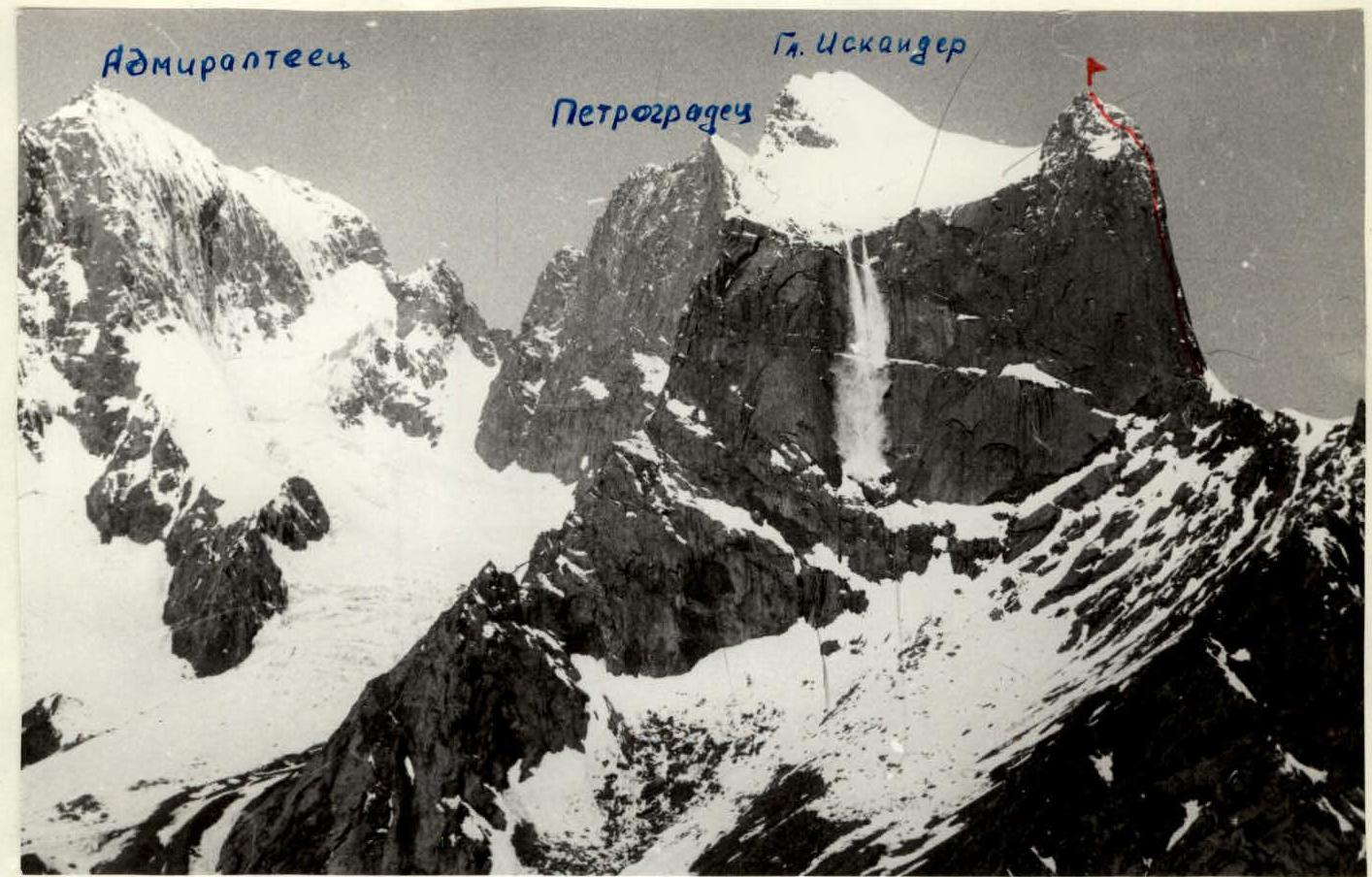
Photopanorama of the area
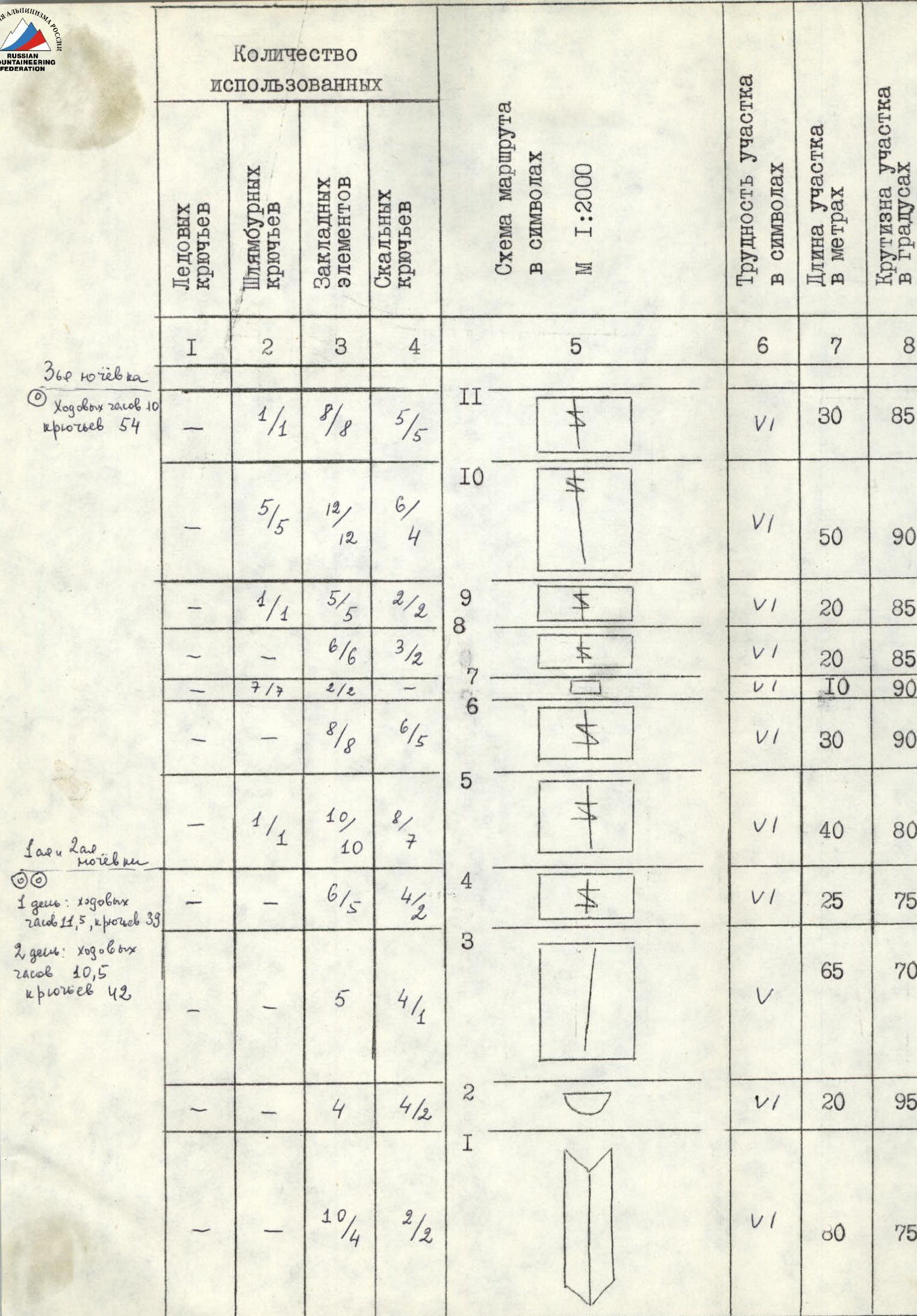
Total climbing hours 37, pitons 198. 4th day: climbing hours 5, pitons 63.
Number used
3rd overnight stay. Climbing hours 10, pitons 54.
Bivouac camp. 1st day: climbing hours 11.5, pitons 39. 2nd day: climbing hours 10.5, pitons 42.
| Rock | Bolt | Nuts | Ice screws | Route diagram | Section difficulty | Section length (m) | Section steepness (°) |
|---|---|---|---|---|---|---|---|
| – | 1/1 | 8/8 | 5/5 | R21 | 6 | 30 | 85 |
| – | 5/5 | 12/12 | 6/4 | R20 | 6 | 50 | 90 |
| – | 1/1 | 5/5 | 2/2 | R19 | 6 | 20 | 85 |
| – | – | 6/6 | 3/2 | R18 | 6 | 20 | 85 |
| – | 7/7 | 2/2 | – | R17 | 6 | 10 | 90 |
| – | – | 8/8 | 6/5 | R16 | 6 | 30 | 90 |
| 1/1 | – | 10/10 | 8/7 | R15 | 6 | 40 | 80 |
| – | – | 6/5 | 4/2 | R14 | 6 | 25 | 75 |
| – | – | 5 | 4/1 | R13 | 5 | 65 | 70 |
| – | – | 4 | 4/2 | R12 | 6 | 20 | 95 |
| – | – | 10/4 | 2/2 | R11 | 6 | 60 | 75 |
| R | Rock | Bolt | Nuts | Ice screws | Route diagram | Section difficulty | Section length (m) | Section steepness (°) |
|---|---|---|---|---|---|---|---|---|
| 21 | – | – | – | 4 | (graphics) | 3 | 40 | 30 |
| 20 | – | – | – | 7 | (graphics) | 4 | 90 | 50 |
| 19 | – | – | – | 3 | (graphics) | 2 | 40 | 0 |
| 18 | – | – | – | 7 | (graphics) | 5 | 50 | 65 |
| 17 | – | – | – | 2 | (graphics) | 2 | 40 | 0 |
| 16 | – | – | 4/1 | 7 | (graphics) | 5* | 60 | 65 |
| 15 | – | – | 5/4 | 5 | (graphics) | 6 | 50 | 85 |
| 14 | – | – | – | 2 | (graphics) | 3 | 25 | 50 |
| 13 | – | – | 2/2 | 8 | (graphics) | 5 | 40 | 70 |
| 12 | – | 2/2 | 4/4 | 4 | (graphics) | 6 | 25 | 85 |
Description of the Route by Sections
Section R0–R1. Large inner corner, two rope lengths long. The start of the section is ruined rocks. The upper part is monolithic. Climbed mainly by free climbing.
Section R1–R2. Traversing a large cornice from right to left, using a crack. Icy rocks. Exit to a steep snow-ice patch.
Section R2–R3. Wall with cracks, mainly climbed by free climbing. Monolithic rocks.
Section R3–R4. Smooth wall, climbed using I.T.O. Micro-nuts fit well. Exit to a small ledge, 0.5 × 1.5 m. Here, a bivouac is organized – two people sit on this ledge, the rest are in hammocks 20 m below.
Section R4–R5. Wall with a crack. The crack gradually narrows and disappears. Move to a parallel crack on the left along a vertical slab, using a bolt piton.
Section R5–R6. Leaving the "Two Birds" cornice on the left, climb upwards towards the "Nose" cornice. At the end of the section, a small overhang is passed through a narrow crack. Micro-nuts fit well.
Section R6–R7. Traverse to a parallel crack on the left. I.T.O. is used, with 7 bolt pitons.
Section R7–R8. Steep wall. In some places, it's possible to climb without ladders. Move upwards – left, under the "Nose" cornice.
Section R8–R9. Climb straight up a vertical crack using I.T.O. Wide wedges are driven for reliable belays. Small nuts are used under the ladders. A small overhang at the top of the section. Leave the "Nose" cornice on the right.
Section R9–R10. The crack gradually widens. Sometimes it's possible to place small friends. Due to not very reliable nut placements, 4 bolt pitons are driven for belay. At the top of the section, you're thrown away from the rock.
Section R10–R11. The crack widens even more. The section is climbed using friends. The upper part is climbed by free climbing. Exit to a small horizontal ledge, 0.8 × 3 m. Here, a bivouac is organized:
- Four people sit on the ledge.
- Three people spend the night in hammocks 20–30 m above.
Section R11–R12. Climb straight up a wide crack and enter a chimney. Two bolt pitons are driven for belay. "Live" rocks when exiting the crack.
Section R12–R13. Inner corner. Free climbing. "Live" rocks at the top. Exit into a couloir under icicles.
Section R13–R14. Traverse to the right side of the couloir.
Section R14–R15. Climb straight up the wall of the right couloir wall. A small cornice at the top of the section.
Section R15–R16. Climb up walls with small ledges, 60 m.
Section R16–R17. Traverse along a good horizontal ledge to the left.
Section R17–R18. Climb up a monolithic wall by free climbing. Rocks are ruined at the end of the section.
Section R18–R19. Traverse along ledges to the left, 40 m, and enter a large rock couloir. "Live" rocks.
Section R19–R20. Climb along the rock couloir towards the summit, 90 m.
Section R20–R21. Exit to the summit along the ridge (rock-ice).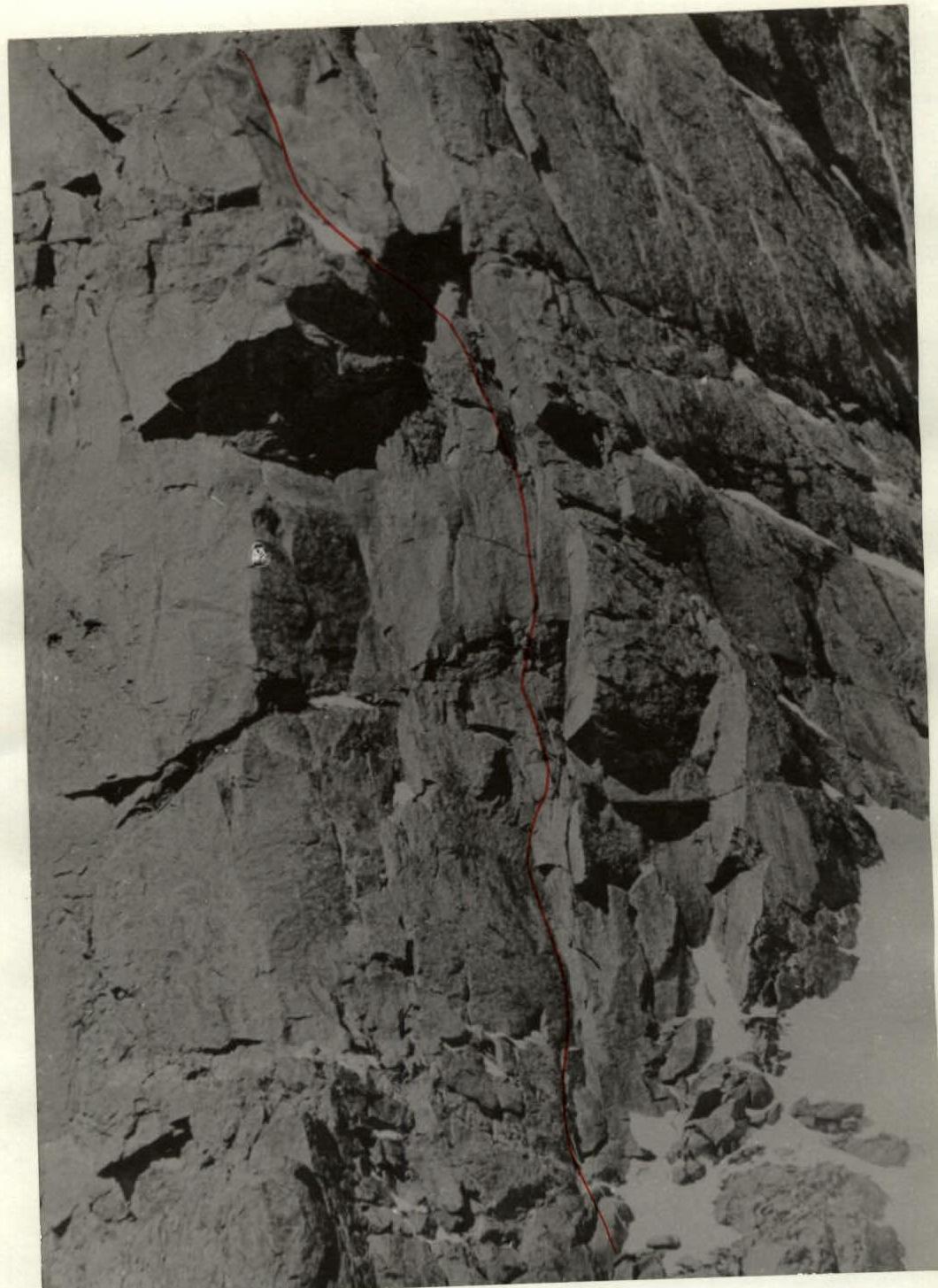
Section R0–R2. Technical part along a tense route.
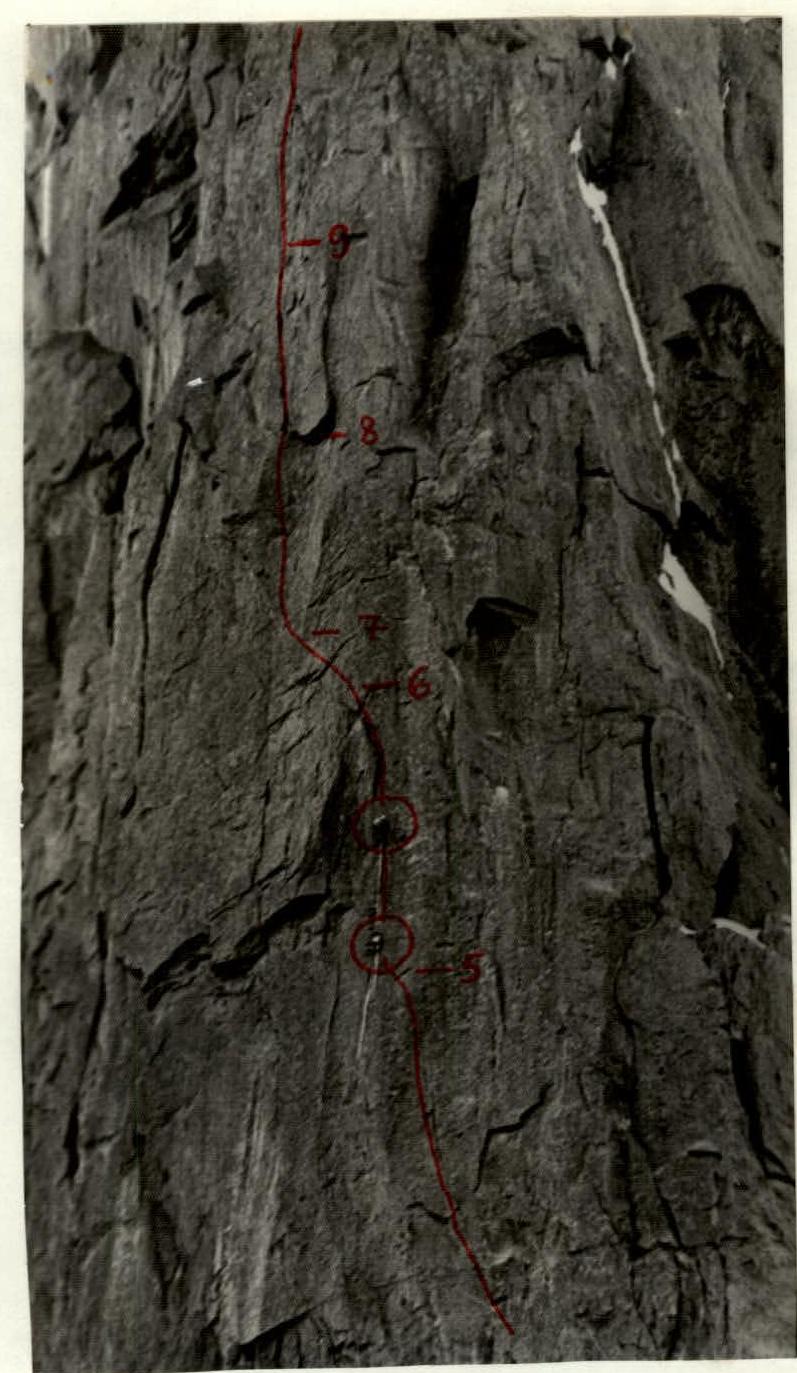 The rope team works on the route from bivouac №1. Taken with a telephoto lens.

Comments
Sign in to leave a comment