
II ASCENT
- Category: High-altitude technical (first ascent).
- Pamir-Alay, Turkestan Range, AK-SU gorge.
- Peak AK-SU Main 5355 m, via the north face and NW edge.
- Proposed 6B category of complexity for the first ascent.
- Height difference: 1785 m.
- Route length: 2300 m.
Length of sections 5–6 is 750 m. Average steepness of the wall section R0–R9 is 70%/3670–4000 m/, R11–R21 is 80%/4060–4470 m/, including 6th category of complexity sections: 85%/3870–3910 m/, 75%/4065–4110 m/, 80%/4110–4210 m/, 95%/4210–4250 m/, 85%/4290–4325 m/, 90%/4430–4440 m/, 75%/4440–4470 m.
- Pitons driven:
| Rock | Bolt | Nuts | Ice |
|---|---|---|---|
| 112, 65 | 11, 11 | 243, 181 | 61, 3 |
- Team's travel hours: 111 h over 10 days.
- Overnight stays:
- 1–2–3 in a tent, 2 people in a hammock at R6
- 4–5–6 semi-reclining, 2 people in a hammock at R13
- 7 — semi-reclining, carved in an ice ledge.
- 8 — sitting, 2 people in a hammock.
- 9 — lying in a tent.
- Team leader: Kalyugin Konstantin Viktorovich — CMS
Team members:
- Erofeev Sergey Andreevich — CMS
- Stalmakhov Alexander Vasilyevich — CMS
- Esipov Vasily Petrovich — CMS
- Blagochinnov Nikolay Mikhailovich — CMS
- Borisov Boris Valentinovich — CMS
- Coach: Kalyugin Konstantin Viktorovich, 1st category instructor
- Departure to the route: July 18, 1984. Summit: July 27, 1984. Return: July 27, 1984.
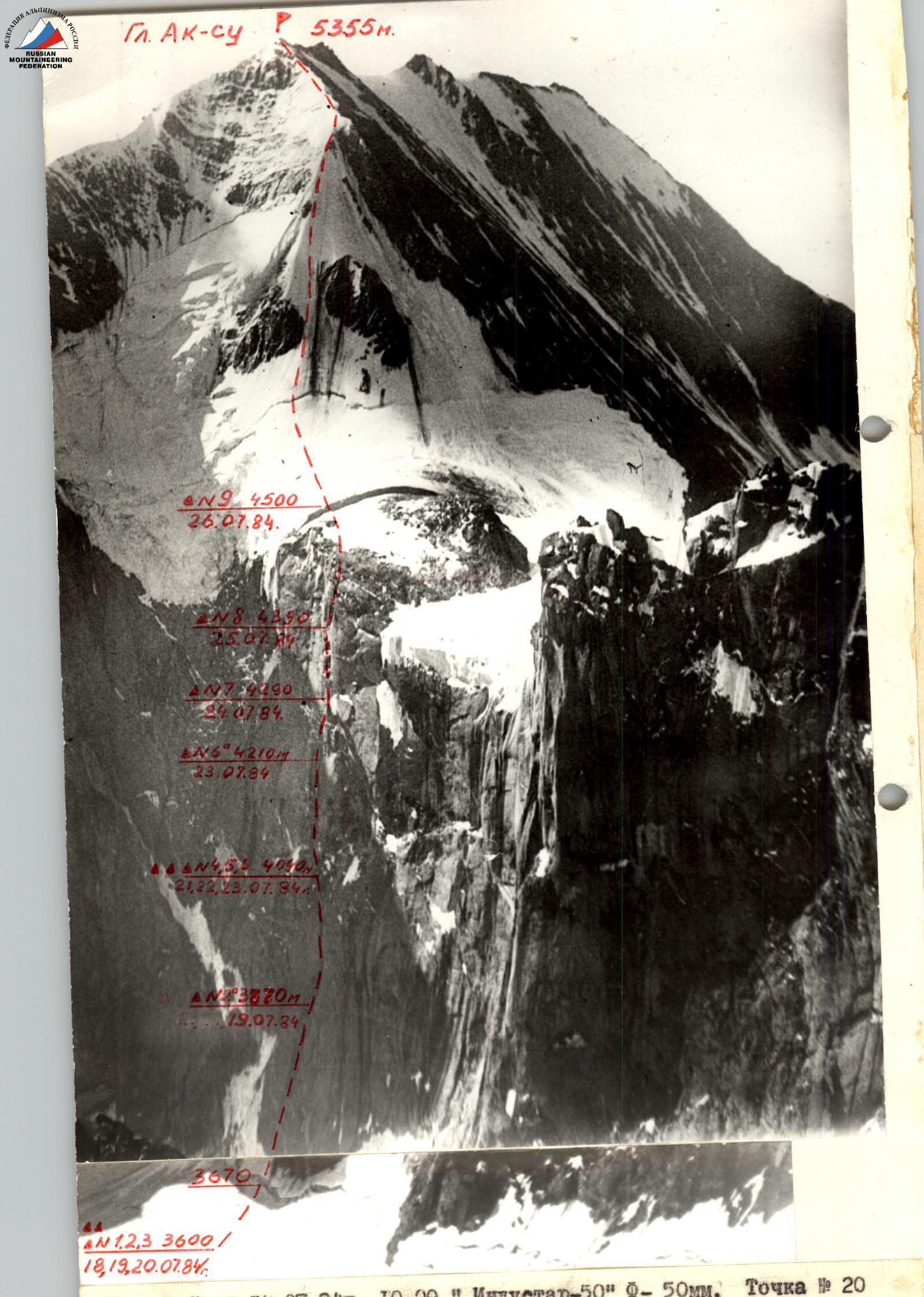
Photo taken on July 14, 1984, 10:00, "Industar-50" lens, 50 mm focal length. Point #20. Distance 2.5 km. Height 4500 m.
| Rock | Ice | Bolt | Nuts | Commentary |
|---|---|---|---|---|
| – | – | – | – | Overnight stay #9 +++ ++ |
| 7/7 | – | – | 8/6 | Photo #13 VI A2-A4 40 m 75° |
| 6/5 | – | – | 6/5 | VI A2 10 m 90° |
| 26/16 3/3 | – | – | 37/22.66/41 | July 25, 1984, 15:00 |
| 7/6 | – | – | 8/6 | +50 m 65° |
| 4/1 | – | – | 5 | Photo #13 overnight stay #8 VAI 30 m 55° |
| 8/6 | 3/3 | – | 10/6 | + A240 m 80° |
| 7/3 | – | – | 14/10 | Overnight stay #7 photo #11 VI A1 40 m 85° |
| 14/11 | 2/2 | – | 34/27.51/40 | July 24, 1984, 11:00 |
| 4/2 | – | – | 8/4 | + A2 50 m 80° |
| 10/9 | – | 3/3 | 26/23 | VI+ Ач4 40 m 95° |
| 11/10 | – | 3/3 | 103/96. 117/109 | July 22–23, 1984, 28 h overnight stay #6α |
| 11/10– | – | 3/3 | 103/96 | Photo #8–9 VI+ Ач4 100 m 80° |
| 14/5 | 1– | 3/3 | 16/8.33/16 | July 21, 1984, 8 h |
| 6/5 | – | 3/3 | 11/8 | Photo #5, 6 VI+ АЗе 50 m 75° |
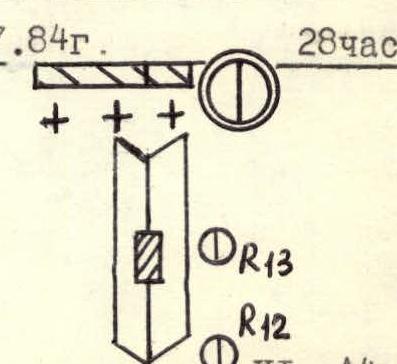
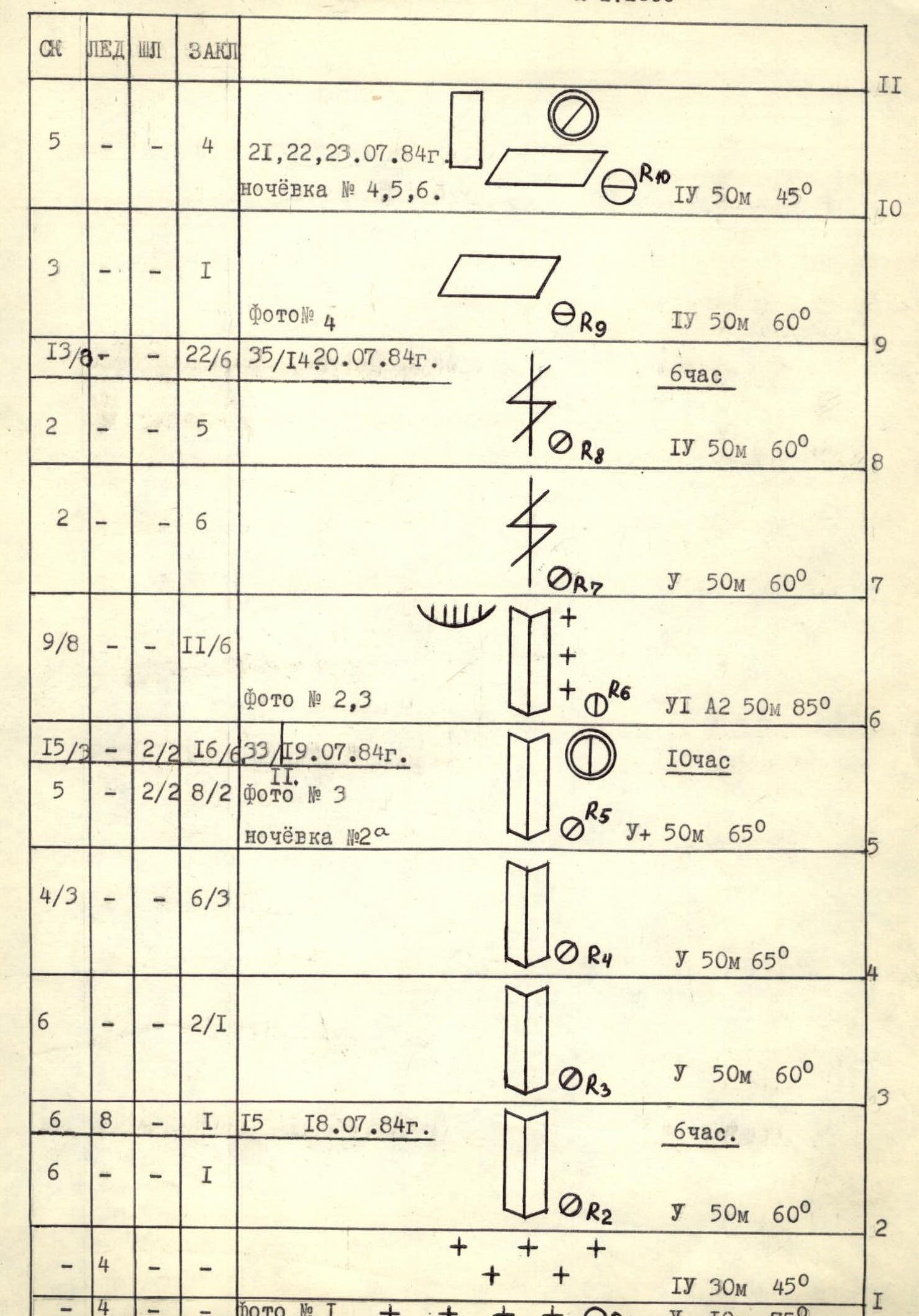
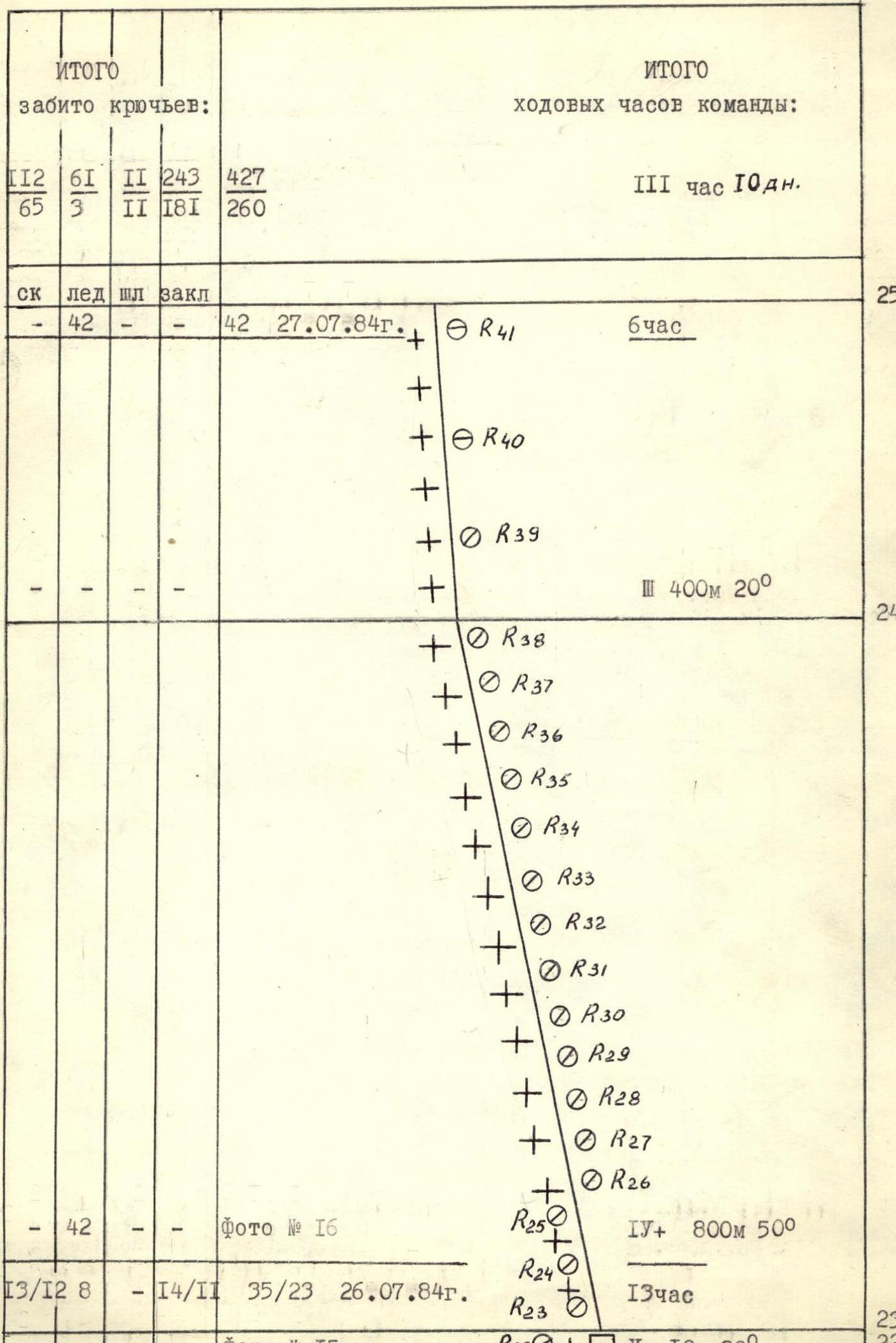
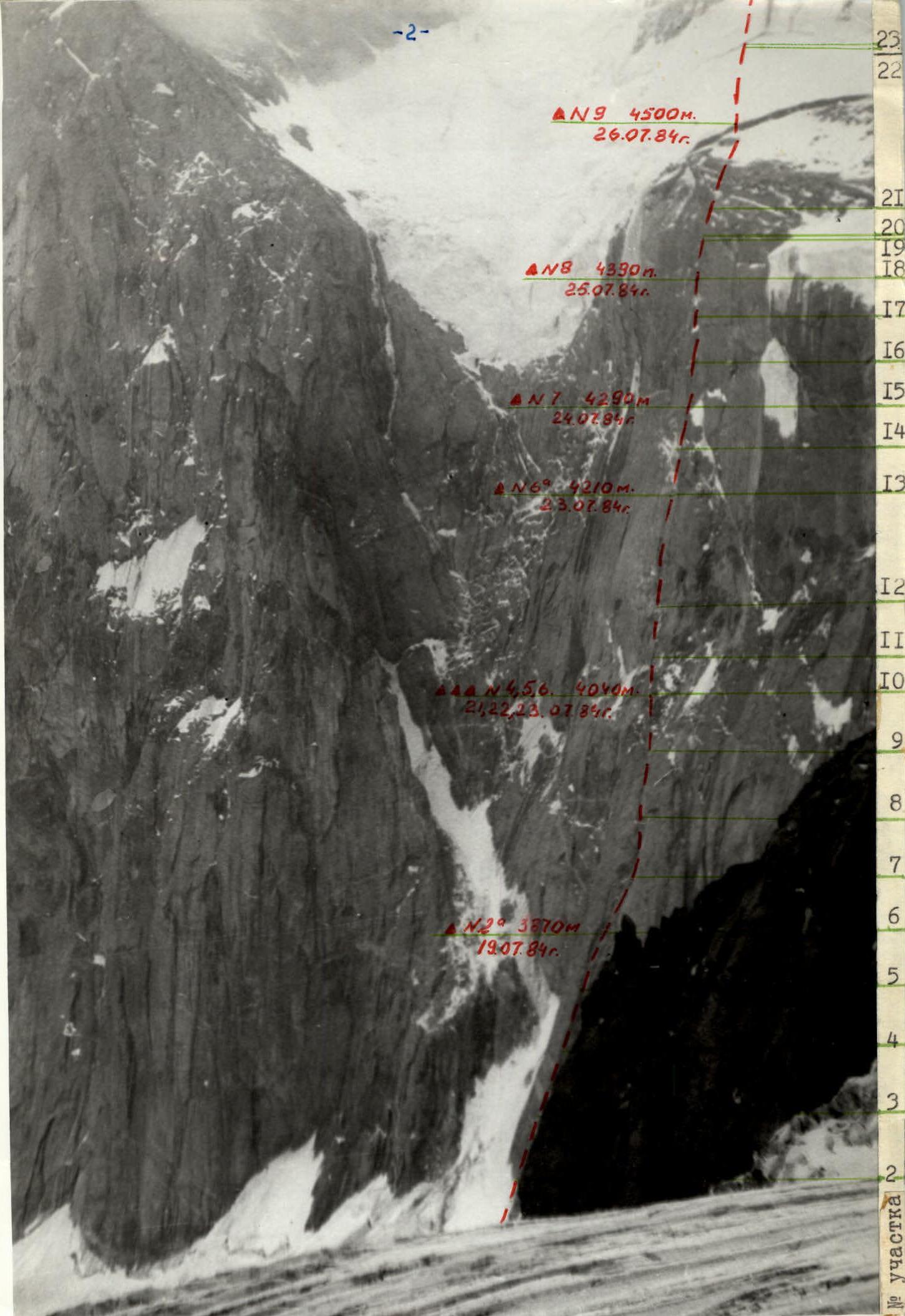
PHOTO OF THE WALL PROFILE FROM THE RIGHT. July 8, 1984, 21:00. Point #21. "Zeiss-Ikon" camera, 75 mm lens. Frame 6×4.5 cm. Distance 2 km. Height 4000 m.
Team's Tactical Actions
Due to the conditions for safe passage on the lower part of the wall from possible ice falls, the time to pass the R0–R4 section was dictated from 8:00 to 16:00. The lack of overnight stay sites on the R0–R9 section forced preliminary processing of this wall section.
- On July 18, 1984, the rope team Stalmakhov–Borisov conducted reconnaissance and processing of R0–R3.
- On July 19, 1984, the rope team Erofeev–Kalyugin worked on the route. They processed and set up fixed ropes up to R6, where the team was caught by bad weather (photos #2–7). An overnight stay in a hammock was organized here.
- On July 20, 1984, the same rope team continued processing R6–R9 and descended to camp #1 at 14:00.
- On July 21, 1984, the entire group climbed up to R10 via the fixed ropes and organized overnight stay #4 (photo #4). The rope team Stalmakhov–Erofeev continued processing R10–R12 (photos #5–6).
- On July 22, 1984, from 7:00 to 16:00, the rope team Erofeev–Kalyugin worked on the wall, then they were replaced by Stalmakhov–Borisov until 22:00 (photo #7).
- On July 23, 1984, the rope team continued moving up the corner and through a 5-meter cornice, and stayed overnight in a hammock (photos #9a, 9, 8).
- On July 24, 1984, Erofeev–Kalyugin continued processing up to the "Nose" R15, where the entire load was pulled up, and the team climbed up. Overnight stay #7 was organized here (photos #10–11).
- On July 25, 1984, they passed R15–R18 and stopped for overnight stay #8 — two people in a hammock, the rest sitting on a narrow ledge (photos #13–14). They processed R18–R19.
- On July 26, 1984, they climbed up to R19 via the fixed ropes, passed the sheer mossy wall R19–R20, and a wet sheer corner with a 2-meter cornice. They stopped for overnight stay #9.
At 16:00, the team of Blagochinnov–Esipov–Borisov departed for reconnaissance and processing of the bergschrund R22–R23. On July 27, 1984, an early start allowed for safe passage of the ice section during ascent and descent. The first person used "fifi hooks", the rest moved along the fixed ropes (photos #16–17).
Fixed ropes were set up on sections R0–R21, R22–R24. Pulling backpacks on sections R6–R7, R11–R21, for a total of 460 m. At overnight stay sites, fixed ropes were organized. Above overnight stays #4, 5, 6, a monolith overhangs.
The use of a two-person hammock with a tent allowed for organizing a comfortable bivouac for a pair at any location.
Communication with observers and the camp was maintained via "Karat" radio set.
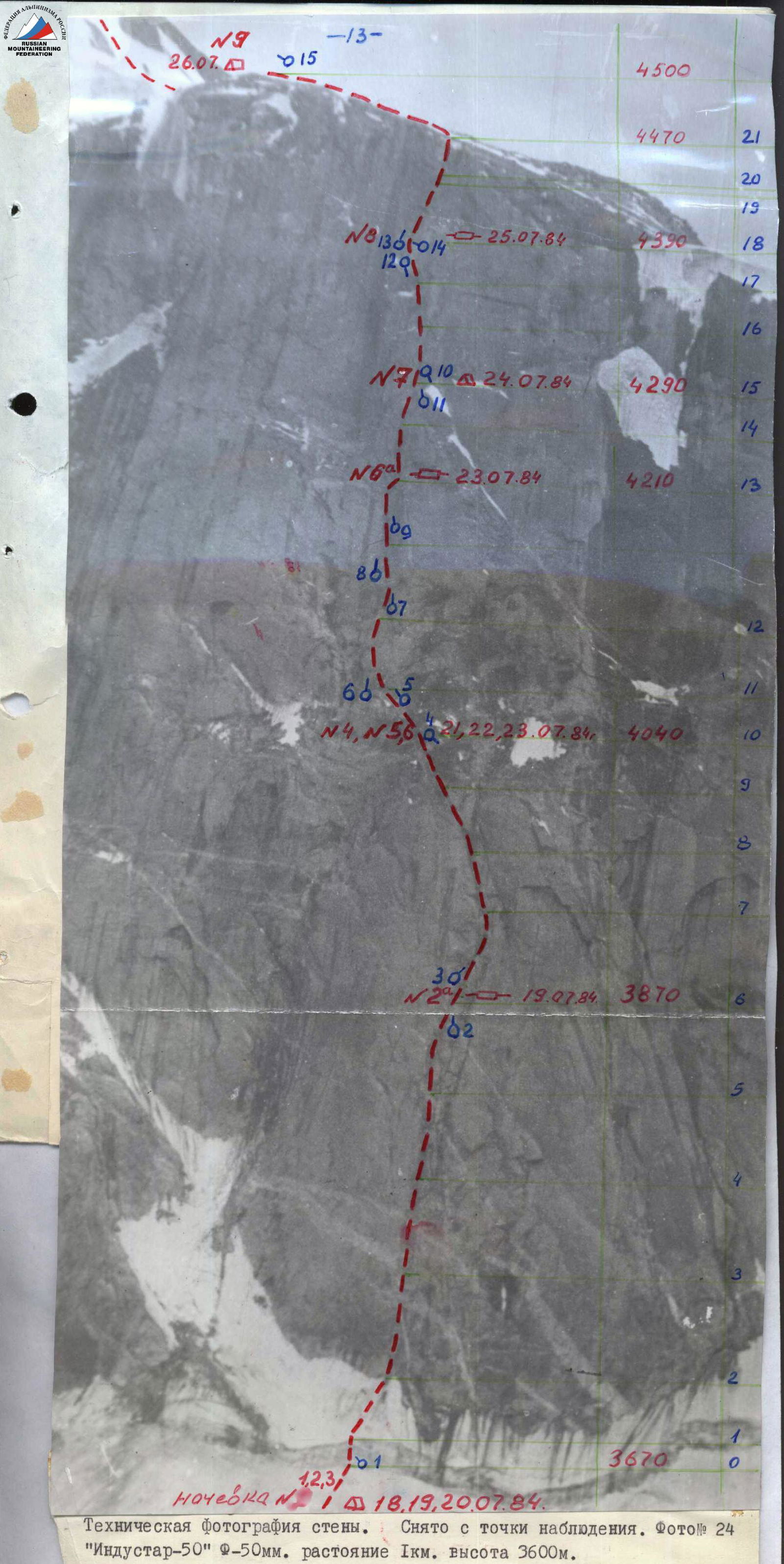
Technical photograph of the wall. Taken from the observation point. Photo #24 "Industar-50" lens, 50 mm focal length. Distance 1 km. Height 3600 m.
- overnight stay in a hammock.
- overnight stay in a tent.
- location of the shot and direction.
During bad weather, they hung a hammock and sheltered in a tent (photo #3).
Movement:
- The first person on a double rope.
- The rest — along the fixed ropes with top-rope protection.
They used pulling backpacks in aviation bags, which:
- Preserves backpacks from wear.
- Reduces friction against the rocks.
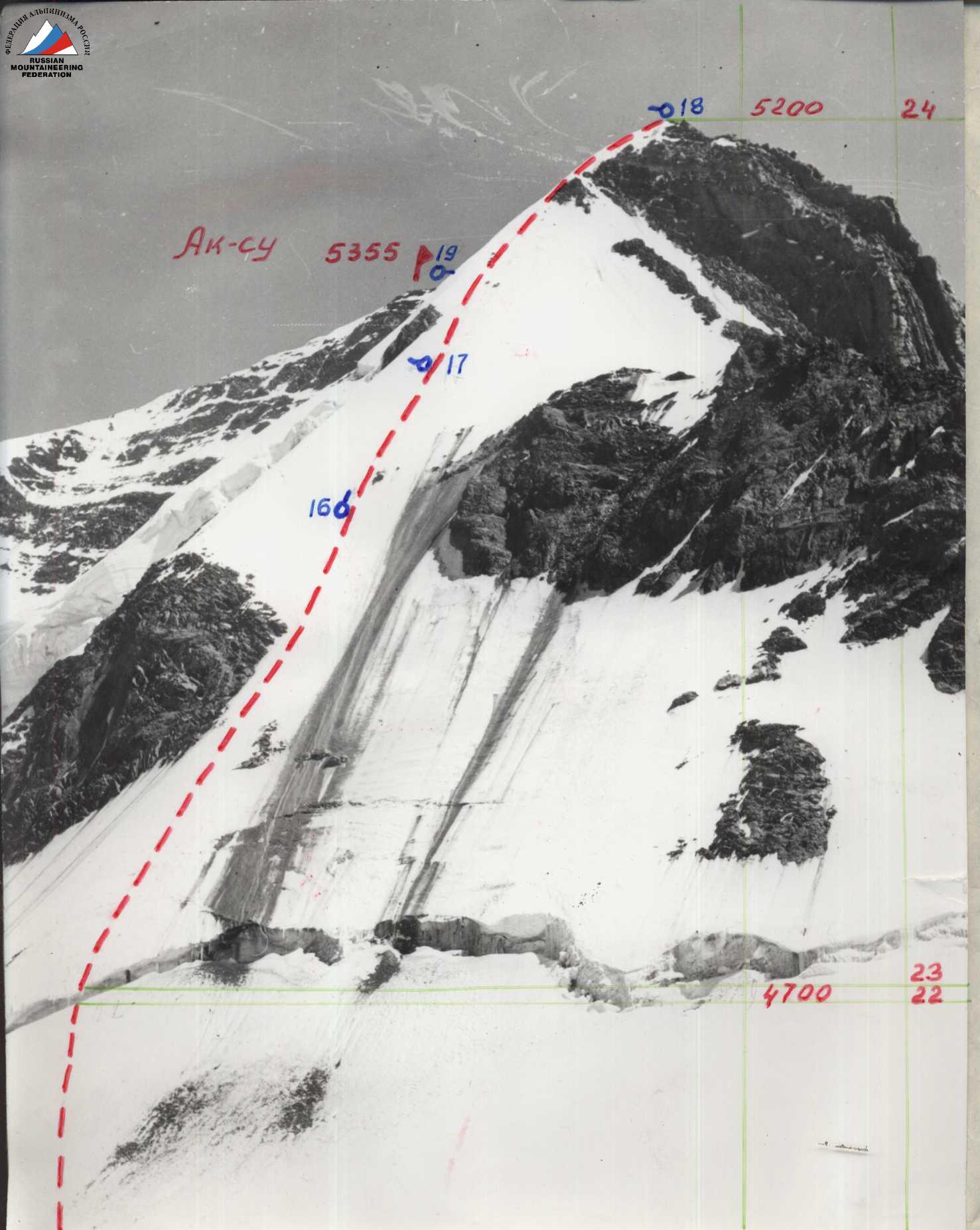
Technical photograph of the upper part of the route. Photo taken on July 26, 1984, 16:00. "Zeiss-Ikon" camera, 75 mm lens. Taken from R21.
Route Description
- R0–R1: Bergschrund with an overhang. Passage in crampons (Photo #1).
- R1–R2: Ice slope.
- R2–R6: System of internal corners and crevices. Passing through the left part is safer! No ledges. Rocks are mossy, slippery, especially after rain. Holds are smooth. Free climbing.
- R6–R7: Internal corner with ice accumulation. Movement with a backpack is impossible. Pulling through the front. Climbing is complex, using ladders (Photo #2).
- R7–R9: Wet cleft, passable by free climbing.
- R9–R11: Climbing of medium complexity with ledges where an overnight stay is possible.
- R11–R12: Wall with loose rocks. Mossy. Few cracks. Bolt pitons and large-sized stoppers are necessary (Photo #5).
- R12–R13: Sheer internal corner. Passed on a ledge. Crack (Photo #7) is passed using pitons and stoppers. After 10 m, an internal corner of 80 m ends with a 5-meter cornice (photos #7–9). Bolt pitons. Movement only on a ledge. Belay point on ladders. Under the cornice, a crack with ice accumulation. Ice is 3–10 mm thick in the crack and 2–4 m down the wall. Edges of the crack are very fragile. In places under stoppers, ice was thawed by hand. Insurance for stoppers with bolt pitons. At the top of the cornice, a sitting overnight stay or a hammock is possible.
- R13–R14: Ascent along a quartz vein. Smooth holds. Live and dislodged stones fly to the edge of the ledge. Very complex! Movement on a ledge and ladders. 95° wall inclination. Belay point between a cork with a cornice 40–50 cm and an overhang (photo #5).
- R14–R15: Wet wall, slippery mossy internal corner! Leads to the "Nose". Overnight stay is carved on an ice ledge (photo #1).
- R15–R16: Two parallel cracks. First along the right, then pendulum to the left (photo #1).
- R16–R17: Cleft filled with ice. In places, insurance through ice screws. Passage of a sheer forehead on ladders (Photo #12).
- R17–R18: Ascent along a throwing crack (photo #12).
- R18–R19: Along the left corner and wall with loose rocks, then pendulum to the right and along the wall and wet internal corner (photo #13).
- R19–R20: Blind sheer crack.
- R20–R21: Internal corner leading under an overhang with ice accumulation. Very slippery! Few holds. Ladders. Exit through a narrow slit to the plateau (Photo #13).
- R22–R23: Bergschrund with an overhang — on fifi hooks.
- R23–R24: Ice slope. Fifi hooks, crampons, ice screws.
- R24–R25: Summit ridge: уууза — рфф — иииon — иилёты. Shale rock.