
(Admiralteets), 5090 m via the "pillar", V. Bashkirov, 85. Pamiro-Alai. Laylyak gorge area 5.4.2.2.
Passport
- Technical class.
- Aksu gorge, Turkestan ridge, Pamiro-Alai.
- Peak Admiralteets, 5090 m, via the "pillar", Bashkirov route, 6A cat. diff. Third ascent.
- Elevation gain: 1500 m.
"Pillar" elevation gain — 740 m. Main part of the "pillar" elevation gain — 560 m. Total route length — 2840 m. "Pillar" length — 920 m. Main part of the "pillar" length — 600 m. Section lengths: 6 cat. diff. — 510 m, 5 cat. diff. — 340 m. Average slope of the route — 74°. Average slope of the main part of the "pillar" — 80°.
- Pitons driven:
Rock Bolt Chock Ice 152 1+34X 232 3 77 28 166 0 X — previously driven pitons reused.
- Team's walking hours: 37 h, days — 4.
- Night bivouacs: — 1 — semi-reclining on a rock shelf; — 2 — sitting on a snow-ice shelf; — 3 — lying on a snow plateau; — 4 — lying on a moraine during descent.
- Team leader: Pavel E. Shabalin, Candidate Master of Sports.
- Team members: — Andrey Yu. Antonov, Candidate Master of Sports; — Mikhail P. Zholobov, Candidate Master of Sports; — Sergey Yu. Tat'yankin, Candidate Master of Sports.
- Team coach: Svetlana N. Simakova, Candidate Master of Sports.
- Departure to the route: July 9, 1991. Summit: July 12, 1991. Return: July 13, 1991.
- Organizations: — "Rodina" sports club; — Kirov regional committee for physical culture and sports.
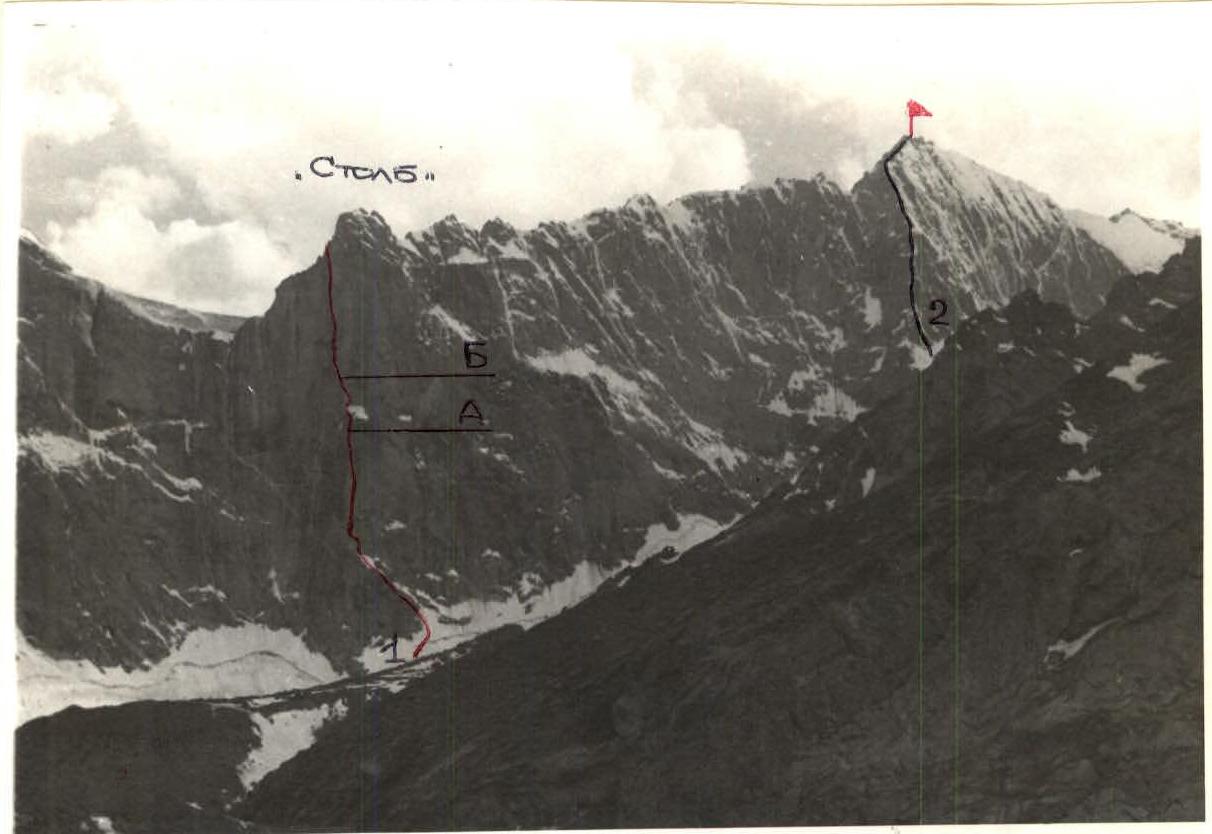
- Team's route via the "pillar".
- NE ridge route (A. Makhnovskiy group).
General photo of peak Admiralteets, 5090 m
Taken on July 7, 1991, 10:15 from the moraine edge of the Ak-Su glacier. Distance 4 km. Elevation 3600 m. Shooting point #1. "ZENIT" camera. "HELIOS" 44M-4, 2/58 lens.
Labels on the photo:
— a — Night bivouac #1, 4250 m; — b — Night bivouac #2, 4405 m.

Team's tactical actions
The tactical plan for the ascent was based on reports from the first and second ascents. All night bivouacs, both primary and backup, were planned in relatively safe and convenient locations, allowing the team to rest properly without using hammocks. Weather conditions affected the team's tactical actions: — Early night bivouac on the first day (thunderstorm); — Continuous bad weather on subsequent days slowed the team's progress and forced them to use a reserve day. Overall, the 1991 season was marked by extremely poor weather.
The team's movement on routes of this level is typically characterized by a relay-like scheme. The first on sections were: — Day 1: R0–R2 Antonov, R2–R10 Shabalin; — Day 2: R10–R13 Zholobov, R13–R16 Tat'yankin; — Day 3: R22–R26 Antonov, R26–R31 Shabalin.
Other sections of the report discuss the use of various technical means. Notably, the use of "friends" and rock shoes opened up new possibilities for traversing extremely difficult sections at a good pace. Meanwhile, on smooth rocks with few holds and cracks, covered in snow and ice, the team constantly used indirect technical aids (ITOs) — a set of pitons, chocks, and light quickdraws suited this purpose.
Ensuring the safety of the first on the rope was given special attention. A double rope, one of which was "Elita-I" UIAA-certified, quickdraws made from dynamic rope LTKP-1200, and belay organization through an "eight" — all this allowed the lead climber to work with a significant safety margin. There were no falls on the route. Belay stances on the "pillar" were mostly hanging; it was rare for the entire team to gather together. The second and third days saw more bad weather — strong wind, wet rocks, snow grains on shelves and holds, periodic snowfall, and fog.
Night bivouacs: — Second night bivouac — sitting, in a tent on a shelf carved into the ice; — Third night bivouac — safe, lying, on a snow plateau.
At the beginning of July, the route was heavily waterlogged: cracks and internal corners were filled with snow and ice. Before reaching the "pillar", the team climbed under a cold shower.
By the end of the third day, the already poor weather significantly deteriorated. Thick fog rolled in, and the team had to move across the plateau with extreme caution. In the morning, they had to dig out their tent, which had been buried up to the ridge. The traverse across the plateau to the ridge was done through deep, loose snow. On July 12, the team moved from the ridge along a heavily snow-covered rock ridge in poor weather conditions (fog, strong wind, snow grains, later — thunderstorm discharges). During the descent, they bivouacked at the start of the Kara-Suu gorge, on a moraine platform.
Nutrition: — Hot meals — twice a day: morning and evening; — All team members had individual snacks for each day.
The route demanded a significant expenditure of physical and moral strength; it's not for nothing that it's considered one of the most "industrial" routes in the area. However, clear planning and strict adherence to the tactical plan in bad weather allowed the team to complete the route with a reserve of strength.
The team was monitored through a 12x binocular. During the ascent, a rescue team was stationed at the base camp.
Table of food products and fuel
| # | Name | Unit | Quantity | Weight |
|---|---|---|---|---|
| 1. | Rusks | kg | 0.3 | 0.3 |
| 2. | Sugar | kg | 0.4 | 0.4 |
| 3. | Slastilin | pack | 1 | 0.02 |
| 4. | Individual tea | kg | 0.1 | 0.1 |
| 5. | Coffee | kg | 0.05 | 0.05 |
| 6. | Dry drink "Venta" | pack | 1 | 0.3 |
| 7. | Chocolate | kg | 0.2 | 0.2 |
| 8. | Dried bananas | kg | 0.2 | 0.2 |
| 9. | Bouillon cubes | pcs | 3 | 0.06 |
| 10. | Wheat porridge NTV | kg | 0.4 | 0.4 |
| 11. | Meat puree (baby food) | pack | 1 | 0.1 |
| 12. | Smoked lard | kg | 0.2 | 0.2 |
| 13. | Sprat pate | pack | 1 | 0.16 |
| 14. | Potato puree (flakes) | pcs | 1 | 0.15 kg |
| 15. | Egg powder | kg | 0.04 | 0.04 |
| 16. | Hard smoked sausage | kg | 0.2 | 0.2 |
| 17. | Honey with nuts | pack | 3 | 0.7 |
| 18. | Soup in a pack | pack | 2 | 0.24 |
| 19. | Alcohol | kg | 0.1 | 0.1 |
| 20. | "Pocket" food (raisins, dried apricots, nuts, sausage, chocolate, apples, rusks, toffee, glucose, cranberries, sublimated juice) | set | 4 | 1.6 |
| 21. | Gas stove | kg | 0.3 | 0.3 |
| 22. | Gas canisters | pcs | 4 | 0.9 |
Total weight of food products and fuel was 6.6 kg. Total weight of food products, fuel, and equipment was 65.6 kg (15.6 kg per person). The first climber worked on the route without a backpack. Total weight of backpacks at the start of the route was 33.6 kg. Starting weight of backpacks on the route was 8.4 kg.
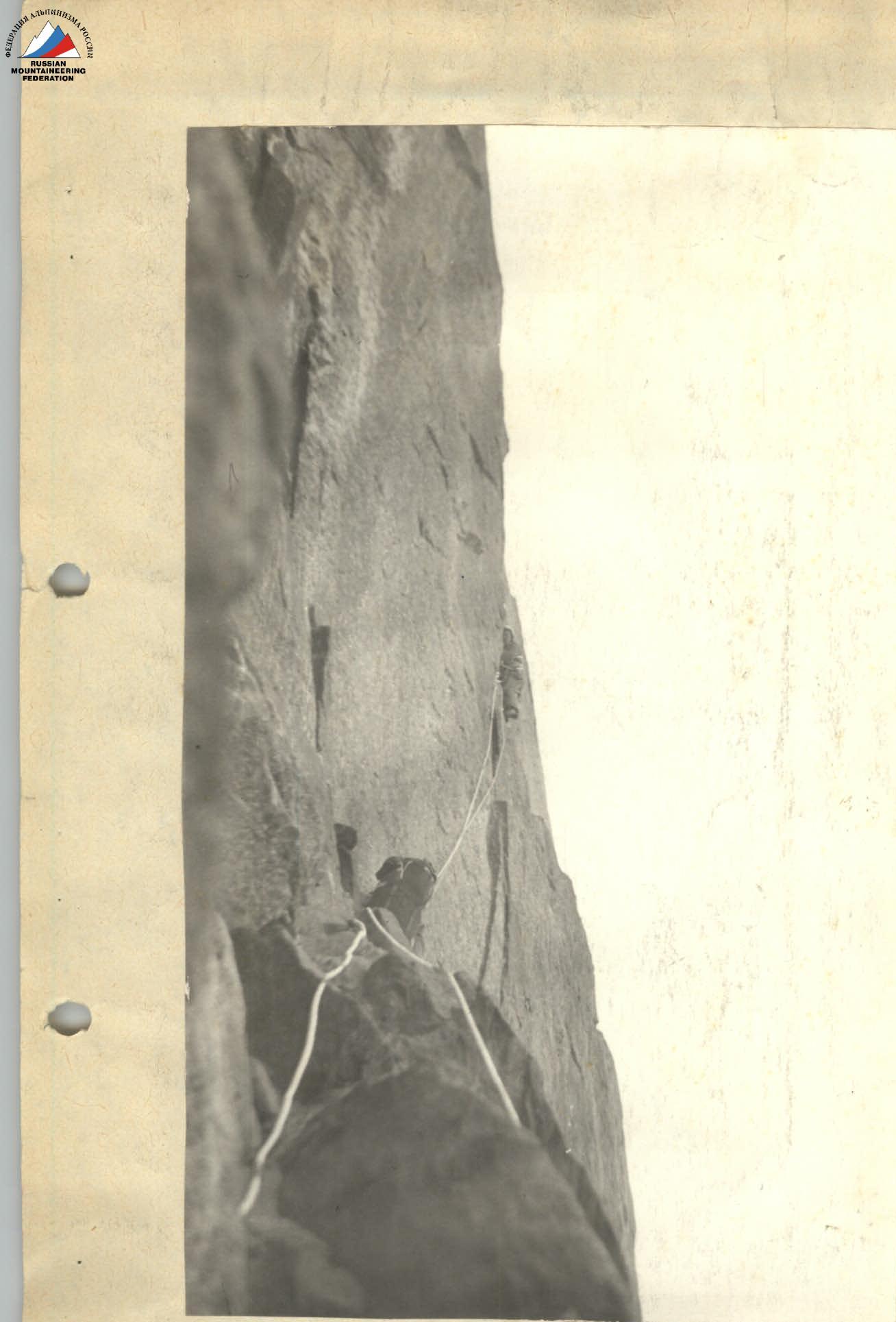
Photo #1. Section R6–R7. Exit to the base of a large internal corner, 6 cat. diff., ITO.
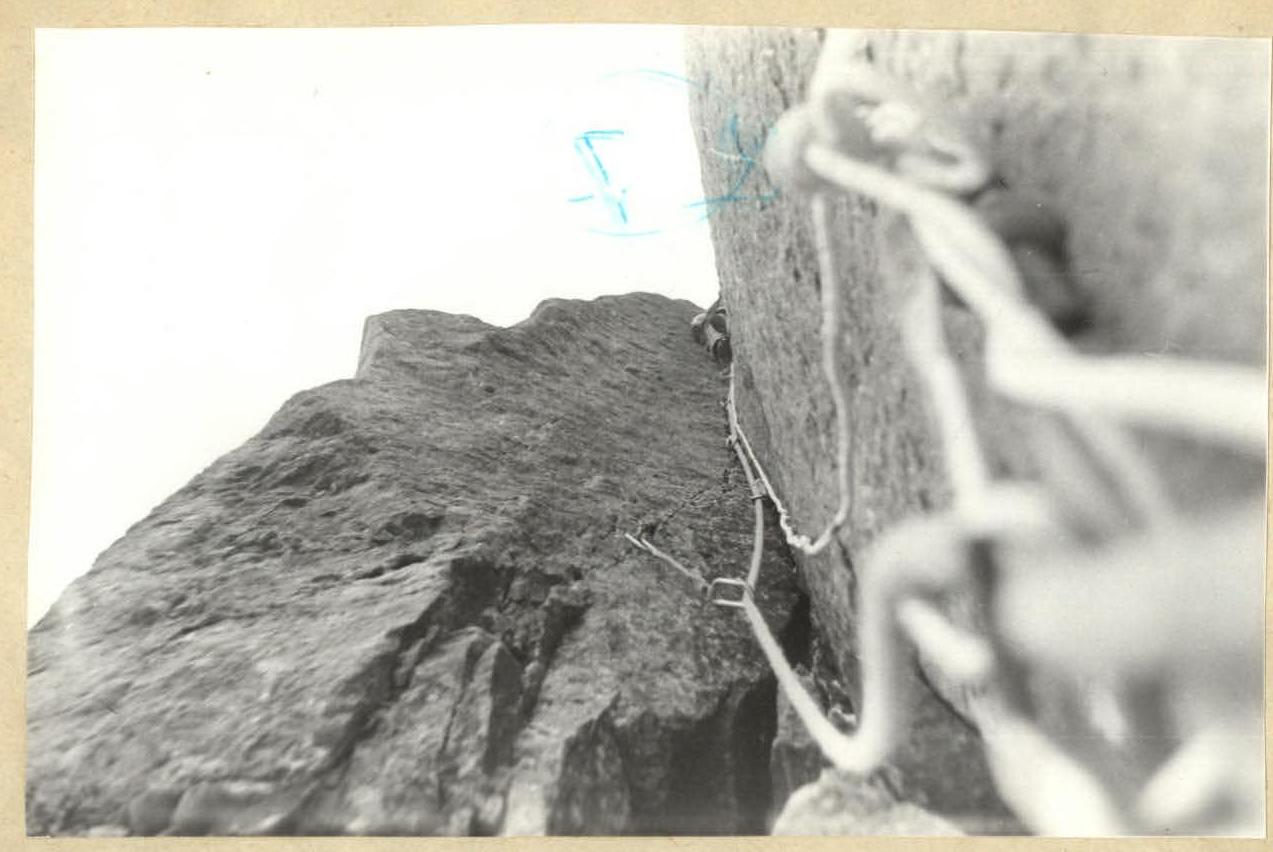
Photo #2. Section R7–R8. Start of the large 80 m internal corner, 6 cat. diff., ITO.
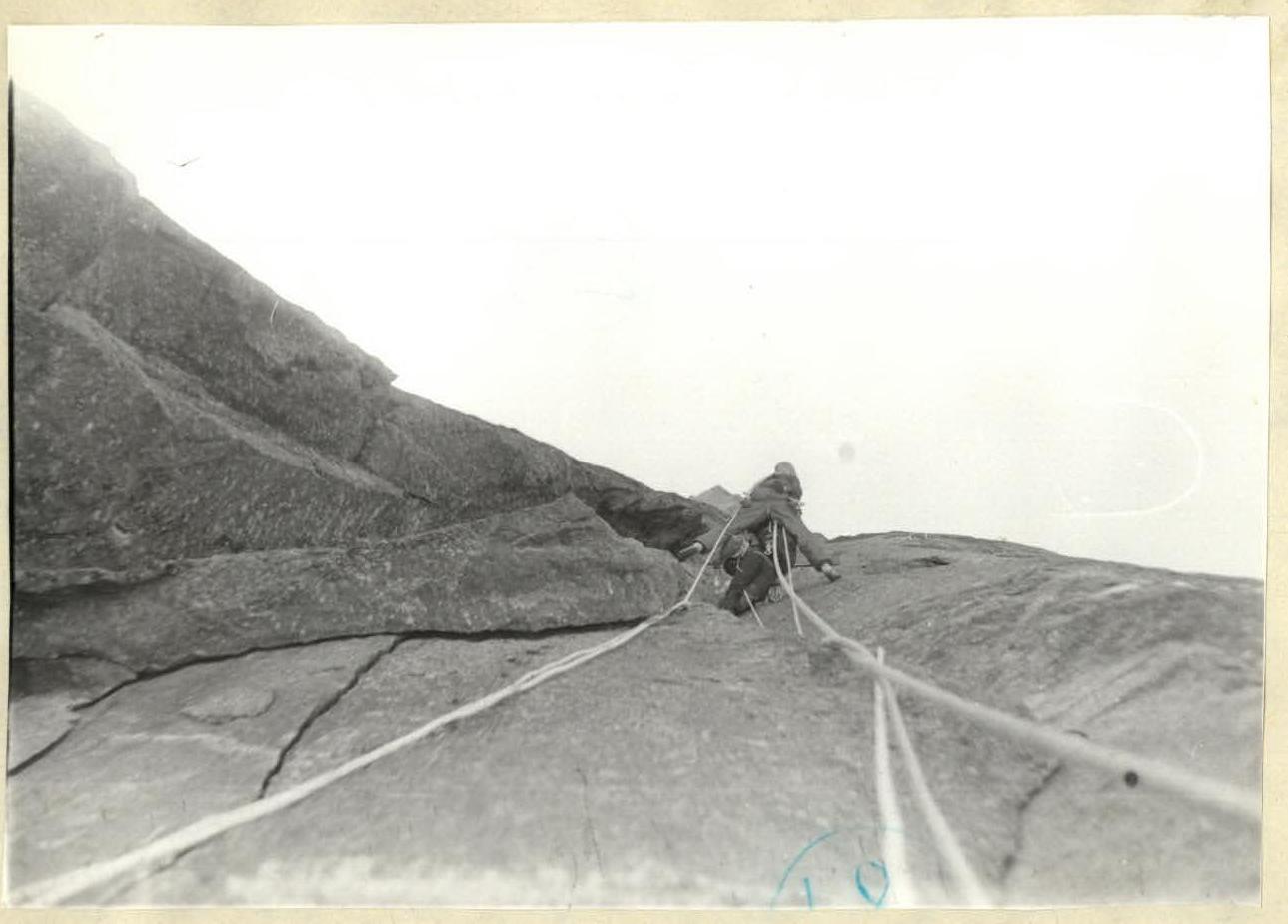
Photo #3. Section R7–R8. Continuation of the large internal corner, 6 cat. diff. Hanging belay stance.

Photo #6. Section R11–R12. Internal corner above a snow patch, 6 cat. diff., ITO. Characteristic "nose" cornice. Hanging belay stance.