
Passport
- Climbing category — high-altitude and technical.
- Climbing region — Fann Mountains.
- Summit Chapdara — 5297 m via the eastern face.
- Difficulty category — 6
- Elevation gain: from the base of the face to the summit — 1300 m, face height — 860 m, average steepness of the face — 85°, length of sections with 6th cat. diff. — 640 m.
- Pitons hammered: rock — 219, ice — 8.
- Number of climbing hours — 47 hours.
- Number of nights on the route — 3 nights.
- Team members: Merlis V.P. — team leader, CMS Vinokurov A.F. — CMS Japaridze Yu.O. — CMS Vorobiev L.F. — CMS Okhrimenko S.V. — CMS
- Team coach — Dauter B.V.
- Date of departure for the route — August 16, 1978.
Date of return to base camp — August 20, 1978.

Photo No. 5. Technical photograph. July 25, 1987, 9:00 AM. "Agat-18" camera. Distance to object — 100 m. Shooting point — 5. Shooting height — 3950 m.
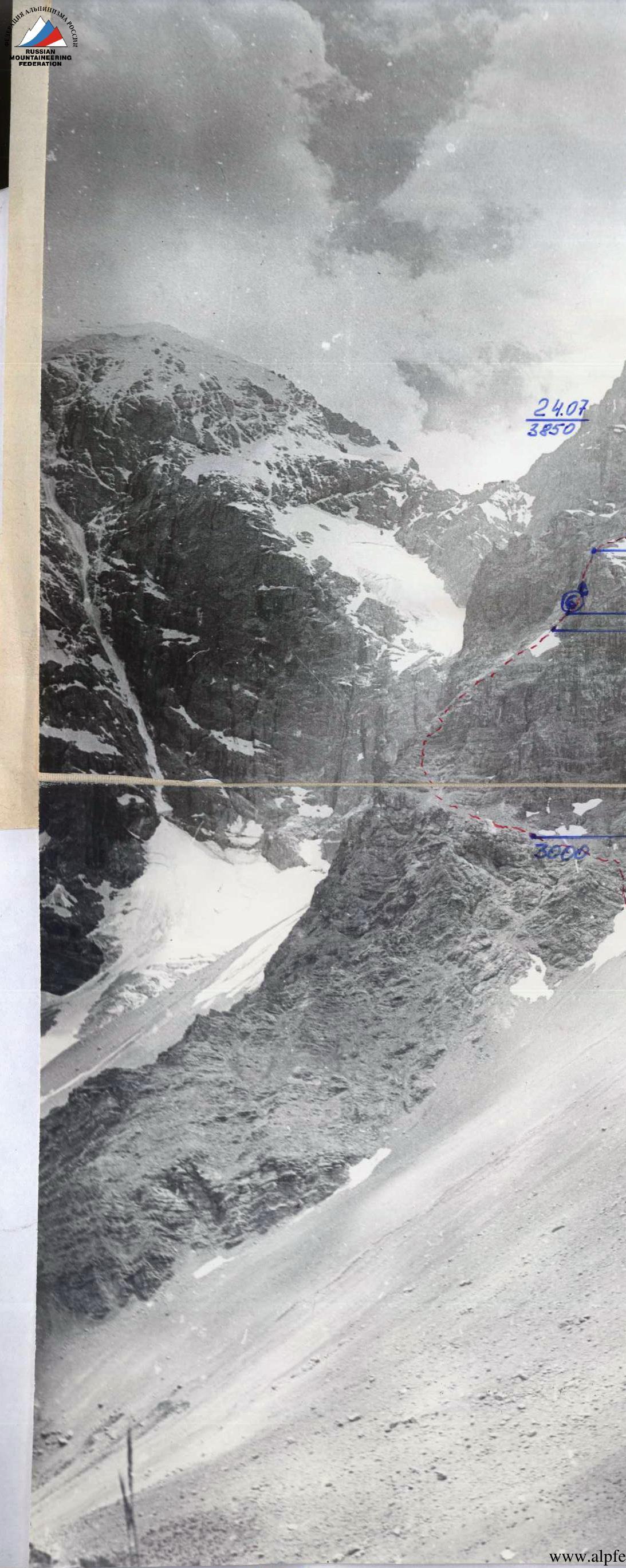
Photo No. 4. Technical photograph. July 19, 1987, 2:30 PM. "Industar-23" lens. Focal length — 105. Distance to object — 400 m. Shooting point No. 1. Shooting height — 3000 m.
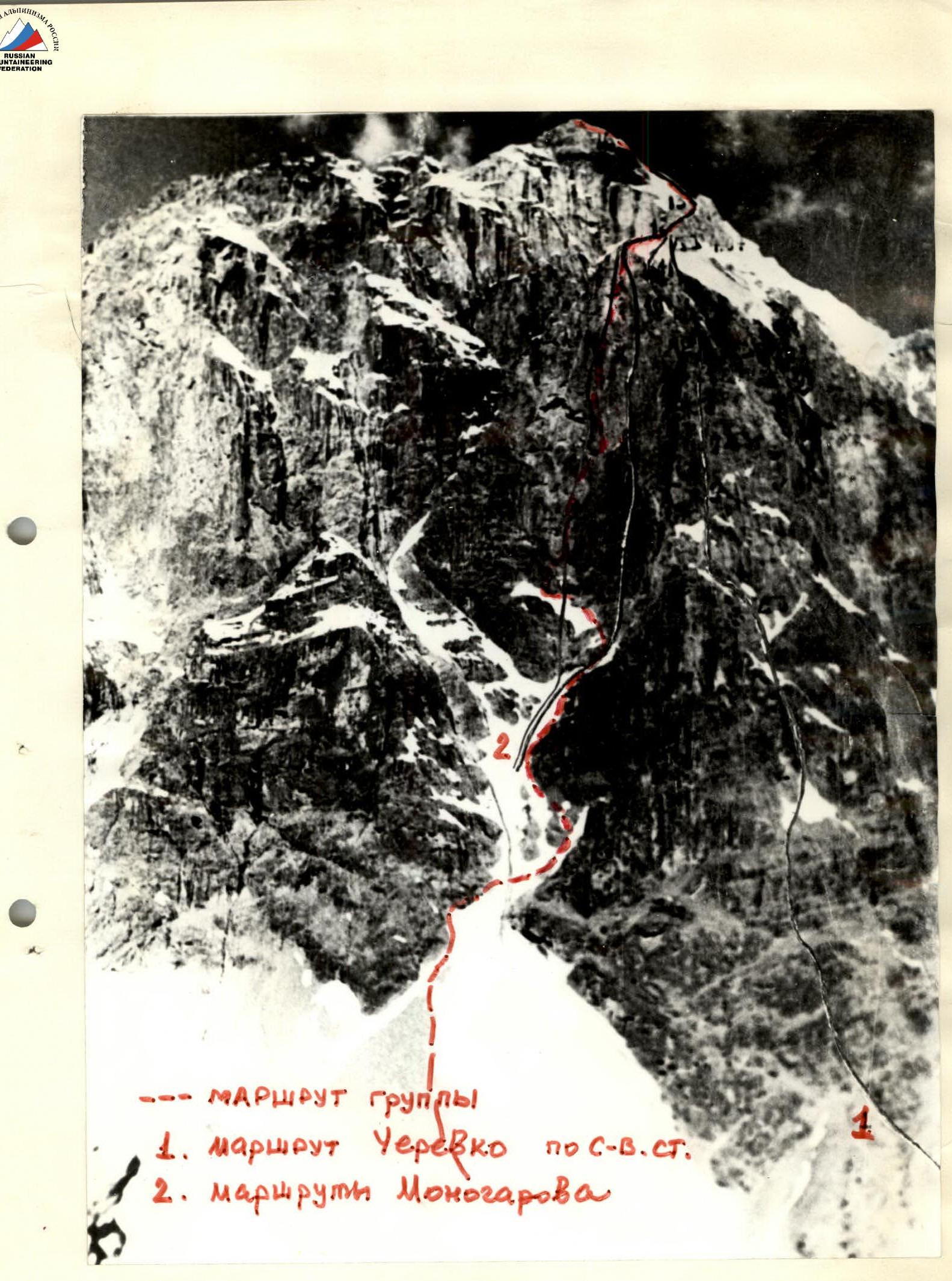
 GROUP'S ROUTE
- Cherevko's route on the NE face.
- Monogarov's routes
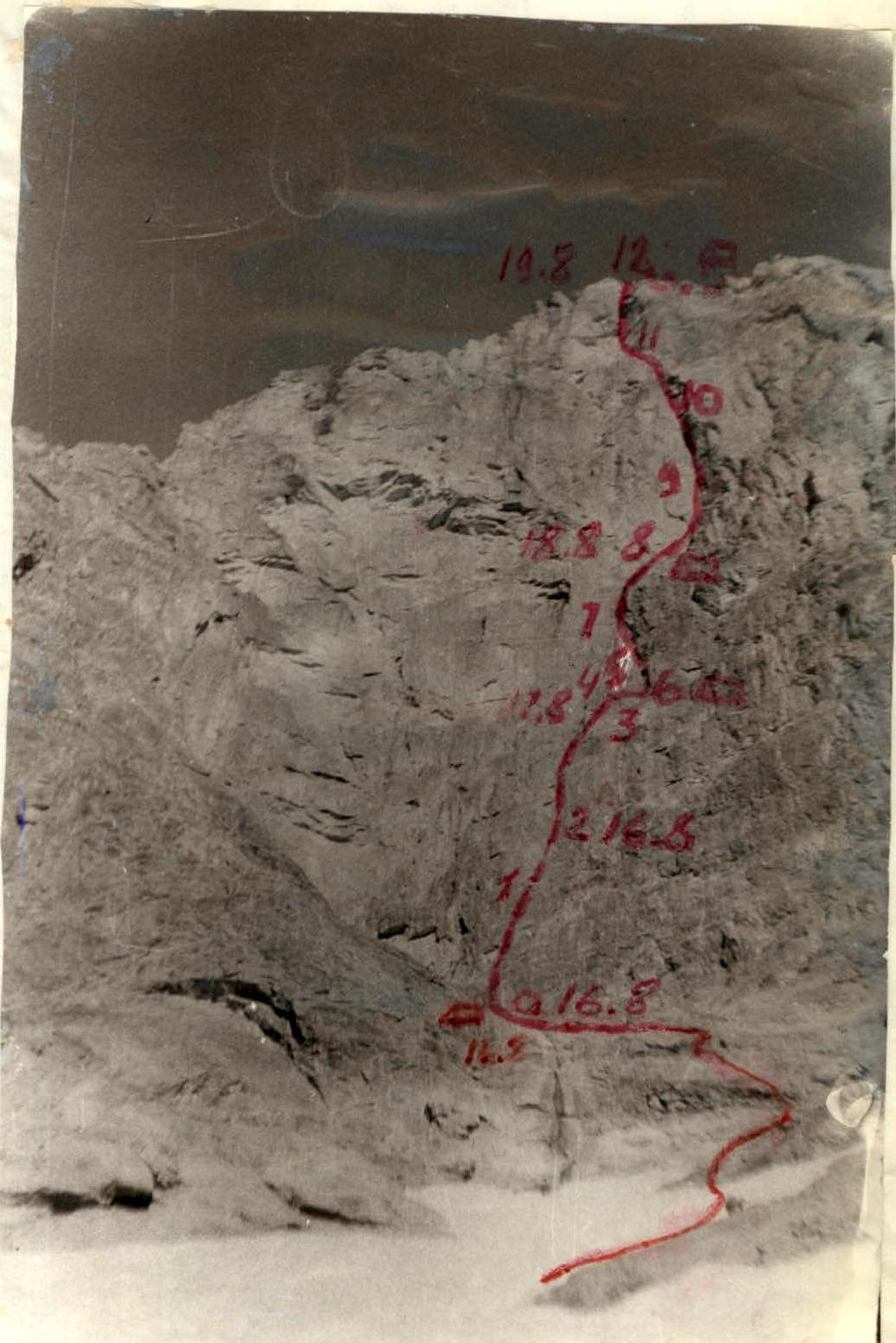
Table
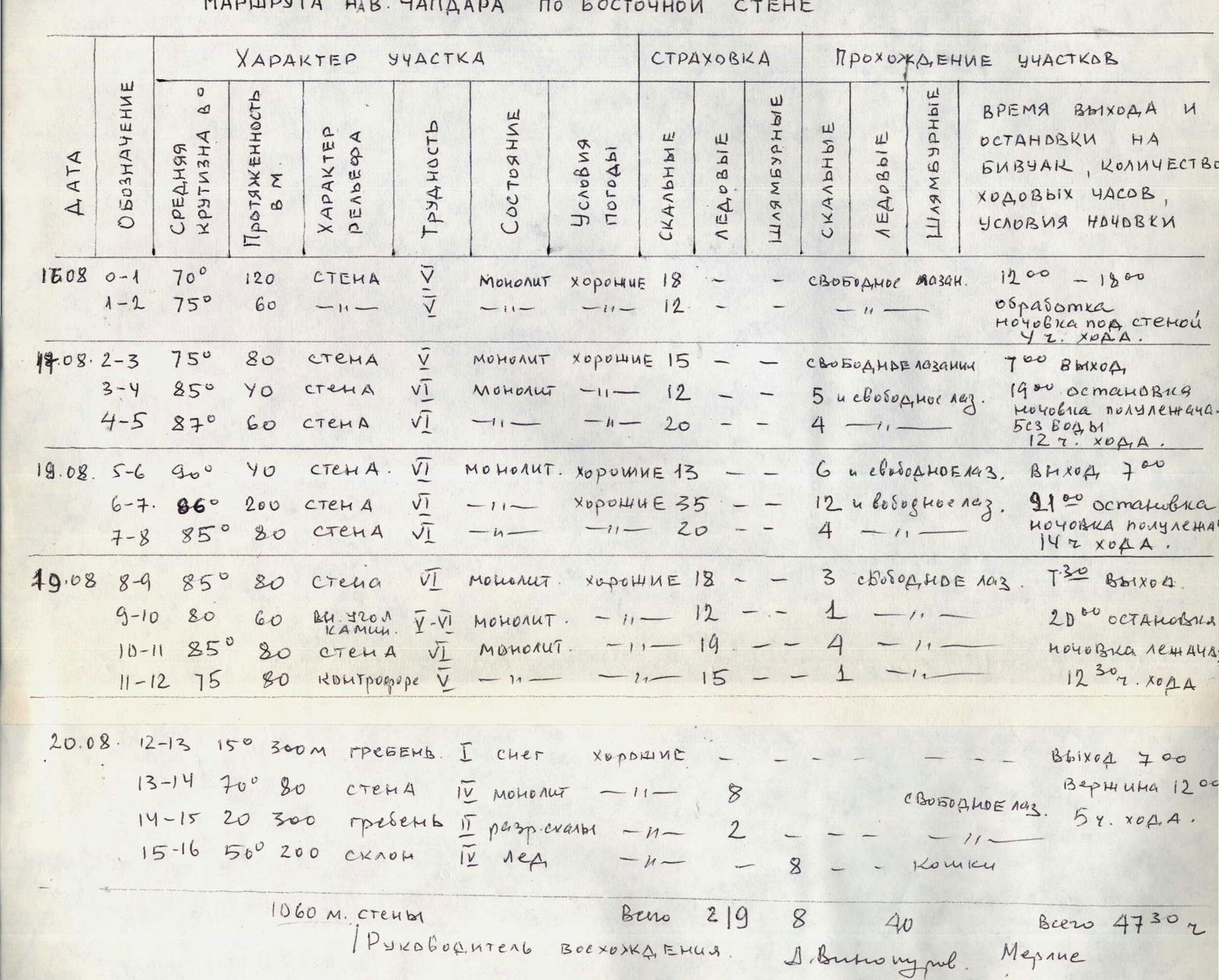
Route to Chapdara summit via the eastern face
| DATE | DESIGNATION | AVERAGE STEEPNESS, ° | LENGTH, m | TERRAIN CHARACTER | DIFFICULTY | CONDITION | WEATHER CONDITIONS | ROCK PINS | ICE PINS | BOLT PINS | PROGRESSION OF ROCK SECTIONS | PROGRESSION OF ICE SECTIONS | PROGRESSION OF BOLT SECTIONS | TIME OF DEPARTURE AND BIVOUAC, NUMBER OF CLIMBING HOURS, BIVOUAC CONDITIONS |
|---|---|---|---|---|---|---|---|---|---|---|---|---|---|---|
| August 16 | R0–R1 | 70 | 120 | Face | 5 | Monolith | good | 18 | Free climbing | 12:00–18:00 processing, overnight stay below the face, 4 hours of climbing | ||||
| R1–R2 | 75 | 60 | –//– | 5 | –//– | –//– | 12 | –//– | ||||||
| August 19 | R2–R3 | 75 | 80 | Face | 6 | Monolith | good | 15 | Free climbing | 7:00 departure | ||||
| R3–R4 | 85 | 70 | Face | 6 | Monolith | –//– | 12 | 5 and free climbing | 19:00 stop, overnight stay half-lying without water, 12 hours of climbing | |||||
| R4–R5 | 87 | 60 | Face | 6 | –//– | –//– | 20 | 4 | ||||||
| August 19 | R5–R6 | 90 | 70 | Face | 6 | Monolith | good | 13 | 6 and free climbing | Departure 7:00 | ||||
| R6–R7 | 86 | 200 | Face | 6 | –//– | Good | 35 | 12 and free climbing | 21:00 stop, overnight stay half-lying, 14 hours of climbing | |||||
| R7–R8 | 85 | 80 | Face | 6 | –//– | –//– | 20 | 4 | ||||||
| August 19 | R8–R9 | 85 | 80 | Face | 6 | Monolith | good | 18 | 3 free climbing | 7:30 departure | ||||
| R9–R10 | 80 | 60 | Inner corner | 6 | Monolith | –//– | 12 | 1 | 20:00 stop, overnight stay lying down, 12 hours 30 minutes of climbing | |||||
| R10–R11 | 85 | 80 | Face | 6 | Monolith | –//– | 19 | 4 | ||||||
| R11–R12 | 75 | 80 | Buttress | 5 | –//– | –//– | 15 | 1 | ||||||
| August 20 | R12–R13 | 15 | 300 | Ridge | 1 | Snow | Good | Departure 7:00 | ||||||
| R13–R14 | 70 | 80 | Face | 4 | Monolith | –//– | 8 | Free climbing | Summit 12:00 | |||||
| R14–R15 | 20 | 300 | Ridge | 2 | Broken rocks | –//– | 2 | –//– | 5 hours of climbing | |||||
| R15–R16 | 50 | 200 | Slope | 4 | Ice | –//– | 8 | Crampons |
1060 m of the face. Total: rock pins — 219, ice pins — 8, bolt pins — 40. Total 47 hours. Climbing leader: V.P. Merlis. Signatures: L. Vinokurov, V. Merlis.

View of Chapdara peak from the north. The upper part of the route, sections R12–R16, are visible.
- Kustovsky's route on the northern face.
- Cherevko's route on the NE face. The eastern face is located behind the ridge.
- "Polytechnic" route on the eastern face from the north.
Brief Description of the Route
Due to the lack of accurate information about the route taken by Monogarov's team, a search for the starting point of the route was undertaken. During the ascent to the face, a backpack with some equipment (ladders, pitons) was discovered. Upon careful examination of the face, a blue canister was spotted at a distance of 200–250 m from the base of the face. Therefore, it was decided to ascend to this canister. As it later turned out, the canister was empty, and our note was left inside.
The face has a concave shape, with ledges and shelves alternating vertically. There are no distinct landmarks along the route. Following the exact path of the first ascenders is quite challenging, as opinions on the route likely varied. Apart from reaching the canister, we managed to follow the first ascenders' path twice more, on sections R6–R7 and R11–R12 (where 7-8 bolt pitons were found on each section). As we ascended, we found two hammocks, rope ends, and bolt piton eyes.
The overall steepness of the face creates sections with maximum difficulty for free climbing. However, careful selection of the micro-route allows for passage without using bolt pitons. The available ledges enable good organization of partner belays:
- creating reliable belay stations;
- ensuring a comfortable position for the belayer;
- controlling the dynamics of movement.
Throughout the entire face, there were no rockfalls, which was quite unexpected, unlike other routes in the Fann Mountains. The face is warm.
Additional difficulties include the lack of water on the first half of the face.
All team members were in good physical condition and had completed 3-4 challenging climbs during this season. Okhrimenko had climbed:
- peak Bodhona via the western face, 6B category;
- peak Zintson via the northern face, 6 category.
Japaridze had climbed:
- peak Bodhona, 6 category;
- peak Chapdara — 6 category (Solonnikov's route);
- peak Chimtarga via the western face, 5B category.
Vorobiev had climbed:
- peak Zintson — 6 category;
- peak Chapdara via the northern ridge — 5B category;
- peak Bodhona — 5B category.
Vinokurov and Merlis had climbed:
- peaks Bodhona, Chapdara, and Zindon via routes of 6 category.
The team's experience enabled them to complete the climb successfully and at a good pace. According to the team's consensus, the route via the eastern face can be classified only as category 6.
Simultaneously with our climb, Karzanov's team was ascending via Cherevko's route (northeast face), which they rated as a 5B category route of increased complexity.
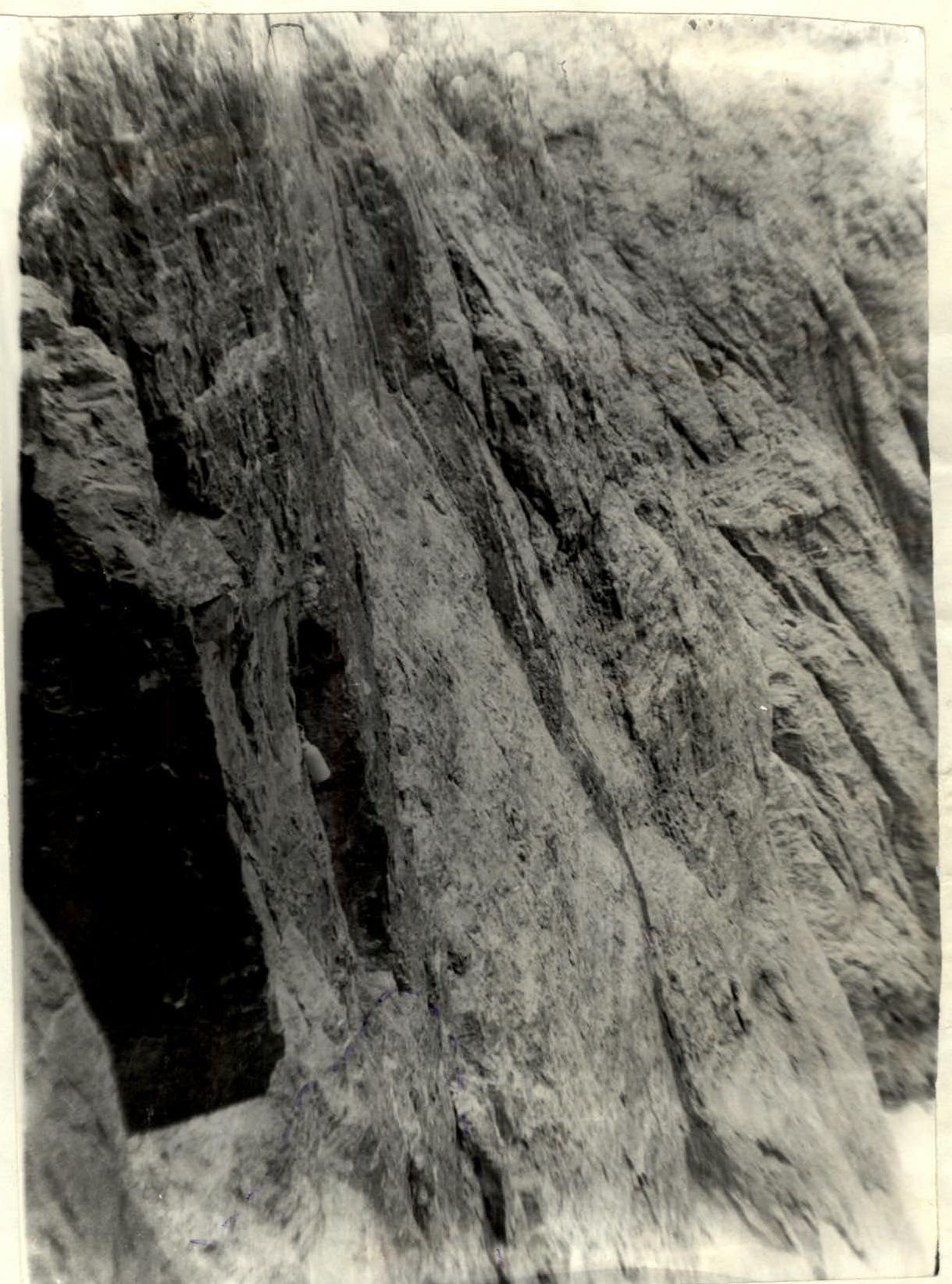
Monogarov's canister, viewed from top left. Section R3–R4.