
PASSPORT
- Rock climbing
- Fann Mountains, Zeravshan Range
- v. Urech (3400 m) via the right part of the North face
- Proposed 5B category, second ascent
- Height difference 700 m. Route length 955 m. Length of section with 6 category difficulty – 95 m. Length of sections with 4–5 category difficulty – 395 m. Average steepness of the wall part of the route 66°
- Pitons hammered: rock 31 Bolts 1/1 Chocks 66/6
- Climbing hours 12 h
- Participants: Aivazov Mikhail Borisovich – Candidate Master of Sports Ovsyannikov Dmitry Alexandrovich – Candidate Master of Sports
- Coach Dzhibraev Yuri Georgievich – Master of Sports
- Departure to the route June 28, 1983 Return June 28, 1983
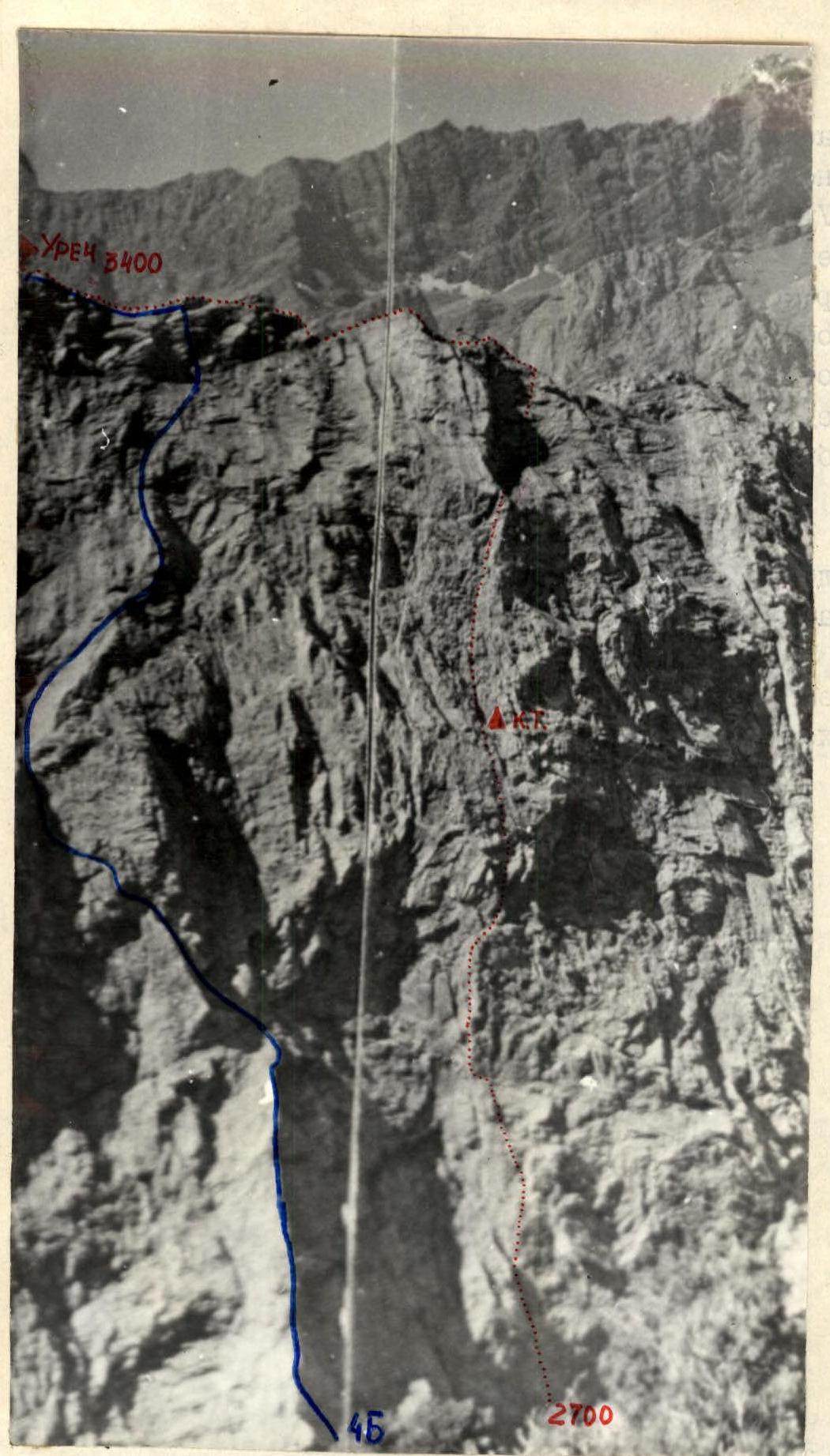
GENERAL PHOTO OF THE SUMMIT, TAKEN FROM THE RIDGE OF PIK TYNNINKIN on June 20, 1983. DISTANCE ABOUT 1 km, LENS I-50. #1
Tactical Actions of the Team
-
Choosing a tactic for the route. When determining the tactical plan for the route, the following main factors were considered by the team:
- 1.1. Estimated technical characteristics of the wall (steepness, height difference, terrain features, presence of objective safety measures on the route).
- 1.2. Stable weather conditions.
- 1.3. Targeted technical preparation of athletes for the USSR championship.
The influence of these factors determined the team's decision to complete the route in one daylight day (10–12 h), which was achieved.
-
Solving tactical and technical problems during the ascent.
2.1. Organizing a fast and safe passage of the route on a double rope, solving the following problems and tasks: a) On the section R4–R5 below the "white spot" – overcoming a hanging, destroyed chimney. 25 m. Ovsyannikov passed it using ladders. b) Directly under the "white spot" – a hanging inner corner (section R8–R9), 20 m, with smooth terrain. Aivazov passed it (chocks, ladders). c) A section of the wall above the control cairn (R16–R17), 30 m long, a smooth wall with micro-holds. A bolt was hammered in the upper part for an artificial hold at the exit. Ovsyannikov passed it (chocks, bolt, ladders).
The team climbed the route with a constant change of lead. The first climber went on a double rope, the second – on a fixed rope with top rope insurance, except for sections (R3–R4, R12–R13, and R22–R25), which the team climbed simultaneously.
Sections climbed by Ovsyannikov:
- R2–R3
- R4–R6
- R7–R9
- R10–R11
- R16–R19
- R20–R22
Sections climbed by Aivazov:
- R0–R2
- R6–R7
- R9–R10
- R11–R12
- R13–R16
- R19–R20
Sections climbed simultaneously:
- R3–R4
- R12–R13
- R22–R25
For larger groups, bivouacs are possible on ledges on sections (R11–R12 and R20–R21).
On the section (R11–R12) before the "large cornice" the team had a rest (30 min), the same on the section (R23–R24).
The control point on a narrow ledge, above the cornice, serves as a landmark before the smooth wall.
The team used the equipment of the team preparing for the USSR championship. They used:
- Chocks like "friend", "segment"
- Hook cam
- Harness for belay "in hang"
- Compact radios for communication and correction of actions by observers
It is impossible to deviate from the route due to the transition from one groove to another; nevertheless, communication with observers helped to adhere to the planned tactical ascent plan.
As subsequent ascents by other teams showed, the route may require more climbing hours.
There is no water on the route.
Scheme of the route to v. Urech via the right part of the wall (through the groove) 5B category.
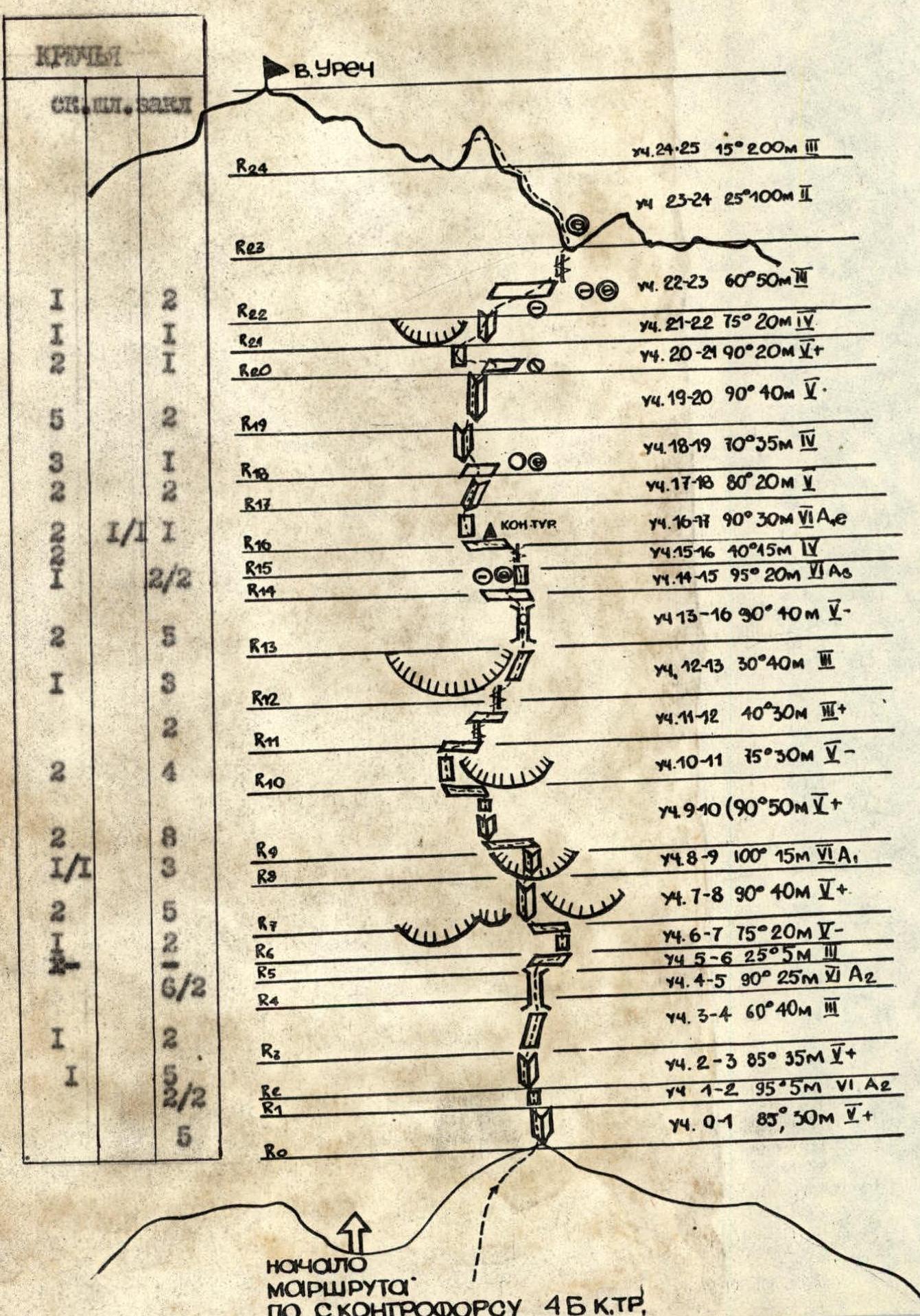
Description of the Route by Sections
The route can be divided into two belts: lower (sections 0–12) and upper (sections 12–23).
The first belt is characterized by unreliable terrain, with many loose rocks. Wide grooves are convenient for using chocks like "segment".
On the overhanging sections R1–R2, R4–R5, R8–R9, it is necessary to use artificial holds.
The large cornice (section R12–R16), which cuts across the entire wall like a powerful barrier, is best overcome to the right of the exit to the ledge at 60 m.
The upper belt is characterized by monolithic structure. The rocks are more smooth. Pitons and small "segment" chocks work well. The most difficult section is R16–R17. This is a smooth, vertical wall, passed on micro-holds. A bolt is hammered in the upper part for an artificial hold. Artificial holds are necessary for the exit to the ledge. There are places for overnight stay.
The ridge of section R23–R25 is not difficult. The descent is trivial.
The route requires good rock climbing skills and the ability to use a wide range of equipment.
Not recommended as a first 5B due to technical complexity.

TECHNICAL PHOTOGRAPHY OF THE ROUTE. TAKEN ON June 20, 1983 FROM THE RIDGE OF PIK TYNNINKIN. Distance to object about 1 km. Lens I-50. #1