
5.3.73 78
USSR Championship in Traverse Class
Report
on the traverse of Maria Peak (4970 m) — Mirali (5180 m) — Chimtarga (5487 m) — Energiya (5105 m) with ascent to Maria Peak via the northwest wall by the team from the Belarus Republican Committee for Physical Culture and Sports
Route Description
July 21–22
The entire group with observers gathered under the wall. The Lozovsky–Nogotov team started processing the route. They fixed two ropes.
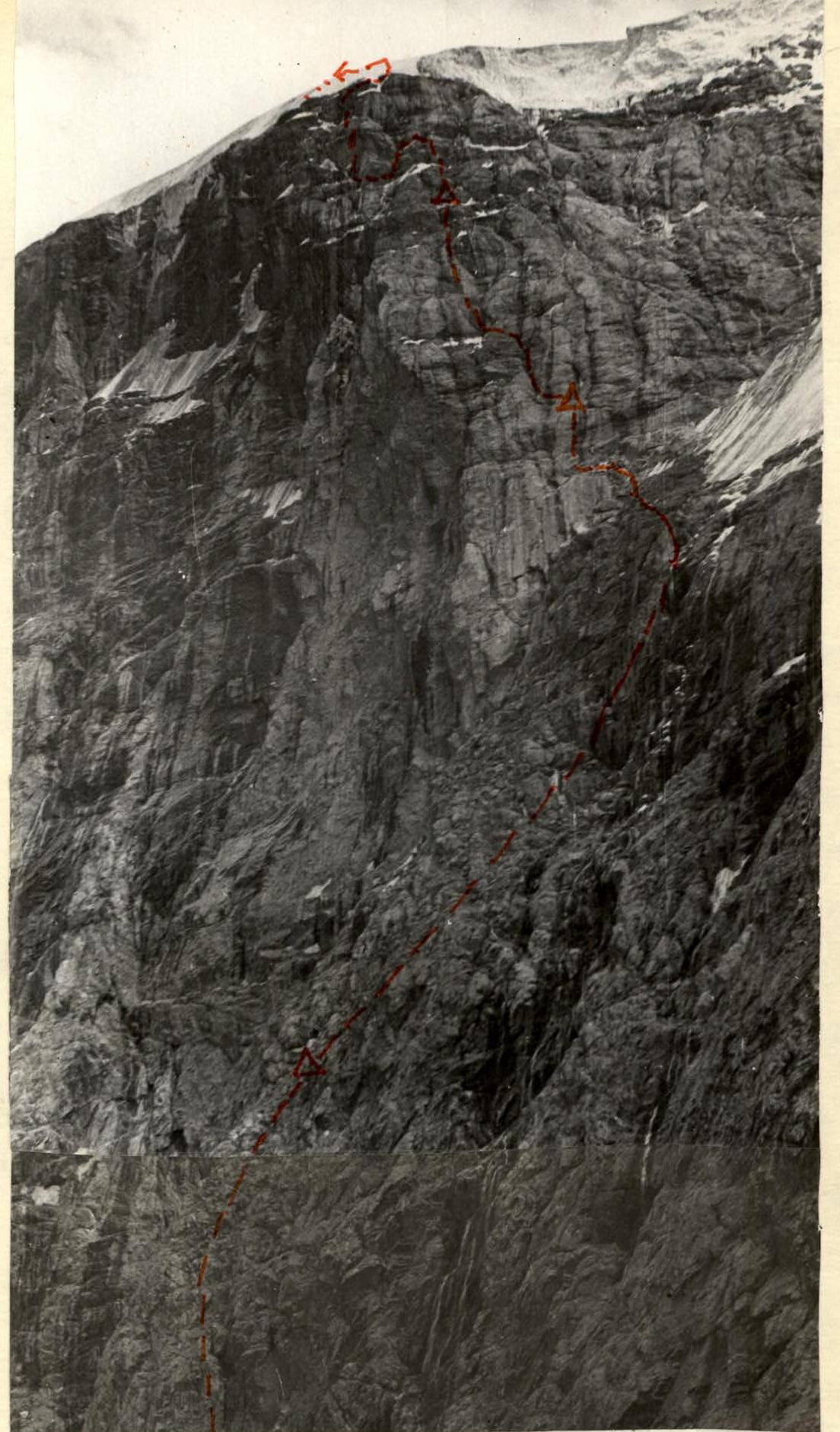
The group departed at 5:30 AM. Within half an hour, they crossed the glacier and approached the rope. The first two ropes traverse zigzagging to the right, then to the left along a crevice through steep, smooth rocks resembling "ram's foreheads" (0–1), and lead to a ledge under an overhanging wet section of the wall, approximately 5 m, with a crack. The first climber goes without a backpack; the rest follow on jumar ascenders for 40 m along the wall (1–3). Backpacks are pulled up. Those who wish can ascend with their backpacks on jumar ascenders. They completed this section by 10:00 AM.
Ahead, a wide, inclined, wet chimney is visible. They bypass it on the left (3–4) and enter a second, smaller chimney with a plug (not visible from below), which leads out onto the wall. Again, very difficult climbing: Lozovsky goes without a backpack; the others follow on jumar ascenders with their backpacks; a couple of backpacks are pulled up (4–5). The general direction of movement is up and to the left towards the main couloir, almost a chimney, which bisects the lower half of the wall from the glacier to the "nose" — a large block in that part of the wall where a gentler section is discernible. The rocks are blocky; climbing is of medium difficulty, but there are very difficult vertical sections 5–7 m long (5–6).
The last 120 m (3 ropes) follow along the main couloir. It's time to look for a bivouac site, but there's no water. Finally, they find a safe spot under a large overhanging section of the wall. Time is 16:30. They can even set up a tent, but there's no water nearby.
- Lipen–Popova go to process the route upwards,
- Kasparov–Nogotov — to process downwards: in the main couloir, exactly 40 m away, is water.
The climbing is of medium difficulty, but the couloir collects stones from the upper part of the wall. It's very dangerous, but there's no other way out. They stock up on water in polyethylene bags for the morning.
- Four team members fit into the tent,
- Nogotov lies down to "guard" the entrance.
60 m of rappel ropes are fixed upwards. Retire at 21:00.
July 23
They start moving at 8:00 AM. The nature of the rocks is the same: walls alternate with ledges, and it's very difficult in places (6–7). They approach closely to the couloir in its upper part, where waterfalls cascade down the rocks. They keep their direction towards the rock ("nose") from which the couloir begins.
The last difficult section (7–8) — and they emerge onto this "nose". The steepness decreases sharply; they can even move simultaneously in places, but this section is the only one on the wall (prone to rockfall precisely due to its relatively low steepness). Its length is 80–100 m (40–60 m in a straight line).
- They traverse this section as quickly as possible (8–9),
- and take cover under the base of the wall.
Here, the wall has a steep bend. Upwards and to the right, the steepness is less, but they need to move left along the "sickle", avoiding the overhanging icefalls above.
The nature of the rock micro-relief also changes: if until now the rocks were mainly "blocky", here they start to resemble "ram's foreheads". Their surface appears to be compressed from quartzite tiles, 3–5 cm or larger, laid like roofing tiles. (As it turns out, rocks of this structure make up the entire upper part of the wall).
Upwards, a completely smooth, monolithic, slightly convex wall stretches. Everyone puts on galoshes or sneakers. At 14:00, the Lozovsky–Lipen team starts moving; the others wait to see how and when it will end. Easy traversing to the left towards the base of a vertical "forehead" with a slit (9–10) and exit under the base of the monolithic wall. The average steepness is 85°, with vertical sections; there are no cracks for pitons. For safety, Lozovsky hammers in expansion bolts. The last 10 m involve moving left into a narrow slit with water. The rope isn't long enough to reach the ledge. They extend the rope and, after another 5 m, reach (10–11) a ledge suitable for an overnight stay (safe, with water nearby). They pull up their backpacks, hammer in a couple more expansion bolts for safety during the night, and "settle in" to sleep. Unlike the previous night, this one is uncomfortable: they keep sliding down.
July 24
In the morning, there's no water, but it will soon be plentiful. So, they decide to move out without breakfast to a more convenient spot with water. Their doctor (Lipen) systematically feeds them vitamins throughout. Departure at 6:30 AM. Everyone wears galoshes. Along the ledge to the left, they approach (11–12) the base of a narrow couloir (12–13). There are vertical sections. A very difficult section. The first climber goes without a backpack. Again, the drill is used. Along the "sickle" left and upwards (13–14), they reach the base of a steep slab with a slit (14–15). The first climber goes without a backpack. They pass this wall by 10:30 AM. Again, left and upwards along "foreheads", with very difficult sections 4–6 m long in places. After six ropes from the overnight, they emerge (15–17) onto a convenient ledge with snow at 12:00 PM. Here, they have a "breakfast" until 13:15 and continue "forward and left and upwards" along "ram's foreheads" (17–20), reaching a shoulder with a snow patch, near a waterfall. 15 m higher (20–21), there's a depression in the rocks resembling a grotto. It's still early — 15:30 — but further on, the rocks are difficult, wet, and it's uncertain whether they'll find such a safe and comfortable spot for the night. So, they process one very difficult rope upwards (Lozovsky), dig into the ice in the grotto, and set up a bivouac. Water is nearby and plentiful. In the grotto, they can even remove their helmets and sleep almost lying down.
July 25
They depart at 7:00 AM. Everyone wears galoshes. Immediately, very difficult climbing: twisting left and upwards along "foreheads" to the left of a couloir with ice (21–22). The steepness of the wall increases. Overhanging sections become more frequent. Already on the third rope (23–24), they use the drill again: "foreheads" with sheer walls; there's nothing to belay from. Then it's even worse: movement isn't strictly upwards but involves traversing left (24–25). Further up, it's very bad. They descend from the "forehead" down a wet wall using a rappel 10 m to a ledge. On the left part of the ledge (20 m), a vertical chimney goes upwards, and it's wet. Lipen climbs the chimney without a backpack (25–26).
Ahead, the rocks glisten in the sun, completely soaked with water. They put on boots. Their feet get wet immediately; it would be good to use galoshes as intended — over their boots. Along the ledge to a rappel anchor, they move left and upwards. Water flows down the rocks in a continuous stream; there's no dry spot.
Two ropes along these rocks (26–27) lead to a pitch (27–28): in the upper part, it's sheer; below, there's ice. A nearly vertical rappel anchor is about 2 m short of the top of the rocks. They can feel that the wall is ending somewhere close. This is indicated by:
- the abundance of water,
- the increasingly frequent ice patches,
- the view of the left part of the wall: they're near the edge of the "sickle".
Lipen climbs this 7th rope after the overnight, initially on wet rocks, then on the rappel anchor right and upwards. It's very difficult; the edge of the ice is thin; the exit is up a steep "forehead" onto a ledge. Above, an ice slope is visible. The rocks are destroyed, wet. There are few cracks for pitons, and the rock is very fractured for expansion bolts.
After the rappel anchor, 20 m right and upwards along "foreheads", they emerge onto a ledge to an ice slope. The ice is permeated with water. They hammer in the last rock piton on the wall (a channel), and Lipen, wearing crampons and screwing in ice screws, climbs the first rope and disappears over the horizon. The others follow along the fixed ropes; their boots hold very poorly (29–30).
On the second rope (30–31), the steepness decreases, and upon completing it, the ridge comes into view. Along the snowy summit plateau, they move all together:
- first left (31–32) until the steepness starts to increase,
- then right (32–33),
- and again on ice (the first on crampons) with belays via ice screws (33–34).
They reach the ridge at 19:00.
July 26
After climbing the wall, they feel physical and psychological fatigue. So, they depart from the bivouac at 10:00 AM. The ridge of Maria Peak is not complicated, except for three sheer walls. The first, about 40 m long, requires careful piton belays and is climbed without backpacks. The second is simpler, with a steepness of about 75° and a length of 20 m. And further — the very exit to the summit — due to the lack of cracks for pitons. The descent from the summit towards Mirali alternates between descending on rappel and scrambling. They bypass gendarmes on the right as they go, along a simple ridge, and reach Mirali (5180 m) at 19:00. The weather deteriorates; snowfall begins; visibility decreases. They descend from Mirali via simple but heavily destroyed rocks to a col towards Chimtarga. They set up for the night on a wide, safe, closed ledge protected by an overhanging rock.
July 27
From the overnight, their path follows a snowy ridge. Within an hour, they approach a rock belt that leads to a steep snow-ice pitch. They move with variable belays (the first on crampons). They reach the summit at 12:00 PM. The weather worsens; it starts snowing. They begin their descent to Chimtarga Pass. In poor weather conditions, the descent requires significant effort and time to organize. It represents one of the most challenging sections of the second half of the route. Difficult climbing alternates with numerous rappels. They descend along the wall 200 m below Chimtarga Pass towards the Zindon valley and set up on a good platform at 20:00 for the night.
July 28
Their route is nearing its end. Before them lies the last peak of the declared traverse — Energiya (5105 m).
- They ascend along a simple but heavily destroyed ridge.
- Further, the ridge becomes steeper; piton belays are required.
- Approximately 4 ropes of medium climbing difficulty.
- They reach the summit at 13:00.
They descend towards Mутные озёра (Muddy Lakes), and stop for the night at Алаудинские озёра (Alaudin Lakes) at 20:30.
July 29
The group, in full, along with observers, returns to the а/л «Артучъ» (Artuch) via Alaudin Pass.
Table
Key characteristics of the ascent route via the northwest wall of Maria Peak. Height difference is 850 m; the average steepness of the wall is 73°.
| Dates | Sections | Steepness of section | Length of section (m) | Nature of terrain | Technical difficulty | Method of overcoming and belay | Weather conditions | Bivouac stops | Departure time | Climbing hours | Sleeping hours | Expansion bolts | Ice screws | Bivouac conditions | Daily ration (g) |
|---|---|---|---|---|---|---|---|---|---|---|---|---|---|---|---|
| July 22 | 0–1 | 80° | 120 | rocks, slabs | medium | combined piton belay | 0:30 | 4 | – | ||||||
| 1–2 | 100° | 5 | wall | very difficult | piton belay | 2 | – | ||||||||
| 2–3 | 90° | 40 | wall | difficult | – | good | 6 | – | normal | 620 | |||||
| 3–4 | 75° | 55 | slabs | – | – | 6 | – | ||||||||
| 4–5 | 85° | 20 | chimney, wall | very difficult | – | 5 | |||||||||
| 5–6 | 60° | 200 | blocks | medium | – | 16:30 | 10 | ||||||||
| Total for the day | 440 | 11 | 33 | ||||||||||||
| July 23 | 6–7 | 75° | 280 | blocks | medium | – | 8:00 | 17 | – | ||||||
| 7–8 | 85° | 15 | wall | difficult | – | 4 | – | ||||||||
| 8–9 | 45° | 100 | ram's foreheads | easy | partly simultaneous | good | 1 | – | image/jpeg](https://summitx.info/media/1/Etp2ZZ8g1JV2b050GEcoZGEWrRscFbmB/img-0.jpeg ↗) | ||||||
 | |||||||||||||||
 |
Route — Traverse
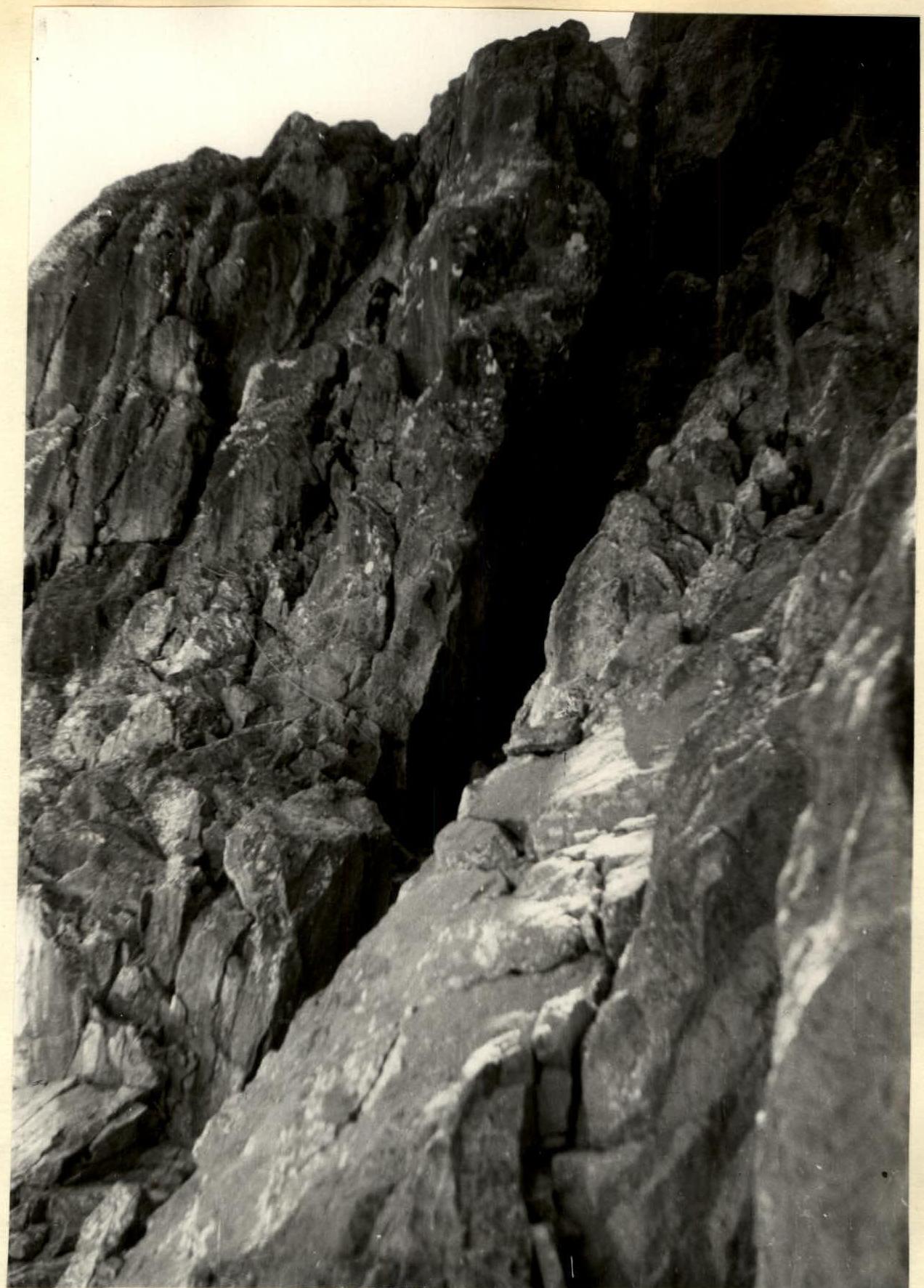
Entering the chimney
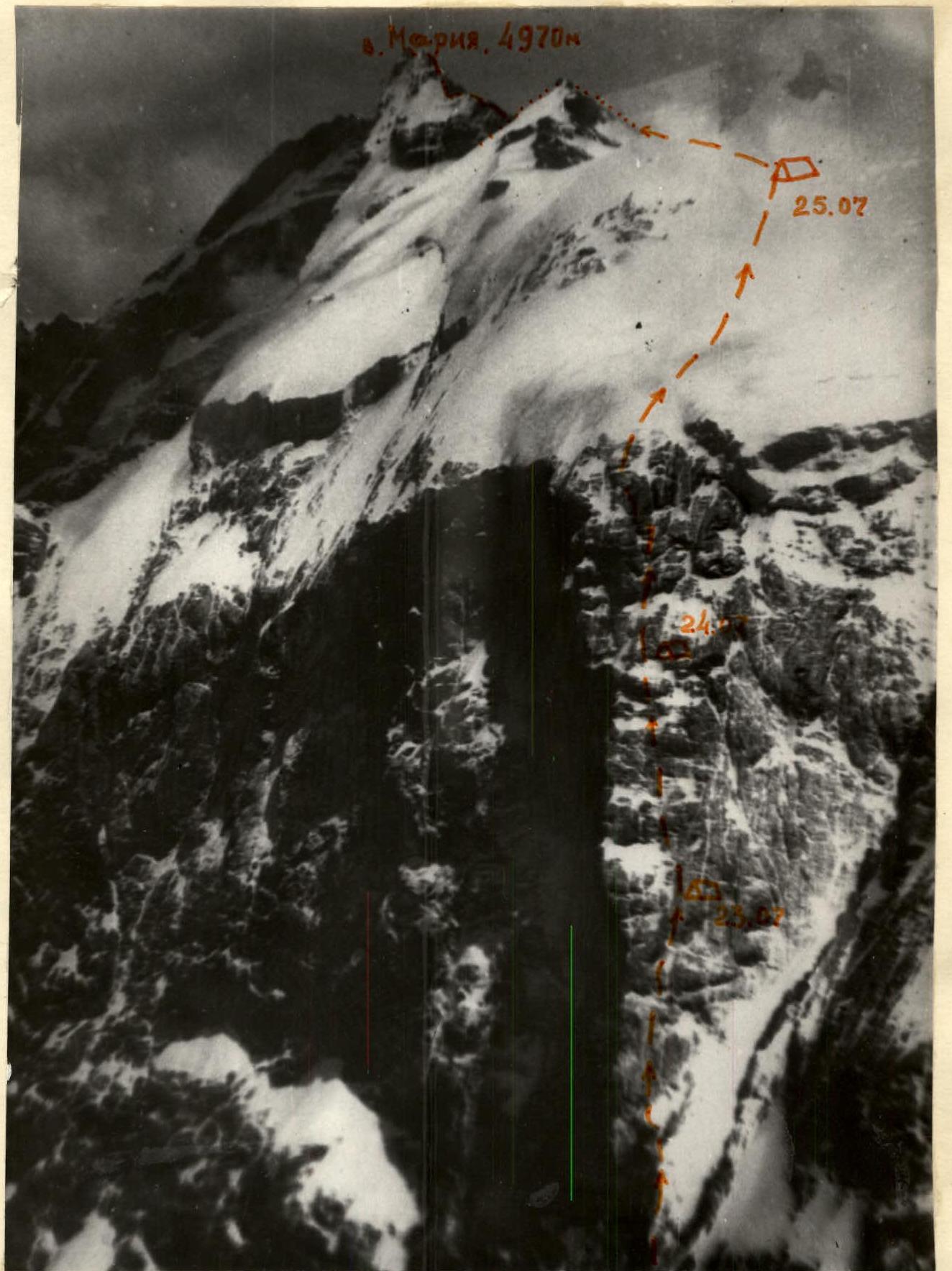
Upper part of the wall

Comments
Sign in to leave a comment