
I. The ascent category is technical. 2. The ascent area is the Fann Mountains, Zarafshan Range. 3. The peak, its height, and the ascent route are
- Peak MARIIA, 4970 m, via the northeast edge, category 5B difficulty, 3rd ascent of the route.
- Route characteristics: height difference — 1460 m, length of sections with 5–6 category difficulty — 1425 m, average steepness of the route — 60°, average steepness of the most difficult sections — 80–90°.
- Pitons driven: rock pitons — 89, including 5 for creating intermediate belay points; chock stones — 65, including 4 for creating intermediate belay points; ice screws — 32.
- Time taken to reach the summit — 25 hours.
- Number of bivouacs and their characteristics:
two bivouacs — one excellent,
- one sitting.
- Names of the team leader, participants, and their qualifications: Dronov Yu.V., Candidate for Master of Sports — team leader; Fevziev R.F., Candidate for Master of Sports Smirnov G.K., Candidate for Master of Sports Babashko V.P., Candidate for Master of Sports Valiulin E.A., Candidate for Master of Sports
- Team coach — Mumdzhi T.M., Master of Sports of the USSR, senior instructor. II. Date of departure and return: departure on the route — July 24, 1979 return — July 26, 1979
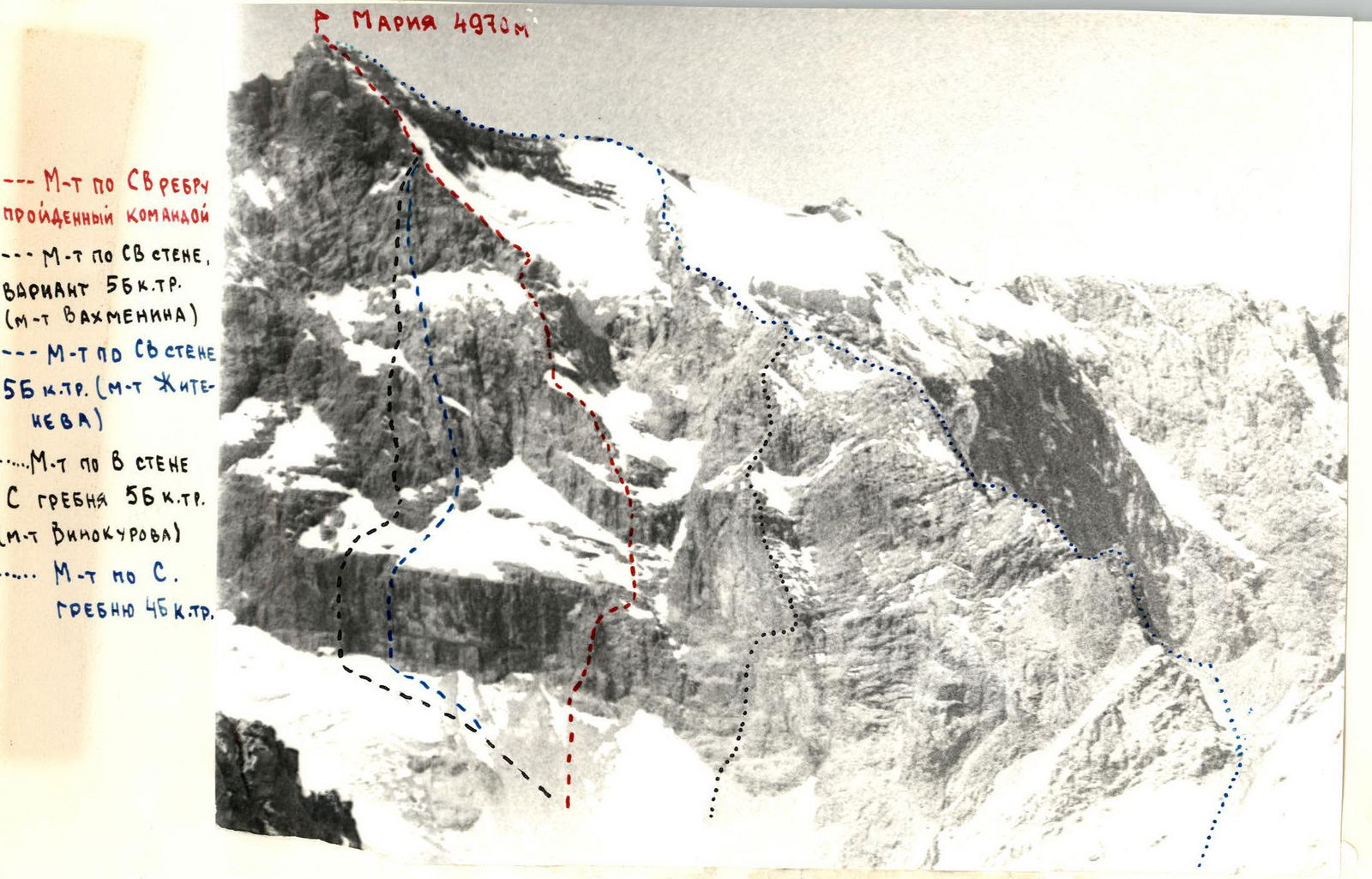
MARKA 4933 m
Geographical and Sporting Characteristics of the Area
The peak Maria, named by the well-known researcher of the Fann Mountains, Paganucci A.B., is located in the ridge of the Zarafshan Range, known in this area as the Fann Mountains due to its geographical, geomorphological, and climatic peculiarities. Here, the Zarafshan Range sharply changes its latitudinal direction, turns south, and converges with the Gissar Range. From Peak Mirali to the west, a spur with peaks:
- Maria,
- Omar Khayyam,
- Rudaki,
- Aurandag,
- Saryshakh,
- Gaznych, known as the West Fann Range, branches off.
The part of the Zarafshan Range from Peak Adam-Tash to Peak Mirali and the part of the West Fann Range from Peak Mirali to Peak Aurandag form a powerful arc with steep northern slopes and significant glaciation, closing the Kulikalon cirque from the south. This wall is often referred to as the Kulikalon Wall.
Geologically, the Kulikalon Wall has two zones by height: the lower zone is composed of monolithic marblized limestones and dolomites, and the upper zone is represented by metamorphic, thin-layered, strongly deformed limestones with horizontal and inclined bedding.
The northern orientation of the Kulikalon Wall determines its harsh character. Receiving virtually no solar heat, the wall is strongly cooled and retains large masses of snow and ice, extending significantly below the snow line (4000 m). For instance, on the northeastern slopes of Peak Maria, there are two snow-ice belts:
- 3600–3800 m
- 4000–4250 m separated by rock cliffs. Above 4300 m lies a large hanging glacier, oriented northward and stretching almost to the summit tower.
The steepness of the rock cliffs contributes to safe passage, as stones thawing and falling from above fly over these rock ledges. The northeast edge (more accurately, the northern edge), rising sharply from the 4400 m mark (above the second snow-ice belt), is also safe to traverse because:
- its left part (in ascent direction) features rock cliffs,
- its right part slopes toward the hanging glacier.
The climate of this area is sharply continental with generally stable good weather in the summer. However, there are seasons with unfavorable weather. For example, in the summer seasons of 1970 and 1972, precipitation was frequent, with frequent rains, and in the summer of 1974.
The first ascents in the Fann Mountains were made as early as 1937 by groups led by Kazakova, Lukomsky, Gusev, and Mukhin.
However, the area gained widespread mountaineering recognition after being thoroughly described by researcher and popularizer of the Fann Mountains, Paganucci A.B., as well as well-known mountaineers:
- P. Karpov,
- U. Usenov,
- V. Egorov,
- L. Kiselev,
- V. Sedelnikov,
- F. Zhitenev
- and others.
The first ascents on Peak Maria from the northern side date back to 1968.
- F. Zhitenev pioneered a route through the central part of the NE wall.
- V. Smrchek ascended via the northern ridge.
In 1970, a team of Tashkent mountaineers led by A. Shabanov ascended the northeast edge of Peak Maria.
Currently, many ascents are made on Peak Maria via the simplest path — the northern ridge, category 4B difficulty, and less frequently — via the northeast wall, category 5B difficulty (Zhitenev's route).
The route on Peak Maria via the northeast edge, category 5B difficulty, was repeated only this year by a team of mountaineers from Karaganda.
Preparation for the Ascent
The northeast edge of Peak Maria, upon careful examination from below (as there was no route description available), appears:
- relatively safe,
- technically challenging,
- combined,
- very logical,
- beautiful.
Despite the overall considerable length and significant steepness of the northeast edge, the length of complex rock and snow-ice sections is roughly equal. All these factors, along with the fact that the route had been traversed only twice, determined the team's decision to ascend Peak Maria via the northeast edge.
As training ascents, the team completed several routes of 3–4 category difficulty, as well as a sporting ascent on Peak Aurandag via the NE wall, category 5B difficulty.
Considering that the team was about to tackle a combined route, they conducted training sessions on the Mirali glacier for two days to practice and improve technical skills and techniques for overcoming steep snow-ice slopes using modern ice equipment:
- titanium ice screws (tubular with special sharpening),
- twelve-tooth crampons,
- ice hammers and ice axes made according to the best domestic and foreign ice equipment samples.
It is also worth noting that during their ascents, the team successfully used chock stones (stoppers, segments, hexes, etc.) for belaying and creating intermediate belay points, alongside a wide range of titanium rock pitons. The ratio of chock stones to pitons used during ascents was approximately 1:1.
During the training sessions on the Mirali glacier, located near the northern slopes of Peak Maria, and on July 23 of the same year, visual observation of the route was conducted using a 12x field binocular to study the route directly and the regime of falling stones and ice.
Based on these observations, the following tactical plan for the ascent on Peak Maria via the NE edge was developed: Day 1 — Approach to the route. Processing of the lower rock belt. Bivouac on the moraine under the route. Day 2 — Passage of the lower rock belt. Passage of the second rock belt. Bivouac at the base of the snow-ice "knife". Day 3 — Passage of the snow-ice "knife", pre-summit rock slopes, and ascent to the summit. Descent from the summit via the northern ridge. Day 4 — Reserve day.
The team carried out the ascent on Peak Maria via the NE edge according to this plan.
Monitoring of the ascent progress and radio communication with the group were carried out from the base camp at Lake Bibi-Djanat by a group consisting of: Mumdzhi T.M. — Master of Sports of the USSR, senior instructor; G.Kh. Avanesov — 1st sports category, instructor; V.K. Kamalov — 1st sports category; V.V. Gornostaev — Candidate for Master of Sports.
Monitoring of the ascent was conducted almost continuously during daylight hours using an 18x field binocular.
Radio communication was carried out at the designated time for the Fann Mountains area (control — 3 times a day, emergency — 3 times a day) using a VHF radio station "Vitalka".
Ascent Diary
July 24, 1979
A group of five climbers (Dronov Yu.V. — leader; Fevziev R.F., Babonko V.P., Smirnov G.K., Valiulin E.A. — participants) depart from the base camp at Lake Bibi-Djanat. After 2 hours, the group stops on the Mirali glacier, 250–300 m from the start of the route.
As our observations show, the lower part of the route is occasionally hit by falling stones until 14:00. After resting and reviewing the start of the route again, the "pair" Dronov-Fevziev begins processing the lower belt. After ascending the glacier, we reach the start of the route. The consultation received from the Karaganda Regional Sports Committee's gathering group was very helpful. We immediately approach the start of the route and see the path to ascend to the first rock belt. The route begins with a 60 m rock wall. Dronov starts first and begins moving up the wall. He works very attentively due to the abundance of limestone dust on small ledges. He passes the rock wall at a good pace (R0–R1), sets up belays, and with top-rope belay, takes in Fevziev.
Further on, the steepness of the 1st rock belt increases to vertical, with some wet patches visible on the wall. Fevziev starts moving along an internal corner. The internal corner is vertical, with a small cornice visible in the middle. Chock stones (stopper, segments) go well, but movement along the corner is very slow due to the limited number of small holds, and in some places, holds are absent, requiring the use of intermediate belay points (ITOs). The cornice is passed with great difficulty.
The belayer warns that there are 3 m of rope left, but there's no convenient ledge for belaying in the internal corner. Belaying is done sitting in a "harness". The belay rope hangs in the air, and Dronov climbs up using two ascenders and with top-rope belay, retrieves the ropes.
The first climber continues further, with very challenging climbing. Another rope of very difficult climbing follows along a wet internal corner, and again, there's no convenient ledge for belaying the second climber (R1–R2). After securing the belay rope to two stoppers, the second climber is taken in while sitting in a "harness".
Further movement is along a 40 m crack, where chock stones go well again. The wall's steepness is slightly less than vertical, but climbing is still very challenging. Finally, after 40 m, we reach a narrow ledge where one person can stand (R2–R3). The last two ropes are retrieved.
After the ledge, movement is along a smoothed chimney. The chimney is very challenging, with some holds missing, requiring the use of ITOs. After 25 m, the chimney ends, and we reach a good, convenient platform under a small cornice. We can continue, but we know that beyond the next rope, there's a snow-ice slope exposed to ice chunks from the upper cirque with a hanging glacier. Stones can also fall from the eastern wall of the northern ridge of Peak Maria. Here, under the cornice, we are completely safe.
After securing the belay rope well and resting a bit, we begin descending.
The rest of the group (3 people), having prepared dinner, watches our descent. We quickly descend and, leaving excess gear at the start of the route, run down the glacier to the eagerly waiting comrades. We are very tired but pleased — the lower belt of the route is processed. Over a hearty dinner, we share impressions of the 1st rock belt and discuss the next day. We decide to go to bed early, as tomorrow promises to be a very challenging day.
July 25, 1979
We wake up at 4:30, have a hearty breakfast, and depart at 5:45. We quickly approach the start of the route, and at 6:00, the first climber begins moving up the fixed ropes. The night was frosty, and our ropes were frozen. Everyone moves using two ascenders. It's tough for the first climber, as he has to clear the ropes of ice. We quickly pass the processed part of the 1st rock bastion in 2 hours.
The связка Fevziev – Valiulin moves forward. After passing 1.5 ropes along icy, non-steep rocks, we reach a snow-ice slope. This section needs to be traversed in the morning and very quickly, as there is a risk of stones and ice falling.
We quickly pass the snow-ice slope and are under the cover of the 2nd rock belt. The связка Fevziev – Valiulin moves forward. Immediately, we encounter very challenging rocks. Movement begins along a steep rock shelf, then we traverse left and reach a crevice ending in a 1 m cornice. Movement is complicated due to the crevice being filled with ice. In some places, we have to use ice equipment (hammer, ice screws).
We pass two ropes and reach a steep 15 m ice slope. The first climber goes in crampons and with ice hammers. He quickly passes the steep ice slope and reaches a monolithic rock wall. The rocks are very challenging, it's cold, hands are numb, but the morning sun starts to warm us up.
The связка Dronov – Babashko – Smirnov moves forward. We continue up the ice slope, which is not steep but very hard. The ice slope ends and transitions into a rock ridge. The rocks are icy, and we move with great difficulty. Water starts dripping from the "ram's foreheads", further complicating our progress on the rocks. We reach a steep 15 m ice slope, then move along a rock but dry slope. At the end of the slope, we see a good platform. The team is a bit tired, discusses, and decides to stop for lunch.
Meanwhile, the "pair" Valiulin – Smirnov processes a 70 m wall, which ends in a 10 m chimney. After processing two challenging ropes, the guys descend. At this time, we brew strong tea and have a hearty lunch — there's still a lot of work ahead.
We quickly pass the fixed ropes and reach a snow-ice slope. The sun is already warming, and movement on the slope slows down as the snow has turned to mush, and beneath it lies blue ice. We have to move using ice hammers, and soon we reach a rock ridge. The rocks are partly icy, with a 60 m wall and a cornice above us.
Dronov moves first. Slowly but confidently, he passes the wall section of the route and reaches under the cornice. Using ITOs, he passes the cornice and traverses along a steep, smoothed slab to the ice. It's tough for the last climber (R14–R15).
Further, we pass:
- a 15 m ice wall,
- a snow-ice slope,
- and reach icy rocks.
There's still enough daylight, and we continue moving. In some places, we use ITOs; the rocks are covered with rime ice. We pass a large monolithic belay. Smirnov works first, alternating with his partner Babashko. Confidently passing the belay, Babashko reaches the ice "knife". Morale is high, and we can feel the proximity of the summit.
Along icy rocks and the icy "knife", we reach tile-like and destroyed rocks. We move very slowly. The first climber has to work carefully, clearing each hold of fine debris and checking its reliability.
We reach the control cairn set up at the exit of the route via the NE wall and NE edge, but we don't remove the note.
To the right of the cairn, under a cornice, is a sitting bivouac. We decide to stop for the night, set up belays, and make ourselves as comfortable as possible.
The sound of the primus stove is comforting, and we all gather around it, discussing the day's events. After brewing strong tea, we have a hearty dinner. We decide to rise early tomorrow, as the upper part of the route should be traversed early in the morning or after noon when the sun no longer illuminates the pre-summit part of the route. Some of us are already feeling sleepy, tired from the challenging day. Huddled together, we quickly fall asleep.
July 26, 1979
Yura Dronov wakes everyone up in the morning. The primus stove is already humming, and water is boiling. We have breakfast. Fevziev moves first. Carefully checking each hold, he passes the first rope. The rocks are icy, and it takes a lot of time to clear each outcrop of ice and fine debris. The pre-summit ridge is now visible, and morale is high.
We reach strongly destroyed rocks. Dronov works first. He passes 40 m and takes in the second связка. The last 40 m are passed by Fevziev, and a quarter of an hour later, the entire group is on the summit.
After a short rest, packing excess gear into backpacks, we begin our descent from the summit via the northern ridge. The descent is familiar to us, and at 23:00 on the same day, we are back at the base camp at Lake Bibi-Djanat.
Table of Main Characteristics of the Ascent Route
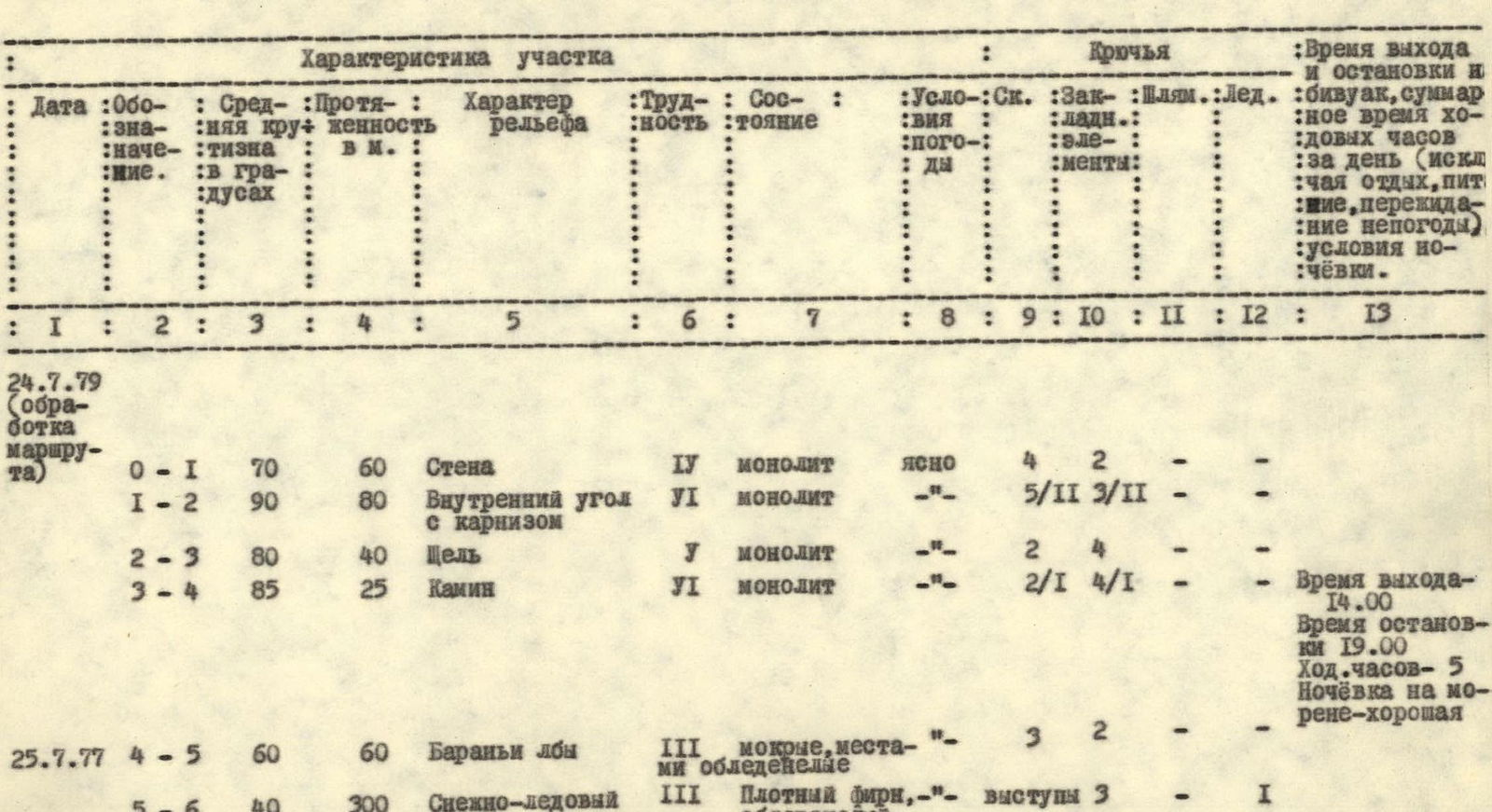
| Date | Section | Steepness | Length | Terrain Characteristics | Difficulty Category | Condition | Weather | Rock Pitons | Chock Stones | Bolts | Ice Screws | Notes |
|---|---|---|---|---|---|---|---|---|---|---|---|---|
| July 24, 1979 | R0–R1 | 70° | 60 m | Wall | 4 | monolithic | clear | 4 | 2 | - | - | |
| R1–R2 | 90° | 80 m | Internal corner with cornice | 6 | monolithic | - | 5 | 3 | - | - | ||
| R2–R3 | 80° | 40 m | Crack | 3 | monolithic | - | 2 | 4 | - | - | ||
| R3–R4 | 85° | 25 m | Chimney | 1 | monolithic | - | 2 | 4 | - | - | Departure time — 14:00, stop time — 19:00. Climbing hours — 5. Bivouac on moraine — good. | |
| July 25, 1979 | R4–R5 | 60° | 60 m | "Ram's foreheads" | 3 | wet, partly icy | - | 3 | 2 | - | - | |
| R5–R6 | 40° | 300 m | Snow-ice slope with rock outcrops | 3 | dense firn, icy | - | 3 | - | - | 1 | ||
| R6–R7 | 55° | 50 m | Snow-ice slope | 4 | ice, dense firn | clear | - | - | - | 2 | ||
| R7–R8 | 80° | 85 m | Rock shelf; crevice with cornice | 5 | monolithic, icy rocks | clear | 4 | 3 | - | - | ||
| R8–R9 | 70° | 55 m | Ice slope 15 m, rock wall | 5 | rime ice, monolithic | clear | 5 | 1 | - | 2 | ||
| R9–R10 | 50° | 100 m | Rock shelf, ice slope, rock ridge | 4 | rime ice, icy rocks | clear | 2 | 1 | - | 1 | ||
| R10–R11 | 65° | 25 m | Ice and rock slope | 5 | dense ice, monolithic | clear | 2 | 2 | - | 1 | ||
| R11–R12 | 80° | 80 m | Wall, chimney | 5 | destroyed, icy chimney | clear | 3 | 3 | - | 2 | ||
| R12–R13 | 55° | 250 m | Snow-ice slope, rock ridge | 4 | mushy snow, destroyed rocks | - | 3 | 4 | - | 1 | ||
| R13–R14 | 60° | 110 m | Rock ridge, snow-ice slope | 4 | destroyed, ice under mushy snow layer | - | 3 | 3 | - | - | ||
| R14–R15 | 80° | 100 m | Wall with cornice, steep slab | 4/5 | monolithic, wet, partly icy | - | 8 | 5 | - | - | ||
| R15–R16 | 65° | 85 m | Ice wall, snow-ice slope | 5 | dense ice | - | - | - | - | 7 | ||
| R16–R17 | 60° | 350 m | Icy rocks | 5 | rime ice | - | 8 | 6 | - | 5 | ||
| R17–R18 | 70° | 80 m | Large belay | 5 | monolithic, partly icy | - | 6 | 2 | - | - | ||
| R18–R19 | 45° | 120 m | Ice "knife" | 5 | icy | clear | - | - | - | 10 | ||
| R19–R20 | 55° | 150 m | Destroyed tile-like rocks | 5 | destroyed, icy | - | 5 | 8 | - | - | Departure time — 6:00, stop time — 22:00. Climbing hours — 15. Bivouac — sitting. | |
| July 26, 1979 | R20–R21 | 55° | 150 m | Destroyed tile-like rocks | 5 | destroyed, icy | - | 6 | 7 | - | - | |
| R21–R22 | 75° | 80 m | Strongly destroyed rocks | 4 | destroyed, icy | - | 8 | 2 | - | - | Departure time — 6:00, stop time on summit — 11:00. Climbing hours — 5. |