
Passport
- Climbing category — high-altitude technical.
- Climbing region — Fann Mountains.
- Peak Bodhona — 5302 m via the right part of the West face (Senchin – Konchin route).
- Difficulty category — 6.
- Height difference: from the base of the wall to the summit 1400 m. Average steepness of the wall 80°. Length of sections with 6th category difficulty — 600 m.
- Number of pitons: rock — 284.
- Total climbing hours — 4930 hours.
- Number of nights on the route — 3 nights.
- Team composition:
Vinokurov A.F. — team leader, Candidate for Master of Sports; Merlis V.P. — Candidate for Master of Sports; Dzaparidze Yu.O. — Candidate for Master of Sports; Okhrimenko S.V. — Candidate for Master of Sports; Prokopenko V.M. — Master of Sports; Vinokurova S.I. — Master of Sports.
- Team coach Dauter B.V.
- Date of departure to the route July 21, 1978.
Date of return to the camp July 26, 1978.

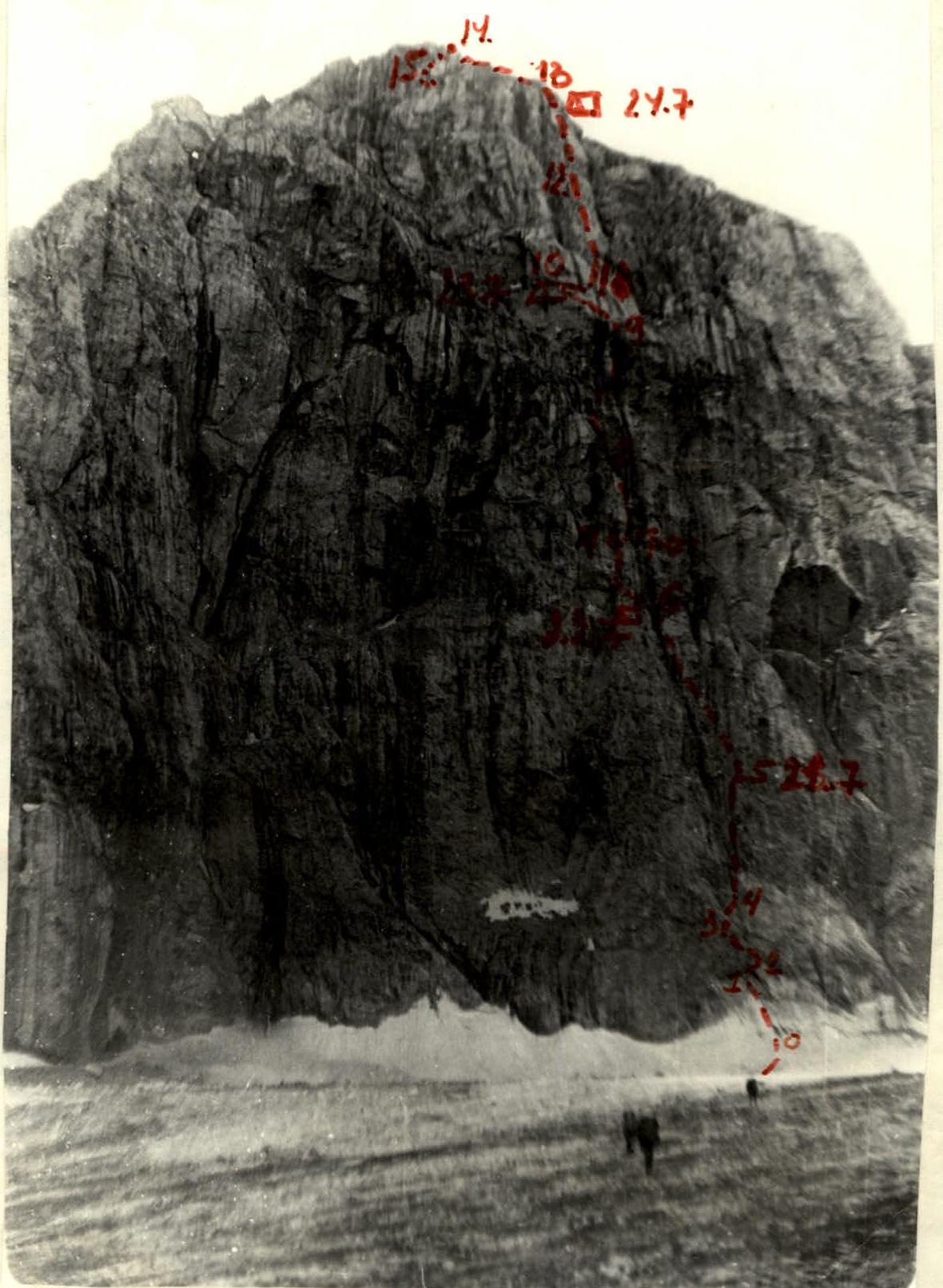
Table
Route to peak Bodhona via the right part of the West face

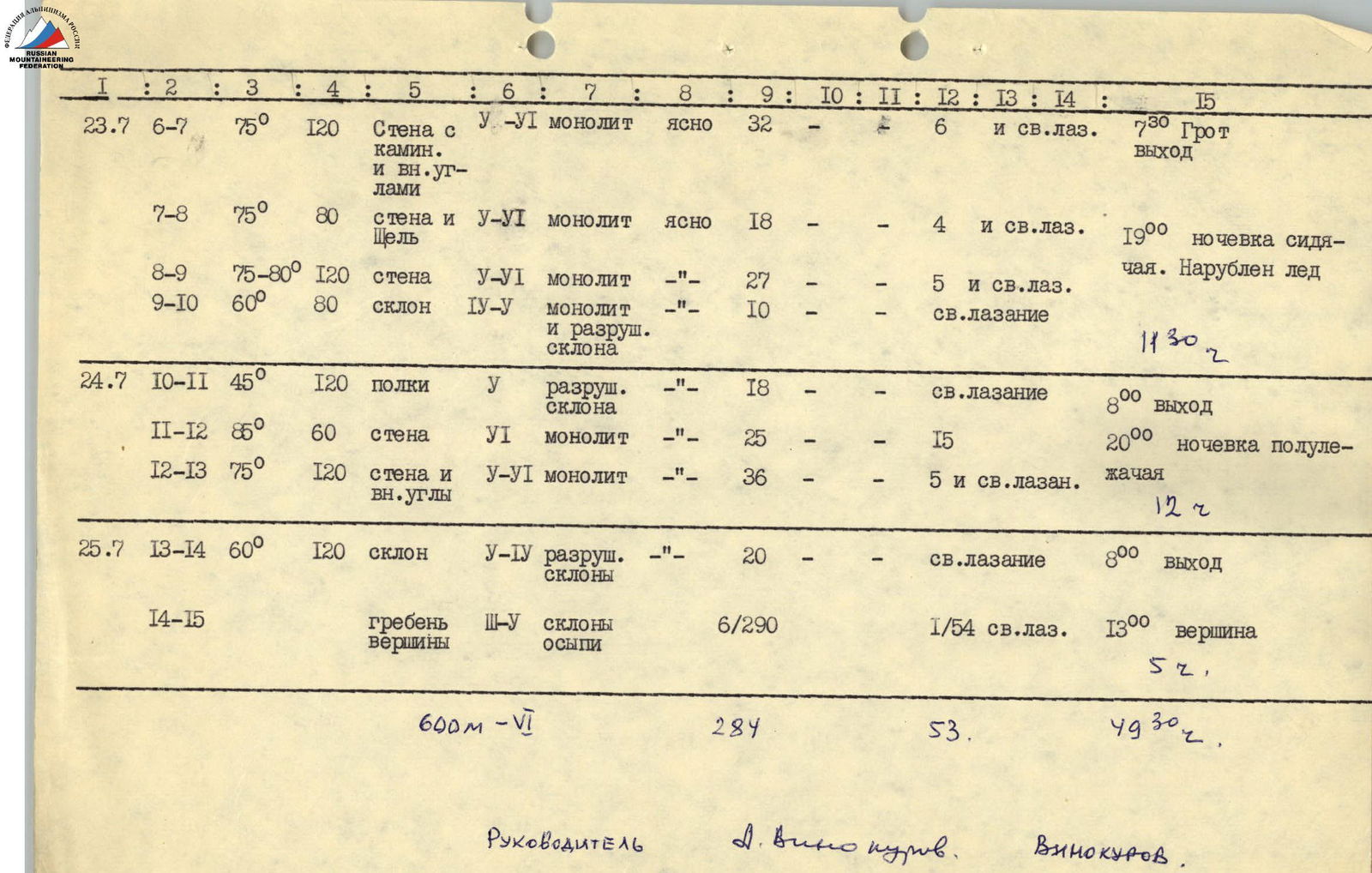
| Date | Section | Average steepness | Length | Terrain characteristics | Difficulty | Condition | Weather conditions | Protection (rock) | Protection (ice) | Protection (bolted) | Climbing (rock) | Climbing (ice) | Climbing (bolted) | Time of departure and bivouac, climbing hours, bivouac conditions |
|---|---|---|---|---|---|---|---|---|---|---|---|---|---|---|
| 21.7 | 0–1 | 60° | 20 | Rock-snow | 4 | snow | clear | 3 | free climbing | 10:00 processing Bivouac on moraine under the wall 20:00 3 people | ||||
| 1–2 | 92° | 3 | cornice | 6 | monolith | clear | 3 | 3 | ||||||
| 2–3 | 70° | 80 | wall | 5 | monolith | clear | 12 | free climbing | ||||||
| 3–4 | 20° | 20 | ledge | 4 | "-"- | "-"- | 4 | "-"- | ||||||
| 4–5 | 85° | 60 | internal angle | monolith | "-"- | 20 | 5 and free climb | 10 hours | ||||||
| 22.7 | 5–6 | 80° | 160 | wall with internal angles and chimneys | 5–6 | monolith | clear | 56 | 10 and free climb | 8:00 departure 19:00 bivouac sitting on second pioneers' bivouac, no water | ||||
| 23.7 | 6–7 | 75° | 120 | Wall with chimneys and internal angles | 5–6 | monolith | clear | 32 | 6 and free climb | 7:30 Grotto departure | ||||
| 7–8 | 75° | 80 | wall and crack | 5–6 | monolith | clear | 18 | 4 and free climb | 19:00 bivouac sitting. Ice chopped | |||||
| 8–9 | 75–80° | 120 | wall | 5–6 | monolith | "-"- | 27 | 5 and free climb | ||||||
| 9–10 | 60° | 80 | slope | 4–5 | monolith and broken slope | 10 | free climbing | 11:30 hours | ||||||
| 24.7 | 10–11 | 45° | 120 | ledges | 5 | broken slope | "-"- | 18 | free climbing | 8:00 departure | ||||
| 11–12 | 85° | 60 | wall | 6 | monolith | "-"- | 25 | 15 | 20:00 bivouac semi-reclining 12 hours | |||||
| 12–13 | 75° | 120 | wall and internal angles | 5–6 | monolith | "-"- | 36 | 5 and free climb | ||||||
| 25.7 | 13–14 | 60° | 120 | slope | 5–4 | broken slopes | "-"- | 20 | free climbing | 8:00 departure | ||||
| 14–15 | summit ridge | 3–5 | slopes | scree | 6/290 | 1/54 free climb | 13:00 summit 5 hours | |||||||
| Total: | 600 m | 6 | 284 | 53 | 4930 hours |
Brief description of the table
In 1977, while staying at the Artuch tourist camp, we received a consultation on the West face of peak Bodhona. Everything suggests that the most safe route via the right part of the wall is the Kolchin route. In winter, while reviewing slides of the route, a group member of Senchin's team, Pavel Sekachev, found that the route was safe. After this consultation, it was decided to follow Senchin's route.
On June 21, in the morning, a trio went out to process the route and hung 5 ropes in a day (up to point 5, where the first pioneers' bivouac was located). This is the most unpleasant section. The rocks, although monolithic, are very slippery, as if lubricated with something, probably polished by falling stones. On the day of processing, the route was hit by stones. The next day, there were no falling stones in the first half of the day. At the first bivouac, there was supposed to be a cairn in a can, but it was not found (or maybe not looked for). To the left, approximately one rope away, a cairn with Kolchin's route hung in a large can. Section 5–6 is a wall with small ledges like shelves and outcrops, alternating with internal angles and small overhangs (resembling the Gorky route on peak Dzhailyk). By the evening of July 22, they reached the second pioneers' bivouac — a sitting ledge with two bolts, to the right of a bottle.
On July 23, after passing 1.5 ropes, they likely joined Kolchin's route and arrived at a grotto, where they found water in two flasks and gasoline. It should be noted that between sections 0 and 6, they encountered equipment, pitons, and carabiners (two aluminum carabiners with a "birdie"). Sections 6 to 10 are similar to the previous day's sections, only slightly easier in some places.
The section from 9 to 10 is a rock face resembling "ram's foreheads" but more broken. The bivouac at point 10 is worse than the previous one. Further, they climbed via ledges to the complex section II–12, which mainly went via artificial holds. The rocks are monolithic.
The route is periodically hit by stones and is objectively hazardous, especially in the lower part. In the upper part, many stones lie on the slope. The entire route keeps the climbers on high alert — there's no place to relax and catch one's breath; one must be constantly attentive.
All team members formed the opinion that it is impossible to climb Kolchin's or Senchin's route purely, as they are quite close to each other (0.5–1 rope apart), so it seems to us that Kolchin's route (as the safer one) should be listed in the classification, and Senchin's route should be considered a variation. Or rather, it should be considered a route via the right part of the West face (including Volodarchik's route).
The team members have 6th category climbs in their resume, and comparing, we can say that the route via the right part of the West face of peak Bodhona is the most concentrated in terms of difficulty, with no lying-down bivouacs. The route constantly requires attention. It demands high technical and tactical skill. In our opinion, it is the most challenging 6th category route in the Fann Mountains that the team members have climbed.
Tactical actions of the team
According to the tactical plan for ascending peak Bodhona via the Zhitenev route, the team planned preliminary processing of the route on the eve of the ascent. On August 19, Mikheev, Gostishchev, and Myakotnikov went out for processing. In 7.5 hours, they hung 3.5 ropes. During the passage of this section, they encountered old rock and bolted pitons, and the rocks were wet. While observing the route, they noticed water flows and waterfalls on the route, which was confirmed in practice.
On August 20, the team did not go out on the route as they participated in rescue operations.
On August 21, at 8:00, the team was under the route. They passed the fixed ropes with great difficulty as they had frozen overnight and continued moving further, changing the leader every 3–4 ropes, using 12-mm ropes with the UIAA quality mark. The first climber was belayed through an "8" figure. For belaying, they hammered in pitons, wedged in nuts, and also used spring-loaded camming devices "Friends". Nuts and "Friends" significantly reduced the time for organizing belays. For better rope handling, they used nylon quickdraws. The rest of the team members moved along the fixed rope using ascenders like "Jumar". They did not pull up backpacks as the average weight was 10–12 kg. The first climber went without a backpack. Due to the running water, the ropes and clothing on the climbers got wet immediately. The weight of the ropes and backpacks increased significantly, making it harder to pull the rope through the carabiners. Due to the abundance of water and ice on the route, its condition significantly deteriorated. In the second half of the day, throughout the ascent, the weather worsened, with snow and hail, which significantly increased the time taken to pass the difficult rock sections.
Bivouacs were organized on snow ledges at pre-designated locations. They climbed via ice couloirs and icy rocks wearing crampons, with belays through ice and rock pitons. After passing the pre-summit tower, they climbed simultaneously with belays on outcrops.
Communication with observers was stable, and no radio communication session was missed.
There were no deviations from the pre-planned tactical plan. The entire route was climbed wearing "Vibram" boots; rock shoes were not used due to the poor condition of the route.