
Ascent Log
I. Ascent classification: technical
- Ascent area: Fann Mountains
- Peak, its height, and ascent route: mt. Aurondagh, 4573 m, via the central part of the NW wall
- Proposed difficulty category: 5B cat. diff.
- Route characteristics:
elevation gain — 1374 m, average steepness — 60°, length of sections:
- R1 — 300 m
- R2 — 150 m
- R3 — 370 m
- R4 — 435 m
- R5 — 40 m
-
Pitons driven: for belaying, for creating rock — 132, ice — 0, bolt — 0
-
Number of climbing hours: 25.5 hours
-
Number of nights and their characteristics: 2, bivouac
-
Surname, name, patronymic of the leader and participants, their sports qualification Samoylin V.A. leader, Candidate for Master of Sports (CMS) Povolotskiy V.Yu. — CMS Zadvoryev Yu.V. — CMS Sitnikov N.N. — CMS Oznobikhin V.A. — 1st sports category Lenskiy S.V. — 1st sports category
-
Team coach: Master of Sports (MS) Mikhailov A.A.
-
Date of departure and return: July 14 — July 16, 1978
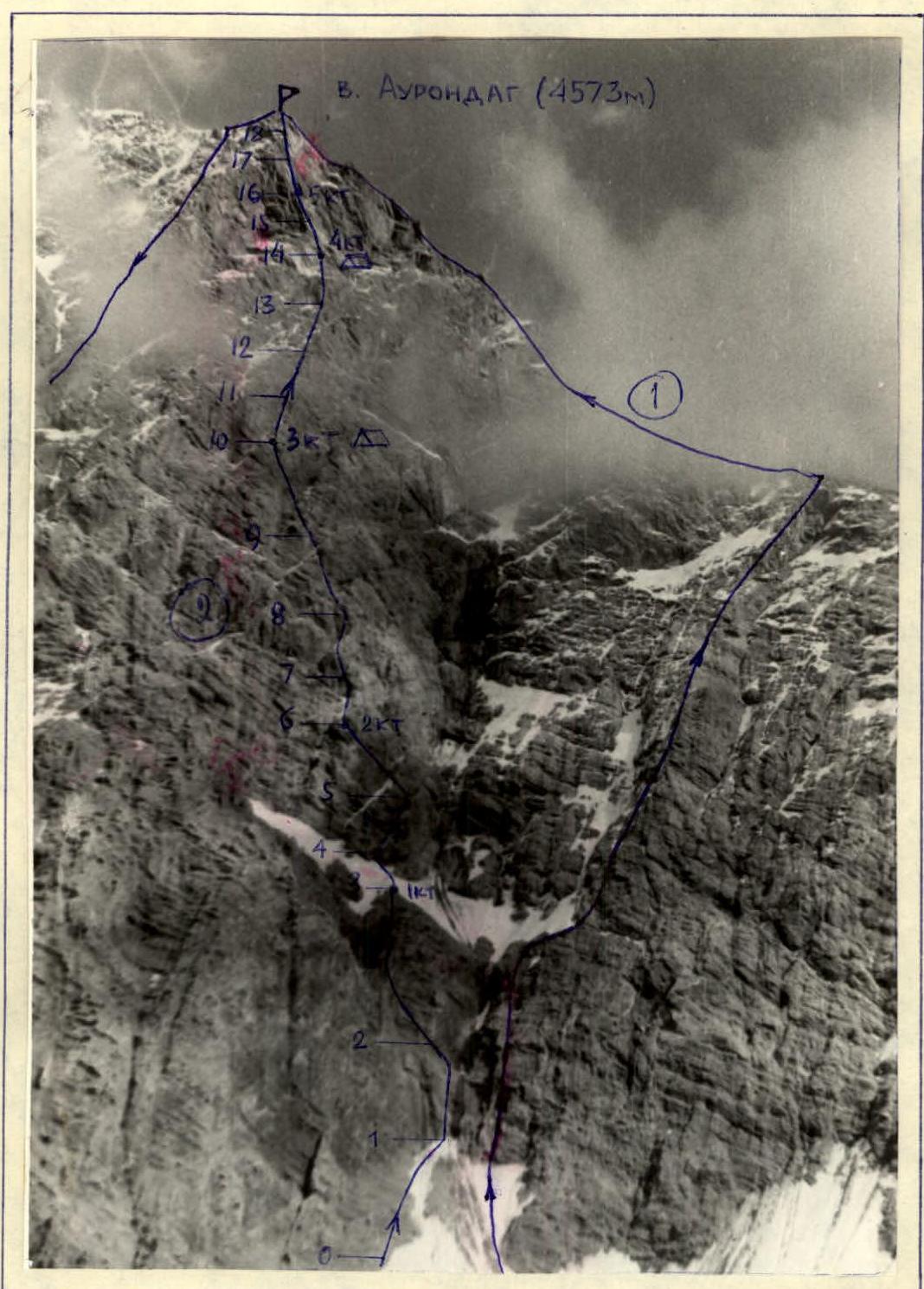
Mt. Aurondagh. 3rd ascent of T. Mumadji's route (2) with marked sections. (1) Previously climbed route, 5B cat. diff.
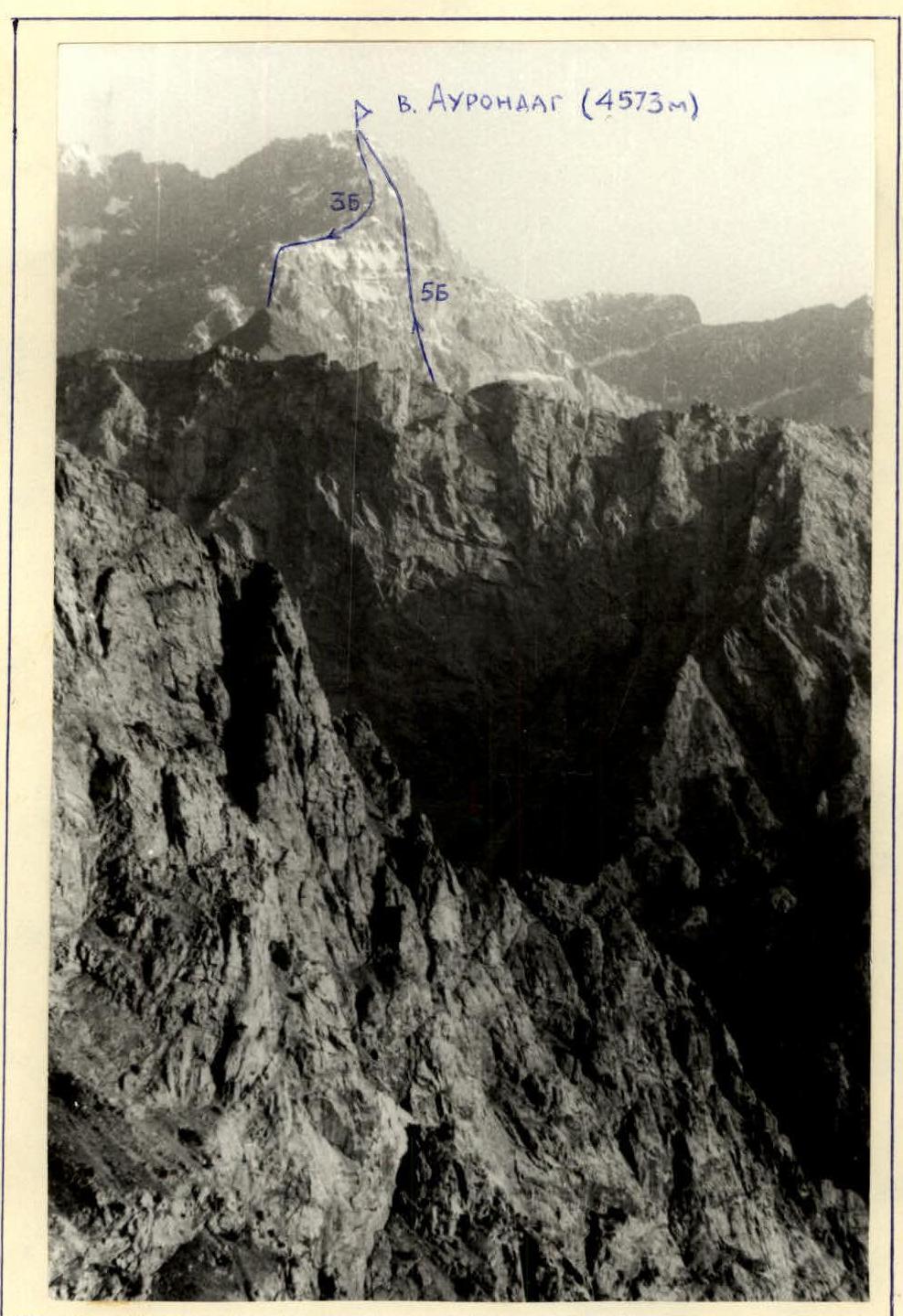
Mt. Aurondagh. Profile view.
Table of main route characteristics
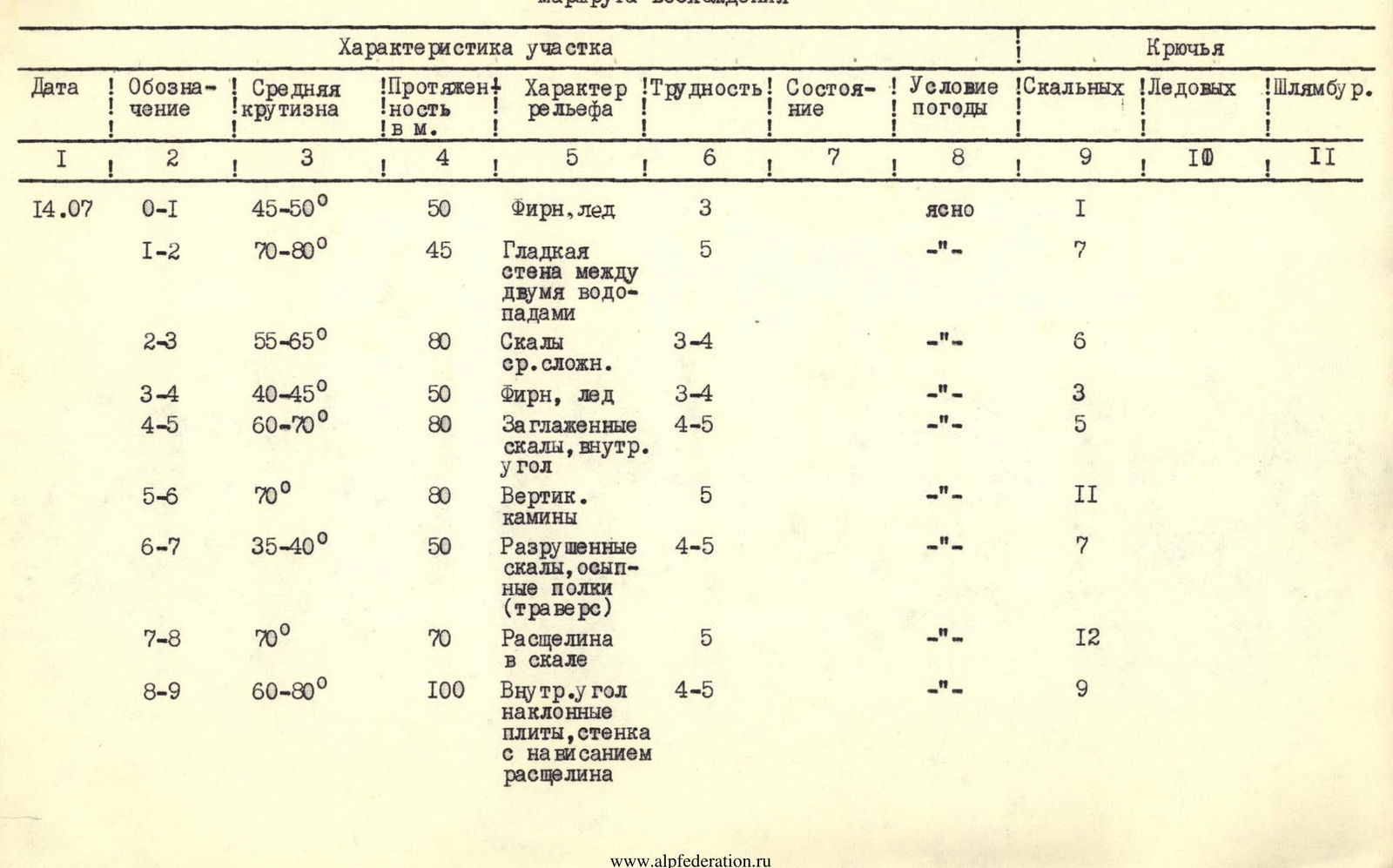
sheet 3
| I | 1 | 2 | 3 | 4 | 5 | 6 | 7 | 8 | 9 | 10 | 11 |
|---|---|---|---|---|---|---|---|---|---|---|---|
| July 14 | R0–R1 | 45–50° | 50 | Firn, ice | 3 | clear | 1 | ||||
| R1–R2 | 70–80° | 45 | Smooth wall between two waterfalls | 5 | —"— | 7 | |||||
| R2–R3 | 55–65° | 80 | Rocks of medium complexity | 3–4 | —"— | 6 | |||||
| R3–R4 | 40–45° | 50 | Firn, ice | 3–4 | —"— | 3 | |||||
| R4–R5 | 60–70° | 80 | Smoothed rocks, internal angle | 4–5 | —"— | 5 | |||||
| R5–R6 | 70° | 80 | Vertical chimneys | 5 | —"— | 11 | |||||
| R6–R7 | 35–40° | 50 | Crumbly rocks, scree shelves (traverse) | 4–5 | —"— | 7 | |||||
| R7–R8 | 70° | 70 | Crack in the rock | 5 | —"— | 12 | |||||
| R8–R9 | 60–80° | 100 | Internal angle, inclined slabs, wall with overhanging crack | 4–5 | —"— | 9 | |||||
| July 15 | R9–R10 | 45–55° | 120 | Rocks, shelves in the wall, small scree couloir | 3 | Heavily destroyed rocks | clear | 9 | |||
| R10–R11 | 50–60° | 80 | Crack and slabs | 4 | clear | 7 | |||||
| R11–R12 | 65° | 80 | Steep ridge | 4 | —"— | 5 | |||||
| R12–R13 | 70–80° | 90 | Sharp crest | 5 | Smoothed slabs at the top | —"— | 13 | ||||
| R13–R14 | 30–40° | 70 | Inclined scree shelves under the bastion's base | 3 | —"— | 2 | |||||
| R14–R15 | 60–65° | 80 | Inclined shelves; wall | 4 | Destroyed wall with exit to a slab | —"— | 6 | ||||
| R15–R16 | 75–85° | 40 | Rock wall | 6 | Smooth slab without holds, quartz "lens" | —"— | 11 | ||||
| R16–R17 | 70–80° | 80 | Internal angle with a cornice, smooth wall, exit to a shelf | 5 | —"— | 10 | |||||
| R17–R18 | 60–70° | 40 | Internal angle, exit to the bastion's summit | 4 | —"— | 4 | |||||
| R18–R14 | descent | to | bivouac | to 4th | K.T. | ||||||
| July 16 | R18–R19 | 20–30° | 300 | Destroyed ridge | 2 | clear |

Reached the summit at 10:00.
Descent via the 3B cat. diff. route along the North ridge
Team captain V. Samoylin Team coach A. Mikhailov
Description of the route and main characteristics
Section R0–R1. Steep firn leading to rocks between two waterfalls. Covered with a crust of superimposed ice in the upper part. Climbed with alternating belay to the left of the left waterfall, then one rope of fixed belay along the randkluft — traverse to the right with step-cutting.
Section R1–R2. Along the smooth steep wall between two waterfalls. One rope of complex climbing — vertically up with exit to the left onto a shelf, fixed belay.
Section R2–R3. Along the right part of the couloir descending from the saddle between Aurondagh and Zierat to the summit of the first bastion. Two ropes of rock climbing with good holds, exit to the bastion on the left — 1st control point.
Sections R0–R3 were climbed with preliminary processing. Based on observations, the recommended time for climbing these sections, from the point of view of rockfall safety, is before 10 am.
Section R3–R4. To the left along a wide inclined shelf to the base of the second bastion — 50 m. Firn, ice. Alternating belay via ice axe, pitons near rocks.
Section R4–R5. Up to the right along smoothed rocks and internal angle to the saddle at the start of the chimneys. Complex climbing with alternating belay, fixed belay.
Section R5–R6. Two vertical chimneys (one above the other), each 40 m. Piton belay and belay via protrusions, fixed belay.
Section R6–R7. To the right, along destroyed rocks and scree shelves. Alternating movement. Increased rockfall hazard!
Section R7–R8. Along a steep crack and internal angle to the summit of the second bastion. Complex climbing with piton belay, fixed belay. Exit to small scree shelves. (Lunch).
Section R8–R9. Along the internal angle and crack to the left upwards (zigzag) through the overhang to the platforms (first ascenders' bivouac). Complex rocks, alternating belay, fixed belay on the section with cornices.
Section R9–R10. Heavily destroyed rocks, shelves in the wall, small scree couloir. Medium climbing, alternating belay. Increased rockfall hazard! Exit to the shoulder to the 3rd control point. Good shelves. 1st bivouac.
Section R10–R11. To the right along a steep shelf around the corner of the wall and then to the left upwards along the crack and slabs (80 m). Rocks of medium complexity, alternating movement.
Section R11–R12. Up along the steep ridge to the platforms (second ascenders' bivouac). Alternating belay.
Section R12–R13. To the left upwards along steep rocks and then along the left part of the ice couloir (steep crest, smoothed slabs). Complex climbing, piton belay, fixed belay.
Section R13–R14. Along inclined scree shelves, exit to a platform under the base of the pre-summit bastion (first ascenders' bivouac). 4th control point. Alternating belay, increased rockfall hazard.
Stop for the night and further, until the exit to the summit of the pre-summit bastion (sections R14–R18), processing:
Section R14–R15. Along inclined shelves and a destroyed wall to the right to smoothed slabs and then to the left under the steep overhanging section of the bastion. Alternating belay, preparation for processing the key section of the route.
Section R15–R16. Smooth sheer wall without holds with a vertical crack, in the upper part overhanging "rusty" unstable blocks — "lens". Exit to a narrow shelf — 5th control point. Very complex climbing using piton belay and ladders, organization of fixed belay. Increased rockfall hazard for those below due to crumbling of the "lens" during its passage.
Section R16–R17. Up along the internal angle and then to the right through cornices with exit to smoothed slabs and a shelf under the base of the crack leading to the pre-summit ridge. Complex climbing, alternating belay, fixed belay.
Section R17–R18. To the right upwards along the crack and internal angle to the ridge and summit of the bastion. Alternating belay, fixed belay.
After processing sections R14–R18, descent to the bivouac on a small shelf at the 4th control point.
Section R18–R19. After climbing along the fixed belay of sections R14–R18, simultaneous movement along the scree destroyed ridge to the summit of Aurondagh.
Descent from the summit to the saddle Aurondagh–Zierat via the 3B cat. diff. route.


