
REPORT on the ascent to the summit "ALAUDIN" via the southern counterfort (4A cat. diff.)
2. Group Composition
- Sandalov I.S. (leader) 1946, 2nd sports category, "Spartak", Kr-sk
- Loginov B.M. 1949, 2nd sports category, "Spartak", Krasnoyarsk
- Trofimov A.A. 1946, 2nd sports category, "Spartak", Krasnoyarsk
- Burlakov Yu.P. 1947, 2nd sports category, "Spartak", Krasnoyarsk
3. Equipment
- Main ropes 2 × 40 m, 1 × 60 m
- Repschnur 1 × 10 m
- Rock pitons 15 pieces
- Carabiners 10 pieces
- First aid kit 1 piece
- Hammers 2 pieces
- Ice axe 1 piece
- Ice axes 3 pieces
- Helmets 4 pieces
- Vibram boots 3 pairs
- Tricon boots 1 pair
- Abalak belts 4 pieces
- Backpacks 1 piece
- Binoculars 1 piece
- Radio "Nedra" 1 piece
4. Nutrition
Dry rations were taken directly for the ascent:
- Apricot compote — 1 can
- Dry sausage — 300 g
- Chocolate — 100 g
- Rusks — 1 pack
5. Previous Ascent Experience of Participants
During training
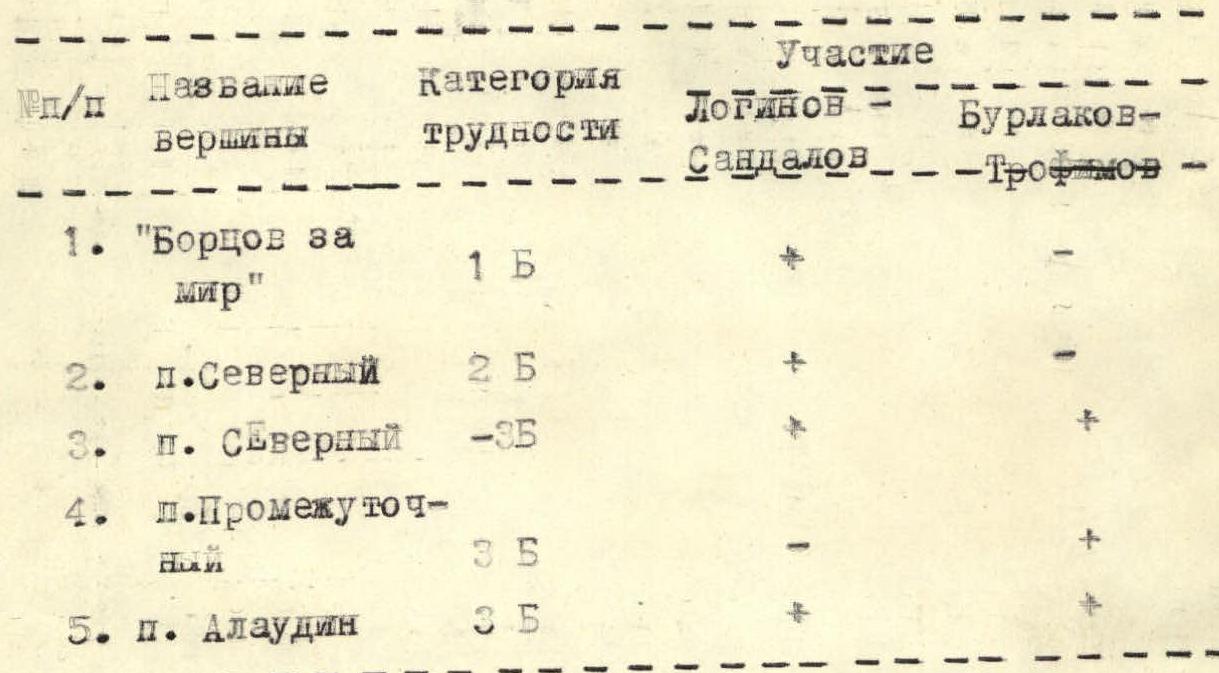
6. Route Reconnaissance
Most of the route was viewed from the pass and during ascents to peak "Severny". Additionally, the group received consultation from Master of Sports Elchibekov (this route was previously climbed by a group from Tashkent) and approximately evaluated it as 4A cat. diff.
7. Description of the Route Passage
July. After lunch at 16:00, the group in full strength headed towards the Alaudin pass. Within 2 hours, they reached the pass, and then, after 10–15 minutes of walking to the right along the ridge covered with small scree, they approached the base of the "gendarme", under which they cleared a spot for the tent. At this time, a wall of dense fog appeared from the side of Kulikol lakes. The Loginov-Sandalov rope team prepared to start processing the lower part of the route but decided to wait due to bad weather. Half an hour later, a strong wind picked up, and snowfall began. They decided to wait out the bad weather at the top. During the communication session at 20:00, they received approval from the base. At night, a lot of wet snow fell, and the tent turned into a cave, despite the fact that the snow was scraped off several times. In the morning, they confirmed that the route was covered in snow. Additionally, during the morning communication, they received a message that the area would be closed for ascents for the next 2 days, and they decided to descend to the base camp.
The next day, they made a gear and supplies throw to under "Bodkhona", and the day after that, they returned to the same campsite. The ascent plan remained unchanged, and the Loginov-Sandalov rope team went out to process the lower part of the route, while Trofimov and Burlakov remained to equip the campsite and prepare dinner.
Section R0–R1. By-passing the "gendarme", the rope team approached a wide scree couloir, ascended it to a snowfield with a slope of 50°, crossed it from left to right, and then exited onto easy rocks.
Section R1–R2. The section starts with a small chimney with water flowing down its walls. Vibram boots do not hold well, so the leading climber, Loginov, bypasses it on the left along the wall with a slope of 65–70°. The rock is smooth. Then he traverses to the right and upwards along an internal corner with a slope of 80–85°.
Section R2–R3. This section is traversed using tension. Then there is an exit onto inclined slabs covered with small stones, which need to be climbed very carefully. After climbing 5–6 meters on these slabs, Loginov sets up a handline of 40 meters, Sandalov extends it by another 60 meters, and in the twilight, the rope team descends down. When the rope team approached the campsite, another tent appeared there - our second group arrived, which will start the route after us. The communication session with the base camp was already conducted, and there were no changes in plans.
July. After a short breakfast, we set out on the route at 7:20. The second group will start the route after we pass the 80-meter couloir and the scree terrace, which we saw from the Alaudin pass. Burlakov, being the lightest among us, goes first along the handline, followed by Trofimov. Part of the couloir is covered with a thin layer of ice. After ascending, the first rope team immediately continues further. The second rope team removes the handline and follows.
Section R3–R4. Inclined slabs, partially covered with a thin layer of ice, are traversed to the right, and we exit onto a 40-meter scree terrace via easy rocks. We move simultaneously along the terrace.
Section R4–R5. Sandalov goes first and starts moving along a narrow crevice with a slope of 70–80°, which leads to a ledge where Burlakov is standing. The three of us, positioned on this ledge, wait for Alexander Trofimov to pass the overhanging section.
Section R5–R6. Trofimov first climbs an inclined smooth slab 8 meters long with a slope of 40–45°, which abuts a 4-meter wall with a weakly defined groove. After ascending this corner, he exits under an inclined slab with a slope of 95–100°. Overcoming it, he disappears from view behind a bend. Then, after climbing another 10 meters up an inclined wall, Alexander finds a spot for belay. After 15 minutes, the belay is ready. Using the rope of the first rope team as a handline, Loginov climbs up. There are no holds on the wall, so he has to climb through the gap between the wall and the overhanging rock. It is a strenuous effort. Finally, he exits onto a slab where Trofimov greets him.
Section R6–R7. Sandalov passes the previous section and continues further, initially climbing up a slab, and then along a wall with a slope of 65–70°. Having passed it through a gap and overcome a small overhanging rock, he exits onto a section where the slope gradually decreases, and follows it to a saddle between two peaks of the tooth (time 10:30). On the right peak of the tooth is the first control point: Burlakov and Trofimov write a note, while Sandalov and Loginov continue their movement.
Section R7–R8. Belayed by Sandalov through a ledge, Loginov climbs onto the left peak of the tooth and determines the further route. Sandalov joins him and descends down an inclined slab (60–65°) with small stones on it. Then he descends down a sheer wall to a good ledge, onto which he then takes Loginov. Here they organize the first rappel to a ledge towards the main massif of Mt. Alaudin. While the rope is being hung, the second rope team catches up. Sandalov descends to the next ledge, which is a short, sharp ridge, and after moving 2.5 meters along the ledge, organizes a second rappel. The rope is secured using a loop thrown over a ledge. After waiting for Trofimov, he descends 25 meters down with a subsequent exit to the left onto a terrace that crosses a wide couloir. Trofimov follows, and they tie in and continue moving towards the summit. Loginov, who descended after them, takes Burlakov. The two of them pull out the rope and follow the first rope team. Initially, they ascend along the terrace, where they encounter patches of snow. We proceed to the left part of the couloir and further, staying on this side along the scree, then along monolithic rocks to the pre-summit ridge. Along the ridge, we ascend to the summit. The descent via the route of 2A cat. diff. took about an hour. At 14:00, we were back at the tents. We prepare lunch and wait for the second group. After the return of the second group, we dismantle the camp and prepare for the next ascent.
8. Evaluation of Participants' Actions
The ascent was carried out in full accordance with the pre-planned route. Participants had experience of joint ascents and were well-prepared physically and technically, acting clearly and competently.
The group approximately evaluates the route to peak Alaudin via the southern counterfort: — 4A cat. diff.
Ascent leader: Sandalov I.S.
Training leader:
 KARLOV G.S.

| Date | Section | Average slope of the section, in degrees | Length of sections, in meters | Characteristics by relief type | Difficulty level | Method of overcoming | Belay type | Time, hours | Notes |
|---|---|---|---|---|---|---|---|---|---|
| 0–1 | R0–R1 | 45–50 | 60 | Snow, rocks | Easy | Simultaneous, alternate | Ice axe, piton | 17:00 (For three sections), 2 hours | Weather is good. On section R1–R2, the belay piton is hammered at the base of the chimney, while the belayer moves out of the way of the stream and falling stones to the right and down (facing the rock, under the cover of rocks). |
| R1–R2 | 70–75 | 20 | Smooth rocks | Difficult | Climbing, alternate | 2/For a ledge, 2 pitons | |||
| R2–R3 | 70–75 | 20 | Chimney with ice | Difficult | Tension | Pitons, 2 | |||
| R3–R4 | 45–50 | 80 | Slabs with ice, scree terrace | Medium, then easy | Alternate, then simultaneous | Pitons, 1 | 0.5 | ||
| R4–R5 | 70 | 40 | Narrow crevice | Medium | Alternate, climbing | Pitons, 2 | 0.1 | ||
| R5–R6 | 65–70 | 40 | Slab, wall with overhanging rock | Difficult, very difficult | Alternate | Pitons, 5 | 2 | ||
| R6–R7 | 75 | 40 | Gap with overhanging top | Medium, then difficult, easy | Alternate, climbing | Pitons, 3 | 0.5 | ||
| R7–R8 | 40–45 | 40 | Ridge of inclined slab, tooth, narrow saddle between tooth and main massif, couloir, ridge | Medium, then easy | Alternate, climbing, rappel, climbing | Pitons, through ledges, 2 | — |
Summit: 8 hours. 18 rock pitons were hammered.
Ascent leader: Sandalov I.P.