
Ascent Passport
I. Ascent class — rock climbing
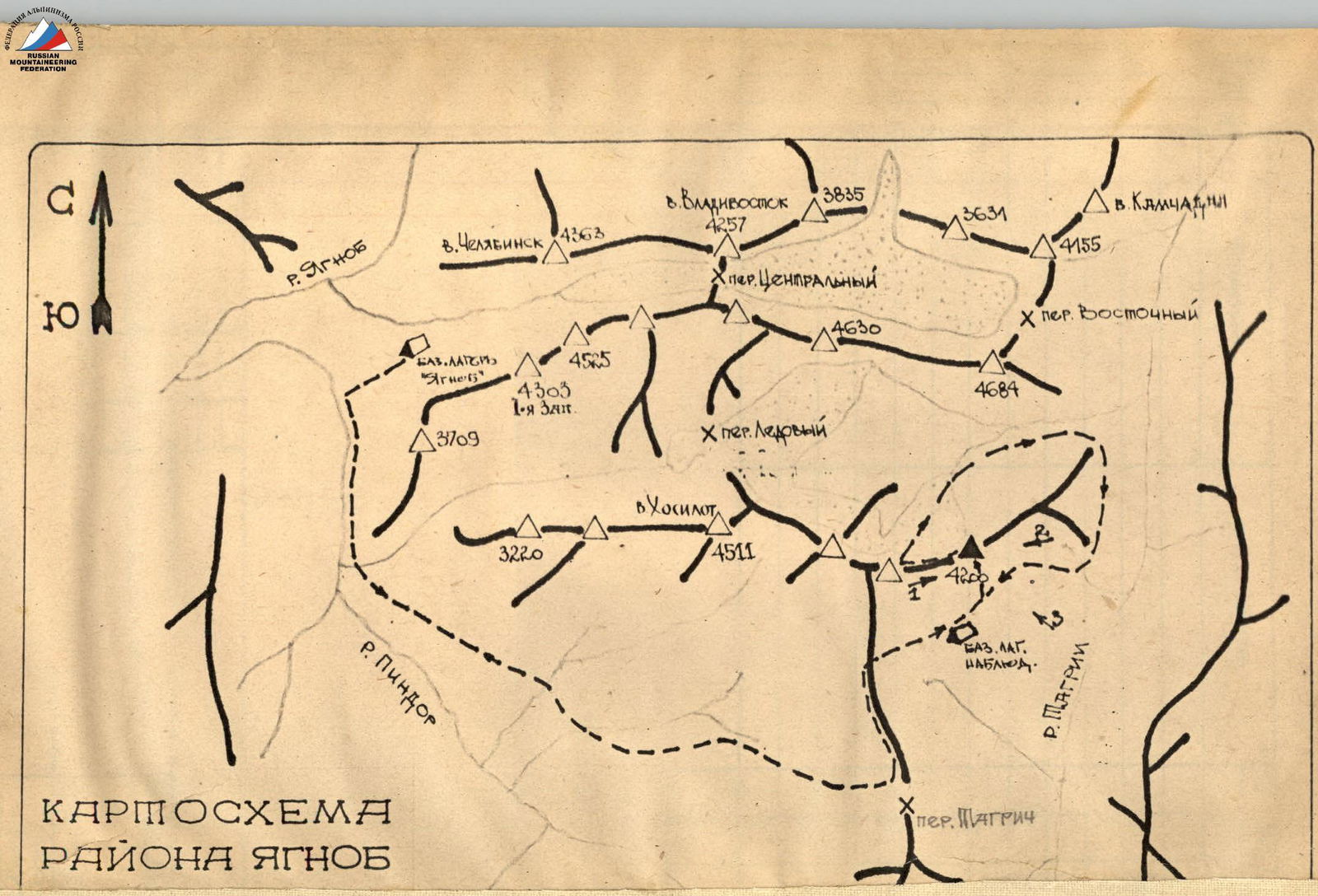
2. Ascent area — Gissarsky ridge, Tagrich valley
3. Ascent route — p. 4200 via the SE wall, 5B cat. dif. (O. V. Kapitanov's route), awarded a gold medal at the 1982 USSR Championship
4. Proposed cat. dif. — 6B cat. dif.
5. Ascent characteristics:
height difference 650 m
average steepness 85°
total route length 744 m
length of sections with 5th and 6th cat. dif. — 547 m: 5th — 173 m, 6th — 374 m
6. Pitons used:
rock pitons 112/37
chocks 72/32
bolt pitons 2
ice screws 6
7. Number of bivouacs on the route, their characteristics:
2 bivouacs with lying positions for 4 participants, one in a hammock
8. Team: ascent made by the SKA-19 OL ZabVO team
9. Participants:
Afanasyev Andrey Evgenyevich CMS, team leader
Gusev Dmitry Petrovich CMS, team member
Shilonosov Gennady Vasilyevich CMS, team member
Belomestnov Sergey Ivanovich 1st sports category, team member
Yudalevich Vladimir Fadeyevich CMS, team member
10. Ascent made in the period:
June 22, 1983 — start of the ascent
June 24, 1983 — return from the ascent
11. Team coach: Yudalevich Vladimir Fadeyevich
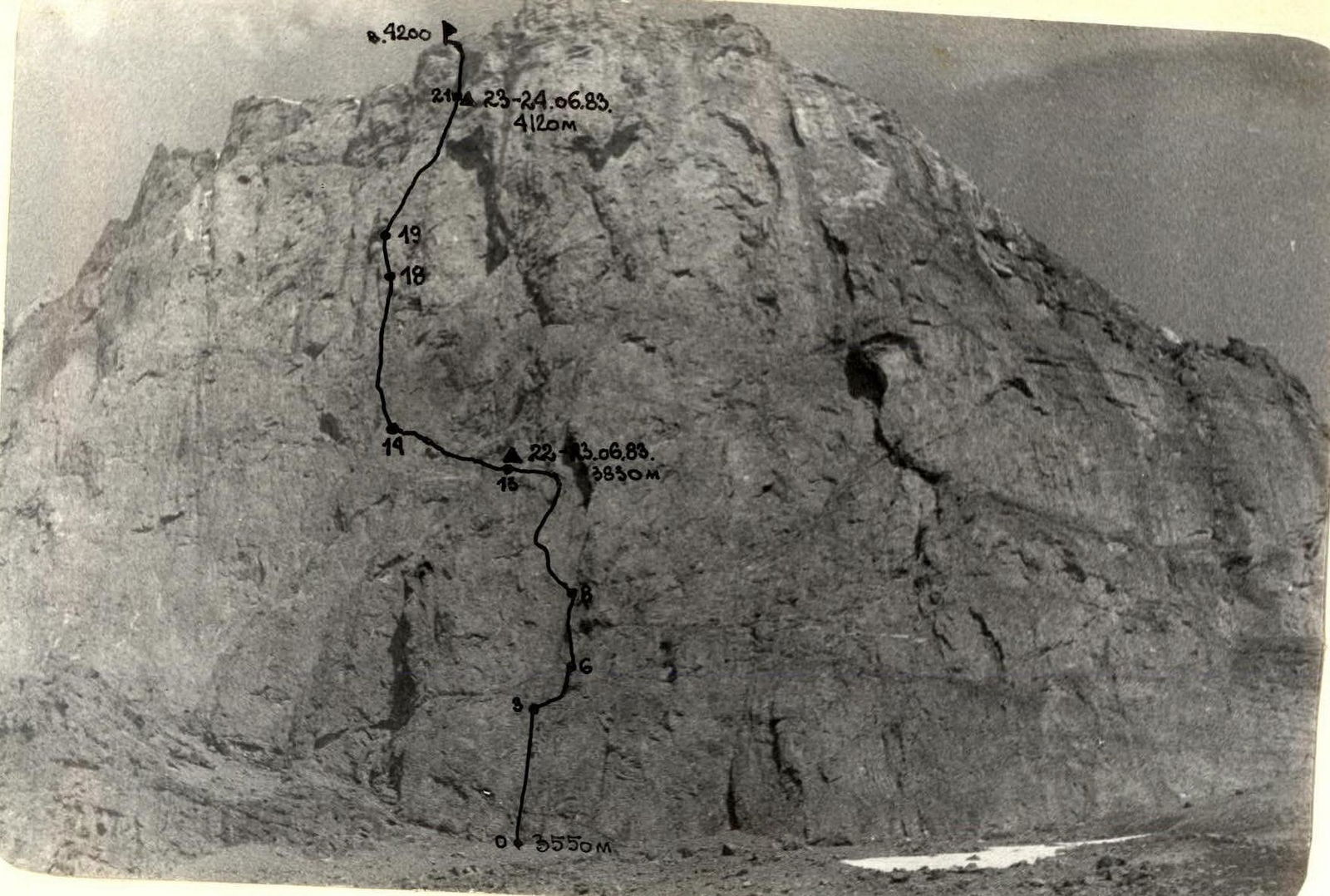
General view of p. 4200 (shot from point #3)
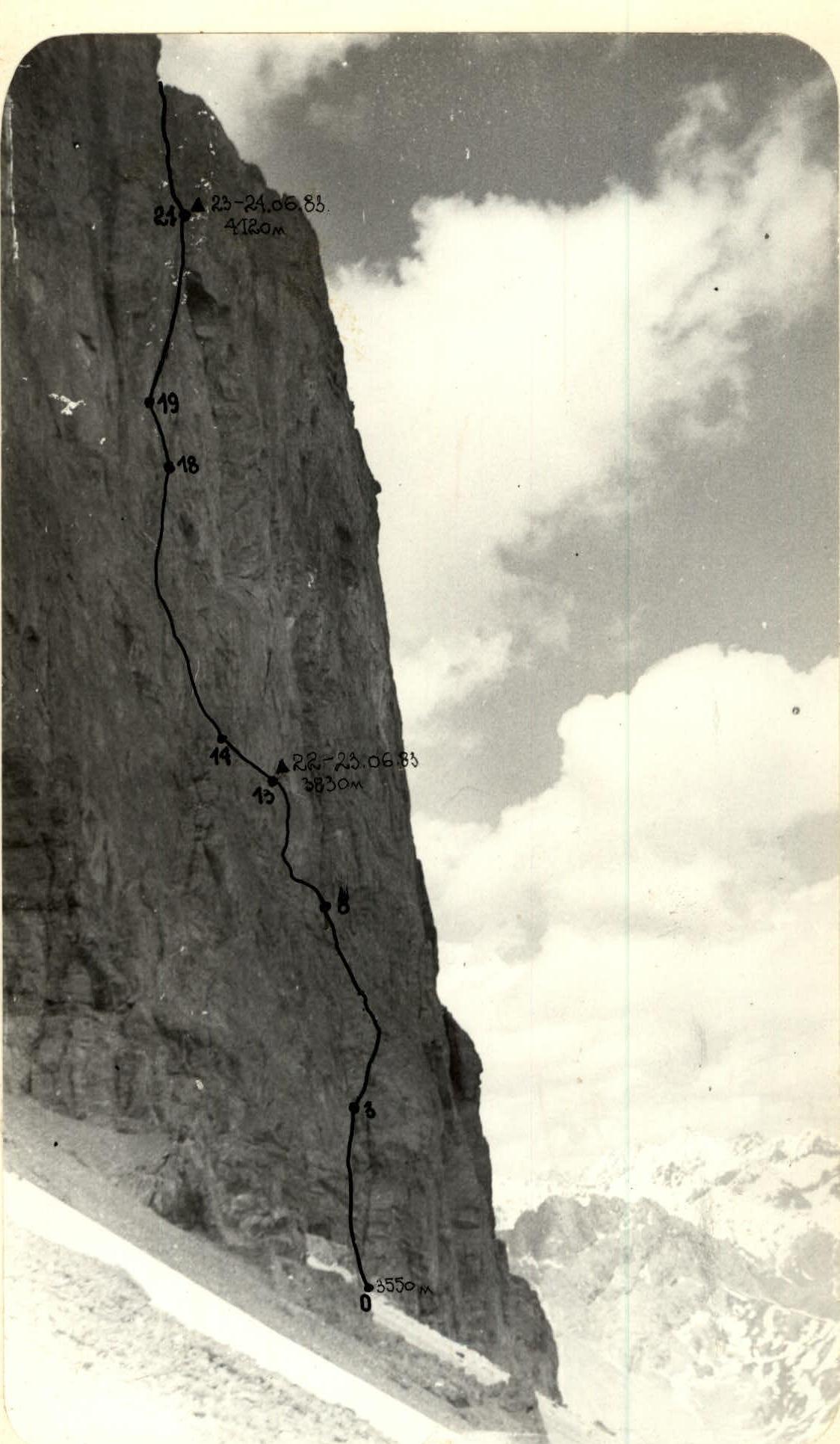
Wall profile from the left (shot from point #1)
Brief description of the route by sections
Approach to the route from the base camp near the Tagrich pass takes 20 minutes across a talus slope.
- R0–R1. Wall with a cleft, passed by free climbing. 30 m, 80°. Very difficult climbing, ladders and sky hooks used. Rocks have a tile-like structure.
- R1–R2. Wall with a limited number of holds, 18 m, 90°. Rocks are tile-like. Sky hooks and ladders used. Climbing is very difficult, with the use of artificial aids.
- R2–R3. Inner corner, 48 m, 90°. Rocks are smooth, few holds. Climbing is extremely difficult with the use of artificial aids. At the end of the inner corner — an overhang.
- R3–R4. Overhang, 5 m, 100°. Climbing is very difficult. Artificial aids used.
- R4–R5. Inclined ledge, 12 m, 45°. Climbing is moderately difficult, exit to a chimney.
- R5–R6. Chimney, 10 m, 90°. Chimney walls are smooth, few holds. Protection via pitons and chocks. Exit to the 1st bivouac of the first ascenders, 1st control point.
- R6–R7. From the bivouac to the left across the wall, 20 m, 90°. Rocks are tile-like. Climbing is extremely difficult.
- R7–R8. Inner corner, 20 m, 80°. Very difficult climbing. Left side of the corner is smooth. Right side — tile-like rocks. Protection via pitons and chocks.
- R8–R9. From the corner at the start of the overhang, climb to the left upwards, 7 m, 90°. Very difficult climbing. Then traverse to the left upwards, 15 m across the wall, 90–95°. Climbing is extremely difficult. A bolt piton used for protection. To the left to a thin flake, steepness 95°. Up a cleft by free climbing, 15 m, 95°. Sky hooks, ladders, and artificial aids used.
- R9–R10. Wall, 10 m, 90°. Very few holds, climbing is extremely difficult. Ladders and artificial aids used.
- R10–R11. Cleft, passed with the use of artificial aids, 5 m, 90°. Few holds, ladders used.
- R11–R12. Traverse to the left, 10 m across the wall, 90°. Rocks are crumbling, difficult to find a spot to hammer in a piton. Climbing is very difficult. Climb to the right upwards via a barely visible ledge to a niche. Climbing is difficult.
- R12–R13. From the niche to the right into an inner corner, 5 m, 90°. Climbing is very difficult, ladders and artificial aids used, a bolt piton hammered in for protection. Crossing a ridge to the left into the next inner chimney, 5 m, 95°. Very difficult climbing with the use of artificial aids. From the chimney, exit to a ridge and into an inner corner, 10 m, 65°. Climbing is moderately difficult. Exit to a bivouac.
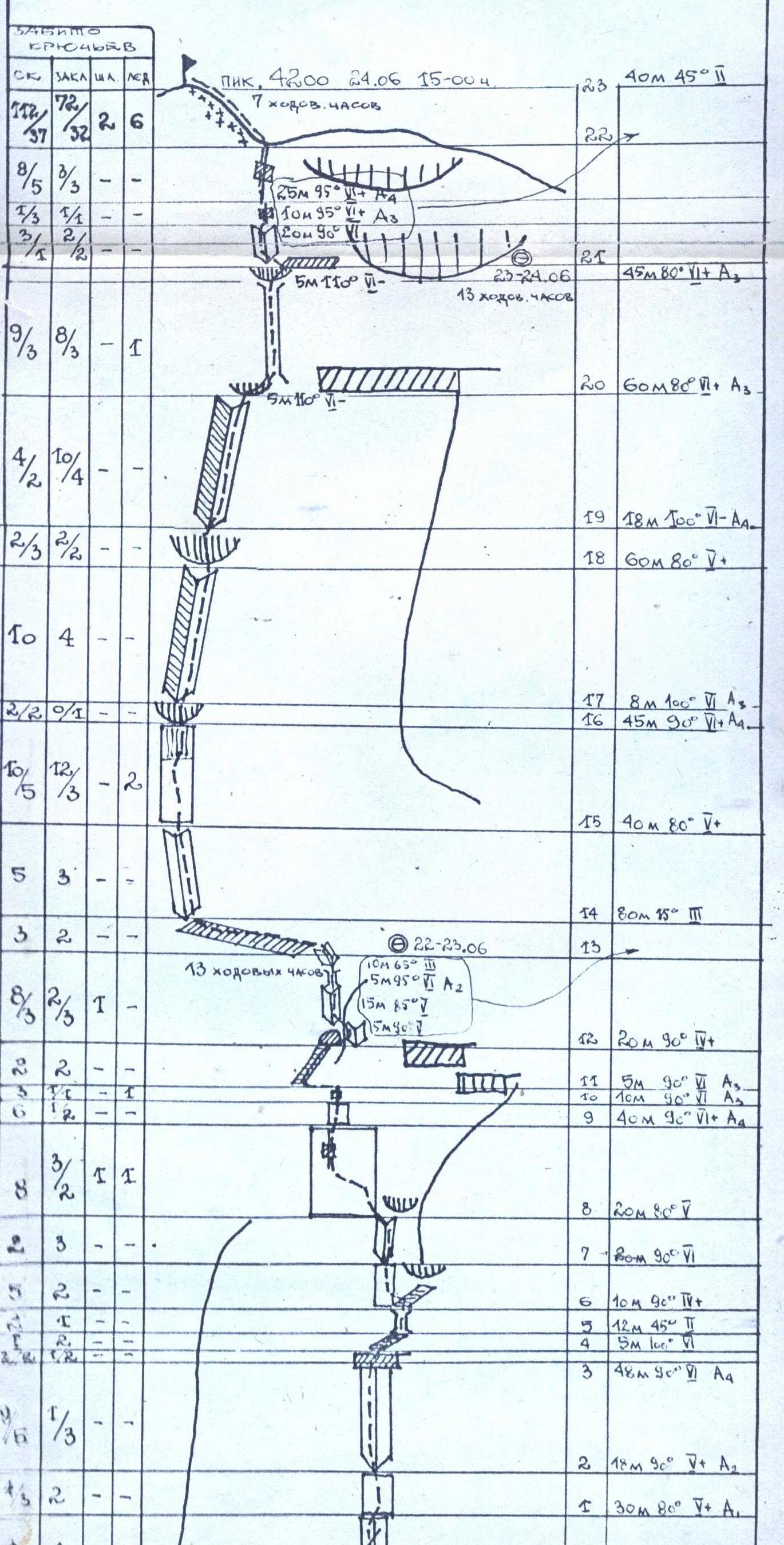
- R13–R14. Traverse to the left via a simple ledge, 80 m with a height gain of 15 m.
- R14–R15. Inner corner, 40 m, 80°. Difficult climbing. Exit to a wide, 2 m ledge under the base of an overhanging wall. Control point.
- R15–R16. Wall, 45 m, 90°. On the wall, in the middle and upper parts, there are overhangs. Climbing is extremely difficult with the use of artificial aids. Rocks have a tile-like structure, in the middle part — crumbling.
- R16–R17. In the upper part of the wall — an overhang, 8 m, 100°. Overcome with the help of artificial aids. Climbing is extremely difficult.
- R17–R18. Inner corner with an overhanging left part, passed via the right edge, 60 m, 80°. Climbing is difficult, in the upper part artificial aids used. Chocks of large sizes fit well.
- R18–R19. Transition from the top of the inner corner to the second inner corner — a wall, 18 m, 100°. Climbing is extremely difficult, sky hooks and ladders used.
- R19–R20. Second inner corner with an overhanging left part, passed via the right edge, 60 m, 80°. Climbing is extremely difficult, ladders, sky hooks, and artificial aids used. In the upper part — a small ledge for protection.
- R20–R21. Overhanging wall, 5 m, 110°. To the right into a chimney, 45 m, 80°. Climbing is extremely difficult with the use of ladders. Rocks are crumbling in places, few spots to hammer in pitons. At the end of the chimney — an overhanging wall, 5 m, 110°. Climbing is extremely difficult with the use of artificial aids. Exit to a bivouac.
- R21–R22. Inner corner, 20 m, 90°. Difficult climbing with the use of artificial aids. Rocks have a tile-like structure, water flows across the rocks in places. Further, a cleft passed with the help of ladders, 10 m, 95°. Cleft to the right, 25 m, 100°. Passed with the help of ladders. Climbing is extremely difficult. Total length of section R21–R22 is 55 m to the exit to the ridge. The team spent 6.5 hours to overcome this section. This section is one of the most difficult on the route.
- R22–R23. Ascent to the summit via a simple snowy slope, 40 m, 45°. Simultaneous protection. Descent from the summit towards p. Khosilot to a col — one rappel and one sport descent. Further down a snowy slope to the Tagrich valley and around the eastern ridge of p. 4200 to the observers' base camp — 2 hours 30 minutes.


