



USSR Alpine Climbing Championship
Rock Climbing Category
Pamir-Alay
Gissar Ridge
D-3 peak Zamin Karor
First ascent of the Western wall via the shortest path
Team from the Committee for Physical Culture and Sports under the Council of Ministers of the Tajik SSR
| Yuri N. Galitsyn | CMS | "Khosilot" |
|---|---|---|
| Vyacheslav I. Lavrukhin | MS | "Khosilot" |
| Vladimir V. Pletmintsev | MS | "Khosilot" |
| Anatoly M. Skrigtil | CMS | "Khosilot" |
Coach: Sergei N. Sogrin, MS
Tajik SSR, Dushanbe, 1977
Ascent Passport
- Ascent category — Rock Climbing
- Ascent area — Pamir-Alay, Gissar Ridge
- Ascent route — First ascent via the shortest path on the Western wall of D-3 peak Zamin Karor — 3709 m.
- Ascent characteristics height difference — 1150 m. (total height difference 1400 m, including the lower rock belt.) average steepness — 85° length of complex sections — 1060 m.
- Pitons used: rock — 277 ice — none bolt — 13
- Total climbing hours — 76.5
- Number of nights on the route — 4, including 3 in hammocks and one lying down
- Team from the Committee for Physical Culture and Sports under the Council of Ministers of the Tajik SSR.
- Team members: Yuri N. Galitsyn — CMS — team leader Vyacheslav I. Lavrukhin — MS — participant Vladimir V. Pletmintsev — MS — participant Anatoly M. Skrigtil — CMS — participant
- Team coach Sergei N. Sogrin, MS, senior instructor
- Dates of departure and return June 30 and July 1, 1977 — route processing July 2, 1977 — departure on the route July 5, 1977 — reaching the summit July 6, 1977 — descent to the base camp.
Brief geographical description of the area and sporting characteristics of the route
The Zamin Karor massif is located in the northern spur of the Gissar Ridge, east of the Anzob Pass.
In recent years, this area has become well-known among mountaineers. The attraction to this unique natural formation for technical and rock-climbing enthusiasts is not accidental. Practically sheer walls of kilometer height with diverse relief present high demands on athletes' technical and psychological preparation, providing great satisfaction from their passage.
It is enough, to note that there are three 6B category routes here, marked with gold and silver medals at the USSR championships, as well as a bronze route. Seven 5B category routes have been laid along the massif's walls, each of which can be a standard for the technical complexity of routes in this class.
Zamin Karor, or as this area is more commonly called, the Yaghnob wall, stretches in a latitudinal direction for 8 km, with the highest point in the eastern part — 4767 m. To the west, the massif sharply decreases and reaches a height of 3709 m at the D-3 peak. Throughout the massif, the northern walls have a steepness of 70° and above, with a height difference within 1–1.5 km.
However, the overall decrease in the absolute height of the massif to the west does not change the wall's height difference, as the base of the wall lowers simultaneously with the decrease in the height of the ridge.
From the D-3 peak, the massif abruptly drops to the west towards the Pindor River with a sheer concave wall. The route taken by the Tajik SSR Sports Committee team follows the shortest path to the D-3 peak via the aforementioned wall. The wall's vertical height slightly exceeds a kilometer. The steepness of the wall section of the route is more than 80°. The wall's relief is technically extremely difficult. The rocks are mainly composed of marbleized limestones, heavily smoothed.
The area's climate is characterized by continentality and significant dryness during the summer, which adds additional difficulties due to the lack of water on the route.
The ascent area is close to the access roads. The walking part takes 3–3.5 hours from the bridge over the Yaghnob River on the Dushanbe — Leninabad highway.
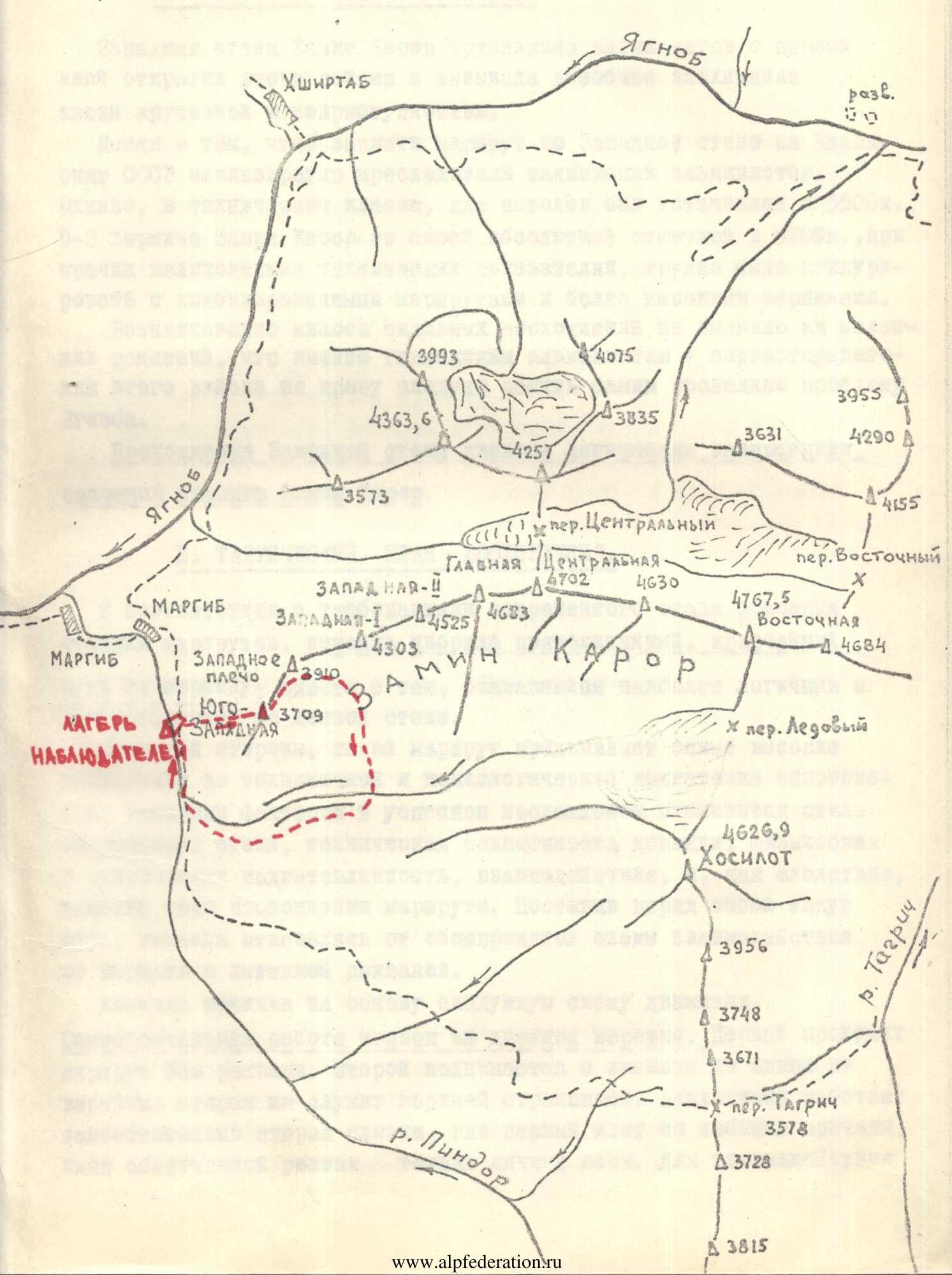
Scheme

Organizational and tactical plans for team preparation and ascent
I. Choosing the ascent object
The Western wall of Zamin Karor has attracted mountaineers since the early days of exploring this area and has caused universal admiration for its steepness and inaccessibility.
Thoughts about declaring a route on the Western wall for the USSR Championship have repeatedly haunted Tajik mountaineers. However, in the technical class, where the ceiling was set at 5500 m, the D-3 peak of Zamin Karor, with its absolute height of 3709 m, found it difficult to compete with combined routes on higher peaks, despite its excellent technical indicators.
The emergence of the rock climbing category left no doubt that Tajik mountaineers, as the pioneers of this area, should rightfully solve the last problem of Yaghnob.
The ascent of the Western wall was a logical completion of the development of the Zamin Karor massif.
II. Tactical plan for the ascent
In accordance with the requirements of the modern stage of wall route development, the team chose a straightforward, shortest path to the summit; this path also turned out to be the most logical and expedient on this wall.
On the other hand, such a route places the highest demands on the athletes' technical and psychological preparation. The decisive factor in a successful ascent becomes the style of wall passage, the team's technical equipment, physical and technical preparedness, interaction, and, as a result, a high tempo of route passage. Having set such a goal, the team refused the generally accepted scheme of interaction via fixed ropes with the retrieval of backpacks.
The team adopted the following movement scheme as the basis: independent work of pairs on a double rope.
- The first climber ascends the route without a backpack.
- The second climber ascends with a clamp on one of the ropes, while the other rope serves as upper insurance.
- Similarly, the second pair works independently, where the first climber ascends on pre-drilled pitons, carrying a lightened backpack with only personal items.
For interaction

and the transfer of pitons and carabiners from the first climber in the pair, a reep cord is lowered. The team's main load is carried by the second climbers in each pair. To ease their work with the rope and hammering pitons, the backpack is suspended from the harness on a short reep cord — the so-called "American" method. Since the wall is practically a sheer drop, the "American" method was used throughout the route. This style completely eliminated all "unproductive" operations on the route and significantly reduced the time taken to ascend the wall. However, such tactics are only possible with very careful selection of equipment and supplies, with strictly limited backpack weights and a strictly regulated movement schedule. Planning a large number of days on the route inevitably leads to an increase in backpack weights and, as a result, to abandoning this tactic.
The team faced similar difficulties during ascent preparation but for a different reason.
The entire route was planned to be completed in 4 days without processing, i.e., 250–300 m per day. Studying the route led to the conclusion that there would be no water throughout the route. The unusually hot summer of 1977 made the ascent even more challenging. Consequently, even with the most careful selection of equipment and minimal rations, the main weight would be water. Even at a rate of 1 l per person per day (which is clearly insufficient on such a "hot" wall), 16 kg of water plus containers would be required. Several tactical options for solving the water problem were discussed. However, the decisive factor was the desire to maintain the initially adopted tactic of independent work by the pairs.
The lack of water throughout the route determined the tactic of preliminary route processing to cache water.
This allowed:
- To reduce the "water hunger" on the route,
- To rationally distribute the weight of backpacks by days,
- To preserve the main tactical principle of route passage.
III. Training cycle
The 1977 team was composed of mountaineers who were members of the Tajik SSR national team, having repeatedly won prizes in USSR championships. The main tactical principles adopted for the upcoming route and its extreme complexity and steepness required the team members to have enhanced special preparation.
Winter general physical training at the "Khosilot" DSSO section
preceded specialized training on rocks, which began in February in the Varzob Gorge. The first training and acclimatization ascents were made in May during the holiday mountaineering event.
The final stage of team preparation for the championship was the second ascent of the "golden" route of 1974 on the North wall of Zindon — 6B category.
The route on Zindon was completed by a group of 6 in half the time taken by the first ascenders, confirming the correctness of the chosen tactics and demonstrating the team's good preparation.
IV. Equipment and supplies
The team had the following equipment:
- Main rope — 2 × 80 m and 200 m for processing
- Auxiliary rope — 80 m
- Titanium carabiners — 60 pcs.
- Hammers — 3 pcs.
- Various rock pitons — 60 pcs.
- Drill — 2 pcs.
- Removable bolt pitons — 10 pcs.
- Platform — 2 pcs.
- Ladders — 4 pcs.
- Rope extensions — 10 pcs.
- Clamp — 4 pcs.
- "Vitalka" radio station — 1 pc.
- Galoshes — 3 pairs
- "Vibram" experimental VTsSPS boots — 2 pairs
- "Vibram" tourist boots — 2 pairs
- Down suit ("leg", jacket) — 4 sets
- Parachute-style harness — 4 pcs.
- Self-insurance loops — 12 pcs.
- Helmets — 4 pcs.
- Gloves — 8 pairs
- Hammocks — 3 pcs.
- Perkal tent fabric — 4 pcs.
- Water flasks (total volume — 13 l) — 4 pcs.
- Polyethylene bag for water — 1 pc.
- Stove — 1 pc.
- Gasoline — 4 l.
- First aid kit — 1 set
- Pots — 2 pcs.
- Backpacks — 3 pcs.
The nutrition plan was for two meals a day. The ration was selected based on 500 g per person per day. The total weight of the products, including one reserve day, was 14 kg.
The team took the following products on the route:
- Fried natural meat in oil — 3 kg
- Salmon caviar — 1.5 kg
- Sugar — 2 kg
- Tea — 0.2 kg
- Nuts with honey — 1 kg
- Crackers — 1 kg
- Cookies — 0.5 kg
- Chocolate — 1 kg
- Onion, garlic — 0.5 kg
- Buckwheat groats — 1 kg
- Semolina — 0.5 kg
- Salt — 0.2 kg
- Canned fish in its own juice — 1.2 kg
- Schisandra extract — 0.5 kg Total — 14 kg
- Water — 20 l in cache.
After processing, the team had, not counting the equipment in use: 21 kg of equipment and 10 kg of products, totaling 31 kg.
Above the cache, the team departed with: 20 kg of equipment, 8 kg of products, and 13 l of water, totaling 41 kg.
The load was distributed into 3 backpacks weighing 6 kg, 17.5 kg, and 17.5 kg.
V. Observation group
The observation group consisted of 4 people and was located directly under the wall by the Pindor River. The senior observer was V. Kraynov — 1st sports category.
The observers regularly monitored the team's progress on the route, kept a log, and maintained radio communication.
VI. Safety measures
The ascent's safety was ensured by:
- thorough team preparation,
- choosing a safe route,
- selecting safe overnight locations,
- a well-thought-out tactical plan,
- radio communication,
- excellent technical and psychological training of team members.
The success of the ascent was facilitated by the passage of a 6B category route on the Zindon peak during the training cycle, where technical and tactical techniques were tested.
During the ascent, highly qualified camps of the "Burevestnik" LOK, Ukrainian "Spartak" were operating in the area, capable of providing assistance in the shortest time.
Ascent chronicle
The last turn of the trail. Our eyes are fixed on the Western wall of Zamin Karor. Through the binocular lenses, we scan the gray, sweltering, sheer walls, trying to spot even small ledges. But hopes are in vain. The wall rises like a kilometer-high sheer drop above the gorge, giving a clear indication that the struggle will be tough and uncompromising.
For millions of years, nature has been processing the wall, preparing it for a battle with humans: smoothing the walls, flattening the slightest protrusions, and placing overhangs in the most unfavorable locations.
Another 1.5 hours of walking through the village of Margib, and under the wall by the Pindor River, in the thickets of barberry and wild rose, the observers' camp is set up.
Upwards, an talus slope leads to the wall. The lower part of the wall is cut by an almost horizontal terrace, where, near a waterfall issuing from the wall, a small birch grove is nestled. Here, we decided:
- To establish a штурмовой лагерь (assault camp)
- To consider the beginning of the route
Although the difference to this grove is about 250 meters of the first rock belt.
June 30, 1977
What we decided to consider as the approach to the route — the rock belt with the waterfall — from the first meters forced us to take out the rope and pitons. The talus led to a 20-meter wall of the rock belt. Vyacheslav Lavrukhin went first. The ascent is not complicated, not above category 3. Further, along limestone slabs with living rocks, about 200 meters to the second 50-meter wall, leading to the forest.
The bright green crowns of birch trees leaned over the transparent keys of deep water, beating from the talus slope. Through the dense green grass and giant ferns, white, fantastically curved birch trunks shone.
The assault camp was quickly organized. Everyone was eager to touch the wall, to feel the inaccessible rocks. From above, the wall looked even more terrifying. A multi-meter overhang loomed over the sheer lower part. But the team's mood was good.
Readiness for the ascent was ensured by:
- moral and technical preparation
- specially selected equipment
- previous training
- passage of a complex 6B category route
The first to go on reconnaissance were Slava Lavrukhin and Tolya Skrigtil. The route from the grove begins upwards through the outpost of the Western wall — the black bastion. 250 meters of rock "belly" proudly protrudes forward from the wall. Black, wet rocks shone like a mirror in the rays of the hot Tajik sun.
- 70 meters of very steep rocks, like "ram's foreheads," lead to the sheer wall of the bastion. On the right, at the contact between black and gray streaks, a crack is visible, stretching to the top of the bastion. To the right of the lower part of the crack is a small ledge and a rock fragment in the form of a slab standing on a long edge.
The climbing is extremely difficult, with ladders being used. The sound of hammering, clinking pitons, and clear commands: "Hand out the red one," "Secure the white one" can be heard from the wall. The black bastion slowly recedes. Fingers are red from tension; even galoshes struggle to find footholds. To ensure reliable insurance, a bolt is used. The soft limestone allows for quick drilling. Meters are gained slowly, but time passes quickly. It gets dark before you know it; it's time to descend.
180 meters of very complex climbing were completed, with 57 rock pitons and 2 bolt pitons used.
After dinner, we fell asleep quickly, the tension of the first day taking its toll. Tomorrow is an early rise and a more intense day. We need to reach the bastion and cache 20 liters of water.
July 1, 1977
At dawn, the pair Yuri Galitsyn and Vladimir Pletmintsev go for further processing. It's easy to work in the morning cool; the rocks are pleasantly cold.
20 meters along the crack lead to an overhang. Here, the wall has a negative incline for 7 meters. Ladders and a platform are used. The climbing is very difficult; sweat obscures the eyes, making it hard to work. It's no easier further on — an ideal sheer drop with microscopic holds. Apparently, the wall has decided to test the team's capabilities from the very start, before allowing them to reach the summit. Climbing first is very difficult. Fingers become numb from tension. Resting at a hammered piton is a relief. The belayer often has to work, hanging on a piton in a harness. Excellent rock climbing skills and, most importantly, faith in the piton hammered by a teammate, give confidence.
Finally, the first climber reaches a small ledge capping the black bastion. From below, Lavrukhin and Skrigtil lift 21 liters of water in flasks and a large polyethylene bag along the fixed ropes. After securing the rope, everyone descends. During the evening radio session, we inform the observers that we will depart on the route tomorrow.
For the day, we processed another 160 meters of very complex, almost sheer rocks. 42 pitons and one bolt piton were used.
July 2, 1977
In the morning, we pack our backpacks, trying to lighten them as much as possible. Specially made "elephant legs" and lightened jackets significantly reduce the backpack's weight. We take raincoats instead of a tent. The wall is completely dry, and the sun beats down from 1 pm to 9 pm. Pletmintsev, with the captain's tacit consent, puts an extra flask of water in his backpack.
At one-hour intervals, team members leave the assault camp, where they could stretch out to their full height and drink plenty of tea. During the ascent, we use the "American" method of transporting backpacks: it hangs at knee level, attached to the harness, and only the legs work with the load, keeping the hands free. When passing overhangs, it doesn't pull backwards. Galitsyn tries to carry the backpack on his shoulders but quickly gives up. The ascent along the sheer fixed ropes is exhausting; we struggle to catch our breath at the re-rigging points.
Lavrukhin and Skrigtil reached the end of the fixed ropes and began working above. Above the bastion, the rocks are not steep, with good holds. After 60 meters, they approach a sheer inner corner with a wide crack in the middle. At the base of the corner is a convenient spot for a bivouac.
Lavrukhin continues forward; the others set up a bivouac:
- hammer in pitons,
- hang hammocks.
Two will sleep in hammocks, and two on small ledges. On a platform suspended from a piton, a stove quietly hums, and steam rises from a pot. Below, in the twilight, the village of Margib disappears.
For the day, we covered 340 meters of fixed ropes and 60 meters of rocks of medium difficulty.
The rope is fixed another 30 meters above. We fill the water flasks — 13 liters. The remaining water must be consumed during dinner and breakfast.
July 3, 1977
We leave the bivouac at 8 am. The fixed rope system is a necessity from the processing days. From today, the movement tactic is independent pairs. The climbing is complex, but the group is prepared for it. There are only 3 backpacks in the group, one lightened for the first climber in the second pair. He will have to climb with lower insurance, using the pitons hammered by the first pair. This will significantly reduce the time taken to complete the route, which is of paramount importance on the Western wall, as every extra day means liters of water, which is scarce.
Pletmintsev and Galitsyn begin the ascent along the inner corner. The left side is composed of living rocks and rock flakes. The right side is monolithic. The climbing is extremely difficult, 50 meters along the sheer right wall of the corner, then left to the goal of the inner corner, along which 20 meters ascend using wedges and ladders. The inner corner leads to the forehead of light-gray limestone. There are very few cracks, most are blind; a piton enters 1–1.5 cm and bends under hammer blows. The foreheads overhang each other, forming a wall. The climbing is very complex and emotional, with tiny holds. The first climber works on a double rope, searching for cracks for pitons and hammering them for more reliable insurance, including a bolt piton. 30 meters of the most complex climbing. Galoshes and friction help. 7 hours and 30 minutes are spent on 30 meters, with 10 rock pitons and one bolt piton used.
Above, there is another inner corner, but wider than in the lower part. The walls are sheer, composed of blocks of light-gray limestone. The climbing is complex; fingers slip on the smooth surface. With great difficulty, you hang on microscopic holds, and only after hammering a piton can you rest. The sun beats with all its force — the back and helmet are hot, legs burn, the mouth is dry from heat and work, and it's hard to talk.
Below, the second pair works confidently. Vyacheslav Lavrukhin is climbing first. He is an excellent rock climber, a former prize-winner at USSR championships in rock climbing. We let the second pair go ahead.
The ascent continues along the right side of the corner. 80 meters of complex climbing take 3 hours. Then 30 meters of smooth, steep rocks lead under an overhang capping the inner corner. Under the overhang is a small ledge where two people can fit. We hang hammocks, stretching them in the inner corner under the protection of the overhang. For the day, we covered 210 meters of steep rocks with extremely complex climbing.
The night passed well; two people lay in hammocks, and two on a ledge.
July 4, 1977
Galitsyn ascends left and upwards from the inner corner through a three-meter overhang on a double rope. The climbing is free but very complex. We offer the second pair fixed ropes. Lavrukhin passes the overhang and replaces Galitsyn. Above the overhang are 30 meters of light-gray rocks like "ram's foreheads." The climbing is very complex, with tiny holds again. The galoshes are already worn out. Lavrukhin spent 1.5 hours on this section. Then a traverse left along a ledge for 5 meters. Through a 2-meter overhang, using ladders, we exit into an inner corner. The walls of the corner are smooth but have a good crack — 10 meters very complex. Further, steep "ram's foreheads" lead to a ledge after 40 meters. Above the ledge is a sheer wall with a crack going left and upwards. The climbing is complex along smooth, light-gray limestone with a steepness of up to 85°. 60 meters of climbing along the crack lead to a vertical inner corner. But the entrance to the corner is blocked by an overhanging "ram's forehead." There are no other options. Using ladders and a bolt, we exit into the corner. Free climbing follows.
The second pair climbs with difficulty. The climbing is very complex; much time is spent hammering pitons. We constantly pass iron upwards on a reep cord.
Pitons don't go well into the side walls of the corner; all cracks are filled with calcite — a very soft and brittle rock; everything crumbles under hammer blows. To organize reliable insurance, we have to hammer a bolt piton into the monolithic wall of the corner.
40 meters of climbing along the corner lead to rock flakes. There are holds, but many are unreliable — they break under load, and below is a sheer drop. Lavrukhin climbs with extreme caution, hammering a piton whenever possible. The climbing is complex and emotional. 10 meters of overhanging flakes require all his strength; he emerges onto a small ledge above the flakes, hammering in a piton. That's it! Now you can rest.
We offer the second pair fixed ropes on this dangerous section. They quickly ascend to the ledge using the rope.
All the time, it seems like the next wall is overhanging above you. Indeed, each subsequent section is extremely steep. We choose a path further left, where many cracks for hammering pitons are visible. Ladder, second one, the body leans back from the wall; you have to attach yourself with a carabiner to a piton; fingers search for holds on the smooth wall surface — there are none. Cracks are shallow and blind. Hope is only on a bolt. The hole is drilled quickly — the rocks are very soft. Ladder. You can rest! Further on, good holds are visible. Free climbing — to a wide crack and right — to a small ledge.
From the ledge upwards, a sheer, wide chimney with an overhanging plug at the top ascends. We climb using free climbing. It's a pleasure! Thick horizontal pitons are used. Under the plug, we move to the left wall of the chimney and ascend along a fissure to light-gray rocks — steep and smooth. After 50 meters, we reach a small ledge, above which huge blocks of limestone loom. We stop under this overhang for the night. The day was very difficult. We covered about 300 meters. Our throats are parched; there's no strength to talk; we want to drink. We leave water only for the morning, as we should reach the summit the next day, where water can be found. We drink all the remaining water in the evening.
July 5, 1977
We rose early in the morning; the night was restless. It was very cramped on the platform. Those who slept in hammocks rested better. Today is the decisive day. We must reach the summit, and the wall has prepared a final overhang at the top. Lavrukhin will be the first to work.
During the morning radio session, we heard the coach's voice. The first question: "How's the water situation?" We learned that Sogrin S.N. and judge Aleksashin L.V. climbed to the observers' camp during the night.
20 meters of free climbing led to a large ledge. The exit to the ledge is via a 10-meter sheer, smooth wall.
From the ledge, the further path is visible. About 200 meters of smooth wall with two overhangs in the middle.
Lavrukhin ascends along a slab to a small ledge under the overhang. Here, he needs to take the second climber. To the left is a curved, smooth, monolithic wall; to the right is an overhanging plane of an inner corner. The path upwards is only through the overhang. There are enough cracks. Ladders and a platform come into play. Above the overhang is a vertical crack. You can climb using free climbing. We pass additional pitons to Slava. The overhang is passed by the second pair along the fixed rope.
From the crack, the exit is into an inner corner. Along the left wall of the corner, we ascend to a small ledge using climbing. From the ledge, again a complex path through the second overhang. But here we find a simpler variant of its passage. The second pair goes first. Galitsyn, using ladders and complex free climbing, overcomes the overhang.
Above the overhang are 40 meters of wall with good holds. We climb using free climbing. And suddenly, the wall ends! A large, even platform. Everyone gathers together.
The sun sets on the horizon. There's no water. The summit is visible ahead. We decide to continue. We inform the observers via radio:
- we will spend the night in the summit area;
- we will descend to the camp early in the morning.
We cover about 200 meters along rocks that are not very steep, up to 70°, and, under the summit tower, in a crevice, find a piece of ice. Here, we settle in for the night. Everyone stretches out to their full height.
July 6, 1977
Early in the morning, without breakfast, quickly changing the note in the cairn, we began our descent along the scree slopes of the southern slope of the Yaghnob wall. We passed through the canyon along a barely noticeable but familiar trail and were at the observers' camp by 8 am.
Evaluation of the group's actions and its participants
All team members have been part of the national team for several years and have repeatedly competed together, becoming prize-winners in USSR championships.
Despite the significant technical, psychological, and physical strain of the route, the ascent took place in a calm atmosphere. Team members worked with full dedication, demonstrating high technical skill and tactical literacy.
Thanks to excellent rock climbing preparation and successful tactical decisions, the team maintained a fairly high tempo of route passage.
Yuri N. Galitsyn — a strong, goal-oriented athlete, possesses excellent individual climbing technique. Tactically literate, decisive, and energetic. A demanding and principled leader.
Vyacheslav I. Lavrukhin — a very calm and restrained athlete, possesses high individual rock climbing preparation, was a prize-winner in all-Union rock climbing championships. He has climbed almost all routes on the Yaghnob wall. Able to analyze the situation, technical difficulties, and make the right decisions.

Table of main route characteristics
Route: First ascent via the shortest path on the Western wall of D-3 peak Zamin Karor
Analysis of the table of main route characteristics and the profile scheme allows us to conclude that the distinctive feature of the route is its significant length with an overall steepness close to sheer. This applies to its wall section. The summit tower is located somewhat further from the wall plane, and therefore, the exit to it is gentler and technically simpler. The insignificant proportion of this section in the overall sum of extremely complex sections is not determining in the overall evaluation of the route.
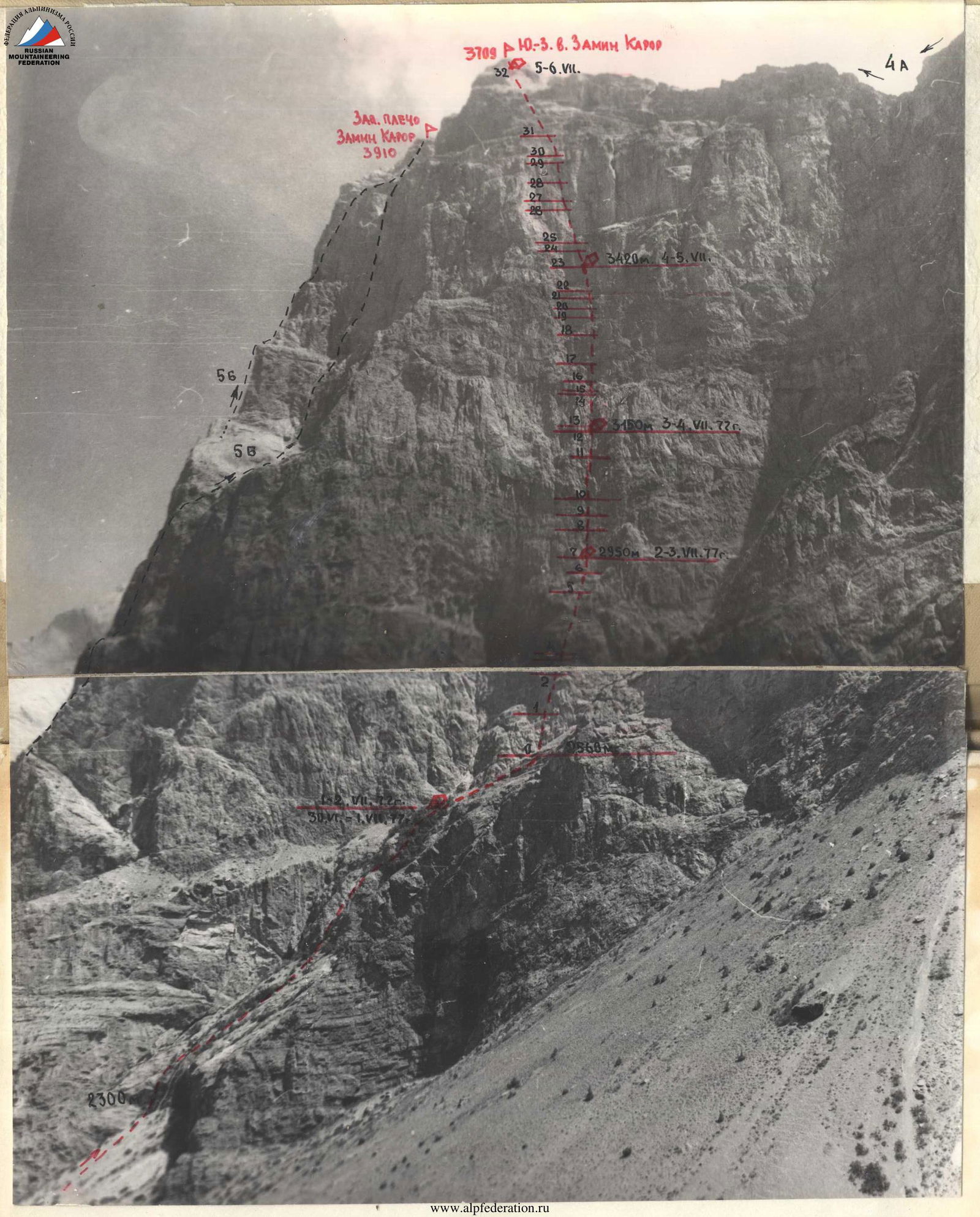
The Western wall has a concave shape, with its overall width reaching 1 km. This circumstance complicated the photography of the route profile. From the right, the wall is bordered by a ridge, along which a 4th category route is laid. Only from here was it possible to take a photograph, which is given in the report and most objectively characterizes the route.
The steepness of the route was determined by a profile photograph, as a result of graphical construction and observations, and was found to be between 82° and 87°. More accurate measurements require special instruments.
The objective data provided and the route assessment by participants, in comparison with previously climbed 6B category routes and within the framework of USSR championships, allow us to evaluate this route as the highest — 6B category.
Appendix


Table of main route characteristics
| Date | Sections passed | Average steepness | Length of section (m) | Characteristics of section and passage conditions | Category of difficulty | Time of departure / stop | Climbing hours | Pitons used (rock) | Pitons used (ice) | Pitons used (bolt) | Overnight conditions |
|---|---|---|---|---|---|---|---|---|---|---|---|
| By relief character | By method of passage and insurance | By weather conditions | |||||||||
| June 30, 1977 | R1 | 80° | 70 | "Ram's foreheads" | 5B | Free climbing, complex, pitons | Clear | 10:00 — 20:00 | 14 | ||
| R2 | 85° | 110 | Walls of black bastion — smoothed rocks | 6 | Very complex free climbing, ITO | « | 10 hours | 38 | 2 | ||
| July 1, 1977 | R3 | 90° | 20 | Walls of black bastion — smoothed rocks | 6 | Very complex free climbing | « | 9:00 — 20:00 | 7 | 1 | |
| R4 | 95° | 7 | Walls of black bastion — overhang of gray limestone | 6 | Very complex, ladders, platform, pitons | « | 11 hours | 6 |


