Passport
of the ascent route to the western shoulder of Zamin-Karor (category III) via the center of the western wall.
- Location area of the peak: 150 km southeast of the Fann Mountains
- Height of the peak: 3700 m
- Height difference of the route: 500 m
- Total length of the route: 1200 m
- Total length of challenging
sections of the route:
- 350–380 m
- Average steepness of the route: 77.5°
- Number of overnight stays, their nature: one, in a weather-protected location, without water
- Number of pitons driven: rock: 140 pcs. bolt: 5 pcs. ice: 0 pcs.
- Nature of the rocks forming the massif: marbleized limestones, the wall is often blocky
- Footwear recommended for the ascent: galoshes
- Number of travel hours spent on completing the route: 25 hours
- Communication with observers: visual, radios
- Weather conditions: July, August are usually dry
- Recommendations: the route is recommended for groups with good rock climbing skills
Ascent Description
The Zamin-Karor peak is located away from the intersection of the Gissar and Zeravshan mountain ranges, south of the Matcha area and southeast of the Fann Mountains area. Despite its uniqueness, the Zamin-Karor wall (up to 1200 m high, up to 3 km long) has only begun to be explored in recent years. Approaching the wall and setting up a base camp is not difficult due to its proximity to populated areas. The village of Margeb is located directly below the wall. From Margeb to the Dushanbe-Leninabad highway is about 10 km via a pack trail, and to Dushanbe is 120 km. The rock terrain and favorable weather conditions create excellent opportunities for highly technical ascents.
A team from the "Burevestnik" special unit consisting of:
| № | Name | Rank | Role |
|---|---|---|---|
| 1. | Petrov M.V. | Master of Sports | leader |
| 2. | Markelov V.V. | – | participant |
| 3. | Burago N.A. | Candidate for Master of Sports | – |
| 4. | Lobachev E.F. | 1st category | – |
undertakes a first ascent (pioneering climb) up the western wall of Zamin-Karor via the center. The route is 500 m to the right of the category 5B route by Sivtsov and appears particularly challenging in its upper part. The absence of snowfields and water on the route adds to the climbers' difficulties.
During the pre-season preparation, all participants in the ascent conducted joint rock climbing training. The team has been climbing together for several years.
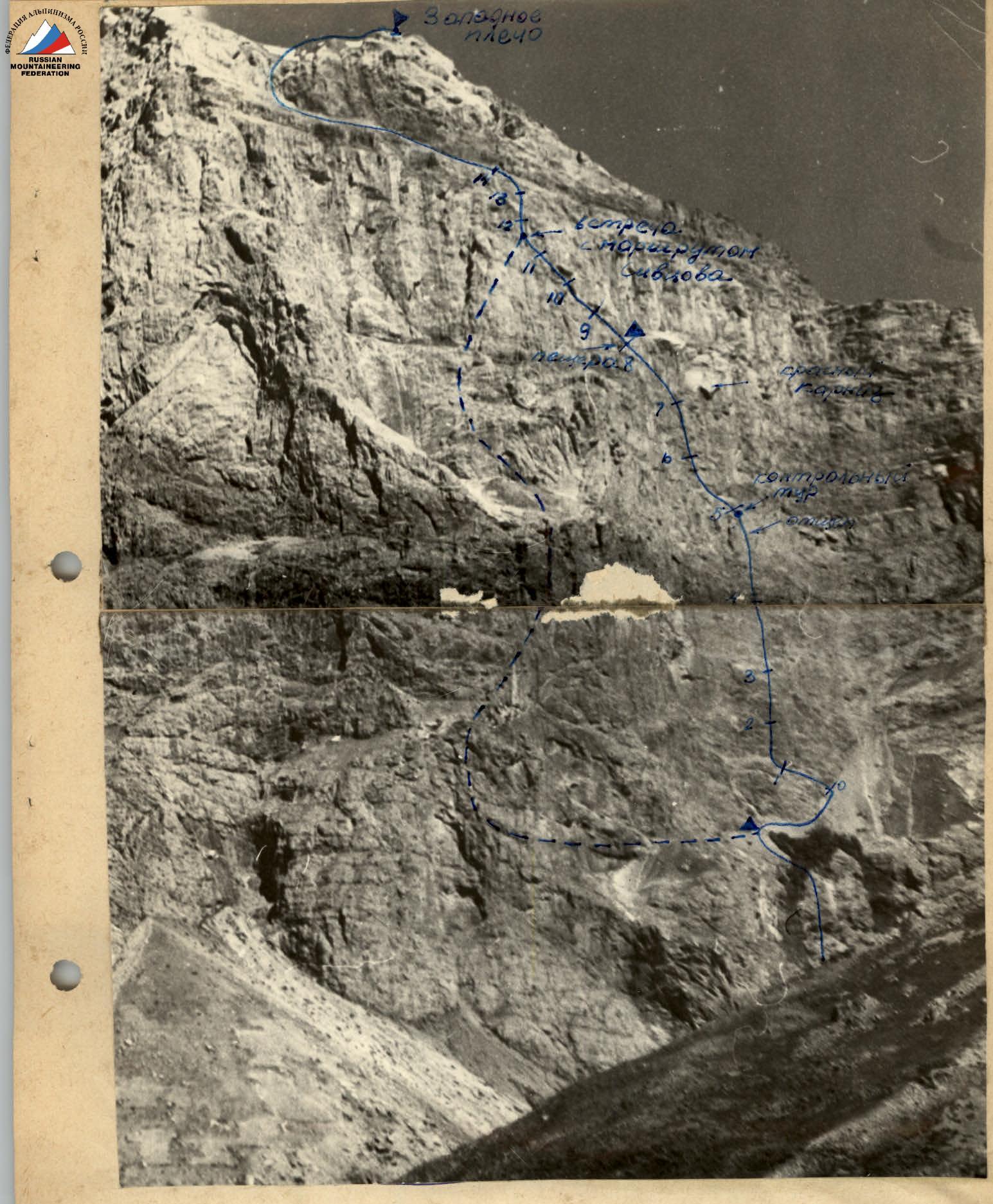
The group departed from the camp near the Dushanbe-Leninabad road at 12:00 on August 3, 1974. Along the left (orographic) bank of the Yaghnob River to the village of Margeb and then to the right towards the scree under the wall, the path follows a pack trail. Further along the scree to the left and upwards towards a grove located on a wide scree shelf on the "ram's foreheads." The ascent to the "ram's foreheads" is done by climbing the rocks to the right of the waterfall. By 17:00, a bivouac is set up under the wall above the forest. The Petrov-Lobachev rope team heads out to process the route.
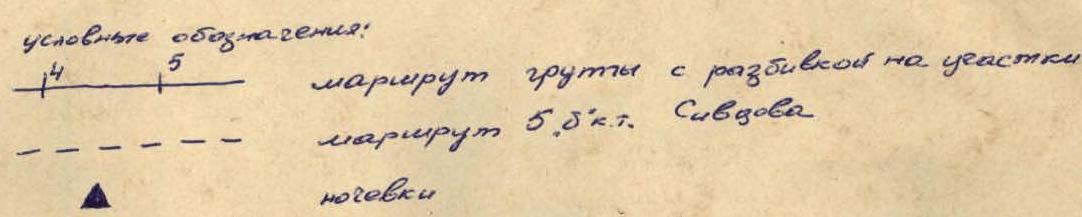
From the bivouac to the start of the route along the rocks to the right via scree is 200 m. The beginning is determined by the rock relief – on the wall, ledges appear leading to the left towards the middle of the wall.
Section R0–R1
Across the ledges, traverse left 60 m, then up 20 m. Climbing is not difficult, with many protrusions. Steepness is 65–70°. 6 pitons driven.
Section R1–R2, R2–R3
Steep – 75°, with a sufficient number of holds, rocks. Climbing is of medium difficulty, about 60 m, direction of movement: left and up, then straight up. The rocks gradually transition from monolithic to fractured-blocky, posing a danger to those climbing below. Encountered ledges are no more than half a meter. After 160 m, exit onto a 13 m ledge. 17 pitons driven.
This is where the processing ends, ahead is a vertical wall with small overhanging sections. Descent to the bivouac is completed by 22:00.
On August 4, ascent begins at 7:00. Breakfast. Departure on the route at 8:30. By 10:30 in the morning, the processed section is completed.
Section R3–R4
The Petrov-Lobachev rope team continues first. Vertical blocky wall. Climbing is very challenging and tense due to the risk of causing a rockfall; the first climber goes without a backpack, and there are practically no places to drive pitons. The wall is 80 m, ending in a 1 m wide ledge. 8 pitons driven, including 2 bolt pitons (for necessary safety). The top of the wall is monolithic, with a steepness of 85–90°.
Section R4–R5
Further left, the beginning of a chimney, which after 80 m ends in a huge flake and a platform with a control cairn. The chimney is monolithic, climbing is very difficult, hauling backpacks over 60 m, with few cracks. 10 pitons driven (3 bolt pitons). Steepness of the section is 85–95°.
Section R5–R6
Traverse up and left 60 m. Climbing is easy, with protection from protrusions and pitons. Exit under a vertical wall. A narrow ledge for a seated overnight stay. Here, the lead changes, with the Burago-Markelov rope team going first. Steepness of the section is 70°. 4 pitons driven.
Section R6–R7
Vertically up 80 m along a wall made of marbleized limestone, smoothed by water. Climbing is very difficult. Hauling backpacks over 70 m. In bad weather, this section will be quite challenging to pass due to the minimal number of holds and their smoothness. 19 pitons driven. Steepness of the section is 85–95°.
Section R7–R8
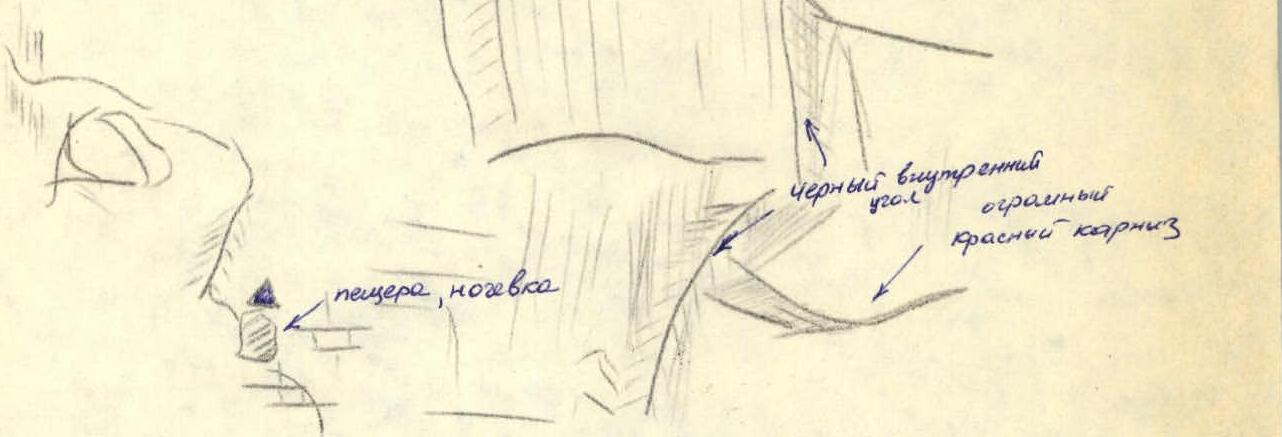
Left and up towards the "cave": blocky rocks, many dangerous unstable stones. Climbing is difficult. Few places for pitons. Steepness of the section is 75–80°. 8 pitons driven. The "cave" is a good spot for an overnight stay; a platform was laid out. No water.
The group spends the night here. On the morning of August 5, ascent begins at 6:30. At 7:30, after breakfast, Burago continues moving, with Lobachev providing protection. Rain starts, and a thunderstorm rumbles not far to the left. From the overnight stay, two options for continuing the path are visible:
- traverse to the right 100 m and then vertically up through a wet internal corner formed by black smooth slabs, through a huge red cornice clearly visible from the trail, exit onto a wide scree field and then onto the ridge.
- ascent up to the left of the cave. The group chose the second option as less dangerous in bad weather.
Section R8–R9
Through unstable vertical rocks, exit onto a ledge above the overnight stay, then through an internal corner with smooth monolithic walls 80 m to a very sloping rock ledge and further through the corner another 20 m. Climbing is very difficult. Steepness of the section is 85–90°. 13 pitons driven. Potential overnight stay location.
Section R9–R10
Further, a vertical wall intersected from left to right by a ledge, in places narrowing to a crack. Passing through the crack is not only difficult but also dangerous due to "live" stones. The narrowing of the ledge is bypassed below with a subsequent exit onto it. Traverse left 15 m with a descent of 10 m, then ascent back onto the ledge. Exit onto the ledge is very challenging, using artificial holds. 19 pitons driven, four two-rung ladders hung. Rocks are unstable. Steepness of the section is 30–90°.
Section R10–R12
Along the ledge, transitioning into an internal corner, movement is left and up. Climbing is mostly easy, with a few difficult spots like overhanging chimneys 5–3 m high. The length of the two sections is about 160 m. The ledge leads onto Sivtsov's category 5B route. 15 pitons driven.
Section R12–R15
Following Sivtsov's route up through the internal corner 160 m to a forty-meter vertical destroyed wall, which ends in a large scree pre-summit ledge. Along this ledge 180–200 m to the left, bypassing the ridge, to a black couloir leading to the summit. On three sections, 22 pitons driven. Steepness ranges from 65° to 80°.
At 18:00 on August 5, the group, having completed the descent via the standard path, was on the trail near the village of Margeb.
Route Characterization
The route fully meets the requirements for category 5B ascents. In terms of difficulty and length, it is not inferior to other routes of this category on the western and northwest walls of the Zamin-Karor peak, with difficulties compounded by the absence of water on the route. Climbing is everywhere difficult and interesting, requiring the group to master the entire technical arsenal of rock climbing (climbing techniques, use of artificial holds, bolt pitons, etc.). The group's preparation met these requirements. The route was completed in two days with one overnight stay on the wall and preliminary four-hour processing. Route data is provided in its passport.
Group equipment taken on the route:
- Main rope: 280 m.
- Auxiliary rope: 80 m.
- Rock pitons: 65 pcs.
- Bolt pitons: 50 pcs.
- Hammers: 4 pcs.
- Carabiners: 55 pcs.
- Two-rung ladders: 9 pcs.
- Rope extensions: 12 pcs.
- Tent: 1 pc.
- "Vitalka" radio: 1 pc.
- Primus stove, first aid kit: 1 pc.
All participants in the ascent wore galoshes. The ascent was made at a good pace, without any extraordinary incidents. A total of 146 rock pitons and 5 bolt pitons were driven.





 The height difference of the route is 900 m from 2600 m to 3780 m. Steepness of the route is 77.5°

Team Captain Petrov M.V.
Team Coach Staritsky V.G.
November 20, 1974
| :--: | :--: | | | 4 | | | 5 |