

ASCENT DOCUMENT
- Ascent class: technical.
- Gissar Ridge, Pamir-Alay.
- p. Zamin-Karor, 1st ascent, 4303 m, NW wall, rock.
- Complexity category 6B.
- Route characteristics: height difference 1200 m, length of sections 890 m, average steepness of the route 72°
- Pitons hammered: rock: 83, 20 bolt: 57, 47 chocks: 153, 29
- Number of travel hours: 49.
- Three overnight stays: — 1st on a rock shelf, lying down, — 2nd on a snowy shelf, lying down, — 3rd on a rock shelf, lying down.
- Leader: Lebedev Vladimir Alexandrovich, Master of Sports Participants: — Arkhipov Vladimir Alekseevich, Candidate for Master of Sports — Kokhanov Valery Petrovich, Candidate for Master of Sports — Ponomarev Vitaly Valentinovich, Candidate for Master of Sports — Kuznetsov Alexander Vladimirovich, Candidate for Master of Sports — Kuzin Alexey Vladimirovich, Candidate for Master of Sports
- Team coach: Kolotiy Valery Ivanovich, Master of Sports
- Date: departure on the route July 27, 1987 reaching the summit July 30, 1987 return July 30, 1987
- Krasnoyarsk Kray Sport Committee.
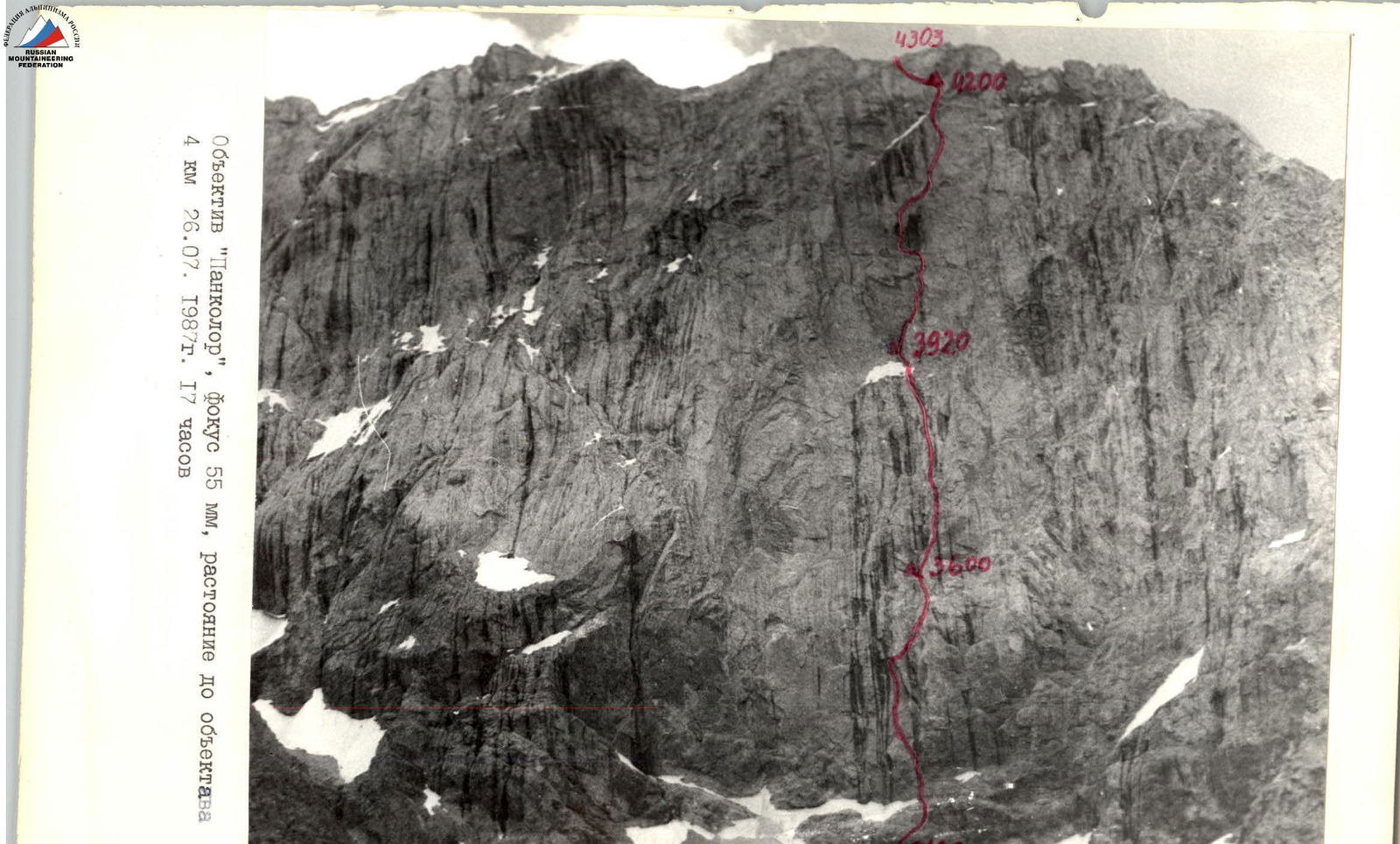
"Pancolor" lens, 55 mm focal length, distance to object 4 km, July 26, 1987, 17:00
Team Tactical Actions
During the team's ascent to p. Zamin-Karor, there were no deviations from the tactical plan. Overnight stays were organized at planned locations, convenient and safe.
On July 26, 1987, two rope teams: Kuzin–Kokhanov and Arkhipov–Ponomarev went out to process the route. They processed 2.5 ropes (sections R1–R4).
On July 27, 1987, the group started on the route. The first rope team to work was Kuznetsov–Ponomarev, and the last to work on the route was Arkhipov. At section R10–R11, they organized an overnight stay and processed 3 ropes above the bivouac. The first rope team to work on processing was Lebedev–Kokhanov.
On the second day of ascent, July 28, 1987, the first rope team to work was Lebedev–Kokhanov. Kokhanov worked first, and Arkhipov was the last to work on the route. At 14:00, when the team was on the snowy shelf "Ryumka", in the middle of the route, heavy snowfall began. On a convenient rock shelf under an overhanging wall, above the snowy shelf (section R21–R22), they began to organize an overnight stay. The rope team Arkhipov–Kuzin went out to further process the route. By 20:00, they processed 3.5 ropes (sections R21–R24).
On the third day, July 29, 1987, the first rope team to work was Lebedev–Kokhanov. Lebedev worked first. Ponomarev was the last to work on the route. In the second half of the day, it started raining, which significantly complicated the movement of the first climber. The overnight stay was organized on a snowy-rock shelf under an overhanging wall.
On the fourth day, July 30, 1987, the first rope team to work was Kuznetsov–Ponomarev. Kuzin was the last to work.
The team used UIAA ropes on the route. On particularly difficult sections, the first climber went on a double rope. The last person in the group worked with top-rope. The first climber's belay was done through a Sticht plate.
The team coped well with technically difficult sections, using a rich arsenal of equipment.
During the ascent, the rescue team along with observers was stationed in the camp under the wall. Radio communication worked regularly without interruptions. The observers' radio station was constantly on receive. The rescue team was provided with a Gaz-66 vehicle.
Table of Food and Fuel
Nutrition was organized as follows: In the morning from 6:30 to 7:00 — hot breakfast; During the day — nutrition from individual packs; In the evening from 21:00 to 21:30 — hot dinner.
- Rusks 1.8 kg
- Fried meat 1 kg
- Condensed milk 2 cans
- Buckwheat groats 0.5 kg
- Boiled potatoes 2 kg
- Lard 1.2 kg
- Sugar 1 kg
- Candies 1 kg
- Honey 0.4 kg
- Black tea 0.2 kg
- Dried fruits (raisins, dried apricots) 1.8 kg
- Walnuts 0.8 kg Total: 12.3 kg
- Gas (3 cylinders of 400 g each) 1.2 kg
Total weight of the team's backpacks (including equipment): 80 kg
| 4. | 10 | |||||||
|---|---|---|---|---|---|---|---|---|
| 3 | 5 | |||||||
| 5 | 3 | |||||||
| 8 | ||||||||
| 9 | ||||||||
| 20 | 4 | 5 | ||||||
| 20 | 4 | 5 | ||||||
| 3 | 6 | |||||||
| 3 | 4 | |||||||
| 3 | 10 | |||||||
| 4 | 15 | |||||||
| 1 | 3 | |||||||
| 4 | ||||||||
| 2 | 4 | 2 | ||||||
| 2 | 4 | 10 | ||||||
| 1 | 6 | |||||||
| 4 | ||||||||
| 2 | 10 | |||||||
| 1 | 4 | |||||||
| 1 | 7 | |||||||
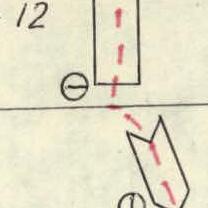 80 m, 70°, 5, R34; 60 m, 60°, 4, R33; 40 m, 80°, 5, R32; 30 m, 70°, 5, R31; 30 m, 70°, 5, R30; 30 m, 90°, 6, R29; 30 m, 80°, 6, R28; 40 m, 85°, 5, R27; 50 m, 85°, 6, R26; 30 m, 45°, 4, R25; 20 m, 85°, 6, R24; 40 m, 90°, 6, R23; 40 m, 90°, 6, R22; 40 m, 80°, 5, R21; 30 m, 50°, 4, R20; 40 m, 70°, 5, R19; 40 m, 75°, 4, R17; 40 m, 70°, 5, R16; 40 m, 75°, 5, R15; 15 m, 70°, 4, R14; 20 m, 90°, 5, R13; 40 m, 65°, 5, R12; 40 m, 70°, 4, R11; 40 m, 65°, 5, R10; 40 m, 65°, 5, R9; 40 m, 65°, 5, R8; 40 m, 70°, 5, R7; 20 m, 80°, 6, R6; 20 m, 85°, 6, R5; 40 m, 80°, 5, R4; 40 m, 80°, 5, R3; 30 m, 80°, 5, R2; 40 m, 80°, 5, R1; 100 m, 45°, 3, R0.
Route Description by Sections
SECTION R0–R1 — movement along gentle rocks with simultaneous belay. SECTION R1–R2 — start of movement to the right of the "unit", then movement along the crack. Chocks like "eccentric" go well. SECTION R2–R3 — movement along the chimney. SECTION R3–R4 — first a steep crack, then a monolithic wall, passable using bolt pitons for belay and aid. SECTION R4–R5 — monolithic wall, местами мокрая, местами проходится лазанием, страховка through крючья and chocks, местами с использованием шлямбурных крючьев как ИТО. SECTION R5–R6 — steep wall, passed by climbing. Movement is complicated by the fact that the rock is wet, so sometimes aid is used. Movement to the left towards the wet inner corner. SECTION R6–R7 — movement along the inner corner under the waterfall. "Eccentric" and "stopper" chocks are used. SECTION R7–R8 — exit from under the waterfall to the right onto dry rock. Belay on chocks. SECTION R8–R10 — movement upwards and slightly to the left. Good points for intermediate belay. SECTION R10–R11 — overnight stay in a tent under the protection of a sheer wall. Then movement to the right along a horizontal shelf and then to the right upwards towards a clearly defined rib. SECTION R11–R12 — movement along the rib. Belay on pitons. SECTION R12–R13 — exit under a steep destroyed inner corner, then to the right along a monolithic slab and pendulum movement onto the rib. SECTION R13–R14 — sheer crack, passed by climbing. Pitons and chocks are used for belay. SECTION R14–R18 — series of walls, shelves, and inner corners. Good places for belay organization. SECTION R18–R19 — movement along snow upwards and then along the boundary between snow and rock to the left. SECTION R19–R22 — approach along walls and inner corners to a shelf. Snow on the shelf. Overnight stay in a tent under the protection of an overhanging cornice. SECTION R22–R23 — cornice with cracks is passed using "eccentrics" of medium and large size, then a steep inner corner leading to a shelf. SECTION R23–R24 — passage of the cornice to the left, exit onto a crack and then to the right onto a small shelf. SECTION R24–R25 — wall leading to a long shelf. SECTION R25–R27 — movement to the left along the shelf and then upwards along wet rocks, местами covered with flow ice under a vaguely expressed inner corner. The rock is destroyed here. SECTION R27–R28 — movement along the inner corner filled with flow ice. Exit onto a shelf with a control cairn. SECTION R28–R29 — steep wall ending in a vaguely expressed inner corner with a crack, местами passed by climbing. SECTION R29–R30 — monolithic wall with an overhang in the upper part (bolt pitons). SECTION R30–R33 — movement along the inner corner and to the right of it, approach under a steep wall and exit onto a sloping shelf. Overnight stay on the shelf under an overhanging wall. SECTION R33–R34 — movement to the left upwards, then along the inner corner exit onto the ridge and to the left onto the summit.