
44
Climbing Report of the Ukrainian Sports Committee Team at the 4th USSR Alpine Climbing Championship (Technical Class) 1979
Climbing Details
- Climbing Class: Technical
- Climbing Area: Yaghnob Wall
- Peak, its Height, and Climbing Route: 1st West Zamin-Karora, 4303 m, via the center of the left part of the wall.
- Proposed Complexity Category: 6B.
- Route Characteristics: height difference – 1353 m; route length – 1670 m; average steepness – 87°; section lengths: 3 – 200 m, 2 – 10 m, 4 – 250 m, 5 – 640 m, 6 – 570 m.
- Number of Pitons: for belaying:
- rock pitons – 207 pcs.
- placement pitons – 83 pcs.
- bolt pitons – 9 pcs. for creating Intermediate Belay Points (IBP), the following were used:
- rock pitons – 22 pcs.
- placement pitons – 32 pcs.
- bolt pitons – 9 pcs.
- Total Climbing Time: 49 hours 45 minutes.
- Number of Overnight Stays and their Characteristics: first in a cave without water; the rest on ledges with snow and ice; all comfortable (four), lying down.
- Team Leader, Members, and their Qualifications:
- Samoded Alexey Anatolyevich, Master of Sports of the USSR – captain
- Zasypkin Vyacheslav Vladimirovich, Master of Sports of the USSR – deputy captain
- Volynsky Vitaly Aleksandrovich, Master of Sports of the USSR – team member
- Grishchenko Viktor Ivanovich, Master of Sports of the USSR
- Vasilenko Gennady Ivanovich, Candidate for Master of Sports
- Golubenko Mikhail Nikolayevich, Candidate for Master of Sports
- Team Coach: Kenetsky Leopold Vsevolodovich, Master of Sports of the USSR, senior instructor.
- Date of Departure and Return:
- July 28, 1979 – departure date;
- August 1, 1979 – return date.
13:30, August 5, 1979 Captain (A. Samoded)
 August 1, 1979
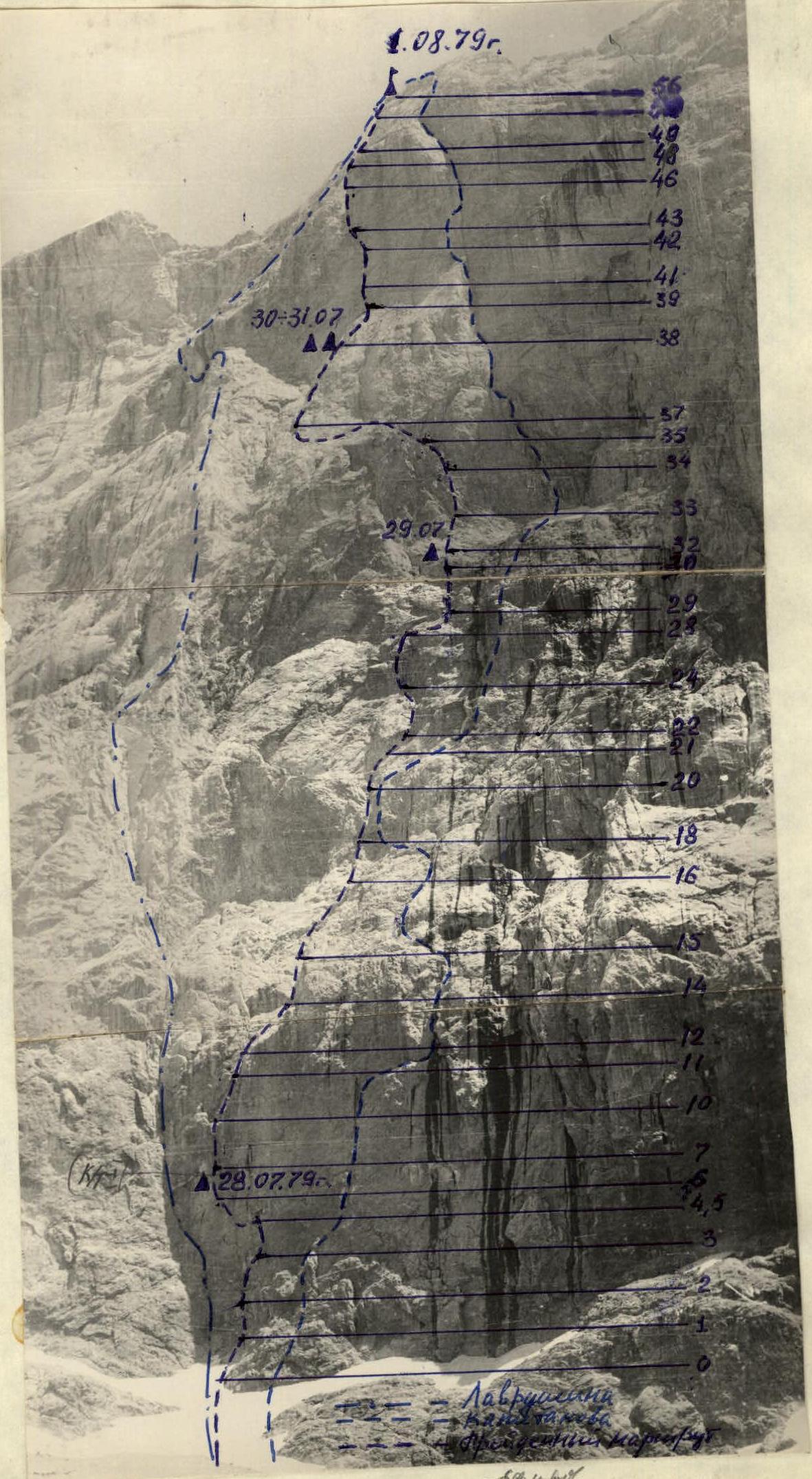 Lavrukhina
Climbed Route.
Lavrukhina
Climbed Route.
Table of Main Route Characteristics
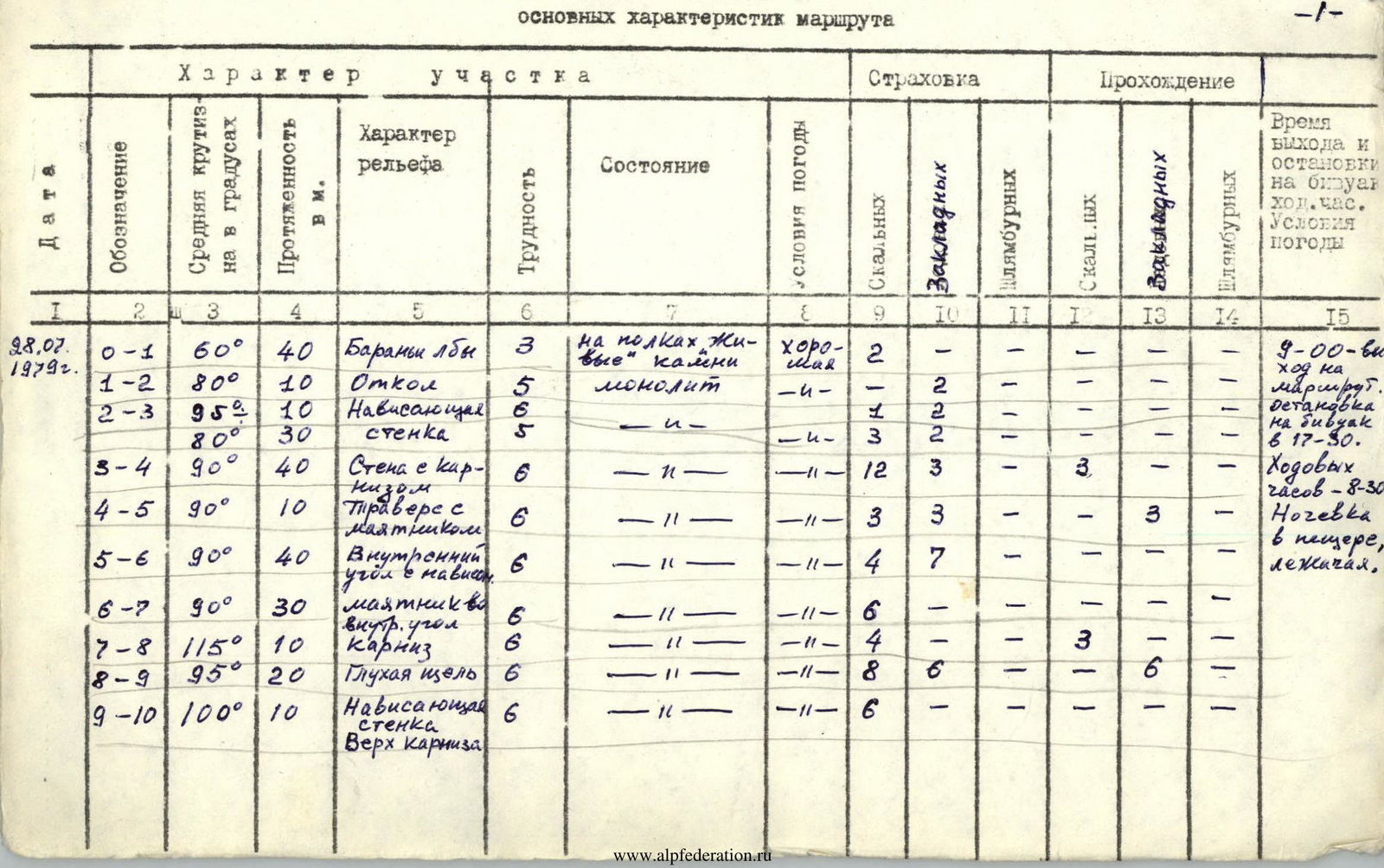
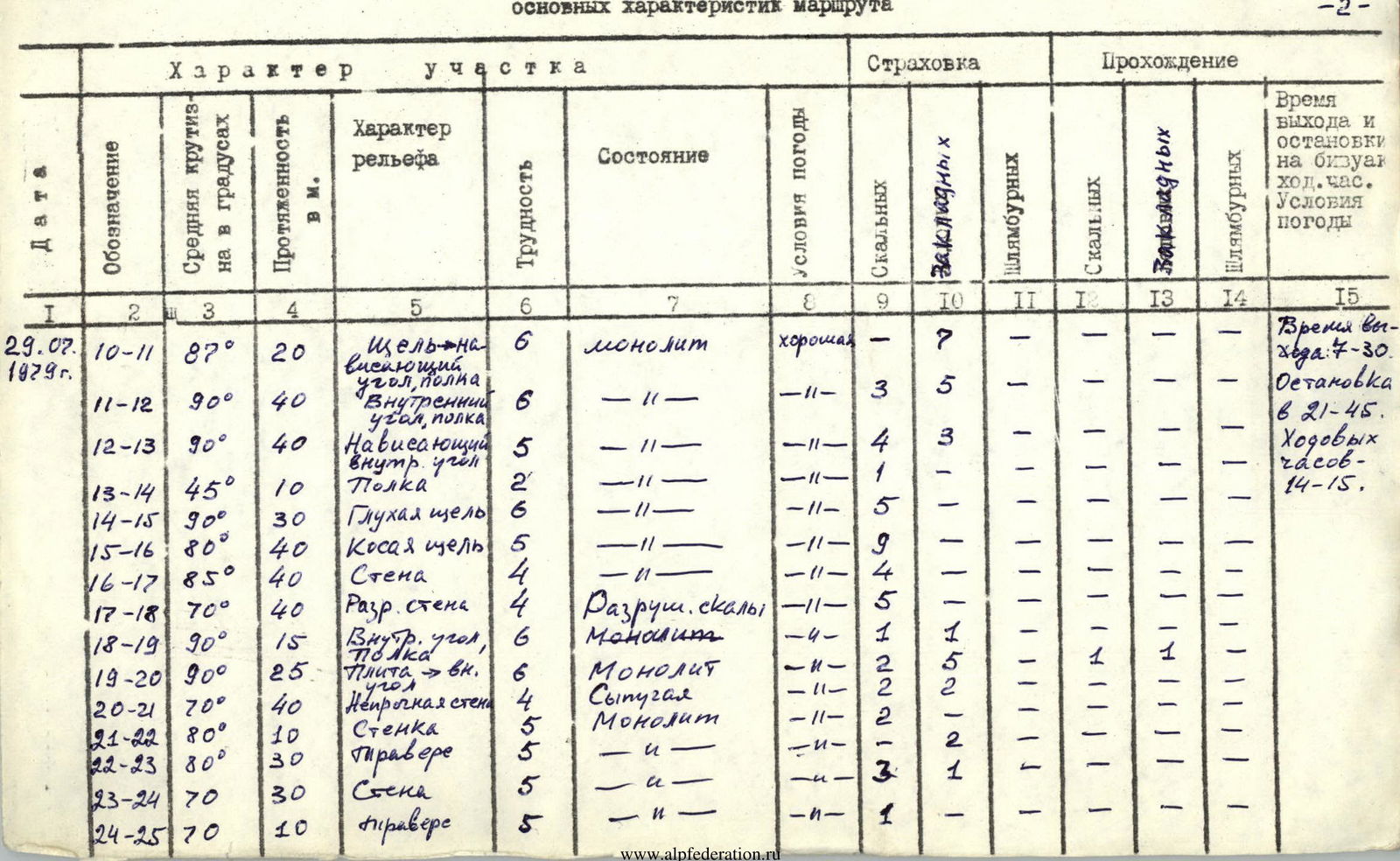

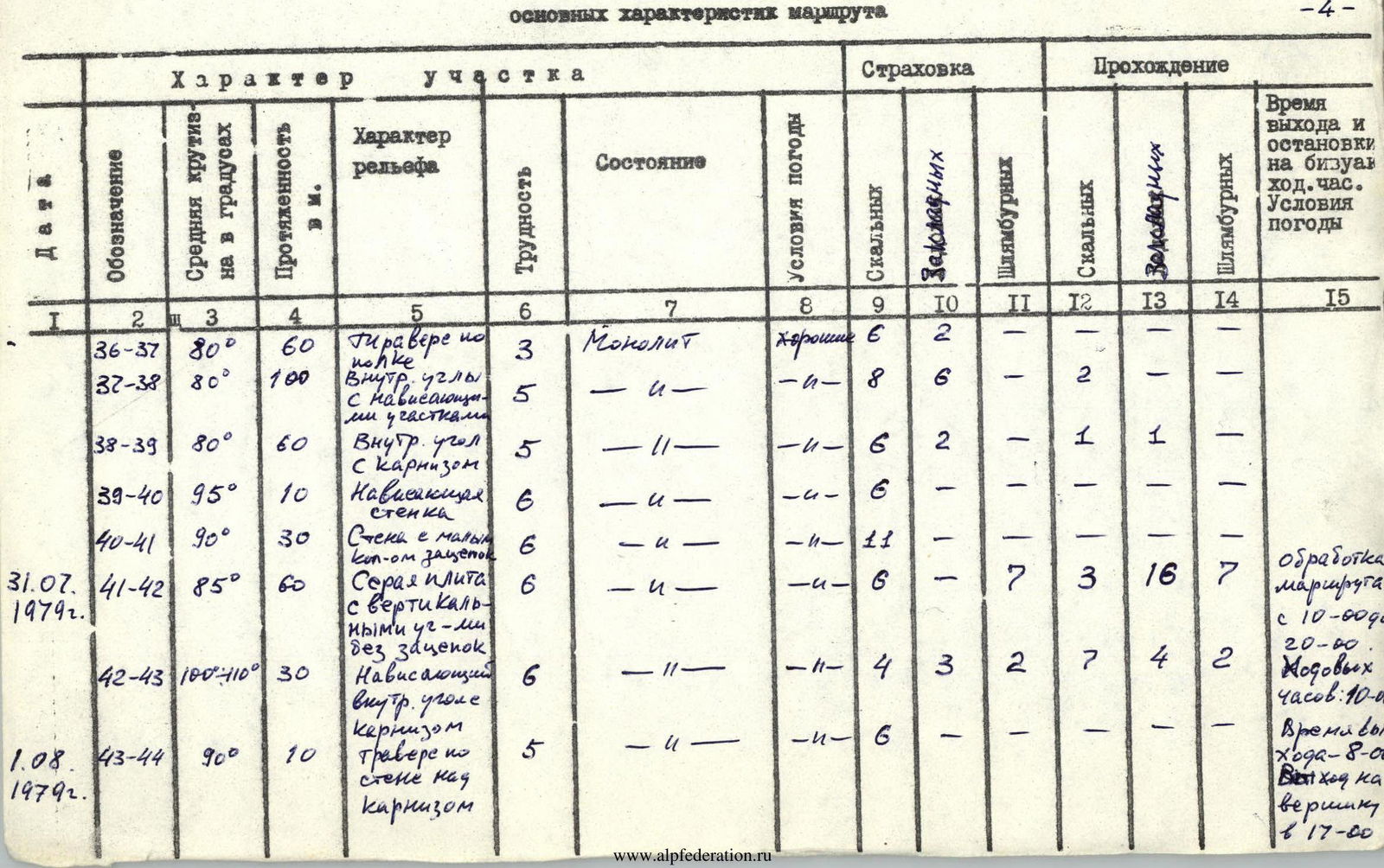
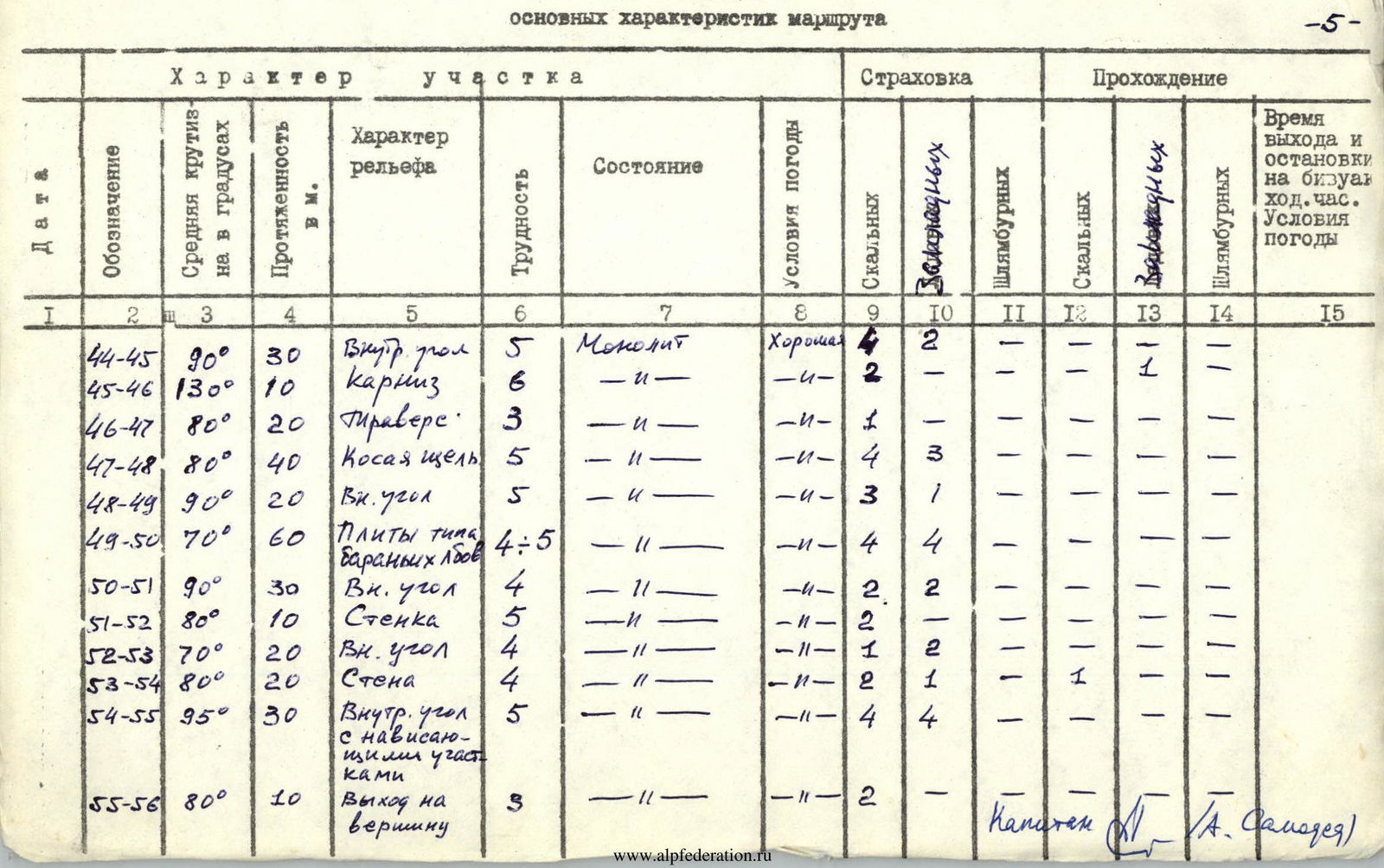
| Date | Designation | Average Steepness in Degrees | Length in m | Terrain Character | Difficulty | Condition | Weather Conditions | Rock Pitons | Placement Pitons | Bolt Pitons | Rock Pitons Used | Placement Pitons Used | Bolt Pitons Used | Time of Departure and Biwak, Climbing Hours, Weather Conditions |
|---|---|---|---|---|---|---|---|---|---|---|---|---|---|---|
| July 28, 1979 | R0–R1 | 60° | 40 | Ram's foreheads | 3 | on ledges, “live” stones | good | 2 | — | — | — | — | — | 9:00 – departure. Biwak at 17:30. |
| R1–R2 | 80° | 10 | Detachment | 5 | monolith | — | 2 | — | — | — | — | — | Climbing hours – 8:30 | |
| R2–R3 | 95° | 10 | Overhanging wall | 6 | — | — | 1 | 2 | — | — | — | — | Overnight stay in a cave, lying down. | |
| R2–R3 | 80° | 30 | 5 | — | — | 3 | 2 | — | — | — | — | |||
| R3–R4 | 90° | 40 | Wall with a cornice | 6 | — | — | 12 | 3 | — | 3 | — | — | ||
| R4–R5 | 90° | 10 | Traverse with pendulum | 6 | — | — | 3 | 3 | — | 3 | — | — | ||
| R5–R6 | 90° | 40 | Inner corner in overhang | 6 | — | — | 4 | 7 | — | — | — | — | ||
| R6–R7 | 90° | 30 | Pendulum in inner corner | 6 | — | — | 6 | — | — | — | — | — | ||
| R7–R8 | 115° | 10 | Cornice | 6 | — | — | 4 | — | — | 3 | — | — | ||
| R8–R9 | 95° | 20 | Blind crack | 6 | — | — | 8 | 6 | — | 6 | — | — | ||
| R9–R10 | 100° | 10 | Overhang. Upper part of cornice | 6 | — | — | 6 | — | — | — | — | — | ||
| July 29, 1979 | R10–R11 | 87° | 20 | Crack, overhang. Corner, ledge | 6 | monolith | good | 2 | — | — | — | — | — | Departure at 7:30. Stop at 21:45. |
| R11–R12 | 90° | 40 | Inner corner, ledge | 6 | — | — | 3 | 5 | — | — | — | — | Climbing hours – 14–15. | |
| R12–R13 | 90° | 40 | Overhang. Inner corner | 5 | — | — | 4 | 3 | — | — | — | — | ||
| R13–R14 | 45° | 10 | Ledge | 2 | — | — | 1 | — | — | — | — | — | ||
| R14–R15 | 90° | 30 | Blind crack | 6 | — | — | 3 | 5 | — | — | — | — | ||
| R15–R16 | 80° | 40 | Oblique crack | 5 | — | — | 9 | — | — | — | — | — | ||
| R16–R17 | 85° | 40 | Wall | 4 | — | — | 4 | — | — | — | — | — | ||
| R17–R18 | 70° | 40 | Disintegrated wall | 4 | disintegrated rocks | — | 5 | — | — | — | — | — | ||
| R18–R19 | 90° | 15 | Inner corner, ledge | 6 | monolith | — | 1 | 1 | — | — | 1 | — | ||
| R19–R20 | 90° | 25 | Slab, inner corner | 6 | monolith | — | 2 | 2 | — | — | — | — | ||
| R20–R21 | 70° | 40 | Unstable wall | 4 | loose rocks | — | 2 | 2 | — | 1 | 1 | — | ||
| R21–R22 | 80° | 10 | Wall | 5 | monolith | — | 2 | 1 | — | — | — | — | ||
| R22–R23 | 80° | 30 | Traverse | 5 | — | — | 3 | — | — | — | — | — | ||
| R23–R24 | 70° | 30 | Wall | 5 | — | — | 1 | 1 | — | — | — | — | ||
| R24–R25 | 70° | 10 | Traverse | 5 | — | — | 1 | — | — | — | — | — | ||
| July 29, 1979 | R25–R26 | 85° | 20 | Wall | 6 | monolith | good | 3 | 2 | — | — | — | — | |
| R26–R27 | 85° | 10 | Traverse under cornice | 6 | — | — | 1 | 1 | — | — | — | — | ||
| R27–R28 | 90° | 40 | Wall with inner corner | 6 | — | — | 3 | 4 | — | 1 | — | — | ||
| R28–R29 | 85° | 30 | Traverse | 5 | — | — | 2 | 2 | — | — | — | — | ||
| R29–R30 | 95° | 10 | Cornice | 6 | — | — | 2 | — | — | — | — | — | ||
| R30–R31 | 90° | 10 | Wall | 5 | — | — | 1 | — | — | — | — | — | ||
| R31–R32 | 70° | 30 | Wall with “live” stones | 3 | loose rocks | — | 3 | 2 | — | — | — | — | ||
| July 30, 1979 | R32–R33 | 60° | 40 | Cascade of ledges | 3 | “live” stones | — | 4 | — | — | — | — | — | Departure at 9:00 |
| R33–R34 | 90° | 60 | Wall with overhang. Inner corners | 5 | monolith | — | 5 | 3 | — | — | — | — | Stop for biwak at 17:00 | |
| R34–R35 | 95° | 40 | Overhang. Wall left of inner corner | 6 | monolith | — | 4 | 3 | — | — | — | — | Climbing hours – 8:00 | |
| R35–R36 | 90° | 40 | Traverse along wall | 5 | — | — | 4 | 2 | — | — | — | — | ||
| July 31, 1979 | R36–R37 | 80° | 60 | Traverse along wall | 3 | monolith | good | 2 | — | — | — | — | — | Route processing from 10:00 to 20:00. Climbing hours: 10:00. |
| R37–R38 | 80° | 100 | Inner corners with overhangs | 5 | — | — | 8 | 6 | — | 2 | — | — | ||
| R38–R39 | 80° | 60 | Inner corner with cornice | 5 | — | — | 6 | 2 | — | 1 | 1 | — | ||
| R39–R40 | 95° | 10 | Overhanging wall | 6 | — | — | 6 | — | — | — | — | — | ||
| R40–R41 | 90° | 30 | Wall with few holds | 6 | — | — | 11 | — | — | — | — | — | ||
| R41–R42 | 85° | 60 | Gray slab with vertical corners, no holds | 6 | — | — | 6 | — | 7 | 3 | 16 | 7 | ||
| R42–R43 | 100°–110° | 30 | Overhang. Inner corner with cornice | 6 | — | — | 4 | 3 | 2 | 7 | 4 | 2 | ||
| August 1, 1979 | R43–R44 | 90° | 10 | Traverse along wall over cornice | 5 | — | — | 6 | — | — | — | — | — | Departure at 8:00. Ascent to the summit at 17:00. |
| R44–R45 | 90° | 30 | Inner corner | 5 | monolith | good | 4 | 2 | — | — | — | — | ||
| R45–R46 | 130° | 10 | Cornice | 6 | — | — | 2 | — | — | — | — | — | ||
| R46–R47 | 80° | 20 | Traverse | 3 | — | — | 1 | — | — | — | — | — | ||
| R47–R48 | 80° | 40 | Oblique crack | 5 | — | — | 4 | 3 | — | — | — | — | ||
| R48–R49 | 90° | 20 | Inner corner | 5 | — | — | 3 | — | — | — | — | — | ||
| R49–R50 | 70° | 60 | Slabs like ram's foreheads | 4:5 | — | — | 4 | 4 | — | — | — | — | ||
| R50–R51 | 90° | 30 | Inner corner | 4 | — | — | 2 | 2 | — | — | — | — | ||
| R51–R52 | 80° | 10 | Wall | 5 | — | — | 2 | 1 | — | — | — | — | ||
| R52–R53 | 70° | 20 | Inner corner | 4 | — | — | 1 | — | — | — | — | — | ||
| R53–R54 | 80° | 20 | Wall | 4 | — | — | 2 | 1 | — | 1 | — | — | ||
| R54–R55 | 95° | 30 | Inner corner with overhangs | 5 | — | — | 4 | 4 | — | — | — | — | ||
| R55–R56 | 80° | 10 | Ascent to the summit | 3 | — | — | 2 | — | — | — | — | — |
Explanation of the Table
R0–R1. Steep ram's foreheads with loose stones on ledges. Movement is done while belaying on a hung rope.
R1–R2. Detachment – the start of the route. Difficult climbing. Belaying through placement pitons inserted into rock cavities.
R2–R3. Overhanging wall. Monolith. Difficult climbing. Holds are reliable. After 10 m, the wall "lays down." Belaying through placement pitons. At the top, a reliable ledge for securing a rope. To the left, there is a 4 m long ledge for approaching the next section.
R3–R4. Start along an overhanging inner corner. After 10 m, take the second climber and, with their help, overcome the cornice. Further ascent is up a very difficult, steep (90°) slab to a depression in the white rocks with grass. Combined pitons fit into the only crack. At the top, belaying is done through wedges.
R4–R5. Traverse left under the overhanging wall, along a vertical slab (feet on friction). Belaying through a ledge and pitons hammered at the end of a crack in a chip (carefully choose them by thickness to avoid chipping off the chip). Further, a difficult pendulum movement left on a vertical wall. Holds on it are "minimal." It's better to traverse, loading the rope smoothly, rather than swinging and trying to hold onto "minimal" holds. Having caught onto a hold 7–8 m below, on the left, by very difficult climbing on "minimal" holds on a monolithic slab, move up to the point of hammering a piton for belaying at the start of an overhanging inner corner. There is a good crack for placement pitons. On the slab, to prevent a fall, they did not use three "heavenly" pitons. The inner corner leads to a cave, 39 m long. It's very convenient for the whole group to gather.
Further movement is through the cave, gaining height (K-1) under a cornice, which is traversed on pitons hammered into an intermittent "blind" crack. Climbing is done in 1.5–2 m increments, just to reach the next spot for hammering a piton. A lot of work is done to organize the piton hammering point. The exit to the ledge of the proposed first overnight stay is achieved by very difficult climbing. It's known that the first 260 m of the NW wall are overhanging. Freely hanging 1.5 m from the wall ropes confirm this. Belaying is done using pitons.
R10–R11. Movement is done by climbing "on detachment" along a crack and an overhanging inner corner. Belaying is done through placement pitons. At the top, there's an uncomfortable ledge.
R11–R12. The group needs to wait until another rope is processed. In the overhanging inner corner, there are "live" stones.
R12–R13. In this part of the route, on sections up to 20 m, rocks may flake off in some places.
R13–R19. These sections are overcome by free climbing. Belaying is done using pitons. The main attention should be paid to careful passage to avoid even the rope from knocking down stones.
R18–R20. Very difficult climbing up a slab on "minimal" holds to an inner corner (one "heavenly" piton for creating IBP). Ladders for organizing a belay point. Climbing along the inner corner is done in opposition. Belaying is done through placement pitons. At the top, securing is done on wedges.
R20–R21. Overcome an unstable wall with "live" flakes by careful climbing. Further, choosing the simplest ascent option between overhanging cornices and smooth, steep slabs with belaying through combined pitons of medium length (≈ 72 m), reach a large flake to the left of a snowpatch and a "funnel."








 R28–R32. Under the flake, traverse right along a slab to the first opportunity to move up 30 m. Then, by difficult climbing, overcome the cornice with the help of a partner on a rope and along a not very steep wall with "live" stones on ledges, reach the overnight stay location.
R32–R33. In the area of the snowpatch, there is a "funnel." Further, initially moving along a rapidly steepening cascade of ledges, then along overhanging inner corners with "reverse" holds, reach a flake overlapping the wall and initially not noticeable. The exit to it is via an overhanging chimney. At the top of the flake, having secured the rope to a reliable ledge, the whole group can gather. Belaying is done using pitons. There aren't many places for pitons. It's better not to pass by a suitable spot and hammer pitons when the opportunity arises. When moving, orient yourself towards the simplest passage among cornices. It's led by an overhanging inner corner with "plugs" that look very "live." To the left of the plugs, along good holds,
R34–R35. The rope is "on balance" with support on friction to reach a ledge over the cornices. The ledge is made of red, slippery rocks for crampons. Carefully traverse left at the end by difficult climbing to reach a destroyed ledge under slabs leading to the upper row of cornices.
After 100 m, traverse left to inner corners, some of which are overhanging, and ascend to the overnight stay location on a comfortable ledge. (In early August, there is still ice.) In this location, climbing is done on monolithic rocks, sometimes with feet on friction "on detachment" in overhanging areas.
R36–R38. Such corners lead to a gray slab under a cornice (the key point of the route). The ascent to the slab is done along an overhanging wall (combined pitons fit into "cavities," thin pitons should hold well). Very difficult climbing.
R38–R39. After a bend, move along a wall with few holds to a ledge where you can hammer in wedges, use placement pitons, and organize a reliable belay point for changing the lead.
The belayer hangs in ladders or on a harness or on a platform. The start of the movement upwards is on "heavenly" pitons to the nearest crack. The pition is approximately 6 cm long. Further, four bolt pitons are hammered through an overhanging section and on "heavenly" pitons to cracks. From there, conditionally using the rope, traverse left to a flake (into it, a Stopper No. 8). With the help of a Stopper and a "heavenly" pitton, a bolt pitton is hammered. From it, traverse left along a vertical wall by very difficult climbing to an inclined ledge (feet on friction), from where, using "heavenly" pitons, reaching "minimal" holds, climb to the start of an overhanging corner ending in a cornice by difficult climbing. The overall overhang is 3 m. The crack accepts a full set of pitons from "petal" to "channel" pitons; "petal" or stoppers from No. 5 to No. 8 are used.
R42–R43. The cornice is traversed on rock pitons hammered from a bolt pitton.
It's better to have a platform to hammer pitons higher from it. Standing on a support hanging in the air is difficult with your feet. Monitor possible chipping off of tiles above the cornice. Eight meters above the bend, in a chip, you can place stoppers for belaying and hammer in short pitons. From this location, traverse left along difficult rocks to the start of an inner corner with a cornice.
R45–R46. The cornice is 30 m away. The cornice is traversed along a large, wet crack. Above the cornice, there's an exit to slabs like "ram's foreheads," alternating with inner corners with overhanging sections, traversed by climbing "on detachment."
R49–R55. Under the summit exit, there's a cornice in the inner corner. On the slabs, movement is sometimes on friction ("Live" stones!)
R55–R56. The summit is reached by climbing a steep, aspen-covered ledge ("Live" stones).
R28–R32. Under the flake, traverse right along a slab to the first opportunity to move up 30 m. Then, by difficult climbing, overcome the cornice with the help of a partner on a rope and along a not very steep wall with "live" stones on ledges, reach the overnight stay location.
R32–R33. In the area of the snowpatch, there is a "funnel." Further, initially moving along a rapidly steepening cascade of ledges, then along overhanging inner corners with "reverse" holds, reach a flake overlapping the wall and initially not noticeable. The exit to it is via an overhanging chimney. At the top of the flake, having secured the rope to a reliable ledge, the whole group can gather. Belaying is done using pitons. There aren't many places for pitons. It's better not to pass by a suitable spot and hammer pitons when the opportunity arises. When moving, orient yourself towards the simplest passage among cornices. It's led by an overhanging inner corner with "plugs" that look very "live." To the left of the plugs, along good holds,
R34–R35. The rope is "on balance" with support on friction to reach a ledge over the cornices. The ledge is made of red, slippery rocks for crampons. Carefully traverse left at the end by difficult climbing to reach a destroyed ledge under slabs leading to the upper row of cornices.
After 100 m, traverse left to inner corners, some of which are overhanging, and ascend to the overnight stay location on a comfortable ledge. (In early August, there is still ice.) In this location, climbing is done on monolithic rocks, sometimes with feet on friction "on detachment" in overhanging areas.
R36–R38. Such corners lead to a gray slab under a cornice (the key point of the route). The ascent to the slab is done along an overhanging wall (combined pitons fit into "cavities," thin pitons should hold well). Very difficult climbing.
R38–R39. After a bend, move along a wall with few holds to a ledge where you can hammer in wedges, use placement pitons, and organize a reliable belay point for changing the lead.
The belayer hangs in ladders or on a harness or on a platform. The start of the movement upwards is on "heavenly" pitons to the nearest crack. The pition is approximately 6 cm long. Further, four bolt pitons are hammered through an overhanging section and on "heavenly" pitons to cracks. From there, conditionally using the rope, traverse left to a flake (into it, a Stopper No. 8). With the help of a Stopper and a "heavenly" pitton, a bolt pitton is hammered. From it, traverse left along a vertical wall by very difficult climbing to an inclined ledge (feet on friction), from where, using "heavenly" pitons, reaching "minimal" holds, climb to the start of an overhanging corner ending in a cornice by difficult climbing. The overall overhang is 3 m. The crack accepts a full set of pitons from "petal" to "channel" pitons; "petal" or stoppers from No. 5 to No. 8 are used.
R42–R43. The cornice is traversed on rock pitons hammered from a bolt pitton.
It's better to have a platform to hammer pitons higher from it. Standing on a support hanging in the air is difficult with your feet. Monitor possible chipping off of tiles above the cornice. Eight meters above the bend, in a chip, you can place stoppers for belaying and hammer in short pitons. From this location, traverse left along difficult rocks to the start of an inner corner with a cornice.
R45–R46. The cornice is 30 m away. The cornice is traversed along a large, wet crack. Above the cornice, there's an exit to slabs like "ram's foreheads," alternating with inner corners with overhanging sections, traversed by climbing "on detachment."
R49–R55. Under the summit exit, there's a cornice in the inner corner. On the slabs, movement is sometimes on friction ("Live" stones!)
R55–R56. The summit is reached by climbing a steep, aspen-covered ledge ("Live" stones).
Captain (A. Samoded)











 ![img-35.jpeg]({"width":1141,"height":138,"format":"Jpeg","uri":"https://summitx↗