Passport
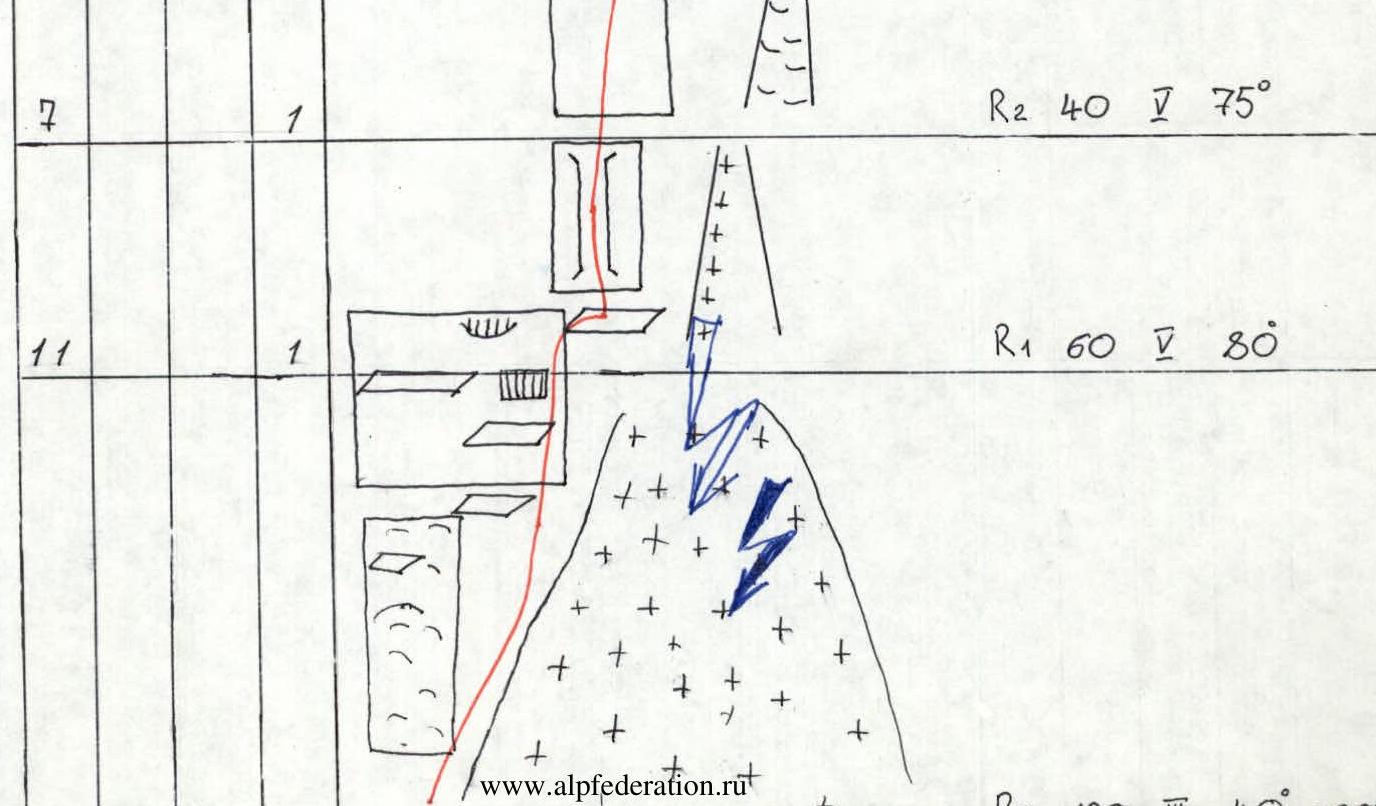
- Technical class
- Pamir-Alay, Gumush gorge
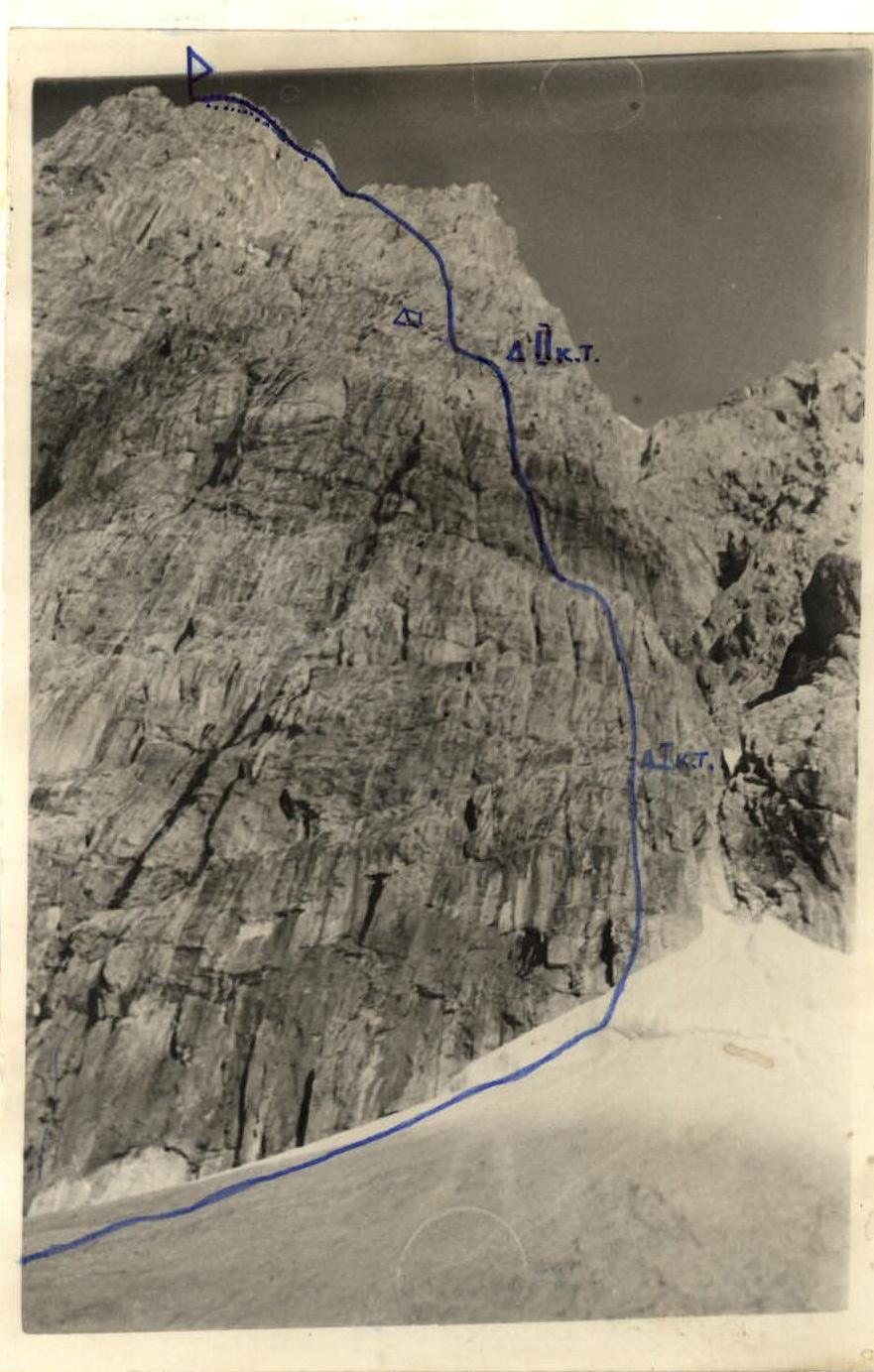
- Peak "4850" (South Karaganda) via the right counterfort of the Eastern wall (route by M. Khitrov)
- Difficulty category — 5B (3rd ascent of the route)
- Height difference 970 m, length 1110 m.
Length of sections with 5–6 difficulty category — 755 m. Average steepness of main sections 70° (3955–4810), including 6th category — 110 m.
- Pitons driven: rock 107/4, bolt 0/0, chocks 30/2, ice 5/0.
- Climbing hours 30 and 3 days.
- Overnights: 1st on a platform below the route (after processing), 2nd — on a rock platform.
- Leader: Ibragimzade Dmitry Davudovich, Candidate for Master of Sports
Participants: Parkhomenko Alexander Leontievich, Master of Sports, Serenkov Pavel Sergeevich, Candidate for Master of Sports, Nagoga Mikhail Alexandrovich, 1st sports category
- Coach: Tomchik Vitaly Silvestrovich, 2nd sports category.
- Departure to the route: July 24, 1982.
Reached the summit: July 26, 1982. Return: July 26, 1982.
Brief description of the ascent
The ascent to peak 4850 "South Karaganda" was carried out by a team from the Odessa Regional Council of the "Burevestnik" Sports Society under the leadership of Ibragimzade D.D. as part of the Ukrainian Republican Council of the "Burevestnik" Sports Society Championship in mountaineering in the technical class, and it took 1st place.
Team:
- conducts joint year-round training,
- has been participating in mountaineering events for many years.
Before this ascent, team members Ibragimzade D.D. and Serenkov P.S. participated in the 1982 USSR Mountaineering Championship in the technical class as part of the "Alay" team.
Peak 4850 m "South Karaganda" attracted our attention not by chance. Currently, 3 routes have been climbed on it, all with 5–6 difficulty category. The route we took (first ascent was made in 1977 by a team from Lenpromcommittee, coach Zh. Gorenchuk) and two other routes were climbed in 1982 by teams from MGS "Spartak" in the Moscow City Mountaineering Championship and Donetsk "Avangard" in the USSR Mountaineering Championship in the technical class. All these routes were climbed on the Eastern wall of the peak.
The approach to the route is not complicated. From the base camp below Gumush pass, along the left (orographically) side of the Gumush river to the glacier, and then along the right lateral moraine to the start of the route. There's a good overnight spot on the glacier. 3 hours from the base camp.
The team's preparation for the ascent was thorough. Light, high-calorie food, high-quality group and personal gear were selected.
On July 24, we left the base camp located below Gumush pass at 9:00. At 12:00, we reached the assault camp in the cirque of peak Gumush Gl. – 4850 m (also known as Karaganda). In parallel with us, a team from MGS "Spartak" led by V. Bashkirov started a first ascent on the left part of the Eastern wall. Two climbers from MGS "Spartak" training camps observed our two teams throughout the ascent. This simplified the provision of reliable radio communication.
We took a "Vitalka" radio with us on the route — we used it to communicate with the observers, who then relayed information about our teams to the base camp via a "Karat–2M" radio station.
After setting up the assault camp at 14:00, we started processing the route. We processed 4 ropes up to the 1st control point. The weather was bad, overcast, with light snowfall. We descended, prepared our gear for the ascent, and rested.
The next morning, we rose early and were at the start of the route by 6:00. We climbed the processed section using jumar ascenders, redistributed the load in our backpacks, and continued upward. The lead climber went without a backpack, on a double rope, throughout the route. The lead climbers rotated.
At 19:00, we stopped for the night and processed 100 m above the route.
The overnight spot was good, with ice available, so there was no shortage of drinking water. The weather was good. On June 26, we started at 6:00. It was overcast, with increasing wind and light snowfall in the second half of the day, and it was cold. The rocks on the route were very challenging, with some sections overhanging, and many chimneys. Two chimneys with flowstone presented particular difficulties.
The entire route was climbed using free climbing, practically without using artificial aids. The route was logical and interesting. The rocks were solid, but there were many cracks for pitons and chocks.
At 18:00, we exited the wall onto the pre-summit ridge. Here, we removed unnecessary gear and changed clothes. At 18:30, we reached the summit. The descent from the summit was not complicated, first along the North ridge through a saddle and peak 4800 m "North Karaganda", and then along the Northwest ridge of peak 4800 m. On the descent, we organized:
- one rappel
- one sport descent
At 20:30, we descended to the glacier. We hid our gear and continued descending. After reaching the Gumush river, we rested, and by 22:30, we were back at the base camp below Gumush pass.
Throughout the route, belaying and self-belaying were of a very high standard:
- The lead climber went on a double rope, all others followed on fixed ropes with top-rope belay.
- Anchoring points for fixed ropes and belays were organized using grouped pitons.
- There were no dangerous falls of rocks or ice fragments.
- Radio communication with the observer group was regular and reliable.
- There was no shortage of any gear or food.
 ascent route
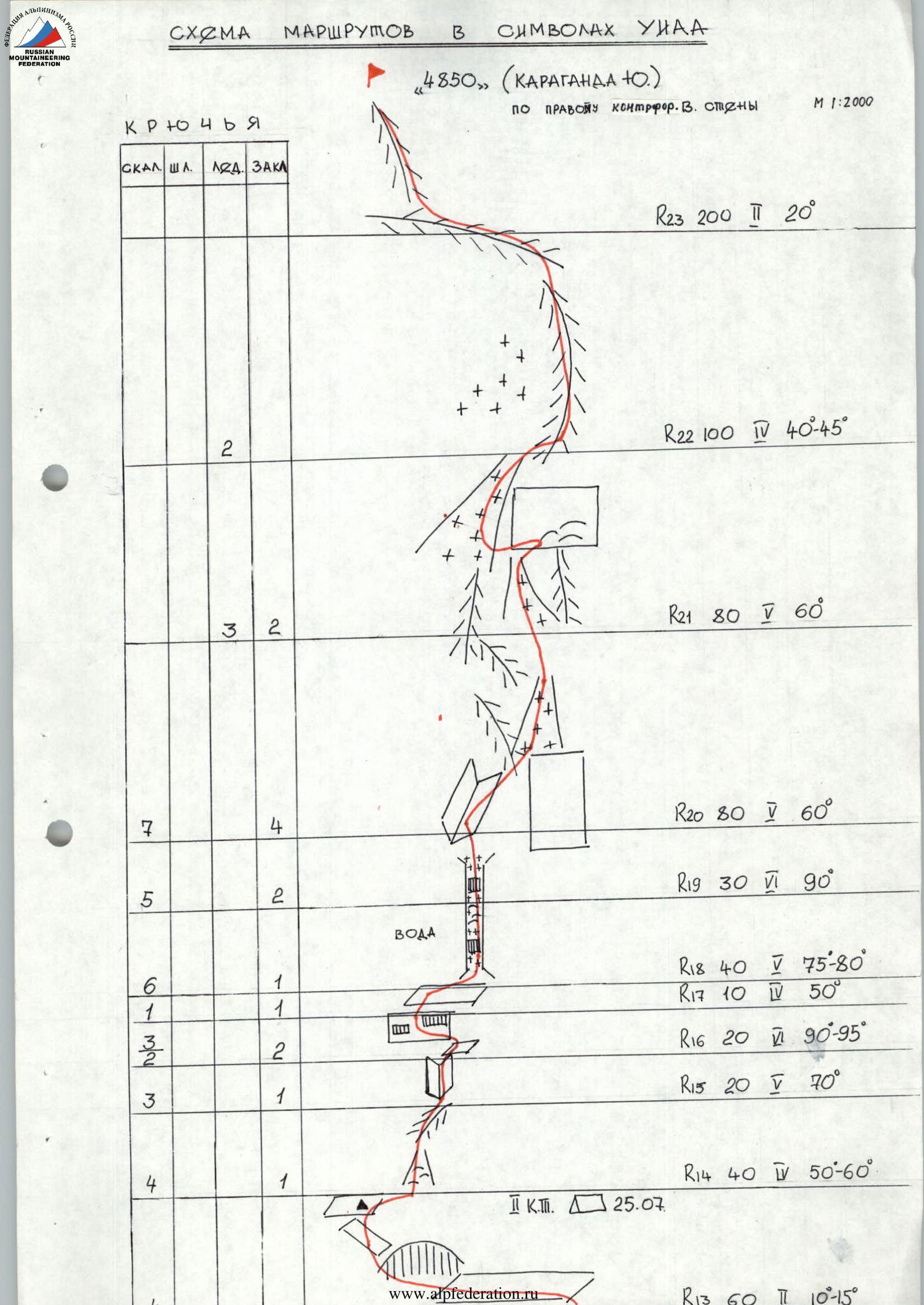
Route diagram in UIAA symbols
"4850" (South Karaganda) via the right counterfort of the E. wall Scale 1:2000
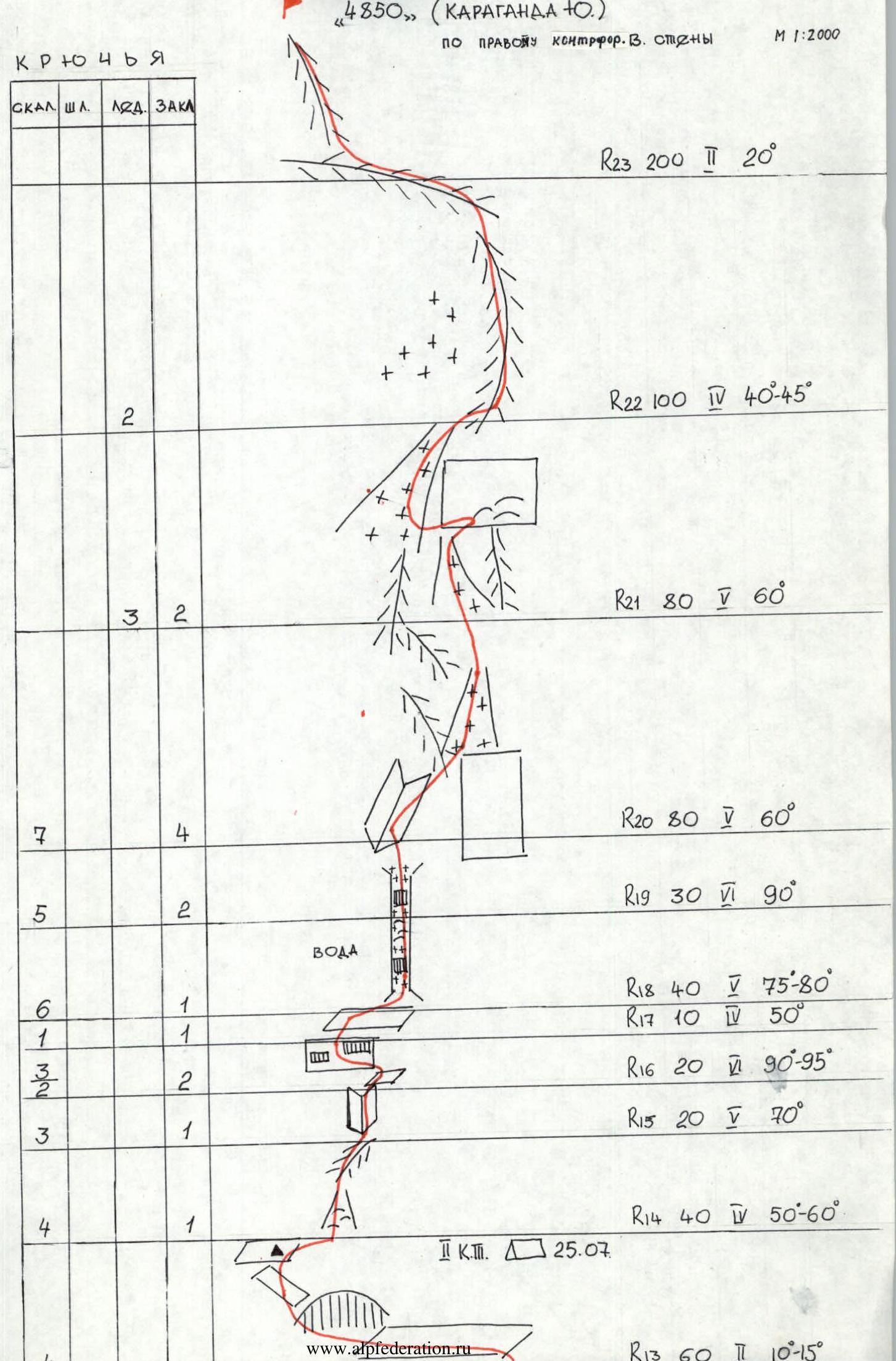
| PITONS | |||
|---|---|---|---|
| ROCK | BOLT | ICE | CHOCK |
| 2 | |||
| 3 | 2 | ||
| 7 | 4 | ||
| 5 | 2 | ||
| 6 | 1 | ||
| 1 | 1 | ||
| 2 | 2 | ||
| 3 | 1 | ||
| 4 | 1 | ||
| 6 | 2 | ||
| 1 | 1 | ||
| 2 | 2 | ||
| 2 | 2 | ||
| 5 | 1 | ||
| 11 | 1 | ||
| 8 | |||
| 12 | 2 | ||
| 1 | |||
| 7 | 2 | ||
| 7 | 1 | ||
| 7 | 1 | ||
| 11 | 1 |
- R23 200 II 20°
- R22 100 IV 40–45°
- R21 80 V 60°
- R20 80 V 60°
- R19 30 VI 90°
- R18 40 V 75–80°
- R17 10 IV 50°
- R16 20 V 90–95°
- R15 20 V 70°
- R14 40 V 50–60°
- R13 60 II 10–15°
- R12 40 V 70°
- R11 10 VI 90°
- R10 20 V 90°
- R9 10 V 90°
- R8 40 IV 50°
- R7 60 V 75°
- R6 60–70 IV-V 60°
- R5 80 V-VI 90°
- R4 15 II 0° PROCESSING 24.07.
- R3 40 V 75–80°
- R2 40 V 75°
- R1 60 V 80°