
The 4300 m peak (Malaia Ossonaly) is located in a spur branching off to the north from the Ossonaly peak. This peak is one of the most interesting objects for rock climbing in the Kok-Su area (Pamir-Alay). The most challenging routes can be laid out along its northeastern wall, which steeply drops to the glacier lying in the cirque of the Pravda Vostoka, Malenkiy Prints, and Ossonaly peaks. The wall is formed by fragile young marbles. Relatively destroyed rock sections alternate with large smoothed slabs. In the center of the wall, there is a huge hollow with a significantly overhanging cornice above it. Passing this section of the wall is only possible with the help of bolt hammers. The route chosen by the team passed to the left, along a part of the wall of the same steepness, which can be traversed by free climbing.
The 4300 m peak is located near the road running along the Kok-Su River from the Alay hostel to the geologists' base. The journey from the Alay hostel to the bridge, from which the road leads to the trail heading to the overnight stays under the peak, takes 3 hours. The bridge is located 1 km after the confluence of the Kok-Su and Dzhugurtash rivers. The trail leads to a small waterfall, clearly visible from the road, and then brings you to the grassy slopes located directly under the 4300 m peak. Here, near the glacier tongue, from which a small river flows, there are convenient places for overnight stays. The journey along the trail from the road to the overnight stays takes 1 hour. The approach along the large talus from the overnight stays to the beginning of the route takes 20 minutes.
The route begins in the center of the wall with large "ram's foreheads," which are overcome in galoshes. After three ropes, there is a small flat area, from which the most challenging part of the route begins, consisting mainly of weakly expressed internal corners and oblique shelves with a small number of holds. From the site, the route goes slightly to the left of the center of the wall and leads to a counterfort, which from this point of the route looks like a ridge. After three ropes, the key section begins (one rope):
- an internal corner with an overhang;
- an oblique crack with an overhang.
The first climber overcame these sections with the help of ladders, using channel hooks and stoppers. The rest passed with the help of jumar ascenders on the "chest-leg" system. At this point of the route, a control cairn is installed (with the help of a rock hook). After another two ropes (steep rocks) along the chimney, there is an exit to the counterfort (10th section, see photo). Along relatively less steep smoothed slabs, the route goes along the counterfort in the direction of the peak. Here, individual steep walls alternate with smooth slabs covered with marble crumbs. There are places for sitting overnight stays. The exit to the peak is along gentle "ram's foreheads." Descent from the peak:
- along the ridge to the north, towards the Kok-Su River;
- by rappel and sport climbing (CAUTION! heavily destroyed rocks);
- then along the destroyed ridge to the trail.
Participating in the rock climbing category of the 1981 USSR Armed Forces and Navy Climbing Championship, the Leningrad SCA team made the first ascent to the Malaia Ossonaly peak and ultimately took second place. The route traversed was rated by the climbers and the coach as category 5B.
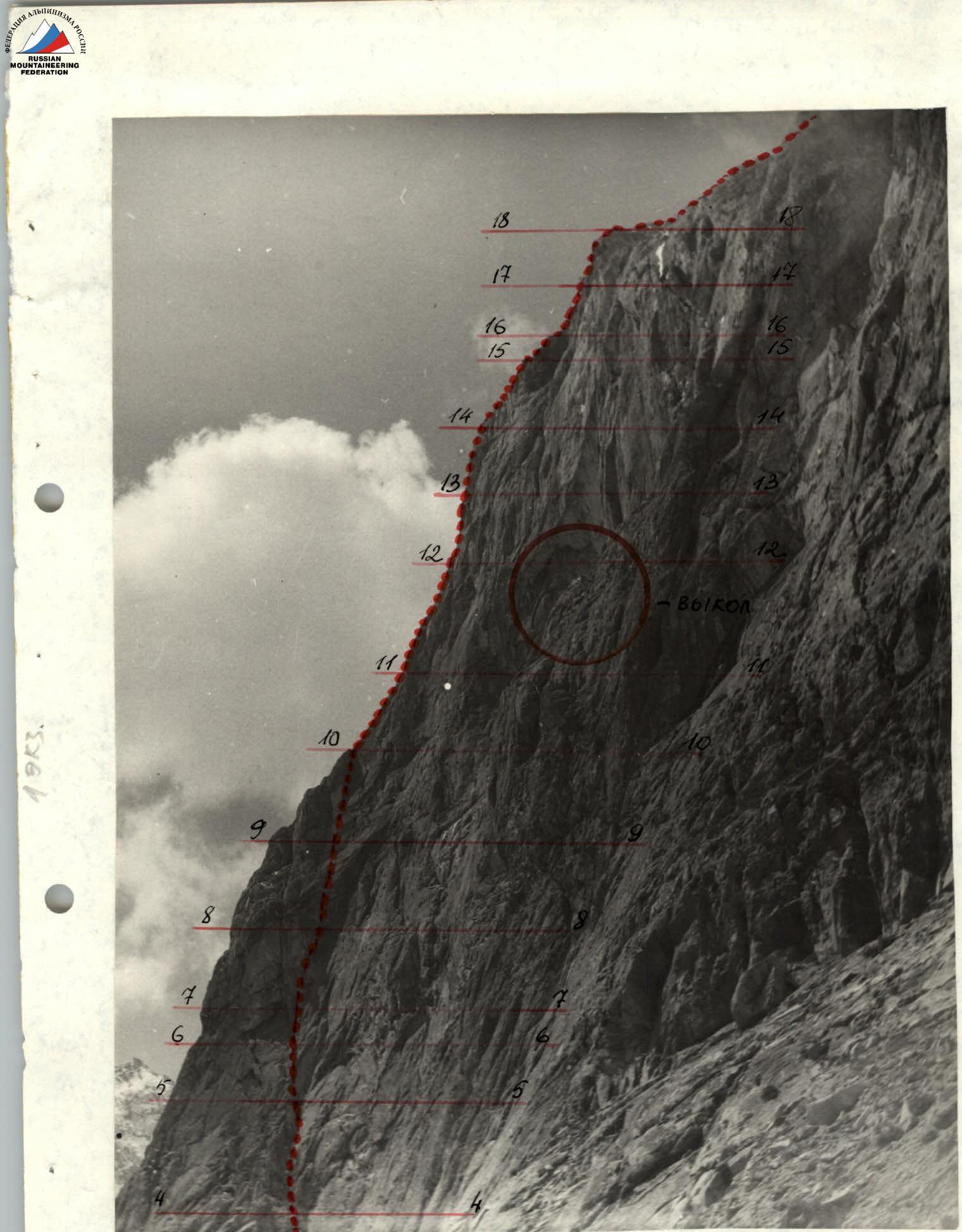
PROFILE (photo from below, from the talus)
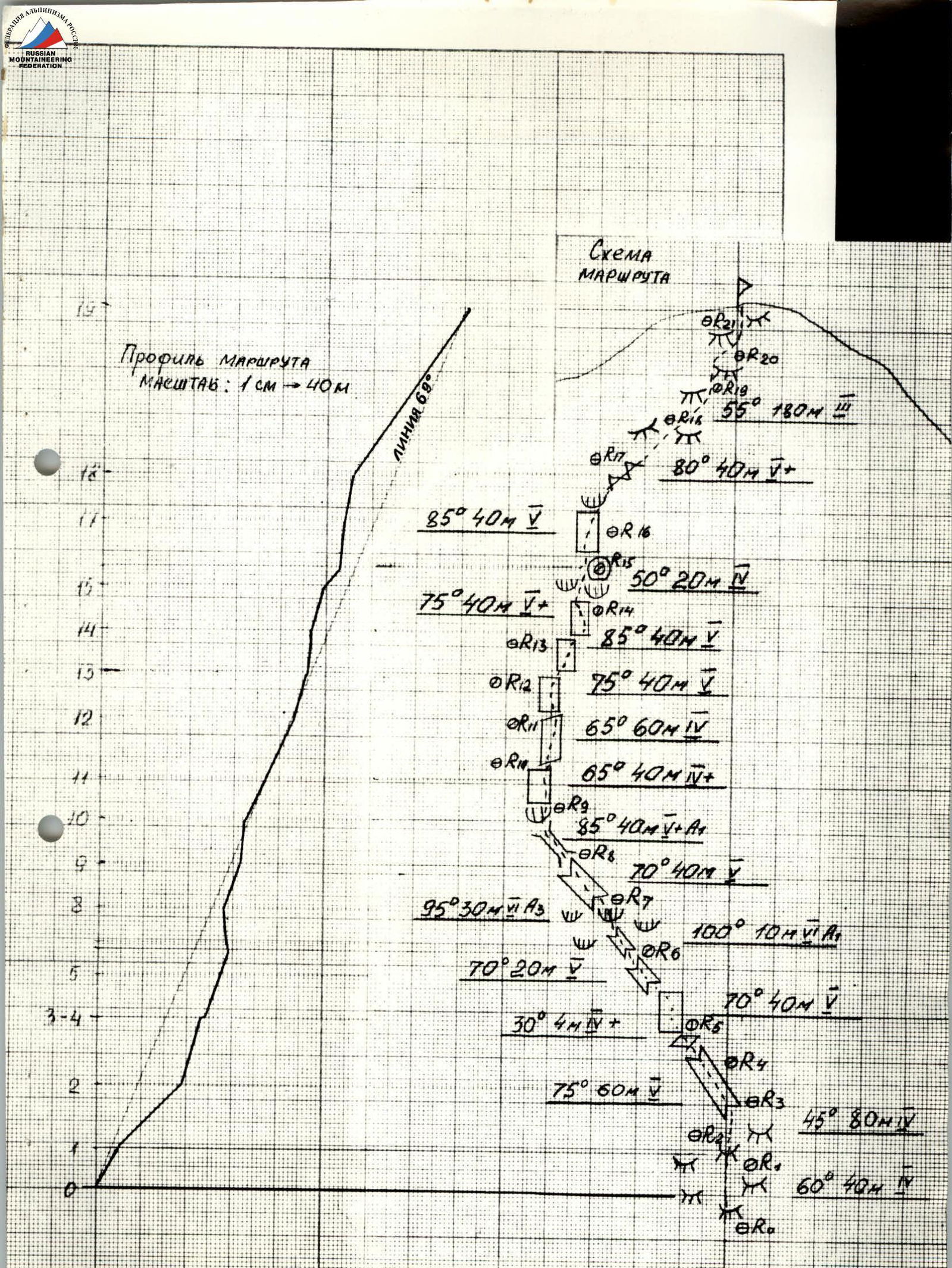
Route Scheme
Table of Main Characteristics of the Ascent Route to the 4300 m Peak via the NE Wall
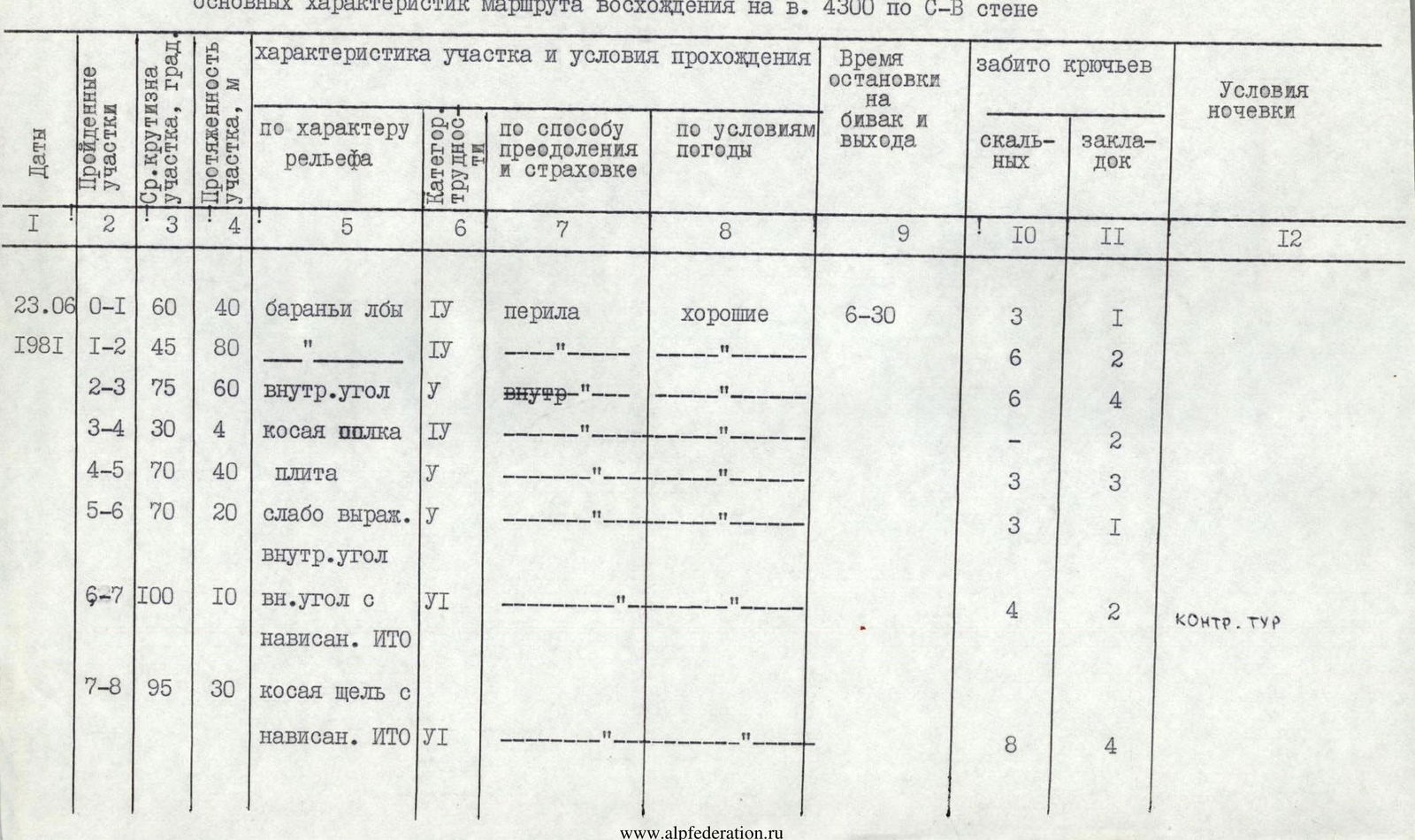
| Dates | Sections traversed | Average steepness of section, degrees | Section length, m | By relief character | Difficulty category | By method of overcoming and belaying | Weather conditions | Time of bivouac stop and exit | Rock hooks hammered | Stoppers placed | Overnight stay conditions |
|---|---|---|---|---|---|---|---|---|---|---|---|
| 23.06 | R0–R1 | 60 | 40 | ram's foreheads | 1 | fixed ropes | good | 6:30 | 3 | 1 | – |
| 1981 | R1–R2 | 45 | 80 | – | 1 | fixed ropes | good | – | 6 | 2 | – |
| – | R2–R3 | 75 | 60 | internal corner | 5 | internal | good | – | 6 | 4 | – |
| – | R3–R4 | 30 | 4 | oblique shelf | 1 | fixed ropes | good | – | – | 2 | – |
| – | R4–R5 | 70 | 40 | slab | 5 | fixed ropes | good | – | 3 | 3 | – |
| – | R5–R6 | 70 | 20 | weakly expressed internal corner | 5 | fixed ropes | good | – | 3 | 1 | – |
| – | R6–R7 | 100 | 10 | internal corner with overhang | 6 | fixed ropes | – | – | 4 | 2 | CONTROL CAIRN |
| – | R7–R8 | 95 | 30 | oblique crack with overhang | 6 | fixed ropes | – | – | 8 | 4 | – |
| – | R8–R9 | 70 | 40 | internal corner | 5 | fixed ropes | good | – | 4 | 1 | – |
| – | R9–R10 | 85 | 40 | chimney | 5 | fixed ropes | good | – | 5 | 2 | – |
| – | R10–R11 | 65 | 40 | feather of counterfort smoothed slabs | 4 | alternate | good | – | 3 | – | – |
| – | R11–R12 | 65 | 60 | oblique smoothed slabs | 4 | alternate | good | – | 3 | 2 | – |
| – | R12–R13 | 75 | 40 | wall | 5 | fixed ropes | good | – | 4 | 1 | – |
| – | R13–R14 | 85 | 40 | slabs | 5 | fixed ropes | good | – | 3 | – | – |
| – | R14–R15 | 75 | 40 | wall with shelf | 5 | fixed ropes | good | 19:00 | 2 | 3 | half-lying on shelf |
| 24.08 | R15–R16 | 50 | 20 | ram's foreheads | 4 | alternate | good | 8:00 | 2 | – | – |
| 1981 | R16–R17 | 85 | 40 | wall with overhang | 5 | fixed ropes | good | – | 5 | 2 | – |
| – | R17–R18 | 80 | 40 | crack in red rocks | 5 | fixed ropes | good | – | 4 | 3 | – |
| – | R18–R19 | 55 | 180 | ram's foreheads and ribs | – | simultaneous | – | 11:30 | 5 | 3 | – |