
Ascent Passport
- Ascent class - rock
- Ascent area - range; Western Tian Shan, Ugam range
- Peak, its height, ascent route - Sayramsky peak, 4238 m, via the western counterfort of the northern wall.
- Estimated difficulty category - 5B
- Route characteristics:
- height difference - 730 m
- length of sections with 5-6 difficulty category - 404 m
- average steepness - 70°
- Pitons hammered: for belaying, for creating RTO
- rock 75
- ice -
- bolt 4
- Number of travel hours - 40 hours
- Number of overnight stays and their characteristics: 3 overnight stays, including:
- on a snow ledge, sitting
- on a rock ledge, sitting
- on a scree ridge, good
- Surname, I.O. of the leader, participants and their qualification:
- Starlychanov Valery Dmitrievich, CMS, leader
- Denisenko Anatoly A., 1st sports category, deputy leader
- Vorobyov Alexander S., 1st sports category, participant
- Lukyanov Sergey I.G., 1st sports category, participant
- Dzhan Nikolai V., 1st sports category, participant
- Team coach: Senior Instructor MS Sedelnikov V. N.
- Senior coach: Honored Coach of KazSSR Ilyinsky E. T.
- Date of departure on the route: July 8, 1977
Date of return: July 11, 1977
General view
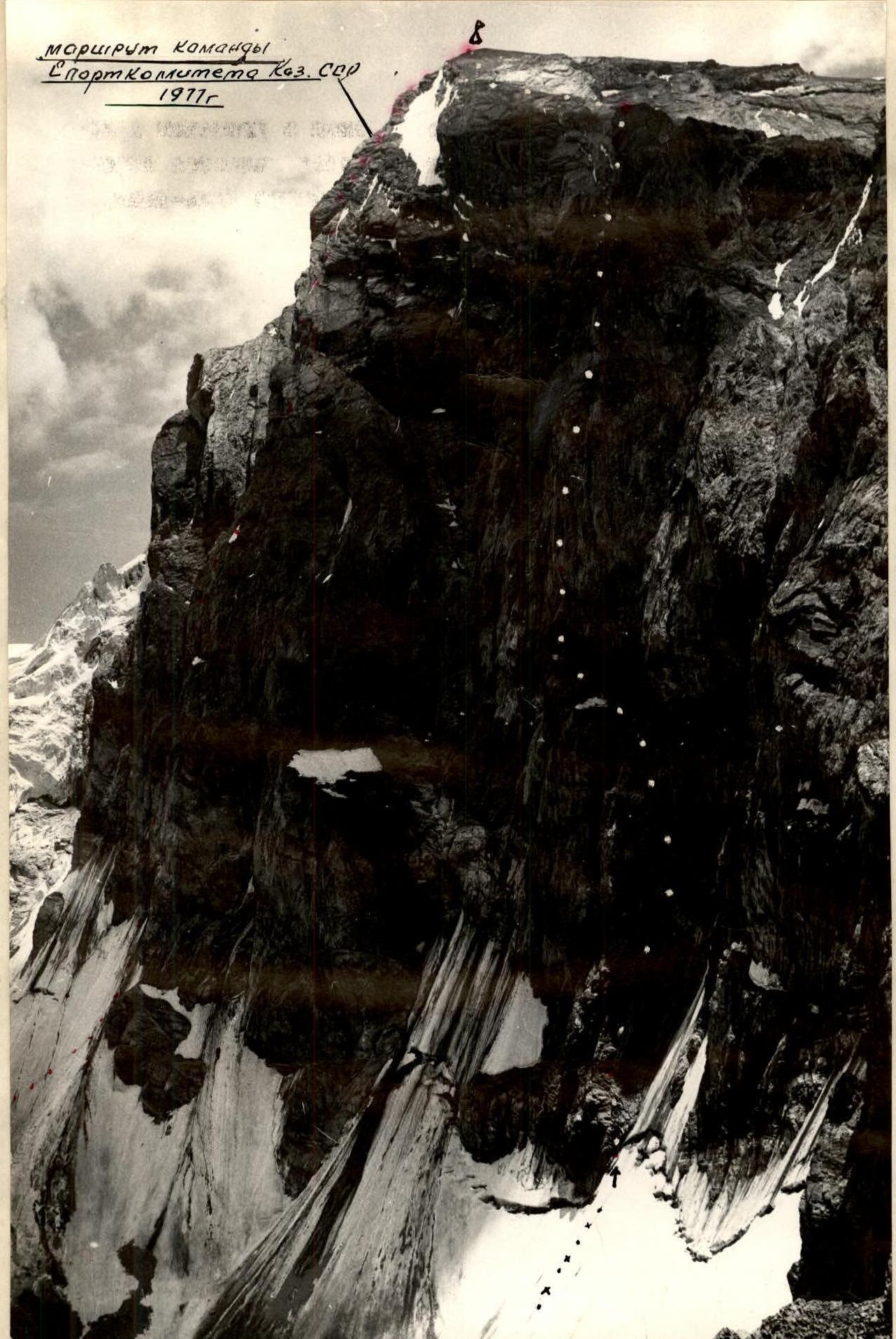

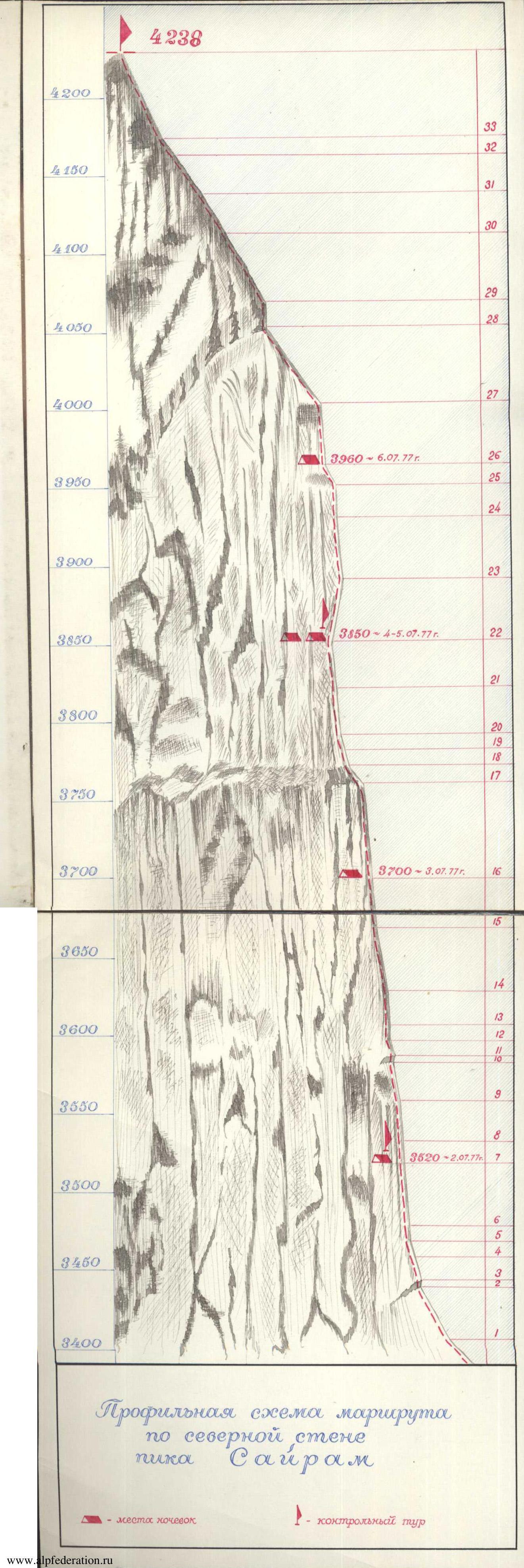
Photo 1. Route profile
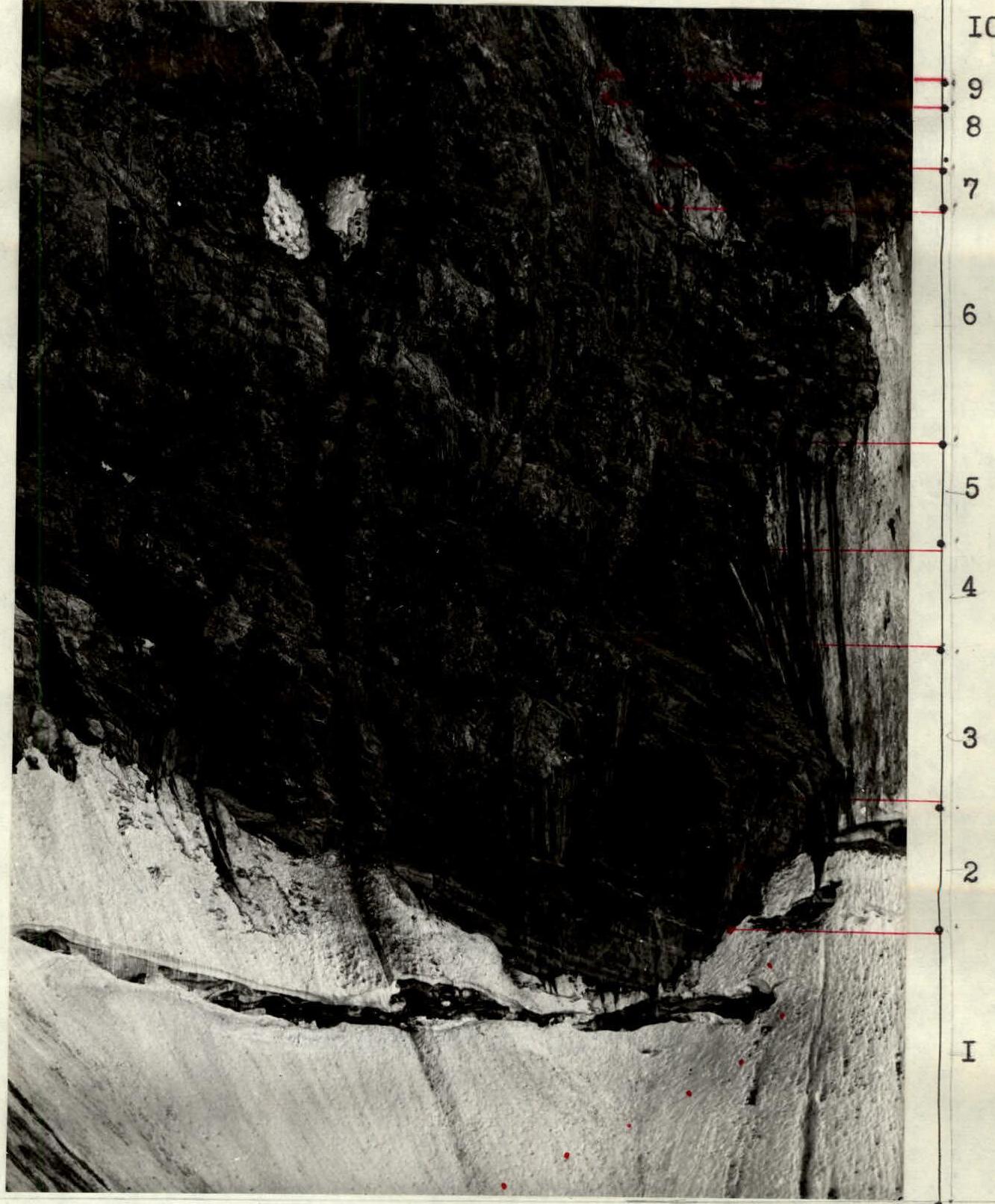
Photo 2. Wall detailing. Sections I–IO
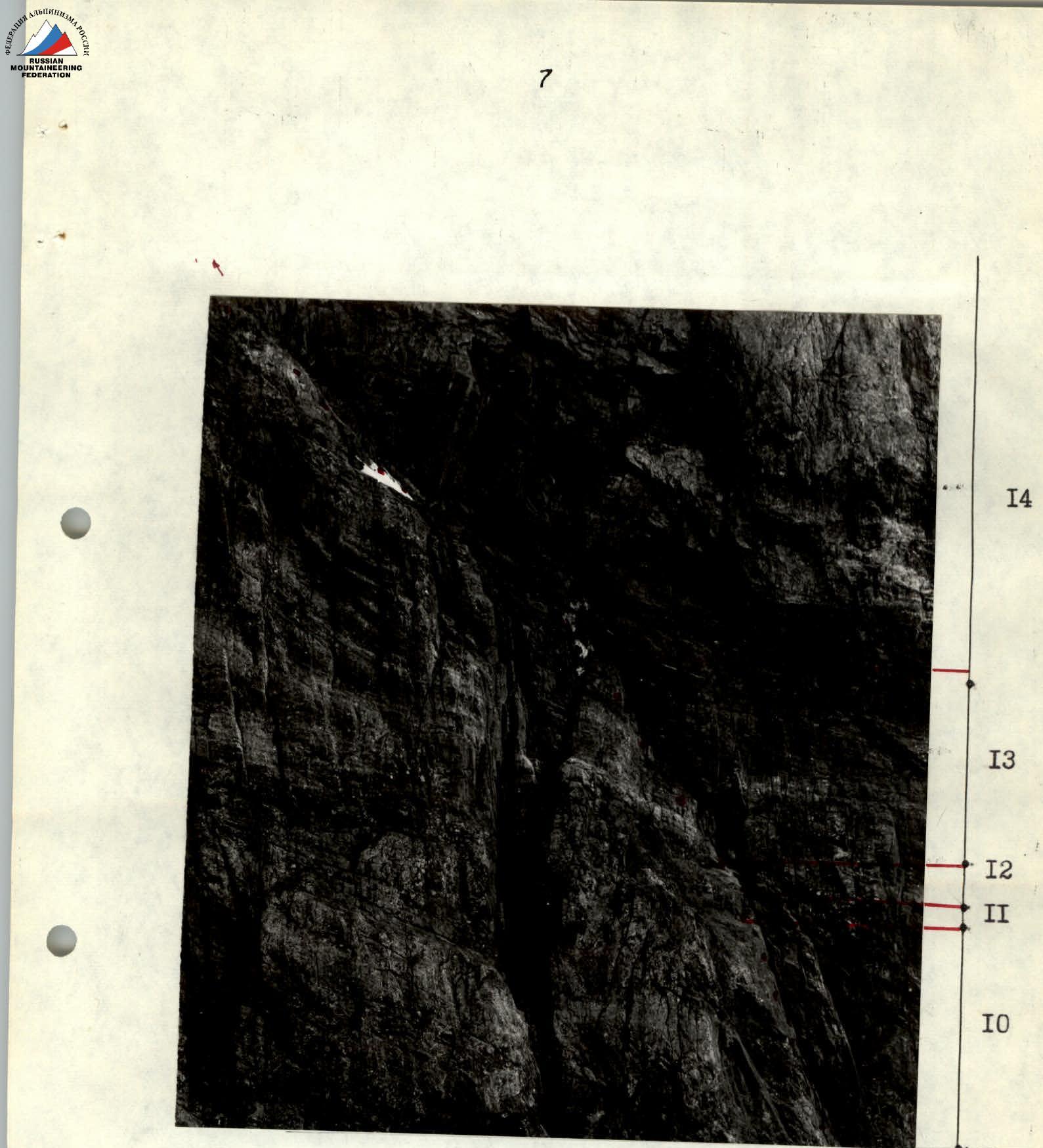
Photo 3. Wall detailing. Sections 10–14
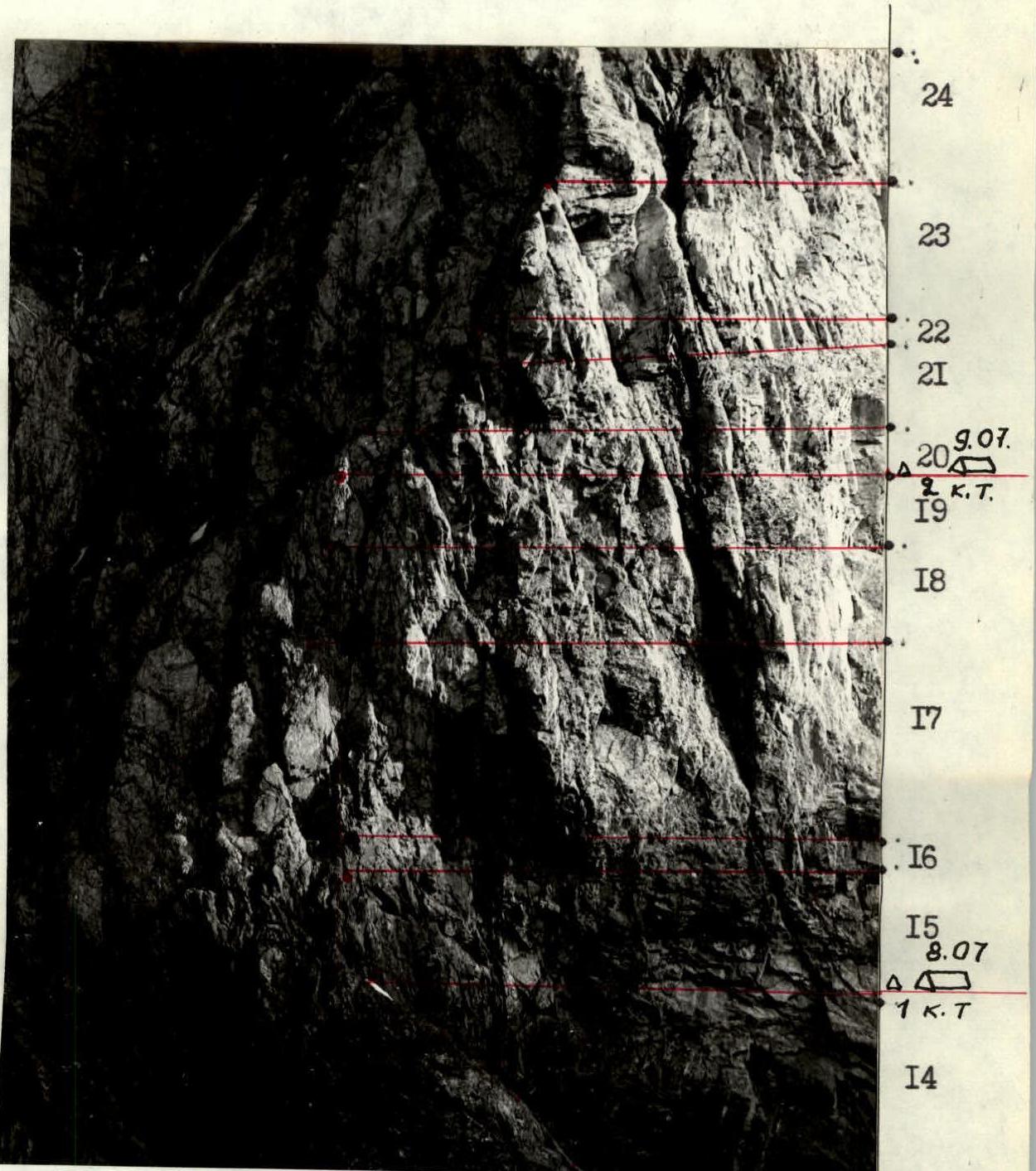
Photo 4. Wall detailing. Sections 14–24
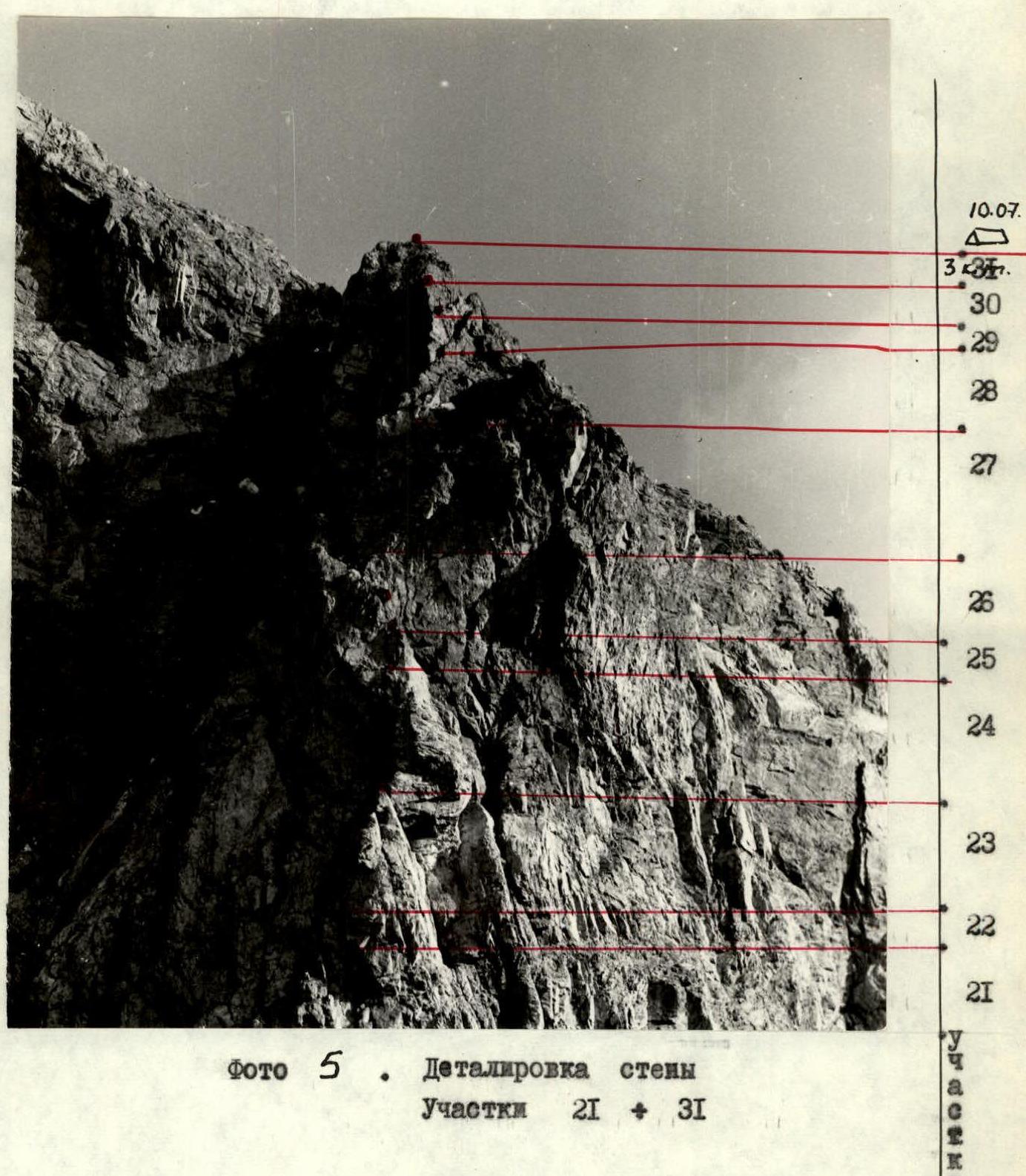
Table of route characteristics
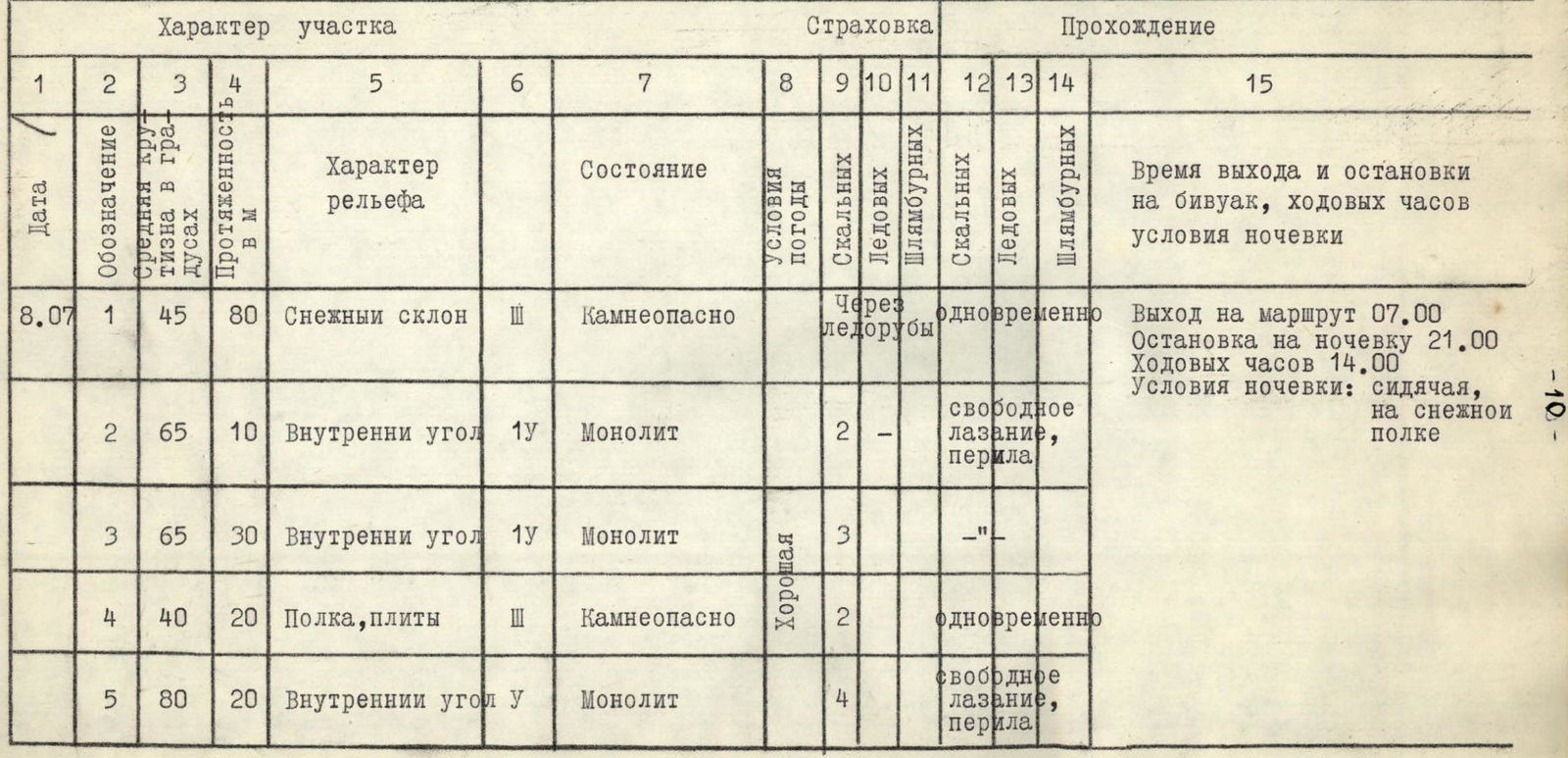
| Date | R | Steepness (°) | Length (m) | Relief | Cat. | Condition | Weather | Pitons (rock) | Pitons (ice) | Pitons (bolt) | Passage method | Additional info 1 | Additional info 2 | Notes |
|---|---|---|---|---|---|---|---|---|---|---|---|---|---|---|
| 8.07 | 1 | 45 | 80 | Snow slope | III | Rockfall hazard | Through ice axes | Simultaneously | Departure on the route at 7:00. Stop for the night at 21:00. 14 travel hours. Night conditions: sitting, on a snow ledge | |||||
| 2 | 65 | 10 | Inner corner | 1У | Monolith | 2 | Free climbing, belay | |||||||
| 3 | 65 | 30 | Inner corner | 1У | Monolith | 3 | "-" | |||||||
| 4 | 40 | 20 | Ledge, slabs | III | Rockfall hazard | Good | 2 | Simultaneously | ||||||
| 5 | 80 | 20 | Inner corner | У | Monolith | 4 | Free climbing, belay | |||||||
| 6 | 80 | 30 | Wall | У | Unstable rocks | Good | 6 | Free climbing, belay | ||||||
| 7 | 85 | 10 | Wall | У1 | Monolith | 4 | 2 | |||||||
| 8 | 80 | 10 | Wall | У | Monolith | 2 | Free climbing, belay | |||||||
| 9 | 90 | 5 | Wall | У1 | Monolith | 1 | 1 | |||||||
| 10 | 75 | 50 | Smooth wall | У | Slab, rockfall hazard | 10 | Free climbing, belay | |||||||
| 11 | 85 | 7 | Wall | У1 | Monolith | 1 | 1 | |||||||
| 12 | 60 | 10 | Wall | 1У | Destroyed | 1 | Free climbing | |||||||
| 13 | 80 | 30 | Wall | У | Destroyed | 3 stoppers | Free climbing, belay | |||||||
| 14 | 50 | 90 | Inclined ledge | 1У | Ice slab, slabs, rockfall hazard | 2 protrusions | "-" | |||||||
| 9.07 | 15 | 80 | 25 | Wall | У | Unstable rocks | Good | 3 | Departure on the route at 8:00. Stop for the night at 20:00. 12 travel hours. Night conditions: sitting, on a rock ledge | |||||
| 16 | 80 | 15 | Chimney | 1У | Unstable rocks | 1 | ||||||||
| 17 | 85 | 50 | Wall | У | Monolith | 6 stoppers | ||||||||
| 18 | 80 | 25 | Wall | У | Monolith | 4 | ||||||||
| 19 | 85 | 25 | Wall | У | Unstable rocks | 4 | ||||||||
| 10.07 | 20 | 50 | 10 | Inclined ledge | 1У | Destroyed | Good | Protrusions | Departure on the route at 7:00. Stop for the night at 21:00. 14 travel hours. Night conditions: lying, on a scree ridge | |||||
| 21 | 80 | 20 | Wall | У | Unstable rocks | 4 | Free climbing, belay | |||||||
| 22 | 90 | 7 | Wall | У1 | Monolith | 2 | ||||||||
| 23 | 75 | 40 | Chimney, wall | У | Destroyed | 21 stoppers | ||||||||
| 24 | 80 | 30 | Wall | У | Destroyed | 21 stoppers | ||||||||
| 25 | 80 | 10 | Chimney | 1У | Destroyed | |||||||||
| 26 | 85 | 20 | Wall | У | Destroyed | 3 | ||||||||
| 27 | 75 | 40 | Wall | 1У | Destroyed | Good | 1-protrusions | |||||||
| 28 | 70 | 20 | Wall | 1У | Destroyed | 1-protrusions | ||||||||
| 29 | 70 | 10 | Wall | 1У | Monolith | 1 | ||||||||
| 30 | 60 | 15 | Edge | 1У | Destroyed | Protrusions | ||||||||
| 31 | 50 | 50 | Ridge | Destroyed | Protrusions | |||||||||
| 32 | 30 | 300 | Ridge | П | Scree | Protrusions |
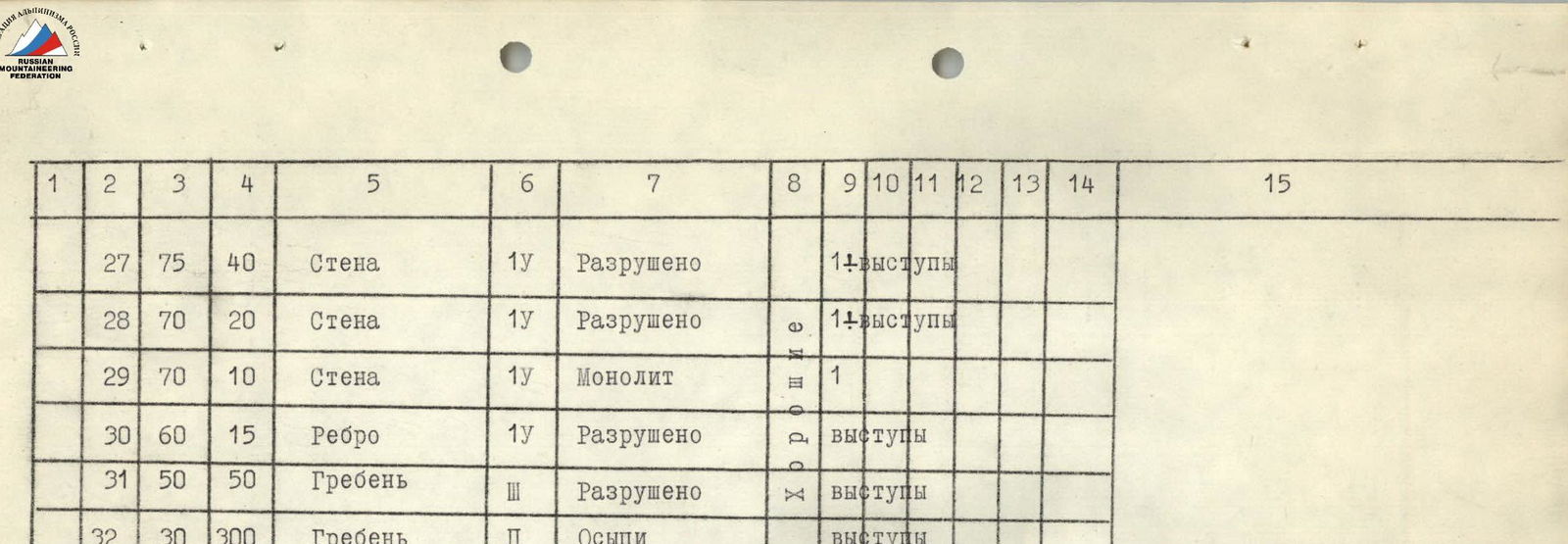
Note: 1. Pitons for organizing overnight stays – 14
4. Explanations to the table of route characteristics.
4.1. General characteristics of the route.
The route represents a clearly defined broad counterfort located at the western end of the northern wall of Sayramsky peak. The route leads to the pre-summit ridge 300 m west of the peak. The counterfort is steep, purely rock, and composed mainly of unstable rocks, but there are sections of smooth rocks (slabs). The route is objectively safe, but rockfall is possible in the lower part, especially in the first half of the day from 8:00 to 14:00.
For passage, the route is complex, traversed by free climbing, and requires high rock climbing skills from all participants. There are no convenient places for overnight stays on the counterfort. Three control tours were installed on the route. The route was traversed with three overnight stays.
4.2. Route description.
The beginning of the route is along a steep firn slope (section 1) to the start of a rocky inner corner (section 2), which, becoming less steep, transitions into an inclined rocky ledge (section 4). The ledge is composed of slabs covered with rock debris.
When passing sections 1-4, special attention is required due to the possibility of rockfall from above. The peak rockfall hazard time is from 8:00 to 14:30.
Wall (sections 5, 6):
- Composed mainly of unstable rocks
- Sections of large-block structure are found
- Holds are few and inconvenient
- Destruction of holds is possible
- Pitons are mainly used in large sizes
10-meter wall (section 7):
- Practically vertical, smooth
- In the middle part - an inclined crack, convenient for passage
- Existing holds are small and smoothed
- Artificial points of support are used at the beginning and end of the section
- Passage is possible only in galoshes (opinion of the team!)
The route through sections 8-11 is straightforward and logical. By character - slabs, with 2-5-meter steep walls. Holds are few, many sections have to be passed on friction. Movement along the belay is possible only with the use of jammers and in a harness. When moving first, it is advisable to use a wide crack located to the right (in the direction of travel).
Sections 12, 13 are somewhat simpler but require tense climbing:
- Rocks are unstable
- Holds are few
- At the end of section 13 - a small balcony where two participants can fit
Section 14 - an inclined ledge:
- Ledge width is about 1.5 m
- Rocks are inclined towards the valley at an angle of about 30°
- Rockfall is possible on the ledge, especially in its middle part
- Rock character - "ram's foreheads", местами - natёчный лёд
- Small, easy-to-pass walls are found
- For belaying, it is possible to use protrusions
- Only alternate movement with careful belaying is recommended
At the end of section 14, on a small snowfield - a sitting overnight stay on a snow ledge. The Vorobyov-Denisenko team processed two ropes of the wall above the overnight stay.
The 1st control tour is installed to the left at the top (1 m) from the snowfield in the inner corner.
For processing and passing sections 1-14, the team used:
- 7 forty-meter ropes.
On the morning of July 9, two ropes were thrown down. The backpack with ropes fell to the glacier without touching the wall.
Section 15 - an unstable wall, местами скалы отбрасывают, характер породы — конгломераты. In the upper part, a chimney (section 16) leads under overhanging rocks. Under them, one person can secure themselves.
From the overhanging rocks, movement is directed to the left onto a 100-meter wall (sections 17-19):
- In the lower part (sections 17, 18), the wall is smooth, with a small number of small but strong holds;
- When passing section 18, small stones and cracks are used;
- Section 19 in the lower part is somewhat overhanging, holds are few, there are enough places for hammering pitons.
The wall ends with an exit onto a fairly wide and gentle ledge, covered with rock debris. After clearing the site, a tent was set up under the wall, protecting from rockfall. The overnight stay is sitting. The 2nd control tour is installed here. There is no water, but there is ice in the cracks.
The Lukyanov-Dzhan team processed two ropes of the wall. In the morning, movement was along the hung belays, moving up to the right to exit under a small steep wall (section 22). The wall is traversed by free climbing (difficult, smooth rocks) in its right part and entry into a crack, which, gradually expanding, turns into an inclined chimney (section 23). Movement along the chimney leads to a small balcony (a place for one person).
Further movement is upward along the wall to the right of the wide chimney. In the upper part of the wall, the rocks are destroyed. The chimney (section 25) leads under the wall (section 26). The wall is destroyed, and passage requires extreme caution. Further movement is along steep, diverse relief destroyed rocks (sections 27-30):
- Movement by free climbing;
- Holds are few;
- Their destruction is possible;
- Belaying is only with pitons.
Section 31 - a gentle ridge, leads to the scree rocks of the pre-peak. On the scree ridge - a site for an overnight stay.
The 3rd control tour is installed on the rocks above the overnight stay. Section 32 - a destroyed rocky ridge, simple movement, and exit to the peak.
Descent from the peak to the overnight stays near the 3rd control tour and then south along a wide scree couloir to the glacier. Further along the glacier to the trails leading to the camp.
4.3. Characteristics of overnight stays.
Initial overnight stays are located on a scree slope, opposite the counterfort along which the route passes. Water is on the glacier 50 meters from the overnight stays. The entire route is clearly visible from the site.
First overnight stay
The overnight stay is organized on a snowfield under the wall (section 14). The site was:
- carved out in the firn,
- laid out with stones and snow, measuring 0.7×2.0 m.
The tent is suspended on pitons. For guy lines, ice axes were used. The danger of rockfall on the site is excluded.
For organizing the overnight stay, it took about 2 hours, and 8 additional rock pitons were hammered.
The overnight stay is for 5 people, sitting.
Water:
- from snow
- from ice
Second overnight stay
The overnight stay is organized under the wall (section 20), protecting from rockfall.
The site was laid out with stones.
It took 1.5 hours to organize the overnight stay.
For tent installation, 6 additional rock pitons were hammered.
The overnight stay is sitting.
There is no water.
There is ice in the cracks.
Third overnight stay
The site was laid out on the scree of the pre-peak ridge. The overnight stay is comfortable, lying. There is no water on the ridge; it is necessary to descend into the couloir for ice.
4.4. Team movement tactics.
The movement of the first team was carried out without backpacks. The movement of the remaining participants - with backpacks, along the belays with the use of jammers, in harnesses, and, if necessary, stirrups. Leaders changed approximately every 5-6 hours of work. For movement, the full daylight was used, as there are no places for overnight stays. Food between overnight stays during movement was carried out by participants independently (sugar, chocolate). The weight of the backpacks was maximally reduced, and there were only 3 backpacks in the team. The passage of the route was carried out in galoshes and "Vibram" boots.
When passing sections 1-14:
- 7 ropes were used.
- Preliminary processing of the route was carried out.
For passing sections 15-31:
- 5 ropes were used.
- Movement of the first - only on a double rope.
- Two free ropes were used for hanging belays, along which the trio moved.
4.5. Team movement schedule:
- July 6, 1977 - Approach from the base camp to the initial overnight stays.
- July 7, 1977 - Observation of the route and preliminary processing of the lower part of the wall.
- July 8, 1977 - Passage of the route. Sections 1-14.
- July 9, 1977 - Passage of the route. Sections 15-20.
- July 10, 1977 - Passage of the route. Sections 20-31.
- July 11, 1977 - Passage of the route. Section 32. Exit to the peak. Descent to the camp.
4.6. Conclusions:
4.6.1. The route was traversed by the team in strict accordance with the plan and required 4 travel days, not counting the day of approach and processing the route.
4.6.2. The route is rock, objectively safe. During the passage, both monolithic and destroyed sections of rocks are encountered. The route requires the use of almost the entire arsenal of mountaineering equipment.
4.6.3. There were no cases of falls or loss of equipment on the route. The ascent was completed without injuries or illnesses, and there were no cases of discipline violation.
4.6.4. The team believes that the route is worth 5B category overall. The route is comparable to routes on peak Trud category 3, Ushbu via the SE wall, but exceeds them in the length of complex sections.
4.6.5. The safety system practically guaranteed control over the team's passage of the route, as well as providing assistance in case of an emergency.
4.6.6. A total of 76 pitons were hammered during the passage, not counting the pitons hammered for organizing overnight stays.
Team captain - V. Starlychanov Team coach - V. Sedelnikov

Comments
Sign in to leave a comment