Passport
- Ice and snow class
- Tian-Shan, Karakol gorge
- Peak Karakolsky, via the center of the North face
- Proposed — 6A cat. dif., first ascent
- Height difference — 1600 m, length — 1850 m. Length of sections with 5 cat. dif. — 170 m, 6 cat. dif. — 248 m. Steepness of the route — 57°
- Pitons hammered:
| rock | bolt | chocks | ice |
|---|---|---|---|
| 12/0 | 0/0 | 8/0 | 265/5 |
- Team's working hours: 32 and days — 3
- Overnight stays: 1st — a platform carved on a snowy-ice slope for 4 people; 2nd — a platform on the ridge
- Team leader: Alexander Nikolayevich Barchuk, Master of Sports of the USSR. Participants: Georgy Fedorovich Akbash, Candidate for Master of Sports; Nikolai Mikhailovich Kozyrev, Candidate for Master of Sports; Vladimir Petrovich Sinelnikov, Candidate for Master of Sports.
- Coach: A.N. Barchuk
- Approach to the route: July 24, 1989. Summit: July 26, 1989. Return: July 26, 1989.
- State Committee for Sports of the Moldavian SSR
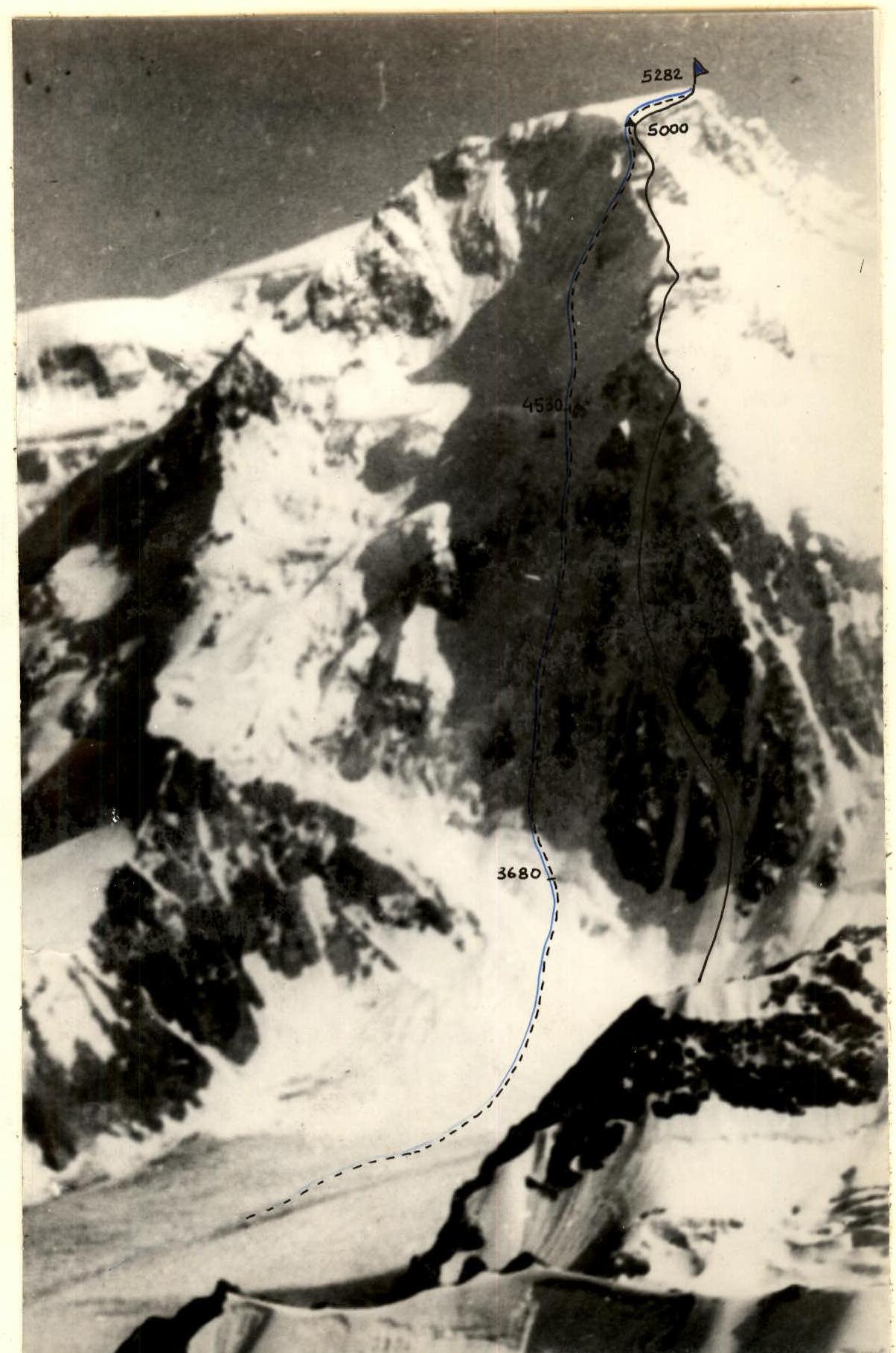
Route of the athlete of the USSR
Classified route "Zmeika"
The main tactical task of the team was to quickly complete the route with minimal expenditure of effort while ensuring sufficient safety measures. Based on this general task and the characteristics of the route, a movement pattern was chosen for a team of 4 people, combining autonomous movement of rope teams (Akbash — Kozyrev, Barchuk — Sinelnikov) with interaction. Using this scheme allowed:
- to organize uniform movement on the route for all team members;
- to change the lead climber in the rope teams without reducing the team's speed;
- to fulfill the tactical plan in terms of time and overnight locations.
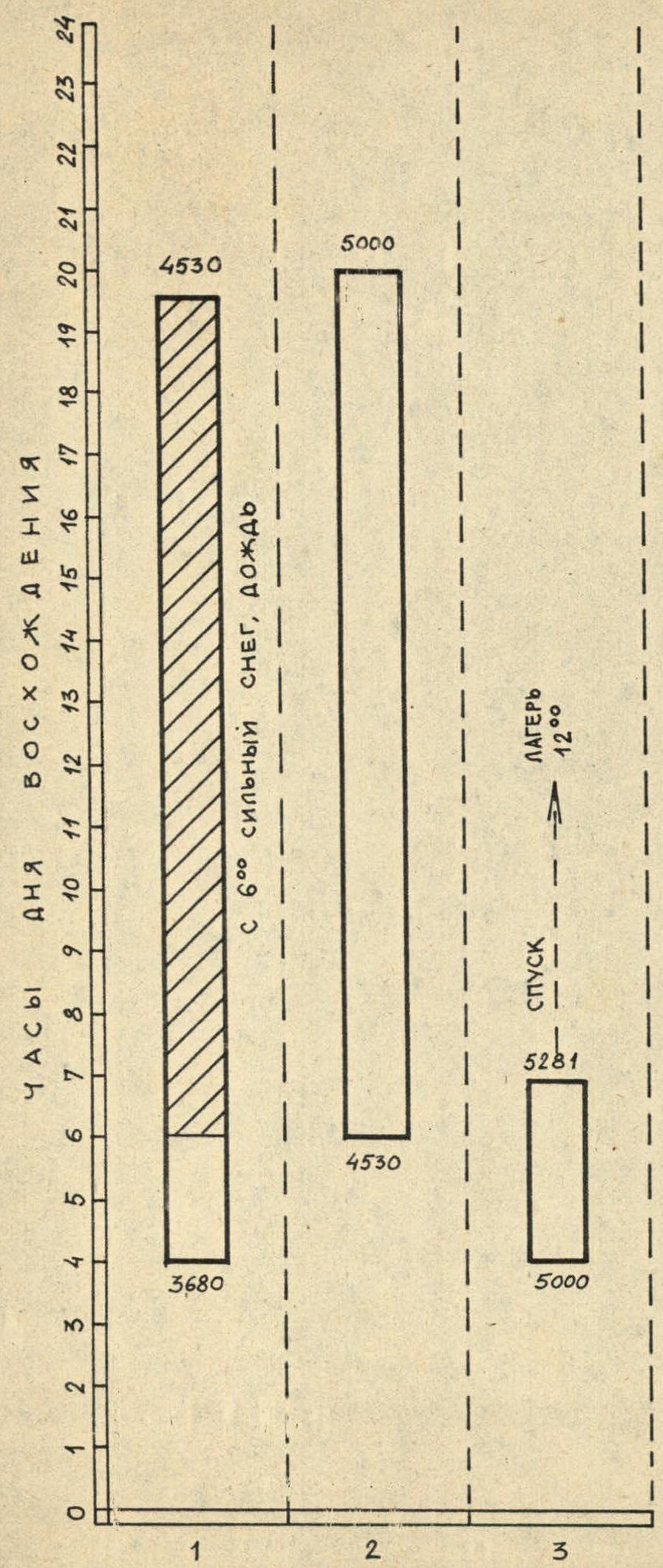
On July 24, the team reached the planned overnight location according to the schedule at 19:30. On July 25, the team set up a bivouac under the summit at 20:00 (planned ascent to the summit at 17:00). On July 26, the ascent to the summit took place after three hours of work — at 8:00. The delay from the schedule was 6 hours, which was caused by the difficult condition of the upper part of the route after the bad weather on July 24 (heavy snow throughout the day).
The movement of the rope teams Barchuk A. — Sinelnikov V. and Kozyrev N. — Akbash G. was carried out as follows:
- The first in the rope team worked on a shortened (20 m) double rope;
- The second approached him with top rope;
- There was a change of lead climber.
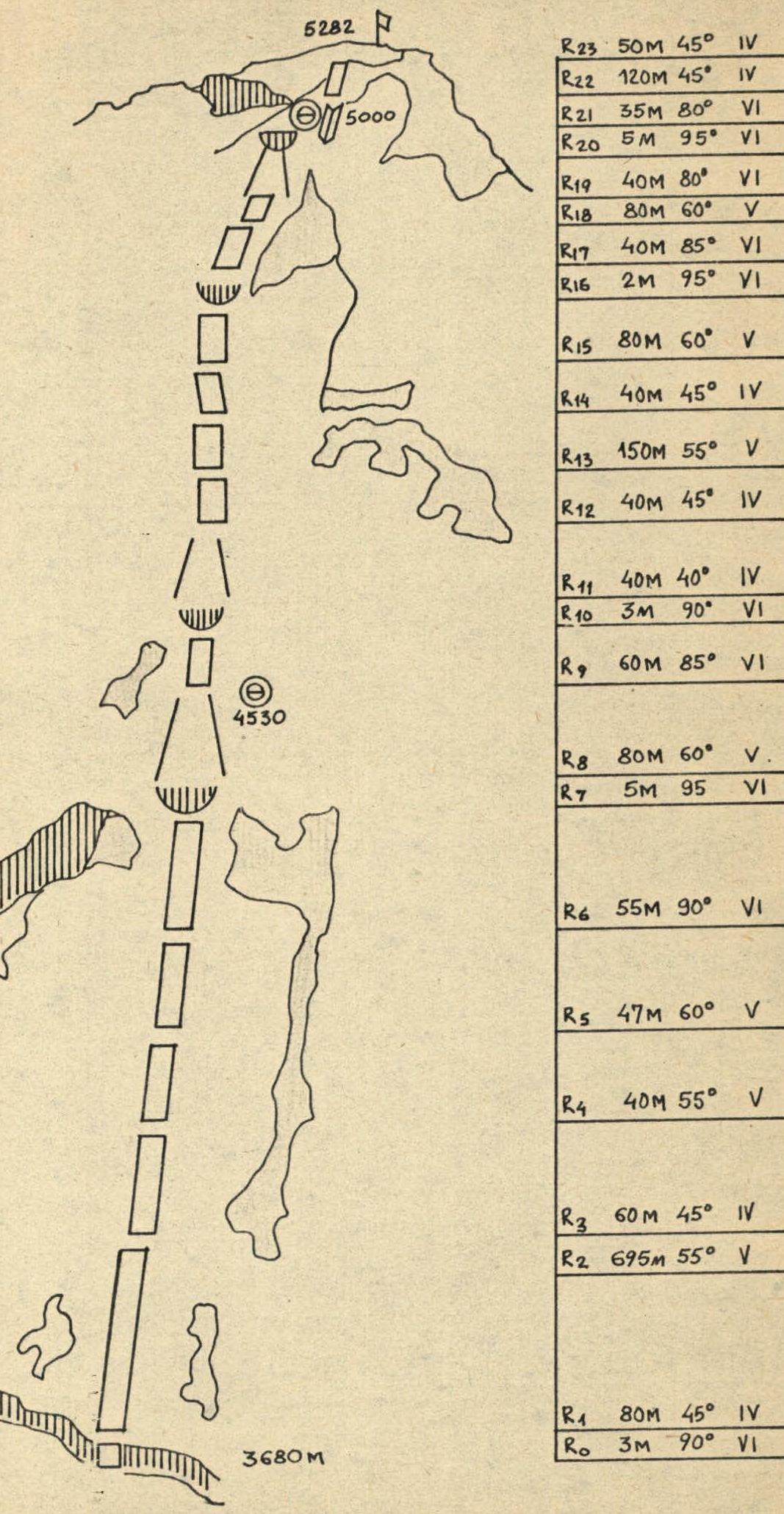
The rope teams moved autonomously, except for sections (R6, R7, R20–R22), where piton interaction was carried out. Thus, the load was distributed evenly among all team members. On key sections (R0, R6–R10, R16–R21), the first in the rope teams were Akbash G., Sinelnikov V., Kozyrev N.
Safety measures
Safety measures for the lead climbers were carried out as follows:
- The first worked on a double rope.
- For belaying, a Sticht plate and blocked carabiners were used.
- The norm for going out from the last carabiner did not exceed 6 m.
- The team used ice screws only of standard sizes with optimal thread pitch and handles that allowed screwing them in at maximum speed.
- On rocky terrain, supporting compact carabiners were not used for belaying.
- All team members wore helmets with UIAA stamp and harnesses with two self-belay loops.
The team's rest was carried out on sections where the lead climber was changed, and nutrition during the day was self-sufficient from individual rations. Hot meals were organized at the bivouacs.
- The first bivouac was organized on an ice-snow slope under the cover of a rocky outcrop.
- The second — on the ridge.
The team from the Moldavian SSR has been conducting year-round joint training since 1986, and since 1987 has regularly participated in the USSR Championship. The team's training plan was developed in December 1988, taking into account the experience of participating in the ice-snow class of the 1988 USSR Championship (final fourth place). According to the plan, the team conducted a 24-day spring training camp in the Caucasus, participated in a "school" (eighth result, which was due to a tactical error — passing the route in triples), then all members participated in the compositions of their teams in the face-to-face championship of the MSSR (p. Dzhigit — p. Karakolsky). The main team has experience on routes of 5B–6B cat. dif. In this area, the team made a competitive ascent on an ice route of 5B cat. dif. on p. Dzhigit. In addition, in 1988, the team made first ascents of the same class on v. Vaytor and Oguz-Bashi (2nd West) 5B cat. dif.
Upon arrival in the area, the team observed the wall for 20 hours. This wall was noted by the team in 1988. In the FA USSR card index, parameters of classified routes on p. Karakolsky were obtained. During the preparation for the championship, team members passed standards for physical and technical training in accordance with the Regulations (the protocol is in the championship's judging panel). Based on observations of the route, a conclusion was made about its safety. The most difficult sections were noted (according to the enlarged section scheme, as well as the exit to the ridge), and bivouac locations were planned. Nutrition was carried out according to rations developed by the Chisinau Research Institute of the food industry, and included:
- high-calorie products — fruit sticks;
- drink "Vio-sport";
- other products (see table).
Focusing on the characteristics of ice in this season, the following equipment was selected:
- crampons with spades;
- ice screws with handles;
- ice hammers of special design;
- 4-person lightweight high-altitude tent.
All non-standard equipment was tested and performed well during the training camp before the championship and the MSSR championship. The team was fully materially supported and equipped, and received sufficient acclimatization.
The team was provided with a rescue team consisting of:
- 8 athletes with Candidate for Master of Sports rank;
- a doctor;
- a radio operator.
Members of the rescue team in this season:
- underwent ice training during the MSSR championship;
- made ascents of 5B cat. dif.
The rescue team was equipped with:
- means of transportation;
- necessary equipment;
- food supplies;
- medicines.
All members of the rescue team were located directly under the route during the ascent. Radio communication with the rescue team, the group, and the base camp was carried out using "Karat" and "Lastochka" radios.
There were no "working" falls or injuries. The route was completed by the team with a reserve of physical and moral strength. On the route, the following were used:
- ice fifis;
- ice hammers of special design.
The observation group and the rescue team went out with the team to select and scout the route, studied it well, and continuously monitored the team. Radio communication was conducted regularly:
- "Lastochka" radios with observers;
- "Karat" radios with the base camp. There were no missed radio communication sessions. In case of lack of visibility, it was agreed to listen every hour. After the team reached the summit (out of sight), the observers went down towards the Metallurg pass. Food waste was returned to the base camp and disposed of. To obtain objective information about the route parameters, the following were used:
- data on neighboring routes;
- VN altimeter;
- angle measurer.
In September-October, it is planned to have the team participate again in the Moldovan television program "Youth Wave". Information about the team's participation in the championship will be published in the newspaper "Soviet Moldova".
Pitons
| Ice | Rock | Chocks | Time |
|---|---|---|---|
| 4 | 3.5 | ||
| 9 | 4 | 2 | |
| 1* | 6 | 1 | 14.0 |
| 1 | 2 | ||
| 11 | |||
| 13 | |||
| 10 | |||
| 1 | |||
| 15 | |||
| 4 | |||
| 24 | |||
| 4 | |||
| 4 | |||
| 2* | |||
| 15 | 15.5 | ||
| 15 | |||
| 1* | 1 | ||
| 11 | 3 | ||
| 8 | |||
| 7 | |||
| 5 | |||
| 98 | |||
| 7 | |||
| 10 | |||
| 265 | 12 | 8 | 33.0 |
| (5*) |
Description of route sections
- R0: 3 m 90° VI
- R1: 80 m 45° IV
- R2: 695 m 55° V
- R3: 60 m 45° IV
- R4: 40 m 55° V
- R5: 47 m 60° V
- R6: 55 m 90° VI
- R7: 5 m 95° VI
- R8: 80 m 60° V
- R9: 60 m 85° VI
- R10: 3 m 90° VI
- R11: 40 m 40° IV
- R12: 40 m 45° IV
- R13: 150 m 55° V
- R14: 40 m 45° IV
- R15: 80 m 60° V
- R16: 2 m 95° VI
- R17: 40 m 85° VI
- R18: 80 m 60° V
- R19: 40 m 80° VI
- R20: 5 m 95° VI
- R21: 35 m 80° VI
- R22: 120 m 45° IV
- R23: 50 m 45° IV