
Ascent Passport
- Class — technical
- Karakol region, Terskey-Alatau ridge
- Peak Jigit (5170), center of the large triangle of the north wall
- Route 6B cat. diff.
- Height difference — 1350 m
Length of sections 5–6 cat. diff. — about 1000 m. Average steepness — 76°
-
Pitons driven — 156 pcs. ice screws — 7 pcs., chocks, loops — 32 pcs.
-
Number of climbing hours (first climber) — 32 h
-
Overnight stays — 1 sitting, 2 lying.
-
ILYINSKII E.T. — Master of Sports, leader
- SHEVCHENKO N.A. — Master of Sports, deputy leader
- SMIRNOV V.A. — Master of Sports, participant
- SEDELNIKOV V.N. — Master of Sports, participant
- GOLODOV Yu.F. — Master of Sports, participant
- AKCHURIN M.Kh. — Master of Sports, participant
- KHRIShchATYI V.N. — Candidate for Master of Sports, participant
- VALIEV K.Sh. — Candidate for Master of Sports, participant
-
Team coach: Honored Coach of the Kazakh SSR ILYINSKII E.T.
-
Departure to the route — August 5, 1978, return — August 8, 1978, August 3 — preparation day. Almaty, 1978
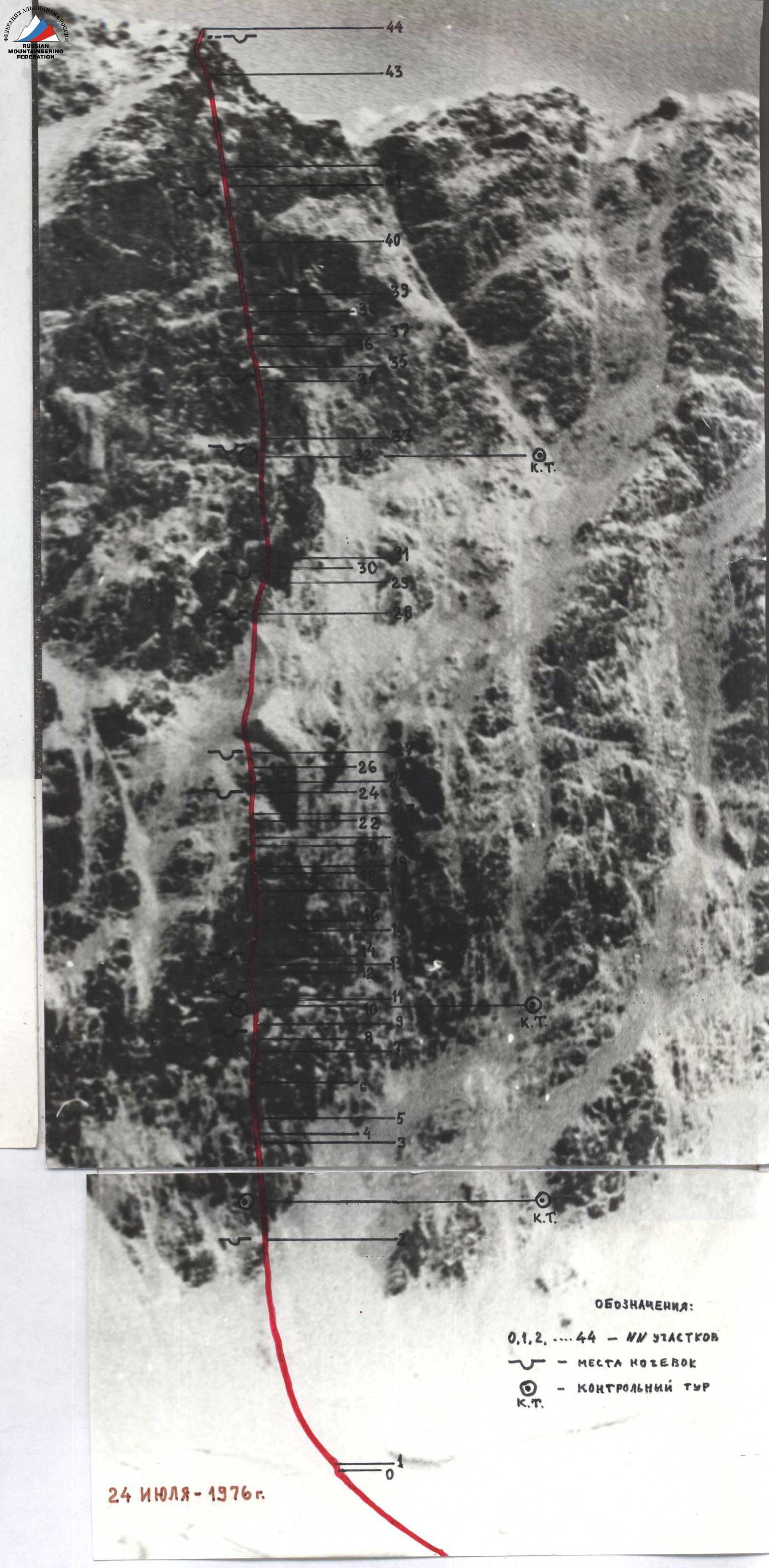

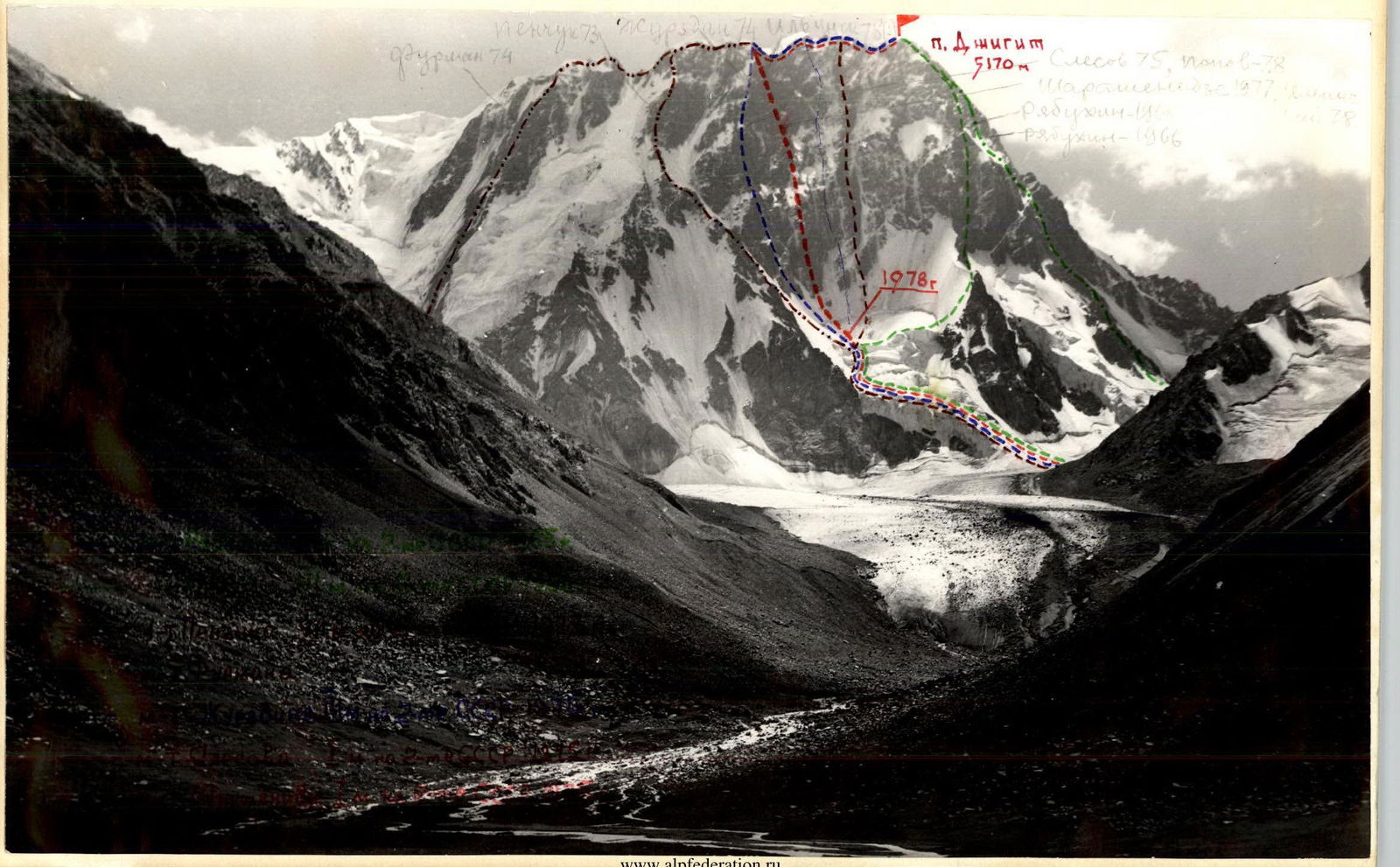
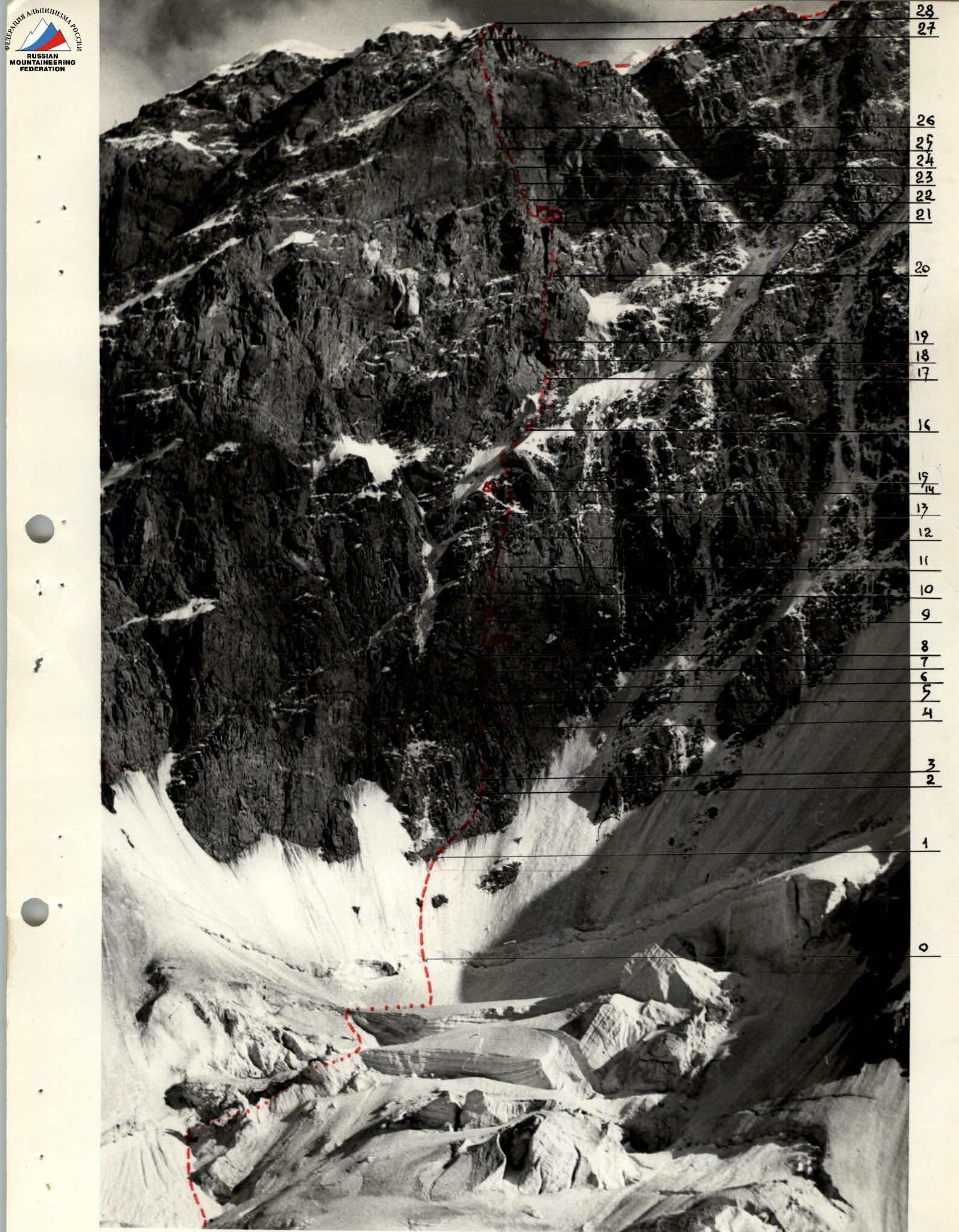
Explanation for the table of main route characteristics
August 3. At 7:00, the group consisting of GOLODOV, VALIEV, and KHRIShchATYI departed for route preparation. Upon reaching the upper part of the "kar," they overcame a steep ice ascent and a bergschrund using titanium front-point crampons and ice axes. By 9:30, the trio approached the start of the route to the upper bergschrund under the "bastion." The first two ropes went through steep ice. Thanks to the use of specialized equipment and well-practiced ice climbing techniques, these 80 m of ice were processed within an hour. They reached the ice part at the base of the "bastion," from where they moved up and to the right along an oblique ledge, an edge under a 7-meter corniche. Up to the corniche, the first climber ascended in Vibram shoes using free climbing. The corniche and subsequent sections were traversed in galoshes. Following the corniche were smooth slabs. At the top of the slabs, there was an exit into an internal corner.
Existing cracks and small ledges:
- were powdered with snow,
- partially iced over,
- significantly complicating the climb.
By 12:00, the weather deteriorated. Sleet started falling. The preparation group maintained contact with observers via a VHF radio station. By 13:00, they reached the second control cairn under an 8-meter corniche. Here, the Georgian team had previously set up a hanging bivouac. The corniche was overcome using artificial aids.
Despite worsening weather, the group continued route preparation. Chocks were frequently used, reducing the energy expenditure of the lead climber. After the corniche, there were smoothed slabs, which were ascended upwards, slightly veering to the left. By 16:30, the group completed route preparation, having traversed 360 m, driven 47 rock pitons, 5 ice screws, and used chocks 13 times. By 19:30, the preparation group was back at the observers' camp.
August 4. Rest day and preparation for departure.
August 5. At 6:30, the first group of four: AKCHURIN, GOLODOV, SMIRNOV, SHEVCHENKO departed on the route, followed by the second group of four 30 minutes later. Communication between the groups and with observers was maintained via VHF radio. By 12:00, the first group's climbers reached the top of the prepared section and began further route preparation. The load of the first climber was redistributed among the other participants. During the ascent of the slabs, artificial aids were used, and after 25 m, the slabs became gentler and transitioned into heavily fragmented rocks, iced over. Another 25 m led to "ram's foreheads," which they followed to the top of the "bastion" under the "white exfoliation." By 16:00, the first climber was under the "white exfoliation." The weather worsened, and a thunderstorm began. At 16:30, a lightning strike triggered a significant rockfall, which passed to the right of their route. By 19:00, the entire group had gathered under the "white exfoliation" and organized sitting overnight stays on two platforms.
Achievements:
- In addition to the prepared section, another 90 m of the route were traversed.
- 16 rock pitons were driven.
- Chocks were used 6 times.
On the "white exfoliation," a control cairn was suspended from a bolt.
August 6. At 9:30, GOLODOV-SHEVCHENKO continued the ascent. A 10-meter sheer rock wall led to a steep ice slope. Here, front-point crampons and ice axes with ice picks were used again. To the left, they circumvented the "white exfoliation." After 80 m of pure ice, they reached rocks iced over. Passing through this section and beyond required significant ice removal, so for safety, the group split in half. The second group of four stayed overnight under the "white exfoliation."
90 m of iced rocks led to a rock wall. The rocks were solid and smoothed. The first climber again wore galoshes. After 35 m, they reached a 25-meter internal corner. The rocks were clean and solid, making climbing very challenging. Aiders and artificial aids were used. The internal corner led to a small platform, above which lay heavily fragmented rocks. This section was traversed using free climbing.
Slightly to the right, they reached a platform under the base of the "flake." Further on were:
- smooth slabs,
- overhanging blocks.
These were traversed using free climbing. At the top of the "flake," there was a good platform for two tents. The overnight stay was lying down.
360 m were processed. 51 rock pitons were driven, and 6 chocks were used.
August 7. At 8:30, the group of four: VALIEV, ILYINSKII, SEDELNIKOV, KHRIShchATYI began traversing the prepared section and reached the top of the "flake" by 12:00. After the second group of four reached the "flake," the duo AKCHURIN-SMIRNOV started route preparation. 15 m from the platform, on a wall under a small corniche, a control cairn was secured to a piton.
From the control cairn, along a steep rock wall upwards and to the left, after 40 m, they reached under a 40-meter internal corner with heavily fragmented rocks, followed by an exit onto solid monolithic slabs. This section was traversed using free climbing.
Within 1.5 hours, the first duo was joined by VALIEV-KHRIShchATYI.
100 m of slabs led under an overhanging wall. The rocks were solid. The wall led to a buttress — rocks partially covered with ice; the buttress transitioned into a heavily fragmented ridge.
360 m were processed, 68 pitons were driven, and 7 chocks were used. The overnight stay was at the same location on top of the "flake."
- August 8. At 8:30, they began moving along the prepared section. By 11:00, they reached the pre-summit snow-ice ridge, which was traversed in pairs while roped together. By 12:30, everyone was at the summit.
The descent followed route 4A cat. diff. to the observers' camp on the "Jigit" glacier moraine; the group descended by 20:00.

Table of Main Ascent Route Characteristics
Ascent route: Center of the large triangle of the north wall of peak Jigit. Height difference: 1350 m. Length of the wall section: 2360 m. Average steepness of the wall section: 76°


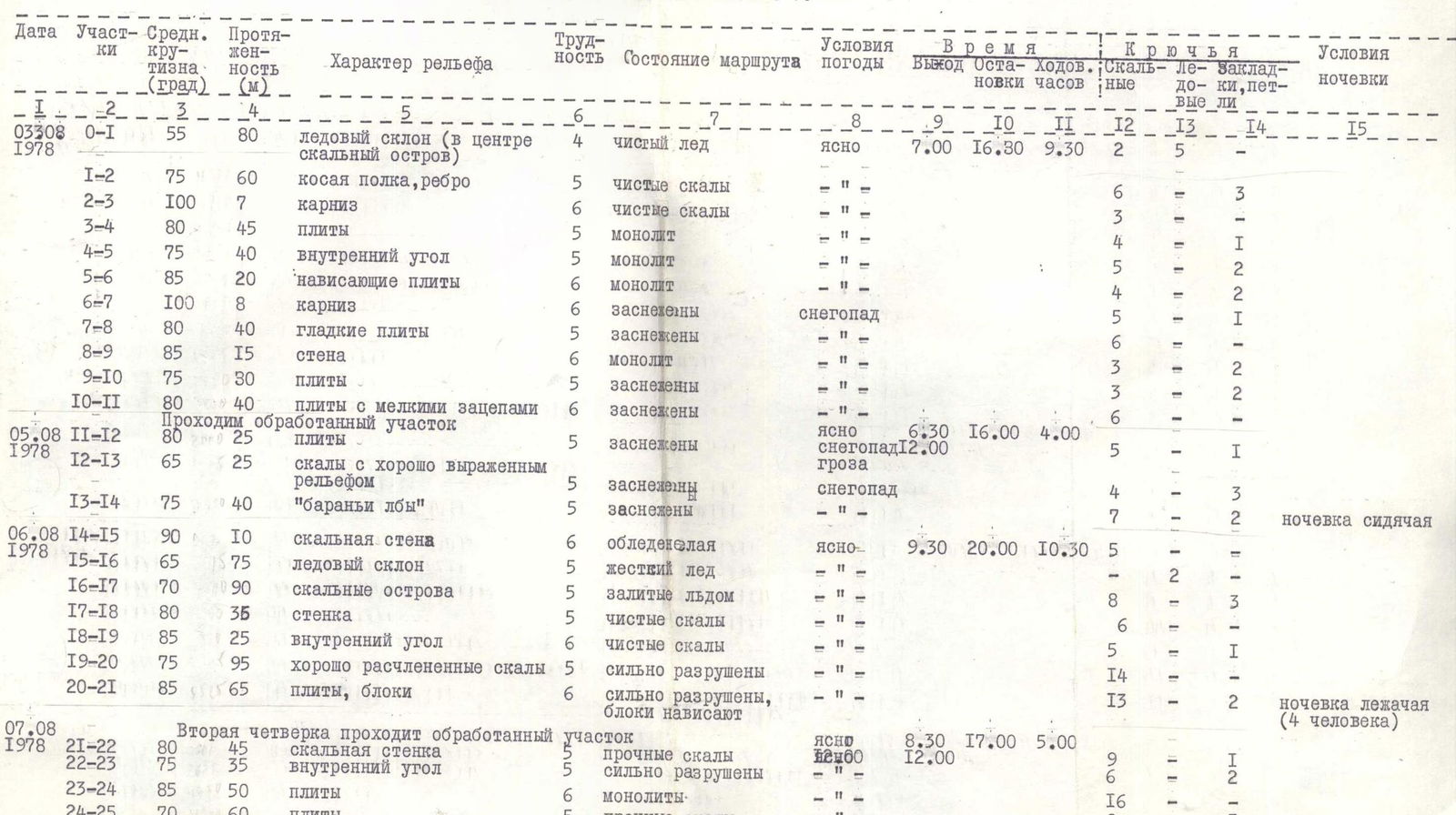
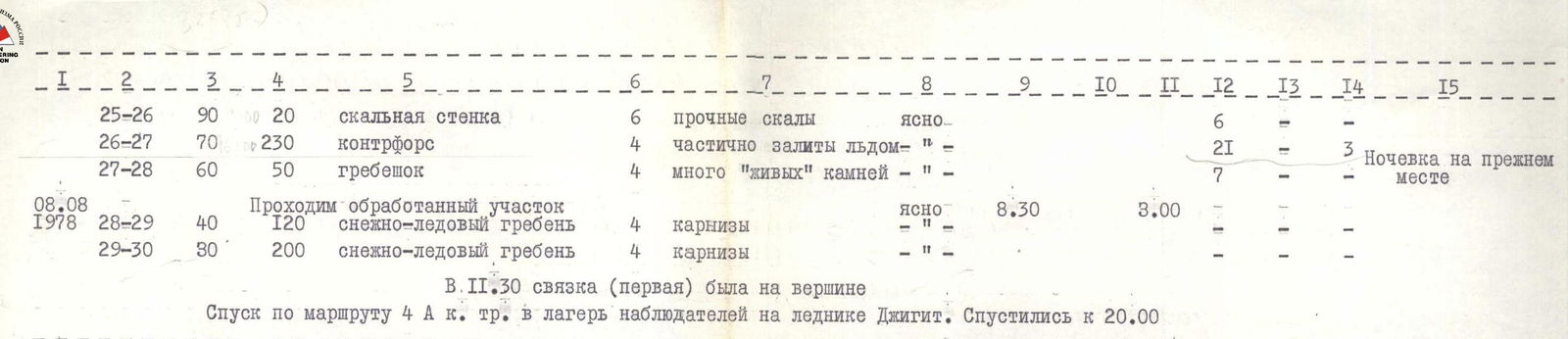
By 12:30, the first rope team was at the summit.
The descent followed route 4A cat. diff. to the observers' camp on the Jigit glacier. They descended by 20:00.
TOTAL: Climbing hours (first climber's work): 32 h Rock pitons driven: 156 pcs. Ice screws driven: 7 pcs. Chocks and loops used: 32 pcs.
For overnight stays, driven: Rock pitons: 26 pcs. Bolt pitons: 3 pcs.


