
Ascent Log
- Ascent Category: Technical
- Ascent Area: Tian-Shan. Terskey Alatau.
- Ascent Route: Jigit Peak, 5170 m, north wall via bastions on the left part of the cirque.
- Ascent Characteristics:
- Height difference 1180 m
- Average steepness 73°
- Length of complex sections 920 m
- Pitons Driven:
- Rock 142
- Ice 66 (49 of which in rock)
- Bolt 1
- Total Climbing Hours: 90 h
- Number of Nights and Their Characteristics: 8 nights.
- 1st bivouac: sitting on the shoulder of the I bastion
- 2nd bivouac: sitting on the shoulder of the I bastion
- 3rd bivouac: normal on the shoulder of the III bastion
- 4th, 5th, 6th bivouacs: —
- 7th bivouac: sitting on the shoulder of the IV bastion
- 8th bivouac: hanging under the ridge of the summit
- Team Name: MOS DSO "Trud" Team.
- Name, Surname, Patronymic of the Team Leader and Members, Their Qualification:
- Team Leader: Vladimir I. Zhurzdin — CMS
- Evgeny V. Podymov — CMS
- Boris S. Kalinychev — CMS
- Valery M. Prokopenko — CMS
- Yuri K. Shchegolev — CMS
- Team Coach: Rustem G. Shafeev
- Date of Departure and Return: July 15 – July 29, 1974
Route Clarification and Tactical Plan
After a training ascent and observations, the main route variant and tactical plan for the first ascent were chosen. The route via the bastions on the left part of the cirque was adopted as the main variant. The bastion overhangs were completely clear of snow after snowfalls, making work on these sections fairly independent of the weather in the area. In the upper part, the route is protected from rockfall and avalanches by a towering counterfort that reaches the ridge.
To the right, parallel to the route, there is a vertical, wide couloir stretching over 800 m, collecting all rocks, avalanches, and ice chunks falling from the walls due to thawing or, conversely, freezing. The shoulders of the rock bastions guaranteed the possibility of organizing at least separate sitting but safe bivouacs (based on this, a tent and two sleeping bags were taken on the route).
The tactical plan included regular rotation of leaders (due to the high physical and psychological strain of the route), processing sections from intermediate bivouacs, pulling up backpacks on bastions, and using ice pitons (VCSPS brand) predominantly for main insurance points on rocks.
Based on the information obtained, 9 days plus 4 reserve days in case of bad weather were planned in the route sheet. The main work was expected to be done in the first half of the day. Leaving the bastions was only possible via the ascent route, and in the uppermost part of the route — through the summit of Jigit Peak.
The duties of the group members at the start were defined as follows:
- V. Zhurzdin and V. Prokopenko — leaders;
- B. Kalinychev and Yu. Shchegolev — team support;
- E. Podymov — coordination of rope teams.
During the ascent, minor adjustments were made to the planned plan: backpacks were pulled up on a larger number of sections, and sometimes this work continued until dark; the complex relief of the IV bastion (gutters, overhangs, chimneys, alternating with traverses) required transferring loads in backpacks in parts; a forced "hanging" bivouac on a very complex ice-covered terrain did not allow the use of either a tent or sleeping bags.
The team maintained regular radio contact with observers. Rope teams could communicate independently via two radios. Several additional negotiations were conducted between rope teams for more precise coordination of actions. The composition of the observation group is provided in a separate log.
The safety of the group was ensured by interaction with the team from MOS DSO "Zenit". At the time of the ascent, the rescue team consisted of instructors from the "Ala-Too" alpine camp.
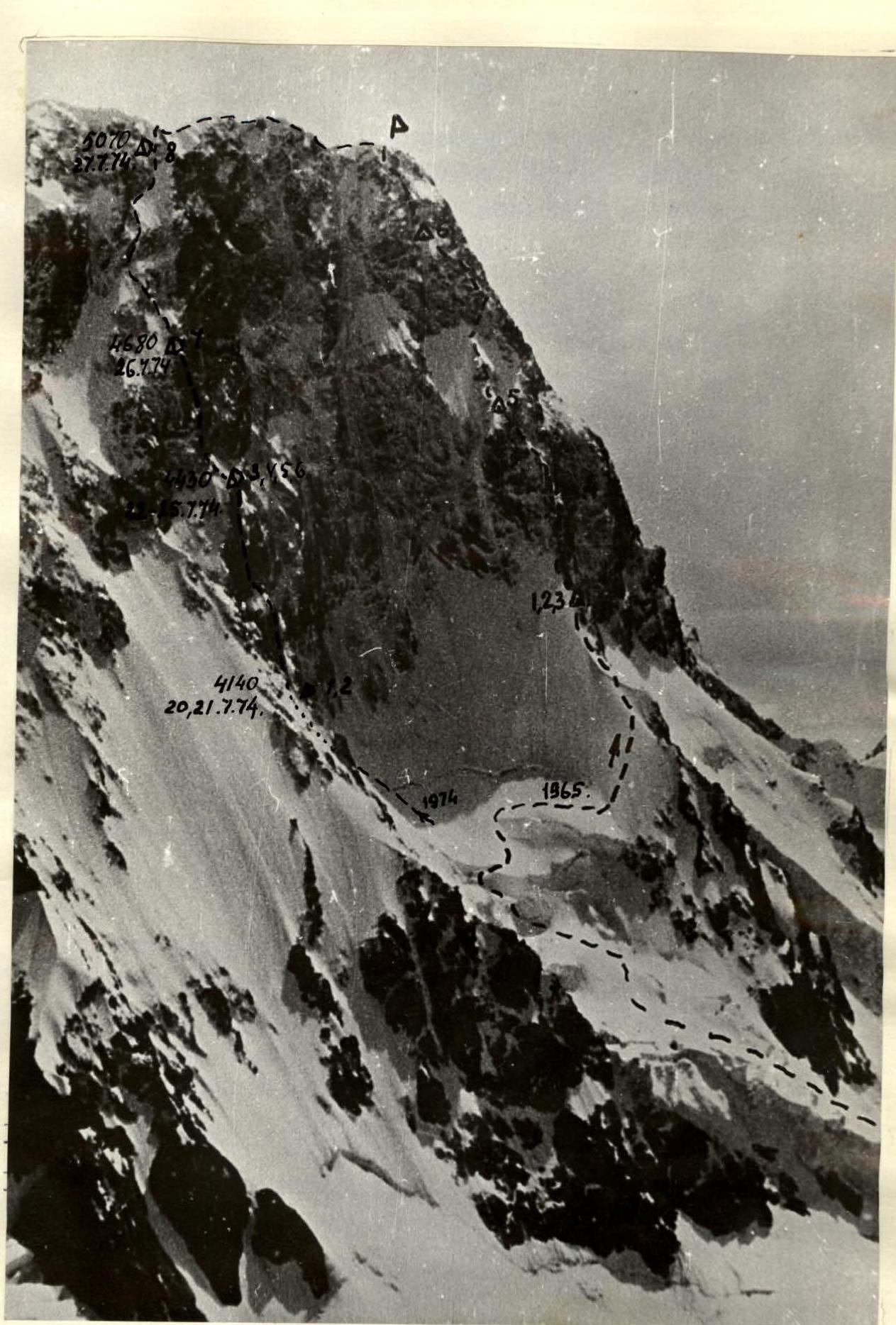
- Profile shot of the cirque from the top of Kh. Botova (4300 m). The cirque character of the wall does not allow for another profile of the route.
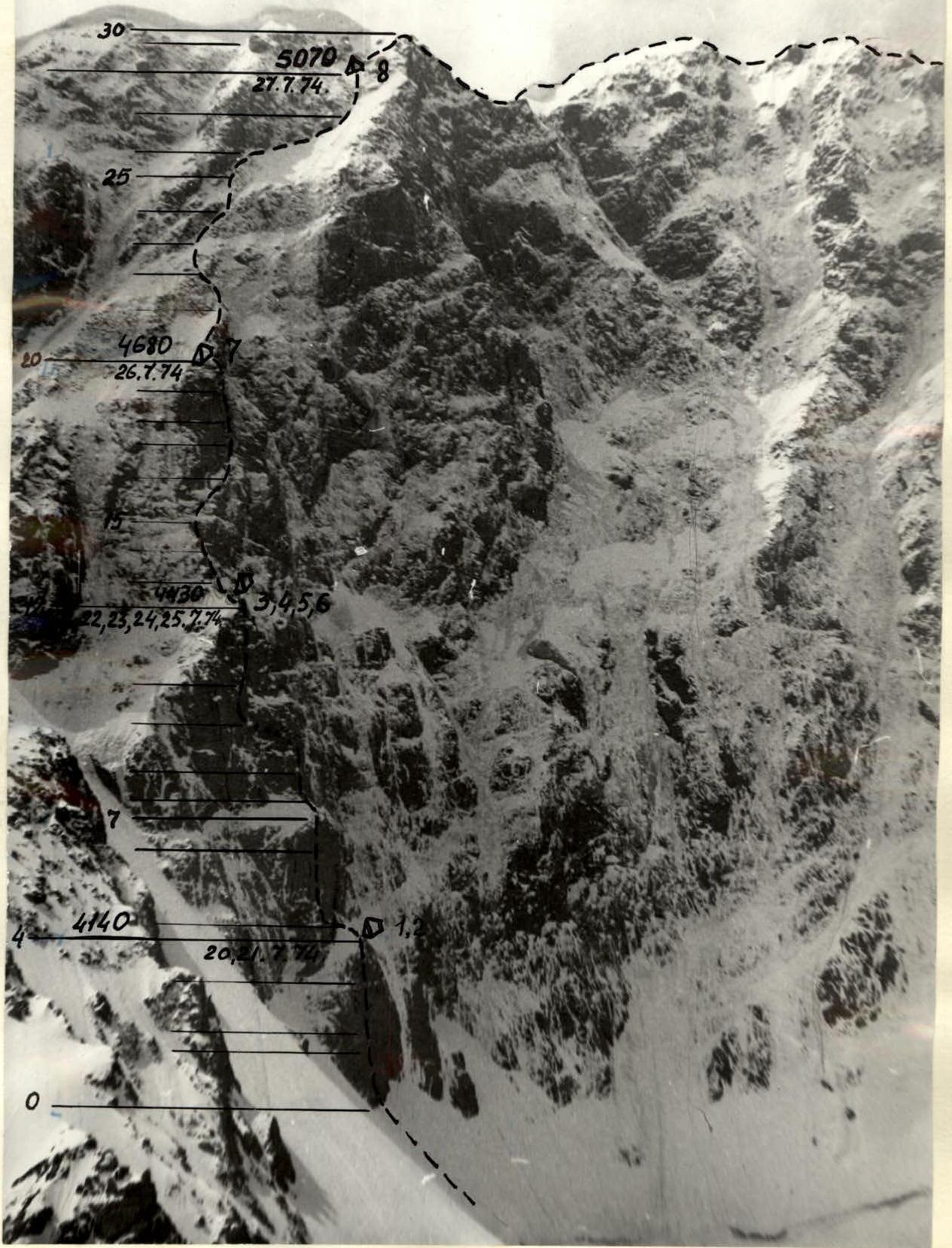
- Map of the north wall of Jigit Peak.
Description of the Route Passage
On July 15 at 6:00, the team departed from "Ala-Too" alpine camp in full readiness and arrived at the observers' camp by 11:00. Backpacks were prepared for forwarding. Paths to the route were planned:
- From the 1st step of the glacier to the left onto the "sickle" route and through a wide snow-ice slope to the right to a mark under the bastion;
- From the 2nd step onto the right part of the wide snow-ice slope under the bastion;
- To the right along the glacier to the 3rd step and under the wall to the left to the start of the route.
On July 16, the rope team Podymov — Prokopenko — Shchegolev with a tent and part of the load proceeded to the 1st step of the glacier. From here, it was clear that the width of the snow-ice slope from the "sickle" to the bastions was 4–5 ropes. Considering that the slope is avalanche-prone, this approach variant was discarded.
On July 17, the pair Zhurzdin — Kalinychev processed the ice breakaway on the 3rd step with ice pitons. Steps were cut, and ladders were hung. Avalanches ran down from the left and right. Large blocks of compressed snow flew 10–15 m from the 3rd to the 2nd step but did not reach the tent. The weather worsened, but the ropes were secured. The 3rd step was processed. On this day, the rope team Podymov — Shchegolev continued forwarding. Everyone spent the night on the moraine.
On July 19, at 7:00, the rope team Zhurzdin — Prokopenko began processing the 1st bastion. The route went steeply upwards at an angle of 75°, becoming sheer after 5 m. Progress was made using artificial footholds, holding onto downward-facing slab detachments. The micro-relief of the section featured granite slabs and blocks with few handholds. The direction of movement was towards a large overhanging slab with a detachment. From the base of the bastion to the slab was 40 m. Ice was found in the detachment. Above the slab, ropes were secured. Rest was possible. Rocks were falling from the left along the edge of the bastion. The traversed path showed that supporting points could crumble. Sometimes, slabs were deliberately broken off for more confident loading.
On July 20, the leading rope team continued processing the 1st bastion. The path lay across slabs (85°, 15 m) and then across rock blocks (75–80°, 10 m). Progress was much harder due to the early hour. Hands froze, and a cold wind blew. The bastion ended in a jumble of large, ice-covered rocks. A spot was organized on the shoulder of the bastion for receiving backpacks. Backpacks were pulled up in two stages: to an overhanging shelf (50 m) and onto the shoulder of the bastion. By 19:30, the entire group was on the bastion. A sitting bivouac was arranged.
On July 21, the frosty morning cast a white-matte sheen of frost on the surrounding rocks, and the sheer walls of the 2nd bastion took on a forbidding, cold appearance. Discussions resumed on where to start the 2nd bastion wall. The start of the ascent to the right along the couloir seemed несложным, but frequent falls of ice fragments and rocks observed the previous day spoke against this option.
On July 22, the first rope team Zhurzdin — Prokopenko processed the 3rd bastion. The route went right upwards, bypassing two overhanging rocks. A complex internal angle led to a narrow, inclined shelf, followed by a steep wall. Progress was very difficult, with extensive use of artificial footholds and ladders. By 16:30, the rope team reached the shoulder of the 3rd bastion and began organizing the pulling up of backpacks.
On July 23, the rope team Prokopenko — Shchegolev processed the 4th bastion. The route went straight up across rocks of medium difficulty, with increasing steepness. A complex ice-covered internal angle was overcome using ladders and artificial footholds. The weather deteriorated, with strong gusts of wind and snow.
On July 24–25, the weather was bad, with continuous snow and wind. The team decided to wait it out.
On July 26, the weather improved slightly, and the team decided to proceed. The rope team Zhurzdin — Prokopenko cleared the route of snow and checked pitons.
On July 27, the weather was clear and frosty. The rope team Prokopenko — Zhurzdin began moving up the ridge. The route involved overcoming a steep snow-covered rock wall, a vertical internal angle, and a snow-ice ascent. Progress was complicated by snow covering all ledges and handholds. By 21:30, the last participant, Yu. Shchegolev, reached a rock on the counterfort, and a bivouac was organized.
On July 28:
- At 6:00, Prokopenko ascended to the counterfort and then to the eastern ridge of Jigit Peak.
- By 9:00, the entire team was on the eastern ridge.
- At 13:00, the team reached the summit of Jigit Peak.
- At 13:30, they began descending to the col between Jigit Peak and Festivalnaya Peak.
- By 19:00, they descended to the Karakolsky glacier, and two hours later, to its moraine, where they spent the night.
On July 29:
- At 10:00, they arrived at the base camp.
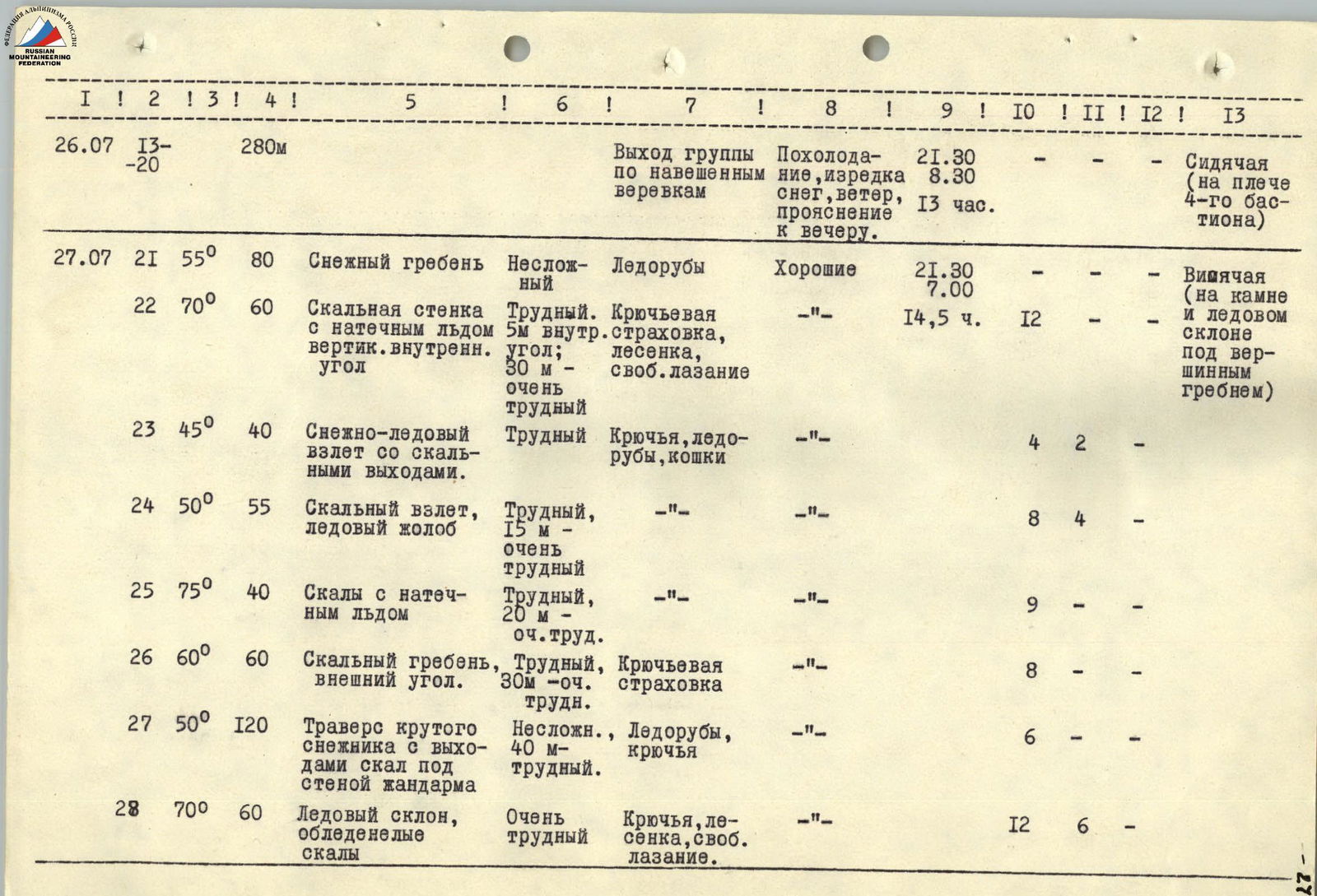
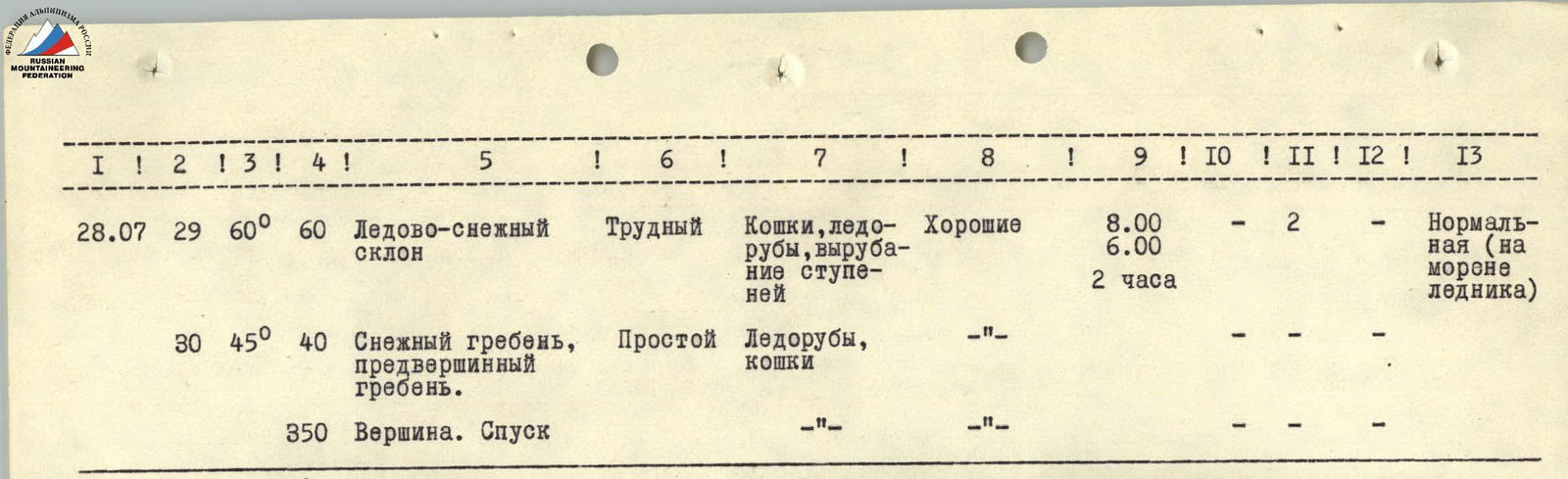
TABLE OF MAIN CHARACTERISTICS
Ascent Route: Jigit Peak, north wall, via bastions on the left part of the cirque.
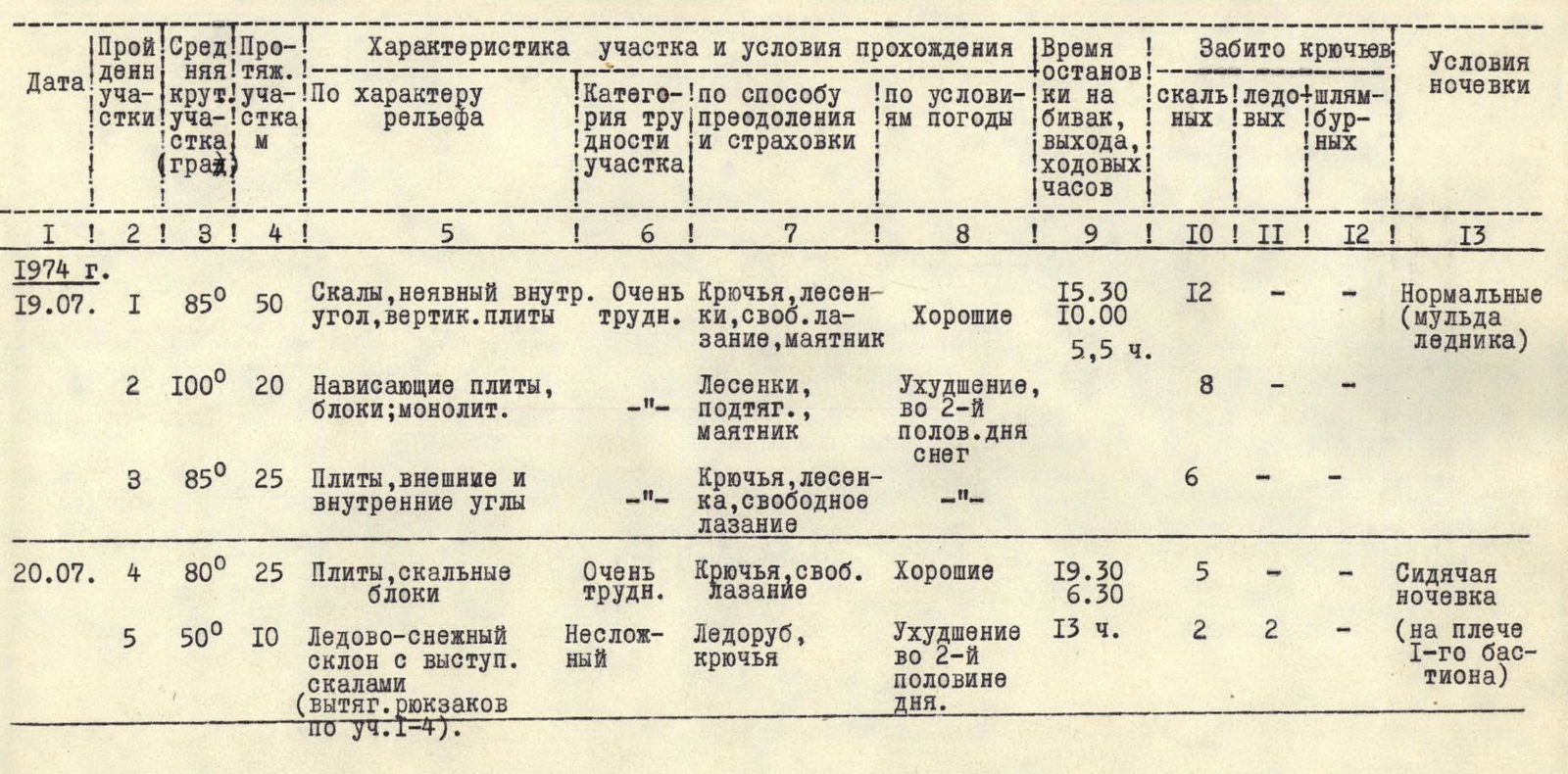
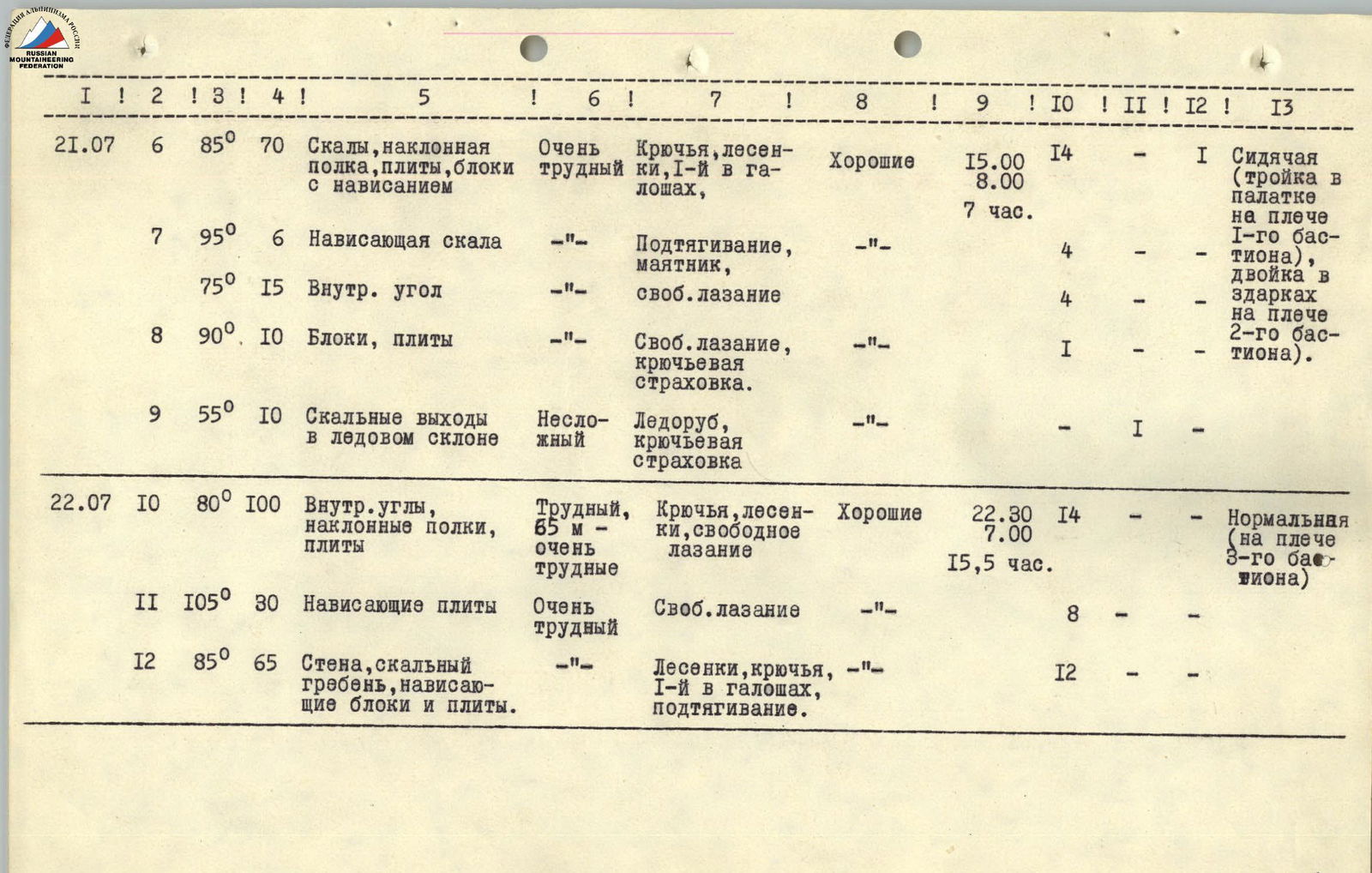
| Date | Section | Steepness (°) | Length (m) | Characteristics of the Section and Climbing Conditions | Difficulty Category | Method of Overcoming | Weather Conditions | Time of Stops: Bivouac, Departure, Climbing Hours | Pitons Driven: Rock | Pitons Driven: Ice | Pitons Driven: Bolt | Bivouac Conditions |
|---|---|---|---|---|---|---|---|---|---|---|---|---|
| 19.07 | R1 | 85 | 50 | Rocks, non-obvious internal angle, vertical slabs | Very difficult | Pitons, ladders, free climbing, pendulum | Good | 15:30 (arrival), 10:00 (departure), 5 h 30 min (climbing) | 12 | — | — | Normal (glacier cirque) |
| R2 | 100 | 20 | Overhanging slabs, blocks; monolith | Very difficult | Ladders, pulling up, pendulum | Deterioration, snow in the 2nd half of the day | 8 | — | — | |||
| R3 | 85 | 25 | Slabs, external and internal angles | Very difficult | Pitons, ladders, free climbing | Deterioration | 6 | — | — | |||
| 20.07 | R4 | 80 | 25 | Slabs, rock blocks | Very difficult | Free climbing | Good | 19:30 (arrival), 6:30 (departure), 13 h (climbing) | 5 | — | — | Sitting bivouac (on the shoulder of the 1st bastion) |
| R5 | 50 | 10 | Ice-snow slope with protruding rocks (pulling up backpacks along R1–R4) | Not complex | Ice axe, pitons | Deterioration in the 2nd half of the day | 2 | 2 | — | |||
| 21.07 | R6 | 85 | 70 | Rocks, inclined shelf, slabs, blocks with overhangs | Very difficult | Pitons, ladders, 1st in galoshes | Good | 15:00 (arrival), 8:00 (departure), 7 h (climbing) | 14 | — | — | Sitting (triad in a tent on the shoulder of the 1st bastion, dyad in sleeping bags on the shoulder of the 2nd bastion) |
| R7 | 95 | 6 | Overhanging rock | Very difficult | Pulling up, pendulum | Good | 4 | — | — | |||
| R7 | 75 | 15 | Internal angle | Very difficult | Free climbing | Good | 4 | — | — | |||
| R8 | 90 | 10 | Blocks, slabs | Very difficult | Free climbing, piton insurance | Good | 1 | — | — | |||
| R9 | 55 | 10 | Rock outcrops in an ice slope | Not complex | Ice axe, piton insurance | Good | 1 | — | — | |||
| 22.07 | R10 | 80 | 100 | Internal angles, inclined shelves, slabs | Difficult (very difficult – 65 m) | Pitons, ladders, free climbing | Good | 22:30 (arrival), 7:00 (departure), 15 h 30 min (climbing) | 14 | — | — | Normal (on the shoulder of the 3rd bastion) |
| R11 | 105 | 30 | Overhanging slabs | Very difficult | Free climbing | Good | 8 | — | — | |||
| R12 | 85 | 65 | Wall, rock ridge, overhanging blocks and slabs | Very difficult | Ladders, pitons, 1st in galoshes, pulling up | Good | 12 | — | — | |||
| 23.07 | R13 | 50 | 20 | Ice-snow ridge | Not complex | Ice axe | Good | 20:00 (arrival), 8:30 (departure), 11 h 30 min (climbing) | — | — | — | Normal (on the shoulder of the 3rd bastion) |
| R14 | 70 | 35 | Rock ascent, sheer slab | Difficult (10 m very difficult) | Piton insurance, ladder | Good | 6 | — | — | |||
| R15 | 80 | 40 | Inclined shelf with ice accretion, vertical internal angle turning into overhang | Very difficult | Pitons, ice axes, crampons at the first | Weather deterioration | 7 | — | — | |||
| R16 | 105 | 30 | Overhanging internal angle with ice accretion | Very difficult | Pitons, ladders, pulling up | Snow grains, wind | 9 | — | — | |||
| R17 | 75 | 30 | Internal angle turning into a gutter | Very difficult | Pitons, free climbing | Snow grains, wind | 5 | — | — | |||
| R18 | 110 | 25 | Rock plug, gutters, chimney | Very difficult | Pitons, ladder | Snow grains, wind | 4 | — | — | |||
| R19 | 75 | 60 | Gutter, slabs, ice accretion | Very difficult | Piton insurance | Strong wind, snow | 7 | — | — | |||
| R20 | 80 | 40 | Slabs, inclined ledges, narrow scree shelves under overhanging rocks | Very difficult | Piton insurance | Strong wind, snow | 5 | — | — | |||
| 24.07–25.07 | Continuous snow, wind, fog, visibility not more than 10 m | Continuous snow, wind, fog, visibility not more than 10 m | Same bivouac | |||||||||
| 26.07 | R13–R20 | 280 | Group ascent via fixed ropes | Cold snap, occasional snow, wind, clearing towards evening | 21:30 (arrival), 8:30 (departure), 13 h (climbing) | — | — | — | Sitting (on the shoulder of the 4th bastion) | |||
| 27.07 | R21 | 55 | 80 | Snow ridge | Not complex | Ice axes | Good | 21:30 (arrival), 7:00 (departure), 14 h 30 min (climbing) | 12 | — | — | Hanging (on a rock and ice slope under the summit ridge) |
| R22 | 70 | 60 | Rock wall with ice accretion, vertical internal angle (30 m – very difficult) | Very difficult | Piton insurance, ladder, free climbing | Good | 12 | — | — | |||
| R23 | 45 | 40 | Snow-ice ascent with rock outcrops | Difficult | Pitons, ice axes, crampons | Good | 4 | 2 | — | |||
| R24 | 50 | 55 | Rock ascent, ice gutter | Difficult (15 m – very difficult) | Good | 8 | 4 | — | ||||
| R25 | 75 | 40 | Rocks with ice accretion | Difficult (20 m – very difficult) | Good | 9 | — | — | ||||
| R26 | 60 | 60 | Rock ridge, external angle | Difficult (30 m – very difficult) | Piton insurance | Good | 8 | — | — | |||
| R27 | 50 | 120 | Traverse of a steep snowfield with rock outcrops under the wall of a giant | Not complex (40 m – difficult) | Ice axes, pitons | Good | 6 | — | — | |||
| R28 | 70 | 60 | Ice slope, icy rocks | Very difficult | Pitons, ladder, free climbing | Good | 12 | 6 | — | |||
| 28.07 | R29 | 60 | 60 | Ice-snow slope | Difficult | Crampons, ice axes, step cutting | Good | 8:00 (arrival), 6:00 (departure), 2 h (climbing) | — | 2 | — | Normal (on the moraine of the glacier) |
| R30 | 45 | 40 | Snow ridge, pre-summit ridge | Easy | Ice axes, crampons | Good | — | — | — | |||
| 350 | Summit. Descent | Easy | Ice axes, crampons | Good | — | — | — |
NOTES:
- The difficulty category in the report is assessed on a 4-point scale:
- "very difficult" — corresponds to routes of 5–6 cat. sl.;
- "difficult" — 5 cat. sl.;
- "not complex" — 4 cat. sl.;
- "easy" — below 4 cat. sl.
- Of the number of pitons driven into rocks, 49 are ice pitons.
Team Captain — (V.I. Zhurzdin)
Team Coach — (R.G. Shafeev)
September 20, 1974
