
Passport
High-altitude class. Central Tian-Shan, South Inylchek glacier, Khan-Tengri peak via the southwestern spur of the south-southwestern ridge. Category 6B difficulty, second ascent.
- Elevation gain: 2500 m, route length: 3280 m.
Length of sections with 5-6 difficulty category: 1015 m. Average steepness of the main part of the route — 60°, of which 6B category difficulty — 120 m.
- Pitons driven:
| Rock | Bolts | Nuts | Ice |
|---|---|---|---|
| 77 | 1 | 81 | 93 |
| 6 | X | 9 | 0 |
X — reuse of previously driven pitons.
-
Team's travel hours: 70 hours, days — 7.
-
Overnight stays: 1st — carved in the ice slope 2nd — carved in the ice slope "sitting" 3rd cave in the snowy ridge crest 4th platform on the snowy ridge 5th-6th platform made of stones on the ridge
-
Team leader — Grigory Nikolayevich Bazhukov, CMS
Team members:
- Nikolay Nikolayevich Sitnikov, CMS
- Sergey Vladimirovich Mamaev, CMS
- Sergey Vladimirovich Shukhman, CMS
- Viktor Vasilyevich Ostanin, CMS
- Sergey Georgiyevich Kvashin, CMS
- Anatoly Gerasimovich Kirzhaykin, CMS
-
Coach — Sergey Borisovich Yefimov
-
Route entry: August 2, 1984 Summit: August 7, 1984 Return: August 8, 1984
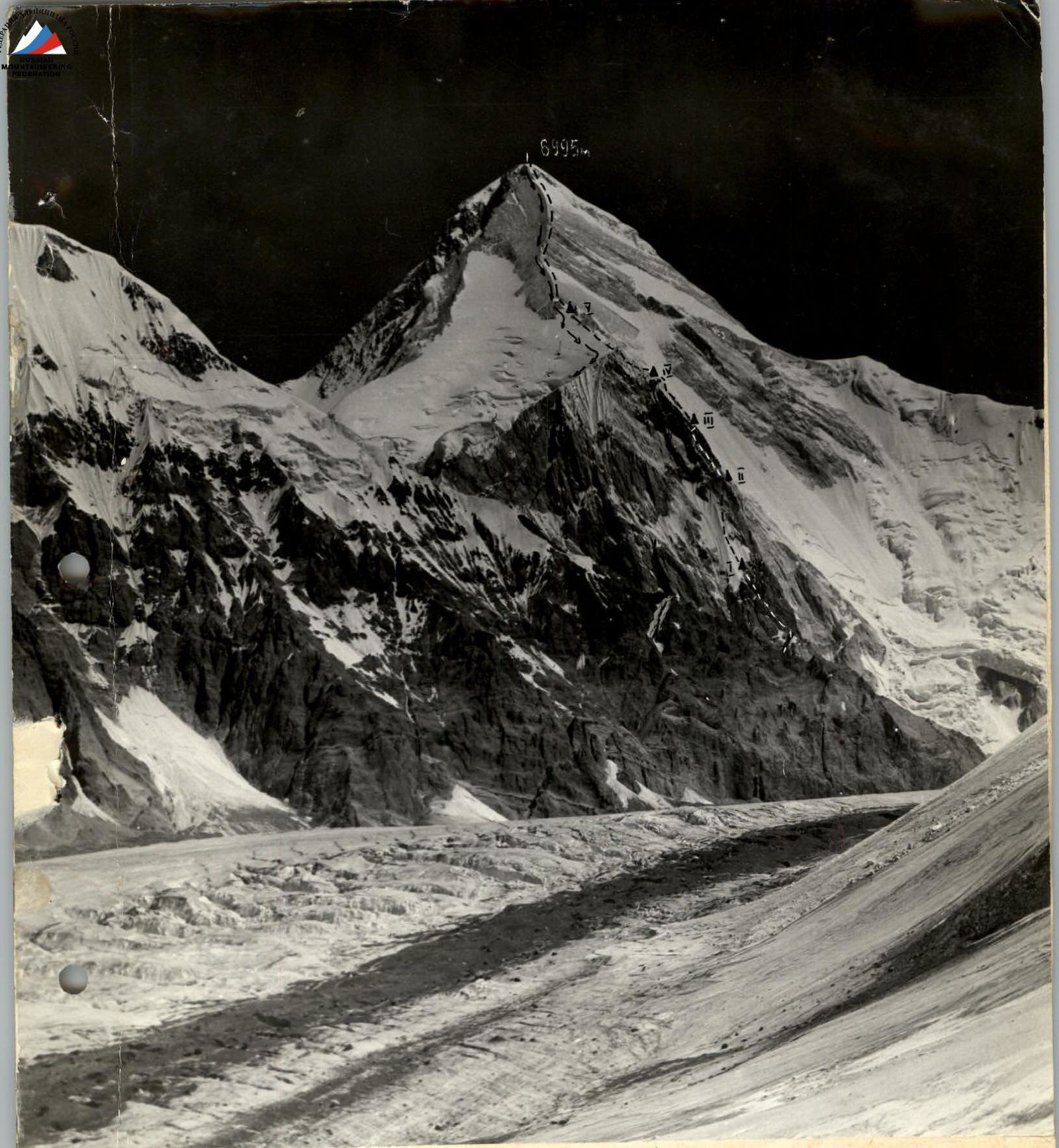
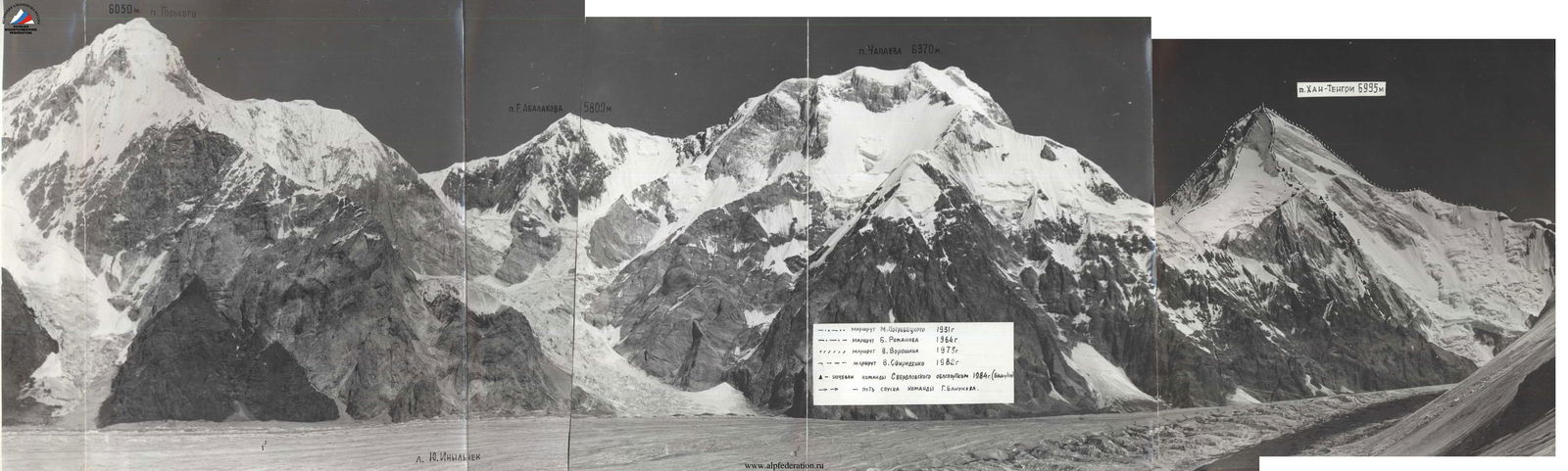
Route profile along the SW spur of the SSW ridge (route by V. Sviridenko, 1982) ascended by the Sverdlovsk regional sports committee team in 1984.
Team's overnight stays. Descent route. "Moscow" camera, F=110 mm, shooting point #2, H=4100 m
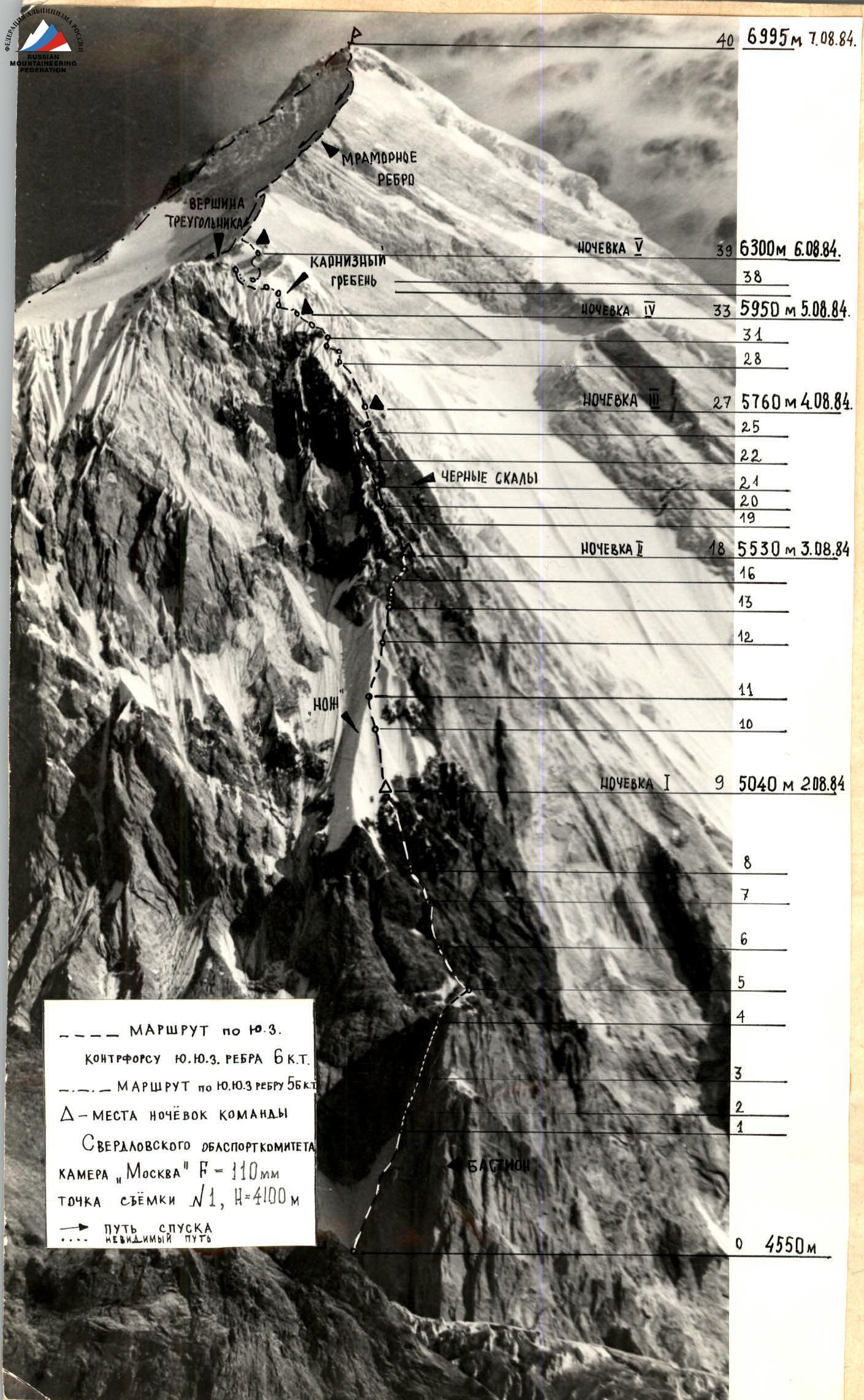
Legend for the route profile
- Route along the SW spur of the SSW ridge, 6B category difficulty
- Route along the SSW ridge, 5B category difficulty
- Overnight stays of the Sverdlovsk regional sports committee team
- "Moscow" camera F=110 mm, shooting point #1, H=4100 m
- Descent route, invisible path
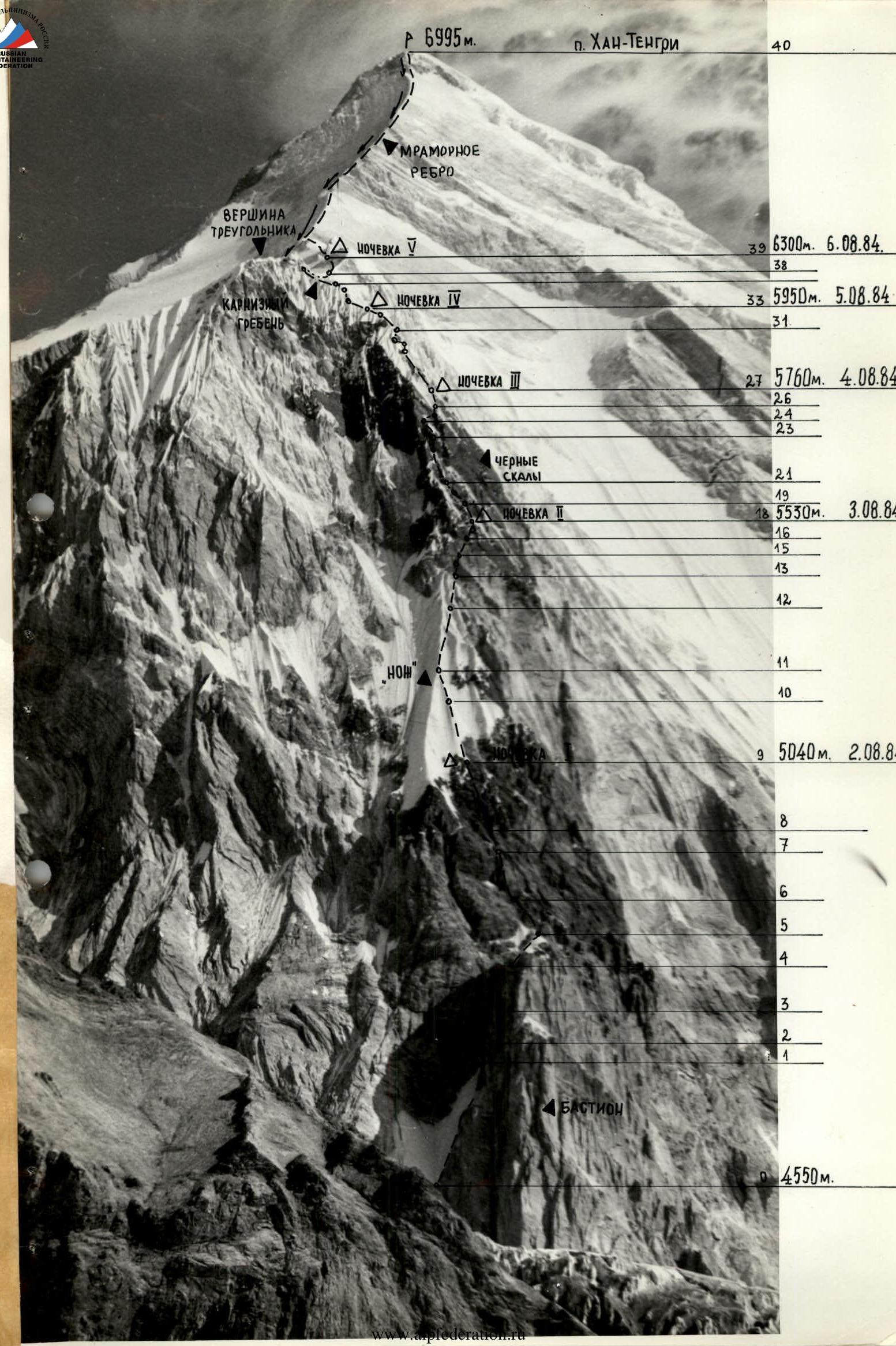
Overnight stays on the route (according to the profile data)
- Overnight stay R1: 5040 m, August 2, 1984
- Overnight stay R2: 5530 m, August 3, 1984
- Overnight stay R3: 5760 m, August 4, 1984
- Overnight stay R4: 5950 m, August 5, 1984
- Overnight stay R5: 6300 m, August 6, 1984
- Summit: 6995 m, August 7, 1984
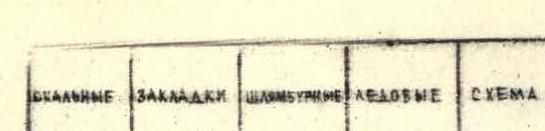 |  |  |  |  |  |  |
|---|---|---|---|---|---|---|
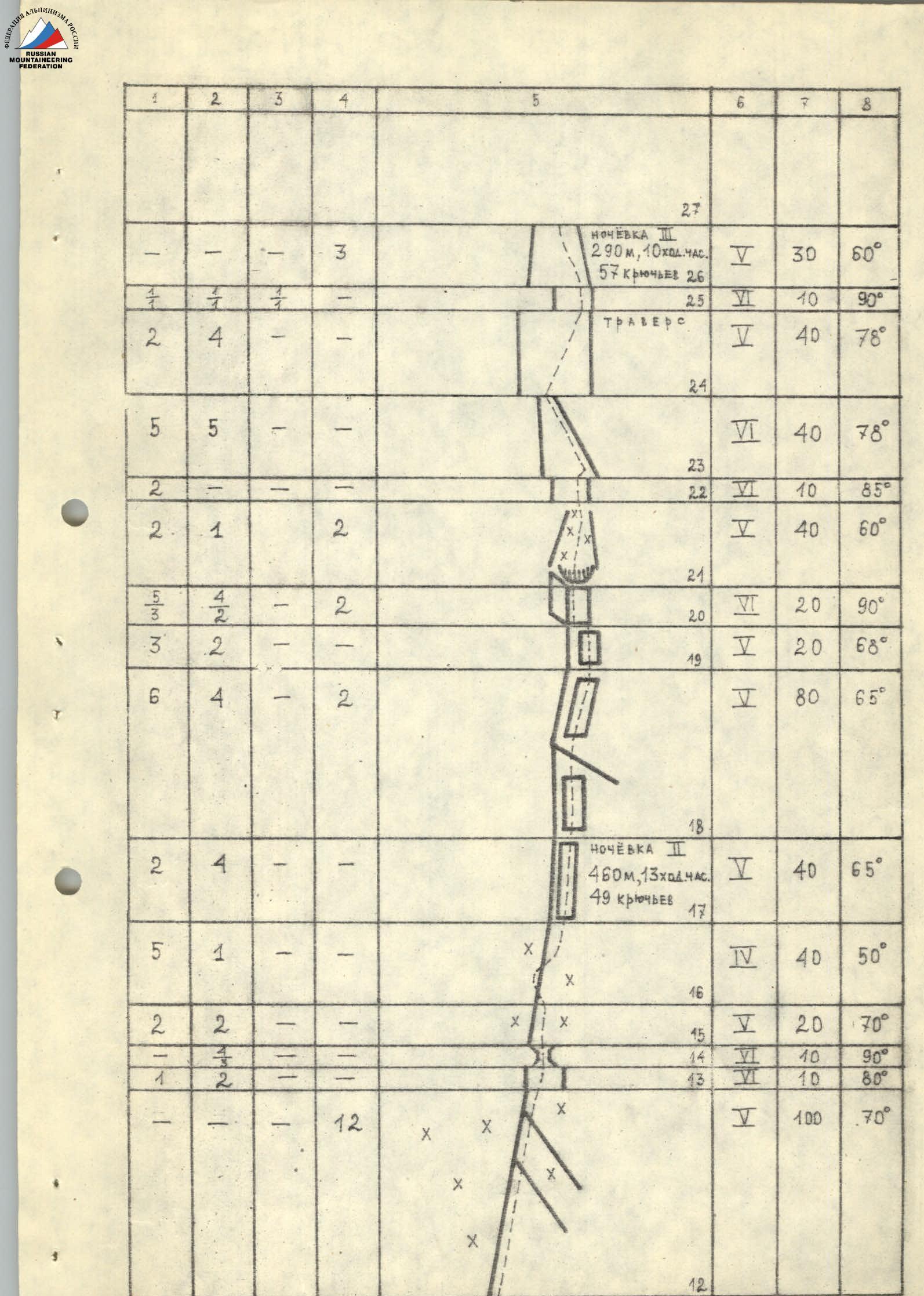
| Rock | Nuts | Bolts | Ice | Route scheme in symbols | Category | Length | Steepness |
|---|---|---|---|---|---|---|---|
| - | - | - | 10 | ![img-10.jpeg] | IV | 160 m | 55° |
| - | - | - | 4 | ![img-11.jpeg] | IV | 80 m | 52° |
| - | - | - | 6 | ![img-12.jpeg] | III | 120 m | 50° |
| 3 | 3 | - | - | ![img-13.jpeg] | V | 40 m | 80° |
| 8 | 5 | - | - | IV | 80 m | 64° | |
| 2 | 1 | 3 | V | 40 m | 56° | ||
| - | - | 5 | IV | 60 m | 50° | ||
| - | - | 5 | X | V | 30 m | 82° | |
| - | - | 3 | X X | IV | 20 m | 50° | |
| - | - | - | X | III | 170 m | 45° | |
| X | |||||||
| - | - | - | 8 | V | 80 m | 62° | |
| - | - | - | 5 | V | 40 m | ||
| - | - | - | 4 | V | 30 m | 75° | |
| - | - | - | 5 | I | 60 m | ||
| - | - | - | 2 | I | 30 m | 38° | |
| - | - | - | 2 | V | 35 m | 38° | |
| - | - | - | - | VI | 5 m | 90° | |
| - | - | - | 2 | VI | 20 m | 77° | |
| - | - | - | - | VI | 15 m | 90° | |
| - | - | - | 9 | V | 120 m | 60° | |
Sheet 7
Team's Tactical Actions
The basic principle underlying the tactical plan, unlike the first-ascent team, was to pass sections up to the next bivouac without preliminary processing of the entire route. The whole team would move from the overnight stays without dismantling the tent.
Only preliminary processing of individual sections was carried out in the evening hours by a pair, with simultaneous preparation of a platform for the tent by the remaining team members (sections R19, R29).
A strict time regime for departure and organization of the bivouac was observed. The food regime provided for two hot meals a day with plenty of drinking water and snacking during working hours.
All sections on the wall were ascended by the first-ascent climber with double-rope protection and subsequent belay station setup. The load of their backpack was distributed among all participants. Participants followed the belay stations with a safety rope using two ascenders. The lead climbing pair was determined the day before by the team leader to work on specific sections. The presence of several leaders capable of working on any terrain facilitated the planning of the load on the lead climber. Thus:
- on sections R2–R5, R22–R24, R30–R32 — S. Shukhman worked;
- on sections R6–R9, R19–R21, R25–R29, R33, R36 — Mamaev worked;
- on sections R10–R15 — A. Kirzhaykin worked;
- on sections R16–R18, R34–R35, R37 — V. Ostanin worked.
The ascent plan was fulfilled in days, although there were deviations from the tactical plan during the ascent. The deviation was related to the difficulty of traversing the snowy ridge with cornices in the second half of the day, which forced the team to organize an unplanned overnight stay on the snowy ridge above the section of black rocks.
Subsequently, in connection with the available information about the possible passage of the marble ridge during the day, the team:
- abandoned the planned overnight stay at 6600 m;
- organized a platform at 6300 m.
However, the team reached the summit with a tent and a stove.
There were no good places for organizing overnight stays on the route. The first platform for the tent was carved in the ice slope. The second platform, due to the thin ice, turned out to be "sitting". For the third overnight stay, in addition to the carved ice platform, a small cave was dug in the snowy ledge.
The platform for the fourth bivouac was dug in the snowy ridge, the 5th and 6th were made of stones on the ridge.
Protection on deep snow was carried out using anchor pitons (sections R33–R34); on snowy-ice sections — with ice pitons after clearing the ice. The team's equipment with crampons developed by E. A. Muravyov was of great importance. Most of the steep ice sections were traversed with ice axes with replaceable picks. The terrain of the route allowed observing the team's movement along the entire path. Communication with the group was carried out via a "Lastochka" type radio station.
Sheet 9
Original title: Description of the route by sections.
The route, generally straightforward and logical, has two main sections:
- I. The main, wall section, up to 1800 m long — in the form of a spur passing through the middle part of the so-called "triangle" — a steeply dropping south-southwestern slope of Khan-Tengri peak.
- II. A pronounced, homogeneous, southwest "Marble ridge" represented by two "sickles".
In the wall section, one can distinguish:
- a rocky bastion;
- then a pronounced snowy-ice ridge — "knife", dividing into two parts at the top;
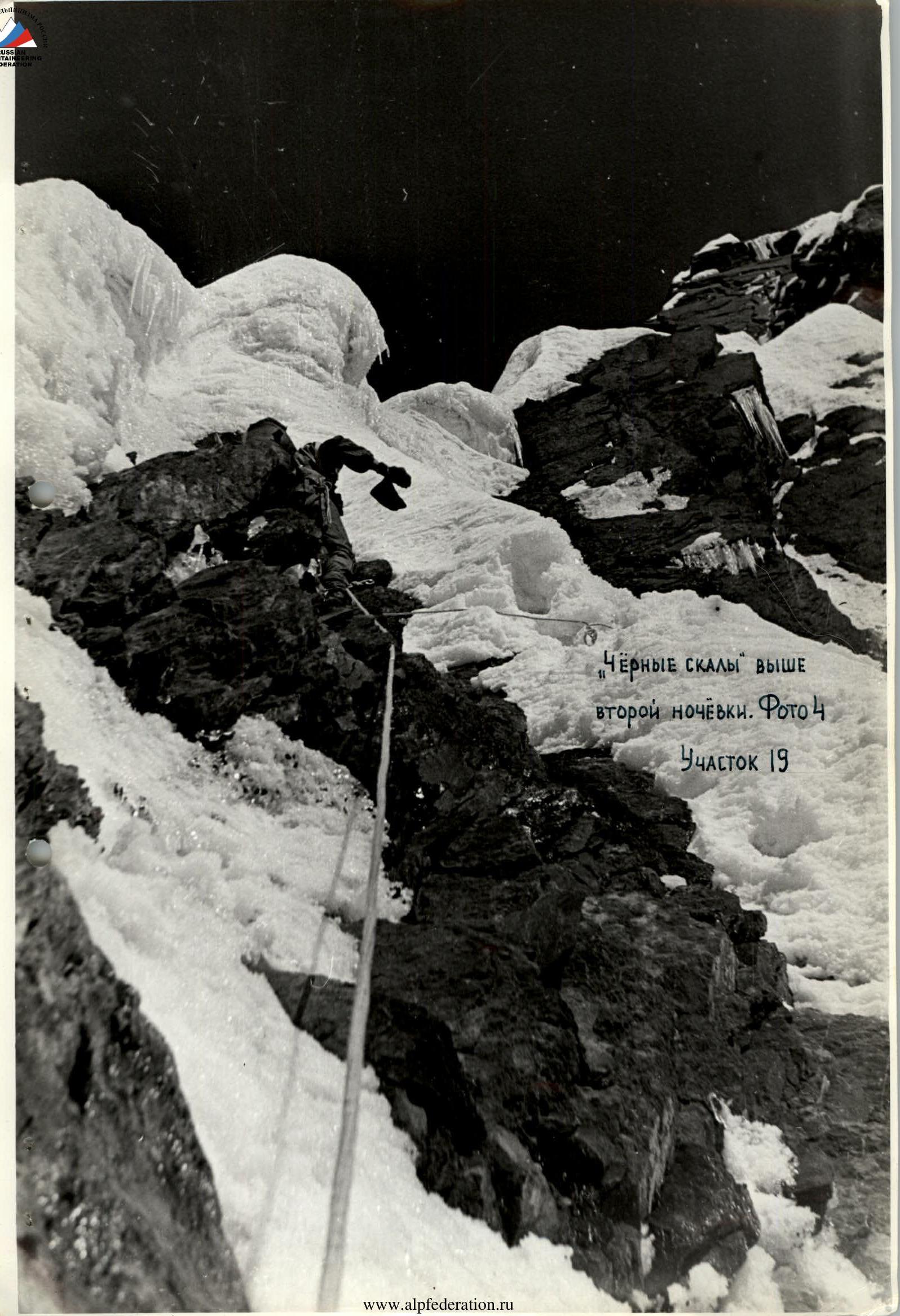
- a section of black rocks, ending with a snowy corniced ridge leading to the apex of the triangle.
Throughout its length, the route is safe from avalanches and rockfall. The only section where avalanches are possible — according to our observations and the description by the first-ascent climbers — is the snowy-ice knife.
A feature of the route is its combined nature — the presence of:
- steep rocky sections,
- rocks covered with ice,
- steep snowy-ice sections and ice,
- a corniced ridge.
August 2, 1984. Entry onto the route
Simultaneous movement in pairs along the snowy-ice slope, ice is fragile, under an uneven layer of snow (section R1).
Then the Shukhman–Mamaev pair works ahead: passage with subsequent organization of belay stations on sections R2–R5.
Section #3 is traversed with an ice axe — steep accretion ice, местами лёд тонкий. Protection with ice pitons.
Passage through sections of destroyed rocks, местами заснеженных and covered with ice — sections R6–R9. Section #7 ends with a narrow chimney, 7 m long. Difficult climbing.
Exit to the beginning of the snowy-ice knife. Organization of overnight stays.
August 3, 1984
The Kirzhaykin–Ostanin pair ascends sections R10–R13; under the snow is ice. Protection is possible only after clearing the ice from snow. On the last ropes before the rocks, the steepness of the ice reaches 70°, passage of all sections using two ice axes; general direction upwards, to the right with intersection of 3 ridges. Exit under a loose overhanging wall, which is traversed along a narrow, snow-filled chimney. Movement is possible only after clearing the chimney of snow (sections R14–R15). The chimney ends with an internal corner, steepness 70°, walls covered with ice (difficult climbing), then exit onto snow-covered rocks, upwards to the right with intersection of snow and ice sections in the form of ridges — to the right side of the ridge — beginning of black rocks (sections R16–R17); upwards along the right side of the ridge, consisting of black slabs covered with ice. Nuts, rock pitons, and bolt pitons of the first-ascent climbers are used (section R18). Overnight stay.
August 4, 1984
Ahead is the Mamaev–Shukhman pair. After traversing sections R19–R20 (destroyed rocks on the right half of the ridge). Mamaev, using ladders, ascends the red wall along an internal corner (R21). Then a narrowing, upper rock couloir, ending with a 85° wall on the right side, was passed by Shukhman — difficult climbing (sections R22–R24). Further, a traverse to the right (R25), a small rocky wall, exit into an ice gully, upwards (R26–R28). Overnight stay.
August 5, 1984
After the ice gully (R29), a rocky wall 15 m long, steepness 90° — traversed using ladders, then along ice-covered rocks (sections R30–R31) approach to the beginning of the sharp snowy ridge. The section is complicated by its narrowness with simultaneously deep snow, passage is possible only after digging a trench (sections R32–R33). Attempts to bypass the ridge were unsuccessful due to the steepness of the slope and snow slippage. Overnight stay.
August 6, 1984
Ahead is the Ostanin–Mamaev pair. Traversing the slope with digging deep trenches. Protection with anchor pitons. Repeated compaction of steps during advancement. Crossing the ridge with ascent along ice using ice axes with clearing of cornices (sections R34–R35).
Then traversing along the right slope (section R36), with:
- intersection of steep ice gullies,
- ridges of loose snow,
- outcrops of destroyed rocks.
Protection with ice pitons. Exit into an ice gully, upwards (section R37) to the apex of the triangle.
Passage with simultaneous protection of the initial part of the southwest ridge, approach under the lower sickle of the marble ridge (sections R38–R39). Overnight stay.
Sheet II
August 7, 1984
Movement with simultaneous and alternating protection along the marble ridge to the summit (section R40).
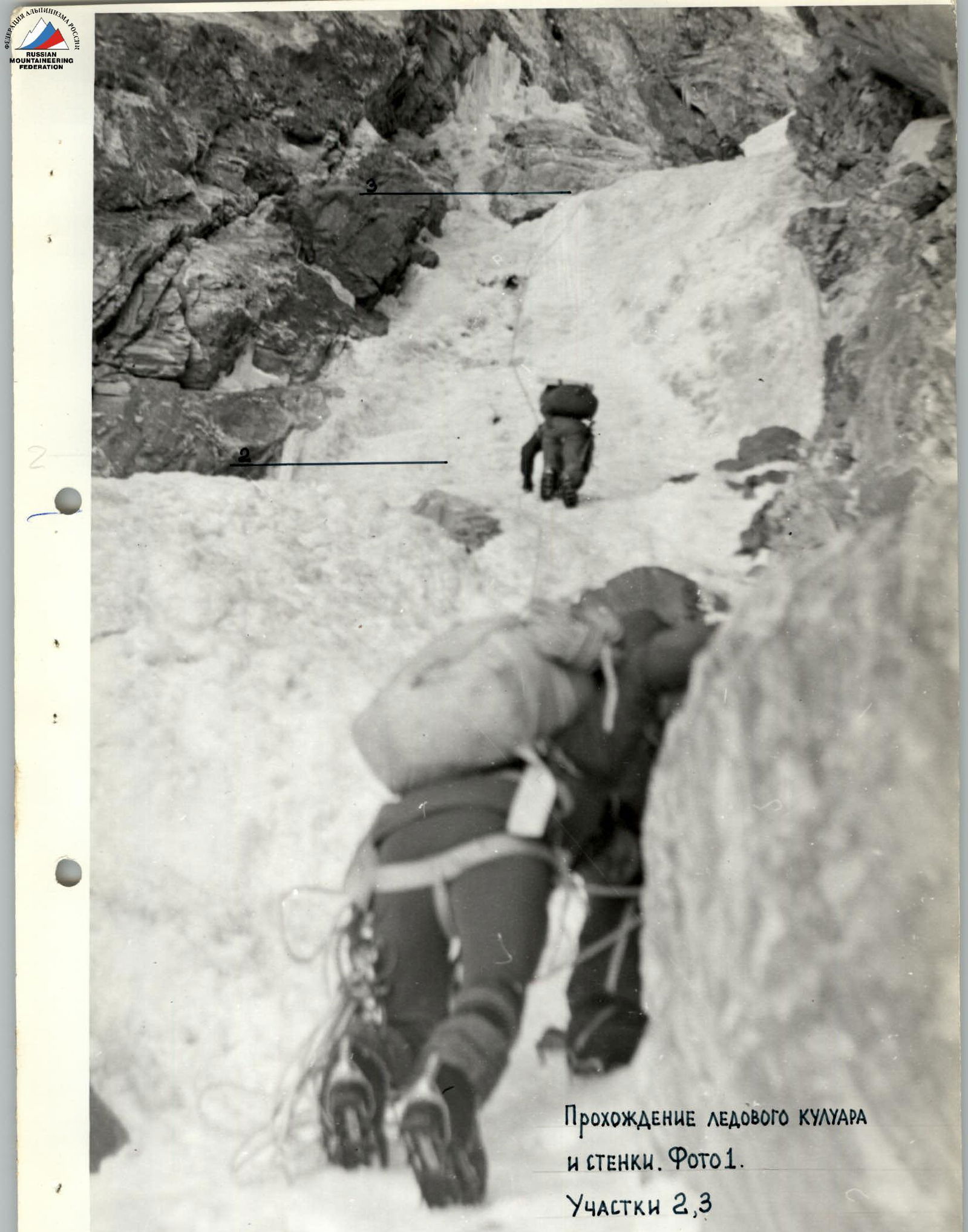
Passage of the ice gully and wall. Photo 1. Sections R2–R3
Corniced ridge. Exit from the 4th overnight stay. Photo 6. Section R34

Comments
Sign in to leave a comment