
-
Central Tian-Shan, Tengri-Tag ridge, S. Inylchek glacier, section 7.9 of the classifier
-
Peak Khan-Tengri (7010 m), from the S. Inylchek glacier along the center and couloir of the Northern wall, Mylovsky's route
-
Submitted — 6B cat. diff.
-
The nature changed
-
The route height difference — 2810 m Route length — 4316 m Length of sections:
- V cat. diff. — 81 m
- VI cat. diff. — 5 m Average steepness:
- main part of the route (sections R1–R174) — 48°
- whole route — 47°
-
Left hooks on the route: total — 6, bolted — 0
Hooks used:
Cam Bolt Ice Placement elem. Friend 226 0 47 34 22 0 0 0 0 0 -
Team's climbing hours on the route: 90 h 30 min
-
Leader: Denis Victorovich Urubko — Candidate for Master of Sports
Participants:
- Sergey Gennadievich Samoilov — Candidate for Master of Sports
- Vasily Talgatovich Pivtsov — Candidate for Master of Sports
- Alexander Yurievich Rudakov — Candidate for Master of Sports
- Damir Sergeevich Molgachev — Candidate for Master of Sports
-
Coach: Yervand Tikhonovich Ilyinsky — Master of Sports, Honored Trainer of the USSR
-
Exit to the route: August 1, 2000 7:00
Summit: August 9, 2000 22:00. Descent to B/L: August 11, 2000 22:30
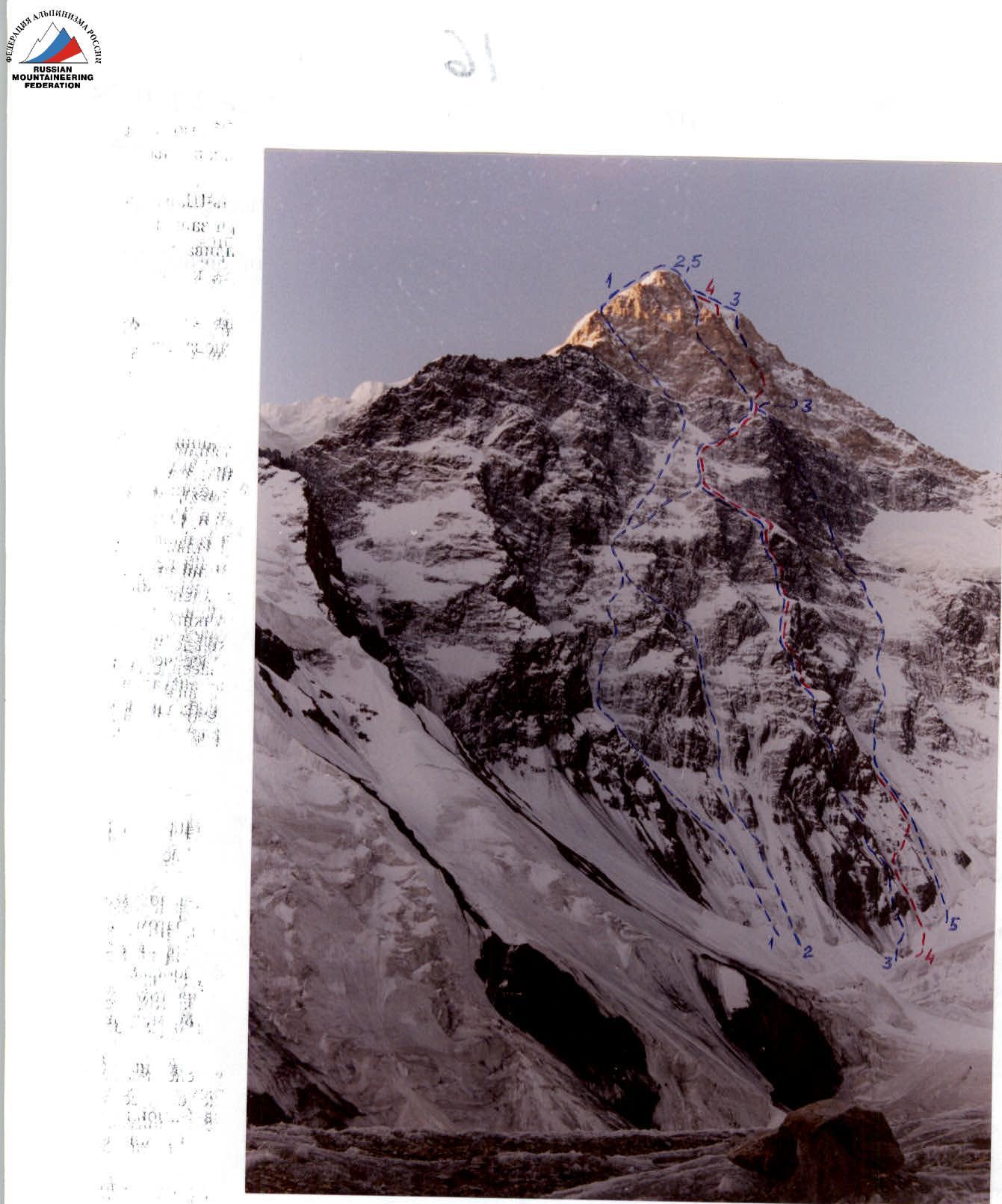
1st route of the Yekaterinburg team in 1998 – not in the classifier 2nd route of Studenin 3rd route of Mylovsky 4th route of the CSKA MO RK team (led by Urubko) in 2000 5th route of Moiseev SKA-12
Brief description of the ascent area
The Central Tian-Shan area is a grand mountain uplift, one of the most powerful in the world. Formed relatively recently, it tends to rise. Composed mainly of metamorphosed rocks:
- marble,
- limestones,
- shales. There are granite outcrops. Weather conditions are very poor, characterized as extremely unstable. The location of Tian-Shan on the border of two global climatic zones (the Takla-Makan desert with Tibet and open northern and western humid air masses on the plains) contributes to a huge amount of precipitation, accumulated in the form of glaciation. A sharp deterioration in the weather and high avalanche danger have repeatedly led to the death of qualified climbers.
The highest peak of Tian-Shan is Peak Pobeda — 7439 m. The second highest mountain giant is Peak Khan-Tengri (7010 m). Its notable and beautiful pyramid has been known to people for a long time. The gorges near the "Ruler of Spirits" were home to one of the branches of the Great Silk Road.
Preparation for the ascent
The CSKA MO RK team undergoes year-round constant training in all types of mountaineering activities.
In 1999, the core of the CSKA MO RK team made joint ascents:
- in winter on p. Sv. Korea via Bagaev's route (5B cat. diff.);
- in spring on Peak Usechyonka (5B cat. diff.);
- in summer, along with other seven-thousanders of the CIS as part of the "Snow Leopard" program, they also conquered p. Khan-Tengri and p. Pobeda in one summer season.
When developing plans for 2000, together with the Senior Coach of CSKA MO RK for mountaineering, E.T. Ilyinsky, the Northern wall of Peak Khan-Tengri was chosen as the object of ascent for the summer season. The autumn-winter period was characterized by intensive special physical loads, as well as regular ascents in the Tuyuk-Su area (from 1B to 5A cat. diff.).
In 2000:
- from March 5 to 12, participants completed A. Ruchkin's route on p. Sv. Korea (6A cat. diff.);
- one of the team members in May 2000 made a oxygen-free ascent on an eight-thousander.
And just before the assault, climbers acclimatized on the classic Khan-Tengri route up to a height of 6700 m.
In previous years, the team had the opportunity to:
- visually familiarize themselves with the route, tactical and climatic conditions of the ascent;
- receive necessary consultations from other conquerors of the Wall.
Based on all this, the group selected the necessary equipment and developed a tactic for passing the route.
Conducting the ascent
The quartet Urubko — Rudakov — Molgachev — Samoilov set out from the Base camp (4000 m) on the right-bank moraine of the S. Inylchek glacier at 5:00 on August 1, and by 13:00 they had fixed 360 m (8 ropes) of combined relief at the beginning of the route.
On August 2 at 4:00, the group left the Base, and at 7:30 they moved along the fixed ropes. Further along the snow-ice couloir, the duo Pivtsov — Molgachev worked ahead. Around 16:00, the weather deteriorated (snowfall), and therefore work on the rocks in the upper part of the couloir was hampered by a strong flow of fresh snow that accumulated from the upper part of the wall. The planned overnight stay was reached at 21:00. The site is safe and convenient.
The next day did not bring changes in the weather, so the group decided to stay in the same place, processing part of the route upwards. Rudakov — Pivtsov — Samoilov fixed 180 m of rope on complex rocks, and by 17:00 they returned to the bivouac.
On August 4, the team started further along the destroyed rocky ridge with intermittent snow fields. The duo Molgachev — Urubko led. By 13:00, the supposed place for the next overnight stay (a safe gentle section of the snow ridge) was reached, and Molgachev — Samoilov worked on processing, fixing 70 m of a steep monolithic bastion. The weather, great in the morning, deteriorated a bit after lunch. Light snow.
By morning, a fresh wind had blown, it was sunny, but streams of snow grains rained down across the entire wall, greatly complicating work on the rocks. The first to work was the Urubko — Pivtsov team. The route consisted of:
- steep rock walls and internal corners;
- a sharp rocky ridge;
- slabs in the upper part. This day brought serious difficulties with organizing reliable insurance points and fixing perlines due to the nature of the smoothed rocks and weak micro-relief differentiation. By 15:00, the "Black Bastion" was passed, and the team reached the oblique shelf in the middle part of the wall. Here, fearing avalanches and considering the steepness of the slope, they continued to work on perlines.
After an oblique traverse left — up, the group found themselves under a steep rocky wall, which guaranteed safety in case of rockfall or avalanche. The overnight stay turned out to be sitting — due to the lack of space on the steep snow under the rocks.
The fifth day of the ascent brought good weather and calm. As usual, the group started from the bivouac around 9:00 am. Pivtsov — Molgachev worked ahead on the route, and after hard work on the snow-covered rock, by noon they reached a place from which the team:
- turned right, crossing the rocky bastion;
- after a traverse, they climbed straight up 45 m;
- then deviated to the right along a snow couloir.
The overnight stay was chosen on a wide ridge protruding from under the rocky step. The overnight stay is good.
Molgachev — Urubko started working the next morning. Deep snow and the height greatly complicated the work, and the upcoming part of the path raised concerns about the impossibility of organizing a convenient bivouac — this forced them to stop for the night immediately after lunch. The Urubko — Molgachev team processed part of the route upwards, while the others prepared a site for the tent. 180 m of rope were fixed. The overnight stay turned out to be convenient.
Waking up early, the group started along the perlines. The Urubko — Rudakov duo continued working on the rock. It was relatively cool, especially on steep sections, where the leader had to climb without gloves. The last wall before reaching the ridge was steep but had good insurance points.
From here, the team's path was into the couloir. However, advancement to the right along its bottom was not possible due to the almost complete lack of opportunity to organize reliable insurance. Therefore, the path passed along the angle between the steep destroyed walls on the left and the bottom of the couloir. Here, the Pivtsov — Rudakov team worked ahead. A steep rocky step was passed head-on, and by the end of the day, the group was forced to organize a bivouac on the first seemingly safe site. The leading duo continued processing (another 135 m), and the others, moving slightly to the right, cleared a tiny area for a sitting overnight stay.
In the evening, the weather began to deteriorate, and at night, a raging wind tore the tent in several places.
In the morning, the weather is bad. Starting earlier than usual, Pivtsov — Urubko continued processing the route. A traverse to the right again led into the couloir, and the path continued between the wall on the left and its bottom. In the upper part, they reached the ice and worked on it for about 85 m.
Further:
- along rocky walls;
- snow "ledges";
- the pre-summit Western ridge.
After 150 m, they reached the summit of Peak Khan-Tengri on August 9, 2000, at 22:00. At the summit, there was wind and heavy snow.
A place for an overnight stay was chosen on the edge of the summit dome (200 m from the summit), and already in complete darkness, a site was prepared for the tent.
The next morning, the team climbed again to the top for photography and leaving a note. Bad weather.
The descent was made along the classic route to the S. Inylchek glacier. The group returned to the Base camp in full on August 11, 2000, at 22:30. There were no falls, injuries, or illnesses.
Radio communication with the Base was carried out regularly at 8:00, 14:00, and 20:00. In addition, listening was carried out from the Base camp every even hour.
Analysis of the ascent
Urubko D. (leader) — The Northern wall of Khan-Tengri was a serious test. A lot of preparatory work was done for this. Fortunately, we were lucky with the weather conditions. The route that the team took was planned in the fall during preparation. I also believe that the logic of the path taken is beyond doubt and is the right choice. The team's preparation allowed us to work relatively quickly and was just sufficient for the Wall, but more qualified individual rock technique is still desirable. All team members worked in harmony and focused on the summit. When working on the last day, several minor technical errors were made due to fatigue and altitude. But good relationships within the team were the key to success that helped us throughout the long ascent. I'm glad I got to lead such a serious route — the first of the "big walls," but hopefully not the last in our team's assets. I also want to note that the trio of Yekaterinburg residents who started at the same time as us and worked along our tracks reached the summit two days later.
Rudakov A. — I consider the ascent successful and worthy of a good assessment. Finally, a team has come together that can tackle such tasks. There were some miscalculations in the selection of equipment due to theoretical rather than practical knowledge of the route and the nature of the wall. But in principle, the team was ready for any difficulties that might arise along the way.
Samoilov S. — Having extensive experience in high-altitude ascents, I can say that the team is strong, cohesive, and communicative. A serious and good ascent was made. Overall, I believe that the group has great prospects.
Pivtsov V. — Naturally, during the ascent, the main thing is safety. This was achieved with some sacrifice of speed, but there was a large margin of safety for the team. In the upper part of the Mountain, fatigue was noticeable, but despite this, the reliability of insurance points was organized like in a textbook — competently. At the stations, all participants were under cover of natural relief elements.
Molgachev D. — For our team, this was the first ascent of such a large scale. I would like to note that despite the advantages of "sledka" hooks, they are too thin, and there was no special equipment for their extraction. Durable aluminum wedges were used very little. Thanks to competent organization, the products were distributed just right for the days, and there was enough of everything: gas and products. The team, I believe, is strong — everyone was ready to work ahead.
Ilyinsky E.T. (Senior Coach of CSKA MO RK for mountaineering) — The team's work during the preparatory period corresponded to the goal of the ascent. Only March–June were not spent intensively enough. The ascent went quite well, but the lack of experience in passing big walls was felt. For example, two days were lost when the team processed the route above the first overnight stay instead of moving forward, and when they stopped for the night under the "rusty" belt in the middle of the day. Also, naturally, I would like to see more confident work from the group leader. During training, it is necessary to:
- practice speed and dynamic stereotype of work on the rock;
- improve physical fitness and technique;
- based on plans for the next year, plan your calendar and training schedule.
Photograph of the summit (taken from the north, from a distance of 5.5 km from the summit)
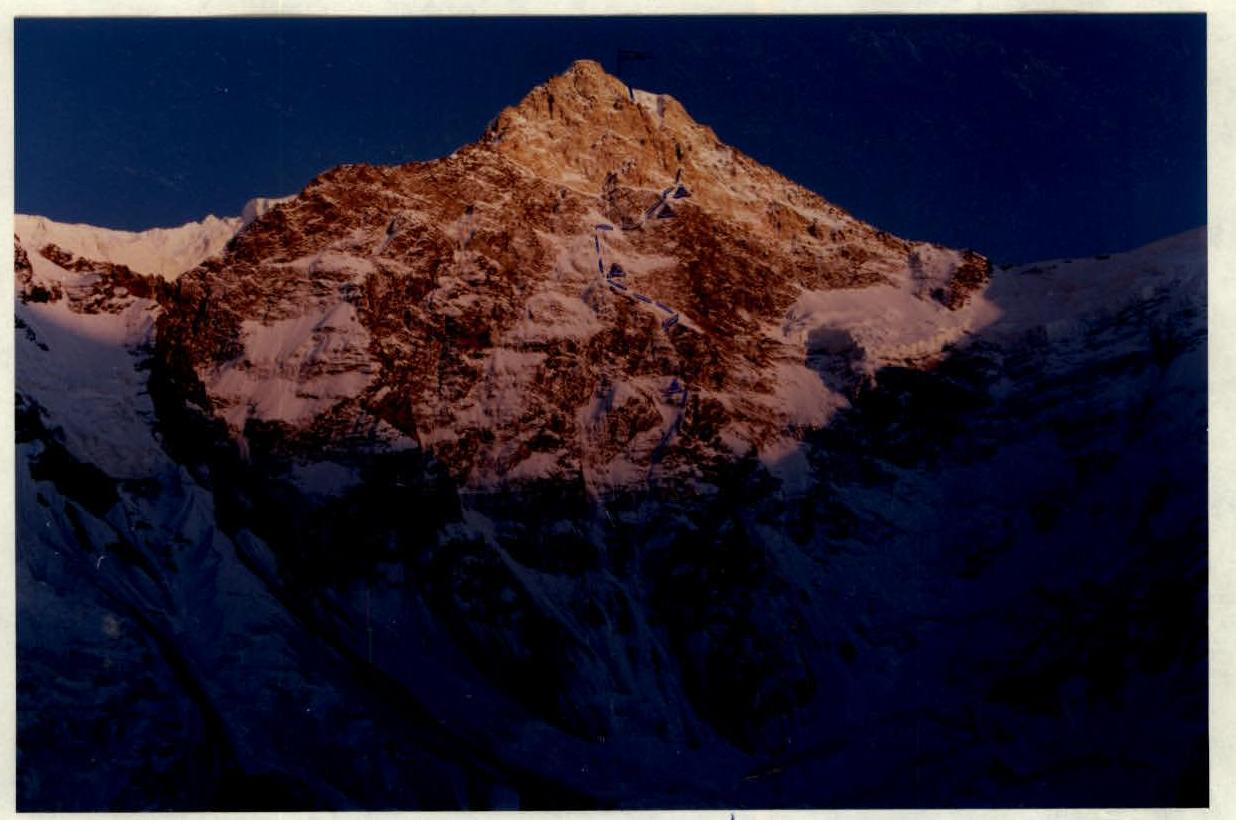
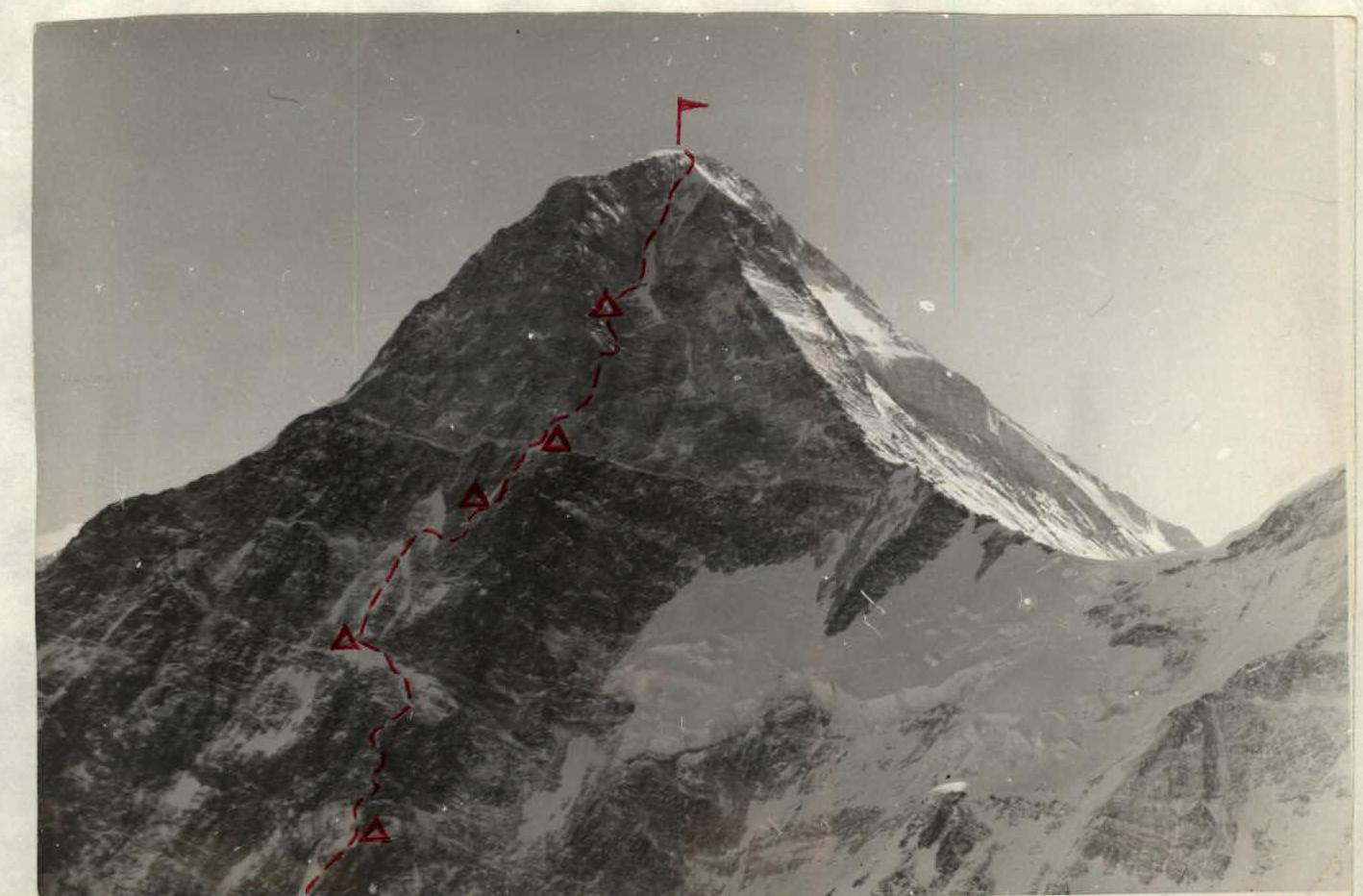
Photo of the upper part of the mountain taken from a helicopter — 2 km from the summit, altitude 5900 m.
Photopanorama of the area
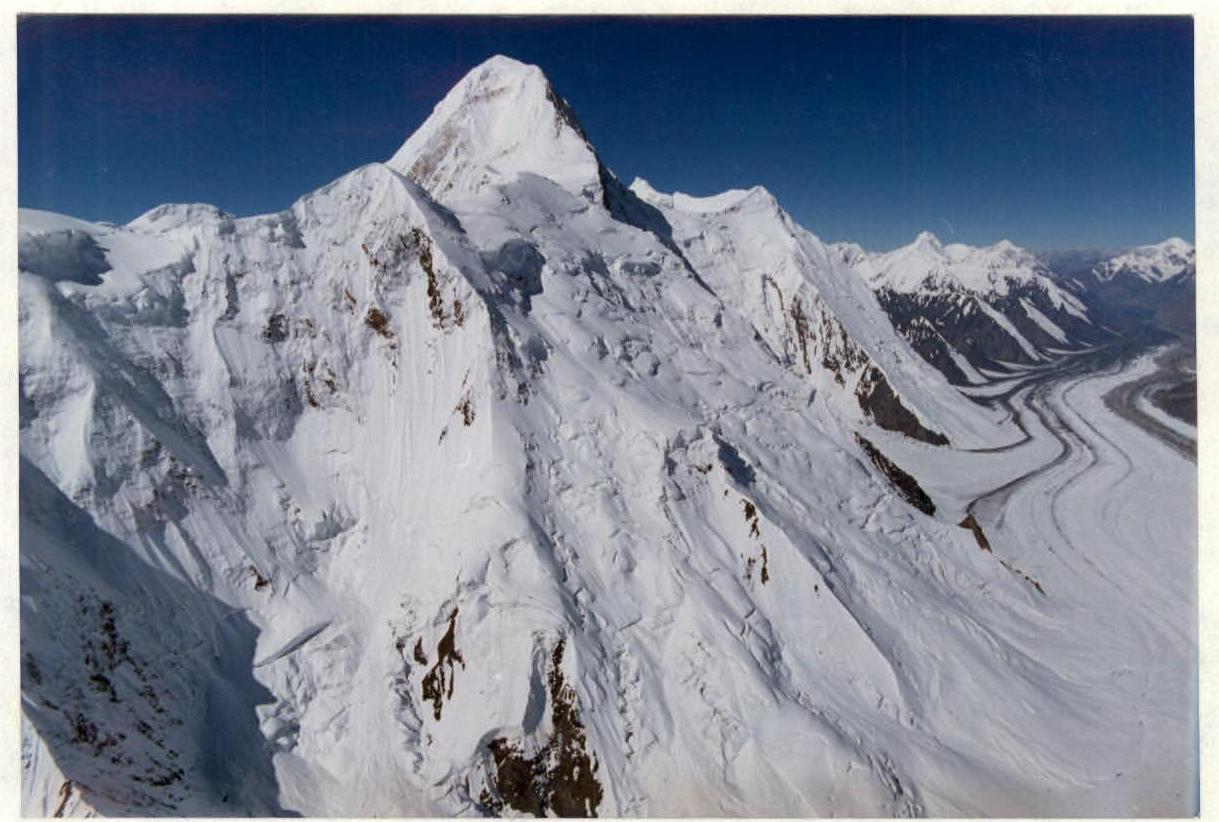
Peak Khan-Tengri (view from the East — 6 km from the summit) with Peak Saladin 6280 m (closer on the photo). In the background, behind Peak Khan-Tengri on the right — Peak Chapayeva 6371 m.
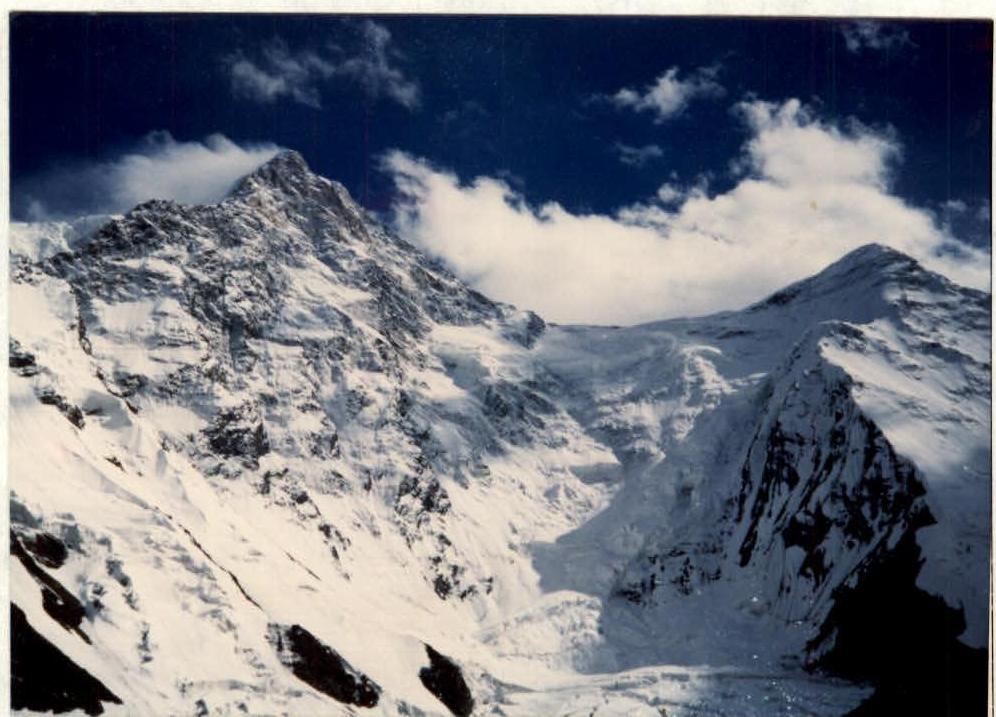
Peak Khan-Tengri (view from the North — 4.5 km from the summit) with a shoulder (6150 m) of Peak Chapayeva (on the right in the photo).
Photo of the wall profile
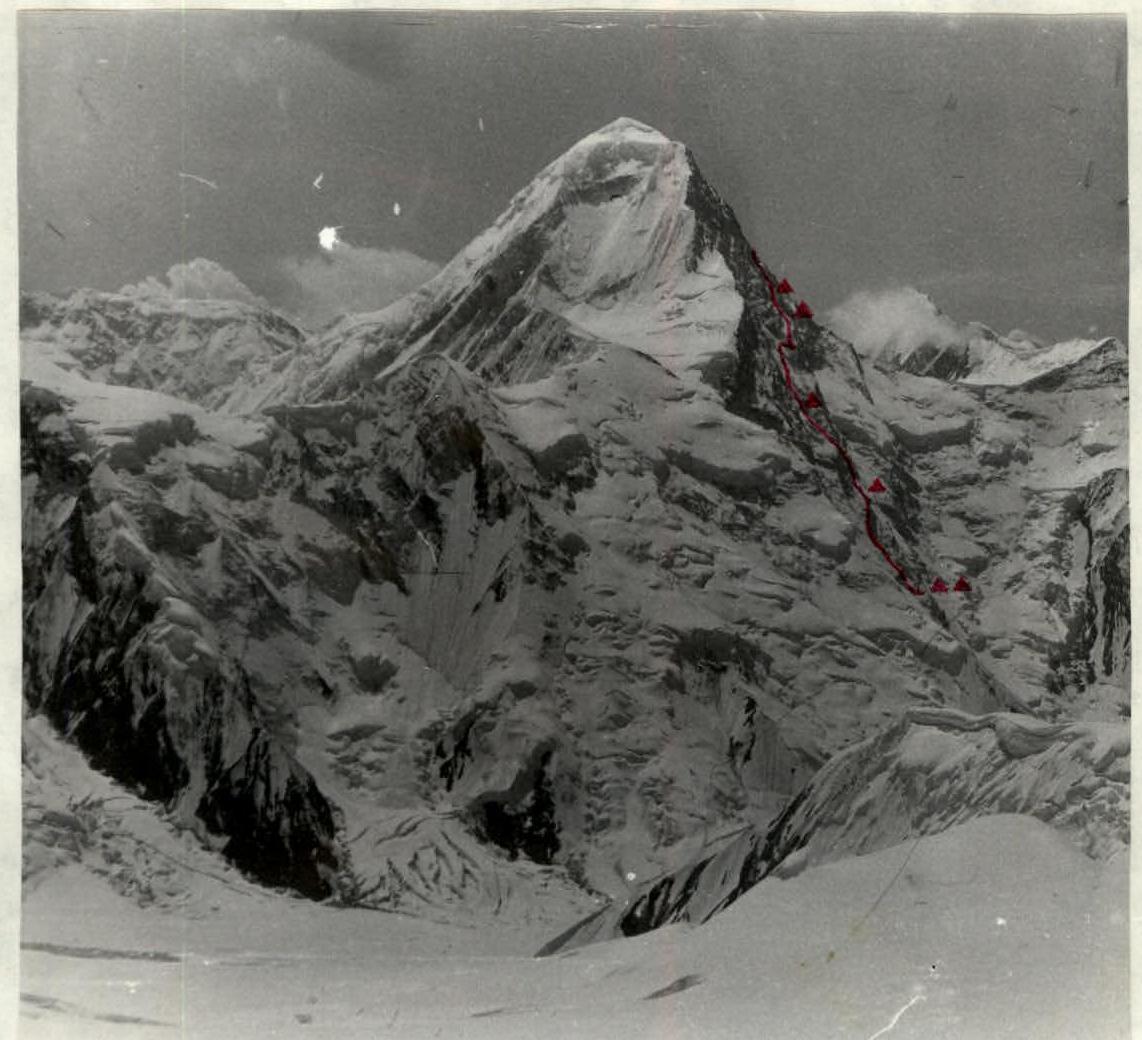
— LINE OF THE ROUTE ▲ — NIGHT STOPS
- Technical photograph of the route

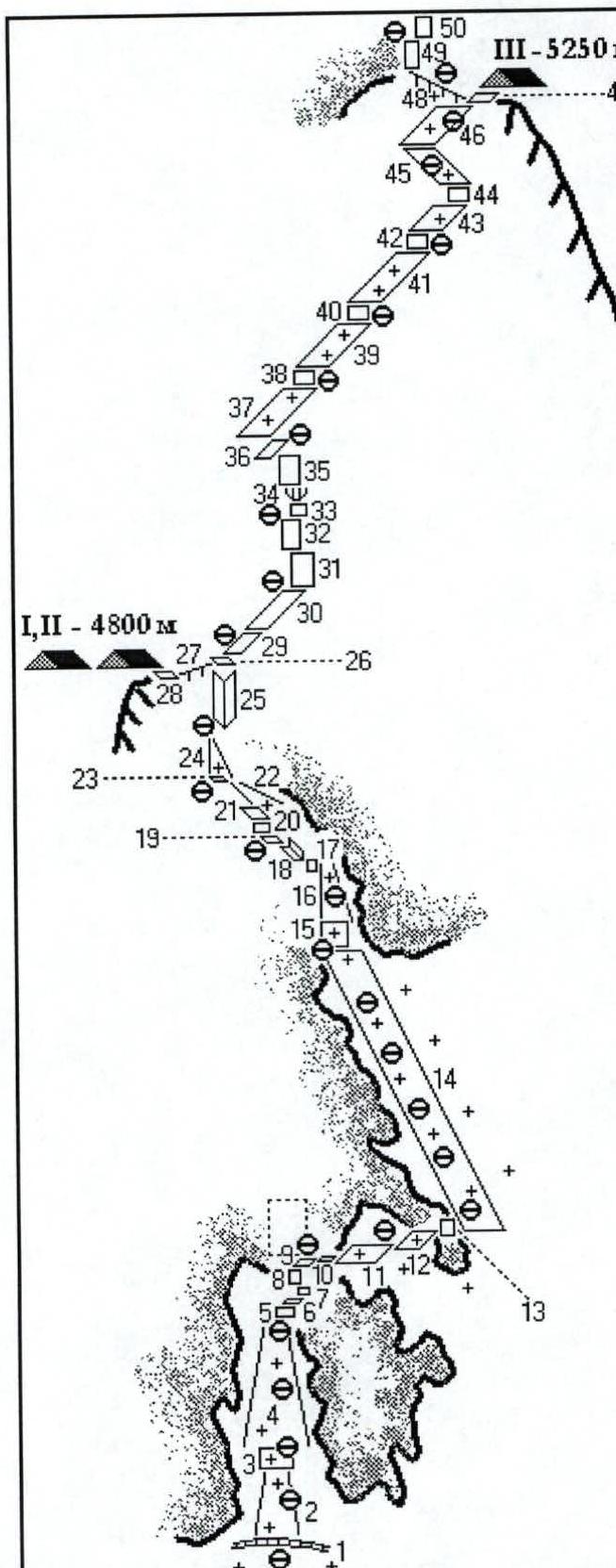
Route diagram in UIAA symbols (no ITO was used)
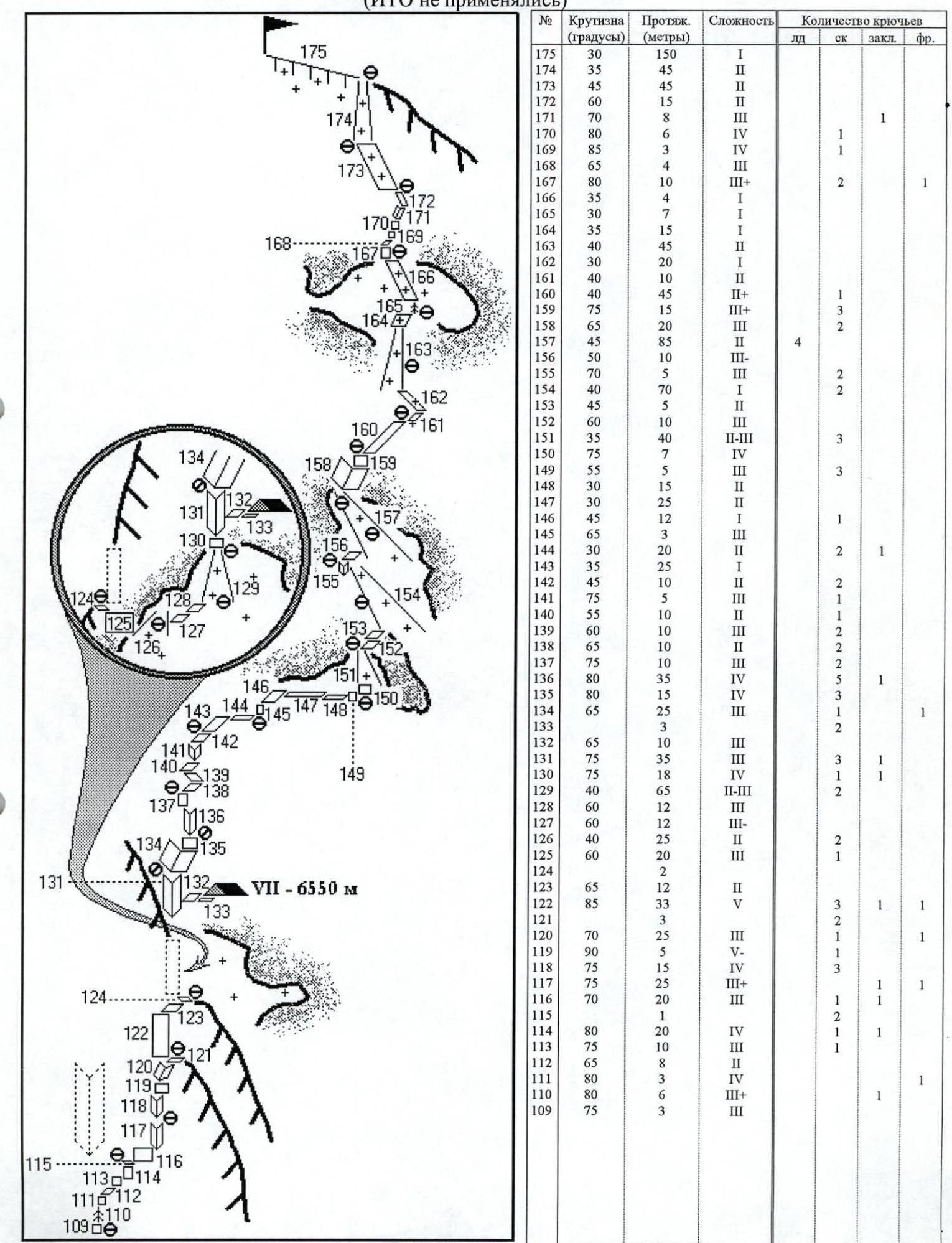
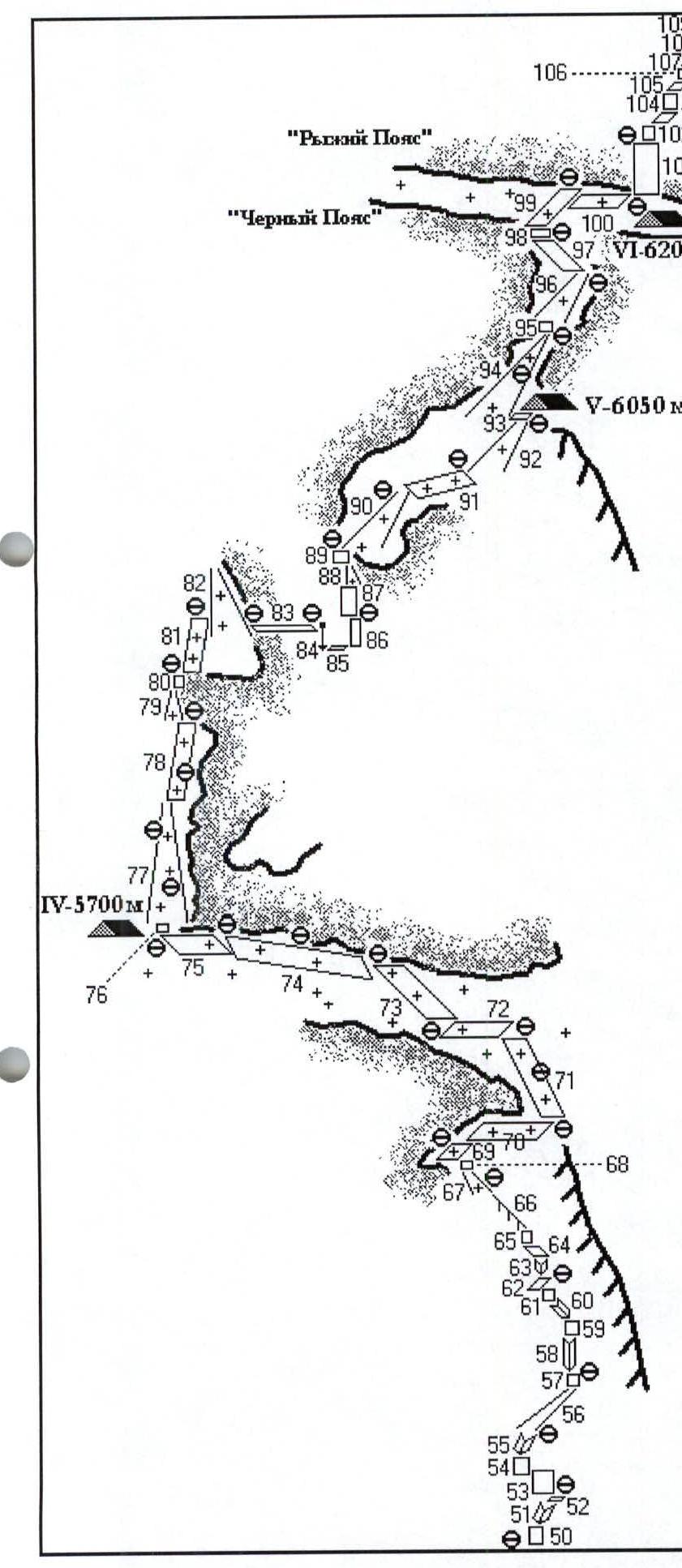


| No. | Steepness (degrees) | Length (meters) | Difficulty | LD | SC | Placement | FR |
|---|---|---|---|---|---|---|---|
| R175 | 30 | 150 | 1 | ||||
| R174 | 35 | 45 | 2 | ||||
| R173 | 45 | 45 | 2 | ||||
| R172 | 60 | 15 | 2 | ||||
| R171 | 70 | 8 | 3 | 1 | |||
| R170 | 80 | 6 | 4 | 1 | |||
| R169 | 85 | 3 | 4 | 1 | |||
| R168 | 65 | 4 | 3+ | ||||
| R167 | 80 | 10 | 3+ | 2 | 1 | ||
| R166 | 35 | 4 | 1 | ||||
| R165 | 30 | 7 | 1 | ||||
| R164 | 35 | 15 | 1 | ||||
| R163 | 40 | 45 | 2 | ||||
| R162 | 30 | 20 | 1 | ||||
| R161 | 40 | 10 | 2 | 1 | |||
| R160 | 40 | 45 | 2+ | 1 | 1 | ||
| R159 | 75 | 15 | 3+ | 1 | |||
| R158 | 65 | 20 | 3 | 3 | |||
| R157 | 45 | 85 | 2 | 4 | |||
| R156 | 50 | 10 | 3- | ||||
| R155 | 70 | 5 | 3 | 2 | 1 | ||
| R154 | 40 | 70 | 1 | ||||
| R153 | 45 | 5 | 2 | ||||
| R152 | 60 | 10 | 3 | ||||
| R151 | 35 | 40 | 2-3 | 3 | |||
| R150 | 75 | 7 | 4 | ||||
| R149 | 55 | 5 | 3 | 3 | |||
| R148 | 30 | 15 | 2 | ||||
| R147 | 30 | 25 | 2 | ||||
| R146 | 45 | 12 | 1 | 1 | |||
| R145 | 65 | 3 | 3 | ||||
| R144 | 30 | 20 | 2 | 2 | 1 | ||
| R143 | 35 | 25 | 1 | ||||
| R142 | 45 | 10 | 2 | 2 | |||
| R141 | 75 | 5 | 3 | 1 | |||
| R140 | 55 | 10 | 2 | 1 | |||
| R139 | 60 | 10 | 3 | 2 | |||
| R138 | 65 | 10 | 2 | 2 | |||
| R137 | 75 | 10 | 3 | 2 | |||
| R136 | 80 | 35 | 4 | 5 | 1 | ||
| R135 | 80 | 15 | 4 | 3 | |||
| R134 | 65 | 25 | 3 | 1 | 1 | ||
| R133 | 3 | 2 | |||||
| R132 | 65 | 10 | 3 | 1 | 1 | ||
| R131 | 75 | 35 | 3 | ||||
| R130 | 75 | 18 | 4 | 3 | 1 | ||
| R129 | 40 | 65 | 2-3 | 2 | |||
| R128 | 60 | 12 | 3 | ||||
| R127 | 60 | 12 | 3- | 2 | |||
| R126 | 40 | 25 | 2 | 2 | |||
| R125 | 60 | 20 | 3 | 1 | |||
| R124 | 2 | ||||||
| R123 | 65 | 12 | 2 | ||||
| R122 | 85 | 33 | 5 | 3 | 1 | ||
| R121 | 3 | 2 | |||||
| R120 | 70 | 25 | 3 | 1 | 1 | ||
| R119 | 90 | 5 | 5- | 1 | |||
| R118 | 75 | 15 | 4 | 3 | |||
| R117 | 75 | 25 | 3+ | 1 | 1 | ||
| R116 | 70 | 20 | 3 | 1 | 1 | ||
| R115 | 1 | ||||||
| R114 | 80 | 20 | 4 | 2 | 1 | ||
| R113 | 75 | 10 | 3 | 1 | |||
| R112 | 65 | 8 | 2 | ||||
| R111 | 80 | 3 | 4 | 1 | |||
| R110 | 80 | 6 | 3+ | 1 | |||
| R109 | 75 | 3 | 3 | 1 | |||
| R108 | 70 | 15 | 3 | 2 | |||
| R107 | 60 | 25 | 1 | ||||
| R106 | 75 | 6 | 3 | 2 | 2 | ||
| R105 | 60 | 15 | 2 | ||||
| R104 | 80 | 18 | 4 | 1 | 1 | ||
| R103 | 50 | 15 | 2 | ||||
| R102 | 70 | 8 | 3 | ||||
| R101 | 70 | 45 | 3 | 3 | 1 | ||
| R100 | 70 | 45 | 1 | 3 | |||
| R99 | 45 | 40 | 1 | 1 | |||
| R98 | 45 | 5 | 3 | 2 | |||
| R97 | 35 | 45 | 2 | ||||
| R96 | 40 | 8 | 1 | ||||
| R95 | 70 | 40 | 3+ | 1 | 1 | ||
| R94 | 45 | 90 | 2 | 1 | |||
| R93 | 5 | 3 | |||||
| R92 | 45 | 60 | 2 | 1 | |||
| R91 | 35 | 45 | 1 | 2 | |||
| R90 | 40 | 45 | 2 | 3 | |||
| R89 | 75 | 10 | 3 | 3 | |||
| R88 | 60 | 15 | 2 | 1 | |||
| R87 | 75 | 25 | 4 | 4 | |||
| R86 | 70 | 20 | 4 | 3 | |||
| R85 | 60 | 10 | 3 | 1 | |||
| R84 | 80 | 15 | 3 | 7 | |||
| R83 | 50 | 55 | 1 | ||||
| R82 | 60 | 45 | 2 | 5 | 1 | ||
| R81 | 75 | 20 | 4 | 1 | |||
| R80 | 65 | 25 | 3 | 1 | |||
| R79 | 65 | 65 | 2 | 2 | 1 | ||
| R78 | 60 | 110 | 2-3 | 6 | |||
| R77 | 75 | 5 | 3 | 1 | |||
| R76 | 50 | 45 | 2 | 1 | |||
| R75 | 45 | 90 | 1-2 | 2 | 1 | ||
| R74 | 50 | 45 | 1 | 3 | |||
| R73 | 45 | 45 | 1 | 2 | |||
| R72 | 40 | 90 | 1 | 3 | |||
| R71 | 55 | 60 | 3+ | 4 | |||
| R70 | 50 | 20 | 2 | 5 | 1 | ||
| R69 | 80 | 3 | 4 | ||||
| R68 | 65 | 15 | 3 | 2 | 1 | ||
| R67 | 75 | 20 | 4 | ||||
| R66 | 80 | 5 | 5 | 2 | 1 | ||
| R65 | 50 | 10 | 2 | ||||
| R64 | 60 | 5 | 3 | 1 | 1 | ||
| R63 | 65 | 5 | 3 | 1 | 1 | ||
| R62 | 95 | 5 | 6 | 2 | 1 | ||
| R61 | 75 | 8 | 3 | ||||
| R60 | 80 | 10 | 5 | 2 | 1 | ||
| R59 | 80 | 15 | 4 | 1 | |||
| R58 | 75 | 15 | 4 | 1 | |||
| R57 | 65 | 30 | 3+ | 3 | |||
| R56 | 75 | 10 | 3 | 1 | |||
| R55 | 85 | 10 | 5- | 2 | 1 | 1 | |
| R54 | 90 | 15 | 5 | 2 | 1 | 1 | |
| R53 | 2 | 1 | |||||
| R52 | 75 | 25 | 4 | 3 | |||
| R51 | 75 | 20 | 4+ | 2 | 2 | ||
| R50 | 75 | 20 | 4+ | 2 | 2 | ||
| R49 | 65 | 15 | 3 | 1 | 1 | ||
| R48 | 35 | 30 | 2 | 1 | |||
| R47 | 5 | 2 | |||||
| R46 | 35 | 70 | 1 | ||||
| R45 | 40 | 30 | 2 | ||||
| R44 | 75 | 10 | 3+ | 1 | |||
| R43 | 45 | 20 | 2 | ||||
| R42 | 70 | 5 | 3 | 2 | |||
| R41 | 40 | 40 | 1 | ||||
| R40 | 70 | 5 | 3+ | 1 | 1 | ||
| R39 | 35 | 40 | 1 | ||||
| R38 | 65 | 5 | 3 | 2 | 1 | ||
| R37 | 35 | 45 | 1 | ||||
| R36 | 45 | 13 | 2 | ||||
| R35 | 75 | 20 | 3 | 3 | |||
| R34 | 110 | 3 | 5 | 1 | 1 | ||
| R33 | 80 | 10 | 4 | 1 | |||
| R32 | 65 | 20 | 3 | 2 | |||
| R31 | 75 | 25 | 3+ | 1 | |||
| R30 | 50 | 40 | 2 | 3 | |||
| R29 | 45 | 10 | 2 | 4 | |||
| R28 | 20 | 10 | 1 | ||||
| R27 | 30 | 15 | 2 | ||||
| R26 | 30 | 5 | 2 | 1 | 1 | ||
| R25 | 75 | 35 | 4 | 5 | |||
| R24 | 50 | 45 | 2 | 2 | |||
| R23 | 1 | 1 | |||||
| R22 | 40 | 32 | 1 | 2 | |||
| R21 | 45 | 10 | 2 | 1 | 1 | ||
| R20 | 65 | 3 | 3 | ||||
| R19 | 35 | 8 | 2 | 2 | |||
| R18 | 65 | 10 | 3 | 1 | 1 | ||
| R17 | 75 | 8 | 3 | 1 | |||
| R16 | 45 | 50 | 2 | 3 | 1 | ||
| R15 | 85 | 15 | 4 | 3 | |||
| R14 | 45 | 235 | 2 | 20 | 1 | ||
| R13 | 65 | 10 | 3+ | 1 | |||
| R12 | 45 | 30 | 2 | 5 | |||
| R11 | 40 | 40 | 2 | 3 | |||
| R10 | 60 | 5 | 2 | 2 | 1 | ||
| R9 | 75 | 15 | 4 | 1 | 1 | ||
| R8 | 65 | 3 | 3 | 1 | |||
| R7 | 60 | 7 | 3 | ||||
| R6 | 70 | 12 | 3+ | 2 | 1 | ||
| R5 | 40 | 80 | 2 | 6 | |||
| R4 | 60 | 20 | 3 | 2 | 1 | ||
| R3 | 40 | 65 | 2 | 1 | |||
| R2 | 90 | 2 | 4 | 1 | |||
| R1 | 2 |
III – 5250 m I, II – 4800 m IV – 5700 m V – 6050 m VI – 6200 m
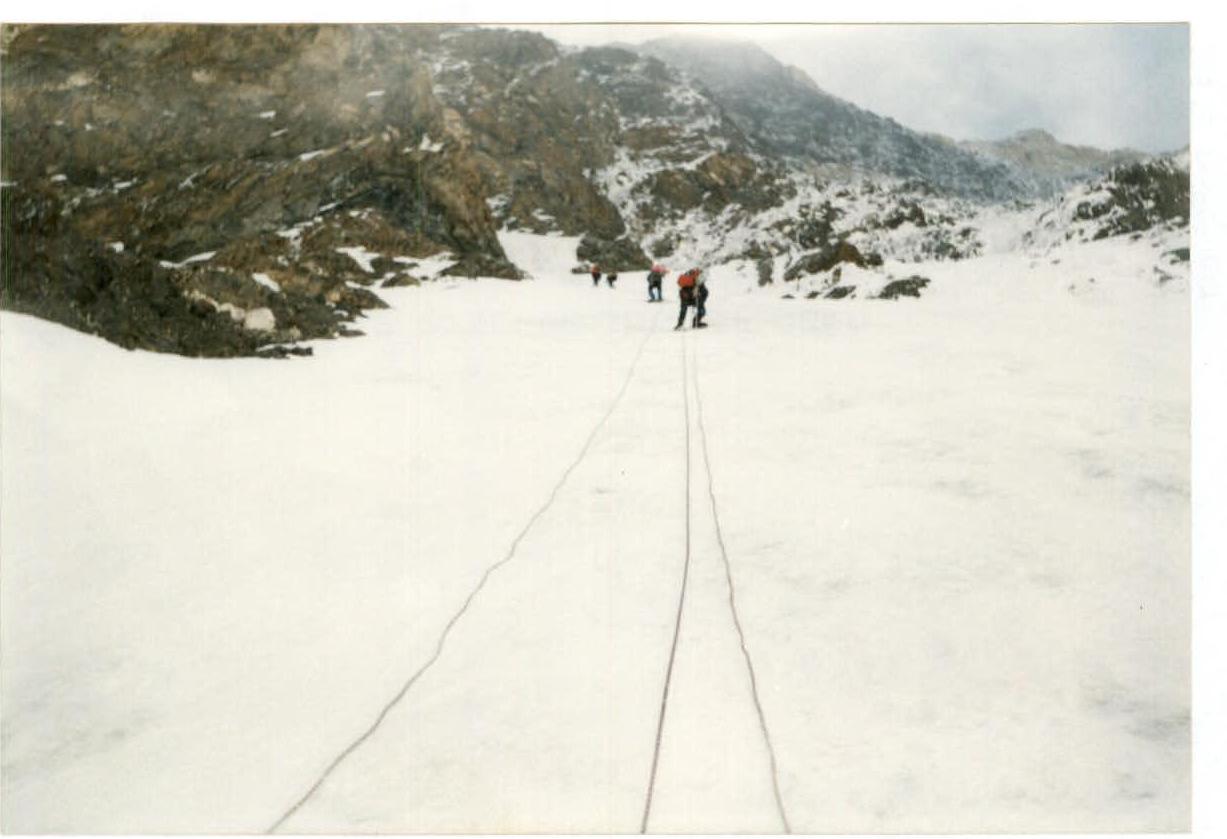
The group is working on section R14, the ice wall of section R15 is visible ahead.
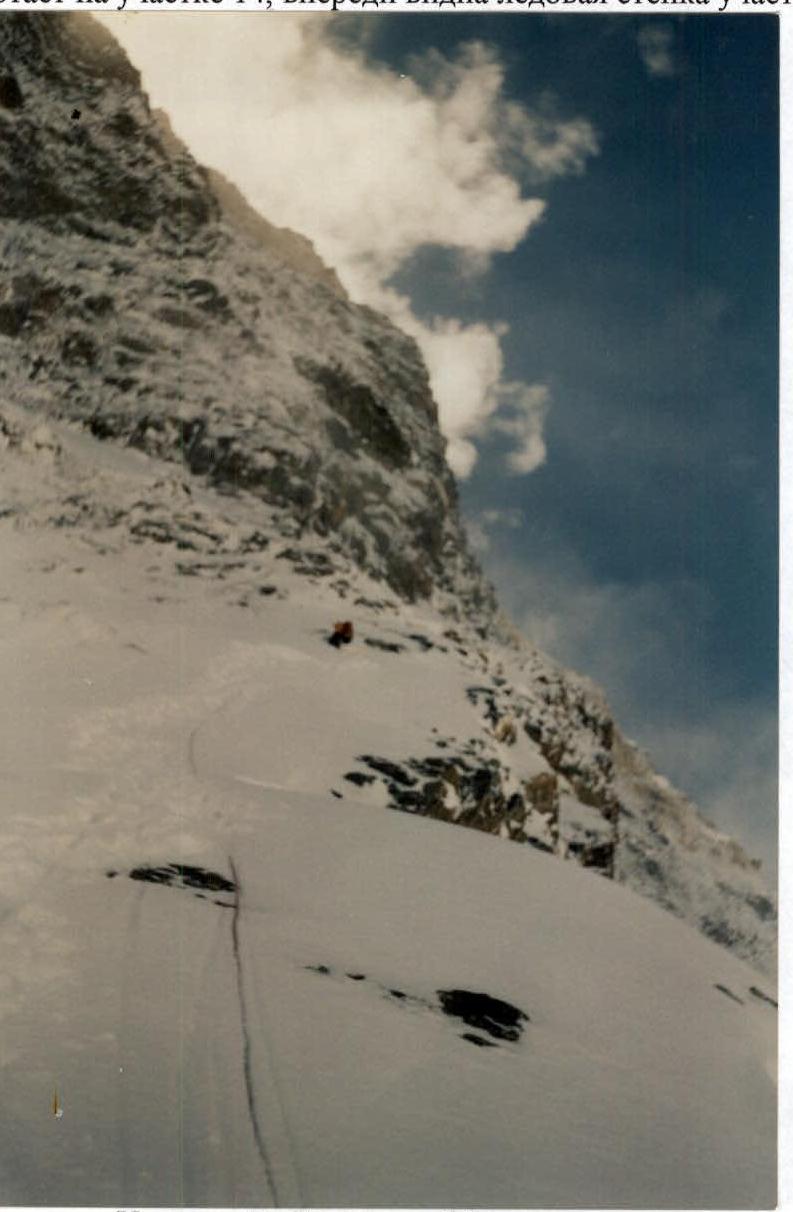
Section R41. Molgachev is ahead.
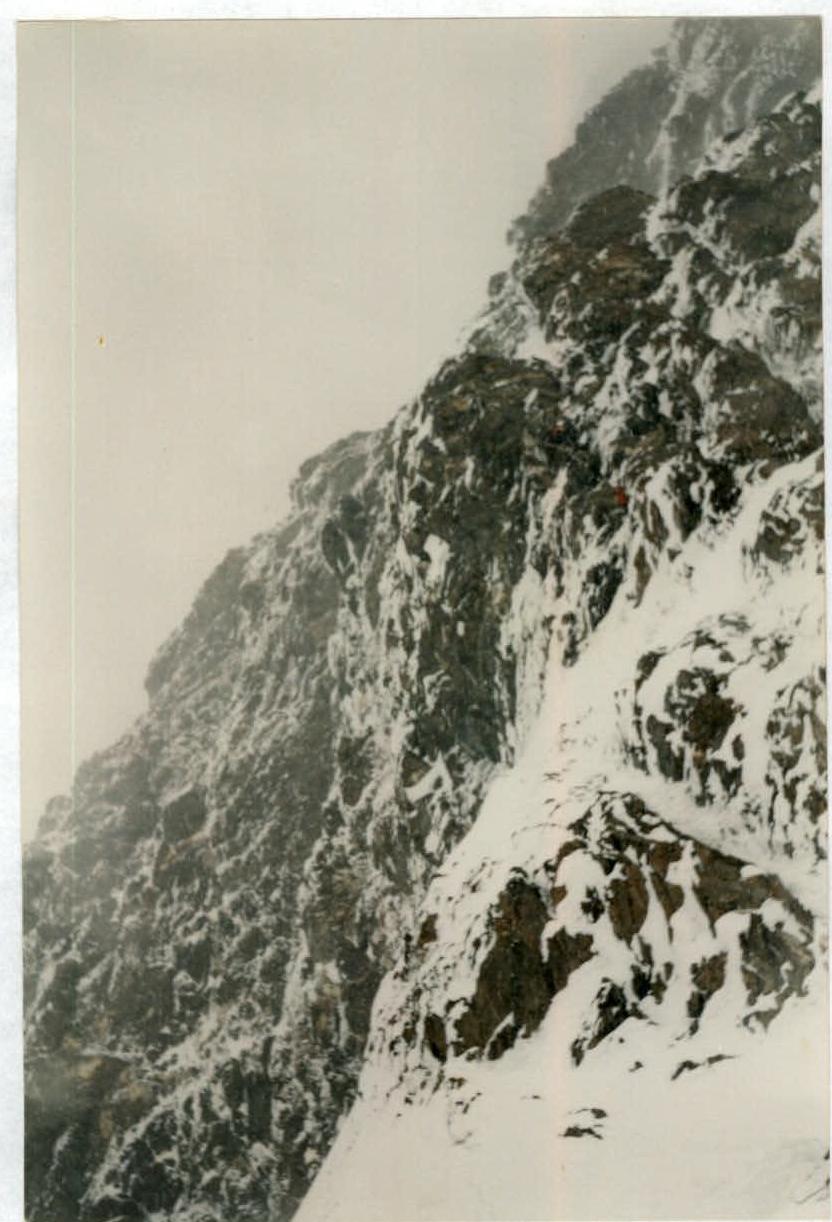
Sections R48–R54. Molgachev — Samoilov duo is working.
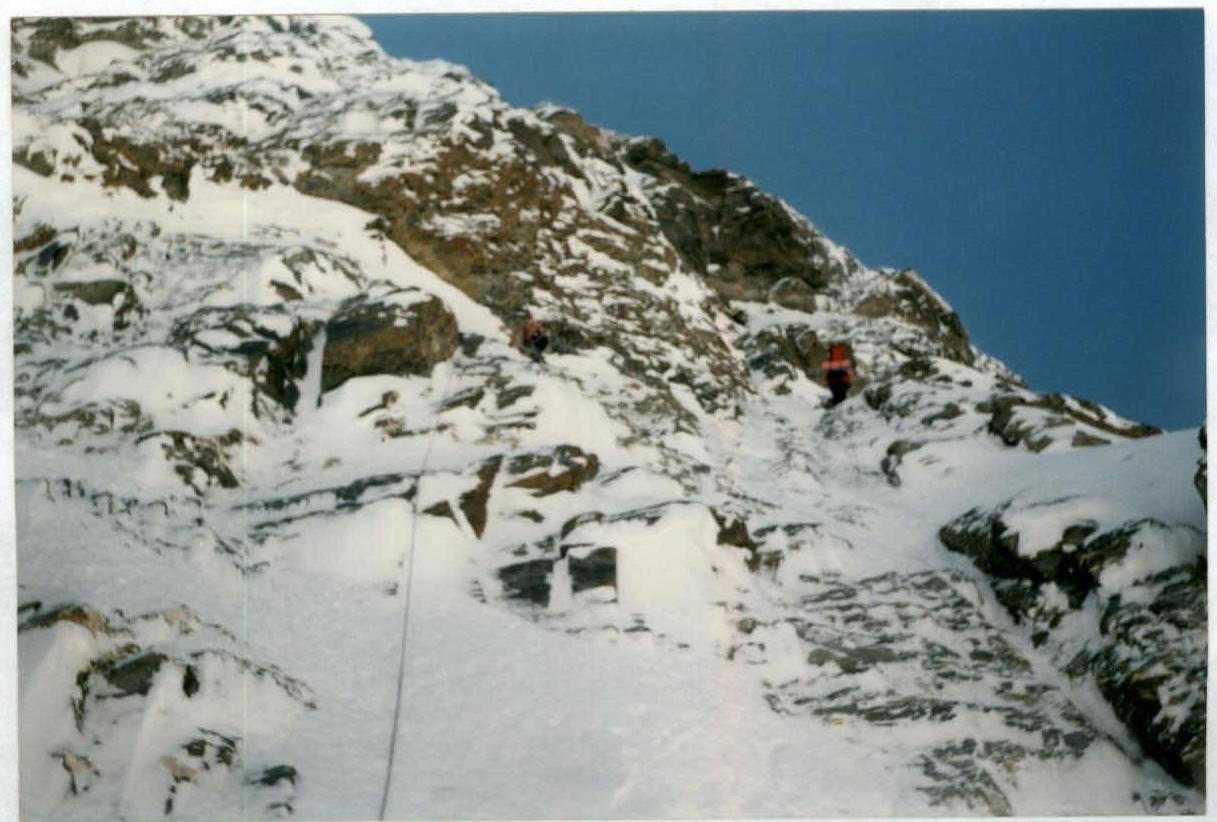
Section R56. Pivtsov — Molgachev are on perlines.
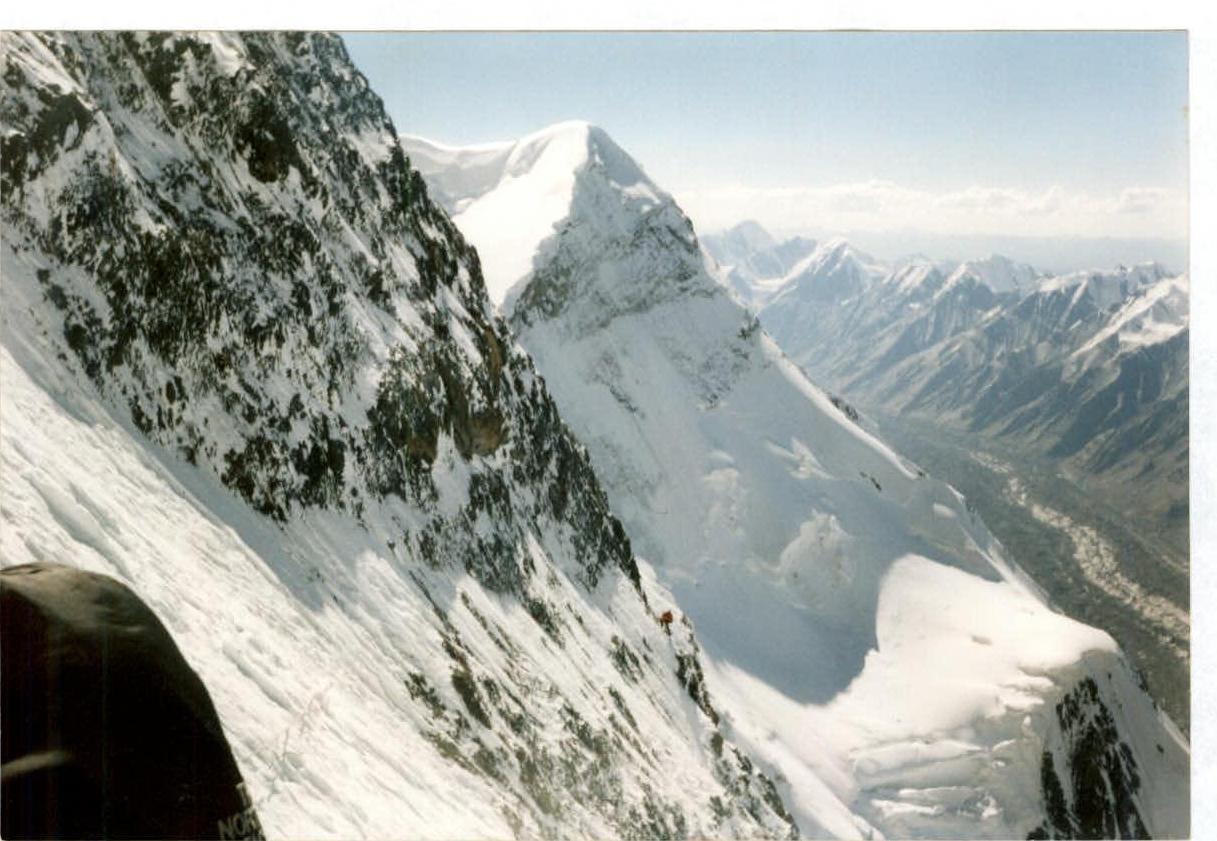
Sections R82, R83. Pivtsov is at the station at the end of section R83.
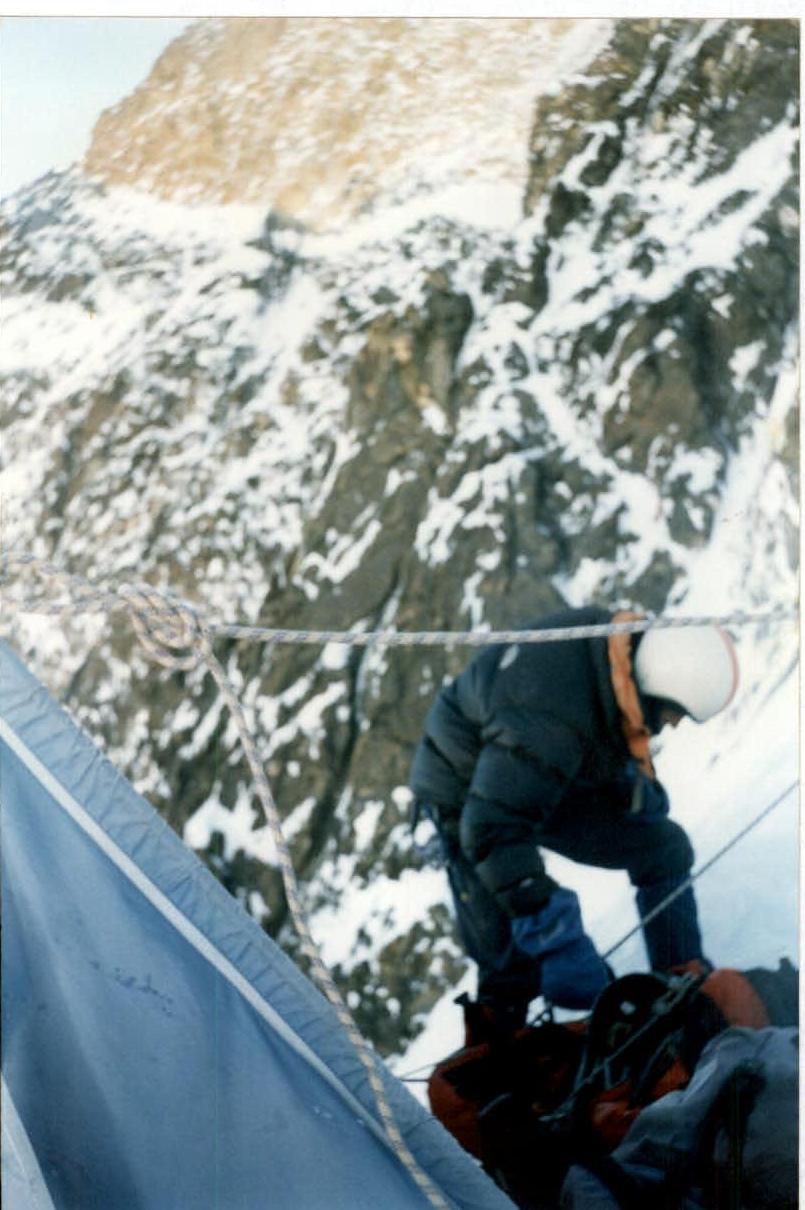
Molgachev is preparing to leave. Overnight stay No. 5 at an altitude of 6050 m.

Comments
Sign in to leave a comment